
Comments
-
Dreaming.While the scientific research on dreams mainly supporting the hypothesis that dreams are 'running through the day's activities' — Shevek
"Running through the day's activities" is poor phrasing. It makes it sound like some kind of playback mechanism. So, if that's the way the researchers you've read are putting it, they're putting it badly. I see it more as a processing of excess/latent/repressed emotional energy. The result doesn't have to look like the day's events at all. But it's often easy - for me at least - to link the nature of my dreams to events of emotional salience occurring during the day. There's a kind of symbolic grammar to dreams that's satisfying to untangle.
While obviously dream-contents derive from experience, I almost never dream about 'the day's events', — Shevek
As per the above, if by "dreaming about the days events", you mean having these events replay in your dreams, that wouldn't be surprising. But it is likely your dreams are based on the emotional impact of those events.
it leaves the analysis of dreams wanting — Shevek
We do need more philosophy of dreams, and of the imagination for that matter. -
Dreaming.I don't have a good answer for that. It depends on where you draw the boundaries to the self. Sleep complicates things and not just in terms of dreams. When I know I have to wake up early in the morning, for example, I generally do - with or without an alarm clock. But who wakes me up? Similarly, if I sleep on a couch, I move around less than when I sleep in a bed and so don't fall off. Why not? Who controls my movements? Is it a part of my self or something purely mechanical and impersonal?
If I say it's "me" that does all this, I'm left with a concept of "me" that in these instances is purely unconscious, and that seems odd. Returning to dreams; when I dream and things get uncomfortable, I can wake myself up from within the dream. But is that my dream self waking me up or my "real" self? And how do they differ? The character of the brain that is in charge during sleep, the sleeping self, is just very difficult to pin down, and my tendency is to think of the self in general as something that cannot be clearly demarcated anyway. -
History and RevisionismThis doesn't just apply to historical events but to current affairs too. I had a similar problem in looking for reliable information about the recent Ukraine conflict. There you had the classic dichotomy involving Western and Russian reporting where the good guy/bad guy narrative was the same on each side only with the roles reversed. One solution would be to gather as much information as possible and try to give it weight based on level of disinterestedness and professional skill. The more disinterested and the more skillful the writer of the source material, the more accurate the information should be - all other things being equal. Another quicker and probably much less reliable method would be to take information from the two extremes (e.g. "America callously bombed Japan when it had other options just to test its atomic weapons/display its military strength" vs. "America reluctantly bombed Japan because, in order to save lives overall, it had no other choice") and presume the truth lies roughly in the middle.
-
What is the point of philosophy?But is there any point in doing professional philosophy? — darthbarracuda
I'll ignore the "professional" part as it doesn't apply to many of us, including me, but I'm reminded of the scene in a Jack Nicholson movie where he says to Helen Hunt "You make me want to be a better man." At its best, doing philosophy makes us better people. Hard to ask for more than that. (And coming to conclusions would just spoil the fun for future generations, no? Besides, that's what science is for.) -
Get Creative!I did an images search on him to get a better look at his work. It's good stuff. Speaking of good stuff: @Cavacava, I love that tree. Have you got a website?
-
Restoration of ValueMy worry is that art restoration cannot be justified as an interpretive exercise because there are tremendous epistemic challenges that obscure the judgement of value from the restorer. — Soylent
I agree there must be great challenges in such work but not that these challenges preclude that work from being considered interpretive.
Perhaps we should view restored art works as distinct from the original and having a merit of their own, but that doesn't seem to be the case (e.g., when people visit the Louvre and see the Mona Lisa, they act as though they are seeing a work painted by Da Vinci). — Soylent
The way great art like the Mona Lisa functions is inextricably bound up with the mythos that surrounds it. A mythos that is immune - barring some disaster - to restorative work . If you hold, as I do, that you can't entirely separate the value of a work of art from the perceived value of a work of art, the fact that people believe they are seeing a work painted by DaVinci is part of the value of that work and in some sense self-justifying. That's to say, there's a kind of a bootstrap issue here. The justification for viewing restored art works as distinct from the originals and having merit (or value) of their own seems to rely in a strong way on them being viewed as distinct from the originals and having value of their own.
The superficial aspects may have been restored, but the nuance of value in the painting is lost in restoration — Soylent
Taking into account the aforementioned difficulties in interpretation, how can we reliably discern whether the work has been degraded at all by the process? And, considering the overall value of the work, even if we were to find it was, couldn't these nuances be considered the superficial here?
(None of this is to claim that restorative work is unproblematic. The issues you raise are important.) -
Depression, and its philosophical implicationsAre you saying that if someone beat you, it would make you feel better to know they feel guilty about it, or something? You're getting beaten either way. — The Great Whatever
I would say if I was being beaten purely for pleasure, I would feel more animosity towards the person inflicting the beating than if they were doing it out of, say, revenge for a beating I had inflicted on them i.e. they had some reason other than the pure pleasure of it. It seems it would also be more humiliating to be abused in that way. And plausible that this emotional response could be considered additive to the purely physical pain inflicted. -
Dreaming.Do dreams help reinforce what we believe about ourselves? We can certainly project meaning on our dreams but not much and not reliably. Random white noise visuals that on occasion yield something we can use? — Monitor
Dreams provide me with characterizations/personifications of my emotional life with which my dream self can interact. And I find that interaction often cathartic as well as informative. So much more than random white noise. I guess it's a matter of coming up with plausible narratives that seem to go beyond just faces in clouds. -
Get Creative!Yes, I like the bowl too. Looks like it would make a good helmet in the event of a nuclear strike.
-
Restoration of Valuethere is an epistemic challenge undermining the full interest of art-value to justify art restoration. — Soylent
Are you simply problematizing here the notion of art restoration, claiming that art restoration may be less restoration than re-creation or degradation in certain circumstances? (Which I would agree with) Or do you have a more specific thesis?
Attitudes towards restored works of art is not that the object has become de-valued through restoration but rather that value has been restored. — Soylent
This line in particular needs further explanation for me. -
Where we standI presumed it was "philosophy" + "forum" but I can't check because Google is blocked and my vpn is playing up.
-
Multiple consecutive postsInterestingly, I've hardly had to moderate anything at all here (or maybe someone else keeps getting there first). (See what I did there :) ).
-
Where we standInteresting stuff. I reckon we're doing pretty well for a fortnight on the road. Cheers for the update.
-
Multiple consecutive postsI've made a couple of consecutive postings myself, Bert. I wouldn't worry about it.
-
Get Creative!Good work @shmik and @Cavacava. I thought I'd add the one below which I took near my place in Thailand where a troop of Macaques live.
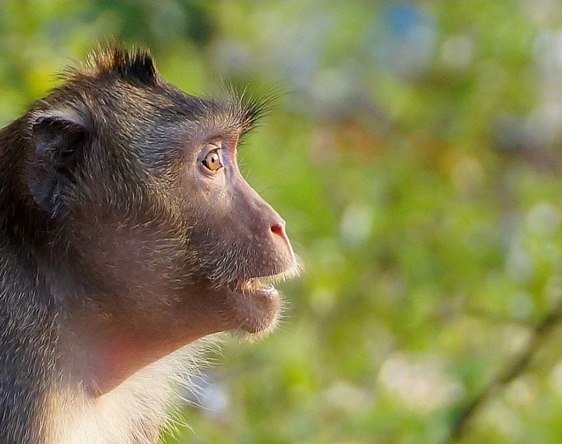
@Monitor -The best way to upload is just to drag and drop a reasonably sized file in jpg format into the comment box. @John - Your pic is probably just too large in terms of dimensions. It would have to be resized for the screen anyway. I advise you to do a .jpg at 95% and maybe make it 6 or 700 pixels across. It won't be perfect but at least we'll be able to see it. (My pic above is much reduced in quality and size but it still looks OK, I think.) Those paintings are great by the way. 8-)
. -
Bad Art@TheWillowOfDarkness and @invizzy - I'm reminded of a study done where subjects were to suppose the Mona Lisa had been burnt in a fire and reduced to ashes. They were then asked if they had five minutes to visit the Louvre and had a choice between viewing an exact replica of the Mona Lisa or viewing the ashes, which they would choose. About 80% chose the ashes (and so would I) illustrating both the religious reverence in which we hold great art (and great artists) and the difficulty of reducing art to any of its component parts.
-
Get Creative!8-) Really like the one of the guy on the floor. Great colours and lines. I've got quite a few people pics on my Flickr thread (the one Yahoo in their wisdom have locked me out of because they don't like vpns...)
-
Get Creative!I've been doing photography on and off for almost all my adult life, usually not very consistently. I got into a bit of photojournalism a couple of years back but the past year it's been mostly stuff like the above. So, these are all fairly recent.
-
Get Creative!Oh, just the photos invizzy. Square and abstract is the format I'm most comfortable with at the moment. Thanks for taking a look anyway, mate. :)
-
Popular Dissing of PhilosophersThe solution is to overcome your prejudices — jamalrob
I more or less agree with this but I wonder how much freedom we actually have on this point. Can we really know what judgments of ours are a result of prejudices? And aren't all our judgments prejudiced to some degree just by virtue of who we are? -
Dreaming.Moving back away from dicks...There seem to be two clear themes here:
1) Dreams as changing in form according to sociocultural/historical context.
2) Dreams as a kind of virtual gym.
Both very interesting. My dreams vary a lot in terms of lucidity, realism, coherence and so on. And though I dream in color images and sound, others seem to be more limited. So, looks like there's a huge variation in contemporary dreamers' experiences maybe not leaving much more room for historical variation. But I don't know. I'd like to hear more on that. As a kind of aside, when I was younger, I was entranced by books that claimed they could teach you to lucid dream and do all kinds of amazing stuff on your night-time adventures. But now I reckon they were just in for a quick buck. Maybe I was wrong though and this leads on to the virtual gym idea. If you could control your dreams well enough for long enough maybe you could get similar effects to those that visualizations have been shown to produce on physical performance. Any dream ninjas here want to share their secrets?
Are you all defining dreaming as a purely mental event? — Monitor
I would. Is there another way to define it? -
Popular Dissing of PhilosophersI guess it's a reflection of the human tendency to think we are smarter than we actually are and to want everyone else to agree with that self-appraisal. Don't expect that to end anytime soon. ;)
-
TPF Twitter accountI don't use twitter but I have put the word out on Facebook. As much as I'm not a fan of FB, it is useful for this kind of thing.
-
The Future of the Human RaceI think it's an issue of gradation on a double level. There is a spectrum of empathy that traverses the range from subjects we know nothing about to those we hear stories about whether those subjects are fictional or not (and your news story illustrates this well). There is also, however, another spectrum of empathy that runs parallel and that is based on how real the subject of consideration is whether we hear stories about them or not. So, we tend to empathize more with those who are closer to us in terms of physical distance and time than with those who are further away even if we are not told stories about them. When these two levels of consideration intertwine in the cases of potential future humans and emotive news stories about fictional people, you get interesting results, but I think interpreting them only in terms of stories is to miss the other level of explanation. So, I think we don't necessarily need much of a story about a subject to feel empathy, but if we don't have one, we at least need to know they are real in some sense. That is to say, as potential human beings can be considered more real than fictional characters (for reason outlined earlier in the thread) the support of a story is not crucial in empathizing with the former whereas it is indispensable in the case of the latter. .
-
Monthly Readings: SuggestionsI changed my mind in the end and went for the Davidson, which was ahead last I looked.
-
Should fines be levied in proportion to an offenders income?I don't think the prevalent view here is that the rich are inherently bad. The question was specifically about fines. I don't see anyone here suggesting the rich should do more prison time for an equivalent crime, for example. But it seems quite obvious that we need a deterrent when it comes to issues such as traffic violations, and a flat fine alone can not be an across-the-board deterrent without being too punitive on the less well off. The other way to do it is too impose penalties that do sting equally like penalty points on licences and so on. Anyway, let's not lose focus on the fairly specific nature of the OP.
-
Bad ArtI think if we go down the route of aesthetics and beauty when judging art, we will find ourselves lost very quickly. When judging art I think it makes less sense to talk about what it is in terms of its form and much more sense to focus on its function. And if you're really looking for a word that stands for what art aims for in how it functions, that word is probably "wonder", "mystery", "awe" or some combination of those emotions. And that hasn't changed with the progression from classical to modern to postmodern art. It's simply that what provokes wonder and mystery, what moves or elevates or inspires us has changed. When art was about imitation, the ability of artists to recreate reality on a canvas or elsewhere was wonderful; and when in a deeply religious age art was about religious imagery that was awe-inspiring. But we progress and pure imitation becomes passé, religion loses it force, and further fields need to be opened in which wonder can play. This is not to say the classics don't still move us - they certainly do - but they move us in the context of their history and the variety of forms of art that exist today that contrast with them. They have not suddenly become bad art but they are not pushing the boundaries of wonder as they originally did.
What is bad art then in this context? Well, if we consider the function of art is to disturb us in a wonderful way then art which does not function or cannot reasonably function in that way is bad art no matter how aesthetically pleasing it might be, and art which does function effectively in that way is good art no matter how banal or unaesthetic its form is. Marcel Duchamp's "Fountain" is often given by people as an example of bad art. And usually the reason given is "It's just a latrine" or "It's ugly" or something along those lines. Here the issue of form and function and the context in which these interplay is absolutely crucial. A latrine in itself is clearly not art, but when a latrine is placed in a context where it is presented as art and in that very presentation serves to disturb, provoke and perplex its audience it can then function as art. Of course, once it's been done it no longer functions in the same way again. The bare latrine as great art is Duchamp's just as the Campbell's soup can as art is Warhol's.
So in a sense art is "what you can get away with" but what's interesting is to focus on why we can get away with it. We can get away with it when what we do functions in a particular way that disturbs or moves us or evokes wonder and mystery. When those emotions are absent, we cease to be able to get away with it, regardless of aesthetic qualities, and what is claimed as art is not accepted as such or at best is labelled "bad art".
(Incidentally, I haven't read the other thread so hopefully this isn't repetitive). -
Things at the old place have changedThey certainly don't have much of a sense of humour about it at the moment nor do some others over there. I'd rather we concentrate on the philosophy from now on too anyhow. For me, that will be here of course.


Baden
Start FollowingSend a Message
- Other sites we like
- Social media
- Terms of Service
- Sign In
- Created with PlushForums
- © 2026 The Philosophy Forum