
Comments
-
Does anybody really support mind-independent reality?I see what you mean, but IMO isn't enough to reject what I am saying. — boundless
I don't think so, because I didn't make any assumptions about labelling other than inadvertantly in order to convey the point about perspective. Regardless of whether or how you label things, there is an image there on your retina or other sensory epithelia that is in some sense can be said to be carrying information about the world. I don't think you need to stipulate boundaries for this to make sense, and in any case, I don't think people really view the world like this anyway. Sure people talk about objects like televisions and cars, but when push comes to shove I think the way people engage with reality is far more fluid and flexible than the idea that we uphold some fixed ontology with lists of well-defined objects. Now you can say this is kind of an anti-realism about objects, which couls be true to some extent, but its also kind of vacuous in a way because ultimately we are talking about different ways to effectively point at arguably veridical information about the world. -
Why the "Wave" in Quantum Physics Isn't RealThat is only true if the so-called background hypothesis, which is typically assumed to consist of a random field locally perturbing the motions of the particles, is assumed to have supplementary non-local Bohmian character as necessary to explain the statistics of quantum entanglement ... in which case your preferred interpretation becomes a variant of the Bohmian interpretation. — sime
If someone wants to call it a variation of Bohmian mechanics, I don't really see an inherent issue but you don't explicitly need Bohmian kind of non-locality for the theory to produce Bell violations. There is at least one version by Levy & Krener (1996) which is does not have Bohmian non-locality, produces all the correct predictons, and even explains that non-locality only comes when an artificially idealized assumption is used for constructing the theory.
quote="sime;983839"]The stochastic interpretation provides a conception of wave-particle duality with an uncertainty principle, but without additional Bohmian mechanicks it cannot explain Bells Theorem, for there is no getting around the fact that classical particle-field interactions that communicate slower than the speed of light cannot explain the 'action at a distance' of Bells inequalities; either the medium denoted by the background hypothesis is local, in which case we do not have quantum semantics, else the medium has non-local effects, in which case we have Bohmian mechanics.[/quote]
Well Levy & Krener's stochastic mechanics van in principle do so without explicit non-local communication.
I think the stochastic interpretation is pedagogically useful for providing a common-sense physical explanation for potentially classical aspects of complementarity that are often mistaken for inherently quantum phenomena, analogous to how Spekken's toy model of quantum mechanics is useful for providing common-sense epistemic intuition for understanding complementarity without assuming a physical account of the Schrodinger equation. But in neither case is there either a physical or epistemic explanation for entanglement. — sime
False. It can produce all quantum behavior and explains it in terms of a non-dissipative diffusion. The issue is that its depiction of QM is radically different from what people are used to so ita difficult for them to imagine. For instance, on stochastic mechanics, spin is a statistical property and doesn't belong to individual particles. An interesting possible consequence is that we no longer have to think of measurement in entanglement experiments as actively changing properties of individual particles. -
Why the "Wave" in Quantum Physics Isn't RealBut notice that embodied unstated realist assumptions about 'what the world is like'. And as Sabine Hossenfelder points out in Lost in Math, there's this tendency in today's physics to rationalise posits on the basis that they supposedly make intuitive sense and then to devise the mathematics to make them stand up. So given your realist predilections, then this approach seems natural to you. — Wayfarer
Very true, we all have different dispositions for intuition; albeit, I would say that the only reason these intuitions are open to us in physics is because of results like quantum theory. Consensus would have opted for a realistic interpretation had it been conceivable in the first place, so I would say a realistic interpretation should be preferable if available. There would be no QBism if a realistic interpretation has heen initially available to us.
And this is being borne out by experimental validation of 'Wigner's Friend'-type scenarios. — Wayfarer
Yes, but a stochastic interpretation has its own viee of Wigner's friend which isn't subjectively perspectival. -
Why the "Wave" in Quantum Physics Isn't RealBut it still relies on a hypothetical substrate — diffusing particles and a non-dissipative background — that isn't observable and must be posited as a metaphysical assumption (presumably subject to further investigation. — Wayfarer
Sure, but I would say it is arguably still better than many other interpretations given it provides an explanation for quantum behavior, it completely deflates the measurement problem and classical limit, it returns metaphysics to what is intuitive and commonsensical. I would say from a standpoint of rationality this is a preferable theory because arguably we shouldn't update our beliefs about the universe (or anything) any more than required given the evidence. And despite the background assumption I think this theory is clearly the least ontologically radical of any alternatives in the sense of diverging as little as possible from pre-quantum beliefs about how the world is, what everyday experience suggests the world is like, what other sciences suggest the world is like.
It seems almost completely conspiratorial to me that the world would have some bizarre, inscrutable ontology when mathematically there is a theory, maybe even multiple theories, that can produce quantum behavior through the kind of common-sensical, realistic, classical-like manner thag the world otherwise presents itself to us as.
And yes, obviously the background is a big assumption; but we already know - or at least quantum field theory tells us - about a kind of background because the vacuum is not empty: vacuum energy and fluctuations. We just don't know if that kind of background could be part of or indicative of the same kind of background as you would want in stochastic mechanics. But at the very least this isn't such a big leap as something like Many Worlds where you are assuming something else radical (and a bit ridiculous) exists that we can never observe and has no basis anywhere else in science. We know a kind of background exists (or you are at least justified in believing it based on quantum field theory):
https://en.wikipedia.org/wiki/Vacuum_energy
We just don't know if it could be the stochastic mechanical one. -
Why the "Wave" in Quantum Physics Isn't Real
It is an interpretation in the sense of Bohmian mechanics, in fact their underlying mathematical structure is very similar.
Entanglement and Bell inequalities are direct consequences of the non-dissipative diffusion like all other quantum behavior. The background hypothesis gives a conceivable way in which the non-dissipative diffusion could be physically realized, albeit without specific details. This is an interpretation explicitly intended to give a physical account of quantum theory.
Right. The theory accounts for the observed statistical patterns of quantum mechanics (similar to the Born rule), but it does so by modelling outcomes, not necessarily by explaining the underlying quantum structure. So it’s phenomenological in the scientific sense of being descriptive, not necessarily explanatory. — Wayfarer
As I said in my first post, it derives quantum theory from non-quantum assumptions about classical particles undergoing diffusion. It proves that in principle quantum mechanics can be instantiated in normal classical particles given the correct specifications which basically just amounts to conserving energy on average. -
Does anybody really support mind-independent reality?There are indeed others, but are there others that fall under methodological naturalism?
The problem is considered real in the scientific community, despite your expressed apathy on the subject. — noAxioms
Again, my point is that this issue is so abstract and we know comparatively little about thr universe works that I don't trust anyone's reliability in offering an explanation which is even close to correct.
At the same time, the problem is not an actual technical problem or one of errors in predictions. The problem is subjective personal incredulity which I don't really share because I have no inherent problem with the issue of very unlikely events occurring, especially in scenarios where we have no context to reliably and assess the issue, like with the question of "why is there anything at all?" -
Why the "Wave" in Quantum Physics Isn't RealThe selection of paths followed is clearly not random. Not asking, being pretty sure there is no answer (yet). For whatever the particle is or is not, the account for the diffraction pattern is MIA - and so far a great mystery. — tim wood
There is actually a mathematically rigorous theory called stochastic mechanics which shows that you can produce all quantum behavior from classical particles that undergo a non-dissipative diffusion.
https://en.wikipedia.org/wiki/Stochastic_quantum_mechanics
What is a non-dissipative diffusion? Well a dissipative diffusion is something like a pollen particle being pushed about seemingly randomly by H2O molecules in a glass of water. As the pollen bashes into H2O molecules, they impart a drag or frictional force on the pollen meaning it leaks or dissipates energy into the environment.
In a non-dissipative diffusion, energy does not dissipate in these interactions; any energy lost would be returned on average to the pollen by the H2O molecules. The system is frictionless in some sense.
What is really unique about stochastic mechanics is its the only interpretation / formulation I know of that actually derives quantum theory de novo from other assumptions. It then suggests that it is sufficient for quantum behavior to be executed by regular classical point particles so long as you enforce the absence of dissipation in its behavior so that energy is conserved on average.
But if you want a kind of common-sense realistic ontology, it probably means you want a model similar to the pollen floating in the glass of water. There are experiments which actually produce quantum-like behavior in this kind of way:
https://en.wikipedia.org/wiki/Hydrodynamic_quantum_analogs
What isn't mentioned in the article but you can find in the papers is that the reason the quantum-like behavior occurs is that vibrating the bath reduces viscous dissipation in the bath, 'viscous-ity' being related to friction due to interacting molecules in a fluid. Effectively, vibrating the bath replaces energy that is lost due to friction, and this makes the bouncing droplet (video at top of the page) exhibit behavior that looks quantum-like.
If hypothetically reality were to be like this then it implies particles are floating around in stuff. Very big assumption, but not so big considering the fact we know that space isn't really empty but filled with a vacuum energy and fluctuations. This provides a very plausible home for this mechanism and the fact particles are floating in a kind of fluid of stuff would give a mechanism for what you are talking about in the post, about how they seem to be guided along paths in a double slit experiment that appear as an interference pattern. Closing a slit then affects whats going on in the fluid which would then pass along to the particles move through it. You no longer have to think about a particle "interfering with itself".
So I think there is no reason to give up on a classical, realistic universe just yet. It is absolutely mathematically possible.
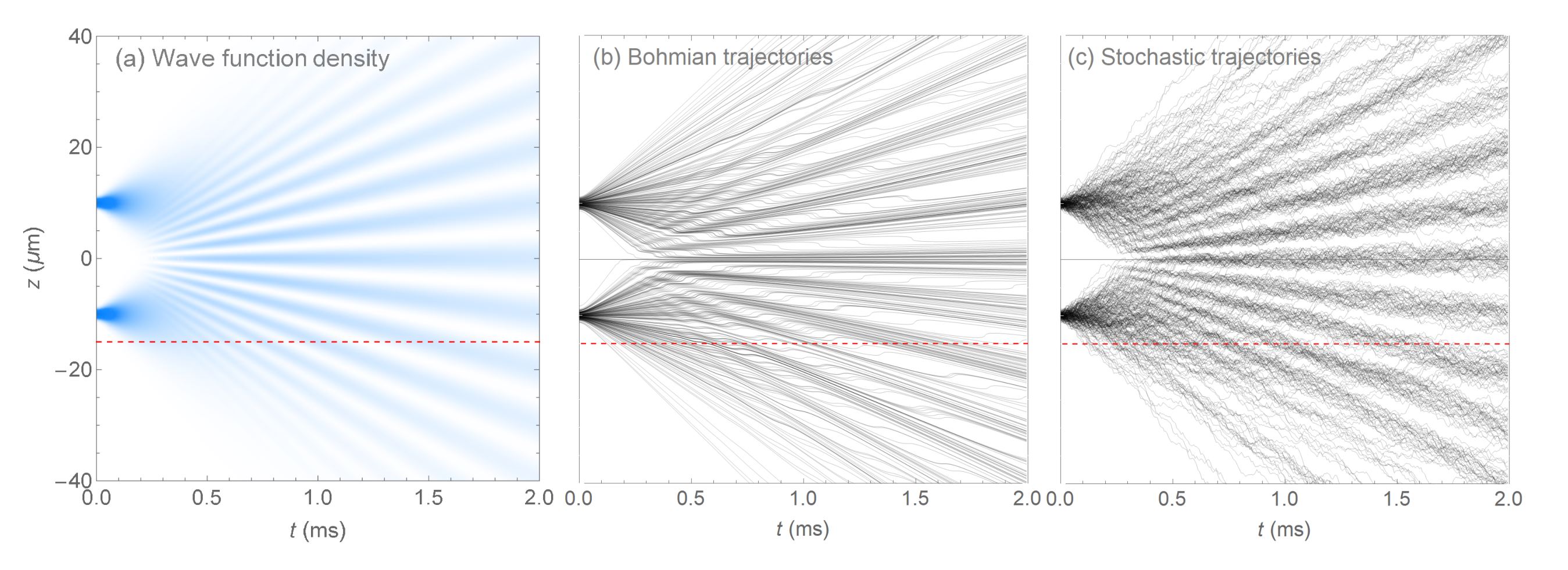
You see in the image trajectories from this approach produced by a mathematical simulation (far right image). Bohmian mechanics also uses classical particles but it effectively just takes the quantum wavefunction and puts deterministic trajectories on top - it doesn't explain anything about why quantum behavior occurs. In contrast, stochastic mechanics starts with a classical description of particles being pushed about like the pollen in a glass of water, and shows that under specific conditions related to energy conservation, as I previously described, all quantum behavior occurs for regular classical particles. -
Does anybody really support mind-independent reality?Yes, 'qualia' might well be about mind-dependent objects but they are certainly not mind-independent objects. — boundless
So, maybe, we are encountering an antinomy here: on the one hand, positing a mind-independent world seems necessary to make sense of our experineces. On the other hand, however, there is no epistemic guarantee that our cognitive faculties can step outside from our perspective and give us a non-mediated knowledge of the mind-independent world. So, it seems that we are stuck in an antinomy here.
So, I guess that the question is: can we really assume that we can make a description of a mind-independent world when we are 'inside' our own perspective and it is not obvious we can really step outside of it? — boundless
For me, i think one might be able to say that even though we view the universe from different perspectives, they arguably all procure information about the world that is still mind-independent. If I view a tree from one angle then another, then through a microscope or through infrared goggles, through the echolocation of a bat, through the chemoreception of an insect on the bark; all of these perspectives produce information that maps onto the world consistently due to the way the external world is. It just happens there is a plurality of ways one can engage with the world and extract consistent information about it. -
Does anybody really support mind-independent reality?There is an intelligible solution. Read the OP. — noAxioms
And there may be others but imo we don't know enough about the universe to give any a substantial construction. There are some cases with theories or ideas where I think there is good enough reason to put it out there and advocate it with reasoned arguments or evidence. For me, I don't think this is one of them. For this particular case I much prefer being conservative; albeit, it is also conforming to my intuition that I don't think unikely events inherently need an explanation. In some contexts maybe they do, but there is no context here for me to make that judgement imo. -
Does anybody really support mind-independent reality?Roll a 10000 dice. Any outcome that comes up is just as extremely unlikely as the next. So no, that's not the problem. The problem is that it came up 6's on all dice, first try. That is a problem. Not being bothered by it is the choice made by most, but that doesn't make it a problem not in need of solving if one wants a valid answer to 'why is reality like this?'. — noAxioms
But this is part of my point. Like you've started using analogies like this when it isn't really clear if this is even a fitting analogy because we just don't know enough.
And even then, I still don't think the analogy is necessarily saying much. The fact that 6's came on all dice came up first try doesn't necessarily warrant an explanation because its perfectly possible.
You can keep asking 'why, why, why... ' but these aren't interesting questions unless there is a kind of reasonable potentiality of an intelligible solution. You may ask why anything exists at all... clearly an example of a question where at least with what we know now does not have a reasonable, even conceovable solution.
I think some people are sometimes too eager to make everything fit into a neat box right this moment. To me, trying to answer these kinds of ultimate questions is just very premature. -
Does anybody really support mind-independent reality?Well, I believe that some properties we assign to 'external objects' are not mind-independent even in this sense. I am thinking about colours, sounds, smells etc in the way we percieve them. — boundless
I think they do capture mind-independent information though. When you see red, it is generally related to actual structure in the world that is being communicated to. Same with sound or smell, albeit there is probably a lot of nuance. And if toy think about it, all I see is color, or "shades" so in some ways I think color an't be any more remarkable subjectivity-wise than anything else we see. Its more difficult to articulate a deacription about color though, which I think may be part of why it often gets special attention philosophically as a kind of paradigmatic example of qualia. -
Does anybody really support mind-independent reality?I'm just noting that human biases tend to slap on the 'real' label to that which is perceived, and resists slapping that label on other things, making it dependent on that perception. — noAxioms
But surely this is nothing to do with the reality outside our heads which is mind-independent, and only about our beliefs about the world and how we should attach labels to it which trivially come under the umbrella of 'mind'. I think there must be a mind-independent reality but obviously any attempt to describe it necessarily is an act inside your head. At the same time, just because you cannot 'access' reality without a purview from inside your head doesn't mean you cannot navigate it accurately in principle; and I think the very consistency in how different people see the world implies mind-independence. I think there is a sense in which we are directly aquainted with information about the world in our perceptions even if it is inherently perspectival, just in the sense that the information you get from the world depends on your position within it and relation to it - but this is non-arbitrary because how you relate to the world is mediated by how the mind-independent world behaves (e.g. you see things because of the laws of physics and the physical structure of your nervous system and body). I do agree we can very easily disagree on what things are "real" - and there may not be a substantial definition - but I believe these discussions are usually so abstract they do not have much interesting implication.
I do subscribe to a perspective where you can basically deflate everything in regards to our minds and what minds are doing - beliefs, concepts, etc - which could be interpreted in terms of a kind og anti-realism. But what is left after such deflation? I don't think such deflation even makes sense without a mind-independent reality that scaffolds what is left post-deflation, and everyday experience and scientific observation tells me that it is there beyond experience. Again, we cannot describe mind-independent reality in a perspective-free way (non-threatening to the notion of mind-independent reality though) which leaves us in a kind of strange loop - there are inherent logical difficulties in self-description, self-reflexivity to the extent that I simply don't think minds ... or brains ... or whatever ... can do it, and we are simply stuck with accepting a limit to what we can talk about regarding fundamental reality, the nature of one's own consciousness, our descriptions and explanations (which can be deflated to acts). But this limit is about us and doesn't extend to reality itself as say someone who supports a relational quantum mechanics might think. Maybe what I am saying is still quite close to what some people are thinking about when they dismiss a mind-independent reality though; but I think describing it using that specific phrase would be misleading, personally.
Part of what has been learned is the incredible unlikelihood of our universe's fundamental constants being what they are. — noAxioms
I have personally never understood the fascination with this topic. I has never bothered me that extremely unlikely things can happen. I have never felt the need to explain it. I am not entirely sure reality warrants an explanations, a priori, and even thinking about a posteriori, I don't think we know enough about reality to be confident that we can narrow down a reasonably accurate explanation and not miss out on some plausible explanation that relies on information we simply don't have yet. However I look at it, it doesn't seem like an interesting topic to me - one that can wait and shouldn't be used to inform beliefs about metaphysics of the universe.
But the exact 'current' state of the moon is not in any way fact.
Bohmian mechanics takes that principle as a premise. Almost no other interpretation does. — noAxioms
For me, I advocate this kind of counterfactual definiteness so this segment I don't think is powerful to me.
It's hard to think it matters that most interpretations don't advocate counterfactual definiteness is you son't subscribe to them, ha. -
On eternal oblivionWhat bothers me, though, is that there is no reason to believe that consciousness cannot reoccur again. It already happened once – I’m conscious now. Why wouldn’t this phenomenon occur again? — Zebeden
But would the fact that it can happen again be any different from the fact that it has happened for both you as well as me (it has happened "again" spatially rather than temporally, as it were), only I cannot experience what you experience because wwr are two different individuals?
Also, what are the merits of eternal reincarnation. You and I probably have it pretty good right now - not just pretty good considering this isn't neolithic era or 14th century France or something like that. Then you look at how lukcy we are to be humans over other organisms.
Surely, it is only overwhelmingly likely to go downhill after this life? Or if not downhill, to another form of life one wouldn't necessarily want to live. I am not sure about life as an aphid. I guess they probably don't live very long anyway. -
I found an article that neatly describes my problem with libertarian free willI think neither determinism nor randomness have anyrhing to do with free will; they are both equally conducive or non-conducive to it. The concept of free will in its prima facie conception makes absolutely no sense when you try to place it in the framework of any kind of scientific framework. The only kind of "free will" that makes sense is something that is kind of trivial like the psychological experience of agency or choice-making under regular psychological conditions.
-
Quine: Reference and ModalityThe distribution of an unknown random number generator could equal anything. If an analyst knows that he doesn't know the rng, then why should he represent his credence with a uniform distribution? And why should the ignorance of the analyst be of interest when the important thing is determining the function of the unknown distribution? — sime
I feel like this kind of issue can still be talked about in the same kind of framework; for instance, Bayesian model selection where you are using Bayesian inference to select priors and models you want to use; and things like hyperpriors and hyperparameters.
Ever heard of imprecise probability? — sime
I don't think it rings a bell -
Quine: Reference and ModalityIt makes no sense to represent ignorance. To me that's a contradiction in terms. — sime
But surely, ignorance is directly related to probabilities. If an event has a probability of 1, you can predict it perfectly; if all the probabilities are equal, then its like maximal unpredictability.
for what does it mean to say that " Hypothesis A is inductively twice as probable as Hypothesis B when conditioning on an observation"? — sime
The probability that some hypothesis was the cause of your observation; and even if your prior is wrong, probability theory is the only logical way of changing probabilities when you see the evidence if you know the likelihood afaik. -
Quine: Reference and ModalityThe best way of expressing ignorance with regards to the likelihood of a possible outcome is simply to refrain from assigning a probability — sime
Then how are you supposed to update your ignorance when you encounter new evidence? -
Disagreeing with Davidson about Conceptual SchemesOK. The idea that we don't "see" anything at all is interesting. I must have missed it. (I'm assuming it's in this thread somewhere?) — Ludwig V
Aha, I think it was something I wrote but must have not posted because it was both too vague and complicated a thought, and distracting from some point of a post. Just forgot I didn't post it.
I agree that the images on our retinas are 2D. But I would say that our brain has access to information about the 3D world through somato-motor engagement (with some reservation about hearing) and I think that affects how the brain interprets the 2D information and consequently how we see it. I think the distinction between our brain doing something and us doing something matters. But I admit that what conscious experience amounts to is not at all clear. — Ludwig V
I think thats fair. -
Disagreeing with Davidson about Conceptual SchemesYou would not be wrong to say that we both see the same markings in a different way. — Ludwig V
What I would say is seeing the same marks differently is more to do with a different engagement with the information extractable from those markings; but I agree that "see" is ambiguous, partly leading to my previous consideration of whether we see anything at all.
You mentioned attention. When I look through a telescope or microscope, I do not attend to the image as such (unless I need to focus the lens, or clean it) — Ludwig V
You're always attending to things whether you realize it or not, constantly scanning parts of what you see.
The case of writing is somewhat special, in that writing is 2D, and the writing in the image on my retina is exactly the same as the writing in the 3D book. So we shouldn't have a problem in agreeing that what I see is the writing (or the marks). What's going on with 3D is still unclear. — Ludwig V
I don't think this is relevant because I don't believe the distinction between the outside 3D world and what we see is relevant given the fact that our brain cannot access anything independently of 2D information. From my perspective, the patterns we see are 2D. Its our somato-motor engagement with the world that brings an additional dimension to what we "see", both in terms of our body and eyes. -
Disagreeing with Davidson about Conceptual SchemesIn each case, your experience will be different. — Ludwig V
Yes, but what is different isn't the markings but your reactions to the markings.
The duck-rabbit illusion that you give is an excellent example. My inclination is that what is happening is still about changes in the way we are reacting to the image: attending, sampling, making predictions regarding the image and confidence of reporting. The experience then is inextricably entwined with our ongoing engagement with the image, imo. -
Objectivity and Detachment | Parts One | Two | Three | FourThe issue for me is that incorporation of the insights I mentioned can inform and transform the content of the hard sciences, just as it has already begun to have its effect on biology, neuroscience and cognitive psychology. — Joshs
Hmm, I don't really recognize that at all, I don't think. -
Disagreeing with Davidson about Conceptual SchemesIt is marks on paper and how those marks relate to other parts of the world. The difference in vocabulary depends on and signals a difference in how we are to think about the phenomenon. — Ludwig V
Yes, but if you look at writing, you just see marks. You don't somehow see marks and the totality of its relations to other parts of the world. Those relations are only experienced in real time in specific behaviors or thoughts or reactions.
But, at the same time, they do work for many purposes, and we've been quite clever about working out ways of pushing the boundaries. — Ludwig V
Yes, I think if you assume that there is some objective way the world is, then they have to work in some effective way, mapping to things out in the world. But, I would say that if one were able to make a coherent separation between some thing and some other thing "representing" it, then their relationship is not an intrinsic one but subject to the whims of how the world allows them to coherently map and the "representation" be used. That it is a representation is then, imo, in a weak sense - hence the use of "". I have no objection to the notion of representation as long as it comes with caveats regarding how they work, how their use can be deconstructed. If everyone were to agree on representation in this sense, then I guess the "" would be redundant though.
or the two are inter-dependent. — Ludwig V
Naturally! -
Objectivity and Detachment | Parts One | Two | Three | FourDifferent sciences talk about things in different ways. Some rely on reductive causal abstractions, some begin from the contextually particular circumstances of persons in interaction. It’s not a question going into the ‘depths’ of an inner subjectivity but of staying close to the interactive surface of intersubjective practice and. it abstracting away from it with with claims to pure ‘objective’ description. — Joshs
Sure, but then I don't understand what the issue is. We have a whole range and breath of intellectual fields, sciences, arts, humanities that generate knowledge or culture in different ways. So I don't really understand what the central issue is here. -
Objectivity and Detachment | Parts One | Two | Three | Four
Sure, but there is no way to communicate about qualitative experiences in a way that is any different to what science, or any other intellectual field, does when it constructs knowledge and talks about things. You can't really go any deeper. -
Objectivity and Detachment | Parts One | Two | Three | FourScience has little to say about your subjective experience as it is impossible to capture. Its not just science, but anyone. Even the closest person in your life doesn't know what your actual subjective experience is. — Philosophim
Completely agree, and partly why I have never really understood what Wayferer is trying to push with his perspective and what precisely he is saying is lacking or what that has to do with science. -
Disagreeing with Davidson about Conceptual Schemes
It's as if you were to say that all writing is just marks on paper etc — Ludwig V
What else is it? Anything else about it does not come from the writing itself but context and relationships those markings have to other things, including our engagement with them. Without those things, yes writing is just marks on paper; writing is nothing more than marks on paper and how those marks relate to other parts of the world.
.. and you only have experiences of your actions because you act. — Ludwig V
Which are not intelligible without experience of them!
I'm particularly interested in whether you think there is such a thing as indirect perception and what that might amount to. — Ludwig V
I'm quite agnostic on direct vs. indirect perception. I think both can be argued in different ways. I think the idea that we are directly aquainted with structure in the outside world is a coherent notion. But I am not someone inclined to say that there is some single, strong, absolute way of describing structure in the world, so I think this direct perception is quite weak. There are plausible inumerable kinds of structure that an organism could tap into when engaging with the world. You could also argue indirectness though in the sense that we are still in some sense insulated from the outside world by our sensory states, the structure of the brain and its possible foibles, and in principle issues of chronic indeterminacy. So I am open to both types.
On "conceptual schemes", I should add that there is quite a lot that Davidson says that I agree with. I think he is right to argue that there is not one single conceptual scheme that all human beings share. I do maintain, however, that our world includes many partially incommensurable schemes - partly shared and partly not. Further, the difference between scheme and content is not anything like as clear-cut as his argument requires. On the other hand, I accept that the differences in thinking can be expressed as beliefs. I think, for example, that belief in God is not a straightforwardly empirical scheme, but the anchor of a way of thinkng about the world that is conceptually different from the way an atheist or sceptic thinks about the world. But then, Davidson doesn't seem to recognize that there are different kinds of belief. — Ludwig V
I more or less agree with Davidson's reasoning in his argument about conceptual schemes but I have never really been familiar woth the context of why he is making these arguments. He is attacking a very strong notion of conceptual schemes; when I think often peoplr talking about this kind of thing just might be referring to what I think is trivial - we use words in different ways depending on the environments and cultures and customs we have been exposed to, and sometimes it is difficult communicating between these things. I don't think this notion needs to be as strong as the one Davidson is attacking. I think maybe the core of what Davidson is attacking is possiby relativism, which would require that not only do people have different ways of talking and refer to different things, but their validity relative to someone's conceptual niche cannot be overturned, maybe entailing that there can be no communication between different conceptual niches in which such a challenge to validity can arise. So maybe thats why his notion of conceptual schemes is very strong, whereas I think most would agree we can uphold the trivial idea that people have different ways of talking or referring without mecessarily having to uphold some kind of relativism. -
Disagreeing with Davidson about Conceptual Schemeswhat I see is the ship or star. — Ludwig V
Which is just a pattern that I see; thats all I mean by image, without further distinctions or assumptions.
But that does depend on linking perception with action rather than experience. — Ludwig V
They aren't mutually exclusive. You only know something about your actions insofar that you have experiences about your actions.
If you suppose anything like an image or model in the brain, the question arises how the brain can access it in order to apply it to the incoming information. The answer is always an observer of some kind. But then, that observer will need to construct its own model or image and there will have to be a second observer inside the first one.... I'm sure you see the infinite regress that has begun. The brain is not an internal observer - unless you call it an observer of the outside world. — Ludwig V
The brain is the model, no infinite regress of observers required.
Some images are images of something, some are just patterns. If you treat them all as of the second kind, you have lost the significance of the image. — Ludwig V
I believe that all the images are just patterns and the significance is retained by way of what I said in the bit you quoted.
I don't understand what you mean here. — Ludwig V
What you see must be constrained by your physical perceptual systems.
If "directly" just means inside the body, then obviously I cannot be directly acquainted with objects outside my body. — Ludwig V
I wasn't using directly in the same sense as earlier!
So, classification needs to be agreed before the facts can be agreed, and if people are in the grip of the idea that animals are just machines, that agreement is not possible. — Ludwig V
Yes, agreed.
We do agree pretty much on how the eye works, yet we describe the facts differently. Our disagreement is not about the facts, but about agreeing a coherent way of describing them, i.e. how to think about them, i.e. a coherent conceptual structure for understanding them. It's not a straightforward task. — Ludwig V
Yes, I would probably agree here too. -
Quine: Reference and ModalityIronically, much of the recent neo-Aristotelianism flows from a growing dissatisfaction with the artificiality of possible worlds semantics. We are slowly correcting modern errors, first with Kripke's modal form of essentialism, and then moving with Fine and Klima towards more traditional and robust forms of essentialism, that do not rely on the overrated device of possible worlds. — Leontiskos
Any good references? -
Disagreeing with Davidson about Conceptual SchemesPerhaps not. But a knuckle joint or a thumb or an arm or a spine can. — Ludwig V
Well, I think its at least debatable. I don't think those joints are anywhere near mobile enough, imo.
None of those is true of images of the car, no matter how many you accumulate. — Ludwig V
Well then the 2D image is how I am seeing a 3D car. I can't shake the awareness that my visual field is two-dimensional (except for the color dimension) even though I can distinguish distance.
wouldn't object to that. But what validates the inference? There must be some way that you can compare the image of a 3D object with the 3D object. But you seem to deny that we can. — Ludwig V
The brain doesn't have any direct access to the outside world. It can never intelligibly compare things with some criterion that has come from the way things somehow are on the outside world. All the brain can do is construct models which make predictions about what happens next, and that can fail and get re-adjusted.
So the image of my car is no different from an image of starship Enterprise or a dragon - and even in those cases, we know what it would mean to see the real thing, even if it never happens. — Ludwig V
Not sure what you mean here.
It depends what you mean by "literally". For me, when I walk through my front door, I literally see my car. If I only see the image on my retina, then I don't see "literally" my car, but an image of it. — Ludwig V
I'm just saying I dispute the idea that there is some kind of phenomenal essence to things that we recognize and perceive - rather I see it in terms of just the direct patterns I see, and my reactions to those patterns in real time. Without those reactions, the idea that I am recognizing an object like a car is empty. I see the 2D patterns of the car and react to them in a way consistent with my recognition of it.
An image is always an image of something else, never the real thing. So my anchor is the real thing. That's what makes the image of a car an image as opposed to a complex array of coloured shapes. — Ludwig V
Sure, but I don't think the "real thing" can be transcend the 2D information accessible from the retina.
I think the difference in our perspective is that you just say you see the 3D car and stop there; while to me, my percepts can be deconstructed so I do see that my visual space is 2D (apart from the color). But you seem to just embrace the idea that you are directly acquainted with a 3D object. When I then ask what it means that I am acquainted with these 3D objects, it comes back to what I have said about 2D information and enactive processes.
But it is not the same as a disagreement about the facts and cannot be settled in the same way. — Ludwig V
But I think the animal case is conceivably a disagreement about facts as opposed to classification. -
Disagreeing with Davidson about Conceptual SchemesThe problem here is about the meaning of "direct" and "indirect". — Ludwig V
I wasn't intentionally implying anything at all here by the word "direct" tbh other than the fact that the sense comes from inside our bodies.
If what we see is the image on our retina, how is that any different? — Ludwig V
Yes, you're right, I think - it isn't. But as I say earlier, I think you could argue that joint positions don't actually directly convey 3D physical space without further integration of information (e.g. A finger joint typically cannot move through all degrees of freedom of 3D space).
The image is more like a lens, by means of which I see my car. — Ludwig V
But what do you then mean when you say that you see your car? There is nothing more, imo, to seeing a car than this 2D information, your reactions to it, and your ability to make predictions about it and engage with it. Thats the only way knowledge makes sense to me. For me, just saying "I see a car" isn't good enough. I need to make sense of what it actually means that I see that car, and this is the conclusion I have come to introspectively. There is nothing but the images - I can just react to them in sophisticated ways.
But I don't see that we ever see that image, because it is extensively processed, including the amalgamation of two images. Don't forget. that retinal image is broken up into what, presumably is an encoding that is quite different from any image.
I'm not sure whether to count the result of comparing two images or the extent to which our lens needs adjusting to produce a clear image a visual cue. It could go either way, I suppose. — Ludwig V
But I don't think whatever is inferred is anything that isn't latent in 2D patterns on the retina, and hence limited by the 2D nature. Hence, why you can manipulate pictures to create illusions of depth; because it is nothing above picking out those 2D patterns. Yes, you can say that is seeing in 3D, but .... similar to the question of "what do you then mean when you say that you see your car?":
What do you then mean when you say that you see depth?
We have 2D information from the retina, and our ability to engage with how that 2D information may change over time and in different contexts.
We can say "that is far away?". But does saying something is far away have any meaning without your ability to move in 3D space. When you say "that is far away?", are you literally seeing "far away" or are you just reacting to a salient cue in a way that represents or pre-empts your ability to recognize and predict what would happen in some context. Is this cue you identify or distinguish anything above a 2D pattern latent on the retina? I guess it isn't technically 2D because color and brightness add extra dimensions, but these aren't inherently spatial. For me, we just use these distinctions to infer something about what would happen with regard to movement. And this is a continual thing too in real-time, not just because we are bodies always sitting in 3D space, but our eyes are continually sampling the environment, and their sampling will be intuned with depth; most of the time, we aren't even aware of what our eyes are doing.
I guess my perspective also leads to the question - are you literally seeing anything?
Not in any essentialitic way. We see complicated patterns and we react to them in real-time.
"What you see" is ambiguous. — Ludwig V
Yes, I think you are correct. But the 2D nature of the image on the retina is not ambiguous - so that is my anchor.
I partly agree with that. But what is learning is not me, it is, let us say, my brain. I don't ever hear two sounds, one for each ear and then realize that I can deduce where the sound is from that. I hear one sound, located in space. The learning and the processing takes place way "below" consciousness and involves an encoding process that is nothing like a sound even though it is caused by sound — Ludwig V
Its going to be the same for vision and hearing.
But are you actually hearing the location of a sound, or just hearing a certain quality to the sound across your two ears that changes are you re-orient your body? If you have no body to re-orientate, what you hear when you "hear the location" could not possibly give you any spatial information - it would simply be a difference in the quality of sound in your ears.
trompe l'oeil painting. — Ludwig V
But I would say this is what we have been talking about all along.
I would say I am not necessarily saying that we don't see in 3D, but that this is nothing above information on a 2D retina and an enactive component regarding movement and prediction. Space itself I think is the same - spatial perception is more like spatial enaction - familiarity with how movement changes visual information. For me the idea of perceiving any space, let alone 3D space doesn't make any sense above what is essentially a behavioral familiarity - spatial perception is nothing above our real-time manipulation of information through movement.
Please let me know if I am annoying you. — Ludwig V
Not at all!
But the disagreement is not a question of evidence, but of interpretation of the evidence. So Davidson's thesis that we can abandon talk of conceptual schemes and return to beliefs and experiences seems to me to be false. — Ludwig V
I would say that this question of evidence interpretation is a question of beliefs and so in that regard, Davdison would not consider it as something about conceptual schemes. -
Disagreeing with Davidson about Conceptual SchemesBut how could we have 3D bodies in a 2D world? — Ludwig V
They are different senses about different things, one from directly inside the body, the other from outside.
I'm talking about what you see. Its a 2D image.
BTW, you are forgetting that we have 3D hearing as well. — Ludwig V
But this is not very different from the visual case in the sense that your learning about 3D space vicariously through cues.
We have learned to interpret 2D pictures as 3D scenes. If all we experienced were 2D, how could we even get the idea of 3D? — Ludwig V
For me, the question here is: what does it mean to say that you interpret 2D pictures as 3D? Does the 2D image magically turn into a 3D one? I don't think so. Thats why I believe that 3D perception, and what we might think of as our experiences of 3D space, are rather about your ability to enact predictions about 3D space through body motion, and your inherent familiarity with that. From my perspective, it is then not an experience per se in the same way that directly seeing blue is, or feeling touch on the skin.
A non-minimalist would have said "to a greater or lesser extent" and cut out all the "maybe" qualifications. — Ludwig V
I wouldn't necessarily say I am a minimalist then, I just don't know what level of mutual comprehension occurs between humans and other animals - and presumably it dependa on the animal - and I was framing it in a way I would if I didn't know what the other person's perspective on that would be either. I think even people who think very little of animal cognition would agree there is a minimal level of intelligibility between humans and certain animals, even in an emotional sense. -
Disagreeing with Davidson about Conceptual SchemesBut none of that is 2D information. — Ludwig V
Well, yes it is 3D information in the sense that the objective world seems to be spatially 3D. I'm just saying that we can only navigate this visually, on a 2D space of the retina.
Maybe proprioception and body motion you can argue actually is much more directly 3D...
[Edit: and I am not sure 3D body information is entirely trivial since no single joint in your body has access to all possible degrees of freedom of motion in a 3D space. It is conceivable to me that information of movement in a single joint is not sufficient for a brain to infer 3D space - rather I imagine, many joints are needed and possibly even other information like vestibular and visual, at least for 3D space as we know it.]
... But then the inference about 3D space as you see it in vision is then a consequence of how body motion changes a 2D image. The non-trivial way in which this happens allows the inference of 3D space, but I would say that this can equally seen as just transitions in 2D patterns on the retina interacting with proprioceptive and other kinds of sensory information. All the visual information about space is inherently 2D. For me, 3D visual perception is not some direct perception of 3D information - you only ever have 2D visual information. Rather, its your ability to enact predictions about 3D space through motion, and your inherent familiarity with that.
It would seem you are a minimalist on this question. — Ludwig V
What would non-minimalism be? -
Disagreeing with Davidson about Conceptual SchemesYet we experience them in 3D. — Ludwig VWe don't make the inference - the results of an inference made "unconsciously" are available (are reported) "directly". — Ludwig V
Depends what is meant by "experience them in 3D" I guess. For me, 3D "experience" is nothing more than our ability to navigate and predict the 2D visual information. In terms of the body, it is about the integration of joint positions and predictions regarding those degrees if freedom -. Imo, the results of the unconscious inference about 3D space - that becomes available to us - is almosr entirely enactive in terms of my familiarity with the consequences of movements in terms of visual and joint information. And we must include eye movement and lens focusing (i.e. ciliary muscle) in this too - your eye palpates the scene in its motion and focusing which is part of your distinct familiarity with 3D space.
That fits with Wittgenstein's idea that human life and practices are the essential context for everything. It would seem that he did not see any similarities with non-human life. This is somewhat puzzling to me, though I would not automatically extend that understanding to all life. There is disagreement among human beings about that.
There is more to be said about how we deal with extreme - non-regular - contexts. — Ludwig V
I would say maybe there is something like intelligibility in common with non-human life. Maybe we can say humans an animals might share some vague sense of mutual intelligibility with regard to something like space or even emotions on some minimal level depending on the animal, but then animals may be incapable of many of the kinds of abstract predictions a human can. Maybe an animal has a kind of intelligibility in terms of the spatial engagement with a ceiling, but an animal may not have access to the kind of abstract semantic relations and predictions a human could associate with a ceiling. Or maybe a writing is a better example - many animals can see and distinguish letters but will never be capable of attaining more abstract, higher-order predictive content about semantic meaning. -
Disagreeing with Davidson about Conceptual SchemesYes. But that's a misunderstanding of what intelligibility is. Intellgibility is not black and white, but a spectrum. He seems to think that "conceptual schemes" are a tight logical structure which is either completely intelligible of completely unintelligible - which leads to his reductio. That fits with what appears to me a very naive view of translation as just a set of equivalences. That's seldom or never available — Ludwig V
Yes I agree, there are gradations of intelligibility. I think the point is that nothing humans do is in principle unintelligible (in regular contexts). When different, say, cultures collide in the same environment, the individuals in that environment are generally engaging with the same structures of the world (or maybe the weaker claim of some common accessible structure is available) - but the difference is their knowledge, ability or simply the norms or conventions of navigating these structures. But they are in principle navigable.
That's very close to what I would call a concept. — Ludwig V
Yes, agreed. I think concepts can be seen as tied to something like meta-awareness or meta-distinctions... awareness of one's own awareness or ability to distinguish one's own distinctions one makes about the world. We model this in word-use - like how we use 'dog' in relation to some coherent structure of experiences.
Not quite right. We have 3D stereoscopic vision because of our two eyes; it fails at larger distances, but it works well at smaller distances - as the 3D films show. Our ears manage to give us 3D hearing as well. — Ludwig V
All visual cues trivially occur to us on a 2D field - the retina is a 2D structure. The use of two retinas does not change this fact. You are just using 2D cues in an interesting way to make inferences that guide action and predictions about the world.
Apustimelogist

Start FollowingSend a Message
- Other sites we like
- Social media
- Terms of Service
- Sign In
- Created with PlushForums
- © 2026 The Philosophy Forum