
Comments
-
Demonstrating Intelligent Design from the Principle of Sufficient Reason
That is classic logic, not modal logic, though, correct? I understand that if we're referrring to what might be we can't set it out in terms of what it currently is. The antecedent is conditional, and it is useful to logically determine an outcome on a possible world because we require that sort of logic to make our decisions.This future scenario, of me carrying an umbrella at 7AM tomorrow morning, is neither true nor false, and Aristotle described it as a violation of the law of excluded middle. — Metaphysician Undercover
Your objection is that the hypothetical possibility is not ontological in existence and so you therefore cannot logically consider it? This I don't follow. Why can't we logically assess possible worlds that aren't actual worlds? This is the point of modal logic.I believe this is because the object, as thing spoken about, has no temporal extension into the future, and therefore has no identity in that direction beyond the present. To say that there is an object, with an identity, in the future, is a false proposition due to the reality of future possibility. — Metaphysician Undercover
I have no problem with modal logic. — Metaphysician Undercover
You say this, but your objections are directed straight at it. You demand ontological reality upon your propositions prior to performing logical functions on them, which is an outright rejection of modal logic. You have a metaphysical demand you're placing upon a linguistic/logical function. You're playing the language game of classic logic and refusing to speak modal logic. That's fine, but it's not an objection about anything inconsistent with modal logic. It's just a refusal to accept it as a mode of reasoning.
This is just to say that if you insist upon actual worlds for the conditions to exist in to perform logic upon them, then you're refusing to consider possible worlds, which is what distinguishes classical and modal logic from one another. -
Demonstrating Intelligent Design from the Principle of Sufficient ReasonMy thoughts on this have returned to our A -> ~ A discussion, distinguishing the vacuous from the semantically meaningful.
One example I came across was Goldbach's Conjecture, which states " that every even integer greater than 2 can be expressed as the sum of two prime numbers." This theory is not proven, thus a "conjecture."
So, consider this statement, "if Goldbach's theory is false, there is an even integer greater than 2 that cannot be expressed as the sum of two prime numbers."
This is a potentially impossible antecedent that offers a logical piece of information in the consequent.
It is modal in the hypothetical form, yet an impossible antecedent, yet not a vacously true consequent.
To the extent it might be suggested that an impossible world antecedent renders a meaningless or a vacuous consequent, I think has to be reconsidered.
The counter to this is perhaps these impossible antecedents are only resulting in definitional consequents and are obscured tautolgies, but, honestly I haven't thought long enough on it. But that feels like a possible lurking response and goes back to my prior comment about the seeming analytic quality of these statements.
That is, is the Goldbach consequent stated above synthetic or just analytically derived from the antecedent?
I'm sure someone has hashed this out somewhere. -
Demonstrating Intelligent Design from the Principle of Sufficient ReasonAn unusual phrasing, but I supose modal logic apples to impossible worlds and is what shows them to contain the contradictions that render them impossible. — Banno
There's an article on everything:
https://plato.stanford.edu/entries/impossible-worlds/#CouRea -
What is faithWell it's not my original thinking. I got this from a Catholic Priest friend of mine and it sounded reasonable. I can't do much about your seemingly sour reaction to it. — Tom Storm
OK, then the Priest provided an ad hom, and you responded to my comment about an ad hom with another ad hom, suggesting it wasn't that it was an ad hom, but that i was just sour. Like I'm at all upset.
The irony is that theists justify their judgment upon others based upon concern for their souls. You offered a similar concern for the souls of theists but from an atheist perspective.I actually think if theists feel this way, it is entirely understandable. No irony. — Tom Storm
My suggestion is that we stop being so concerned for each other's differing views. I trust wholly in the sincerity of your atheism, have no desire to modify it, and don't believe that but for some unfortunate circumstance you'd be different. Different strokes. -
What is faithSpeculating: I think some theists believe they have read all the right philosophy and theology and have many of the answers and that modern secular culture is debased and decadent. They're probably angry about the state of the world, and when they encounter people with views they've identified as the cause of contemporary troubles, they lash out. — Tom Storm
Explain how this isn't pure ad hom.
I say this because even if you're entirely right, it might be they're theists because theism is true.
It'd be like me opining that atheism is borne from trauma and alienation and whatever else sounds right. Wouldn't your response simply be, sure, all of that, but that you're atheist because that position is correct.
Not to mention it sounds like you care for the souls of the misguided. Ironic. -
The News DiscussionWho in their right mind would want to be a plumber? — frank
They make really good money and according to some videos I saw online, women really enjoy when they come over, but something seemed off about it. -
Currently ReadingThe answer is simple: I read it years ago and my taste has changed, so instead of continuing to say I don't like it I ought to see if maybe I do like it, because Tom is wise. — Jamal
You're right. I feel like shit now. Just read and hopefully enjoy. -
Currently ReadingQuite persuasive. I might try it again. — Jamal
Is this really a thing? I mean I get how tastes can change over time, but can it happen by persuasion? Like, this wine is delicious now that you point out it has hints of cinnamon.
I suppose if you learned something you didn't know that made the book meaningful (like did you know it had to do with American vacuous excess? No, I didn't realize that, so now I like it because it feeds into my bias about America, or some such (hah!)) you could better appreciate it then.
But that's not what happened here. You agreed to reconsider on his arguments from subjective taste alone.
I'm not going to allow a pro Gatsby rebellion to take place without a fight. -
Demonstrating Intelligent Design from the Principle of Sufficient ReasonCan you see another way to save Meta from modal collapse? Is p(x)⊃☐p(x) too strong a rendering of his account? — Banno
Alright, I'm following along here.
If all we wish to do is save any aspect of modal reasoning so as to avoid absolute collapse, we have to show such a thing as modal reasoning exists in impossible worlds.
This is so because under the hyper-essentialsm advanced "if I were wearing a blue shirt" is logically equivalent to 2×2=5.
So, if 2×2=5, then i am the king of France.
Or, if God is not omni-benelovent, then there is no problem with evil (assuming we are taking a classic definition of God here).
That is, we've entertained what might happen in the impossible world, which is modal reasoning.
Clearly something feels different here, as our hypothesizing is purely analytic. This differs from me saying "If I were wearing a blue shirt, it would better match my pants."
This strikes me as what we discussed a while back regarding if a then not a, the vacously true. But is this modal reasoning? Maybe in some form. We're entertaining hypotheticals, but not in a world that exists.
At a minimum, this does show that extreme essentialism limits modal reasoning to the logical fringes at best.
is a possible object, and this means that it cannot have a true identity. — Metaphysician Undercover
If it rains, I'll get my umbrella is modal logic, and it may or may not be raining at the moment or ever again in the future. Why do these temporal issues of what is happening now or later interfere with our ability to logically assess? That is, can I not logically reason based upon the antecedent without the antecedent being true in this world? That seems what modal logic is. -
Demonstrating Intelligent Design from the Principle of Sufficient ReasonThe upshot is that while in Meta's system we might be able to say "Meta might have read Kripke", this cannot be more than a string of words. We cannot make any deductions therefrom, like "If Meta had read Kripke then we might not be having this conversation". — Banno
I'm not sure about this. We make deductions from hypotheticals where we openly acknowledge loss of identity. As in, "if I were you, I'd have read Kripke." Can't I make deductions therefrom while admitting me being you is not something that could exist in a possible world to the extent it contradicts identity of objects?
Or, ironically, isn't your analysis of Meta's argument a contradiction of your argument. You asked "if Meta is correct, what would the consequence be?" Do you suggest you were only able to assess Meta's statement if Meta were correct in a possible world, even though Meta says he can't exist but in this world?
Not that I agree with Meta's other thoughts on hyper-strictnesss of identity, but I don't know a consequence of it is the inability to assess hypotheticals entirely. And I do agree there are consequences to modal practice if one accepts @Metaphysician Undercover, but maybe not as severe as stated. -
Currently ReadingIt has very extensive commentary, which is very good. . Sample page:
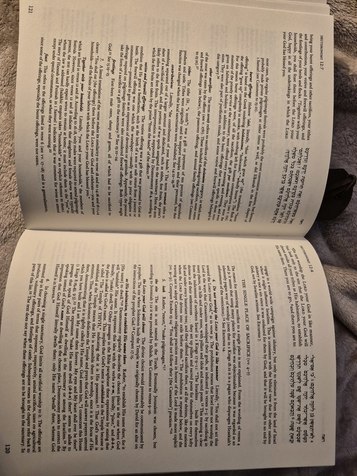
Artscroll is the Orthodox shul version. -
Currently ReadingI'd be interested to hear more about these, especially the JPS commentary. I take it that it draws from thinkers like Rashi and Nachmanides, as well as the Talmudic rabbis and others? — BitconnectCarlos
I'd describe the commentary as scholarly and academic, with some references to traditional sources, but no expectation the reader is Orthodox or necessarily a believer. It's not like the Artscroll chumash. -
Currently ReadingYeah, but did you care he died, like were you at all invested in him as a character, or was it just pretty prose?
-
What is faithAs explained, I'm not so keen on such theological meanderings, to what may have began here: — Banno
You recited Christian theology and all I did was note it. I had no deeper purpose, as if to spread the love of Christ, as if I have any personal attachment to such theology.
The debates here are minimally substantively theological. They generally ask the question whether theology is stupid. Those who don't think it's stupid get pissed and start defending their religion, leaving them prey to further antagonism.
The OP here didn't answer what faith was as much as whether faith is stupid or dangerous or foolish.
Since faith is the centerpiece of religion, it seems its answer would lie somewhere in a theological discussion that preceded our conversation. -
Currently ReadingThe Great Gatsby.
Beautifully rich writing though a little too rich for my pedestrian tastes, I guess. — praxis
I place that book among the most over-rated books of all time. -
Currently ReadingThe Lonely Man of Faith by Joseph Soloveithik. A dicussion of spiritual man versus obedient man. Interesting dichotomy.
Deuteronomy - The JPS Torah Commentary - by Yahweh Almighty. A retellling of a tale of a people. Questionable fact wise.
Slaughterhouse Five by Kurt Vonnegut. A war fucks everything and everyone sort of story. Point made.
The Art of Experience by John Dewey. A pragmatist"s essays on aesthetics to provide fodder in the Shoutbox. A bit boring. -
What is faithI blame ↪Hanover... And of course you are welcome to your views. — Banno
Very well, but for someone so averse to conversations of God, you're omnipresent in these threads.
I, for one, have never begun such a thread, but I'd like to think I keep them balanced, since theism does not entail reliance upon any particular written document, any particular hermeneutic, or actually any scripture at all. -
What is faithTotally irrelevant and a classic example of resorting to denigration when no argument can be found. — Janus
No, your statement was just categorically wrong, so I provided a similar statement to mirror yours, hoping to point that out, but you just got mad.
There are thousands of years of theological debate, consisting of hundreds of millions of pages. And then you say "there's just no way to rationally debate it."
I'm just saying maybe rethink your post, which is really not a major event. I'm truly not trying just to piss you off. -
What is faithThere seems to be no rational way to argue that when it comes to scripture — Janus
There are no books providing argument in support or against Wittgenstein either.
I just thought I'd write a post as bad as yours so you could see how bad it looked when you read it. -
What is faithI don't agree. It will suffice to point out that "bad" philosophical arguments include those that rest on authority, divine or otherwise. — Banno
Debating the meaning of original philosophical sources is common here and in academia. There must be some reason you read and debate Wittgenstein for example which goes beyond just trying to put a random puzzle together. That is, you sympathize with his views, believe he has something significant to say, and think he carries a certain knowledge beyond yours worth pursuing.
Does that mean you blindly accept anything be says? Of course not, but there's probably built in deference.
We can both pretend that we've arrived at our fundamental positions after worldly search. I coincidentally found meaning in Judaism, it having nothing to do with my environment, and you having found meaning in the leading anglo-analytic thinkers, that too having had nothing to do with your environment.
Sure.
We're all looking for meaning, and you must begin with some source you're willing to grant credibility to. There are enough legitimate means to finding that meaning that we need not force each other to any particular one. It is the intolerant proselytizer that smugly arrives that we can do without because he lives under the illusion his brand of wisdom is best and that he'll change someone's mind who's not looking to change.
If someone has found meaning in John Smith's interpretation of gold plates stumbled upon supposedly in the Adirondack for example, and he has full buy in to all that due to his upbringing, why would I suggest it's bullshit? That i don't get.
Again, philosophy is the pursuit of wisdom. -
What is faithI'll stand by that. — Banno
Okay, but that's not what you said in the post I responded to.
In summary there are three things that identify a move from a philosophical enquiry to mere theology:
claiming that god is the answer to a philosophical question
using scripture, revelation or other religious authority in an argument
entering into a philosophical argument in bad faith. — Banno
I wish you'd number your three elements for clarity. You also don't attach an "and," or "or," so I don't know if you have to have all 3 or just 1 to be in bad faith. I only understand lawyer speak, sorry.
Two responses: (1) Not all theological systems require scripture be the word of God, which would mean your objection is to only certain theologies, and (2) you need to define what "philosophical argument" rightly is to explain why your criteria are necessary to remain within in it.
It sounds like you view philosophy as pursuit of truth, with only certain types of justifications permissible to reach that truth.
I submit that sophy means wisdom, not truth. -
What is faithAlmost. I've writ about it at some length. What's philosophically illegitimate is dependence on divine writ. — Banno
It makes no sense to deny the philosophical import of divine writ. Why would you deny a writing from God himself?
What you mean to say is one shouldn't justify one's belief in a document based upon their false belief it is from God.
Yet that does not mean the writ is false. It just means the basis for accepting it is invalid
This therefore means one shouldn't justify one's disbelief in a document based upon their correct belief it is not from God. -
The inhuman systemWould that the race were so provincial that one could opt out of it -- as it is I'd bet on convincing the guys at the back it'll be easier to just take the prize than win the race. — Moliere
The game may be immoral or objectively unfair, which could be a reason to opt out, but, saving those concerns, victory favors the competitive. If being stronger wins, they get stronger. If playing the victim wins, they play the victim. -
What is faithPerhaps. I'm not so keen on such theological meanderings. Thanks. — Banno
You mention trinity and the primacy of love as a value in a thread about faith and think no one will notice the consistency with Christianity?
An argument could be made that you're just making the argument that Christianity would be fine if Christians would just adhere to their creed.
I think most Christians would give an Amen to that. -
Toilets and AblutionsThe physics of the toilet is also fascinating. The sudden release of water from the tank causes the pressure build up and release and you get that classic flush. If you were to take a large bucket of water and dump it in the bowl, you could create the flush effect without flipping the handle.
A partially empty tank from too frequent a flush results in that disappointing non-flush we all know of.
I would assume if your bladder burst and copius amounts of urine flooded past your loins, it would be theoretically possible to gain the flush hands free, the ambition of every schoolboy. I say boy, not girl, because girls curiously have less interest in such things. No idea why that is. -
What is faithWere I writing in opposition to myself here, I might be pointing out that faith is one amongst at least a trinity, and that when set in the context of hope and love it shines, and my arguments fall away. — Banno
So this is a complicated statement, crossing categories with strong Christian allusions (lthe trinity and primacy of love (John 4:8 "Whoever does not love does not know God, because God is love)).
So, faith and hope I'd classify as epistemic categories. It describes the way we know our reality. Faith falls into the certainty class, and should we say we have fauth of something we indicate in our speech as it is. To hope (as to wish, to dream) we don't indicate it is, but we state it as a hypothetical or aspired for reality. The point being that I place hope and faith as ways of qualifying our knowledge of the Good., but not the Good itself
But love, as you use it, sounds like tthe Good iself, the thing we wish to achieve.
Your comment could therefore be interpreted as saying faith in something other than love is dangerous, which is consistent with saying that faith in something other than God is dangerous, if we equate God with love, as John did. -
What is faithYou've changed the topic. I haven't seen any argument that religious folk disproportionately evil, or more so than atheists. — Banno
If that's not your view, I stand corrected. I take as an example a prior quote of yours though,
"this goes beyond the merely epistemological point, to demand a response from the faithful as to their humanity.
Faith is not always a good. If your faith is strong enough for you to fly a Boeing into a building, or to fire rockets indiscriminately into a city, then something has gone astray."
Why the cautionary tale identifying the dangers of faith if evil is just an attribute of mankind? Is not implicit in this comment that those without faith are more benign than those with? If just an argument for moderation, why not mention the dangers of extreme atheism as well?
Anyway, to clarify, which makes for the better society, ceteris paribus, one all of theists or one all of atheists? -
What is Time?If plank state 1 is followed by plank state 2 without apparent rhyme or reason and that negates a meaningful concept of time, either you're requiring a conscious narrative of events for time to exist (and thus a conscious observer), or you're requiring underlying internal laws exist that dictate this change despite it appearing random.
This is to say that if the ball becomes a fish becomes water, and it's not the lack of a conscious observer being unable to understand the progression that collapses time, but it's the lack of ontological structure that does it, you've created an untestable theory because it's possible laws exist that just can't be understood.
On the other hand, if a conscious observer arrives at a narrative that explains the plank state transitions, you now have meaningful time, even if the conscious observer is entirely wrong in his explanation.
This seems to suggest the only reliable description of time requires a conscious observer, right? -
The inhuman systemOur system is built on the illusion of pressure, control, and rush. — Martijn
you LIKE this system, then that's one thing. But don't gaslight people here into thinking that the system is only in my head. — Martijn
My post didn't say anything about the dictates of reality, but then condescendingly suggesting you can feel free to live under whatever delusion you wanted.
I offered the platitude of the Bard, and I said to be true to yourself. That you've read that as me monkeying with your head is on you.
You, on the other hand, present the position of intellectual transcendence, as if you stand above the fray and can see it as it is, a social contrivance, designed to enslave.
My point wasn't to enter the capitalist/Marxist debate that looms obviously in this discussion, but just to point out that I would find it as profoundly unfulfilling to live in stable security without highly variable successes and failures as you apparently find the opposite.
Candidly, I encourage those who don't wish to compete not to compete. Races are easier to win with fewer contestants. -
The inhuman systemI can't disagree with the post to the extent the poster found comfort from his internal struggles by interpreting his world as he did.
For me, I like the chaos of competition and the rush of the chase. I don't like sitting still and could not survive passively waiting for I want.
While the post suggests his analysis applies universally and is perhaps an objectively correct stance, it's really not, but is just the flip side of those who insist the opposite is the correct stance.
The answer is to your own self be true. -
Toilets and AblutionsHow about this. I am wondering that today maybe with think of the act of defecating and bathing as a habit where it was once imbued with far more ritual and meaning than in the past. For women 'toilette' seems to hold a social significance compared to men. If we go back far enough was it held in higher regard and of higher importance for all? We are animals so territory marking may be something worth considering here? — I like sushi
I think there is a reason that feces is instintively foul, which likely relates to it being generally unhealthy waste, although my dog doesn't seem as offended by it and considers it a bit of a treat. She will vomit after eating it though, so maybe it's an intelligence thing as well.
I suspect that various traditions treat the act of defacation with differing levels of holiness. I beleive Judaism has a prayer to recite after a good shit. Perhaps some also pray for a good shit, particularly after a long haitus.
I can't really remember what we were talking about, but maybe something to do with why a toilet is so close to the tub. I can see how a romantic tryst in the bubble bath would be enhanced by the convenience of being able to take a massive immediately thereafter, allowing you to jump back in the suds for another round before getting the shivers. If a cooler of Budweiser were nearby, I think we might have perfection. -
Toilets and AblutionsI am not sure what nudity has to do with this. I think that is more or less Victorian era hang up.
btw I only get naked when I go to the toilet because this country is VERY hot. — I like sushi
Modesty rules pre-existed Victorian times obviously, going all the way back to the time when Adam draped his junk with a fig leaf.
Bathroom privacy is very much in the news these days in other contexts as well. This is just to say that placement of toilets next to showers in the same private room does have something to do with the privacy afforded by that private room while unclothed. It would also explain why we don't put locked doors around our kitchens, despite them too having water supplies.
Also, when I was a kid I drank from the garden hose and I always kept my pants on. -
Toilets and Ablutionsdo not buy into the idea that it is simply due to plumbing convenience as we do not find toilets, baths or showers in kitchen areas. Adjacent, yes. Combined, no. — I like sushi
You don't get naked when you cook, so it's not necessary to put an oven next to the bathtub. Bathrooms are private places, which explains putting toilets next to showers. It's the private room. -
Toilets and AblutionsWhat do you think about this strange partnership? Why on earth does anyone have a toilet located anywhere near where they clean themselves? Obviously it is practical in one sense, yet in order it seems absurd to the point of being obscene. — I like sushi
There are differences between spiritual cleansings (baptisms, mikvahs) and hygienic cleansing (scrubbing the grease off your paws). I take "ablution" to reference the spiritual sort. My guess is most traditions wouldn't allow a spiritual dip in the shitter.
Cleaning requires water requires pipes, so the toilet finds itself hooked up to the same water pipes and drain pipes as the shower, thus the close proximity. Most bathrooms are clean, although I wouldn't bare ass it at the Highway 21 Stop and Go. In prison, where I've not been, I hear they brush their teeth in the shiny steel bowl, but there's lots of stuff not worth talking about goes down there.
What say the Rabbis? https://www.yeshiva.co/ask/7431
I think the story goes that the privy was outside up until it was hygienic enough to come in from the cold. It's just a modern convenience that emerged through technology more than some change in social norm. -
What is faithYou want to to turn all that's been said here into a bit of pop psychology. Fine. There's your straw man. — Banno
Not pop psychology, but perhaps actual psychology. If it is the case that religious based reasoning does not dictate an evil propensity yet the empirical evidence shows the religious are more evil than their atheist counterparts, then some explanation as to why might be interesting.
For example, if I'm a Satanist, it might be that my evil ways are dictated by my ideology, and so you could rightly criticize Satanism. But if I'm a Christian and my evil ways are not dictated by my ideology, you can't rightly criticize my Christianity. If you can show, however, that Christians are disproportionately evil (even though there's nothing in their ideology that entails that evil (as there is with Satanism)), then I'd be interested in knowing what that is.
Buit that interest isn't a philosophical question. It's a psychological or sociological one. Maybe all Republicans are great dancers. If they are, I'd want to know why because it doesn't seem like dancing ability should arise from that belief system. It also doesn't seem like joining the Republican party will make me a great dancer. -
What is faithThat's simply not what I read in the responses to my posts here. — Banno
If you have located someone willing to argue the strawman, defeating them only proves you've found the weakest form of the argument to defeat. It doesn't suggest anything more philosophically as to what faith based beliefs entail.
The best I can decipher is you wish to generalize a psychological profile to those of faith, pointing out they're a particularly dangerous sort.
That's not philosophy. That's sociology. I'll defer to the studies whatever they might say. Regardless of what sociological studies say Christians, for example, typically are does not mean they logically must be.
And that's the philosophy question. That Christians or whoever might suck at higher rates than atheists isn't because of their religion. It's just because they suck. -
What is faithFor many, it is uncomfortable to draw attention to that aspect of faith. — Banno
It's really not. It's like pointing out that governments can do evil things and thinking that only anarchists remain comfortable because they swore off government.
That religion has done some really bad things isn't debatable.
It's also not really debatable that government and religions are political entities. People and power create. Sometimes they create good. Sometimes not.
My response all along has been the special pleading of religion as evil, not denying it can be evil. -
What is faithBut perhaps the issue isn't how many bullets were fired by anger and how may by faith, but in acknowledging that at least some were fired in faith. — Banno
I think plenty are fired on the basis of faith, but my point was to push back on the idea that faith based beliefs are particularly dangerous by comparison. And to completely purge of bias, if we're going to acknowledge that some bullets are fired on the basis of faith, we must also acknowledge that a good many bullets never make their way to flight due to those of faith. To suggest otherwise sort of characterizes the religious as muzzled pit bulls, inherently dangerous but made safe if properly controlled and surveilled. Some are actually good actors through and through.
But perhaps you and I agree were others will differ. Do we agree that it is the actions, not the thoughts oft he actor, that have the main moral import?
And especially, that an act is done in good faith is insufficient for it to be counted as a good act, or a being the right thing to do. — Banno
I am generally sympathetic to this view because it comports with my personal religious views because prioritizing act over intent is typical of the more ancient belief systems, but like an old tie, it seems to have come back in style. They say the road to hell is paved with good intentions, which makes the point that trying to do right but fucking everything up isn't something you can be excused from.
One reason you find this sort of reasoning in older moral systems is that what is considered right and wrong is often more clearly laid out, sometimes being very rule oriented. If we can say X, Y, and Z are wrong, we leave less to our own personal evaluation, and so we needn't evaluate our intent when we evaluate the act. For example, if the rule is "thou shalt not lie," then you can't lie. If you do lie, but you do it for a variety of kind hearted reasons, it doesn't matter. You lied. We don't get into some complex calculus of trying to figure out when it's ok to lie and then trying to justify later when everything fucks up that we made a good faith effort at doing the math and it saying we could lie, but it turns out we probably shouldn't have.
There are limits to this concept though, because I do see a difference between a bad act committed as the result of incompetence versus malice. My wife serving me spoiled meat because she failed to check the expiration date is quite a different event than her serving it up because I failed to fold the laundry. By the same token, if she serves me up what she thought was spoiled meat in order to punish me for my poor housekeeping, but it was actually now perfectly aged and of even higher quality, I don't think she gets an award for being such a good spouse.
It reminds me of the movie Taxi Driver, where a failed assassination attempt on a presidential candidate resulted in the return of a child prostitute to her parents and the would be assassin becoming a hero. I still see something pretty bad about the would be assassin's behavior, even though he did bring Jodie Foster back to her parents where she could go on and make more movies.

Hanover

Start FollowingSend a Message
- Other sites we like
- Social media
- Terms of Service
- Sign In
- Created with PlushForums
- © 2026 The Philosophy Forum