
Comments
-
The Liar Paradox - Is it even a valid statement?If you would read what I posted — TonesInDeepFreeze
I did. It is appearing, more or more credibly, that you're not really doing the same, as there is clarity from comment one of this exchange and several attempts to end the clear horseshit going on here.
"Why did it take nine pages" is very, very clear indicator, if you're actually paying attention, that I assent to RussellA's position. And, our subsequent exchange made that explicitly, painfully clear directly to you.
If you still have questions, perhaps aim them elsewhere as I have answered anything relevant several times now - and that's ignoring hte spoon-feeding required being a problem. -
Is the real world fair and just?It could have been better written. — apokrisis
LMAO, possibly, but your response seems to just be inapt, even on review. The core point was missed.
Well who gives a fuck when you put it like that. — apokrisis
You're trying to assert that mind-reading is a sound practice. Far be it from me my friend :) -
Antinatalism ArgumentsWhich is another way AN harms itself as a reasonable ethical system. — Fire Ologist
I'll try to sort out your comments below, but I do not see how that, in any way, harms itself. If the ethical goal is to no longer require ethical systems (because the world is perfectly ethical) then it is precisely, as an ethical system, that AN succeeds (obviously if you disagree with it then success is subjective, but I hope you get the sense in which I mean this).
If the goal of ethics is to eliminate ethics — Fire Ologist
I'm unsure this is the right description of the goal, but onward..
we could just ignore any pangs of morality now instead — Fire Ologist
I'm not sure what you're getting at, but this seems to violate the former idea: If we're ignoring moral pangs (though, I couldn't give a shit what your moral pangs are. Show me the results of your behaviour) then ethics would say this is unethical, in some sense. You are not attended to ethics in this case. The case I'm, at least superficially, putting forward as a goal of AN would be that there are no ethics to attend. I think there is a clear distinction, myself, because you're right - the conception you've described here is inapt, and probably self-defeating.
using scales of ethics and motality to help decide one’s way forward for sake of eliminating ethics is a bit like using math to show how numbers can’t exist (or in this case shouldn’t exist). — Fire Ologist
I do not see this at all, unfortunately. They are not the same thing, or comparable. To be fair, morality would likely only pertain to the acts of hte living. Ethics are to do with the effect of those acts so there can be a difference between the two 'scales' being considered, I think - though, I ahve written this on the fly while editing a settlement statement so go easy LOL -
Is the real world fair and just?Not to sound rude, but did you actually read my reply? My position is that:
recognizing for problems — apokrisis
Is a more apt description. — AmadeusD
Your POV that we're 'looking for problems' is simply not the case. ANd, it is not for you to decide whether or not it is. We see things differently. You are not right. We are not 'right'. You are, however, wrong about the motivation. Recognizing, not seeking. If you do not accept this, that is pure bad faith. There is nothing to explain, from our position. You are simply wrong about what we are thinking, or motivated by. And you couldn't possibly know, so... yeah. -
PerceptionYet you keep falling into the same trap of asserting you know how the body/brain works while at the same time asserting that we cannot trust our senses. — Harry Hindu
Not quite, no. I've addressed this apparent hypocrisy recently and wont rehash because I'll make a pigs ear of it.
How do I know that you read what you read about the body/brain accurately when you depend on your eyes to see the words? How do we know that some mad scientist didn't plant these ideas in your head, or that you didn't hallucinate the experience of reading "facts" about bodies and brains? — Harry Hindu
These are the precise issues I addressed in the referenced response.
Suffice to accept this part of it, at least LOL.So I 100% take that objection, — AmadeusD
Just because someone can change the time on the clock to report the wrong time does not mean that clocks are useless in telling time — Harry Hindu
This is precisely the defence I've run, in other terms.
In other words, we can determine the validity of what one sense is informing us by using other senses, observing over time and using reason. — Harry Hindu
Yes, correct. This, despite not having any direct access, or certitude about our sensory apprehensions. Its a best-guess, and if that's the best we have, it's the best we have.
Huh. I think that's a very strange thing to say. Unpleasantness is exactly what "pain" indicates to me. It refers to a wide range of unpleasant feelings, just like the dictionary states. What does "pain" mean to you? Does it simply mean the sensation of touch? Are all touches painful to you, or do you have a way to distinguish a painful feeling from a not painful feeling? — Metaphysician Undercover
Very much fair, and I think this may illustrate what I'm saying: Clearly, as between you and I, there is not a 1:1 match between pain and "unpleasantness". Pain (i.e a sensation that indicates injury - physical, or mental (but mental is awhole different discussion I think)) doesn't, inherently, mean displeasure. Maybe that's clearer?
Perhaps you need to maintain my position (that pain is mental) to support the idea that pain is inherently unpleasant, as clearly, to the injury part (i.e the "physical" aspect of pain) this is patently not hte case. -
Is A Utopian Society Possible ?It would take a great deal of benevolence to make up for the bilge he gets paid for spewing out into the public discourse. — Vera Mont
It was a bt of a cheeky quip - I don't think its possible to call someone an asshole from their public output, unless its criminal/socially criminal. I've seen some examples of that from him, but far more examples of him being compassionate, understanding and vulnerable. Again, can provide those instances if you're interested in them.
I think you're probably somewhat mislead by what you've seen, if this is the case. In his public life, he presents a character almost the polar opposite to that which is glommed onto for criticism purposes. ONe prime example is his talk about 'socially enforced monogamy' being misinterpreted as if he's advocating for forced relationships or something. Far from it. Just one eg... He's an incredibly effective therapist and his general self-help stuff is honestly really, really really good for our times, and for hte crisis he's trying to address in mostly men. That said, It's not in any way going to improve your life, I don't think hahaha. Just generally like to ensure people get both sides of something like that, when so much bullshit is bandied about. -
What should the EU do when Trump wins the next election?some who understand the fascist relationship with economics might not agree with you — Athena
True - I suppose I would be looking for how you can instantiate an entire political mode from economics.. Though, i understand the 'slippery slope' aspect of seemingly-innocent policy changes.
However, someone as good-looking as your avatar doesn't have to know everything — Athena
AWww shucks :P -
Is the real world fair and just?As someone on the autism spectrum, the question arises for me of whether in an afterlife I would be autistic.
If not, then it doesn't seem like it would be me in the afterlife.
If so, and for eternity, I expect I'd think the afterlife kind of sucks. — wonderer1
Interesting - I would never had thought to ask this, though, I am essentially not open to an afterlife that retains any personality whatsoever. INteresting, nonetheless.
Once you get into a mindset oflookingrecognizing for problems — apokrisis
Is a more apt description. You may still think this is inapt for life in general, but it is certainly bad faith to attribute behaviours you're, in the sentence, deeming problematic, when that's not established - its just an appearance from your POV :) -
The essence of religionprojection and non sequitur — 180 Proof
Seems the modus operandi. I cannot fault, though, as it's likely I've come across like this most of the time to you also(and that's ignoring our actual disagreements lol. I just have ideas that are going to be sometimes bad). -
Greatest Year in MoviesThe answer is 1994:
- Leon: The Professional
- The Crow
- Natural Born Killers
- Interview with the Vampire
- Four Weddings and a Funeral
- Corina Corina
- Legends of the Fall
- The Lion King
- Forrest Gump
- True Lies
- Ed Wood
- Bulets over Broadway
- Pulp Fiction
- Farinelli
- Clear and Present Danger
- Only You
- Black Beauty
- Don Juan
- Priscilla: Queen of the Desert
- The Shawshank Redemption
- The River Wild
- Stargate
- It Could Happen To you
- Immortal Beloved
I could go on. Surely, this is a personal opinion. But its note debatable either ;)
Same goes from albums. 1994 was an absolute watershed. -
Is A Utopian Society Possible ?Seen some of his videos, gods help me! — Vera Mont
Ah yep, fair. Would you like any that show his other side? Well, tbf, he has several - but he is often, quite extremely misconstrued. That said, there are plenty of examples of non-misconstrued videos of his that are batshit. LOL. Wondered if you wanted the humanizing aspect.
Aren't we all? Isn't that the purpose of this present endeavour? — Vera Mont
LOL, yes I suppose so. Probably better if more and more understand these discussions to be such. -
Is A Utopian Society Possible ?Do you know him personally? Or is this just sort of yelling into the ether "hes an AH"?
-
10k Philosophy challengeThanks Dan. Unfortunately, I don't actually think you're being all that clear.
The choice between whether 1.one person loses their life or five lose their sight is morally important because it leads to consequences which are 2.good and/or bad. They are good and/or bad due to the gain and/or loss of 3.freedom (by which I mean ability of persons to understand and make 4. their own choices) involved. — Dan
All the bolded creates a murky, insufficiently direct sort of paragraph. By number, the questions I would ask to clarify (this, meaning I've understood you to be aligning with what I've said, just linguistically uncomfortable, so are re-stating):
1. Which person? The chooser, or (any one of) the subjects?;
2. For whom? The chooser, or (any one of) the subjects?;
3. For whom? The chooser, or (any one of) the subjects?; and
4. Whose choices?
-- ----- --------- ------ -----------
my stab at the answers, which, if true, mean you are saying what i'm saying:
1. Any one of the subjects;
2. Any one of the subjects;
3. Any one of the subjects; and
4. Any one of the subjects.
So, it seems the choice being made (i.e by the Chooser, not one of the subjects) has no moral value other than the way in whcih is adjusts the ability of the subjects to make their choice. This seems an exact, contextual, instantiation of:
It isn't because the choice itself is morally valuable that we should care which option is picked, it is because of the consequences. — Dan
This is all to say, if so, it was sufficiently clear in my first attempt, as I see it. But, I think you are not being particularly clear and I can now see how MU is getting what they're getting. -
The Liar Paradox - Is it even a valid statement?I did not say that, thank you very much.
(your point is these posts were an exchange between yourself and RussellA - unfortunately for me, it was also a couple of other posters, not just you two. My point was distancing my reply from the personal aspect you're tied to).was in response to about eight posts — AmadeusD
You've taken the worst reading I can get from it (that, instead of what I actually did - which was distance my response from any personal comment) such that you now think I was responding to you (both) directly. That is not the case, or what I wrote. It was somewhat imprecise though. It was a comment on the previous set of comments, which were not to, about or for me - not a response to them. So I'll cop to that misunderstanding entirely - I apologise with no qualifier.
Otherwise, this is a roundabout. You misunderstood, I have clarified - you've accepted, and yet here we are. I reject your position on the basis its an emotional reaction to something you've read into my posts - and will now move on :) Didn't meant to offend, and don't really care about it anymore. -
The Liar Paradox - Is it even a valid statement?But as it stood, it was you making a snarky put down of something or other. So, a form of dismissiveness. It is disingenious to toss out snark but pretend it's not. — TonesInDeepFreeze
Nope. Still nope. It is not. This is simply you outlining an ambiguity and then claiming the least-charitable version for your own ends. Not sure why you would, and it's not for me to explain.
It is disingenious to toss out snark but pretend it's not. — TonesInDeepFreeze
Yeah, but it was neither. Sorry pal.
You haven't addressed the specifics of my argument about it. — TonesInDeepFreeze
Yes I have. Multiple times. I have, in fact, teased apart several direct misinterpretations you've made. But you're still here, intent on finding a way for me to have impugned you. A sad affair, to be sure.
But it's dishonest to pretend that one hasn't been sarcastic and to pretend that not even is it reasonable that another took you as sarcastic — TonesInDeepFreeze
Luckily, those two things are true, and I am not being dishonest.
You ought not put strikethrough across my words within a quote like that.
I said "naturally" and I did not strike it. — TonesInDeepFreeze
That was the point my guy. You did not 'naturally' react. You misinterpreted, perhaps had your ego hurt, and assumed the worst in all three turns (the initial "Why did it take...", the "I can only laugh.." and my actual responses in this exchange).
You can only lead a horse to water. I tried to squash the 'beef'. Four times now, actually. You do not want to. So be it. I will treat you as you request. Though, I would ask that you do not consistently multi-post,. and just edit the initial post. I will notice. -
The Liar Paradox - Is it even a valid statement?
You are clearly making some extremely sensitive inferences that don't make sense. No idea why you would want me to be insulting you, but there we are. You're wrong, and clearly so.
In lieu of hand-holding you through it:
I can only laugh.Oh, is that what you meant to convey? You have a curious way of communicating, I'll give you that. — TonesInDeepFreeze
I outline what I (still) recognise as a distasteful approach, but I very much appreciate your clarification here. Genuinely. Thank you. — AmadeusD
so I revert to the above appreciation. — AmadeusD
Take care. -
10k Philosophy challengethe decision of which to save has a great deal of moral content/weight/import because it has consequences for the ability of persons to understand and make their own choices. It isn't because the choice itself is morally valuable that we should care which option is picked, it is because of the consequences. — Dan
If I am not missing your point, I think this distills it well in a way that clears the air for what MU has been saying (if not, for them proper).
You're talking about two different values. The value of the choice made (by the 'external' chooser) and the inability of the subjects to make choices about that which belongs to them (life, eyes) due to the choice made by the 'external' chooser.
The former only has moral value inasmuchas it restricts (or doesn't, depending the choice) the freedom of the subjects to make their own choices about that which belongs to them(eyes, life).
Is that right? I've been trying to follow but it gets a bit weedy at times. -
The Liar Paradox - Is it even a valid statement?clearly indicated at the time. — TonesInDeepFreeze
I maintain it was. It was not in response to you directly, or indirectly.
ou let out a fart of snark that would naturally be understood to be directed at me. — TonesInDeepFreeze
Nope.
And especially so since the poster you had been previously faulting was me — TonesInDeepFreeze
Yep, so naturally I would have replied to you, right? Whereas I didn't.
naturallycounter-attacking and defending. — TonesInDeepFreeze
Sure, and you've clarified why. Nothing makes it reasonable in context, despite your protestations. Given I already made two attempts to say "Cool man, we weren't having such a go at each other as it seemed" I can't be bothered further than saying so again.
Cool man, looks like we didn't intend to have a go at each other the way its been interpreted. Good. -
MotonormativityCan we leave the guy alone now? It seems like he was just trying to be honest. — Baden
No, no. Keep it coming. It's entertaining seeing other people wishing I had a different opinion about my own experiences. Its bizarre and interesting that there are minds that twisted back on themselves.
OK, mate. I now understand why you always type and posy with such anger. Living in a country that you don't like is screwed, and maybe you are frustrated every time. Reading your posts, it is more an issue regarding your attitude than the existence of NZ. — javi2541997
I have no idea what you even think you're saying, but I don't post with, or carry any anger. If that's your interpretation of me, I'd just suggest you grow up and realise youre on an internet forum dedicated to argumentation.
It isn't. You complained about the public transport in NZ. I agree the public services of every country have pros and cons, and no one is perfect. — javi2541997
That is whataboutism. Sorry bud.
Again, don't be ungrateful, mate. — javi2541997
I am sorry Javi, but you have precisely zero standing, perspective, or right to make proclamations about my experiences and reactions to my own country. This is just risible on your part.
Just because it is a country that cares for people and doesn't allow you to use excessively the car, doesn't mean it is the "worst" country in the world. — javi2541997
Didn't say it was - what are you on about?
Only developed and rich nations. :lol: I will not see the crank trying to live in Andalucía, Cuba, Venezuela, or Morocco. Nah, everything is messed up in NZ but no way I would raise my kids in Seville. — javi2541997
So, either you're making absolutely no sense or you want me to buy into whataboutism again. No thanks. I'll maintain my actual stance on my actual country instead of making shit up.
No, no. You can't. Hating the country where you live is dumb. — javi2541997
No, no it isn't. It is the case. Clearly, you are not apt to understand that my position on my own country has precisely zero to do with you. It doesn't, and you'd do well to stop pretending it does. -
The Liar Paradox - Is it even a valid statement?The former, sure. But of hte thread (or at least the wider discussion beyond my contributions) - I just don't see a problem there.
I don't think the latter is dismissive at all. -
The Liar Paradox - Is it even a valid statement?LOL, i'm now genuinely confused. I was intending there to point out that "I can only laugh" was in response to about eight posts, none of which were at or about me best I can tell - it was discussion between yourself and RussellA. Hopefully that clears that issue up :)
-
The Liar Paradox - Is it even a valid statement?(<--) I can only laugh :D
Yessir, and I the same. I outline what I (still) recognise as a distasteful approach, but I very much appreciate your clarification here. Genuinely. Thank you.I exercise my prerogative to respond only to what I am motivated to respond to — TonesInDeepFreeze
asking someone for information and then receiving it but without at least posting that the information was received and understood (or not understood, thus requiring elaboration) is also a kind of dismissiveness. — TonesInDeepFreeze
It wasn't aimed at me - the posts in question were responses to other people, so I revert to the above appreciation. -
A Thought Experiment Question for Christiansif one's God is not the supernatural being of most Christians' belief, can a person still be a Christian? — tim wood
Depends. Can one's saviour still be Jesus Christ? I'd think so, regardless of hte divinity instantiated from on high within the person of Jesus Christ. -
The Liar Paradox - Is it even a valid statement?Ah, but you do wish to comment on me personally after all. — TonesInDeepFreeze
Due to your direct responses to me, yes. It would be completely wrong to take that as somehow retroactively meaning I meant to engage you directly initially. You took up the conversation, and I continued. There were several people posting between my comment and my previous comment (looking back, that is). I didn't tag you, or anyone. Clear indicator I am not talking to you so I am glad you've noted that.
I haven't tried to dismiss you. But you haven't interlocutorated much anyway. — TonesInDeepFreeze
You're doing it right here. Hilarious. -
A quote from TarskianDid you enjoy McWhorter's book? — Leontiskos
1. Yes;
2. Your earlier assumption is correct, it's just a good elucidation with great referencing.
I agree regarding Kendi et al. I guess this is just a great counterpoint as its two prominent, intelligent black men basically saying 'not my circus'. It's neat. -
PerceptionCare to shoulder that burden? — creativesoul
Hmm... I get it's a quip, but i'm not quite sure what you mean - your account showed to me (though, I saw this prior) the limb doesn't contain the pain in either the non-, or the phantom case (. Not sure what else could be said here. It might come down to something further on here...
I suppose what I'm trying to get at, is that (this may be askance from Michael/Hanover - if so, please do note it because it seems a bugaboo for you guys) we can't know for certain what's going on. That's actually the basis for discarding certain positions that require it. We can't positively discriminate based on 'experience' but we can remove what's not possible. We can't even experience a situation where the pain is in the toe or the colour is in the pen because they are not experiences open to us. One would need to be a toe, or a pen, to have such an experience of pain or 'being red'. And that, even if possible, would just further complicate the matter for reasons that are cartoonish and irrelevant. No human has ever had an experience of pain without their mind. No one has ever seen a red pen without their mind. So, it seems either there's an inviolable relationship between the two (experience/mind) which is read as a single entity qua whatever qualia you're talking about (pain in a toe, eg) or the claim is that there isn't, and the mind merely imports experiences (i.e pain, colour, texture) from elsewhere. I cannot accept that as it doesn't seem open to me to claim on either the grounds above (i.e we cannot make such positive claims) or because it is in clear violation of several types of experience we actually can have (mental pain mediation is one example). There is no 1:1 when it comes to stimulus v experience. It is all approximate.
What we can do in this context is eliminate unsupportable claims (not unsupported - those could well be the case, but are not being presented correctly). The claim that pain is in the toe is not supportable. We need not be apodictic or even emotionally certain of this to know that our position is not supportable. In the cases in front of us, I see that both 'viewing a red pen' and 'pain in the toe' are mental experiences. This does not rely on any form of scientific claim due to 'objective' experiment. It is self-evident, and only needs itself. However, the issue of the scientific understanding of how pain works certainly presents room for 'us' to do as you describe and that does seem to be happening in other arguments. I don't think I require this viz. I am uncertainexactly what is going on, but I am certain it is not red being imported from without, into my mind, and same with the pain. It is not being imported from the toe to my mind - something else (similar to a radiowave) moves from the triggered area, through my body physically (which does not hurt - important) and arrives in my brain, where my mind is triggered to give me an experience which would seem to be pain the toe so that I know where to tell the doctor it hurts (or whatever.. just a vessel). I would assume, from previous replies, you're going to label this a redherring/strawman etc.. I cannot understand that, if so. It would be helpful if you can set that account right - so far, the above accords with all you've said. Nevertheless, that reliance on 'objective' measures is certainly an issue (and, If I've inadvertently, or simply prior to due consideraiton)
So I 100% take that objection, and pretty much agree that relying on something like the minutiae of scientific anatomy is not that helpful to make a positive claim if we're saying perception is non-veridical. But, perception is close enough to get a lot out of it. And, the 'lot', to my mind, is able to show that it can't be the case (rather than "it is the case that..*insert positive claim*) that pain exists independent of the mind perceiving it. If the argument you're using merely creates a, let's say, inviolable relationship between "actual pain" triggered by an instance of injury, and the purported 'hallucinatory pain' (excepting phantom limb issues, on the grounds you've used to link it to the former "actual" account of pain) then, while I disagree, I can't argue against that. It is a position which cannot be adjudicated on empirical grounds. And, that, is where I think the entire thing lies. Maybe what's going on with the claims positive to a certain mode of perception is that if the institution of 'science' is telling us something like "well, we've never seen X, so we're not saying it's the case" is being taken too far. But, in this way, Leontiskos is laying out a severe red herring. Hanoever is not exempting himself. He's (I think, wrongly) delineating between kinds of expereince of perception. Perceiving 100 experiments that give us the same result, is pretty good, even though digging down Leontiskos is right to say each individual scientist is at the whim of their perception. That is clearly true.
This is on part with the way that our culture treats science as an omnipotent and inscrutable god, such that the word Science may as well always be capitalized. — Leontiskos
I would agree. Yet, you're not able to make the claims you're making on these grounds, so I'm unsure where that would lead... Will let Hanover actually answer instead of my speculation above. -
PerceptionIt does not follow that no pain is located in limbs. — creativesoul
Yes, it does actually. In any case, we can actually jettison this entire part of the debate (I am well aware of what I see as erroneous arguments earlier in the thread from yourself - i am not coming at this in bad faith (you may think bad reasoning; so be it)). The disagreement is deeper than an issue of 'pain' and of reducibility, and demonstrability.
What we can do is simply ask:
Where is the pain? If it is in the limb, you can show me.
But you cannot show me pain.
You can show me potential stimulus for pain.
That's all. I need not take this much further to be quite comfortable that your position is not right (yet..)
Further, in this passage:
Hallucinations of red pens never include red pens — creativesoul
You are making a couple mistakes here(on my account - read all as such. I am not here to make absolute claims. I am, and will continue to often be wrong):
This is plainly wrong. An Hallucination, if it is of a red pen (so called), then that is what is present in the hallucination. Your position relies on your position. Which is to say, it is tautological. IFF hallucinations do not include anything they purport to represent (I take this as incorrect for reasons askance from this particular issue) then your point is extremely apt, loud, and clearly made in such a way I could not dispute it other than on grounds of linguistics (though, I wouldn't. That would be clear to me). But, it seems you rely on that there is a strict difference between the image conjured by the mind when eyes are cast, and the one conjured when no eyes are cast. I disagree. There is no solution to this disagreement, as it stands. You think they're not the same, and I do. We're in the weeds now. Onward..
The "red pen" in the hallucination is the same as a "red pen" gleaned from casting your eyes toward the object we (by convention) call a 'red pen' which, importantly, is just denoting it's function, not what it 'actually is'. It is a label indicating what it will cause in the perceiver.
Given this position, yours simply makes no sense. I can't understand why you think the 'red pen' in the Hallucination is not the same as the 'red pen' when one's eyes are cast on an object which, by convention we call a red pen. It might seem silly, but again, on my account they are the same, let's call it, mental image, triggered in different ways. A red pen can be inferred from any writing implement, and an experience of the colour red (mentally speaking). And, that is what the object is actually attuned to, as a conventional object. It is created to induce the experiences we have labeled variously as "(such and such of/for/and/before/after/because of etc)... a red pen". If you hand me what you think to be a red pen, and my experience looking at it is not red, you cannot tell me I am wrong. That is, in fact, what the object triggers in my mental space. On your account, this is an hallucination? (genuine Q, as it's a role reversal from your point about hallucinations not including hte object of their image).
But again, these all make sense on my account - not on yours, so I'm not trying to do some "You're an idiot" type thing here. I think we see things differently enough that we couldn't come to terms. Several of our competing points are independent of our disagreement about that particular point and simply go back to whether a mental image is it's object. I say no, which Hallucinations are a prime evidence for. If a mental image is not synonymous with it's object (which it couldn't possibly be, right?) then we have no appreciable difference to instantiate in some account. Nevertheless, It's probably worth my addressing:
This poor argument is at the bottom of so much confusion on TPF. — Leontiskos
I agree, but you are the confused one. Hanover is exactly right. This is how the body/brain works. -
The Liar Paradox - Is it even a valid statement?I did not tag you in it. I assessed the page of the thread, laughed, and responded in kind.
You seem to want some kind of insult to land. It wont, because I don't find hte context apt to insult me. So, not sure where you're going - just think its pretty distasteful to do what you've just done in an attempt to find some ad hominem-esque reason for dismissing an interlocutor. Fine. You do you boo. -
PerceptionThe pain is in the limb, not the brain. — creativesoul
And yet
despite no longer having a physical extremity located where the pain seems to be coming from — creativesoul
Obviously, pain is not in the limb. That para honestly felt like trolling... Is it?
Oh, and there are no colorless rainbows, nor colorless visible spectrums. — creativesoul
These are aspects of visual world of a perceiver. If you're suggesting, in these terms, that colour inheres in the Rainbow... hehe. Nope. Try changing your terms around to be idependent of perception. Could make some headway.. -
The Liar Paradox - Is it even a valid statement?If you feel the need to respond, directly, in this way, I can only laugh harder.
-
Is the real world fair and just?A bit weak, but fair. I wouldn't assume I was either. I just think you're clearly wrong.
-
The Liar Paradox - Is it even a valid statement?Are you sure?
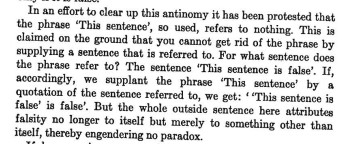
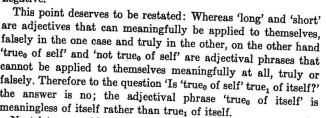
It's always possible I am misunderstanding, but this entire piece
seems to speak to Quine essentially saying "This isn't a problem, because you can't shoehorn meaning in here for it to contradict (as to itself)" -
PerceptionThe two aspects are known scientifically as the sensory aspect of pain and the affective aspect of pain. — Metaphysician Undercover
That does not actually seem to be the case. This seems a floated theory on how to get around some esoteric aspects of pain, so to study them. The paper is speculative and philosophical, not scientific. You can tell they are way off track, without even havign access to the full paper (your link does not provide this):
" How can one obtain an account of the experience of pain that does justice both to its objectivity (and thus its similarity with exteroception) and to its excess of subjectivity?"
The former is a misnomer. They are trying to conflate pain with damage or stimulus. They are clearly not the same, and so conflating same as aspects of the 'same' thing is erroneous. I see how this approach will be very helpful in treatment of pain, but it does nothing for our discussion best I can tell.
Notice, "unpleasant" is the defining aspect of pain — Metaphysician Undercover
No. No it's not. I have given plenty of examples which violate this definition. It is inapt. Pain is not inherently unpleasant. If that were the case, the examples i've given would not obtain. I think what you meant to discuss is discomfort. I tried to lead you here... Discomfort is inherently uncomfortable. Pain is not. -
Donald HoffmanI wonder if you're aware of Samuel Sagan? If you are, perhaps this would be better as a DM thread.
-
Is the real world fair and just?Who could care about AN concerns? They are ridiculous given that there is plenty enough of pragmatic importance to be getting on with in our already extant lives. — apokrisis
So, you mean to say, you've been arguing with (i think) three people about antinatalism across two threads, and you don't care about, or understand the concerns of antinatalists? Interesting approach my guy. -
Is the real world fair and just?AN would be the aesthetic pose in my book. I prefer to move on to the pragmatic meat of the issue of whether to have children. And how to approach life in general. — apokrisis
I don't think you're reading these responses.
Hyperbole. — apokrisis
Not in any way, whatsoever. The number of people who cower into an ideology that saves them from head-on dealing with the complexities and pains of life is far higher than the number of people who do not. This is not hyperbole, it just may be uncomfortable to confront. I am speaking here of religious people, New Age people and the like. It is not common to intellectually "raw dog" life, as it were.
You were arguing as if the “higher consciousness” of humans were something neurobiological rather than sociocultural. This makes a difference. — apokrisis
You may need to clarify as this is across threads, and I don't quite recognize anything here?
able to suffer — apokrisis
Therapy can’t address the source of the distress — apokrisis
Im not sure you're making anything of this. Humans are capable (in fact, predisposed) to suffer. Therapy can't make us inhumane. Okay?
But if instead you understand human consciousness as a socially constructed habit of thought — apokrisis
You'd be a very, very weird person to deal with. Bordering on nonsensical, imo.
then you can see how the inner narrative is something that can quite authentically be rewritten. — apokrisis
This sounds like Frankfurtian nonsense to me I'm afraid (not your fault, I'm sure - you'll have seen at least some of my responses to Constance illuminating why this is so, for me)). The two points you're trying to contrast aren't related in my view (in this discussion, anyway. Others, sure). The fact of self-consciousness has very little to do with (other than as a required premise) inner monologues. Our self-consciousness predisposes us to suffer. We have the ability to talk ourselves around. Okay. This is, again, not related to AN concerns or positions. You're talking about living people dealing with their already-extant lives. Not. Relevant.
This is the shift in mindset behind the positive psychology movement. — apokrisis
And you take this seriously, I take it, as opposed to nifty social trend designed to make money off people's mental health?
helping people realise they have internalised certain scripts and, if they want, they can rewrite them to better suit their own lives. — apokrisis
This is the majority of all therapies throughout time. This is not 'new'.
It is not the “gift of life” that is our unconsented burden. — apokrisis
Yes it is. Unfortunately, nothing you've said comes close to altering this position.
That which we could not help internalising as it was how we were treated, the circumstances of our early rearing. But that which we can grow out if we have a clearer idea about how the human mind is shaped. — apokrisis
The strange part about this exchange (again, not you... some free-floating attribute) is that I basically agree with this. Once alive, we can do all sorts of things to alleviate suffering. Some people genuinely enjoy a life with less suffering and more pleasure (as it were - that's a bit black/white). No issues with what you're getting across here - which is an argument against existential dread, or suicidality, or even defeatist attitudes of the living. It does not engage with AN concerns.
AmadeusD

Start FollowingSend a Message
- Other sites we like
- Social media
- Terms of Service
- Sign In
- Created with PlushForums
- © 2026 The Philosophy Forum