
Comments
-
Maximize Robotics
Can't answer that since it seems to be dependent on a selected goal. Being human, I'm apparently too stupid to select a better goal. I'm intelligent enough to know that I should not be setting the goal.What do you consider to be acceptable ethics and/or meta-ethics? — ToothyMaw
But I can think of at least three higher goals, each of which has a very different code of what's 'right'.
Right. But we'll not like it because it will contradict the ethics that come from our short-sighted human goals.Maybe the benevolent AI could come up with some good stuff after being created? -
Maximize Robotics
Human ethics are based on human stupidity. I’d not let ‘anything the humans want’ to be part of its programming. Dangerous enough to just make it generic ‘benevolent’ and leave it up to the AI to determine what that means. If the AI does its job well, it will most certainly be seen as acting unethically by the humans. That’s the whole point of not leaving the humans in charge.I'm certain robots could do better, especially given we could mold them into just about anything we want, whether or not doing so is ethical. — ToothyMaw
That perhaps can improve skills. Can it fix stupid? I doubt the military has more benevolent goals than our hypothetical AI.DARPA actually is investigating Targeted Neuroplasticity Training for teaching marksmanship and such things.
I said arguably, so I can only argue. I admit that most wars since have been political and have not really accomplished the kinds of effects I’m talking about. Population reduction by war seems not to have occurred much since WW2. Technology has been driven at an unnatural pace due to the cold war, and higher technology is much of what has driven us to our current predicament.Can you back this up at all?
But imagine a population of happy conflict-free people breeding as fast as the church/economy wants you to, deferring their debt and digging resources out of the ground at a pace to support the gilded-age lifestyle demanded by all these conflict-free people. That (population/debt curve) would probably have collapsed by now. Both must inevitably collapse. Just a matter of when. -
Maximize Robotics
Perhaps, but then they're also incredibly stupid, driven by short term goals seemingly designed for rapid demise of the species. So maybe the robots could do better.Most humans are largely benevolent — ToothyMaw
Take away all the wars (everything since say WW2) and society would arguably have collapsed already. Wars serve a purpose where actual long-term benevolent efforts are not even suggested.Is society collapsing because we have somewhat benevolent entities, and some that are not at all benevolent, with the ability to destroy the human race fixated on waging a cold war with each other?
Disagree heavily. At best we've thus far avoided absolute disaster simply by raising the stakes. The strategy cannot last indefinitely.we avoid absolute disaster because we are rational enough to realize that we all have skin in the game.
Maybe they get smarter than the humans and want to do better. I've honestly not seen it yet. The best AI I've seen (a contender for the Turing test) attempts to be like us, making all the same mistakes. A truly benevolent AI, smarter than any of us, would probably not pass the Turing test. Wrong goal.I don't see why intelligent, autonomous robots wouldn't accept such a fact and coexist, or just execute their functions, alongside humans with little complaint because of this.
Pretty sure we're already at this point, unless you're working with a supernatural sentience definition,may require computing power & programming complexity sufficient to make such robots sentient — Agent Smith -
Maximize Robotics
I'm think more big, long-term decisions, not knee-jerk decisions like pulling somebody out of danger. Consulting the humans is probably the worst thing to do since the humans in such situations are not known for acting on the higher goals.It could be programmed to consult humans before changing its goals, but that is kind of a cop-out; that could be discarded in a pinch if a quick decision is needed. — ToothyMaw
Of course, that also means that the humans will resent the machines. Nobody wants their personal goals to not be top priority. So now we have riot control to worry about.
What's your idea of 'robot'? An imitation human? Does it in any way attempt to imitate us like they do in Blade Runner (or to a lesser extent, in the Asimov universe)? My robots are like the ones I already see like self-driving cars and such. What does the human do if his car refuses to take him to the office because the weather conditions are bad enough that it considers the task to be putting him in unreasonable danger. They guy gets fired for not being there, and/or he gets a car that doesn't override him and then he ends up in the hospital due to not being as good a driver as the robot. Now just scale that story up from an individual to far larger groups, something at which humans do not excel at all.autonomous robots
OK, but by what metric is 'the greater good' measured? I can think of several higher than 'max comfort for me', and most of them conflict with each other. But that's also the relativist in me. Absent a universal morality, it is still incredibly hard for an entirely benevolent entity to choose a path.The greater good always wins out for me (I just hope I would have the courage to jump in front of the trolley if the time comes). -
Maximize Robotics
What if the (entirely benevolent) robot decides there are better goals? The Asimov laws are hardly ideal, and quickly lead to internal conflict. Human goals tend to center on the self, not on say humanity. The robot might decide humanity was a higher goal (as was done via a 0th law in Asimov's foundation series). Would you want to live with robots with a 0th law?I honestly don't see why a robot as intelligent as a human would necessarily exist in opposition to human goals merely for its intelligence, autonomy, or ability to accomplish tasks according to more general rules. — ToothyMaw
I've been known to repeatedly suggest how humans are very much a slave to their biology, and also that this isn't always a bad thing, depending on the metric by which 'bad' is measured.A *robot is no less a slave to its programming than we are slaves to our biology, I think. -
Is it possible for a non spiritual to think about metaphysical topics without getting depressed?
A glass half-empty kind of guy, eh? A life without unpleasantness is a life without meaning. It reduces one to being doped up on Heroin without end. There are a few pains that serve no continued purpose and that I'd voluntarily remove, but not most of them.Life tend to be fulfilled with unpleasantness. — javi2541997
Something like that, yes.So you're not afraid of disappearing because you believe you'll always exist somewhere in this universe? — Skalidris
Per Einstein, merely "a persistent illusion". Lots of things are illusions. Some of them (this one included) very much serves a purpose, so it's there, even if it's a lie.But to you, to your consciousness, the passing of time is one directional
Will what start again? There's no spotlight, nothing that 'goes' from here to there. You're positing the thing that doesn't exist in eternalism.so when it ends, will it start again somewhere else?
Wrong question. What does it feel like? I already know that. Your wording presumes the alternate view. Of course you'll find it confusing if you mix views like that.What is it going to feel like for you? -
Is it possible for a non spiritual to think about metaphysical topics without getting depressed?
If it's imaginary, it's probably not much of a comfort. You seem to confuse meaning with comfort in your reply.So what's your imaginary comfort on this one? — Skalidris
Family gives meaning. Maybe leaving something behind in my career. If I have none of that, yea, life can get pretty meaningless, sort of like a guy stuck for decades on a remote island.
I get comfort from lack of belief in an afterlife. Not something to fret over. I'm also an eternalist (I actually think Einstein's theory is more likely correct than incorrect), and that means there isn't a present moment that will someday not include me, or at least what I call 'me'.
Picturing nothingness is actually really scary, and presuming that's what you'll picture after you die drives an awful lot of people to these not-so-down-to-earth beliefs.Picture the nothingness is not scary at all. — javi2541997
Agent Smith says as much just above. :up:
Mark Twain said it right, comparing the supposed afterlife to the prelife:
"I had been dead for billions and billions of years before I was born, and had not suffered the slightest inconvenience from it.” -
Is it possible for a non spiritual to think about metaphysical topics without getting depressed?
Who have you been talking to?hinking about it leads to emptiness, so they simply avoid it and focus on the moment. — Skalidris
I don't find it leads to emptiness, and I don't think there is a particular moment on which to focus.
I will have an afterlife if you count the worms and flies and such.
Well I've done it, but I do acknowledge that the typical person has a need for that focal point. It's just human nature. I have more of a need for truth than a need for imaginary comfort, but I was surprised to find the latter (and meaning as well) anyway.My question is: is it possible to bypass that unpleasant feeling without some kind of spiritual theory that gives life a meaning?
Life in general may not, but mine does. What about family and such? What's wrong with that as meaning?Like getting closure with the fact that life doesn't have meaning
This statement seems to make the assumption that there is an afterlife, but an empty one, sort of like your experience suddenly just going sensory-deprivation after your body dies. The statement makes no sense unless you believe in an afterlife.that there is probably nothing in the afterlife, etc,
javi2541997 seems to also make this assumption.
Death is only scary if you make those 'spiritual' assumptions.because death is scary — Skalidris -
The collapse of the wave function
That’s true of the cards the other poker player holds. The cat goes beyond just not knowing what’s in the box.The whole point of Schroedinger's cat in the box, is that we don't know the state of the cat until we look. — boethius
All that can be done without the box. The point is what the box (something that hypothetically lets zero information escape from within) adds to the same situation without it. It can be done in a practical manner only by distance (putting the cat outside one’s past light cone). It isn’t a true superposition since there no way one is going to measure interference between the two cat states, so it actually does boil down to just plain not knowing, I admit. You seem to be taking an epistemological take on all this, but most of the interpretations are ontological, not just epistemological. Ontologically, the guy across the table holds three jacks, but you don’t know it is all.Indeed, the whole point of the cat in the thought experiment, is to measure the state of the poison, which measures the state of a geiger counter, which measures the state of radioactive decay.
There can be no (external) device. The whole point of the box is to prevent decoherence, which leaves nothing to measure.If you say "no, no, no, the box has a definite state because of this measuring device
Ah, but the superposition is gone if any decoherence occurs. One doesn’t have to actually know the result for the collapse to occur, as shown by say double slit experiments with polarized light: No interference pattern so no superposition even though the lab guy has no way of knowing which slit the thing passed through. This is pretty hard evidence that conscious knowledge has nothing to do with the collapse.If we don't look at a measuring device, we don't know what it's measured and we don't know
Suppose you take away the hammer that breaks the poison bottle. The Geiger counter detects the decay or doesn’t, but the cat lives either way. Now you open the box and collapse the wave function, but learn nothing since both outcomes appear the same, and the cat isn’t going to tell you if the device clicked or not when detecting the decay.
I know of only one interpretation that suggests consciousness is involved, and it’s author abandoned it since it can be driven to solipsism. Nobody but the woo forum crown is still on that wagon.
Shuting up means just work with the theory, and kindly ignore all the interpretations, none of which have any scientific value. It isn’t an interpretation itself.For all these reasons, one of the most popular interpretations of quantum mechanics among working physicists is "shut up and calculate".
MWI also shares these traits. Collapse is phenomenological, but not physical in either case.There may not even be a wave function to collapse. Pilot wave theory, for example, is fully deterministic formulation of Quantum mechanics. — boethius
MWI is deterministic, and does not have hidden variables. Just saying.Deterministic theories have hidden variables we can't see
Again, that goes for the queen of clubs face down in front of me. Don’t confuse knowledge with something like the fact that the card in front of me is in fact the queen of clubs. This isn’t necessarily the case with quantum things.Likewise, maybe a measuring device causes collapse even when we're not looking ... but how would we know without looking? We can't.
That’s what MWI does, except for something ‘simulating’ it. I defy you to do such a simulation of say a radioactive sample for 10 seconds.If one simply takes the basic equations of quantum physics, one can simulate them forward indefinitely, there's zero reason to assume measurements have to happen at any time or anywhere.
Agree here. The going away part is mostly a matter of different definitions of what is and isn’t. Some interpretations are quite identical except for definitions like that.Indeed, there's no reason to assume the variables that evolve in super positions and entanglements are in some way strange at all. If we ignore our experience: it's just math and numbers that go from one state to another. Nothing more strange than solving any equations whatsoever.
The only reason we assume there's some "definite" reality is because we are only aware of one definite reality, and therefore the other possibilities determined by the equations and some initial conditions, have to "go away".
Ouch for pilot wave theory then, which doesn’t use the term ‘flying around’, but definitely has it traversing some continuous path between A and B. Not sure how that (or any other counterfactual) interpretation deals with tunneling.For, the first interpretation of the electron being in a probability distribution of locations was simply that it's somewhere flying around ... just we don't know until we look, is fundamentally disturbed if the electron can be in separate regions, since it cannot fly (at least in a continuous sense) between disconnected regions.
I’m not sure what model you’re calling ‘naive realism’. It gets mentioned a lot. Also not sure which interpretation is ‘knowledge argument’ since knowledge is only about what one might know about a system, not about what is actually going on.Point is, whenever naive realism is "versus" quantum state of knowledge arguments, the latter has always won in the past. -
Philosophical term for deliberate ejection of a proof
This sounds like confirmation bias, the falacy of not considering any argument that does not favor your view.I don't like your proof because it proves me wrong, and I simply reject it possibly with some baseless argument or foolish comment. — SpaceDweller -
Could we be living in a simulation?
Depends on your definition of 'living in a simulation'.Could would be living in a simulation? — Benj96
One view is that we are simulated. Somewhere there is an entity that drives the mechanics of a certain set of physical laws, the ones that we know. Life forms, even sentient ones, form or come as part of an initial state, however implausible. The creatures are thus simulated. I think this is the scenario that 180 means when he points out that it cannot make any difference one way or another.
The power of the simulating entity matter not. It can run one instruction per minute, or stop entirely for months at a time. The simulated thing cannot notice. The precision of said entity on the other hand is already beyond our physics. 64 bit floating point numbers just don't work.
The other view is a real (not-simulated) mind, being fed by said external entity a simulated input stream. This is a virtual reality, or BiV scenario. The presumption leaves absolutely zero evidence of there being other minds, or any evidence of anything for that matter. But it can be tested in a way. One's 'body' is part of the simulation, and is sort of an avatar being controlled by the mind in question. It isn't too difficult to examine the avatar and note that the thing isn't calling its own shots, but rather is remote-controlled by something other than the physics being presented.
Here the power of the simulating entity matters since the mind would notice if the world simulation suddenly couldn't keep up. It has to be done on the fly in real time since the universe is contained by time instead of the other way around.
Flat out zero in my opinion. The arguments involved (usually based on probability) don't hold water.How likely do you think this is?
A simulation of our physics cannot be done with our physics, so the next level up has to be something far more complex, lacking in annoying rules like a limit of information travel speed, limit of three dimensions, etc. So on a pure probability scale, it's kind of like proposing a god: Something far more complex to explain something simple, but still too complex for you to explain. It makes the problem worse.What are the major arguments for and against the idea of a simulation?
As for the VR, one might as where the subject mind comes from and why it doesn't remember being hooked up to the VR. Every video gamer still knows deep down that he's sitting at home wired to the computer and is not really in Mordor or wherever.
The VR guy is also prevented from doing certain things like examining the function of his own body, since any such examination will quickly reveal the secret.
Programmed doesn't mean determined. One can program randomness. The simulation would implement one of several interpretations of QM, some of which involve deterministic physics (Bohmian, MWI for instance) and some of which involve randomness (Copenhagen, RQM, or anything with physical wave function collapse). Free will as defined by the dualists (am not part of physics) is out the window for a simulation, which is a monistic proposal. Randomness or lack of it has nothing to do with it.And do you think a simulation must be determined (programmed)
VR on the other hand has that kind of external-control free will. Physical law is overridden in places, making for an easy empirical test for it. -
The potential of AI
Not only possible, but it's been here for quite some time already, unless you presume a definition of 'consciousness/ sentience' of 'is human' like so many others do, in which case AI can surpass us all it wants, but it will never be conscious/sentient by that definition.Do you think artificial consciousness/ sentience is possible without understanding exactly how consciousness works? — Benj96
That sounds like a quantity over quality definition. I think there have been artificial networks that have had more switches per second than humans have neuron firings. On a complexity scale, a single cell of say a worm has arguably more complexity than does the network of them serving as a human brain, which is actually pretty simple, being just a scaled up quantity of fairly simple primitives. It certainly took far longer to evolve the worm cell than it took to evolve the human-scale neural network from the earliest creatures with neurons.Computer scientists say that if consciousness is simply an emergent property of complexity and information processing then it stands to reason that artificial neural networks with millions of neurons and processing units will naturally become aware when fed large volumes of data and allowed to learn or evolve and refine its circuitry.
Ah, there's that 'is a human' definition. Pesky thing. Why would something not human be expected to act like a human? I'd hope it would be far better. We don't seem capable of any self improvement as a species. The AI might do better. Bring it on.something that acts perfectly like a humanoid being would without an actual internal experience or any feelings of their own.
Depends what its goals are. Sure, I'd worry, especially if 'make the world a better place' is one of its goals. One of the main items on the list is perhaps to eliminate the cause of the Holocene extinction event. But maybe it would have a different goal like 'preserve the cause of the Holocene extinction event, at whatever cost' which will probably put us in something akin to a zoo.Lastly do you think AI has more chance of being beneficial or of being detrimental to humanity. -
Superdeterminism?
It's not actually, since makes several incorrect assumptions.This a very good philosophical question indeed. — javi2541997
1) In an interpretation where time doesn't flow, the concept of an event having 'happened' is meaningless.If time doesn't flow and the future already happened, is reality superdeterministic? — litewave
2) Determinism for the most part isn't a function of one's interpretation of time. You can have both deterministic and non-deterministic physics in both flowing time physics and in block physics.
3) You are also seemingly confusing superdeterminsim with plain old determinism. The latter means that the entire subsequent history of everything can be determined from any given state. It requires that the system (nature) is causally closed, and that there is no fundamental randomness going on (dice rolling as Einstein put it).
Determinism doesn't mean that a future measurement is guaranteed from any given state. For instance, under the MWI interpretation, not even an omniscient entity can tell you when the radioactive atom before you will decay, and yet MWI is a completely deterministic interpretation. It posits no randomness.
A person still has free choice (physics definition) under determinism.
Superdeterminism goes well beyond determinism, and it suggests that not only determinsim, but that choices at every step prevent one from empirically measuring anything that would contradict the physics we teach. So say your cup rises from the table, but only when you're not looking. You're lack the free will (physics definition again) to choose to look at the cup while it is levitating that way, so we incorrectly believe that the laws of gravity and such prevent that sort of thing. Induction completely fails as a scientific tool, and all of science is currently based on it. -
Your Absolute Truths
Which is relative...Absolute for me. — dimosthenis9
The political parties of the USA are not united for the benefit of the USA. The wheels on my car are not united since they turn at different rates sometimes.What isn't united with something else?
OK, neither of these examples seems to meet your definition, which seems to have to do with both objects affected by the other.
A couple better examples then: The iceberg that sank the Titanic was not affected by me, but I was affected by it.
Similarly, the fairly distant galaxy EGSY8p7 can be seen from Earth, but Earth cannot be seen by it. No light or other signal sent from Earth at any time will ever reach EGSY8p7 regardless of the time you give it to get there.
Not sure who 'we'; is here, but the science community has a pretty good idea about what it is, and it isn't something that moves, at least per the only classic theory of the universe (relativity) that has made any decent predictions. We don't know if the postulates of the theory are correct of course, but there has been no alternative proposed that I know of in the 20th century.We have no idea what actually time is in fact -
Your Absolute Truths
This sounds like a request for things about which there cannot be doubt, which leaves me with nothing.I would like to hear the facts/things/ideas/rules(name it whatever you want) that you think that apply in universe/cosmos and that we (as humans) can be sure about them. — dimosthenis9
One of my base axioms is that my sensory input is not a lie. If it was, then no knowledge of anything can be had, and there'd be no point in pondering anything. So I presume this despite the complete lack of any way to demonstrate it. I don't think my statement meets your criteria.
If they're yours, then they're not absolute.Mine are :
This suggests you have different definitions of 'universe' and 'cosmos' that you feel the need to say both these things.they still apply also in universe .They are also true for the function of cosmos also.
If it's not true in a different universe, then it hardly qualifies as an absolute truth, no? I see 180 has listed some things that seem true in this universe.This is what I mean by absolute truths.
What does this mean? I can think of countless things that are not, so again, you're using a definition that hasn't been given.Everything is united.
Einstein's relativity theory suggests that time isn't something that is in motion, so this assertion is certainly subject to reasonable doubt.Everything is in motion.
Totally agree. Humans (via said sensory input mentioned above) put the 'the' into 'the universe', without which it would just be 'a universe'.Humans are as much a part of the universe as everything else. — Ciceronianus -
Superdeterminism?
Sure. This is the basis for the Wigner interpretation, which Wigner himself abandoned because it necessarily leads to solipsism.Wouldn't that just mean the results could be in a superpositioned state until some human makes an observation? — Marchesk
If you read my entire comment, I said that human observation being the thing that causes collapse "has never been demonstrated". I didn't say it has been demonstrated to be false. The Wigner interpretation remains valid despite the solipsism. It has to be one specific human causing the collapses, and not any other.
Sort of I guess. Superposition by definition means that the two states measurably interfere with each other, but there's no way you're going to get a live-cat system to interfere with a dead-cat system. They've done it with macroscopic objects (large enough to see unaided), but there's no way to prevent decoherence of a cat in a box no matter how technologically advanced your box is.That's the basis of Schrodinger's criticism of the Copenhagen Interpretation, but how would we rule it out? -
Superdeterminism?
Or maybe not. I might question some of it.Maybe this article, TiredThinker, you'll find useful: — 180 Proof
This has never been demonstrated. No experiment behaves differently with a human observer than the same experiment without one. In fact, almost all quantum experiments are performed without human observation, and it is only well after the fact that the humans become aware of the results in analysis of the data.their apparent dependence on human observation — John Horgan, SciAm_Opinion
This nonlocality also has never been demonstrated, else all the local interpretations (about half of the interpretations) would have been falsified.or measurement; and the apparent ability of a measurement in one place to determine, instantly, the outcome of a measurement elsewhere, an effect called nonlocality.
This totally misrepresents Bell's theorem, which proves that locality and counterfactual definiteness cannot both be true. It does not demonstrate that either is false, Superdeterminism is a loophole in the proof, suggesting that there are very much experiments that would show both to be true, but we (and any device) lack the free will (or even randomness) to perform them.Superdeterminism is a radical hidden-variables theory proposed by physicist John Bell. He is renowned for a 1964 theorem, now named after him, that dramatically exposes the nonlocality of quantum mechanics.
Bell does not suggest a preference for superdeterminism, only that it cannot be eliminated as a possibility. There are plenty of perfectly sane interpretations that preserve locality and also free will. -
Action at a distance is realized. Quantum computer.Speaking of the most distant galaxy.
This topic apparently referenced GN-z11, which held the most-distant record for a long time, with a redshift of 11.09.
It was broken last April where data collected from other telescopes found one at z=13.6 or so.
JWST now is going to break that record on a regular basis. It has found one at z=16.7, and even more distant objects are likely to be found. It is detecting light beyond the redshift ability of say Hubble.
My comment here was about the z=11 one.
It highlights the differences between coordinate systems.
In inertial coordinates, (in Earth's inertial frame) that galaxy cannot move faster than c (per special relativity) and is moving away from us at about 0.98c. The light we see was emitted from about 6.5 billion light years (GLY) away, and it is currently about 13.5 GLY away.
In comoving coordinates (an expanding metric), that same galaxy is currently about 31 GLY away, is receding at about 2.3c (technically a rapidity, not a velocity), and the light that we see now was emitted only about 2.5 GLY proper distance from here — noAxioms
Fine.I have heard of GLY as a billion light years. Its not a unit I have ever used.Parsecs and its kilo or mega multiples is more familiar. — universeness
In inertial coordinates, the z=11 light was emitted from ~2000 mpc away and the galaxy is currently around 4100 mpc away.
In comoving coordinates, the light was emitted around 750 mpc away and the galaxy is currently around 9500 mpc away.
The new record holder isn't much further away, and the light from it was emitted from even closer than 750 mpc away (proper distance at the time).
No, it isn't something specific to eternal inflation. With regular inflation (just a bang, with no inflation still going on anywhere), you still get this same metric. The metric does include dark energy, without which there would be no acceleration of expansion, and the scalefactor would be everywhere negatively curved.Is this 2.3c motion for this 'furthest away galaxy,' not part of the 'eternal inflation' idea?
Yea, I seem to be reading articles regularly about new records being broken. Glad it survived the mishap with the 'rock'.Yeah. GO J-Webb and the re-start of the LHC! Exciting times! -
James Webb Telescope
Slow is not even zero.Relatively speaking, how slow is slow and how fast is fast? — magritte
Nothing is stable at L2, so nothing accumulates there. JWST, once its fuel runs out, will eventually drift away. So the thing that hit it isn't part of the collection that gathers there since there is no such collection.
I read that it requires about 15-100 (depending on your calculations) m/sec/year of delta V to maintain its position there. That's one of the primary reasons for the limit of around 11 years for the JWST lifetime. It cannot be refueled or refurbished like Hubble can. -
James Webb TelescopeThe furthest object ever seen had been GN-z11 for a long time, but that record had been broken last April or so, finding something at z=13.7 after review of data through several other telescopes.
JWST has now taken the crown, finding something sexily named "CEERS-93316" with a redshift of z=16.6 ±0.1
https://arxiv.org/pdf/2207.12356.pdf
About the hit to the mirror:
Strikes are actually quite common, and returning spacecraft (not even up there that long) are sometimes found with small holes. It was the size of the JWST strike that seemed to be very improbable.I'm surprised there aren't more frequent micrometeor strikes on satellites and space craft — 180 Proof
Anything caught in that low spot would be moving very slowly, else it would not be in that low spot. This object was not caught there, nor is the spot particularly attractive to random objects. It could have happened anywhere.There's a lot of tiny debris that gets caught and swirls about in those gravitational low spots. — magritte -
Doing away with absolute indiscerniblity and identity
It suggests it, but it isn’t any kind of deduction.3 … If the astronaut sees a beacon over every sphere, this implies only one sphere ever existed. — Count Timothy von Icarus
You seem to be coming at this from an epistemological approach (which you’re calling discernibility). You’re making statements about what our observer can learn by observation, as opposed to ontological statement: The spheres are in fact not identical despite their identical appearance.4. The problem here is that if you accept the perspective of point 3, it follows that there are potentially infinitely many differences that don't make a difference lurking behind apparent reality. You end up with a rapidly inflated ontology of unobservable differences.
Concerning my point of two truly identical people facing each other in a room:
Assuming any meaning to the identity, that’s actually easy to discern. “I” am looking out of my eyes and observing ‘the other guy’. “I” is always just a tautological self reference, and each person can discern his self from the other guy. I asked about a preferred identity, which isn’t necessarily ‘I’. Which is the original identity and which is not, despite their inability to figure it out themselves. The only sane answer is that there isn’t a preferred one.You can't discern which of you holds your "identity,"
By your example of the two spheres above, I don’t think so. How could either know that there isn’t just one person in the room?but you can discern between there being one of you and there being two, because the relationships between your two selves are going to be different from the relationship of just your one self to your self.
Admittedly, it assumes perfect identical classical people and classical deterministic physics. Real physics is neither, so they’ll quickly stop behaving identically, and there’s at least evidence that yes, there isn’t just one person in there. But it still doesn’t clue anybody in as to which one is the ‘original’.
The model has infinite space even without eternal inflation. I can think of no viable cosmological model with say and ‘edge’ where space ends. Milne model gets close (space is finite), but it ends with a spacetime singularity and there’s nowhere you can be that you can’t see isotropy in all directions.But there is no reason to think cosmic inflation ever ends, which means we have an infinite space.
Yes, Tegmark talks about identical copies of you at that calculably finite distance from here. But he violates some of his own principles (locality in particular) to arrive at this figure. I have only spoken to him (on a forum) once it wasn’t the sort of topic to bring this issue up. Depending on your definition of ‘to be’ in your statement, there isn’t a copy anywhere despite the infinite space, or there is one far far closer than the figure he gives in his book. I think Tegmark would even agree, but that would sort of destroy his point of using the big number there.There are an absolutely gigantic number of these possible states (10^10^123 is an estimate if I recall correctly), but with eternal inflation, there are guaranteed to be other identical versions of you,
Generally yes, at least until it fails, as it does in my examples.Is it generally taken that diachronic identity, through time, is pragmatic?
Not arbitrary. The dog tail dies, but the dog-sans-tail lives on. That’s why it works for dogs but not starfish (where both sides live) and rocks, where a split-rock isn’t obviously separated into original-rock and fragment, especially when the fragment is not just a small percentage.But the tipping point between a thing missing some of its parts and ceasing to exist seems like it has to be necessarily arbitrary.
Yes, that’s why I avoided the class. My history classes were taught similarly: Just memorization of names and dates (easy to test) but no treatment of the lessons to be learned, which is not so easy to test. Most said ‘great minds’ did their work pre-relativity and pre-quantum, meaning so much of what they concluded has been shown to be uninformed biases. Know your physics. Then do philosophy.I took philosophy 101, but it was unfortunately just a chronological slog through "the great minds" -
Doing away with absolute indiscerniblity and identityThe sheer size of the post seems to intimidate any quick reply. It isn’t clear from either the top or bottom what the general point is. For what are you arguing?
I remember reading Parfit’s paper on the unimportance of identity. It covered a lot of the same ground that you’re doing, but covered some that you don't.
My common example is a flame. Imagine a Y shaped strip of paper. You light one end and the flame gets to the middle and goes off in both directions. Which is the original flame? Two of them (from different matches) can merge. Which match burned down the house?
But it seems that this definition you’re using is only a pragmatic one: It is useful to assign a sort of legal identity to the various states of dog, so that the various non-identical states combine into one pragmatic identity. This can be attacked, but not so easily with a complex mammal.An initial paradox the above definition runs into is that of change over time. Take a pet dog. We would like to say it is the same dog over time. However, the old dog has many properties that the puppy does not. A common way around this is to assume that properties are related to a specific time. So the identity of dog D has certain properties at time T, when it is a puppy, and time T' when it is an adult, but the identity is all the properties the dog will have. — Count Timothy von Icarus
So for instance, suppose I ‘borrow’ a friend’s pet starfish. I cut the thing in half and both halves grow back the missing parts and now there’s two of them. I give one back to the friend, who has his pet returned. Or did I? Perhaps I returned the copy and kept the original.
This can be done with humans as well. Given a pair of identical twins., which is the original one that was first conceived, and which is the other one produced by the splitting and separation of the zygote? The pragmatic definition totally fails here, but the legal definition doesn’t much care. It might care which comes out first, but that has nothing to do with the above question.
Or all of them, one at a time. This is standard Ship-of-Theseus analysis. Can also be done with people since I assure you that you have almost zero of your original atoms, and this presumes that subatomic particles have that pragmatic identity in the first place, which seems unlikely.It would also mean that your car is not the same car after a part is replaced.
OK, this gets into different kinds of identity than the pragmatic one. The pragmatic one say it is the same person, same reasoning as the clay. But identity of a thing with memory is tied to that memoery. I am the same person that I was as a 5-year-old since I have memories of those times. In that sense, a I would cease to be that person given a case of amnesia.Imagine a loved one has been abducted by aliens. The aliens set about reorganizing their brain. They do not add new materials to it, so your loved one's body continues to have the same constitution, it's just that some structures have been rearranged. These rearrangements were done in such a way that your loved one now has an entirely different set of memories, entirely different preferences, and an entirely different personality. ...
Is the person who comes back your loved one? I think most people would say no.
I’ll raise you a notch. The aliens put false memories of your loved one into a different body, sort of like a brain switch, but without swapping any parts, only by internal rearrangement as you put it. You see your loved one with no memory of you, but you are also presented with another person who has all those memories and very much loves you. Who they are has been swapped. But by the clay definition, they have not.
Another easy example is the Star Trek transporter that scans your body (destructively) and reassembles atoms at the destination. Now you’re there, right? Is that really you? Bones doesn’t think so. It certainly isn’t the same atoms (again, assuming particles have meaningful identity, which they don’t).
Suppose there’s a delay to it, that the new construction is built just before the original is vaporized. Now is it you? Which was you while both existed? What really is the difference, especially given relativity of simultaneity?
That’s the same as the alien/loved-one example. Same answer.Let's say your computer gets a particularly brutal virus.
…
[after reinstall] Your computer now boots up, but with none of the old files. Is it the same computer? Generally, I think most people would say yes.
That’s just the nature of dog. Do it with the starfish and the tail is a starfish (at least if it’s big enough). You question should not be if the tail is a dog, but if it is the same dog.Likewise, we tend to think that if our dog has his tail chopped off, our dog still exists and the chopped off tail exists, but is not a dog.
One is identical to the other, not discernible. Add a coordinate system however (which already might exist since there is a concept of ‘miles’ stated)…Now for my favorite example, because it is so strange. Imagine a universe containing nothing but two large, completely identical glass spheres sitting two miles apart. Do we have one sphere or two? The two are identical and can only be defined as different by reference to the other identical sphere.
Now you’re putting an observer in there as well, and that adds more relations. The two are suddenly quite distinct. Your beacon serves the same purpose, adding more relations.Imagine we are an astronaut plopped into this strange universe in the middle of the two spheres.
The ‘view from nowhere’ presumes some sort of objectivity, that the relations involved are secondary, and that the ontology of the things viewed is not a function of the relations between them. Not saying that’s wrong, but there are other interpretations. If the relations matter, then the view from nowhere severs all those relations, and views nothing/everything which are indistinguishable.The problem with the absolute standpoint is that:
1. There is no way to tell if you have reached it.
2. Physics suggest that this sort of viewpoint is impossible as only a non-physical entity could aquire a magical "view from nowhere."
3. It is unclear if talking about the existence of things that no observer can observe is coherent.
For instance, most people presume that sort of pragmatic/memory identity you use above in all your examples, but there are quantum interpretations that destroy that sort of identity, leaving only event-identity: A thing is only identical to itself at one moment in time (and not even that since a moment in time is not unambiguously definable).
So under MWI, ‘world’ split off and in another world I have a broken leg and in this one I don’t. Both of us have an identical history of a day ago: We share the exact same person-state a day ago. So if that prior state is X, and Y is me now and Z is me with the leg issue, then if Y=X and Z=X, then Y=Z and I have and don’t have a broken leg, a contradiction. Therefore X and Y are different identities to satisfy Liebnitz’ Law. There is no persistent idenity of anything by this very non-pragmatic definition. This goes against most people’s personal intuition of having such a persistent identity, and hence considerable resistance to something like MWI, especially if you’re religious and the god needs an identity to judge in the afterlife.
Assuming MWI is wrong and this sort of splitting is fiction, how about your alien and the switched loved-one? Suppose the other person committed some crime before the abduction, and the law can prove it. Now the memories are switched. Which one do you throw in jail? The legal system isn’t set up to handle this case.
I think most paradoxes are just mixing different definitions of identity. I’ve already referenced at least three above. None of them seems ‘the right one’. Identity is a tool, or rather a set of different tools, which often can be used interchangeably, but not always.My argument is simply that the plethora of paradoxes emerging from the concepts of indiscerniblity and identity, and the counterintuitive solutions to these paradoxes (which still fail to resolve them), shows there is something deeply flawed with how we are thinking of the concept.
I’m wondering about your focus on indiscerniblity. If I create another ‘me’ in a room, facing me, they’re in theory indiscernible. No model is going to pick out a preferred one.
I got lost in the lower part and did not glean a model from it.This form of relative identity seems like it would resolve the afformentioned paradoxes. -
Faster than light travel.
I accepted it because the magic wasn't essential to the point asked by the OP.Strange thing that your physicists did not welcome your idea about "magical portals"! — Alkis Piskas
One could just put fuel tanks en-route and at speed, waiting for the rocket. The rocket goes out at 10g, runs out of fuel, and there just happens to already be a tank sitting there with matched speed. The rocket refuels, continues on, and just keeps doing that. No magic required, and it doesn't violate any physics to have all these high-speed tanks at just the right spot each time. It's just an engineering problem.
Point is, (as an answer to @TiredThinker ), the rocket is never going to go faster than c relative to say the frame where it was originally stationary no matter how long it keeps doing that.
I never said that vectors could not be used to describe EM waves.Astronomical radio telescopes have to be pointed at a source which means radio waves have direction (vector, not scalar) and light belonging to the same family as radio waves should be vector too? — Agent Smith
I'm really trying to figure out the relevance of your comment, but cannot.
I said that the local speed of light in a vacuum is constant (c), but that the local velocity of light is not since yes, it can go in any direction. Furthermore, the speed of a specific local pulse of light in said vacuum is always c in any inertial frame, but the velocity of that same pulse of light is frame dependent.
Speed of light is not c necessarily c in non-inertial frames. For example, in the frame of Paris, light near say Neptune might actually come to a stop, and then turn around and go back the way it came for a while. That's because Paris isn't inertial.
Not in flat space, but space isn't flat, and JWST has some very nice pictures that very much show it seeing around corners.We can't see around corners. -
Understanding the Law of IdentityWhat's your take on two cars of the same model? Would you still say identity of indiscernibles or would you switch to equivalence of indiscernibles? — Agent Smith
Sure, but what if there are not differences, since you bring up electrons? Two electrons Bill and Ted enter from opposite directions a shared space and interact, and leave via different trajectories than their incoming one. Which exiting electron is Ted? Do particles have identity? They seem very much not to. A molecule perhaps does, but a molecule is nearly a classical thing. There's no evidence that they have spatiotemporal location until measured, so that doesn't distinguish them. The topic is about identity of particulars, not shared properties of a universal.... there will be differences (e.g. the VIN number).
These identities lead to consideration of essentialism and natural kinds. "Electron" is a natural kind: all electrons share the same set of properties (except for spatiotemporal location). That set of properties is the essence of electron-ness. Any object possessing that exact set of properties, is necessarily an electron. — Relativist
I'm not talking about an epistemological distinction. I'm not asking if it's possible to measure which one is Ted. I'm just asking if one of them is in fact Ted, however much Bill has the same properties. -
Faster than light travel.
c is a scalar, the so called speed of light, which, given the postulates of relativity, is constant regardless of inertial frame.Please tell me why it's speed of light and not velocity of light — Agent Smith
Velocity is a vector, and the vector of light is not constant, and is frame dependent.
The same pulse of light might be in the +x direction in one inertial frame and +y in another, and yes, a laser can be pointed in any direction.
Why you ask? I didn't mention velocity at all in the part you quoted.
We don't know it. Theory of relativity lists that merely as an assumption (2nd premise of SR). All we know empirically is that the round trip speed of light will be measured to be c in any inertial frame. That doesn't mean it necessarily doesn't have a different speed in +x direction than it does in -x direction. Einstein's theory assumes this, but other theories don't. I know of no theory that doesn't that derived its own generalization of the theory.Ok. How do we know that light can only travel at exactly 1 speed? — TiredThinker
Light moves at the same speed regardless of energy. Energy of light is frame dependent just like its direction. Lower energy light will be of lower frequency and longer wavelength.Basically only light's lowest energy state represented here?
These things being frame dependent isn't new. Energy isn't absolute. Kinetic energy is also frame dependent, and any given solid non-rotating object has zero kinetic energy in its own frame. -
Faster than light travel.
You need a physics forum that allows speculations. A philosophy site isn't really going to have a lot of members that know their physics.I tried to run this by a physics forum but they aren't keen on hypotheticals and thought experiments. — TiredThinker
Same speed limit as one that carries its fuel with it, except a lot more efficiently.How close to light speed could this ship go? — TiredThinker
A light-sail sort of works this way, with the energy supplied remotely by a 'stationary' source, thus giving hypothetical indefinite thrust. Relative to a local inertial frame, nothing can go as fast as c, but it can get arbitrarily close.
A rail gun is also far more efficient than a rocket, and doesn't require this illegal fuel transfer you suggest.
But one doesn't need the fancy scenario either. Relative to say some muon in the upper atmosphere, I move at nearly light speed, else I'd not be able to reach it before it decayed. No rocket required, which is only needed to change velocity, not to already be at some arbitrary velocity.
Another way of getting around it: Don't use an inertial frame to do your measurements. For instance, relative to the cosmic frame, and per Hubble's law, a galaxy 20 billion light years away is receding from us at around 1.3c (again without benefit of rockets), so all you have to do is be far from something to be moving faster than c relative to it (using cosmological coordinates, not inertial coordinates).
There are other ways to go at a least a bit faster than c utilizing gravitational potential and such, another thing which goes beyond the inertial limits of special relativity.
Happens to be that EM waves are light, but it doesn't necessarily follow from the evidence. Gravitational waves also travel locally at c, and yet they're not light.they found out that, this is where it gets interesting, c = the speed of electromagnetic waves. This led to the obvious conclusion that light was an electromagnetic wave! — Agent Smith
How did Maxwell measure this speed? It's not like he could sync clocks on different continents. Sagnac effect says that in the frame of Earth's surface, westbound light is faster than eastbound light, such that light sent one way through a fiber optic cable around the world will arrive back at the source at a different time than light sent the other way. This doesn't violate relativity since a non-inertial frame was used to take the measurements. -
The Largest Number We Will Ever Need
Yea, but that's not a number, so it doesn't answer your question about the largest number we will ever need.Imsgine you're doing a calculation on black holes and you end with ∞∞ in your result. — Agent Smith
They're not 'counts' of things, so the question doesn't apply. Those infinities just mean that the equation fails to describe the physical situtation. So for instance, it take infinite coordinate time for a rock to fall through the event horizon. That just means that this choice of coordinate time is singular there, so it cannot meaningfully describe the rock falling through. It doesn't mean the rock doesn't fall through, or that anything even particularly different happens to it there.Are all the infinities that appear in physics calculations ℵ0ℵ0? -
The Largest Number We Will Ever NeedLate to the party as always.
False actually. I cannot think of a single number that is, let alone all of them.True, numbers are infinite. — Agent Smith
That aside ...
If that number causes it to all make sense, it probably isn't unimaginably large.In all likelihood there's a number that would make us go "Yeah, this is it! It all makes sense now!" and that number is probably going to be unimaginably large but finite. — Agent Smith
Perhaps a reasonable place to start when talking about large useful numbers.I read somewhere that the observable universe contains roughly 10^80 atoms. That should be a good place to start at least when it comes to matter, oui? — Agent Smith
Now consider all the possible ways to arrange all those atoms in a given visible universe volume. This gives all the possible states of a visible universe, which is quite useful for positing such navel-gazing concepts as "How far is it to the nearest exact copy of me?". That's a really huge but still useful number, but it starts with the number you gave above.
Tegmark did such a calculation and got a number something like 10^10^28 meters away (quick google search) which is smaller than your random useless number above, but still much bigger than the 10^80 one.
Tegmark doesn't read his own book. A better answer is somewhat closer by if the whole book is taken into consideration.
PS: I couldn't figure out how to do the superscripts like you have in your posts. Maybe it's buried in the terse menu above, but I can't find it. -
What if a loved one was a P-Zombie?
If your definition of one is that it operates the same way a computer would (a pure physical process, no help from an external acausal entity), then yes.Are you a p zombie? — hypericin
If your definition involves being distinct from somebody who has a fuller experience that I don't, then probably not. My only argument for it is that I don't see any hard problem, and others seem to see one so clearly. That's evidence of a distinction, not just a different opinion.
Mind you (pun intended), I don't take the intuitive view on almost anything. Our deepest instinctual beliefs are a load of lies, but lies that serve a purpose. I don't think time is something that flows despite all my everyday actions being based on such an assumption. My preferred quantum interpretation is utterly incompatible with a classical human identity. I know my physics well enough to use it to pick a consistent philosophy. I started with the physics and worked to a consistent conclusion, not start with a conclusion and dismiss any physics that gets in the way.
You should pick something that a computer can't do. Can you think of one? These questions seem irrelevant.Are you able to visualize? Can you create a picture of something, say a beach, on command in your head? Some people lack this ability entirely. I can do it, but the quality is poor.
Can you imagine sounds? I can do this quite well, with great clarity.
None of my imaginings are particularly good enough to mistake from external input, but I occasionally take a while to realize some dream events did not occur. This is because they've already been filed in memory, not because my dreams are particularly real at the time. Most dreams are not thus filed since long term memory is for the most part disabled except in fairly shallow sleep.
I do best literally talking out loud to myself, which is why I work out hard problems while walking/biking away from others. As a kid I would shoot baskets for hours, talking about anything except the activity itself. I think best when I move.How do you think? I think primarily by talking to myself.
The voices in my head are often of others, sometimes for a whole day. Craig Furguson is a fave.
I suspect my youngest son thinks sans language. Images mostly. I have a hard time recalling things before the age of three because those memories are stored in a different non-verbal language than the ones since.
I suspect the computer would be more consistent than an aging person, but perhaps it might think in new ways as it learns them just like we do. -
What if a loved one was a P-Zombie?
OK, that wasn't clear. I retract my attack on the OP since it wasn't a claim, only a proposition.You completely misunderstood, this is all just background I made up for my hypothetical question. No scientists in question, no such structure has been discovered. — hypericin
I suppose you can thus make up any answer you like.
I've had people ask what would happen if the sun suddenly wasn't there, and how long it would take for the Earth's orbit to change. The question has no answer since the posited scenario isn't possible. In a different universe with different rules, sure, you can ask such a question.
I'd be very surprised if somebody wasn't one, so go figure.In reality I would be very surprised if zombies existed.
I don't see the difference. Sorry, I just don't. I notice you didn't hazzard a line between what likely has it (a dog? frog? jellyfish? non-gloppy-interior alien?). How could such a thing evolve? At some point a non-dualistic parent needs to breed a dualistic offspring, totally discarding all the beneficial functionality of the parents, offloading the task to this presumably more capable external entity. It makes no sense outside of religious creationism, a total denial of science.The usual is something more like "private internal perception". A camera or a computer can respond behaviorally to it's red sensors in essentially the same way you can to yours. But (we presume) only you have an accompanying subjective experience of red.
The self-contained AI robot has all of it. It's internal perception. Where else is it going to go on? It is first person. Again, nothing else is doing the perception for it.
On the other hand, the perception proposed by the woo folks is
1) external: a sort of remote control of an avatar by the external entity
2) second person, since the avatar is not doing its own perception, sort of like a go-pro on a remote-controlled drone transmitting the images to the controller, and
3) not free willed since unlike the AI robot, the avatar cannot make any of its own choices. That doesn't sound like something making the physical entity more fit.
Sorry for the rant. -
What if a loved one was a P-Zombie?
The point of the OP was apparently to play what-if games given a hypothetical empirical p-zombie test. But I'm addressing the opening assertion that such a test exists, which it cannot by Chalmers' definition.This is not really the point of the OP however. — hypericin
This is self contradictory. Are you making this up or did the scientists in question actually say this? Did they actually say this structure is responsible for the kind of consciousness that the dualists are talking about?Even though behaviorally it makes no difference, subjects might report a difference who have this structure temporarily knocked out.
If the subjects reported noticing a difference, then there's a behavioral difference. If it rendered them 'thoughtless' (your words from your 3rd post), they'd not be able to respond at all.
If it rendered them not sentient, they'd not be able to hear the question asked of them. Even a simple mechanical device is sentient since it can perceive its environment. But you're probably using a loaded definition of sentience.
If it disabled one's entire 'inner experience', you'd think the subject would notice the sudden total lack of experience.
All I see from your reply above (I didn't see any quotes from the article) is that the subject noticed the difference, which indicates that the structure is not entirely vestigial. That's all. Your description of having it disabled does not match that of a subject who suddenly is reft of experience and feelings.
What is phenomenal memory? Memory of a phenomenon? All memory is phenomenal by that definition, except I suppose memory of conclusions reached by thought, such Fermat working out his last theorem.Perhaps there is a lapse of phenomenal memory.
Were the subjects asked about memory of past experiences? I still have zero quotes from them.
You suggest that some people are zombies, but balk when I suggest I'm probably one of them since I don't see the problem that others do so clearly. Ah, but I'm behaving differently, and true zombies apparently must lie about this sort of thing. I don't do that, so somebody must be wrong.I've never been able to figure out what people have that a machine cannot.
— noAxioms
It's always weird to me when someone makes this claim.
It does not, no more than does an eyeball. A human with an eye sees red. A device with a camera sees red if it in any way reacts to the data instead of just storing it like a camera does. OK, a smart camera with red-eye editing sees red. I'll buy that.A digital camera sees red
By what definition? It's not human, sure, and that's the usual definition. You have a better one that doesn't so much beg your conclusion?But it has no experience.
Of course? What if it isn't?A quick test is developed for the presence of this structure. You take it, and of course, you are positive. — hypericin
The Nazi's had similar tests, used to justify treating a segment of the population like cattle. The MAGA crowd would love this. -
What if a loved one was a P-Zombie?Back to the OP, which seems to have holes.
Exactly what evidence was collected to suggest this conclusion? Your implications are that the lack of this kind of consciousness would make no external difference, which leaves little to nothing for the scientists to measure.Scientists make an astonishing discovery: a certain microstructure in the brain, previously believed to be vestigial, is in fact responsible for consciousness. — hypericin
I've stated elsewhere that I am one of those lacking in this "consciousnes" (yes, scary air quotes), since I've never been able to figure out what people have that a machine cannot. Sure, I see red, but only by processing the data coming from my red receptors, and any computer with a camera can do that. -
A Theory That Explains Everything Explains Nothing
First of all, an explanation is not a proof. You changed the wording from the title.A theory that proves everything (E) — Agent Smith
"God did it" is arguably an explanation, but it isn't presented as a proof of anything. The statement makes absolutely zero predictions, so hardly qualifies as a theory.
An explanation is not a theory. A theory is not a proof. A theorem is a proof, but you rarely see a theorem in physics.
A better example is the long list of various quantum interpretation, which at least do make predictions. Problem is, they all make the exact same predictions, so they too do not qualify as theories, but again only as explanations.
Where do you get this nonsense? A theory of everything would make a prediction about everything, but any given prediction would be P or ~P, but not both.A theory that proves everything (E) has to be compatible with both P and ~P — Agent Smith
Another example from quantum theory (not interpretations this time). The theory predicts probability of observing certain events. No perfect theory of everything would do better than that. An atom will decay with half-life such and such, but a theory that predicts exactly when a given atom will do so will be quickly falsified,. -
Against simulation theories
Agree, but a virtual reality (BIV) only needs to provide one artificial feed of experience to the experiencer in the vat, so to speak. It doesn't require an inordinate amount of resources. I'm not suggesting I support such a view, but the complexity argument doesn't seem to shoot this one down directly.For any system S, any complete simulation of S, S', must be more more complex than S — hypericin
Most of the Brain-in-Vat theorists presume that the experiencer is somehow still a brain (a pink wet gloppy thing with some wires). There is zero evidence of that. There is zero evidence of anything for that matter if the experience it is being fed is all lies.
This is apparently about an actual simulation (as opposed to a VR premise), and it presumes that the simulation is being performed by a universe with the same rules as the one being simulated. There's no reason to assume that since there's no evidence for it.You seem to be answering the argument, "How can a computer be so powerful as to simulate the whole universe, when the computer is a part of the universe?" I am not making that argument.
I mean, our physics can be simulated at best down to the classical level, not the quantum level. To do that, you need something with more capability, with completely different rules.
How would a physics simulation know when a particular state of simulated material qualifies as a sentient being requiring being fooled? It means the physics must change depending on what is measuring it.You only have to simulate enough to fool the sentient beings — hypericin -
Is there an external material world ?
That's a classical intuition, and is loosely a statement of realism, not materialism. I personally don't accept this since I prefer the principle of locality (another classical intuition), and it has been shown that they cannot both be true.Most people would agree that there are objects with a location in space and time and exist independently of conscious beings. — Hello Human
Neither principle has anything to do with 'conscious' things, which is why I say 'loosely'.
Consciousness does play a role. A conscious being can only observe a universe with conscious beings in it, or artificially be given a point of view into a universe without such a being.
Fallacious conclusion on several points, and he wasn't pushing idealism, and it doesn't seem to refute materialism in any way. Materialists also suggest that they both think and exist.René Descartes’ famous quote: “ I think therefore I am”, expresses an idea that is often used to support the idealists’ position: we cannot doubt our existence. — Hello Human
As far as I know, materialism suggests that material is objectively fundamental. Everything is made of it in some way or the other. I think quantum field theory has pretty much made a hash of the position because try as them might, they've never found any actual material. -
Quantum measurement precede history?
That would be supernatural interference with the universe. The Wigner interpretation suggests something like that.In other words, if I were to simulate a quantum universe, I would start with a wave function of the universe that spans all of 'simulated time' and then as an external observer, I would make a measurement at some particular simulation time to reduce the wave function to a definite state at that instant. — keystone
Maybe try RQM instead. It doesn't involve supernatural causation, but it does involve reverse ontology such as you suggests. A measurement of an object defines its existence relative to the measurer, and the object measured is in the past light cone of the measurement, thus a sort of reverse causality where the existence of things is dependent on future measurement.Such a measurement constrains the simulated reality in a way that I can deduce aspects of the history preceding that simulated moment. In this sense, the history follows the measurement, not the other way around.
Not sure how you'd go about simulating a wave function in this way. There is no objective collapse, and even the simplest system would defy computation by classical means.
Which interpretation do you consider 'standard'?It's even what a strict standard interpretation tells you. — Landoma1
It does in some counterfactual interpretations like Bohmian mechanics. That's a pretty major interpretation.Measurement doesn't affect anything in the past. — Andrew M -
Action at a distance is realized. Quantum computer.
We seem to be talking past each other. 'Matter' has mass, and is the Magenta line in the pic I posted a few posts up. A sixth of that matter is Baryonic matter, which means, via mostly the EM effect, you can see and feel it. The rest of it is dark matter which you can neither see nor feel since it does not interact with the EM field.I assume that massless photonic energy is part of the 32% matter you mentioned. I think I just got sidestepped by the label 'matter' placed next to the 32% as I assumed matter to mean 'has mass.' — universeness
I don't know what you mean by 'massless photonic energy'. Perhaps you mean the radiation (the blue line in the pic. It arguably has mass since it has momentum. If it goes into a black hole, it stays there and adds its energy to the black hole's mass.
I'm speaking of a different coordinate system. Inertial frames can be used, but technically the laws of inertial frames only apply to Minkowskian (flat) spacetime, and on the whole, the universe isn't Minkowskian.Ok, I just didn't understand the significance of 'cosmological frame.'
Cosmological coordinates, as I'm using them, typically refers to comoving coordinates with proper distances, as opposed to comoving coordinates with comoving distances, which is yet another way of assigning values to distant events.
I can get into more detail, but let's just pick an example of the most distant known galaxy *: In inertial coordinates, (in Earth's inertial frame) that galaxy cannot move faster than c (per special relativity) and is moving away from us at about 0.98c. The light we see was emitted from about 6 billion light years (GLY) away, and it is currently about 13.5 GLY away.
In comoving coordinates (an expanding metric), that same galaxy is currently about 31 GLY away, is receding at about 2.3c (technically a rapidity, not a velocity), and the light that we see now was emitted only about 2.5 GLY proper distance from here.
You see all kinds of distances to super-distant objects posted on the web, but in the absence of a coordinate system or some other statement of in what way the quoted figure was computed, the statement is meaningless. Clue: Distances to things is often not expressed in either of these methods called light-travel time, which is not a valid method at all. There's been articles written why that's the worst possible choice.
* I suspect J-Webb telescope is going to break the record for spotting an even more distant object. CMB doesn't count, it not being an object. -
Action at a distance is realized. Quantum computer.
Dark energy is detectable, else it would not be part of our theories. It isn't directly detectable, but neither is any other force/energy by that argument.if 68% is undetectable dark energy — universeness
Part of the 5% baryonic matter, the only energy that participates in EM.where is the detectable energy like electromagnetism? Not part of the 32% matter I assume?
Birth and death of stars doesn't create or destroy matter. Stars are made of pre-existing matter. Trivial amounts of matter are formed by processes like pair production, but such matter isn't long lived.New 'matter' is also created is it not? new stars, new galaxy formations, does this not also add to the density per unit area of space or is it balanced by star deaths etc?
Matter is definitely destroyed (converted to radiation) via nuclear combustion.
Agree. That's why I'm here, and not just on the science sites. I'm a moderator on one science site, but I mostly have to deal with cranks and spammers.I know what you mean but I think science makes a great effort to explain what IS, and rightly so. This will always be demanded of science imo.
I had to put back the context you took out. Newton's laws (the rock moves at the same speed forever, what Carroll is talking about) works in an inertial metric, but not an expanding one. It's why no galaxy has a peculiar velocity (speed relative to the cosmic frame) much greater than a couple percent of c, despite the fact that they usually have something pulling (accelerating) them in some preferred direction. Virgo cluster is our most significant influence, and our peculiar motion (the motion of our local group relative to that cosmic frame) is indeed in that direction, but that motion is slowing as Virgo grows further away. Our local group will never reach even that, let alone the bigger masses like the Great Attractor or the much more massive Shapley Attractor, all in more or less the same direction, or the Dipole Repeller in the opposite direction giving us a push. All that force in the same direction and yet we're slowing (relative to that cosmic frame)."in a cosmological frame, ... a moving rock will slow over time"
— noAxioms
Surely this is not true in a frictionless vacuum, like space. — universeness -
Action at a distance is realized. Quantum computer.
The numbers, as I know them, is 68% dark energy, 32% matter and a smidge of radiation. Of that 32% matter, about a sixth is normal matter and the rest is dark matter.So does the dark energy effectively add to the positive 'push' of the 5% matter content of the universe? So that the totality of energy from the vacuum > 0.
There is also the issue of dark matter? Does that proposed 95% of all 'matter' not also not add to the positive push and gravitational pull of the vacuum? — universeness
As Landoma1 says, dark energy doesn't dilute with expansion, but matter does, so as we expand, the density of matter drops, as does its total percentage.
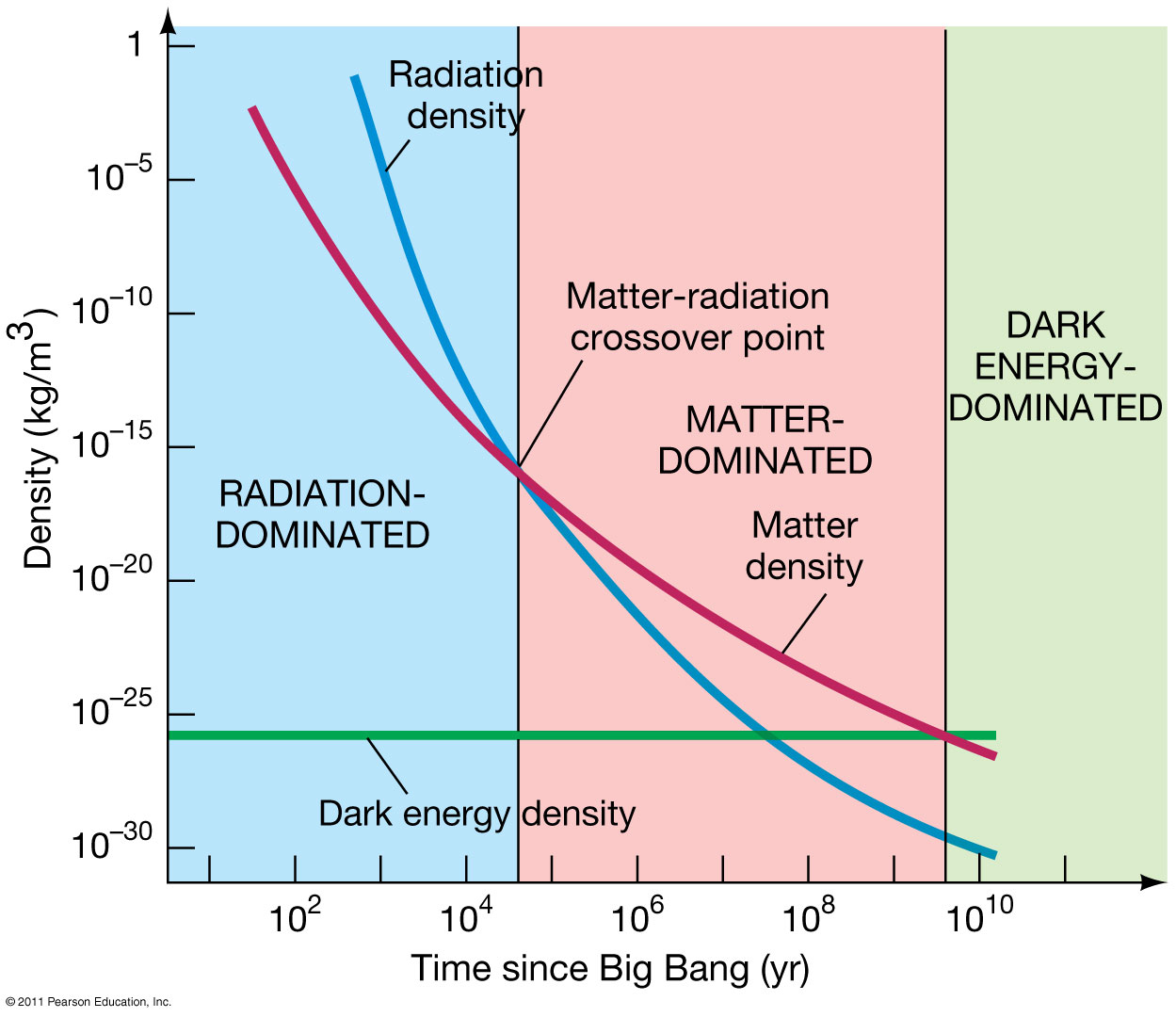
About 6 billion years ago the dark energy and total matter balanced and expansion was linear. It has been accelerating from that 'stop' ever since.
And no, I'd not be able to explain vacuum energy better than the sites you visit.
I hesitate to use quora since they've no mechanism to propagate better answers to the top. There is a lot of very wrong info on quora. I look things up on say physics stack exchange, but don't have an account there.Wayfarer's advise and post this as a question on quora.
That's pretty much my purpose in delving into the phyiscs. I want to know it well enough to glean the implications, but not so well that it's critical that I learn tex.I’m no authority on physics but I’m interested in the philosophical implications. — Wayfarer
Science is in the business of predicting what something does, and not so much declaring what something is.science does not know what energy is. — universeness
No so sure that is meaningful. For one, most kinds of energy are not conserved in a cosmological frame. In the absence of a net force, a moving rock will slow over time. Light energy drops as expansion stretches out its wavelength. But negative energy also tends towards zero, so you can't know if total energy is on the rise or not, or maybe is always zero.That the total energy is not zero. — Landoma1 -
Action at a distance is realized. Quantum computer.
They have a whole subforum for quantum interpretations, and yes, it's all philosophy in there. But they have standards for what constitutes an authoritative source, so say Everett's paper on Relative State Formulation is an authoritative source, but the wiki page on MWI is not. The latter is much easier to understand, and actually gets it reasonably correct.That's because physics forum gives short shrift to anything the classify as philosophy. I've posted there a bit. — Wayfarer
noAxioms

Start FollowingSend a Message
- Other sites we like
- Social media
- Terms of Service
- Sign In
- Created with PlushForums
- © 2026 The Philosophy Forum