
Comments
-
Israel killing civilians in Gaza and the West BankI think you are all overlooking how much this is just a feeback loop of the extremes. Hamas and Netanyahu should thank each other, they hold everyone else hostage.. They keep each other in power. But yet the general populations are complicit as well, because they too can't get out of the "security/revenge" cycle and so vote the extremes back in because of the very thing they started and perpetuated. Go deeper than the usual blame/victim performance you are all doing. — schopenhauer1
Bibi can thank Hamas for getting a boost in the upcoming elections. And religious extremists hold hostage the whole conflict on both sides. Of course we can ask why it is so, but we will not like the answers.
Let's look at this from a different perspective: How do people calm down and genuinely put things past and want peace?
How did Europeans stop being bellicose at each other? How doesn't Elsas-Lothringen be anymore the hot issue between France and Germany? Where did the nationalistic fervour go?
The answer is obvious: Because millions have died in two World Wars. After two World Wars enough Europeans have died and enough Europeans have thought that killing has to stop. In the Middle East, the death toll has been far lower. Palestinian deaths have not been genocidal. In the 1948 war the estimates are between 3 000 to 13 000 dead. In the first and second Intifada about 7 000 were killed and in later conflicts the numbers seem to be below 10 000. In 73 years Israel has lost in conflicts something like 23 000 soldiers and civilians dead. That is less that my country (which is roughly the same size in population to Israel) lost in 105 days when it fought the Winter War. With our Continuation War the death toll was far more deadly (over 60 000). In the Yugoslav Civil Wars the death toll was 130 000 to 140 000. Somehow nobody isn't wanting a rematch there, so I guess well over hundred thousand dying does silence the warmongers and those who demand "justice" and think they have the "moral right" for the land. In Palestine, this hasn't happened. Who controls the Temple Mount is extremely important for many. And it will be so in the future too. -
In praise of science.
That's the result when you teach only criticism. Before criticism, you have to learn what the actual idea is and how it explains issues. By only teaching criticism you make people negative and hopeless.Their diet has been one critical of the scientific view, the emphasis on negative consequences of scientific work. It was interesting to see their faces change as they realised there was some hope. — Banno
Science is just a tool.
— frank — counterpunch
No. It's not. And that's why Popper is wrong. — counterpunch
How about a method? -
Has this site gotten worse? (Poll)My feeling is that the tolerance towards posts and threads that aren't even close to having philosophical quality has increased. Which means the kind of evangelical religious stuff, racist apologist low-quality posts, ad hominems, and BS posts that destroys any quality focus on a specific topic just keeps going. When I first looked for a forum like this and found this forum, it felt like a place that got rid of the usual internet idiots and morons in favor of a better quality discussion for complex topics. But it feels like since my initial experience, the tolerance of idiots and morons has gone up and it's close to impossible to see a discussion that doesn't just let some rabid idiot go on a crusade.
If I were to recommend moderators to improve on one thing, it would be to clean up the place. There are far better places for evangelical nuts, racist apologists, and people who don't even know what philosophy is. 4Chan-like forums and Reddit threads dedicated to that kind of stuff, instead of clogging up this place.
— Christoffer
:100: YYYYYYYYYYES. This entire post bears repeating (and can't be repeated enough as far as I'm concerned). — 180 Proof
OK man, I'll repeat it.
But I think that the vast majority of the people here are influenced by the current environment, be it social, political or economic. And it will show. Especially with the topics that make people mad and bring on the ad hominem attacks towards your fellow PF members.
The fact is that few topics that aren't directly philosophical won't get much debate if it isn't something that the public discourse is debating about. We are not so special, unfortunately. -
Israel killing civilians in Gaza and the West Bank
Has Israel proclaimed exactly where it's borders are? I'm not so sure it has.If I were to take a step back and view Israel as just another state I could say that Israel is using Gaza and the WB as a bargaining chips. — BitconnectCarlos
One basic problem is that Palestinians (and for that matter Lebanon) are so weak it's not sure they can uphold peace like the Jordanian and Egyptian army for the time being. Some one can of course argue that this is the intent of Israel.
Because it says to be a modern democratic country and hence should be treated with the same bar as other ones as let's say as the UK?I don't understand why so many westerners care so much about Israel and seemingly hold it to the highest moral benchmark. — BitconnectCarlos -
Has this site gotten worse? (Poll)On the other hand, any forecast of price development of something like Bitcoin is on shaky grounds
-
Has this site gotten worse? (Poll)
But notice the longer term discussion activity compared to Bitcoin price movement.It topped (unless it makes a miraculous recovery) just about at the most recent post there a month ago. — Baden
The thread was active three years ago in December 2017 - January 2018, where we got basically the first 9 pages. Then, uh, I waked the thread up a year later...which just brought few comments and didn't spark much interest. But then the thread started in earnest on page 9 again for the last three pages from six months ago until a month ago. Now compare how this "active interest time" of this thread compares to when bitcoin has had a vertical rise, then a sharp fall yet coming down to a lower level that luckily is higher than the "bubble started".
OK, I admit the statistics aren't there yet, but I'll say that the thread is a genuine "canary in the coal mine" -indicator as it didn't "sound the alarm" in the summer of 2019 when prices were going up. Now if the thread stays silent, will Bitcoin consolidate on a lower level (yet higher than before the last uptick)? :razz: -
Who owns the land?
It has the word 'social' in it? :snicker:That property is a social convention does not obviously render it amoral. You'll need more argument here. — Banno -
Has this site gotten worse? (Poll)As I was saying, I don't get the antinatalism threads...
-
The tragedy of the commons
In a functioning democracy, those that only assume to represent the people's interests will have the disastrous surprise defeat in the elections. And those can be also on the right. One might think this might improve things, but many times it doesn't, especially if the winners are populists, again who can be either on the right or the left. Populists are great in portraying every problem of having emerged because of the evil corrupt rulers. And usually that's all they have, apart of being incapable of reaching any kind of consensus in the democratic process and not having actual solutions to the problems. If they are also authoritarians, what a great mess it will be.Have you never noticed how the right represent peoples interests whereas the left assume, the people exist to represent their interests? — counterpunch
But this is a bit off the subject.
I think this thread became current because of @Banno in another thread saying:
The tragedy of the commons is a capitalist myth. — Banno
I asked him why it's so. I might have not noticed his answer... -
Has this site gotten worse? (Poll)My perception is that the level of discourse on this site has declined. — hypericin
I think it has stayed the same with compared to the old Forum. And it hasn't died, that's for sure. (The old site had a strange death, you know. Odd story.)
The thing what I like is that when newbies ask the classical questions about math and logic, there are those who take the time to give good answers to them and try to educate people. And I really like the comments of people like @fishfry and @jorndoe and others in math & logic. One old member I think isn't around is Moeblee, who also commented in the math section of the old PF site. I've always been fascinated by the incompleteness results Gödel and Turing, and nice to see the topic has stayed popular. I think there's still something very important there for us to find out.
Of course then it's nice to discuss the current events with the gang. Usually what things are discussed, what especially create a heated debate, do actually tell something about how things in the World are going. Later some threads are nice to view in hindsight. A classic in these cases will be the coronavirus -thread, the long Donald Trump -thread, the brexit -thread and, one of my favorites, something you might not think to find in an Philosophy Forum, the cryptocurrency -thread. I'll definately buy bitcoin if that thread is not commented for six months. Active discussion on that thread means that bitcoin is topping (or at least, has been so).
What I don't get is the antinatalism threads... -
Israel killing civilians in Gaza and the West Bank
Aggressors are those who usually take territories.Aside from the territories, do you consider Israel the aggressor in the '67 war? I don't mean the one who took the offensive, I mean the one who is in the wrong. — BitconnectCarlos
I don't put so much emphasis on the moral rectitude or the moral justifications for wars. Those typically are just propaganda. And many warmongers talk about justice and to correct the wrongs of the past. The debate about if "a nation is morally just to take military action" is just one question. What kind of military strategy and tactics it uses is another topic, and so is what it's end objectives with the action are. All those are three different questions and even if to opt for a military solution can be understandable/acceptable, the strategy and tactics or the objectives can be quite unacceptable.
In fact, when the Arab neighbors attack the young state of Israel, nobody of them was at all interested in creating an independent Palestine, but to take as much of the former British mandate for themselves as possible. This lead to the fact that they were highly uncoordinated. Jordan annexed the West Bank and even if the annexation was granted by the UK, USA and Iraq, the Arab League for example only accepted that Jordan could annex the territory "until the Palestine case is fully solved in the interests of its inhabitants." Then of course this was annexed later by Israel in the Six Day war. -
Israel killing civilians in Gaza and the West BankI don't think that that position (the necessity argument above) is ultimately wise because I believe only lasting peace can secure safety and security. — Benkei
This is the disturbing issue: Netanyahu's policy is that there simply will be no peace, that the Palestinians and Arabs want only to destroy Israel and push them to the sea, hence giving up anything will makes things just worse. Perpetual war is the answer.
And think of it this way: Hamas just saved Bibi Netanyahu from a political mess he was in.
(AP) Now, as Israel and Gaza’s Hamas rulers wage their fourth war in just over a decade, Netanyahu’s fortunes have changed dramatically. His rivals’ prospects have crumbled, Netanyahu is back in his comfortable role as Mr. Security, and the country could soon be headed for yet another election campaign that would guarantee him at least several more months in office.
The stunning turn of events has raised questions about whether Netanyahu’s desperation to survive may have pushed the country into its current predicament. While opponents have stopped short of accusing him of hatching just such a conspiracy, they say the fact that these questions are being asked is disturbing enough. -
Israel killing civilians in Gaza and the West BankA real threat, considering the influence of Wahhabism there. — Benkei
Actually poor Arabia, if the corrupt Saudi family is ousted.
That Arabia is the enemy that the US craves for: place from where the majority of the 9/11 terrorists came from, birthplace of Wahhabbism and Osama bin Laden. -
Israel killing civilians in Gaza and the West Bank
Since Bitconnect doesn't understand that Israel starting a war ("Pre-empting", as they say) and annexing territory in 1967 from three of it's neighbors makes it an agressor, this debate won't go anywhere.You can't be an oppressor and then claim victimhood when the oppressed lash out. — Benkei -
Israel killing civilians in Gaza and the West Bank
And if there is a revolution in Saudi-Arabia and the Saudi prefix is dropped? What if Saudi-Arabia goes the way as former US allies like Iran and Pakistan? From friend and ally to an enemy or problematic partner? Just like with Egypt, there is a possibility for a potential conflict.Sure, but who does Saudi Arabia use these weapons against? Yemen. Besides being a crime of the very worst calibre in global affairs, Saudi Arabia is not going to use all those weapons against an enemy that can fight back to some degree. — Manuel
The place is still a powder keg. -
Israel killing civilians in Gaza and the West Bank
I'm not so sure that Israel wants to "empower" the Gulf States. Just having a same threat (Iran) does go only so far.To add to those, the U.S. shares close geopolitical goals with Israel, to empower the Gulf States — Saphsin
Let's remember that Saudi-Arabia was actually in war with Israel and did send a small contingent of troops to fight Israel in 1948 and also in 1973 and has been a huge financier of Israel's enemies in the past. Quite similar is the relationship with the other Gulf States. The normalization of relations just in the past Trump administration shows how strained the relations have been.
Co-operation of Israel with Saudi-Arabia (or Turkey) is more of an unholy alliance that neither side wants to officially acknowledge. Saudi-Arabia doesn't have diplomatic relations with Israel. But let's say like with Egypt and Jordan, Israel is at least in some terms with them and doesn't communicate with them only by either making military strikes or by refraining from using military force (like with Hamas, Hezbollah, etc.). -
Who owns the land?That's why we need to distinguish between legal and moral rights of ownership. — Apollodorus
Apollodorus, what do you think is the basis of either legal or moral rights? -
Who owns the land?Sure. But we don't need to agree with that. — Apollodorus
Hmm. I think you just made Banno's point about "property is owned with the agreement of those involved, and hence enforced in virtue of that agreement" and thus "There are no rules for determining ownership beyond that". :smile: -
Israel killing civilians in Gaza and the West Bank
If it would be just the military industry, then I guess the US would have done the same as France: switch sides to a more profitable arms export market. This actually has happened thanks to the Peace agreements. Let's not forget that France was the major arms supplier for Israel first and only later did it become to be the US. France helped Israel with it's nuclear weapon, not the US.Sure. But the real Israel lobby is the military industrial complex including the Pentagon. They have strategic interests in Israel, they can depend on it to do dirty business for the US, including eliminating secular Arab Nationalism as they did when they defeated Nasserism. — Manuel
And when those arms are partly paid by the US taxpayer, the reason has to be something different than just arms exports. There has to be the religious right, AIPAC, the "Judeo-Christian heritage" and all that in the end to make Israel enjoy such a position that it has.
The big bucks in arms exports are made in Saudi-Arabia:

-
Who owns the land?
She was Estonian. They are very smart people. Few, but smart.Ah, we bow before Counterpunch's ex- girlfriend! With such brilliantly expounded argumentation, how could he be wrong! — Banno
And why do think it's a myth? People do put their self interest ahead of a collective interest, where the costs are then is brought upon everybody later. But today is more important than next year. -
Israel killing civilians in Gaza and the West Bank
The actions how Israel defends itself and what it tries or doesn't try to solve the conflict is something surely be a topic to discuss and to be critical about. Any country should be under scrutiny if they have annexed territory with other people than themselves.Another way of saying, yet again, stay on topic, which concerns the proportionality of Israel's military response and whether the U.S. should support it. — Baden
The only time Israel anticipated such a move was when the Cold War ended. After the Soviet Union wasn't a threat, they correctly understood that Washington could perhaps look at whom it supports at a new light. This happened to South Africa: suddenly the US didn't need an ally to keep in check Marxist advance in Southern Africa and the Apartheid system became the real issue. Hence Israel took the initiative with the Oslo Peace process. Unluckily the Palestinians didn't understand that this was once in a lifetime opportunity.But pressure inside the US is changing rather quickly and sooner or later, this will have a strong reaction in Israel, because they will be isolated and won't be able to kill children like nothing and destroy press buildings. — Manuel
What the Israelis didn't then understand, but now have understood is that US supporting Israel isn't because of US Middle-Eastern foreign policy objectives, but because of highly powerful lobbyist groups as AIPAC and the Christian Evangelist movement, which the latter upholds supporting Israel as a religious duty. It hasn't anything to do with classical realpolitik: that's the crazy realpolitik here.
If people think that the new woke crowd can topple the religious right, well, good luck with that! I just assume that Americans will yell at each other and remain in separate tribes. Perhaps the military assistance will be smaller. Israel doesn't actually need it to be the dominant power in the region. -
Israel killing civilians in Gaza and the West Bank
Russia was also an agressor in WW2. It started wars. And yes, was once attacked with it's pants down, but did have plans to attack Germany (assuming that Germany would be weakened by fighting the Western allies, namely Britain then).Was the Soviet Union the aggressor after the pushing back the Germans on the Eastern front? Poland fell under their control. So did Berlin. Do we describe the USSR as the aggressor in this war? — BitconnectCarlos
Russia annexed a lot of territories from many countries during and after WW2. Some that it kept after agreeing to slice East Europe and the Baltics (and Finland) with Nazi Germany. So yes, not an innocent victim with only peaceful objectives in mind. Far from it.
German and Soviet troops having a nice time after another successful historical division of Poland in 1939. Brothers in arms then.
-
Israel killing civilians in Gaza and the West BankFurthermore to correct your errors.
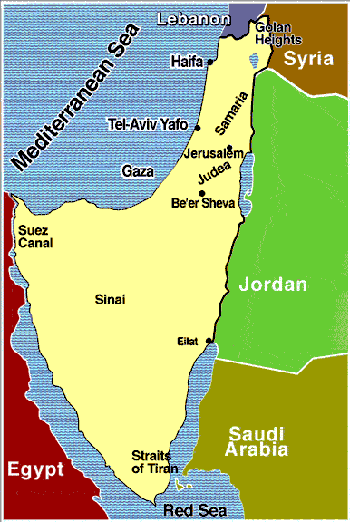
Gaza was under the control of Egypt. West Bank under Jordan. The Golan Heights part of Syria.
These areas were annexed by Israel.
When you annex territory, you simply can't deny being an aggressor. -
Israel killing civilians in Gaza and the West BankI don't believe the Gaza or WB are technically annexed; I've heard both referred to as 'self-governing' or 'disputed territories' but not part of Israel proper. — BitconnectCarlos
You were saying that in 1967 Israel wasn't the aggressor.
After the 1967 war the Israeli borders were like this:
-
Israel killing civilians in Gaza and the West BankAnd the Israelis then were the terrorists, at least for the British.
And if you continue the text you quoted:
Irgun and Lehi (the latter also known as the Stern Gang) followed their strategy of placing bombs in crowded markets and bus-stops.
Anyway, seems that it's abhorred that one could think of this conflict in any other way than one side being the innocent victim and the other the bloodthirsty perpetrator. Demands for justice usually start wars. What's so difficult in accepting that Israel carries on an apartheid state and has treated from start the Palestinians as second rate citizens and Hamas wants to kill all the Jews?
peaceful too. — Manuel
Peaceful too?
Anyway, off topic... -
Israel killing civilians in Gaza and the West Bank
Considering there aren't any hominin than us, Homo Sapiens, around, I wouldn't give any people a waiver in this case.If we go back far enough, everybody's an invader or colonialist of some kind. Maybe not the Aborigines in Australia. — Manuel
I bet if had the others been left alone (by us), there likely would be still other hominins around even today... -
Who owns the land?Is there any legal / moral framework that can be used to resolve these issues in an impartial manner? Or put differently - what are the rules for determining the rightful owner of said property? — EricH
In my view there are no rules.
States are considered Sovereigns.
There isn't actually an authority over them. Put an authority over them and they aren't independent and sovereign. That's what independence is about.
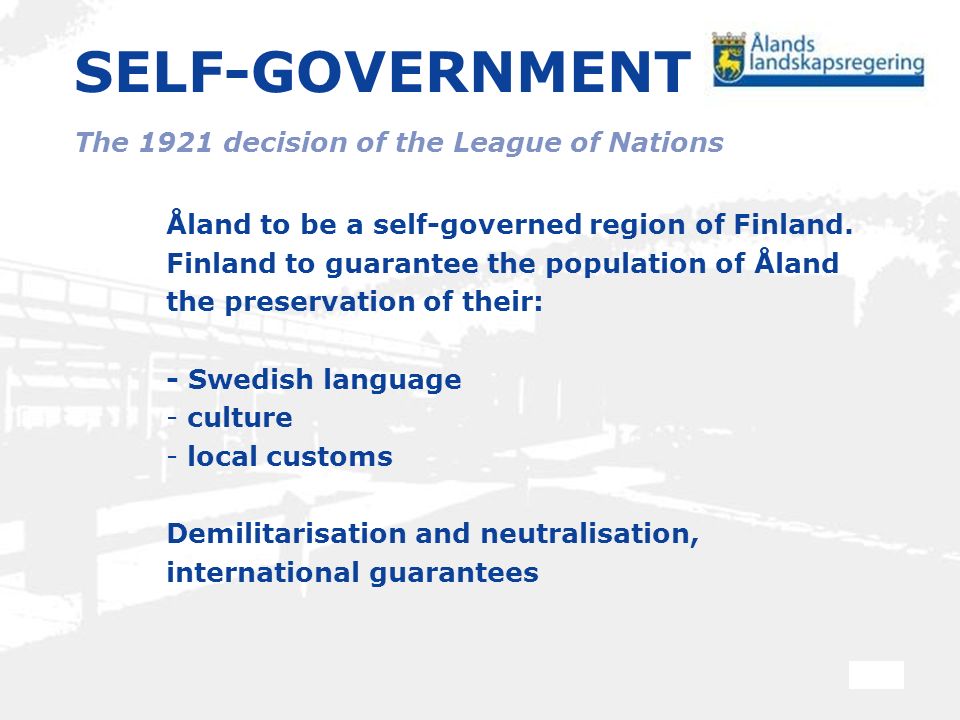
We might create a legal framework to solve such issues, and hopefully both sides can agree on the verdict given by it and don't have to go to war and spill blood over it. We can have a community of nations that can get a nation to accept an agreement. But countries can be very stubborn and when they are, either you leave them to be so or in the end fight them. Yet luckily even nation states can be reasonable as this. Good example is my nation with our neighbors the Swedes when it came to the Åland Islands. One of the successes of the League of Nations, actually
Swedish troops in the Åland Island in 1918:

Now the autonomic region on it's webpage:
-
Israel killing civilians in Gaza and the West Bank
What the...This is just a semantic issue. Yes, Israel went on the offensive but I wouldn't call Israel the aggressor (therefore they didn't aggress.) If A starts attacking B and B manages to gain the upper hand and subdues A, B is not the aggressor. A was the aggressor even despite B managing to come out on top. — BitconnectCarlos
So an attack that which ends up with annexations of lands from Jordan, Syria and Egypt isn't aggression?
By the end of the war, Israel had expelled another 300,000 Palestinians from their homes, including 130,000 who were displaced in 1948, and gained territory that was three and a half times its size.
With that logic I assume you think that Operation Barbarossa was just a pre-emptive attack, hence a defensive operation. And turned out to be one unsuccessful one in that. But Stalin was planning for a war! -
What is the Problem with Individualism?Wait, what? You mean even in failed states people tend toward clan and group? Who'd a thunk it? I don't think that is the flex you think it is. — James Riley
I think Somalia had it clan based society far before the civil war that made it what it is now. -
Scottish independenceWell, unlike the British, they indeed have accumulated that wealth because they have not spent it.
Yet in truth, the share of GDP of the oil sector isn't so huge compared to other oil producing countries....which tells something. Norway was already wealthy when it found oil and proved to use the revenues better than for example UK. Actually thanks to the fact that they asked a philosopher what to do with oil revenue.
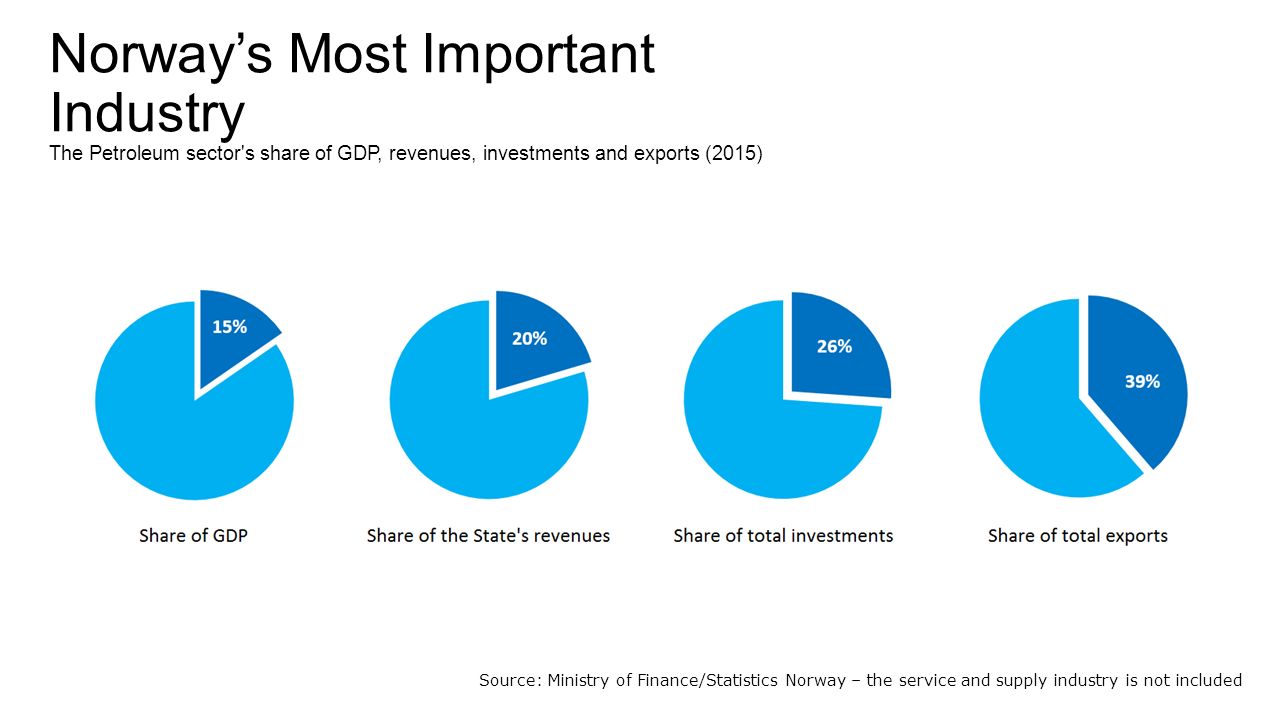
Now compare how well Venezuela has done with far more larger oil resources. -
What is the Problem with Individualism?How does the state of realized individualist freedom look in practice? — Echarmion
Somalia. — James Riley
Pretty old and idiotic argument nurtured by leftists.
Yet a tribal society like Somalia with clans and clan structure with hierarchical system of patrilineal descent groups being so important has hardly anything common with individualism (or libertarianism/liberalism). Nonexistent or non-functioning states aren't so rare.
But ignorance make the memes work:
And of course, the part of the economy that works even with the problems hardly makes it to the news. -
Israel killing civilians in Gaza and the West Bank3. Israelis did not aggress in '67. — BitconnectCarlos
?
Think you are mixing the Six Day War with Yom Kippur war here. Or something. -
Scottish independenceHowever, these predictions did not come to pass. - In summary, as the SNP made the mistake in 2014 (according to the chairman of the SNP's own growth commission) of planning to base Scotland's economy on North Sea revenues — RussellA
Comes to mind the Scottish idea of getting a fabulous colony in the Mosquito Coast, which would raise vast riches to the country with the Darien scheme in the late 17th Century.
There is something similar with the idea of this external income source ...and not simply having the Scots pay taxes.
In truth, natural resources give far less income than something manufactured with skill and technology. -
Israel killing civilians in Gaza and the West BankI believe Hezbollah may still receive support from Iran, but I doubt Hezbollah would get involved in this matter now. — Manuel
Well, they already have shown they are awake here.
(Times of Israel, Friday 14th May, 2021) Three missiles were fired at Israel from Syria Friday evening, hours after the Lebanese Hezbollah terror group said one of its members was killed by Israeli fire during a donnybrook on the border.
(To give an context for this, during the 2006 war Hezbollah was firing over 200 rockets at Israel in a day.) -
Israel killing civilians in Gaza and the West Bank
"World opinion" is so vague that it hardly matters.But no, I doubt Hamas has world opinion in mind. — Manuel
They do get assistance and funding from the outside and although this conflict likely increases the assistance, naturally the expenses are spiralling in such a conflict too.
Yet Hamas isn't funded by Iran anymore, I think. -
Al-Aksa Mosque, Temple Mount, and the restoration of peace to the Middle EastYour plan involves a lot of loading, unloading, shipping, and dumping debris into the Marianas Trench. Too much trouble. It would be easier to just nuke the Temple Mount, then everyone everywhere could share its alleged holiness. And while we're at it, might as well get rid of several other centers of superstition and nonsense. Everyone can make up their own lists--but let's keep to under 10 nukes in all. — Bitter Crank
Oh but that wouldn't create the jobs that this kind of a huge operation would take. And using nukes creates a cloud of radiation that at worst could be blown by the wind to Europe. Greta wouldn't be happy.
Besides, once the wailing wall and Al-Aqsa mosque are on the bottom of the Marianas trench, James Cameron could direct an interesting film about "The Secrets of the Marianas trench -The Temple Mount". He likely would get easily finance from the religious fanatics.
There's already plastic bags at bottom of the Marianas trench, so religious rocks can easily fit there too as humanity has already trashed that serene place on Earth.


-
Scottish independenceFear of going it alone as a minnow. What currency would they use? They want to keep the £, but Westminster will not be so amenable. Sanctuary should be found within the Euro, but post-Brexit it's a longer and uncertain road to get into the EU. And I think many Scots aren't ready for the loss of Queen's-head-on-the-coins Britishness. — Tim3003
This is the thing I didn't understand when listening to the pro-Independence narrative: this so-called "independence-light". They were saying that it wouldn't be a change as if they could pick the positive aspects of independence, but refrain losing positive aspects of the union. It really raises question how much actually the Scots want to be independent. After all, the world didn't end in the UK after Brexit happened.
I assume that the Queen could stay to be head of Independent Scotland. As Alex Salmond has said years ago, the union of the crowns predates the union of the parliaments which he wishes to end. I assume this view hasn't changed with Nicola being at the helm. Canada and Australia are independent countries from the UK, so why couldn't Scotland have the monarch they have had? The royal family loves to be in Scotland. So it would be just basically a personal union. So she (the queen) could easily continue even on Scottish money, if the Scots wouldn't want to go with the euro. -
Scottish independenceWhy has Scotland remained in the union?
Is the question that simply too many English have moved to Scotland and openly displayed anti-English sentiment has made them firm supporters of the union?
(Yeah, that's what is lacking here from a typical European dispute: blaming ethnic minorities.)
Or are the pro-Independence people simply too annoying? -
Israel killing civilians in Gaza and the West Bank
More like the is US an ally of Israel and Israel decides what to do. You see, client states get orders from their masters and here that isn't happening. For the US relations with Israel is above all a domestic policy.Israel is a client state of the US. Nothing they do happens without the latter's backing. The game to be played is a long one. — StreetlightX
And this isn't because only of AIPAC, it's because Christian evangelists back wholeheartedly Israel, hence the US doesn't treat Israel as a normal country. The whole situation has become to this as everybody panders to religious zealots.
ssu

Start FollowingSend a Message
- Other sites we like
- Social media
- Terms of Service
- Sign In
- Created with PlushForums
- © 2026 The Philosophy Forum