
Comments
-
Donald Trump (All General Trump Conversations Here)Trump and one of his heights during his presidency. Netanyahu giving a speech at the celebrations of a new settlement in the Golan Heights:

No better friend for Israel. -
Is there something like progress in the philosophical debate?
One way to think about it:Does modern philosophy still make valuable contributions that create new knowledge, or are contemporary philosophers just busy analyzing existing knowledge? — Matias
Did any philosopher contribute anything new to philosophy in the 19th Century? Was there anyone then that made us think about issues in a new way. Do we refer to any 19th Century philosopher when talking about philosophy or should we more accurately only refer to philosophers before 19th Century, who had the original ideas?
Did any philosopher contribute anything new to philosophy in the 20th Century? Was there anyone then that made us think about issues in a new way. Do we refer to any 20th Century philosopher when talking about philosophy or should we more accurately only refer to philosophers before 20th Century, who had the original ideas?
If you answer "yes" to both 19th and 20th Century philosophy, why would you think nothing would happen in the field in the 21st Century? -
What is "cultural appropriation" ?
Well, in order to move on, here's the outrageous she had to apologize for. No, it wasn't a comedy skit, but a dance act she was training for (and a picture from not even the actual show act):Miss Finland was wearing it in a comical context? (Just curious--was she in a comedy movie, a comedy skit show, something like that?) — Terrapin Station
Cultural appropriation scandal (among many):

Luckily the outfit wasn't worn in the actual competition.
And of course, some non-Sami have thought wearing the costume would even be a show of respect to the Sami or to show that one is from Lapland, but in our times of cultural appropriation, not so. Hence hopefully such pictures as these youngsters dressing like this in Northern Finland (likely celebrating end of school) is an issue of the past:
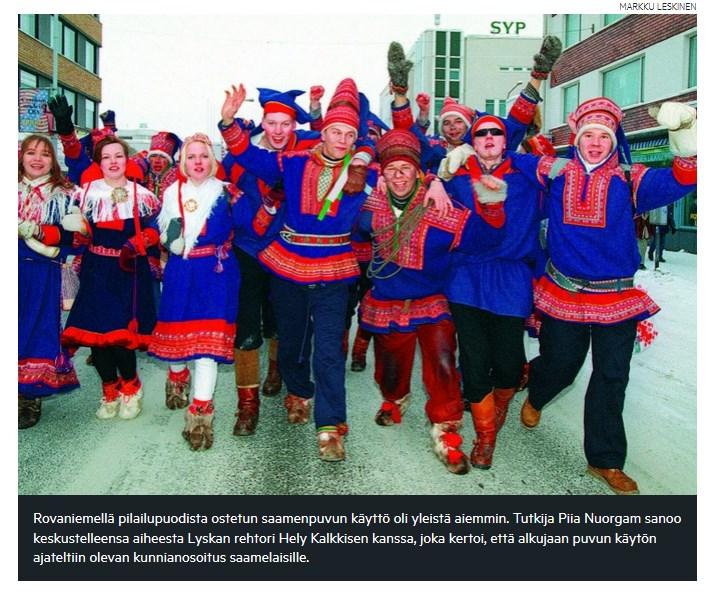
Another cultural appropriation scandal, this time when an alpine-skier athlete from Northern Finland decided to wear similarly a Sami look-a-like costume at her last skiing competition. She was from Rovaniemi, Lapland. This is the way the activists referred to this:

She apologized too.
But what is evident, if you listen to the vocal activists, is that the discourse is directly copied 100% from English speaking World, because this is the narrative that woke people use and they can relate to it easily. Hence they talk about colonization. Even with the referral to Finns being the 'white majority'. It works, you know.
Would this copying below be cultural appropriation itself, I don't know, likely not.

Anyway, enough of Sami dresses. -
What is "cultural appropriation" ?
I wouldn't refer to 'they' here to the Sami in general, as I think majority don't care about if someone else uses their traditional dress or a cheap copy of it.Just curious what the heck their argument would be for that. — Terrapin Station
How do these things get to be debated? The media has to invent things to be scandals. This time the outcry was such a typical media event (as usual these things are): miss Finland wore a cheap costume bought from a masquerade-shop that looked like a Sami outfit. Media people were outraged. Oh, was she really, really sorry about it. And what ensued later was a debate about 'cultural appropriation'. It's only few 'woke' people who basically want to be in the media and have no problem of being a spokesperson for an indigenous people. Or in this case, a Sami artisan that makes herself the dresses who made the argument that nobody else than the Sami ought to use the costumes.
The basic argument is the typical one. That the dress/costume is important for their cultural identity and since how it looks is based on your family ties (hence when you marry you can change your costume to the new family's one), the details are important. Yet it's being used as a comical outfit and the culture is deprecated and not respected with improper use of the costume. Typically with bad "Made in China" copies of the costume.
I think you got the hang of it, but I'd say it's this lazyness of how the 'woke' journalists takes the a controversial media debate from the US and then tries to make a similar "controversy" in the domestic scene. So when the debate in the US has been about 'cultural appropriation', doesn't take long for the similar discussion to 'erupt' here too. That it never has been a problem before tells something.So, an interesting example, but I'm unsure of the target of your critique. — Baden -
What is "cultural appropriation" ?
Yes, but apparently it isn't limited to that anymore. I just love it when these blossoms of American Leftist-culture are copy pasted in the exact same form to everywhere around the Globe. Hence you can find the same discussion everywhere.the term as originally introduced (in the 70s) in its anti-colonialist sense has value — Baden
So "Cultural Appropriation", that you earlier told more directly to be " the real damage to people and their way of life that can potentially be done by stupidly fucking with stuff that is very serious to them" is indeed used in different context. It's not about Americans getting upset about some other people taking in American mainstream culture (and doing stupidly fucking stuff with it), but namely that the culture of indigenous people or minorities is copied by the majority (or typically, by whites).
This discourse has popped up also in my country.
Yes, also we have the only indigenous people found in the EU, the Sami, and there has been also the discussion of cultural appropriation of Sami culture in this country. The argument has been around the wearing of the Sami traditional costume. And some in the Sami community (and others people supporting them) have argued that only Sami ought to use the costume. As the dress (or crude versions of something like it) is one typical thing tourists can buy as a souvenir when visiting Lapland, a brew for a heated debate is ready.
A Sami mother with her children in traditional dress, the gakti:

Of course the American discussion simply assumes with indigenous people same kind of situation as with the native Americans in the US: a traumatic history of persecution (equivalent to genocide), segregation, a huge racial wealth gap and strained relations between various people continuing to this day. A divide between natives and the colonizers. If copy pasted to the Sami and the Finns, it becomes quite funny, actually. In Finland Finns and Sami have lived beside each other for thousands of years. If there has been open hostility between the two, it happened in Antiquity/Bronze Age and has left no historical traces (other than the Sami live nowdays in the North). There is no wealth gap between the Sami people and Finns living in Lapland. There is absolutely no racial difference between them: the Sami are just as blonde and blue eyed as Finns are and according to the American insistence of putting people into separated racial groups, they (the Sami) would be considered white. This upsets the whole racism and intersectionality viewpoint of this debate, because the only ones that would be fond of "a white nomadic people" likely would be some loonie white-supremacists!
And as there hasn't been any kind of segregation between Finnish and Sami people, it means that the Sami actually have a huge row about just who can say he or she is Sami. How it is established that someone is or isn't Sami is a major problem. This makes even the estimates of Sami to differ from 50 000 to 100 000 people (here in Finland the estimates are that there are 6 000 to 9 000). The question has significance more than just who ought to have the right to wear the dress, it is a question of who can vote in the Sami parliament. The general Nordic model would give voting rights to any person that has learnt as mother tongue (first language) Sami or who's one or both parents, grandparents or great grandparents would have learnt it. The present Sami parliament (here) opposes this adamantly and wants a a far more stricter definition to being Sami. If the Sami get priviledges, thanks to them being an indigenous people, this creates some bitterness among the Finns living in Lapland, especial those that are in reindeer herding business too. And as there is no "Wounded knee" incident, not even the infamous eugenics programs that Swedes had against the Sami, hence there simply isn't the fuel of shame of past treatment that woke people surely would use in the issue. The only issue I know is that the Sami language wasn't taught at schools before 1992 (which could be argued by some as persecution), yet one has to understand that this is about this really is a small minority: there are far larger minorities in Finland (like the Roma or Russians) that don't have minority language status like the Sami (which they got earlier here than in Sweden).
But who cares about the small details when you can have a debate like "in the Big World" about cultural appropriation! -
The leap from socialism to communism.we have an example here of a country, within which there are free and fair elections, i.e. democratic contra authoritative, and the government owns the majority of the wealth and controls several key companies which are vital to the economy. This certainly seems to me like a step in the direction of a workable socialism. — Maw
So what you are basically arguing is that state capitalism is a step into socialism: countries investing their revenue into the stock market (of other countries) is socialism, which sounds very funny. But I guess you look at megacorporations like BP or Equinor (former Statoil) and see wonderful examples of steps towards socialism...
Because that wealth that you are talking about, the Norwegian 1 trillion dollar wealth fund (Government Pension Fund Global), which was last year worth about $195,000 per every Norwegian citizen (which explains the stats you desperately cling on to as evidence of a step towards socialism), invests in the global stock market and hence just embraces the globalized capitalist system. The fund doesn't at all invest in Norwegian companies as the Norwegians understand the negative consequences such move could have (which truly would be genuinely a way to socialism...and also a path to inefficiency and possible corruption).
Basically a step to the right from traditional socialism, I'd say.The Nordic system, along with worker cooperatives, etc. etc. being a step in the right direction. — Maw
What you are totally missing (and likely won't even bother think about) is that the system isn't at all "a step in the right" direction. Having government owned companies simply doesn't change the capitalist system. It's not a precursor to socialism. Especially when these arrangements have been done in unison with the right wing parties: for example Statoil was formed by a unanimous act passed by the Storting, the Norwegian parliament. What is crucial to notice that these kind of acts by the government don't attack capitalism and do not try to change the model to socialism.
That Equinor (the state oil company of Norway) competes in other markets than just on Norwegian territory show the efficiency and the market driven mentality and the success of the company. The dismal performance for example of the Venezuelan PDVSA shows how socialism wrecks things (even if the company wasn't performing well either when the country was run by a right-wing administration). The whole narrative of "curse of oil" is actually about the perils of nationalization of a lucrative industry (which doesn't ask much if anything from the labour force in the country).
And do you live in the Nordic countries? I do. Referring to your "workers" cooperatives, the most successful cooperatives here are simply consumer owned cooperatives that are managed totally like modern corporations. They have just the exception to other corporations that the "member card"-program is simply an "owner"-card program. In Finland we have cooperatives that simply dominate the retail market and have pushed out the "Mom and Pop "-stores out. Cooperatives that did fail here were those owned by Finnish Communist Party as they simply weren't well lead well, which just show how lousy true communists are at capitalism (or managing anything). -
The leap from socialism to communism.
That is your argument for socialism? I don't know if I should laugh or be genuinely happy, perhaps I'll do both.Excluding wealth from home-ownership, Norway's government owns over 70% of the nation's entire wealth, which is notably more than the percentage of wealth in China that's owned by it's government. The state owns over 70 companies, including the largest financial company, telecom company, and oil company. That sounds like a successful and workable socialized ownership of capital to me. Additionally, other models that socialize capital such as worker co-operatives are successful alternatives to traditional company models. — Maw
Norway is a capitalist country. No way around it. None. You could argue that it's a mixed economy, I could agree with that. But just think WHY Norway's government owns over 70% of the nation's entire wealth. There's a simple reason for that.
It's that they not only had nationalized their oil wealth like many oil producing countries have done, but (unlike the UK with the North Sea oil revenue) didn't use the oil income to finance government spending. What they made was an enormous Sovereign Wealth Fund and used only the interest from the fund to finance the Welfare State, and this is the reason WHY the government wealth is so high in Norway. So your prime example of large government owned wealth is because of a 1 trillion dollar wealth fund investing in over 9 200 companies globally just tells the state where socialism is now. In denial. Because these kind of schemes are quite ordinary in Nordic countries, which aren't socialist. As if we mean by socialism the thing it used to mean in the 20th Century, not that it's just a derogatory word for some and something that differs from the present US for others.
But as a Cuban card carrying communist said to me in 1989, the objective of socialism in Cuba is to become a Sweden.
And Sweden of course, is still a capitalist country. -
The Ionan School and the Inception of ScienceYour question is like "How did Mathematics start?"
The first idea would be to say that it started with the need to count things. Yet if a smart animal can count to four, meaning that it's math system is comprised of "nothing, 1,2,3,4, a lot", is that truly mathematics? If it is, then math isn't just our thing and if it isn't, then where do you draw the line?
Same can be asked of science. Now to answer that basically it was the Milesian school is just part of the narrative of how Western science evolved as obviously there would be the "shoulders of giants" that the Milesians stood on too. Yet the idea that a) lets look at reality without religion and b) let's assume there are laws in nature are simply part of what I would call "Let's look at the World realistically".
And I'd say science evolved basically from a necessity, like mathematics. You simply cannot have people just by accident noticing stuff and applying it before the Milesian school. -
The leap from socialism to communism.
Well, jackals and jackasses aren't great as leaders in ANY society no matter who owns the capital.I would say "It is better to be live in a well run capitalist economy than in a socialist economy run by jackasses. Similarly, "It might be better to try socialism than put up with a ruinous capitalist system run by jackals, even if socialism has not been proven to work." — Bitter Crank
The Social Democrats, the Ex-Communists (the Leftist Alliance), the Green Party and the Centrist Party are making a bold new effort here in my country now. The conservative Party is in the Opposition after being 12 years in power.The fact is, capitalism is not proving itself compatible with a liveable future. The oil companies (capitalists all) clearly plan to suck up the last profitable drop of oil and burn it. By the time they get done doing this, a liveable future will likely be impossible. Unfortunately, it doesn't seem like our democratic institutions are going to be able to control the economic powers.
I'm not sure there will be any sort of socialist revolution. But I'm pretty sure capitalism is offering a no-win future. Socialism seems worth a try. — Bitter Crank
But if there's democracy, there's a safety valve called elections, so I'm not afraid of what is to come. Try as hard as they want. (And the new administration already backtracked from the most extreme left-wing ideas... :up: ) -
The leap from socialism to communism.
As Slavoj Zizek has said, Marx many time said that history/events can go the other direction he envisioned them going... and that typically was the way how things went.So, I may have been using the terms too broadly. I still feel as though the logic is sound in the OP, according to Marxist economics. — Wallows
Like (if I remember my Marx correctly) that the Proletariat can choose just to want higher pay and not opt for a revolution and communism. Which actually is a smart observation. -
The leap from socialism to communism.Where was it tried? — Valentinus
Where has socialism been tried? Let's see...
Russia, China, Poland, East Germany, Czechoslovakia, Hungary, Romania, Bulgaria, Yugoslavia, Albania, Cuba, Cambodia, North-Vietnam (Vietnam), Mozambique, Angola, Laos, Afghanistan, Benin, People's Republic of Congo, Ethiopia, North Korea, Mongolia, Somalia, South Yemen, Nicaragua, Syria, Libya, Algeria, Sudan.
Among others.
And then there has been the socialist revolutions, uprisings and proxy states not being very successfull either:
The Paris Commune (18 March–28 May 1871)
Strandzha Commune (18 August–8 September 1903)
Soviet Republic of Soldiers and Fortress-Builders of Naissaar (December 1917–26 February 1918)
Finnish Socialist Workers' Republic (28 January–29 April 1918)
Odessa Soviet Republic (31 January–13 March 1918)
Donetsk–Krivoy Rog Soviet Republic (12 February–May 1918)
Alsace Soviet Republic (9–22 November 1918)
Free Socialist Republic of Germany (9 November 1918 – 11 August 1919)
Commune of the Working People of Estonia (29 November 1918 – 5 June 1919)
Saxony Soviet (November 1918–14 March 1919)[52]
Latvian Socialist Soviet Republic (17 December 1918 – 13 January 1920)
Free Territory (1918–1921)
Lithuanian–Byelorussian Soviet Socialist Republic (27 February–25 August 1919)
Hungarian Soviet Republic (21 March–6 August 1919)
Mughan Soviet Republic (March–June 1919)
Bavarian Council Republic (6 April–3 May 1919)
Limerick Soviet (15–27 April 1919)
Crimean Socialist Soviet Republic (28 April–26 June 1919)
Bessarabian Soviet Socialist Republic (May–September 1919; 15–18 September 1924)
Slovak Soviet Republic (16 June–7 July 1919)
Persian Socialist Soviet Republic (9 June 1920–September 1921)
Galician Soviet Socialist Republic (8 July–21 September 1920)
Hunan Soviet (9 September 1927–October 1927; succeed by Jiangxi–Fujian Soviet and then Chinese Soviet Republic)
Guangzhou Commune (Guangzhou Soviet) (11 December 1927 – 13 December 1927)
Shinmin Prefecture (1929–1932)
Nghệ-Tĩnh Soviet (1930–1931)
Chinese Soviet Republic (7 November 1931 – 22 September 1937)
Socialist Republic of Chile (4 June–2 October 1932)
People's Revolutionary Government of the Republic of China (22 November 1933 – 13 January 1934)
Asturian Socialist Republic (October 5–18, 1934)
Anarchist Aragon (21 July 1936 – 1939)
Revolutionary Catalonia (21 July 1936 – 1939)
Finland Finnish Democratic Republic (December 1939–March 1940)
Political Committee of National Liberation of Greece (10 March 1944 – 28 August 1949)
Second East Turkestan Republic (12 November 1944 – 20 December 1949)
People's Republic of Korea (6 September 1945–February 1946)
Azerbaijan People's Government (November 1945–December 1946)
Republic of Mahabad (22 January–15 December 1946)
Provisional People's Committee for North Korea (February 1946–9 September 1948)
Marquetalia Republic (1948–1958)
Provisional Revolutionary Government of the Republic of South Vietnam (8 June 1969 – 2 June 1976)
National Revolutionary Council of Gambia (30 July 1981 – 5 August 1981)
Democratic Republic of Yemen (21 May–7 July 1994)
BUT OF COURSE... nobody from any of these countries or these revolutions etc. GOT IT RIGHT! :razz: -
Is a major conflict imminent in the Middle East?The problem with these threads is that there is always one dominant narrative used:
"Neocons are trying everything, including false flag operations to get the US to war because the military-industrial complex wants a war."
And.... that's basically it. Nothing else. And nothing else than what is decided in Washington is important. No other actors seem even to exist on the scene. Every other country is just either an innocent target of US aggression, an innocent bystander or a lackey of the US without any own agenda. And here it would be extremely important to discuss the agenda of Israel and Saudi Arabia. People might know philosophy in this forum, but their knowledge of Clausewitz might not be on such level. Above all, the idea seems to be that it's either peace or the all out war and nothing else in between. Yet there is a multitude of options not only the US can do, but also a multitude of other players that can have different responses also. It's basically international politics.
So is war imminent? Look at the following photo:

It is a picture of AMERICAN SAILORS surrendering to the Iranian Revolutionary Guard. 10 sailors were detained and later released by Iran. This happened in 2016 and... no war happened. What the incident did was that it got some US Navy officers fired, but no cruise missiles were fired against Iran. The debate about if the US will attack Iran, which is just a lousy option by any standards, typically doesn't really take at all into account how actually the US has handled Iran for a long time.
And this should be noticed when discussing these issues just by "are we going to war or not". The US has had incidents with Iran, yet typically the US will launch attacks only at far weaker countries. With stronger opponents the issue is about the scale of the response where the only response isn't to attack Iran.
So I'm not convinced that there is a major conflict imminent. There's a lot can happen, a small military incident is more imminent that a major conflict, but typically the "nearly WW3"-option is that people get excited about.
Besides, the US never, ever has any kind of desire to have strategic surprise on it's side. It will declare it's intentions publicly because the most it's worried is how the US voters take the issue. And they have to be put into a warmode. Israel, on the contrary, seeks to gain strategic surprise. Hence if Netanyahu is aggressively vocal, it likely means that at least Israel won't attack any of it's neighbours. -
The leap from socialism to communism.
Socialism didn't work anywhere where it was tried, so hopefully nobody is trying to leap back to that misery.However, I don't believe we will ever be able to make the leap from socialism to communism. — Wallows
No.Here's why... Socialism is the golden mean between the benefits of progress and prosperity that competition entails under capitalism, whilst preserving the benefits of the proto-communist state through high taxation and redistributive policies. — Wallows
Your confusing a mixed economy to socialism. If you keep capitalism and add a welfare state to it, that's not socialism. Mixed economy is a form of capitalism where most industries are privately owned with only a small number of public utilities and essential services under public ownership and the government has a larger role than otherwise in the economy. Typically there is a welfare state.
If you have a functioning democracy, it's likely that however dominant socialists (or basically social democrats) would be, the opposition will be heard and the policies will be basically a compromise. What this means is that the economy will likely stay capitalist thanks to (private ownership), even if the government has a lot to say and decides to nationalize some industries. -
Is it wrong to joke about everything?
It's a subtle thing, actually. Yet the first step to get one segment of people to harm another segment is to dehumanize the other people. Dehumanizing the enemy in war works, you know. And one way to do that is to tell derogatory jokes. Jokes are a great way to get people to talk about others in a derogatory way.It's wrong to joke about everything if it harms people.
I can't see how it could harm anyone. Because the harm in joking seems to come through the way you joke about it rather than what you joke about. — luckswallowsall
But then again, all this of course can be taken out of context also and a quite innocent joke can be attacked with having a veiled sinister agenda. Especially today.
. -
What is Freedom to You?
Well, we do have our own country....or perhaps a Finn? — Theologian
Even if the majority of Finns know that they are or at least have been a totally expendable nation, meaning that nobody actually would have cared a rat's ass if about 4 million Finns had been killed or had been deported to Siberia, many Finns today can forget the past and take it as a given that they do have an own country and a government that has it's positions filled with their own people who speak their own language. A Kurd or a Palestinian simply cannot do that as it's evident that they aren't in charge of the land they live in. But they do have a possibility to have an independent country (especially the Palestinians). Yet for instance the Ainu people in Japan can only deam about having their own country.
Yep. Freedom can be discussed from the viewpoint of the individual or from the viewpoint of the collective.I guess your answer and mine to the OP deal with completely different issues. — Theologian
In a democracy / justice state, yes....although perhaps the point I made regarding individuals in a society also applies to your point as well? — Theologian -
Is it wrong to joke about everything?I think you can make jokes about any topic, yet the way you make it and just how you make it is important. Something that is just veiled as a joke might not be proper at all.
It's like the difference between a cartoon and a travesty. One picture is intended to be funny and actually can be respectful (and getting angry about it just shows the person has no humour) while the other picture can simply describe vitriolic hatred. And the latter doesn't have to be at all funny, which can be quite intended. -
Is a major conflict imminent in the Middle East?Anyway, if a second aircraft carrier sailed to the region, then I would worry a bit.
-
Is a major conflict imminent in the Middle East?
What's so sad about?If John Bolton gets his way, yes. It's sad that Trump spoke so insightfully in 2016 against the endless, mindless semi-covert wars, and has now put neocon maniacs Bolton and Pompeo in charge of foreign policy. — fishfry
Trump doesn't care a shit about anything else but himself.
For Trump to talk about endless wars was as hollow as his talk about fighting corruption, draining the swamp, was exactly just 'campaign talk', just something you say to get votes. Or do you really think someone wanting to build an even better military would really think about the endless wars? Heck, the guy was for attacking Libya. You had to be a idiot to believe this guy. So that makes a lot of people umm... well, you know. -
What is Freedom to You?
In a newly emerged nation the largest freedom is the freedom from the old nation that had people under it's control and had lost the legitimacy to it's power among the people. Typically this has been another people who either had been or had evolved into being foreign entity. This usually creates a very different atmosphere in the nation than in other more established countries where their Independence struggle is just a course in history, not something that happened just year ago or so. Hence newly formed countries look as to be very patriotic/nationalistic (well, they have to be actually) as they are still pouring the foundations of a new nation. The legitimacy of the state has to be earned, you know. Hence just what about in freedom is important changes through time.Hypothetically, if you were to create or live in a new nation, what would you expect to be your basic freedoms? What would you expect to be obligated to do? What would you expect not to be able to do? — TogetherTurtle
Perhaps you have to be a Kurd or a Palestinian to understand just what it means not to have one's own nation state today, because today we take it as granted as our credit card working when shopping online. Of course there are many various people's that don't even have any dreams of an own independent nation and these people are really just fade away to being the another people as the last members knowing the language die of old age.
One modern nation state and just how many languages/dialects were spoken before:
The freedoms of an individual is a totally different issue than a freedom of a people. So when you ask above about "if you were to create or live in a new nation", that kind of freedom is actually bit different from the question 'how much the government intrudes into my personal life?' The latter question is especially close to the American heart.Essentially, I believe that "freedom" is more of a scale, in which one side is the ability to do anything at any time without consequences, and the other is not being able to do anything at all times. I don't think that there is any kind of right answer, I just wish to see where the happy medium is for most people. — TogetherTurtle -
The Blind Spot of Science and the Neglect of Lived Experience
And why cannot we just accept that we don't know consciousness just as we don't know dark matter etc?On the other hand, those who reject physicalism will point to consciousness as if it is well enough understood to demonstrate that it cannot be explain in physical terms. — Fooloso4
As you said above, this doesn't go through at all.That we might be thought of as "heaps of particles that blindly follow physical laws while having the illusion of choice" just shows one way of thinking that obviously does not tell the whole story of human, or even animal, beings. Contemporary science is not so reductive as this outmoded Newtonian vision; but that seems to be taking longer to sink in with some of those who like to call themselves philosophers than it should. By reacting against this reductionist model you are actually perpetuating it, because you see only the "either/or" of (necessarily reductively materialist) science versus some kind of idealism. A painfully facile approach! — Janus
A true blind spot. -
What should be considered alive?
Well, if all in a group of humans are infertile, then that group won't be here for long. -
Is positivism still popular?Let's say that positivism is such an old idea that it's not something that scientists get hyped up. They wouldn't form a positivists-circle at your nearby Ivy-League University.
In fact it can be used as a derogatory word: one history professors said about one historian excelling in "creating source-positivist crap". (Source positivism in historiography means that historical truth is and only is in official documents found in archives. It excludes oral history, memoirs or interviews or anything else than documents as viable historical sources.) -
The Blind Spot of Science and the Neglect of Lived Experience
And how would it be possible by only looking at physics, the movement of particles to derive how elephants behave in groups?Sure we can't use the laws of physics to derive how elephants behave in groups or what it's like to watch a sunset, but materialists would claim that in principle, it is possible. — leo
You are simply dismissing issues like entropy, randomness and quantum mechanics or that not everything in the phenotype is explained with the genotype. And with social sciences it's totally obvious that things simply don't get explained by movements of particles. Nobody would believe such reductionist crap.
I would assume that many (scientists also) see the evident danger of oversimplification and simply losing crucial issues through abstraction in reductionism. What we can say is that reductionism works sometimes and in some occasions it doesn't. That would be the more compelling case.
Actually what many scientist don't believe is the existence of God and spirits. That's for sure. But that is simply is not what you make then to be: that they have to believe in the most simplistic reductionism and materialism that basically was the scientific paradigm in the era of Newton.The problem is that many believe that science shows materialism to be true, including many scientists, while this is not the case, and that's what the article in the OP is about. — leo
Descartes claimed that non-human animals could be explained reductively as automata; meaning essentially as more mechanically complex version of clock-works, which were the hyped up computers of the time. If you ask present day atheist biologists, I presume that nobody will go with Descarte's view on animals being automata similar to the automata we have built around us.
And I would argue that many scientists understand that we don't know everything about consciousness, yet that doesn't have make them be either a) believe in reductionism or b) be religious. Those aren't the two only views scientist can hold. -
The Blind Spot of Science and the Neglect of Lived Experience
And that utterly fails to answer the actual questions. This kind of reductionism is simply totally and utterly useless.Can be reduced to particles in the sense that "how mammals communicate" or "what the monetary policy ought to be" would be thoughts held by a human being, and these thoughts would correspond to a specific pattern of electrical activity in a brain, and that electrical activity would correspond to many electrons moving in some specific way. — leo
You see, you don't have to believe in emergentism of the spirit, but simple 'emergentism' emerging from the need to answer specific questions that rise from phenomena that simply cannot be answered by "root causes". Simply put it, physics cannot answer to every question there is in science. Hence the observation that everything is made of particles doesn't take us anywhere in a huge field of scientific topics. Add social sciences into the mix and physics is totally useless in those fields of inquiry.
I wouldn't speculate what the intensions are of our fellow site members, but just to give my point of view on things. Yet I can relate to this what you said above, StreetlightX.And the truth of course is that woo peddlers like the OP need science to be this reductive boogeyman all the better to leave breathing room for their own two-bit idealisms. Nothing is more terrifying to them than to learn that science itself repudiates these shitty reductive takes on science, least their own space of intellectual manouver is shrunk to nothing. — StreetlightX
Having studied economics in the university, it's very easy to notice the superficial semi-ignorant criticism the field of economics gets with those typically criticizing the present. They typically argue that economics is devoid of anything other than maximization of wealth and Economists are the new priesthood of globalization etc. And in the end they purpose a more humane approach or whatever (and only loosely that is, not actually what it would be) that would make this inherently evil field of humanities better.
Of course economists do very well know the deficiencies of their own field. Once a professor told us the joke of two economists going back home at night and the other one noticing that he has lost his keys. The other one walks back to a lamp post and starts looking for it there. "Do you think that I lost it there?" says the first person. "Not likely, but at least here I can see if they are here" responds the other one.
And that's basically the reason why a lot of study has gone to economic markets with many similar small companies while the study of oligopolies, the actually prevailing economic market situation in the World, hasn't got much study. And the reason it's simply so complex and hard.
So really, the real question is just what are saying to solve the problem one has shown to exist. -
What should be considered alive?
Indeed.
And just how smart would it be and how interesting discussion you could have with the AI are really totally open questions. Yeah, you could assume NOW that the AI would be this highly intelligent entity with surprising new ideas and viewpoints. Yet there is the possibility of the AI being... something resembling a Trump-voter from a little town in Kentucky who dropped out of school and has been on the farm since then. And who hasn't a lot to say, actually. :razz:
You see all the time people talking about AI "getting out of hand" like in the Terminator-movies or discussing this "Technological singularity", where AI enters a "runaway reaction" of self-improvement cycles, people seem to think intelligence being this quantifiable thing. (And for some like Elon Musk it's a clever move to side with the "computers-can-be-dangerous" crowd and appease them, btw.)
Yet knowing all the Worlds telephone books inside and out doesn't make you super-intelligent. Perhaps useful in some occasion, but not the most interesting entity to have an interesting discussion with. -
What should be considered alive?
It's a question of classification, yes, and I think TheHedoMinimalist has another idea than just classification at mind here.Maybe we need a precise definition of life, so that we can easily and conveniently classify things as alive or not. Or maybe there's another reason? Is there?:chin: — Pattern-chaser
Perhaps when you are talking in the future to an AI that is fully conscious, aware and independent, you might have an interesting discussion with it about the subject. Would it consider itself alive or dead? It may perhaps see itself as conscious, but not as a living being and it might consider itself hence dead. The dead interacting with the living might sound awesome to it, who knows? -
The Blind Spot of Science and the Neglect of Lived Experience
No.fundamental physics claim to describe the fundamental constituents of the universe, of everything including ourselves, and other scientific fields (chemistry, biology, neuroscience, psychiatry, ...) submit to this position of authority that fundamental physics has, they are imbued with the belief of physicalism. — leo
Physics doesn't claim anything like that.
That is a philosophical view only and what you are describing is more of reductionism. And this is more of view of the ignorant people in the media that put physics on the pedestal and ask quantum-physicists or cosmologists philosophical questions ...because of their field of topic. As if the physicist would know some root causes. Usually these people simply don't even observe that they are holding a reductionist view towards science.
In truth actual scientists usually stay away from other fields they don't know and acknowledge they amateurs in other fields.
And this is called reductionism.There is the widespread belief that in principle everything reduces to and emerges from the constituents described in fundamental physics, that is elementary particles interacting with one another as described in laws of physics. — leo
Yet a quantum-physicist has no clue based his own field how mammals communicate or what the monetary policy ought to be. The idea that one phenomenon can be reduce to other more fundamental phenomena and in the end "everything would be physics" is just silly as physics has a limited scope to the field of science. -
What should be considered alive?
Living organisms can also die, so the dead/alive dichotomy is quite understandable. Again why life has a lot to do with living organisms.But there is also a more colloquial meaning of the term that often comes into conflict with the scientific meaning. This colloquial meaning refers to life as the process of being alive or animated. — TheHedoMinimalist
No. As you mention later, I would have to take care of it that it stays alive. With a plastic contraption that is designed to fool people that it is a plant, I wouldn't have to worry so much.1. Imagine that you have a potted plant in your house. You would likely treat the plant like you would any other object in your house. — TheHedoMinimalist
Or it would see to be behaving more like an animal? And we do have moving plants like tumbleweeds.But, wait a minute? Wasn’t it alive before that freaky event? What makes it seem like it is more alive now? — TheHedoMinimalist
Nope. It simply builds from (processed) materials a machine. No sex involved.This mother robot now fulfills 2 of the 3 requirements for life by the scientific definition:
1. It reproduces — TheHedoMinimalist
Actually not. An electric motor or whatever motor or battery there is to give energy to the machine isn't what you call a metabolism: the chemical processes that occur within a living organism in order to maintain life. We are not there yet.2. It has a metabolism — TheHedoMinimalist
Well, it is.3. It doesn’t have cells
But, it’s not clear why the 3rd requirement is all that important. — TheHedoMinimalist
To give a counterexample which is close to your examples, assume that we find from Mars under the sand an extremely old remnant of something that isn't just rocks or sand. Now to find out if it would be a extraterrestial fossil or an extraterrestial robot and we would be exactly looking at these kinds of clues. And if we assume that it indeed would be an Alien "robot", but these Aliens have far advanced technology, so that their robots operate like an living organism, we likely would be fooled to think that it's a fossil. To argue that it's an advanced planetary lander of a third party would feel highly unlikely, when it looks like the remains of a plant or an animal. -
The Blind Spot of Science and the Neglect of Lived ExperienceWhen scientists just do there jobs, look at some new collected data and make their scientific article on what the data can tell to us, it isn't hard to imagine that by observing this 'behaviour' you get the impression of scientific materialism and physicalism being the dominant beliefs in the scientific community.
Ask them a little bit else and you can notice that physicalism isn't the trendiest fad in the community.
There's a lot of that in the Copenhagen interpretation (which Bohr was a member of), which goes so far away with this that it puts the observer in the middle of things. In the extreme it goes to arguments like if nobody looked at the moon, it might collapse or something like that.Are you familiar with 'the observer problem' in physics? With the decades-long debate between Einstein and Bohr about 'the role of the observer' and whether there is a 'mind-independent reality'? That is what provided a lot of the impetus for these kinds of developments. — Wayfarer -
Anti-RealismAnti-realism might be a useful device for philosophical sceptism or to counter the most egregious overreaches or oversimplifications that people do in the name of realism. As a general World-view it might not be the most useful things.
-
What should be considered alive?
Why to insist on redefining life and not simply making the juxtaposition with having capacity for autonomous action and being incapable of it? Why life and living organisms would have to be fixed with this new far more narrow and a bit equivocal definition?, I think we should draw the line between living and non-living on the capacity for autonomous action. — TheHedoMinimalist
Starting with Aristotle and continuing to this day, biology makes a totally reasonable argument for the demarcation of living organisms from other. After all, we do have similarities with plants: we both have DNA and RNA, we both have reproductive systems and so on...
It's extremely confusing especially when then your argument goes on that automated machines that perhaps would be built (in totally different fashion than living organisms) are considered living. Besides, just how autonomous robots are? A mechanical device that has been programmed to do something does what it has been programmed to do, if it doesn't brake down. And since we don't have genuinely autonomous machines, it's really a bit vague issue to refer to possible future robots. Because then again I could make the hypothesis that in the future there would be autonomous plants too. -
What should be considered alive?
Those things are important.Biologists define living things as organisms and emphasize their ability to maintain homeostasis and replicate its genetic information. But, are those things actually important? Should we really think of living things as just a collection of cells which replicate themselves? I think of life as the process of being alive and as a state of animation. I do not understand why we consider trees and fungi to be alive. — TheHedoMinimalist
Considering something living is quite important to us and there is an obvious difference on how we treat living things versus simple chemical compounds or elements, hence the distinction is important.To draw the line how the biologists have done is understandable and quite easy. If we don't draw that line so, just where do we then draw the line? -
Why is Ayn Rand not Accepted Academically?
Rand is one of these typical immigrants to the US who praise the exceptionality of the American system. She makes this mix of individualism, libertarianism and capitalism in a way that obviously some Americans like. I think it is simply counterproductive brush this of as ludicrous humbug of one crank. You Americans genuinely voted Trump to be your President, so that tells a lot. And people here are discussing solipsism, so...enough people believe in Rand's ideology to have political force. — boethius
Your lurid example of merging with Scientology is beside the point here, so I'll answer to this above.would you change your opinion of the Girku being crankish material just because it developed into a political force? — boethius
If many people believed in Girku or whatever whacky movement, I wouldn't just skip their ideas being baseless. You see, I genuinely believe in democracy. And I believe that the vast majority of at least my fellow adult citizens are sane and aware of political realities hence capable of choosing their elective representatives and upholding the nation of ours. And things have gone here quite fine. If they would start believing in Girku, sure, I may not agree with them, but simply stating that they are CRAZY doesn't get us anywhere else than in a worse fix. For some movement to become a genuine political movement, it simply cannot be an eccentric cult, but something that ordinary mentally stable people will adhere to. Calling then those ideas (that you don't support) ideas of a crank / madman is just part of the typical political tribalism of today that doesn't see a need for any dialogue. Naturally just sidelining them being cranks and crazies would be extremely arrogant and condescending. You see it's one thing to argue "I disagree with you, you are confusing" than to say "You should get help because you are mentally ill." The latter is not dialogue.
Look, I just made a comment that she isn't a fascist to Pattern-chaser's comment, It's you that is making a huge fuss about it.I'm sure you are aware I have not once called her a fascist in this argument nor bring the word "fascist into the argument", just that, once the word appeared and you took issue with it — boethius
This is this strange adjacency accusation which I actually don't like at all. That basically what you actually say doesn't matter, but if the wrong people (who you don't have things in common) refer to you, quote you or whatever, then YOU have common ideologies and sympathies with them. Even if you have said you oppose them. This is simply ludicrous and utterly illogical.my own view that fascists saw it convenient to promote her ideology (does this make her a Fascist yes and no. No, to the extent "she doesn't want fascism in her heart", yes to the extent she was promoting an ideology and cooperating in processes that lead to fascism). — boethius
First of all "promoting an ideology and cooperating in processes that lead to fascism" is the typical "political gateway drug"-argument used by intolerant, narrow minded and typically ignorant people on both sides who really share a hatred of the other side (but I don't think you are one of these however). The other side hasn't just bad ideas about policies that in the end won't work, no, they have this evil covered up agenda that they try to sell in sheep's clothing. It would be TOTALLY SAME as to make the case that Bernie Sanders as a "socialist" is "promoting an ideology and cooperating in processes" that leads Communism and totalitarianism to come. And many Trumpist will definately be thinking so, if Bernie would some day become President.
And it's absurd, but that's the way the World is.
Of course you did have the declarations in Soviet Union of it being "the real democracy" and similar stuff can happen (like neonazis saying that actually they are for libertarianism), but the likely reason is just there is absolutely no ideological backbone, but only issues are given to people to what they like. As I said, it's absurd. Yet in a Philosophy Forum we might discuss the actual ideologies and what people actually say...
It's not tricky, it's a historical fact that many ideologies have started from the simple idea that making the World better, some people simply have to be killed. And many people have accepted these kind of ideas, unfortunately. And on both sides of the political divide.For, as you are certainly also aware, "well meaning" and "what we want" (absent any critical thinking that would what our actions are likely to lead to) are tricky concepts in moral philosophy. Is the SS officer taking his coffee on the Fields of Mars and seeing Jews and other riffraff being assembled to be sent to the East somewhere, morally exculpated because he might "means well" and "wishes them no harm". — boethius
And why would the SS officer even think so? If he would be a devoted nazi, he would likely understand that someone has to do the ugly stuff, but he has to be strong as he, after all, is an übermensch. Just as the NKVD officers liquidating peasants as class-enemies could find solace, being a true communist fighting for the revolution, in the theories of Marx that the class enemy has to be dealt with and this will happen in a violent way. -
Putting the Mutually Assured Destruction doctrine to rest.Aircraft carriers dont just carry aircraft they can fly. During the Gulf was they carried road pavers, which are much larger than B52s. We dont know what they carry, and we dont know where nuclear bombs actually are. All we know is that one of the B52s landed in Qatar and there is a state visit next week. — ernestm
Indeed, your comments are stupid. Needless to say, but you simply cannot fit a B-52 into an aircraft carrier and why would such totaly ludicrous thing be done WHEN AIRCRAFT CAN FLY TO QATAR. B-52's wingspan is 52m, length 48,5m and height 12,4m, which is far larger than any road paver. Perhaps you are mistaken it for something else.And this has got simply stupid. I — ernestm
And INF treaty is not about if nuclear weapons are WMD's or not, so this is all clueless.
Another topic please... -
Putting the Mutually Assured Destruction doctrine to rest.
Reclassification? And why the UN? What does the UN have to do with US nuclear policy? What does Trump have to do with the UN?So the reclassification will definitely be reaching the UN Security Council soon, but probably not until August. That's the way it is is now. — ernestm
And anyway, I guess what you are saying we can see in just a few weeks. So we see in few weeks.
Why wouldn't he be in Washington DC? He met Greek Defence Minister there last Friday.We don't know where Acting Defense Minster Shanahan is at the moment, — ernestm

Please try reading correctly the articles. No aircraft carrier is carrying any strategic bombers, especially something as big as a B-52.The USS Aircraft Carrier Lincoln is carrying some B52s from Shanahan's nuclear exercise last month. It was meant to be in Croatia, but suddenly appeared in the Red Sea. One of the B52s landed in Qatar. — ernestm
These new assets will join the Abraham Lincoln Carrier Strike Group and a U.S. Air Force B-52 bomber task force in the Middle East region in response to what the Pentagon calls “indications of heightened Iranian readiness to conduct offensive operations against U.S. forces and our interests.”
Then again, the US simply has aircraft carriers operating in the Middle East. Quite normal. So normal that they actually made a news article when there wasn't any US aircraft carrier on the high seas.
Above all, there's just ONE aircraft carrier there, Lincoln in the Red Sea. A bit different if there would be two or more. Nothing to see here. -
Why is Ayn Rand not Accepted Academically?
Really? Address something that I actually wrote in the edit section? Gosh.Edit: I'll of course address the "she's not fascist argument" — boethius
Good you had the answer in parentheses and added "though not much". Otherwise it would have been really awkward. There is obviously no reason whatsoever to discuss the thoughts of a crank.(and we will find some common ground there, though not much) — boethius
And obviously that is the most effective way to counter the ideas is to call her a crank. Now why didn't I think of this when somebody starts to talk silly things like Marxist economics. Just denote the Marxists to be cranks. They'll surely notice their error, apologize and change their views. Problem solved boethius style.but my position is her philosophy is crank level — boethius
Of mediocre 18th Century philosophy? No. Because she's a crank, got it.I view this as a gross misrepresentation — boethius
But she's a crank.I agree that Rand doesn't "want fascism", — boethius
Is this good English? (As a stupid foreigner, how could I now?)the issue is whether her philosophy, if taken to heart, leads to fascism anyways regardless of what she wanted and if there's anything in her philosophy, other than blatantly contradictory statements or simply flatly denying it, that would lead us to conclude otherwise. — boethius
Still, it's a whimsical idea that has been reurgitated so many times that it starts to sounds like it would be true (for leftists, thati is): that laissez-fair capitalism and individualism "anyways regardless" transforms to fascism. Yet wasn't it that libertarianism lead to Somalia-style situation? I remember that meme widely cherised in the left also. Oh, that might be so yesteryear. Now it leads to fascism, got it.
And of course, if Rand's views are silly, then we can refute her views with equally silly arguments like she is a fascist. Sounds really convincing. -
Why is Ayn Rand not Accepted Academically?
Ok, so now I have to defend my argument. With references. With Detail. So be it, Boethius.Yes, please defend your thesis by referencing Rand's material. — boethius
So I saidShe was neither. I would say she was a writer that more of right-wing libertarian conservative who invented her own philosophy of objectivism, which typically is just a resell of older classical philosophy done in a light-weight manner. And when her actual work are works of literature, so her philosophy is quite weak. — ssu
So I'll defend my argument. With "neither" above refers to the earlier arguments that she was a socialist or a fascist:
1) Ayn Rand is not a socialist
This might be obvious to any Rand reader as she is devoted in seeing Laissez-Fair Capitalism as far more than private ownership of capital and resource allocation through using the market mechanism, but truly an ideal in political economic system, which has good philosophical ramifications. Her hatred of socialism ought to be evident, but if not, just one quote from many:
Reference to Rand,
There is no difference between communism and socialism, except in the means of achieving the same ultimate end: communism proposes to enslave men by force, socialism - by vote. It is merely the difference between murder and suicide.
2) Ayn Rand is not a fascist
As Ayn Rand champions the individual and is against centralized government, it should be obvious that she isn't for fascism either, an ideology that believes in the strong government that has a central role in nearly everything. Basically Rand see's socialism, communism, fascism and nazism as a similar thing, basically as the collectivism and 'statism' that she opposes. She's against the idea that they actually would be any kind of opposites (fascism and socialism that is).
A quote from Rand:
The difference between [socialism and fascism] is superficial and purely formal, but it is significant psychologically: it brings the authoritarian nature of a planned economy crudely into the open. The main characteristic of socialism (and of communism) is public ownership of the means of production, and, therefore, the abolition of private property. The right to property is the right of use and disposal. Under fascism, men retain the semblance or pretense of private property, but the government holds total power over its use and disposal.
And if that line isn't somehow enough, well, just listen 12 minutes to the following:
It's quite ridiculous line that Rand would be a fascist. This assumption perhaps starts from the idea that when she is so much for capitalism, then she actually wants fascism. Idea of hidden agenda or adjacency or something as loony is similar to the traditional line that 20th Century communists saw fascism.
3) Ayn Rand's objectivism is a resell of older classical philosophy done in a light-weight manner
With light-weight manner I refer to the fact that Rand first stated her philosophy fictional novels, not philosophical works. In a fictional novel it's even more easy to assume extremely unrealistic narrative than in some historical or philosophical text. And why it's a resell of older classical philosophy:
My philosophy, Objectivism, holds that:
1) Reality exists as an objective absolute—facts are facts, independent of man’s feelings, wishes, hopes or fears.
2) Reason (the faculty which identifies and integrates the material provided by man’s senses) is man’s only means of perceiving reality, his only source of knowledge, his only guide to action, and his basic means of survival.
3) Man—every man—is an end in himself, not the means to the ends of others. He must exist for his own sake, neither sacrificing himself to others nor sacrificing others to himself. The pursuit of his own rational self-interest and of his own happiness is the highest moral purpose of his life.
In my view perhaps this would have been something modern yet mediocre in the time of the Enlightment, but saying facts are facts is very amateur (perhaps not understanding the circular reasoning). Statement 2) comes close to something like naive realism with the spin on the importance of the individual. It also simply disregards traditional philosophy. Statement 3) is just part of the appraisal of laissef-faire capitalism and individualism to a larger than life philosophy. In my view this is quite shallow. And then one quote that does show Rand's shallow and limited understanding of philosophy.
The only philosophical debt I can acknowledge is to Aristotle. I most emphatically disagree with a great many parts of his philosophy—but his definition of the laws of logic and of the means of human knowledge is so great an achievement that his errors are irrelevant by comparison.
Of course, philosophy seems for Rand not to have advanced since Aristotle... before her, at least.
Do I favour Rand? Hell no. But I won't agree with stupid arguments like "Rand is a fascist/socialist" because they go against her thinking totally and thus just shows an ignorant and condescending attitude that actually Rand followers will be waiting to hear especially from the left. Hence it's actually counterproductive. Far better to attack the loony side of her ultra-individualist ideology, which smells being a motivational book for the American travelling salesman.
Hopefully this would clarify my argument, Boethius. Because from your response I think you haven't even bothered to look at what I wrote. (So that you would read this long answer is, well...) -
Why is Ayn Rand not Accepted Academically?
?And what is even your position here? That Rand should be taken seriously?
Demonstrate your case, cite her passages that are serious philosophy and explain to us why. — boethius
Actually I stated what I thought quite clearly about her if you would mind reading what people say. But seems like your hunting for some Rand supporter to attack. To unleash some wait, it's coming...
Or is your case only that we should be very, very concerned that the poor innocent ivy league freshman that attends the local "council of Rand" to quickly verify that there is no possible criticism of how money is accumulated, either by his family or anyone else and he should never for the rest of his life reflect on his devotion to whoever pays him the most as he launches his brilliant career in corporate America, and he can simply brush aside thousands of years of political philosophy that has grappled with the problem of corruption in government and vulnerability to a full take over by rich and powerful citizens, because it is easily solved by just viewing money as votes and "influence" is what everyone is doing anyway (look, these "philosophers" are doing it right here!), the rich just win while the poor lose -- that we should be overly concerned this poor boy with the depth of knowledge of a frisbee and the innocence of a soft eyed lamb will be slightly taken aback to find out that critical thinkers on the internet don't just throw out thousands of years of political philosophy when they hear "greed is good" and "altruism is evil" and "dollars should be votes" and "taxes are immoral and robbery ( ... but also deny any moral code that would be the basis to assert anything at all is immoral apart from self-interest ...)" and "there is no public good apart from the interest of individuals! ... construed in whatever way is needed to remove constraints on the rich while protecting their property, whether it's in the interest of anyone else or not, of which we will always claim they are policies for the public good anyway even though we literally just said the public good doesn't exist, only individuals. I. I am an individual."? — boethius
Wow, you got it on paper, no, to the internet. In three or four sentences? That weed had to be good. Or was it just booze? -
Why is Ayn Rand not Accepted Academically?
Let's start with his views and ideology for starters.

ssu

Start FollowingSend a Message
- Other sites we like
- Social media
- Terms of Service
- Sign In
- Created with PlushForums
- © 2026 The Philosophy Forum