
Comments
-
Ukraine CrisisYeah, fascists and tankies often make cozy bedfellows, even as they try to make bogeymen out of each other. In the post-Soviet Russia the relationships between various flavors of communist/socialist and far-right nationalist/neo-fascist groups have been so incestuous that they are sometimes collectively referred to as the Red-Browns (after brownshirts). Unsurprisingly, in Europe and America both the far-right and the far-left are Putin's closest allies.
Which makes all this "denazification" rhetoric all the more insane on its face. Timothy Snyder characterizes Putin's regime as schizo-fascism. -
What jazz, classical, or folk music are you listening to?Another beautiful violin concerto. Not yet "typical" Britten, and not often performed, owing to its great difficulty. (Jascha Heifetz declined to premier it, because he wasn't sure it was even playable.) It doesn't sound like a virtuoso stunt in the hands of Janine Jansen though.
Reveal -
The possibility of fields other than electromagneticSo this is not about fields at all. The actual question being asked could be stated as follows:
Can a researcher postulate an unknown force of nature (to use a somewhat dated expression) in order to explain anomalous results of an experiment?
Short answer: No.
Longer answer: Not so fast.
Anomalous results are ubiquitous in science. Any student who has performed lab experiments has obtained anomalous results on occasion, be it a couple of outliers or an entire data set. The same goes for most professional experimentalists. Needless to say, the overwhelming majority of these occasions do not betoken a scientific discovery, let alone some fantastic new force of nature. That alone should tell you that jumping to conclusions is unwarranted.
There are many potential reasons for anomalous results: equipment malfunction, external interference, faulty experimental design, faulty analysis, even scientific malpractice. Any honest researcher will try to rule these out first. That means critically analyzing your experiment for potential faults, and if none stand out, conducting additional experiments with tighter controls and more data points. Most of the time, this results in either eliminating the anomaly or explaining it in terms of known science.
Only once these most likely causes for the anomaly are ruled out does the search for a new explanation begin. But what could such an explanation look like? There are as many answers as there have been scientific discoveries, but one thing is common to all of them: merely positing "subtle forces that hadn’t yet been discovered" won't cut it, even if you make up a sciency-sounding name for these subtle forces, such as "morphic fields." The reason is that such "explanations" explain precisely nothing. Stripping off superfluous and unwarranted verbiage, all they say is that "there is something that accounts for these results being just so." Well, duh. -
What is a person?"Person" does not have the sort of sharp and unambiguous meaning as, say, the Sun (something that we all understand the same way, at least ostensibly). Not only is it hard to nail down a universal definition, but there are genuinely ambiguous cases, as when someone is said to have become a different person. Can one change so much as to become a different person?
In my opinion, "a person" is not a matter of fact but a manner of speaking.
This seems to be entirely a function of pragmatic convention. — noAxioms
So it's obviously a bad idea to draw conclusions from language conventions. — noAxioms
But language conventions are pragmatic conventions. -
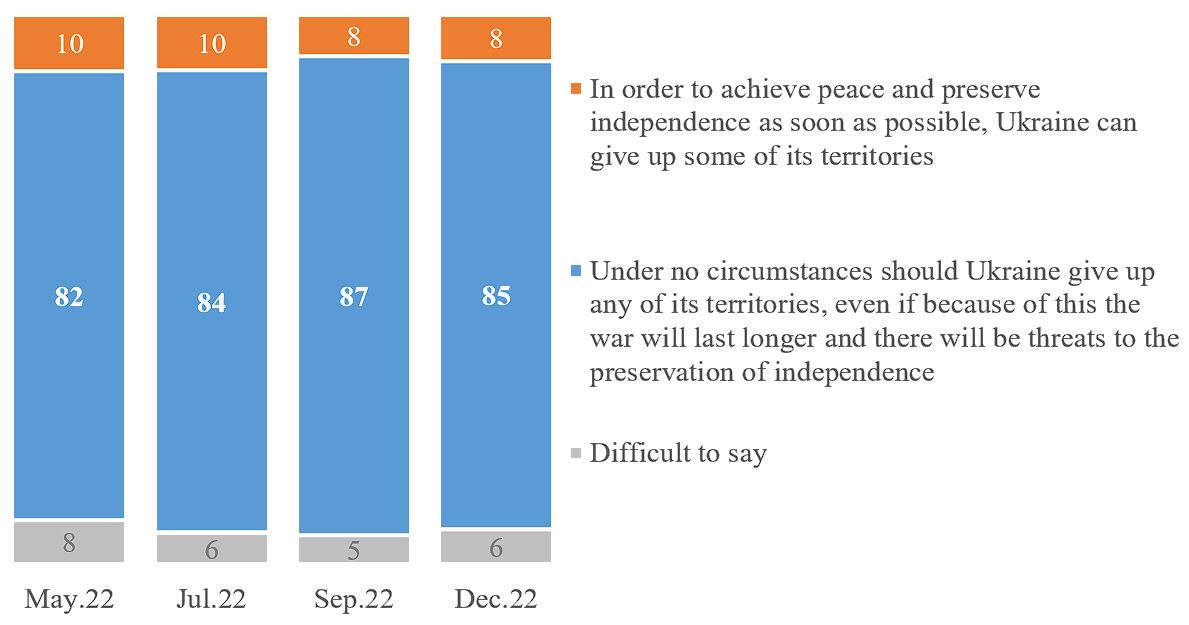
Ukraine CrisisKyiv International Institute of Sociology released the results of the latest telephone poll, which it has been conducting periodically since May: Dynamics of readiness for territorial concessions for the earliest possible end of the war: results of a telephone survey conducted on December 4-27, 2022
-
What jazz, classical, or folk music are you listening to?I challenge anyone to listen to this song all the way through without e.g. tapping your foot, bobbing your head, etc to the rhythm. Its just infectious. — busycuttingcrap
What did I win? (Just kidding! I like it.) -
Ukraine CrisisFor me, the most cogent challenges to his view come from writers Jan Smoleńsk and Jan Dutkiewicz. — Paine
Thanks for the article. It nicely exposes the willful ignorance and parochialism of westplaining Ukraine. One phrase strikes a false note though:
After the breakup of the Soviet Union, Ukraine several times attempted to assert and defend its westward course, including in 2004 and in 2014, both times to great resistance on the part of the Kremlin. There is no point in denying that the West actively intervened in this. But so did Russia. — Jan Smoleńsk and Jan Dutkiewicz
This suggests some sort of parity between Western and Russian intervention in Ukraine over the last 20 years. But that's blatantly false. I am not even sure what they meant by Western intervention, other than the West just being there as a major presence on the world stage going about its business. That can't be ignored, of course, but that in itself doesn't usually merit the characterization of "intervening." As far as anyone knows, Western dealings with Ukraine were open and consensual. It's not like they strong-armed and corrupted Ukrainian officials, penetrated the military and security apparatus, attempted assassinations, played power games with gas supply, issued threats and ultimatums, and finally intervened militarily - Russia provably did all of those things.
On the matter of agency:
Given that the only combatants on the ground are Russian invaders and Ukrainian defenders, the implication that this is a battle between the U.S. and Russia over influence is ridiculous. — Jan Smoleńsk and Jan Dutkiewicz
It is pretty insane to think that Ukrainians defending their country against Russian invasion are merely doing someone else's bidding. Now, if we look at Russian fighters, there is some truth to that characterization. By all accounts, when Russian soldiers were ordered into Ukraine on February 24, it came as a shock to them, as it did for the rest of the country. They had a very vague idea of what they were fighting for, and still do. And that is reflected in the poor troop morale on the Russian side, which just about everyone acknowledges. The difference with Ukrainian defenders is stark.
Besides, Ukraine is a very different country than Russia. Whereas Russia has been living under a progressively more repressive autocratic rule for the last 20 years, Ukraine has had two democratic revolutions over the same period. Even during the most oppressive years of Yanukovich's rule, they still had opposition representation in politics, and a lively and diverse media landscape. And since Yanukovich's fall they have elected and then voted out one president and voted in another. Who wasn't doing so great before the Russian invasion, by the way: Zelensky's ratings were pretty low going into 2022. So to assert that Ukrainians are fighting for Zelensky is just as insane as to assert that they are fighting for NATO. -
Ukraine CrisisMichael McFaul, former ambassador to Russia, now Professor at Stanford, recently gave a lecture: "Explaining the Causes and Consequences of Putin’s Invasion of Ukraine"
His main thesis: "It's democratic expansion, not NATO expansion that has created this tension between Putin and the west and Putin and Ukraine."
Not much new for most of us here, but one of the arguments that he gives in support of this thesis is that relationships between Putin's regime and the West weren't always that hostile. What's more, NATO expansion wasn't much on the agenda until very recently - when there actually was no cause to raise this as a concern, since Ukraine wasn't going to be admitted to NATO any time soon, if ever. He recalls that in all the high-level talks where he was present (he was ambassador during Obama's administration) the expansion of NATO was hardly ever brought up. -
Natural selection and entropy.I think we are on the same page. It's just that for me energy transfer means that, well, energy is transferred between parts of the system or between the system and the universe, as you say. And that doesn't need to happen during mixing. The Gibbs equation illustrates that: as you said, there is no change in (total) enthalpy with mixing, and enthalpy change stands for heat exchange with environment, assuming total volume and pressure are constant.
-
Natural selection and entropy.Yeah it gets more complicated. What you're talking about, I think, is Gibbs "free" energy. Energy transfer still occurs, it's just not in the simple terms I set out. — Moliere
Does it? What if the gasses are at thermal equilibrium? Where does energy transfer take place in mixing?
Let's take the air in your room, which is mostly a mixture of nitrogen and oxygen at thermal equilibrium with each other (albeit different concentrations). We know that they almost certainly won't spontaneously separate into regions of all nitrogen and all oxygen (thank God - or entropy - for that!) This spontaneous separation won't happen even if thermal equilibrium is maintained throughout. Indeed, bracketing out energy transfer makes it especially easy to see why spontaneous separation does not happen: the number of combinations corresponding to a state of separation is negligibly small in relation to the number of all possible combinations under the same conditions.
(Gibbs free energy is closely related to entropy, and it will decrease as a result of mixing, just as it does as a result of spontaneous energy transfer.)
Or consider mixing in reverse. You need to do work in order to separate mixed substances, transferring energy into the system - but not the other way around. In this sense, mixing does involve an asymmetric energy transfer.
Heh, that's pretty good. But I'd counter the experimental definition. "macro-scale" already says too much, in this notion — Moliere
Well, the experimental definition fails at sufficiently small scales - hence the stipulation. Try to say anything about the entropy of three particles kicking around in an empty can. The concept of entropy is applicable to bulk materials, where you can neglect or average out their internal structure. -
What jazz, classical, or folk music are you listening to?Stravinsky allegedly said about his violin concerto that he wanted to write "a music that would have no emotional resonance." What a load of crock! It's pure joy.
Reveal
Also this:
Reveal -
Ukraine CrisisLOL at "my very accurate denials". Not going to waste my time arguing with another freak, but here are a couple more links for general reference:
Human Rights Watch, "We Had No Choice": "Filtration" and the Crime of Forcibly Transferring Ukrainian Civilians to Russia, September 1, 2022.
Since Russia’s full-scale invasion of Ukraine on February 24, 2022, Russian and Russian-affiliated officials have forcibly transferred Ukrainian civilians, including those fleeing hostilities, to areas of Ukraine occupied by Russia or to the Russian Federation, a serious violation of the laws of war amounting to a war crime and a potential crime against humanity.
The laws of armed conflict prohibit the forcible transfer and deportation of civilians from occupied territory, including children, and prohibit a party to the conflict from evacuating children who are not its own nationals to a foreign country without their parents’ or guardians’ written consent, except temporarily as needed for compelling health or safety reasons.
Amnesty International, Ukraine: Russia’s unlawful transfer of civilians a war crime and likely a crime against humanity, November 10, 2022.
Under international law, there are additional protections for children, people with disabilities and older people that are relevant to the situations of those who have been forcibly transferred or deported. International humanitarian law requires, in the process of an occupying power undertaking transfers or evacuations, as Russia has done in Ukraine, “that members of the same family are not separated”. As described in Chapters 3 and 4, Russian and Russian-controlled authorities have, at times, separated children from their parents, in breach of these obligations. Furthermore, the Fourth Geneva Convention prohibits the occupying power from changing the family or personal status, including nationality, of children.
Regarding adoptions of Ukrainian children in Russia, the CRC calls on states “to respect the right of the child to preserve his or her identity, including nationality, name and family relations as recognized by law without unlawful interference”. It outlines that any system of adoption “shall ensure that the best interests of the child shall be paramount” and that the adoption is authorized by competent authorities who determine the adoption is permissible and, if required, the persons concerned have given their informed consent. It also states that intercountry adoption may be considered an alternative means of care “if the child cannot be placed in a foster or adoptive family or cannot in any suitable manner be cared for in the child’s country of origin”. For children deprived of their family environment, the CRC calls for “due regard... [to] be paid to the desirability of continuity in a child’s upbringing and the child’s ethnic, religious, cultural, and linguistic background.”
In violation of these legal obligations and Ukraine’s moratorium on intercountry adoptions, Russian and Russian-controlled authorities in the DNR and LNR have transferred Ukrainian children to Russia and facilitated the permanent adoption of some Ukrainian children by Russian families, depriving them of the opportunity to grow up and receive care in their country of origin. Moreover, in the chaos of war and in the absence of formal relations between Ukraine and Russia, unaccompanied and separated Ukrainian children risk being identified as orphans available for adoption when they are not, possibly preventing reunification with blood relations and guardians.
Convention on the Prevention and Punishment of the Crime of Genocide
Article II
In the present Convention, genocide means any of the following acts committed with intent to destroy, in whole or in part, a national, ethnical, racial or religious group, as such:
(a) Killing members of the group;
(b) Causing serious bodily or mental harm to members of the group;
(c) Deliberately inflicting on the group conditions of life calculated to bring about its physical destruction in whole or in part;
(d) Imposing measures intended to prevent births within the group;
(e) Forcibly transferring children of the group to another group -
Natural selection and entropy.Entropy really "clicked" for me when I understood it as nothing but the direction we observe energy to move — Moliere
That's a nice way to put it. Although there is also such a thing as entropy of mixing, as when two dissimilar gases mix with each other, in which no energy transfer needs to occur.
In general, I would describe entropy as the tendency of some macro-scale processes to be strongly time-asymmetric. That is, under the same general conditions we will almost never see their spontaneous reversal. Thus, ice cubes will melt at room temperature and never form out of room-temperature water; cream will mix with coffee and never spontaneously separate from it, and so on. -
Response to Plantinga's Evolutionary Argument Against NaturalismThis is the only place in the body of the post you mention evolution. You don't really explain how it fits into the argument. — T Clark
It doesn't. This is just a brief summary of Plantinga's original Evolutionary argument against naturalism. The OP attempts a parallel argument as applied to God, instead of naturalism.
I had a hard time following your argument. — T Clark
You'll have a hard time following it if you haven't read Plantinga. (I wouldn't blame you if you don't want to bother.) -
Ukraine Crisis"Resistance is futile!"
They just can't help acting like movie supervillains, can they?
In related news: Putin gives eight golden ‘rings of power’ to CIS leaders, keeping another for himself -
Ukraine CrisisPutin, Isolated and Distrustful, Leans on Handful of Hard-Line Advisers
Russia’s president built a power structure designed to deliver him the information he wants to hear, feeding into his miscalculations on the Ukraine war
This article is based on months of interviews with current and former Russian officials and people close to the Kremlin who broadly described an isolated leader who was unable, or unwilling, to believe that Ukraine would successfully resist. The president, these people said, spent 22 years constructing a system to flatter him by withholding or sugarcoating discouraging data points. — The Wall Street Journal -
What jazz, classical, or folk music are you listening to?Sometimes I find Modernist art more "interesting" than actually satisfying to watch/read/listen, and this goes for some of Varèse that I have listened to. But this one I liked:
Edgard Varèse - Amériques -
Ukraine CrisisWow.
I read several of those articles and found the talking points of boethius and Tzeentch in bold relief. In some cases, they have been transcribing the text verbatim. — Paine
Another of his sources is Brian Berletic, aka Tony Cartalucci, a far-right conspiracy theorist who has been amplifying Russian propaganda, and before that has championed Assad's regime in Syria ("independent Arab state that spends on human welfare and refuses to surrender to Israel"), Myanmar junta, and other such noble causes. -
Ukraine CrisisAcross Ukraine, the Russian losses mounted. A giant armored column of more than 30,000 troops at the core of Russia’s force pushing south toward the city of Chernihiv was eviscerated by a motley group of Ukrainian defenders outnumbered five to one, soldiers and senior officials said. The Ukrainians hid in the forest and picked apart the Russian column with shoulder-fired antitank weapons, like American-made Javelins. — New York Times
This popular narrative of "a motley group of Ukrainian defenders" that eviscerated Russian armored columns "with shoulder-fired antitank weapons" was challenged in a recent report by RUSI. They maintain that, contrary to popular belief, most of the Russian losses during their failed Kiev push were inflicted by conventional Ukrainian artillery. -
Ukraine CrisisThe New York Times published a big investigative article: Putin's War
How could one of the world’s most powerful militaries, led by a celebrated tactician like Mr. Putin, have faltered so badly against its much smaller, weaker rival? To piece together the answer, we drew from hundreds of Russian government emails, documents, invasion plans, military ledgers and propaganda directives. We listened to Russian phone calls from the battlefield and spoke with dozens of soldiers, senior officials and Putin confidants who have known him for decades.
(You should be able to read without subscription if you open the link in a private/incognito window.)
It is mostly narrative interpolation, and those who have been closely following the war won't find much that they don't already know, but some specific details are intereting. Here are some highlights (per NYT):
- Some Russian soldiers described being sent to war with little food, training, bullets or equipment — and watching about two-thirds of their underprepared platoon be killed.
- Many of the people closest to Putin fed his suspicions, magnifying his grievances against the West.
- The U.S. sought to stop Ukraine from trying to kill Valery Gerasimov, a top Russian general. American officials were worried that an attempt on his life could lead to a war between the U.S. and Russia. Gerasimov survived the attack.
- A senior Russian official told the C.I.A. director that Russia would not give up, no matter how many of its soldiers were killed or injured. One NATO member has warned allies that Putin might accept the death or injury of as many as 300,000 Russian troops. Here’s how Russian data journalists calculate Moscow’s toll from the war.
- Invading Russian soldiers used their cellphones to call home, enabling the Ukrainian military to find and kill them. Phone intercepts obtained by The Times showed the bitterness Russian soldiers felt toward their own commanders.
-
Ukraine CrisisThe Economist interviewed General Valery Zaluzhny, the head of Ukraine’s armed forces.
Now, normally I don't pay much mind to government or military officials' statements. You have to read between the lines to get a morsel of useful info. But Zaluzhny is no politico, and he is known for speaking candidly on those infrequent occasions when he speaks in public. And indeed, this interview is not what you might expect: "Rah-rah-rah! Crimea in six months!" Not at all. -
Galen Strawson's Basic ArgumentModernist deterministic moral arguments of those like Pereboom, Strawson and Nussbaum surrender the absolute solipsist rationalism of free will-based models of the self in favor of a view of the self as belonging to and determined by a wider causal empirical social and natural order. — Joshs
Who are they arguing against? No one but no one believes in Strawson's strawman of a self-caused, perfectly autonomous agent.
If we ask why the agent endowed with free will chose to perform a certain action , the only explanation we can give is that it made sense to them given their own desires and whims. If we instead inquire why the individual ensconced within a modernist deterministic or postmodern relativist world performed the same action, we would be able to make use of the wider explanatory framework of the natural or discursive order in situating the causes of behavior.
That's news to absolutely no one. The understanding that our decisions are influenced by many things, and furthermore that the development of our character is influenced by many things, is already built into ordinary interpersonal relationships, as well as modern justice systems. -
Galen Strawson's Basic ArgumentIn an Interview with Galen Strawson:
"I just want to stress the word “ultimate” before “moral responsibility.” Because there’s a clear, weaker, everyday sense of “morally responsible” in which you and I and millions of other people are thoroughly morally responsible people."
I don't know what he means by "ultimate" responsibility. — ChrisH
In that interview he says:
Almost all human beings believe that they are free to choose what to do in such a way that they can be truly, genuinely responsible for their actions in the strongest possible sense—responsible period, responsible without any qualification, responsible sans phrase, responsible tout court, absolutely, radically, buck-stoppingly responsible; ultimately responsible, in a word—and so ultimately morally responsible when moral matters are at issue. Free will is the thing you have to have if you’re going to be responsible in this all-or-nothing way. That’s what I mean by free will. That’s what I think we haven’t got and can’t have. — Strawson
He uses similar superlatives in the "The Impossibility of Moral Responsibility" essay. According to his thesis, what this "ultimate responsibility" amounts to is being self-caused in a God-like way, having no causal history whatsoever, so that you are the sole originator not only of your actions, but of your personality - "what you are." He continues with this admonition to his fellow philosophers:
I like philosophers—I love what they do; I love what I do—but they have made a truly unbelievable hash of all this. They’ve tried to make the phrase “free will” mean all sorts of different things, and each of them has told us that what it really means is what he or she has decided it should mean. But they haven’t made the slightest impact on what it really means, or on our old, deep conviction that free will is something we have. — Strawson
This is hilariously lacking in self-awareness. You might think that, unlike all those armchair philosophers who just make shit up, he, Strawson, went out and did some actual research. But he does exactly what he accuses others of doing: he tells us "that what [moral responsibility] really means is what he... has decided it should mean."
Meanwhile, if you want to know what ordinary people, not philosophers, think about things like agency, responsibility and free will (what he in passing refers to in the interview as "the weaker, everyday sense"), a body of research does exist in sociology and a relatively new discipline of Experimental Philosophy (which in this area is basically a crossover between sociology and philosophy). And for my money, it is this everyday sense that actually matters, not the artificial constructs that philosophers make up, such as Strawson's "ultimate responsibility". -
Galen Strawson's Basic ArgumentThis is problematic. The argument declares for determinism in the first premise, and then discovers it at the end as if it has proved it. — unenlightened
Although the main argument seems to leave out the possibility of indeterminism, Strawson does discuss indeterminism and argues that, if anything, "random factors, for which one is ex hypothesi in no way responsible" make matters worse for personal responsibility. This is the part of the argument with which I unreservedly agree. (But these are well-known objections - cf. Ayer: "But if it is a matter of pure chance that a man should act in one way rather than another, he may be free but can hardly be responsible.")
But of course the cause of my actions is my imagination. I imagine the pleasant taste of beer and that might cause me to head to the fridge, or I might catch sight of my burgeoning beer-gut and think again. The causal path of thought cannot be predicted even if it is mechanical because of the halting problem. So the question is begged as it always must be. — unenlightened
I don't really understand what this has to do with predictability. The argument is that, assuming causal determinism and a fixed past, you could not have become anything other than what you are. (And furthermore, if a non-deterministic component is also in play, you have no more control of it than you have of the past.) Predictability does not play any role here. (And halting problem?)
But the argument is further disguised by talk of "ultimate responsibility" as if it is something deeper than ordinary responsibility. Which it clearly isn't. I choose to drink beer and then I am drunk, and I am responsible for the way I am - drunk. And if I get in a fight or run someone down, I am responsible for that because I am responsible for the way I am. And of course the law recognises that one attains an age of responsibility, one is not born with it, but develops the capacity to change one's state. It also recognises diminished responsibility, when circumstances are overwhelming. There is a lot of work being done by that weasel word, 'ultimate', that it has no permit for. — unenlightened
I agree. If "utlimate responsibility" is defined as causa sui, against which Strawson needlessly argues, then it has little to do with what we normally understand by responsibility. And if it is his argument that what we take responsibility to be is reducible to mechanistic causation, then he is plainly wrong. -
Galen Strawson's Basic ArgumentHere is Strawson's paper: Galen Strawson: The Impossibility of Moral Responsibility (1994)
summarizes it accurately. Much of the short paper consists of restatements and elaborations (or belaboring) of this thesis. Here is a longer version from the paper:
(1) You do what you do because of the way you are.
So
(2) To be truly morally responsible for what you do you must be truly responsible for the way you are – at least in certain crucial mental respects.
But
(3) You cannot be truly responsible for the way you are, so you cannot be truly responsible for what you do.
Why can’t you be truly responsible for the way you are? Because
(4) To be truly responsible for the way you are, you must have intentionally brought it about that you are the way you are, and this is impossible.
Why is it impossible? Well, suppose it is not. Suppose that
(5) You have somehow intentionally brought it about that you are the way you now are, and that you have brought this about in such a way that you can now be said to be truly responsible for being the way you are now.
For this to be true
(6) You must already have had a certain nature N in the light of which you intentionally brought it about that you are as you now are.
But then
(7) For it to be true that you and you alone are truly responsible for how you now are, you must be truly responsible for having had the nature N in the light of which you intentionally brought it about that you are the way you now are.
So
(8) You must have intentionally brought it about that you had that nature N, in which case you must have existed already with a prior nature in the light of which you intentionally brought it about that you had the nature N in the light of which you intentionally brought it about that you are the way you now are …
Here one is setting off on the regress. Nothing can be causa sui in the required way. — Strawson -
What jazz, classical, or folk music are you listening to?Richard Strauss - Metamorphosen (1945)
Composed in the final weeks of the war, when the composer's world was crumbling around him. If the theme sounds vaguely familiar, listen carefully: about 3/4 of the way in, and then again at the very conclusion of the piece the source of the theme is revealed.
RevealIt is the funeral march from Beethoven's Eroica symphony -
What jazz, classical, or folk music are you listening to?:up: I loved that video (and music too, of course).
-
Ukraine CrisisBritish Royal United Services Institute (RUSI) published Preliminary Lessons in Conventional Warfighting from Russia’s Invasion of Ukraine: February–July 2022. You can read the executive summary at the linked page, and the full PDF is available from there.
This report is an account of the pre-war plans of both Russia and Ukraine, the course of the initial phases of the war between February and July 2022, an overview of what has been learned about the AFRF, and an assessment of the implications for NATO and specifically the UK military. — RUSI
The authors caution that the report was based to a large extent on classified and sensitive data, which precludes discussion of methodology. "For this reason, this report should not be considered a work of academic scholarship and it does not use citations." -
Ukraine CrisisPutin offers yet another reason for annexing Ukrainian territories (not a new one though):
I think it should be obvious to all those present here why we supported and eventually agreed to the recognition and admission of Donetsk, Luhansk, and then two more territories into the Russian Federation. Look at these young women. How does [meeting participant] Fedorova, who lives in the Lugansk Republic, differ from other Fedorovs [common Russian surname] somewhere in Novosibirsk, St. Petersburg or Moscow? Nothing. These are our people. — Putin -
What jazz, classical, or folk music are you listening to?That's harsh. No love for Ives?
Berg - Violin concerto To the Memory of an Angel
The conclusion is just heartbreaking. -
Torture is morally fine.Are locutions such as "torture is bad" truth-apt? — SophistiCat
Of course not. — Vera Mont
Well, that's one long-standing philosophical debate closed! -
Torture is morally fine.So the OP question is not about truth anymore again? — Vera Mont
It is hard to tell, to be frank. The OP insists that it is, but then when philosophers discourse about truth (or anything else for that matter) things get complicated. Are locutions such as "torture is bad" truth-apt? Controversy! I am with @Banno on this: I am happy to count as "true" any statement that I would endorse.
Does the OP endorse the statement "torture is bad"? I should hope so. -
Torture is morally fine.There are no such things as regards physics. There are such things as regards biology. For biology to operate, life is a necessity and the sustenance of life is therefore inherently good. A moral claim based on that premise may not universally true, since much of the universe is non-living, but it is true for a class of material entities known as organisms. — Vera Mont
I don't mean to stick up for error theorists, but I am with them (and with Humeans) on this one. One shouldn't confuse explanations for morality being the way it is, and reasons for acting morally - that would be a naturalistic fallacy. Explanations can be biological, anthropological, social, or perhaps even physical. Motivations ultimately require value judgements. The gap cannot be bridged. -
Torture is morally fine.If nothing can be good, or bad, how can anything ever be good, or bad? — Leftist
Your question is (perhaps deliberately) unclear. If you are bothered by the apparent tension between moral talk (locutions such as "torture is bad") and the ontology that denies moral properties, then there are several ways out of this conundrum: fix the language, reconsider the argument about the language (perhaps embrace non-cognitivism instead), reconsider ontology (perhaps abandon moral realism).
What should not be in question is what we actually mean when we say things like "torture is bad." What we care about when we say these things (@Moliere) is neither language nor ontology - only metaethicists care about that. -
Torture is morally fine.What if the moral claims are simply not truth-apt? — Moliere
And so it seems to me that you've missed the point of morality. Who cares that it's not "true"? — Moliere
When I want to make safe meta-ethical claims, error theory is home base. — Moliere
If you are referring to the above (moral claims are not truth-apt), that is non-cognitivism, rather than error theory. Error theorists (and Leftist, if I am not mistaken) maintain that moral claims have the grammatical structure and the apparent intention of saying something true about the world (the real world, not a fictional universe of Star Trek, for example). But that (they argue) is a mistake, because for a moral claim to be true, there ultimately needs to be something out in the (real) world that has the property of being good or bad or otherwise morally flavored, and there are no such things.
However, when error theorists say that it is not true that "torture is bad," they do not therefore mean to say that "torture is fine": that would be repeating the same mistake. Indeed, all this theorizing does not necessarily imply anything about common morality. All it means (if you accept their arguments) is that moral talk is confused. But you don't have to change your moral attitudes on that account. The appropriate therapy would be to fix the philosophical language, rather than behavior. -
Torture is morally fine.@Leftist seems to be reasoning from the error theory, except that Leftist doesn't quite get it. Leftist doesn't get that the error theory is a metaethical position: it is concerned with the nature of moral talk. It doesn't, for example, conclude that "torture is fine," nor does it conclude that "torture is wrong." It concludes that both statements are false - more or less for the reasons that Leftist gives: because they lack truthmakers. There is nothing in the world that could make something good, bad, or even morally neutral. That doesn't imply moral nihilism though.
-
What jazz, classical, or folk music are you listening to?I love that knifepoint between late romanticism and early modernism. I'd like to live there. — Noble Dust
At about the same time (1900s) Ives asked a question that is now stuck in my head. Does anyone know the answer? ;)
Reveal
SophistiCat

Start FollowingSend a Message
- Other sites we like
- Social media
- Terms of Service
- Sign In
- Created with PlushForums
- © 2026 The Philosophy Forum