
Comments
-
What is self-esteem?...they ought to recognize what they can or can not do. — Question
That was rather my point. High self -esteem might lead to happiness - lets suppose. But if Ithink I am the Good Samaritan, or the uber-mensch or whatever turns me on, when in fact I am simply a deluded and arrogant little shit, then my self-esteem is not 'true'. Such fantasies actively prevent one from taking those steps, 's or some other program, that will lead to possibly being less of a shit.
High self-esteem leads to the complacency that problems are all down to someone else; probably it's a conspiracy ...
Of course, if it just so happens that I am a great philosopher or the prettiest pensioner on the block, then it is only sensible to acknowledge this. -
What is self-esteem?We philosophers prefer justified true self-esteem to high self-esteem. Which is of course the reason most philosophers are unhappy.
-
So you think you know what's what?Interesting to see that what's what consists to a large extent of what most people thing is what, or think ought to be what. A higher percentage than I expected.
-
Exam questionThe only reference I can find to 'logical entity' is in a javascript programming tutorial. Otherwise, an entity is a thing that actually exists, and logic as far as I know makes no existential demands.
"Logical entities always evaluate as a Boolean result."
(from here.)
Well the human condition is alive or dead - I guess that's fairly boolean.
Therefore, adhering to the principles of logical deduction, I develop the conclusion in terms of descending consequences that the question is a pile of dingos' unmentionables. -
Denial of Death and extreme JihadismSo, the ancient Christian death seekers were clearly different from those Muslim death seekers who kill themselves now intending to kill others as well. There's a difference between wanting to be killed and wanting to kill others while killing oneself.
But it would seem that in each case it's believed that dying is good, and that God wants us to die in a particular way or will reward us if we do so. And these are dangerous thoughts indeed. Once we think God wants us or others to die, or that it's good that we or others die, we not only accept but seek death; our death or the death of others, or both. Worse, we think we should kill. Death becomes a moral imperative. — unworthy speculator
The death or not others is surely a trivial difference compared to my own death. My own death is in my language an act of identification. Rome, as the secular power is being invited to 'ratify' the identification by performing the office of executor and thus promoting the mere faithful to the status of martyr.
It's not even really a matter of what God wants, since He can doubtless shift for himself, it's more a badge of identification. Which of course is why jumping off a cliff will not do at all. For mass suicides you need something extra in the way of collective hubris. -
Denial of Death and extreme JihadismIt's not uncommon or peculiar. Think of the thousands of soldiers walking into machine-gun fire during WW1.
All it requires is an identification with nation, religion, or whatever, that is stronger than the identification with the body. This happens quite easily as a social psychological process. If I tell you enough times that if you are not with us, you are against us and that all our problems are their fault, you will find it hard and eventually futile to resist. If you do resist you become one of them, and your death follows anyway with added ignominy.
Try here for a somewhat less simple-minded exposition. -
Can you start philosophy without disproving scepticism?Five pages of what in a generous mood I will call 'philosophy' seem to demonstrate what is intuitively and by definition the case, that one cannot disprove scepticism without starting philosophy. Indeed, since scepticism is a philosophical position, one cannot even articulate it without starting philosophy.
Can you start philosophy without disproving scepticism?
It follows from the above, that either one can start philosophy without disproving scepticism or one cannot start philosophy. But we have started, and therefore the question can be answered in the affirmative.
And they say philosophy never makes progress. -
Mental Illness, Mental Strength and Philosophical DiscourseI don't see how this is possible. He may try to feign it, but since he lacks the first-person understanding of empathy, his feigning will only ever be very imperfect. It's like me trying to feign that I'm in love with someone without ever having experienced love myself. — Agustino
People do feign falling in love, and people who are lonely and hungry for love will fall for the deceit enthusiastically, almost conspiring to maintain the fantasy. And they won't thank you for disabusing them, and they will get hurt. I'm very glad you lack that ability. I'm a poor actor too. But assuredly one can be a passably good actor by mere imitation and without empathy.
And in the context of worldly goals; one person may have very modest goals and succeed in all of them, while another may have fantastic aspirations and achieve them only to a moderate, or even small degree, and yet achieve far more, in worldly measures such as money, fame, power and so on than the first. Who, then would be the greater failure? Or think of art; what is better; to achieve greatness but fail to be recognized or to achieve universal acclaim and yet be a mediocrity? — John
I have mentioned Van Gogh, a great artist who had serious enough psychological problems to harm himself, and be hospitalised more than once.
Consider Winston Churchill. A great man, a great leader, a great success, who suffered all his life from depression.
Or there is the phenomenon of the autistic savant. It is thought that Mozart was one.
The game of trying to sanity equal to success or strength simply doesn't work, because we are not one dimensional beings. One can have abilities and disabilities at the same time, and they can be the same thing. And one can have disabilities in one area and great talent in another. -
Mental Illness, Mental Strength and Philosophical DiscourseNow can you see that the two of them are very different? — Agustino
Well I apologise if I misled you. I assumed you had some familiarity with the psychological terminology. But the difference is not all that huge. The Forbes article rather assumes that we know that a psychopath is more or less as described by Psychology Today, and proceeds to explain how someone who has these traits can nevertheless appear plausibly competent and talented.
I wish I could wean you off your black and white thinking about this. You have just seen the same condition being described positively and negatively in your own view. But they are talking about the same condition, psychopathy.
A medical surgeon needs the ability to de-empathise with his patient to the extreme of being able to treat them pretty much as a piece of meat. But hopefully, this talent is used only when needed, and he does not regard his wife and children that way, or even his colleagues. Now the psychopath typically lacks in empathy, but can feign it when he finds it convenient, because he does not lack insight and understanding of others. This is a simple example of a talent and a disability coinciding. -
Mental Illness, Mental Strength and Philosophical DiscourseSee, your idea of mental illness refers specifically to the individual, "one". — Metaphysician Undercover
There is something, but not everything, to be said for the view that sanity/madness is relational. To call someone, or some behaviour insane is to admit that one cannot 'make sense of it'. And then of course to try and make sense of it in terms of some deficit or excess. The implication then is that one cannot be mad on one's own, or mad to oneself - not that one cannot find oneself to have been mad from the POV of having 'recovered one's wits'.
But then consider PTSD. The sufferer may know he is 'not himself', with or without knowing the cause or label.
But talking of madmen, one might take something from Wittgenstein's discussion of family resemblances here. It may be that there is only one way to be sane, but there are certainly many ways to be mad. What seems to be coming from this discussion, at least it's coming to me, is that a mental condition can be at the same time a weakness and a strength, a deficit and a (compensating?) talent.
Things are not made simpler by the fact that most disorders are 'spectrum' disorders, such that more or less everyone is to some extent traumatised, paranoid, psychopathic, schizophrenic, autistic, and so on. I speculate that whatever leanings one has in one direction incline one to find that disorder less real. Thus to the extent that I am paranoid, I find paranoia to be a perfectly sensible way of thinking and acting, not a disorder at all.
Another person worth considering is Van Gogh. Both his huge talent and his mental fragility are pretty much unquestionable. Likewise his failure in his lifetime and his huge legacy and influence after his death. And I think he was a good man. -
Mental Illness, Mental Strength and Philosophical Discourse... what is understood by "psychopathy" there isn't that. It's actually mental strength, but it's painted as mental weakness merely because people are afraid of strength, and they're especially afraid of strength when it could be used for evil. — Agustino
I think you need to look at that again, and see if this bears any relation to what you think Jesus was like. -
Mental Illness, Mental Strength and Philosophical DiscourseIn our society, very frequently we seem to associate evil with mental illness, and goodness with mental strength. One of my main points in this thread is that such an association is wrong. — Agustino
One form of mental illness in particular. The mad axeman is mainly, but not entirely a myth with respect to schizophrenics, but I'm not sure what you are getting at here. Are you saying that psychopathy is a mental strength, or are you going back to the 'success proves sanity' trope? -
Mental Illness, Mental Strength and Philosophical DiscourseAbsolute and unwavering dedication to one's principles does, and will always attract, worldly success. It is because of that absolute and unwavering dedication to his principles that Socrates' death had such an effect on his contemporaries, and inspired some, like Plato, to create a movement around it. — Agustino
Yes, Hitler still has his followers. But that does not prove him sane. Unwavering dedication can also be stubbornness to the point of monomania. Principles can be wrong. -
Mental Illness, Mental Strength and Philosophical DiscourseThe skills and mindsets that maximise the chance of survival in war on the other hand are controlled aggression, courage, daring, pragmatic intelligence, critical thinking, patience, resisting pain, decisiveness etc. But notice there is an asymmetry in terms of fitness between the two mindsets. The "war" mindset, let's call it, is superior to the "peace" mindset. It's true that during peace the person with the "war" mindset will have a harder time - he won't be as successful as the other guy. But he'll manage. But - during war on the other hand, the "peace" mindset is first to be exterminated, while the "war" mindset has a greater chance of survival. — Agustino
And tell me unenlightened, if Socrates had chosen to run away instead of accept death, would his principles have survived? — Agustino
You are so busy arguing, you are missing the point, and arguing against your own position. Jesus, Socrates, and the principled man of peace, not to mention the principled man of war, and the suicide bomber are not to be judged by their survival or their death.
It is exactly the man of principle, who holds to the rational consequences of his principles who is least adaptable and far from the cockroach like resilience you seemed to extol, is most fragile and vulnerable in purely physical (worldly) terms. Their anti fragility is mental and spiritual in being true to themselves, and 'single-minded' in the sense of not suffering from a conflicting need to 'succeed' at the cost of their own integrity. -
Mental Illness, Mental Strength and Philosophical DiscourseBut do you think personal survival always makes sense? — Agustino
No I don't think that. I think that personal survival is part of earthly success, along with having rendered unto one some of that which is Caesar's, and so on. I don't think either, that Socrates' taking on death succeeded in founding an academy. I think he would be insulted that you thought that he died for anything other than in defence of his principles - a spiritual reason.
Earthly success is about survival and earthly prospering, as you say, if not for oneself then for the tribe, or for humanity, and I suppose, if you count the treasures of the Vatican, then Jesus' death was an earthly success. But I don't think Jesus counts them at all.
But this is getting a bit off topic. One can perhaps judge the sanity of a man by subsequent events, but it is no help in judging his sanity now. His survival or not, his prospering or not, his adulation or not, these are not good guides to his sanity. -
Mental Illness, Mental Strength and Philosophical DiscourseHis crucifixion is precisely the crowning of his Earthly as well as spiritual success. — Agustino
Well you need to educate me about this, because it's a use of the terms 'earthly', 'spiritual' and 'success' that is wildly different from my current understanding. On the face of it, it looks like you are moving the goalposts in a great hurry, because earthly, as in cockroachly success, certainly didn't include not surviving a few posts ago. -
Mental Illness, Mental Strength and Philosophical Discourse... take the cockroach. It is a species of insect that has evolved very little, if at all, in the past 300 million years. It is very adaptable, and not fragile to modifications in its environment - — Agustino
But you see that's the thing. Norman Normal is as Taleb would say fragile. — Agustino
I would say that Norman is a cockroach. He is like the vicar of Bray in adapting to society, or like the decent citizen who becomes an extermination camp guard. In a consumer society he consumes, and in war he fights.
But my evolutionary analogy was intended to steer you away from survival/ success as a measure of sanity. I had thought you would see immediately that a sane man can get crucified. And with Jesus in mind, I suggest that sanity is fragile in that worldly sense; that it is vulnerable to social insanity, precisely because it cannot adapt itself to the world gone mad. -
Solutions to False Information and News in Our Modern WorldJust to feed your paranoia a little... It is obvious that they are feeding you stories about false news being so influential to make you so distrustful you do not commit to any position or hold to any truth. Actually, most of the news is true, unfortunately.
-
Mental Illness, Mental Strength and Philosophical DiscourseHow can we reconcile this with the proposed concepts of mental strength and mental illness? — Metaphysician Undercover
With great caution!
For example, a heightened sensitivity, or even a new sensitivity to some environmental/social factor, may look like a weakness. For instance, in my lifetime in the UK there has developed a sensitivity to child abuse (as we now call it), that wasn't taken seriously before. There is still a deal of resistance to this namby-pamby attitude.
At the same time, speaking from experience, there are conditions that are fairly clear cut, just as there are mutations that are obviously maladaptive. The disintegration of speech, of contact with reality, and of the personality, that constitutes the classic schizophrenic are pretty obviously not going anywhere good, for society, for the species, for the individual, or for anything else. Although even here one should be cautious; it includes a creativity, and a sensitivity that with the right nurturing can become productive and transformative. -
Mental Illness, Mental Strength and Philosophical DiscourseNo this thread isn't for me to defend any kind of idea. I made that clear in the opening post. This thread is for brainstorming, by everyone. I'm happy you're unhappy with my definitions - so go ahead and reframe them. Propose a different framework. Do whatever you think has to be done. Explore the subject. You don't need me to explore the subject. You can do that yourself. — Agustino
'Mental strength' could be seen as functioning analogously to 'fitness' in evolutionary theory. One cannot say much about it in advance, and what is fit in one ecology may be unfit for another.
For Norman Normal, anything that deviates from current accepted practice is incomprehensible, and therefore probably insane - mad sad or bad. But Norman turns out to be mistaken if the deviance becomes accepted and society changes. At which point the madman retrospectively becomes the leader and hero. Just as the successful mutation becomes the new species, whereas the unsuccessful becomes the new disease.
Gregory Bateson has related ideas. (But do watch out for the cultish offshoots.) -
The key to being genuineI'm thinking I pointed out a real flaw in the idea that one is automatically genuine if they just make no effort to be genuine. — Stosh
Well I agree, and that is not what I said, but rather the inverse, that if one makes an effort to be be genuine one is automatically not. But the implicit thrust of my comment is that genuineness is a contradictory and thus inappropriate goal. Most of us are genuinely flawed, if not actively unpleasant and antisocial, and for such, being genuine is the last thing we should seek. As those from a Cristian tradition would have it, following Thomas a Kempis, the task is the opposite, The Imitation of Christ.
Only for those who are genuinely virtuous is there virtue in genuineness. -
The key to being genuineI suppose this means that if someone habituates their affectations , they are genuine, and if someone overcomes their fears , its disingenuous. — Stosh
I suppose this means that you disagree, but can't be bothered to make a serious contribution. -
Mental Illness, Mental Strength and Philosophical DiscourseI would intuit that both mental strength and mental illness have to do with non-conformism of one kind or another. Successful non-conformism we label mental strength - non-successful one, mental illness. What makes for successful non-conformism? What is successful non-conformism? — Agustino
Yes, this is the two-fold problem; once we reject 'normal' as the measure, on the one hand it is hard to find the appropriate diagnostic authority, because the shrinks are normally insane, or insanely normal, and on the other hand, there is the problem - even if one is sane, of knowing that one is and distinguishing between sane and insane non-conformity.
Sometimes it is easy; I spent some weeks looking after a schizophrenic, and there was no question in anyone's mind which was the madman and which the revolutionary. But 'success' is also a problematic criterion. There was this guy I heard of who said strange things and got himself crucified ... with the benefit of hindsight, he seems rather sane and successful, but at the time, success seemed a long way away.
'Distress' is also sometimes proffered as a criterion, and it has the merit of fitting the medical bill of leading to a 'complaint' - the old term for illness. But again the manic, the schizophrenic, the paranoid, are not usually inclined to complain... and it is the madman who does not know he is mad that is most needful, and hardest to identify.
When the church was dominant, the question was whether one's visions were from God or the devil. I don't think things have really changed much. -
Mental Illness, Mental Strength and Philosophical DiscourseThink of it as street psychology/psychiatry that's going on here. — Agustino
2. Should hearing voices, seeing apparitions, and the like always classify as mental illness? — Agustino
I apologise for not following your instructions, but you yourself have said nothing original; there is a long tradition of alternative and anti - psyche out there, and in the context of hearing voices in particular, there is a movement against medicalising such experiences of some standing. I link to their position statement by way of largely agreeing with you without claiming to have invented anything.
Having said that, or got someone else to say it, I'll pick at the nit of 'incapacity'. It's a weasel word. A pacifist is incapable of the normal function of fighting, a miser is incapable of generosity, an unhappy person is incapable of smiling. More seriously, almost any deviation from current political received wisdom might be called an incapacity.
And on the other side, very many folks in prison have demonstrated an incapacity of one sort or another, almost every homeless person too. And in these cases, it is a failure to recognise and diagnose that leaves them without help or understanding.
So how does one spell out the difference between mental strength as conformism, and mental strength as resistance to a mad society? -
Non-necessity (modal logic) and God (theism)A logical world is an all-inclusive, complement-free entirety (all, "everything") where ordinary logic holds.
Like in the illustration, the whole deism column is a suggestion of a possible world (God and Universe). — jorndoe
In which case, if necessarily sentient G. then necessarily sentient world is trivial. -
Non-necessity (modal logic) and God (theism)A possible world is an inclusive entirety, where ordinary logic holds. Here are some suggestions, e.g. deism (ignore the simplicity, it's just for illustration): — jorndoe
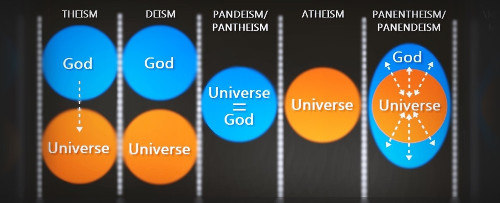
Well if God, then all of these are possible worlds except the atheist world. But it still seems to me that God only necessarily carries sentience into worlds he enters: 1 & 3.
Otherwise, if one wishes to say that a universe without sentient beings is still a sentient world because 'God knows', then one simply accepts the fact, and rejects premise one.
Always and everywhere God, therefore a non-sentient world is a contradiction. Which no longer requires that a piano is sentient. -
Non-necessity (modal logic) and God (theism)... but works of art are not (possible) worlds. — Terrapin Station
They are for God. -
Non-necessity (modal logic) and God (theism)It doesn't clarify to to substitute 'with respect to'. Compare...
Necessarily, every work of art requires an artist, and necessarily, an artist must be sentient. But not necessarily is every work of art sentient, unless the artist participates in the work of art in such a way as to be present in it - as in performance art. This participation is what I am calling 'immanence' in God's case. -
Non-necessity (modal logic) and God (theism)Yes, that assumes immanence. There is a difference between necessary for, and necessary in, which you elide above.
So God can be necessary in the sense of having to create a world without the created world being necessarily sentient. If God intervenes in the world to play the piano, then it is a different matter. -
Non-necessity (modal logic) and God (theism)If G's existence is necessary, then G carries sentience along to all possible worlds, so that sentience exists in all possible worlds, making it necessary by definition, which contradicts 1. (G figures at most in possible worlds with sentience. A necessary characteristic of a necessary entity, is itself necessary.) — jorndoe
I'm finding this one hard to make sense of. Why should God 'carry' sentience to all possible worlds? God creates a possible world consisting of, say, a piano, and not much else. Why does the piano have to be sentient? It looks as though there is the assumption of immanence??? -
Drunk philosophyDrink is a cure for the awareness of one's own ignorance and frailty. That's why drunk drivers are so dangerous.
-
Living a 'life', overall purposes.We see ourselves as living at a specific point of a over-reaching linear time line. As if our present is a train, travelling along a train track. The train track being our present, the track being our 'life'. Essentially what I'm arguing against is any conception of one's existence as being anything over what's presently being experienced.
So this idea of us having a 'life', is wrong. We merely exist presently. Time is not some linear objective thing which our present travels along. How time works is mentally we (presently) project a past behind us, and a future before us, the present being a movement. It's an illusion that there's an 'overall' time. And so there can't be an overall life which we have or lead. Essentially all there is, is what's presently being experienced.
And the same argument applies to the idea of an overall purpose to which one might (say) is the overall end to their life, their 'reason' for living. — dukkha
It's an excellent exposition of presentism until you apply it, and then it all goes pear shaped. When I wait for the bus, it is not because I desire to wait, but because I desire the bus and it isn't here. Indeed desire itself is invariably a projection to the future.
So let us admit that such mental projection enhances life by enabling learning, planning, cooperation and imagination. The architect draws in great detail a house that does not exist so that the builders can coordinate their present activity to produce in the future a beautiful home. This is the power of thought, which no one would wish to be without.
But the problem I think you are trying to solve, the mistake you want to correct is also a very real one; that we confuse thought and life. But the solution is not to stop thinking, but to understand the limits of thought and not to imagine we can live in it. Purposes are part of thought, not of life. -
How to reconcile the biology of sense organs with our sensory perceptions?I love how all the deep philosophical problems are laid out Janet and John, first reader. "Spot sees the ball." It is called naive to suggest that Spot does actually see the ball, because we philosophers somehow know, and if we don't them scientists will tell us, that the ball is out there, and over there, and couldn't fit in Spot's eye anyway. So Spot doesn't 'really' see the ball.
The more detailed the analysis of how one sees, with photons, receptors, neural pathways, learned interpretation, and so on, the more clear it becomes that one does not see what one seems to see. It is as if one takes a watch apart to find out how it keeps time, and then presents the little pile of cogs and springs to demonstrate that it it does not.
There are only three terms: 'Spot', 'the ball' and 'sees'. Let us say that everything contained in the surface comprising Spot's furry skin and the surface of his eye is Spot, ignoring for the moment the undigested dinner, doggy breath,and gut bacteria. So 'Spot' includes his eyes the lenses and receptors, his learned interpretations, neurones and so on.
I'll pretend we've all seen the ball and know what it is.
And then there is 'sees' which is the sum of processes that make up the relational interaction.
If it is kept in mind that the analysis does not in fact dismantle Spot, the ball, or seeing, and that seeing is not consuming, touching, knowing everything about, or whatever, then I think it will turn out that when Spot sees the ball, it is the case that Spot sees the ball, and not interpreted light or the workings of his doggy brain. -
What's wrong with being transgender?Do you have any examples of how what some call aberration can eventually turn out to be indispensable innovation in the past in humans or other animals? — intrapersona
You might consider the sickle cell gene. One copy confers some resistance to malaria, two copies gets you anaemia and early onset death. -
If a tree falls in a forest...In Scotland I once came across a tree (silver birch) that had fallen thee times. each time it had turned its growth upwards again from where it lay. I didn't ask it if it had heard its own fall, but had definitely responded to to it.
If a tree in the forest sang 'I get knocked down, but I get up again' would you believe it? -
Is it good to cause stress in others?... the rest for which we are always striving. — schopenhauer
Striving for rest is exactly that unnecessary, contradictory, and fruitless stress creation that I deny is necessary. Like the war to end war it is bound to fail and bound to engender suffering. Don't do it. Stop doing it. -
Is it good to cause stress in others?1. This is undeniable, one cannot know the future or control the whole world.
... people may prefer stress and want to see others have the stresses that they are habituated to. — schopenhauer1
2. This loses its rhetorical force once it is clear that stress is not necessarily negative. It does not require habituation, and indeed the stress of novelty can be included. So you are reduced to saying that folks may enjoy life and want others to enjoy it. -
Is it good to cause stress in others?You knew damn well that 'stress' is the shortened form of 'distress'. — Bitter Crank
Not only did I not know it, but also it is not true. The two words have different origins from latin via Old French. Or so google tells me. But even if it had been true, the two words have rather different meanings currently which is worth teasing out.
Organisms must endure stress to survive at the least, endure undue stress when overburdened, and seek out stressful situations to provide novelty and something to do otherwise. So it is exposing an organism to stress because it is a necessary part of being an organism. — schopenhauer1
Yes, this is rather what I thought. Rather than conceptualise stress as a particular psychological state, you seem to generalise it to include almost any sensation at all, hunger, fear, arousal, whatever. And with such a sense stress is indeed inescapable, since to be alive is to be responsive to the environment, and if any response is stress then life is stress.
But then I no longer agree that stress in this sense has any connection with distress, that is is inevitably negative or harmful. -
Is it good to cause stress in others?To take this a step further, being born is essentially being exposed to stress. — schopenhauer1
Well hang on. "Exposed to stress" is to my understanding a term of projection, as if stress were something in the world, rather something in oneself.
Why is it assumed that a new human must be born to experience stress in the first place? Does the parent's preference for stress get carried over to the assumption that the child should also prefer stress? Does stress need to exist in the first place if it can otherwise be prevented? — schopenhauer1
Clearly new humans neither need nor want to be born for themselves. Parental motivations are many and varied, ( a desire to continue oneself through the child, and economic security for a couple of examples) but a lot of the time children are born because of a lack of thought to prevent it and not much else. Assumptions hardly figure.
But to cut to the chase, I would say that stress is not necessary to life. One can very well do without it. But I think you do not admit that possibility?
unenlightened
Start FollowingSend a Message
- Other sites we like
- Social media
- Terms of Service
- Sign In
- Created with PlushForums
- © 2026 The Philosophy Forum