
Comments
-
The Objectification Of Women. A man who's concerned about his woman's sexual needs, especially if she looks to greener pastures, will, in all likelihood, keep her on short leash lest he become cuckold or the like; this tendency of men probably spills over into other freedoms a woman can have. — TheMadFool
A 'man' who is so insecure and small dicked about his relationship that he thinks of women on leashes and worries about her 'looking for greener pastures' is no man, and should probably fucking hang himself. Sorry but this language is revolting. -
The Objectification Of WomenObjectification is about eroding or ignoring agency - treating them as an object is failing to recognise them as a thinking, feeling human being with options or a voice. — Possibility
I guess my point is that sometimes you don't want to be treated as a 'thinking, feeling human being'. Like - fuck me and leave and never talk to me again and certaintly don't ask me about my aspirations (because that would be crossing the line). Like, respect my agency by not getting into my personal life, by keeping this sexually transactional (or better, let's respect each other's agency by doing so).
But I get your point - as long as everyone's on the same page, and both (or more!) parties are OK that situation - that one has permission, as it were, to be treated like that, then that's cool. I dunno how to put it - like an agental suspension of agency maybe. -
The Objectification Of WomenTo be frank I'm pretty weary of some of the discussion here - I want to add the idea of perfectly healthy objectification, in which someone - man, woman, whatever - is happy to be trated as a sheer object of desire, if only to fuck a partner or enjoy the pleasures of whatever freaky kink with no strings and no commitment whatsoever. The question is weather this behaviour is being used as a crutch, or otherwise compromises what might be otherwise more healthy mechanisms of life-interaction, social or otherwise.
To be it blunty: there is literally nothing wrong with wanting to be fucked or wanting to fuck for the sheer pleasure of it, so long as everyone's in on the game and it doesn't lead to compromizing other mechanisms of a healthy life. Objectification is not a problem in itself. There's something very alluring in being treated as a sheer object, and treating someone else like that in turn, so long as there's transparency on both sides. It's not necessarily easy to do, and requires alot of fine treading to do well sometimes. It's important to recognize when things start to become unhealthy or toxic, or when people exploit asymmetries of sexual power or attraction.
The issues set in when objectification shifts from interpersonal to social or political - when men or women become objects at a level of media portrayal or social policy or whathaveyou. When objectification becomes the dominant mode of social understanding of gender or gender relations. There's a great deal to be said for objecting to that kind of objectification, which exploits the dynamics of interpersonal relations for advertising or power or narrative construction or whathaveyou. Otherwise, if you want to fuck anything that moves, or be fucked by anything that moves, all power to you. Be a slut, just a healthy one, if your psychology allows for it. -
The Objectification Of WomenIt also happens to be entirely false that women dressed 'provocatively' suffer higher rates of sexual assault. Those who carry out such assaults look for women who are weak and vulnerable - which is why elderly women, girls under 12, and women who know their attackers make up among the largest demographic of sexual assault victims. Sexual assault is about power and opportunity, not looks. People like @Outlander need to stop peddling this rubbish misinformation.
-
The Objectification Of WomenThis thread just reads like someone who is terrified of feminine sexuality. Anyone can want to have their brains fucked out of them without being only that. And anyone can want to have their brains fucked out of them without you being the one doing the fucking. If you have a problem with that, then that's entirely your problem, no one elses.
-
Does systemic racism exist in the US?It's funny how that institutional history is always blotted out in favour of some pseudo-science masquerading as hard nosed facts, peddled by the ignorant. You posted, a long time ago, a great pair of videos on race, genetics, and... racing. Might you be able to find and post them again? That's where I learnt about the Jamaican running legacy.
-
Does systemic racism exist in the US?It's OK darling, one day you'll graduate from kindergarden and it will all make sense. Keep up the hard work in the meantime!
-
Does systemic racism exist in the US?No doubt. It's not like you can read to begin with anyway.
-
Does systemic racism exist in the US?Err, that's not what I was paraphrasing — Judaka
Ah I see, now you get to tell me what I meant too. Guess its par for the course with you. -
Does systemic racism exist in the US?This is a point too stupid to argue, so sure, I'll leave you to it.
-
Does systemic racism exist in the US?Ah yes, it was his fault for not being healthy enough to be subject to police brutality.
-
Does systemic racism exist in the US?Oof. You think that translates into a thesis about what would make people 'think like me'? And you accuse me of being illogical? With a literacy standard like that?
-
Does systemic racism exist in the US?I'm getting pretty tired of you dragging in topics that no one is talking about - aliens and Jesus among other miscellaneous rubbish - so fully expect that trash to be deleted from here on out if you keep it up.
-
Does systemic racism exist in the US?StreetlightX saying more people would think more like him if people of their race were getting murdered on a daily basis or something. — Judaka
Quote me, go on. -
Does systemic racism exist in the US?Necessary reading, especially for those pretending to give a shit about 'divisiveness' :
Meanwhile, as cops deploy chemical weapons and violence against protesters, we’ve seen the rise of the Tone Police — a battalion of keyboard warriors that patrols the terms of the discourse and berates protesters for the alleged crime of stridency. These pundits, think tankers, social media icons, and Democratic elites have started insinuating that the protesters’ language may be too divisive, discomfiting, and extreme — and therefore represents an act of political malpractice that will only harm the effort to make progressive change.... [But] If you actually believe that politics is more than some game you watch at a sports bar — if you actually believe it is about the real, tangible world — the more accurate and empirical way to judge success is to consider whether a cause, slogan, or movement has actually started changing public policy and the political discourse. By those metrics, contrary to the critics’ pooh-poohing, the protesters bellowing “defund the police” have had far more real-world political success than most naysaying Democratic consultants and pollsters that gets paid millions of dollars for political counsel.
In only a few short weeks, the protests have built up enough pressure to force New York and Colorado state lawmakers to pass police accountability initiatives, and Connecticut and Minnesota are on their way to holding special legislative sessions to consider doing the same. Whereas only weeks ago most public officials in the United States might have scoffed at the idea of ever reallocating police funds to other priorities, public officials in (among others) Minneapolis, New York, Denver, Boston, Los Angeles, Salt Lake City, Seattle, and Houston are now responding to protesters’ pressure by considering a wholesale reevaluation of bloated police budgets. Hell, protesters have brought so much pressure to bear that even congressional Republicans — the single most retrograde group of politicians in the entire nation — feel the need to pretend to support police accountability.
This is the political efficacy of mantras and slogans that the scolds say are too strident. However divisive you think the “defund” or “abolish” or “disband” language is, by creating easy-to-understand clarion calls, the protests have abruptly moved the entire Overton window. They have polarized the situation to the point where once-marginalized police reform proposals now seem like the absolute minimum conservative position, and long-overdue structural budget changes are now on the table. That’s far more political success in a few weeks than the know-it-all pundits, political consultants, and Twitter geniuses have ever mustered in their entire lives.
Most relevant for this particular thread:
The truth is, critics citing current polling snapshots as supposed proof of protesters’ electoral malpractice are inadvertently exposing themselves as immoral and politically shortsighted — and either hostile to the entire concept of mass movements, or embarrassingly ignorant of our nation’s history. ... Indeed, with an obsessive focus on polls, the critics of “defund the police” seem unable to cognitively fathom the political value of any cause that aims to be more than a thermometer. To them, public opinion is not dynamic, it is instead frozen in place forever, and any mass movement trying to change it must be committing electoral suicide....
What we do know is that those who actually want things to change are not the folks priggishly berating the language of protest amid a paroxysm of police violence. The pedants doing that are the “moderates” who pop up in every chapter of history — the naysayers who always try to undermine the righteous cause. They are the Tone Police standing in the way of progress. They should be ignored.
https://jacobinmag.com/2020/06/black-lives-matter-blm-protests-george-floyd
More agitation, more divisiveness, more disunity, more unrest. -
Does systemic racism exist in the US?Amazing. When people protest on racial grounds, they're doing it wrong because it's really a question of class. When class comes to the fore, the question of race is being 'hijacked'. It's almost as if all these objections are just utterly unprincipled excuses which stand for nothing but the affirmation of the status quo :chin:
-
Does systemic racism exist in the US?You're welcome to start a thread on overpopulation. For my part, I think the refrain of 'overpopulation' is entirely regressive. I don't think it is an accident that the populations that happen to be most 'responsible' for overpopulation are the poor, the dark, and the extremely underprivileged, usually from the global south. 'Overpopulation' is, as far as I'm concerned, classist bullshit. Especially insofar as those populations with the lowest growth rates tend to have the highest environmental footprints. The question of population is a distraction from how to make the world we currently live in liveable for everyone, for which we have plenty of capacity. I won't say any more on this though, 'cause it's off topic.
-
Does systemic racism exist in the US?My prediction is that they will not do as you think they should, but that it will likely be one of the other approaches. — Hanover
Don't get me wrong, I think you're exactly right. I have no expectation, none whatsoever, that things will play out how I think they should. But I dare myself to be surprised. That's all. Everything I write is a a dare to be surprised. It's absolutely the case that 'the final result' will more than likely look different from what anyone expects. I'm under no illusions about that. No one expected these protests, the kinds of conversations they opened, the political atmosphere they birthed, the scale of what they are bringing about (perhaps never to be substantiated). Radical politics is not about fulfilling possibility so much as transforming what is possible - literally doing the impossible. The best I do here is keep a space for that kind of thinking alive. A better world is possible. If you think that's viable, then anything's on the table. -
Systemic racism in the US: Why is it happening and what can be done?Some excerpts of left critiques of BLM that @Issac might be interested in, along with anyone else:
. (Essay One)Black Lives Matter sentiment is essentially a militant expression of racial liberalism. Such expressions are not a threat but rather a bulwark to the neoliberal project that has obliterated the social wage, gutted public sector employment and worker pensions, undermined collective bargaining and union power, and rolled out an expansive carceral apparatus, all developments that have adversely affected black workers and communities. Sure, some activists are calling for defunding police departments and de-carceration, but as a popular slogan, Black Lives Matter is a cry for full recognition within the established terms of liberal democratic capitalism. And the ruling class agrees.
(Essay Two)The focus on racial disparity both obscures the nature and extent of the political and strategic challenges we face and in two ways undercuts our ability to mount a potentially effective challenge: 1) As my colleague, Marie Gottschalk, has demonstrated in her most important book, Caught: The Prison State and the Lockdown of American Politics, the carceral apparatus in its many manifestations, including stress policing as well as the many discrete nodes that constitute the regime of mass incarceration, has emerged from and is reproduced by quite diverse, bipartisan, and evolving complexes of interests, some of which form only in response to the arrangements generated and institutionalized by other interests. Constituencies for different elements of the carceral state do not necessarily overlap, and their interests in maintaining it, or their favored components of it, can be material, ideological, political, or alternating or simultaneous combinations of the three.
Challenging that immensely fortified and self-reproducing institutional and industrial structure will require a deep political strategy, one that must eventually rise to a challenge of the foundational premises of the regime of market-driven public policy and increasing direction of the state’s functions at every level toward supporting accelerating regressive transfer and managing its social consequences through policing. 2) It should be clear by now that the focus on racial disparity accepts the premise of neoliberal social justice that the problem of inequality is not its magnitude or intensity in general but whether or not it is distributed in a racially equitable way. To the extent that that is the animating principle of a left politics, it is a politics that lies entirely within neoliberalism’s logic. -
Does systemic racism exist in the US?Upsetting people is easy and people are selfish, you want to argue otherwise? — Judaka
No I agree systemic racism is pretty upsetting and if anyone gave a shit about their own self well-being they'd want to do everything in their power to see the end of it. -
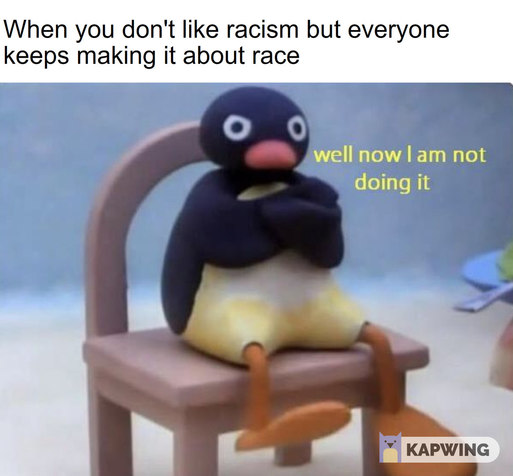
Does systemic racism exist in the US?Y'know - even if it were entirely true that the mention of race "scares off" potential allies - what the fuck kind of "allies" are so pathetically self-involved that issues of racism end up being about their own hurt snowflake feelings? Exactly why is that not the problem, rather than the demand that everyone has to tip-toe around these self-absorbed pricks who, when faced with the overwhelming phenomenon of systemic
racism'discrimination', need to have their stupid fucking feelings placated? What even kind of argument is that supposed to be?
-
Does systemic racism exist in the US?Actually if you talk about bad things at all, that too causes bad things to happen. Because that's how reality works and is totally not how babies are placated.
-
Does systemic racism exist in the US?Anyone who doesn't understand the significance of what 'systemic racism' is and why race matters in the US (and elsewhere) in the present context ought to watch this - which, notably, largely discusses the state of affairs before George Floyd's murder. Everything Mexie discusses here becomes analytically invisible were race to be artificially removed from the picture.
-
Martin HeideggerTo be perfectly honest I'm simply intimidated by the Spheres trilogy. And everything else he puts out. He writes very big bloody books. Which has never stopped me before, but I need to space them out and there's so much I (feel I) "need" to get to before diving into Sloterdijk. Don't get me wrong, I want to read him, but it's just a bit of a matter of an economization of time. I'm still tossing up whether or not I'm going to do the three volumes of Capital by the end of the year...
And I've seen that Tyler Cohen interview. I think maybe part of the 'problem' is that Zizek is playing to many audiences at once, and, yes, it's hard to square all of what he attempts to do. It'd be interesting to me to see how Sloterdijk does it. But I think it's useful as a reader to try and take responsibility for what one gets out of him. Reading Zizek always puts my guard up. I'm more critical when I read him than other authors and I almost get more out of him precisely for that reason. A kind of pedagogy of suspicion that is all the more productive because you can't trust your source. -
Martin HeideggerRegardless, can you give an example? — Xtrix
You have to understand how much I don't particularly like talking about Heidegger in depth. I've done a great deal of it and I've squared my intellectual accounts with him long ago. Nonetheless, in the spirit of laziness, here is a snippet from Lingis, whose argument basically boils down to the fact that being-toward-death cannot do the job that Heidegger wants it to do, and that the temporal and 'possibilizing' (my term) role assigned to it is far too theoretically overburderded and misses a certain immanence of death which frustrates any attempt to give it a temporally orienting/horizoning role (Blanchot, whose name has cropped up in this discussion, incidentally, was all about this - death disorients as much as it orients). Here is Lingis:
Heidegger argues that the sense of the irreversible propulsion of a life toward its end precedes and makes possible every unilateral array of means toward particular ends and every determinate action. But can death, which has no front lines and no dimensions, assign a determinate direction to one's life, and thereby impart a unilateral direction to the connections in the instrumental field? The anxiety that anticipates dying does not anticipate a last moment situated in the time of the world which my existence extends. Death is neither present nor future; it is imminent at any moment. How could death then fix the end and bring to flush the ends possible in the time that lies ahead?
Heidegger concedes that the path of one's own destiny, which unifies one's life and one's situation, cannot be drawn from the nothingness of death. He then argues that it is in the common world, in paths inscribed on the world by others, that one finds the possibilities left for one and for which one' s own powers are destined (B&T p. 434). Yet he would have to explain that the lives of others trace out paths of possibility which they leave for others because the path they actualized was an assignation put an them by death. The explanation only displaces the question.
In Heidegger's dialectic, anxiety, the most negative experience, experience of nothingness itself, converts into the most positive experience, positing my existence as my own, positing the world in its totality. The entry into the world as my home passes through the most extreme degree of alienation. ... [By contrast] to the dialectic that seeks to retrace the genesis of the world, Maurice Merleau-Ponty objected that distance, differentiation, gradation, pregnancy are primitive notions and that the facticity and nothingness with which dialectics constructs them are twin abstractions. — Lingis, Sensibility
There's alot more to this, and the full measure of the critique can't be given without contrasting it against that account for which 'distance, differentiation, gradation and pregnancy' are primary - but I simply have no desire to put in that work (for a related, Derridian critique, see here, 24mins-37mins; for a fleshed out account of the kind Lingis refers to, see here).
I will say, with respect to the discussion of etymology more generally - it's probably a good rule of thumb not to trust philosophers with doing it 'accurately'. They all have some kind of agenda and I'd much rather trust an actual philologist or linguist whose discipline it is. One of my other favourite philosophers - Giorgio Agamben - engages in long philological analyses all the time (he was a student of Heidegger's at one point), and while I love his work to pieces, I wouldn't dare offer any of it up without qualification to take it with a grain of salt. -
Systemic racism in the US: Why is it happening and what can be done?The sheer volume of work involved can be overwhelming at times. I remember working 64-hour weeks doing mandatory overtime. That’s not healthy. That’s why eventually I made a choice between my job and my health, and I chose the latter. You can see how qualified candidates will leave their job or lateral to other police departments because of the underfunding situation. — Wolfman
One of the things involved in defunding/refunding (I going to couple the two from now on: defunding police and refunding other public services), from what I understand, is a concomitant need to scale down the scope of a cops job. That is, to lessen to workload by offloading much of it to other, perhaps more qualified resources - which would also mean allowing cops to focus on things like investigative work or even more training for actual threats. There's a piece doing the rounds, ostensibly written by a former police officer, and one of the points I think was incredibly striking was this:
(from here).During my tenure in law enforcement, I protected women from domestic abusers, arrested cold-blooded murderers and child molesters, and comforted families who lost children to car accidents and other tragedies. I helped connect struggling people in my community with local resources for food, shelter, and counseling. I deescalated situations that could have turned violent and talked a lot of people down from making the biggest mistake of their lives. I worked with plenty of officers who were individually kind, bought food for homeless residents, or otherwise showed care for their community.
The question is this: did I need a gun and sweeping police powers to help the average person on the average night? The answer is no. When I was doing my best work as a cop, I was doing mediocre work as a therapist or a social worker. My good deeds were listening to people failed by the system and trying to unite them with any crumbs of resources the structure was currently denying them.
....And consider this: my job as a police officer required me to be a marriage counselor, a mental health crisis professional, a conflict negotiator, a social worker, a child advocate, a traffic safety expert, a sexual assault specialist, and, every once in awhile, a public safety officer authorized to use force, all after only a 1000 hours of training at a police academy. Does the person we send to catch a robber also need to be the person we send to interview a rape victim or document a fender bender? Should one profession be expected to do all that important community care (with very little training) all at the same time?
To put this another way: I made double the salary most social workers made to do a fraction of what they could do to mitigate the causes of crimes and desperation. I can count very few times my monopoly on state violence actually made our citizens safer, and even then, it’s hard to say better-funded social safety nets and dozens of other community care specialists wouldn’t have prevented a problem before it started.
So a defund/refund call is more than just taking away money. It's about transforming the scope of what a cop should be doing, making the policing role more specialized and less sweeping, and then putting that money into alternate sources which would tackle crime at their source, rather than being reactive about it.
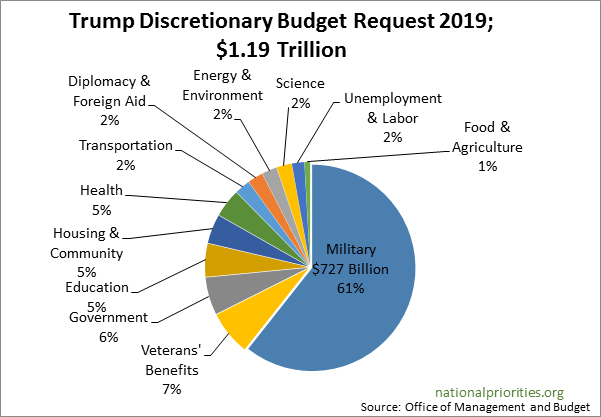
Also, what you said about defunding the US military is exactly on point too. If some of the city budgets for police are obscene, the share of military funding for the US national budget in general is even more so:
-
Currently ReadingVerso have a bunch of their books on the police for free download here atm:
https://www.versobooks.com/lists/4732-abolish-the-police -
Systemic racism in the US: Why is it happening and what can be done?You're a fraud, I don't give a flying hoot what you do, I'm just pointing it out.
-
Systemic racism in the US: Why is it happening and what can be done?God he's making things up as he goes along.
-
Systemic racism in the US: Why is it happening and what can be done?No it's really fine, your basic confusion of correlation with causation doesn't need so much as a laugh to respond with.
-
Systemic racism in the US: Why is it happening and what can be done?Ah, yes, my numbers, which are of a single year, deliberately distort facts about change in crime over multiple years. Yes, very deliberate - I can see how they conspired to do that. Spooky.

Streetlight
Start FollowingSend a Message
- Other sites we like
- Social media
- Terms of Service
- Sign In
- Created with PlushForums
- © 2026 The Philosophy Forum