
Comments
-
At the End of the Book, Darwin wrote...Yes, new species in the biogenesis sense — TheMadFool
This makes no sense. -
At the End of the Book, Darwin wrote...What do you mean 'new life'? New species? New individuals? New domains of life?
-
Where is the Intelligence in the DesignEh, the universe is largely horrible. Vast expanses of nothingness, where most everything will kill you, and not even with intent but out of sheer indifference. Most animals live on the edge of death and human animals are now far into the process of killing off the biodiversity of the Earth, with ever more inventive and effective means. When, that is, they are not killing each other, or simply sucking dry some parts of the Earth to furnish others. Nature is mostly waste, indifference, and catastrophe. What order there is is mostly just a temporary harnessing of chaos, destined to be undone in the long run. It takes a great deal of self-blinding to see 'simplicity, efficiency, and beauty' as diffuse throughout the cosmos.
-
At the End of the Book, Darwin wrote...Evolutionary theory is an account of how life, which is already there, evolves. It is not an account of the emergence of life from 'non-life' (abiogenesis). In other words, the 'if' conditional in this question has nothing to do with your question:
"If evolution is true then why aren't new life-forms popping into existence?"
The 'forms' that Darwin speaks of are species and varieties of life, they are intra-vital forms, not one life form set against a different one. That said, there are 'kinds' of life, as might be gleaned from looking at a tree of life diagram, where you can find the three major 'domains' of life - bacteria, archea, and eukaryota - that come closest to being what you call 'forms of life':
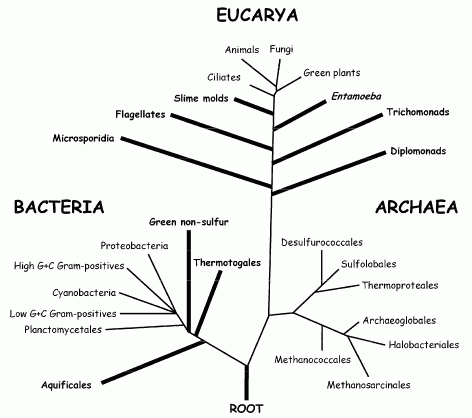
As to why these three and not others, the answer largely has to do with various chemical, energetic, and environmental constraints (i.e. how various atoms and molecules bond, how energy is generated, stored, and expended, and where and how minerals and environmental processes are distributed in space and time) the study of which is very much still an active field.
That all said, the most promising theory has to do with deep sea vents, which provide a mineral rich, warm, and continually generating entropic processes for the formation of life. -
Where is the Intelligence in the DesignTrue. Theology goes up against the wall first, when the revolution comes. Multiverse theorists get a slightly nicer wall.
-
Obfuscatory DiscourseThe basic rule of philosophical writing is: respect the intelligence of your reader as you would your own. If you find yourself being asked to to 'explain like you would to a child' to another fully grown human being, then you may as well be asking them to go intellectually fuck themselves. If you don't ask something of your reader, if you don't attempt to wrest their mind from torpor ever so slightly, you may as well not bother. Become a politician or something instead.
-
Where is the Intelligence in the DesignMy favourite God. An impertinent little shit.
Also for once I agree with @Wayfarer: multiverse theories are as much a failure of thought as all of theology. They're attempts to put off and displace cosmic questions, not answer them. An cosmogonic IOU note passed off as currency. -
ReallyYou can blame Plato. He was the dolt that kept insisting upon what the Good the True and the Beautiful really were, in contrast to all the other stuff they apparently really weren't.
-
Where is the Intelligence in the DesignI suppose, but I'm holding the Old Man to a deservedly high standard. Given all the Omnis and all. Reckon maybe a C+, as far as things go. Might just scrape on through to universe-ity, with some remedial night class or something.
-
Where is the Intelligence in the DesignIt's a staple response to ID that had an intelligent God created the world, he would have to have been supremely incompetent and not all that bright, given the kludgy and jury-rigged nature of the universe. Wiki even has a page on it, the 'Argument from poor design', or simply 'unintelligent design'. It's true that none of this preludes the idea that God really is a bumbling idiot, and if anything, is a quite a nice thought.
-
Currently ReadingJoseph Carew - Ontological Catastrophe: Zizek and the Paradoxical Metaphysics of German Idealism
Started this yesterday and I'm 2/3s through. It is fantastic. -
Death anxietySpeaking of Plato, he was pretty chill with death too in fact, but for reasons almost diametrically opposite to Nietzsche. Thus, in one of the worst texts ever written in the history of philosophy, you can read this:
"Those who practice philosophy in the right way are in training for dying and they fear death least of all men. Consider it from this point of view: if they are altogether estranged from the body and desire to have their soul by itself, would it not be quite absurd for them to be afraid and resentful when this happens? If they did not gladly set out for a place, where, on arrival, they may hope to attain that for which they had yearned during their lifetime, that is, wisdom, and where they would be rid of the presence of that from which they are estranged?
...Will then a true lover of wisdom, who has a similar hope and knows that he will never find it to any extent except in Hades, be resentful of dying and not gladly undertake the journey thither? One must surely think so, my friend, if he is a true philosopher, for he is firmly convinced that he will not find pure knowledge anywhere except there. And if this is so, then, as I said just now, would it not be highly unreasonable for such a man to fear death? / It certainly would, by Zeus, [Simmias] said." (Phaedo) -
How Do You Do Science Without Free Will?To begin with the question of justice, I'm not that convinced that there really is any univocal understanding of 'modern' justice. I say this insofar as I'm cognisant of the raging debates that take place in modern philosophy over exactly this question, and understand it to be a rather open field. Still, I get the drift of your question (a rough shift from revenge to fairness), and I'd point first and foremost to the pedagogic aspect of human freedom that I mentioned previously: the idea that freedom is learned, that we are inducted into more or less mastery over our capacities in a way that equally allows us to disavow or disregard our ethical education.
This capacity for learning is largely (but not altogether) particular to the kind of animals that we are. We have to be put in touch with our natures, as it were. Importantly, it is the necessity of such a discipline of freedom that opens up the moral dimension of human life, in a way largely inaccessible to other animals and say, tidal pools. This is something you'll find for instance in Kant, for whom "man only becomes man by education". Or else for someone like Spinoza for example, it is living 'according to reason' that puts us in touch with (our) nature, and enables us to 'act from virtue'. But it is also the case that we don't always do that, and can act in ways contrary to our reason, and with it, nature.
The big question that gets raised is then over nature itself, and how one can act contrary to nature. That requires a whole discussion in itself, but the main takeaway is that there is definitely room to accomodate the intuition that there is a specificity to human morality that distinguishes our actions from those of hurricanes. In the terms above for instance, we can understand how it is that we might not hold a mentally ill person culpable for their actions: at the limit, such a person might be in-capable of understanding what he or she has done (or is doing), having not had the opportunity to educated into moral sphere. And we can say this without having to recourse to a vocabulary of the 'will' according to which he or she did not 'will' their action. -
Death anxietyNietzsche at least, wasn't anxious about death per se: he was anxious about deaths that did not sanctify life:
"Many die too late, and a few die too early. The doctrine still sounds strange: "Die at the right time!" Die at the right time - thus teaches Zarathustra. ... Everybody considers dying important; but as yet death is no festival. As yet men have not learned how one hallows the most beautiful festivals I show you the death that consummates - a spur and a promise to the survivors. He that consummates his life dies his death victoriously, surrounded by those who hope and promise. Thus should one learn to die; and there should be no festival where one dying thus does not hallow the oaths of the living. ... In your dying, your spirit and virtue should still glow like a sunset around the earth: else your dying has turned out badly." (Z, "On Free Death")
And perhaps you'd like Spinoza's sunny disposition, for whom "‘the free man thinks of death least of all things, and his wisdom is a meditation on life, not on death" (Ethics). -
How Do You Do Science Without Free Will?Really? A quote taken from somewhere else entirely with no relevance to the discussion is a supposed to... have relevance to the discussion? Yeah, nah. And no, for the record, I don't tend to answer one-line 'gotchya' questions, and when I do, I give them responses proportionate to the little squirts of thought-ejaculate that they are.
As for everything else - my point was that the assumption built into your question about man and machine was faulty, or at least in dire need of some semblance of substance. Going ahead and further assuming the significance of the distinction via a little etymology lesson is not an argument but just more assumption. As for speaking about the 'rights' of slaves, one can only laugh at the complete historical anachronism at work here. The very language of 'rights' was invented literally more than a millennia after the time of Aristotle, so to speak of a slave 'not having rights' is about as true as speaking of them as not having iPads. True, but also hilariously misplaced.
And if what I'm 'clueless about' is some kind of boat on a horizon that is logical and also intuitive but can't be argued for - the closest you've got to having said anything of substance about free will - then I fully assume being clueless about a non-sense. -
How Do You Do Science Without Free Will?Funnily enough, for Aristotle, who had neither the word nor concept of 'machine', slaves were what he called 'animate instruments' (ktema ti empsychon) or 'instruments for instruments' (organon pro organon) (in the Politics). This was precisely in contrast to the free man, or master, who was distinguished by his use of slaves. One of the things this kind of approach brings out what counts as free or not free is not a metaphysical distinction, but a mobile one: that freedom is not coextensive with man as such, but with some men and not others.
Aristotle's analysis of slaves notwithstanding, the takeaway here is that there is no reason to think that man can't be equated with machines, if certain conditions of freedom are not upheld. But thinking in this way would would mean, once again, having to give up the incredibly stupid idea of free will as some kind of a priori metaphysical guarantee of human freedom, served on a plate to man by God. It would require, again, looking at the world, observing conditions, making at effort at understanding, and acting provisionally and with risk. This no doubt offends the sensibilities of those who think humans are in any way special, which can only be a good thing.
In any case, your questions at this point are just poo-lobbing from the monkey pen. They're unthinking knee-jerks beneath response. If you have something substantial and interesting to say, say it. No one gives a fuck about Egyptian ceremonies. -
How Do You Do Science Without Free Will?Quick note: it’s worth considering those ethical moments which follow from necessity: “why did you save the child from drowning?” “I couldn’t do otherwise”. In such a case, responsibility is taken on in the guise of necessity: ‘doing otherwise’ would be seen as an abdication of responsibility, a shirking of ethics, and not its condition of possibility. Further, it is precisely the sense of being driven by necessity that qualifies as freedom from the blind contingency of events: I can't sit idly by and watch the child drown, I must intervene: in this way, I exercise my freedom (or: my freedom is exercised - I am a passive subject of my freedom, which can be traumatising for me), one aligned with what I am able to do, and not with what I 'will'.
-
How Do You Do Science Without Free Will?Can we come up with an alternative account of freedom and responsibility that is simple enough for everyone to understand and consistent enough with ordinary notions of fairness such as to be acceptable to everyone? I have yet to see any such account. I have not yet seen any coherent alternative account that is consistent with ordinary notions of personal responsibility at all, whether simple or complex. — Janus
There are lots of models of ethics and responsibility that make no use of free will. Ancient ethics, to take one example (internally differentiated, insofar as isn't really one big 'ancient ethics') had robust accounts of ethics, responsibility, and freedom, that largely tuned upon our capacities to do: freedom as capacity or ability (I can) and not freedom as will (I will). In these models, our actions follow from who it is we are as people (our 'natures' or 'essences' to use the vocabulary of the Stoics and Spinoza), defined roughly by our ability to do certain things.
Importantly, what could be worked upon was precisely 'who we are': an ethics of the self as a matter of self-fashioning and self-care (the self as a work of art - Nietzsche, Foucault), all the better to act 'in accordance with our natures' and thus act freely. Hence the seemingly strange alignment of freedom with necessity (Stoic 'destiny') that is often found in ancient texts of ethics, incomprehensible to many modern ears. From this also follows an 'intellectualist' orientation of ethics in which ethics requires understanding ourselves and the world around us, such that for someone like Socrates, evil was a function of a deficiency in knowledge. The Stoics and Spinoza will take up this thread in their ethical injunction to act 'according to Reason'. Hence also an alignment of freedom with discipline and pedagogy, such that one learns how to be free.
One feature which I find overwhelmingly attractive about such approaches to ethics is its situatedness of the self in wider contexts and environments, which can enable and cultivate, or inhibit and stifle such understandings and development of capacities. There is a way of conceiving an entire ecological scaffolding of ethics, which underpins our ethical development or regression. And this is where politics meets ethics, at the point at which we find ourselves in a world with others, which itself can be worked upon to better cultivate (or debilitate) our ethical being. The work of the self becomes incomplete without a concomitant working upon our environments. Only in this way does ethics return to its roots as ethos - a manner of dwelling.
All of this in radical distinction to the solipsism of the fucking will, which bursts out of nowhere from some inner who-knows-what, engineered to be deliberately and radically distinct from any environment or world, meant solely to lash us ever more tightly to God least we burn in hell for not following his dictates. Hence Deleuze's remark that the will in 'free will' is the equivalent to a 'denial of existence itself' and a depreciation of all that does exist. Contrary to this, the ethical tendencies which I've outlined can be found scattered all through - at least - the Western cannon (long before the advent of free-will), and have been picked up by plenty of contemporary authors, if one wants to find them. Our pop-discourse about ethics and freedom remains utterly destitute however.
(They've been like six or seven threads on free will in the past week or so on the forum alone, each consecutive one more miserable than the other). -
How Do You Do Science Without Free Will?Is an insignificant choice - quite literally, a choice that has no significance, makes no difference - meant to be a mark of our... freedom?
-
What knowing feels likeWithout having followed the thread, one quick remark on emotion and evolution: emotion may well have developed as adaptive feature of our psychic lives, but that doesn't at all mean it stayed that way. One of the hallmarks of evolutionary development is the repurposing of novel traits to ends other than which they adapted for. And this is nowhere more clear than with emotions, which can be ruinous to the human aninal. Addiction, obsession, depression, neuroticism and so on can be seen as, among other things, emotions de-coupled from their life-preserving function and rerouted into autonomous circuits that can lead to horrible things like suicide. Psychoanalysts lovingly called this the death drive.
Evolution is simply the survival of the good-enough, not the fittest. And the good-enough can be incredibly fucked up. Anyway, off topic. -
How Do You Do Science Without Free Will?Don't really think that imagery is helpful or useful. The point is that free-will responds to a very specific problematic, and marks a massive transformation in how we think about freedom. That transformation remains, while it's motivation has been entirely lost, rendering it a totally incomprehensible notion. Worse, because it dominates the prevailing discourse on freedom, it makes trying to think through the idea of freedom almost impossible. Worst still, Augustine concocts free will to bind us ever more tightly to God, to make us better servants of God. And people think this is how we ought to secure our 'freedom'? :vomit:
-
How Do You Do Science Without Free Will?Nope. Bunch of mistranslated bullshit. You won't find freedom articulated with the will in any of Cicero's writings - the liberum voluntatis or arbitrium voluntatis. Bobzien again, reflecting on the use of in nostra potestate which is what Cicero discusses in De Fato:
"Our texts (Cicero, Gellius, Plutarch) do not allow us to establish in what way exactly the phrase 'depending on us' or 'in our power' (in nostra potestate) was understood. But they contain sufficient information to rule out [certain interpretations] ... First, there is nothing in our sources [that] the concept of moral responsibility ever connected with a belief after the deed that one could have done otherwise, or with feelings of guilt or regret that one did what one did. ... Second, there is some evidence that speaks against such a concept: ... Cicero ... attach[ed] moral responsibility to the fact that the agent is the main causal factor of the action—not to the idea that the agent could have done otherwise". (Determinism and Freedom in Stoic Philosophy)
Dihle reckons Cicero was simply pretty casual with his terminology and writes that Cicero mashed-up both Latin and Greek cognates without paying all that much attention to the differences: "Cicero, however, used the word voluntas not only to denote what was called προαίρεσις or βούλησις in Greek. Sometimes, even in philosophical texts, voluntas means desire or spontaneous wish rather than deliberate intention,' and in other passages the impulse itself (ορμή), which comes from deliberation or from conscious moral attitude, is called voluntas." The large semantic area which is apparently attached to the word in Cicero's philosophical vocabulary corresponds to the general usage of his time. So he does not seem to have seen any difficulty in the identification of "intellectuaustic" βούλησις and "voluntaristic" voluntas, since he presupposed their identity even outside philosophical discussions." (The Theory of the Will)
Augustine even has a go at Cicero for not having anything like this notion of free will: "The concession that Cicero makes, that nothing happens unless preceded by an efficient cause (cause efficiens), is enough to refute him in this debate... It is enough when he admits that everything that happens, happens only by virtue of a preceeding cause (causa praecdente)" (City of God).
That's how much 'free-will' fucked everything up. We can't even read pre-Augstinian philosophy - or Augustine, apparently - without slapping anarchonisms onto it. -
How Do You Do Science Without Free Will?The only reading of that collection of contradictory quotes that makes sense to me would be to see them all as instances of a contemporary attempt to tie the concept of 'free will' to christianity — csalisbury
That's about right, but things are complex. Arendt, for instance, fudges a bit Paul's role in the whole thing. She cites Paul as having 'discovered the Will and its necessary Freedom', but in truth not even in Paul does the term 'will' appear anywhere. Rather, he prepares the way for the term insofar as his conceptual 'innovation', as it were, was to insist upon a certain 'voluntarism' of human action that was quite original to Paul, elaborated in the context of the necessity of God's grace. Dihle:
"This difficulty about a term for will, so badly needed in St. Paul's entirely voluntaristic interpretation of man's life and salvation, results from its very nature: the notion, although not the term, of will occurs, with substantial changes and variations in function and meaning, in the discussion of theological, soteriological, and ethical questions. ... Perhaps it is the great variety of different aspects under which the phenomenon of intention and will is considered that prevented St. Paul from inventing a definite term. Each of these aspects could have demanded a separate set of terms to denote the results of speculation. St. Paul's theological reflection embraced his own and his people's religious experience as well as the needs and purposes of practical, above all congregational, life." (The Theory of the Will in Classical Antiquity)
As for the '2nd century thinkers' Bobzien cites, she herself is a bit fudgy about that too (though she's probs just being intellectual honest):
"Presumably in the early 2nd century, and as a consequence of combining Aristotle's theory of deliberate choice with his modal theory and with his theory regarding the truth-values of future propositions, this concept was interpreted as implying freedom to do otherwise. Who exactly was responsible for this new indeterminist understanding of that which depends on us is unclear, but it seems to have been accepted thereafter both by some Peripatetics and by some Middle- Platonists.
...Alexander [of Aphrodisias] stops short of a concept of free will, due it seems in part to the fact that he believes the human soul to be corporeal. The need of a free will becomes pressing in Platonist and Christian philosophy, in the context of the problems of how vice entered the world, and how god's providence and foreknowledge of the future is compatible with human responsibility. But this is no longer in the context of a physical theory of universal causal determinism, characterised by principles of the kind "like causes, like effects." Rather the determinism is now teleological only, and the context theological." (The Inadvertant Conception and Late Birth of the Free-Will Problem)
The road to 'free will' was long and complex, but the brutal condensation is this: it's emergence involved a change from the I-can to the I-will. From Aristotelian potentiality to Christian willing. One of the factors that enables this shift is the disembodiness and omnipotence of the Christian God: evacuated of body, he becomes sheer 'will': only bodies have capacities that can be excercized this this or that manner, in this or that differential context. The Christian God, shorn of body, has no 'need' for capacity, and becomes ephemeral and immaterial word and will. Augustine, who then takes seriously the fact that man is made in the image of God, then transplants 'will' from God to Man, and thoroughly fucks human understanding of freedom for the next few centuries.
Already in 1962 - a decade before any of my previous citations - Deleuze will write that "We create grotesque representations of force and will, we separate force from what it can do ... inventing a neutral subject endowed with free will to which we give the capacity to act and refrain from action". (Nietzsche and Philosophy). Spinoza being the ultimate reference for freedom without will, freedom engendered from necessity, which 'moderns' find utterly perplexing ("Waaaa revisionism!"). -
How Do You Do Science Without Free Will?I super like the idea of 'free won't', which has the merit of being able to be made sense of, unlike a certain 'free will'. Still, while I think that such a notion has a part to play in a broader conception of freedom, it remains too 'punctive', a depthless instant that largely - but not altogether - shares with 'free will' an inattention to the conditions under which freedom is excercized and sustained. A kind of freedom ex post rather than ex nihilo. It's inspiration is at least biological, which is more than can be said of free will.
-
How Do You Do Science Without Free Will?If we are not willing something, then what are we doing? — Hinterlander
Eating, fucking, building, working, lying, typing, listening, standing, staring, crying, holding, shooting, laughing, praying. Willing? Humbug. -
How Do You Do Science Without Free Will?Maybe coin the major writings as "atheology". — Hinterlander
Bataille tried this already. In any case no. The only properly atheist response to God is: 'what's that? Never heard of it; doesn't sound very interesting, got better things to do'. -
How Do You Do Science Without Free Will?Why? What warrants any of this? We did perfectly fine with any concept of 'will' for hundreds of years. It's hardly some primal datum of human experience so much as it is a cultual meme and grammatical quirk.
-
How Do You Do Science Without Free Will?StreetlightX, for clarification, your objection of free-will in a Christian context is that it allows God off the hook when it comes to the problem of evil? — Hinterlander
No, I couldn't care less about God. That free will was invented as a theological solution to a theological conumdrum is taint enough. The problem, by the way, is not freedom, but the 'will'. Freedom had a long and illustrious history as a concept before being nailed to the cross of the 'will', on which it has rotted away on ever since. Extracting freedom from its theological context entirely is what needs to happen; not retinkering with theology to make it just so. The first thing to go ought to be the 'will'. We don't need secularized theological concepts. We need concepts utterly indifferent to theology and any of its concerns. -
Hong KongThe Hong Kong protests show quite clearly how Communist China will fail.
First and foremost, the Chinese leadership and the Chinese Communist Party is literally afraid of one thing: their own people. — ssu
I would not conflate the people of HK with the people of China. While I can only speak for Beijing - I've not been outside the capital - the Chinese citizenry are far more loyal, trusting, and accepting of the State than are HKers. The Chinese state commands the allegiance of their people in ways hard to fathom for many Westerns. The State is China, in a way that is not separable into distinct units. That said, this applies far more to the Han majority than any of the other minority ethnicities in the country, who are variously treated like refuse when necessary. -
How Do You Do Science Without Free Will?For good measure, here's one last one from Albrecht Dihle's 1982 The Theory of the Will in Classical Antiquity:
"It is generally accepted in the study of the history of philosophy that the notion of will, as it is used as a tool of analysis and description in many philosophical doctrines from the early Scholastics to Schopenhauer and Nietzsche,' was invented by St. Augustine."
If 40 years ago this was 'generally accepted', one has to wonder what, exactly, is the charge of 'revisionism' other than a flagrant fucking rainbow flag of "I don't know my history and I'm making shit up in its place". Actually, looking it up, Arendt's book, The Life of the Mind, from which I quoted was published in 1971. One wonders how anyone at least 50 years too late the party has the balls to speak of 'the literature' which ought to be 'surveyed'. -
How Do You Do Science Without Free Will?Yes I can see how citing and quoting four authors (six, really, if you count Gilson and Brown) somehow becomes 'one or two' authors, while simultaneously being accused of not 'surveying the literature', while you get to be 'not that interested in history' while availing yourself of this apparent uncited and unsourced mythical history nonetheless. And I'm dogmatic.
And of course free-will is tainted by its theological roots - I'm not trying to 'insinuate' this: here's me being explicit about it: free-will is theological trash. It's as if someone were to say 'look, just because the doctrine of the trinity was a tad bit theological doesn't mean we can't use it without reference to some God or another'. Well no, they're both as rubbish as each other and stem from the same poisoned chalice.
As for concepts being 'conflated with that which they purport to address', wtf else are concepts if not designed specifically for addressing 'what they purport to address'. Concepts are not plucked from the air to play with for funsies, they're put to use in contexts which alone give them any sense. That the historically and philosophically illiterate have done just that is just the reason that "free-will" is even more fraught a concept than it was before. At least the Christians knew full well what they were doing when they invoked it, unlike our supposedly 'modern' thinkers who are currently beating an aeons dead horse called 'free will' while asking it to do a little trot for them. -
Hong Konghttps://www.smh.com.au/world/asia/harrowing-video-that-shocked-hong-kong-shows-cycle-of-escalating-violence-20190901-p52mv9.html
"Black clad special forces police storm through the train, wielding batons. More police, dubbed “raptors” by HK’s protest movement, stand at the doorways of the carriage - the only escape route - and spray pepper spray directly at screaming passengers. ... More video shows police striking a protester already on the ground, squashed beneath a scrum of police knees. When they realise a South China Morning Post reporter is videoing the scene, they try to block his camera.
"HK lawyer and commentator Kevin Yam says each weekend seems to provide a more likely excuse for Carrie Lam to enact emergency legislation, as the government not only fails to stop street protests but more importantly loses the battle for the HK public’s hearts and minds. "If we look back over the escalation of violence in the last month there is one consistent pattern - when there is a hardcore of protesters that go a little bit too far with their actions, the police always respond with action that goes way further than the protesters.
With Lam refusing to respond to protester’s demands with even the simplest action - formally withdrawing an extradition bill she has said won’t proceed - the cycle of violence in HK appears set to worsen."
Fuck the HK state and their castrated leaders. -
How Do You Do Science Without Free Will?In response I'm just gonna whine a little bit:
"The great scholar of late antiquity Peter Brown... points out that Augustine has been called the “inventor of our modern notion of will.” Augustine deflected the locus of human striving for meaning and purpose away from the philosophic and scientific search for the human place in nature and the cosmos and toward a concern for the individual will. His achievement was a “shift from cosmos to will,” “a turn[ing] away from the cosmos,” Brown says." (Heidi Ravven)
"An examination of the attempts carried out by Western thought to provide an ethical foundation for sanctioned action (with this term we are indicating from this point forward action imputable to a subject and productive of consequences) shows that, when they are not simply absent, as happens in classical Greek culture, they coincide with the laborious elaboration of the concept of free will in Christian theology and remain, perhaps for this reason, singularly fragile." (Giorgio Agamben)
"It is then presumably only a slight overstatement when I conclude with saying: the problem of physical causal determinism and freedom of decision entered the scene in the 2nd century A.D., by a chance encounter of Stoic physics and the fruits of early Aristotle exegesis, with the contemporary focus on the culpability of mental events and the introduction of a power of decision making as catalysts - and it was not part of the philosophical repertoire for long." (Susanne Bobzien)
"Authors well read in Greek literature have always been aware of this lacuna. Thus [Etienne] Gilson notices as a well-known fact “that Aristotle speaks neither of liberty nor of free will...the term itself is lacking,” and Hobbes is already quite explicit on the point. ... It cannot be “seriously maintained that the problem of freedom ever became the subject of debate in the philosophy of Socrates, Plato, and Aristotle”... The reluctance to recognize the Will as a separate, autonomous mental faculty finally ceded during the long centuries of Christian philosophy ... It was in close connection with the preparation for a future life that the Will and its necessary Freedom in all their complexity were first discovered by Paul. ... Hence one of the difficulties of our topic is that the problems we are dealing with have their “historical origin” in theology rather than in an unbroken tradition of philosophical thought." (Hannah Arendt)
None of this, of course, can stand up to the Logical and Innate Feeling of Shamshir's circumnavigating, observational little boat of free-will.
Streetlight
Start FollowingSend a Message
- Other sites we like
- Social media
- Terms of Service
- Sign In
- Created with PlushForums
- © 2026 The Philosophy Forum