
Comments
-
Philosophical CartographyThen take the saying, a picture is worth a thousand words. You have that as a common saying, even among ordinary folk.
But, what you're trying to do is reach a limit but never quite converge in my opinion. — Posty McPostface
This is wishy-washy. -
Philosophical CartographyThe map can only present itself as an image in two dimensions. — Posty McPostface
The point is that dimensionality is not only visual when it comes to maps (or anything else for that matter): a dimension simply designates a variable, and a visually 2 or 3D map can expresses variables far in excess of its visual dimensionality. I.e. the restriction you're trying to gesture toward is not a relevant one. -
Philosophical CartographyCartography doesn't account for the fourth dimension that philosophy exists in. — Posty McPostface
But cartography isn't constrained to any particular number of dimensional degrees at all; consider Minard's famous map of Napoleon's campaign in Russia:
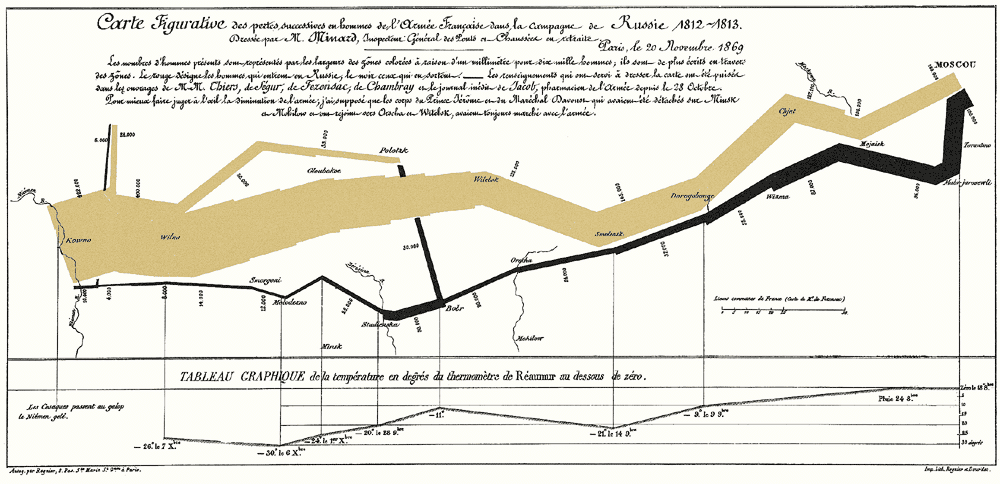
It contains at least six points of data: number of troops; distance; temperature; latitude and longitude; direction of travel; and location relative to specific dates. Modern, interactive, digital maps can contain even orders of magnitude larger points of data: in most cases the problem is not to add dimensions, but to cull them in order to be rendered legible in the face of data overload. Philosophical cartography, is at once both easier and harder than this: easier because operates largely in the largely dimensionless world of words (and so perhaps should be called philosophical cartology) which makes it infinitely more malleable, and harder precisely because it is no longer constrained by the graphic and thus much harder to follow. Books - and not just philosophical books - are all maps in their own way; philosophy's distinction is in dealing with the terrain of concepts and of sense. Philosophy plots concepts as maps plot terrain or time.
In fact, picking up on the Wittgenstein thread, one could say that the constraints that function in a philosophical cartologly replace the graphic with the grammatical: to construct a philosophy is to construct a grammar, to the degree that "grammar tells what kind of object anything is" (PI §373); a philosophical map maps the world according to the grammar that it develops, highlighting these relations over those ones, allowing these moves of conceptual translation while disallowing others. If "essence is expressed by grammar" (PI §371), then philosophy's capturing of essences takes place by way of grammar (elsewhere Witty will speak of how "a drop of grammar" can "condense a whole cloud of philosophy" (PI §315)). And just as maps have their own grammar - the grammar of a heat map will differ from the grammar of a river map - so do different philosophies have grammars specific to them.
Thus - for example - the (concept of) Ideas of Plato will differ from the Ideas of Kant will differ from the Ideas of Deleuze: each has a grammar distinct to its 'language-game', locating the 'joints of the world' differently each time, and articulating the world according to the grammar specific to the philosophy (in the original sense of the word the Greek arthron: to join, and hence articulate, both world and word). These maps - these philosophies - each paint the world in a different light, bringing to light these features or those features, being more or less relevant, more or less significant, depending on the context of a particular investigation. -
Philosophical CartographyPhilosophy is like cartography - each investigation reveals the aspect of human experience that it is interested in, and its utility is judged by it's being put to some use or another. This is a metaphilosophical position.
Metaphilosophy is an act of philosophy (as your second quote describes).
Therefore a metaphilosophical investigation is also like a map, drawing out those aspects of the field that the cartographer is interested in, and measured by its being put to some use or another.
Therefore it must be the case that the metaphilosophical theory that philosophy is like cartography and so similarly constrained, cannot itself be normative. — Pseudonym
There's simply no way anyone with any familiarity with Wittgenstein could make this kind of argument with a straight face: as if the metagame is here an act of interpretation. As if every act of philosophy - and hence language - doesn't carry its own metagame on its back in the mode of the practice of that self-same act of philosophy itself. Philosophical competency on holiday. -
UniversalsWhat does it mean to say they exist as names alone? — Vipin
In a way this is the question that defines the terrain of nominalism: to answer this is to have a theory of nominalism, and there are quite a few of those. You're right that nominalism is generally anti-Platonic (insofar as Plato is said to be a realist, and not a nominalist, about universals). So to get your conceptual bearings, the opposite of 'nomialism' is usually said to be 'realism'. The SEP is, as always a good but detailed introduction to the topic:
https://plato.stanford.edu/entries/nominalism-metaphysics/#NomAboUni -
UniversalsPerhaps a less confusing way to put it is that nominalism doesn't necessarily have to be committed to the denial of universals as such. What it denies is rather the 'reality' of universals; it says that that universals only exist, insofar as they do exist, as names, as nominata, and not as something substantial - as if another entity, another ens - apart from particular instances of 'strong arms'. Not 'whether' universals exist but 'how' they exist (as names, as things): this is perhaps a more tractable approach to nominalism.
-
Philosophical CartographyIs this a fair comparison? — Πετροκότσυφας
Definitely. To employ a language-game is simply the minimal criteria of any coherent discourse, let alone philosophy. To set out a language-game in which the distinctions made shed light upon, or help think though, a problematic immanent to the game: that's philosophy. To cite a quote I often return to:
"A philosophical theory is an elaborately developed question, and nothing else; by itself and in itself, it is not the resolution to a problem, but the elaboration, to the very end, of the necessary implications of a formulated question. To criticize the question means showing under what conditions the question is possible and correctly raised; in other words, how things would not be what they are were the question different from the one formulated. This means that these two operations are one and the same; the question is always about the necessary development of the implications of a problem and about giving sense to philosophy as theory. In philosophy, the question and the critique of the question are one; or, if you wish, there is no critique of solutions, there are only critiques of problems". (Deleuze, Empiricism and Subjectivity, my emphasis). -
Philosophical CartographyYou've not specified what would qualify as success in any of these measures. — Pseudonym
Then it seems you are not a competent speaker of the English language. -
Philosophical CartographyIs the distinction between two approaches to philosophical systematization well-founded? Does cartographic philosophy meet the challenge of positively responding to the critique of static systems as laid out in the OP? Is that challenge well articulated? (I'd like to think 1) Yes, 2) Mostly, 3) Could be better). If you're a particularly good reader you might be able to see more, much more, in it than the schematic laid out here, and pursue those implications further. Then we'd have an interesting discussion beyond this novice muck.
Any more hand holding you need? -
Philosophical CartographyAny work of philosophy that qualifies as such furnishes its own criteria of assessment - how is this so hard for you to understand?
-
Philosophical CartographySufficient to whose satisfaction? — Pseudonym
Sufficient to the problem as articulated: the physiognomy of our problems, as John so felicitously put it. Do they not teach the basics of immanent criticism any more? That you keep coming to this idea of 'subjectivity judgement' or 'agreement': it simply shows that you simply don't know what you're talking about. Even your questions are badly put; they don't deserve answers because they're not even worthy of their own articulation. Doubly tragic coming from a reader of Wittgenstein. -
Philosophical CartographyAnd the measure of the substance of an issue is...? — Pseudonym
... Unable to be decided in advance of the issue's being articulated and its implications laid out. No doubt this seems like magic to anyone unacquainted with the elementary tenets of reading tout court. -
Philosophical CartographyThe offense taken at the examination of the presumptions in one's own field is not an adequate defence against any issues thereby raised. — Pseudonym
Would it be that you had anything of substance to offer as an 'issue thereby raised'. -
Philosophical CartographyThat's therapy. In a thread like that we engage in a discussion with someone in order to better understand the nature of the problems that have wormed their way in, why s/he's not getting what s/he wants from the activity of engaging these problems in the way s/he is, and what changes in her life, her meta-philosophy and her understanding of these problems might get her feeling right again. — John Doe
I agree - this kind of thing is therapy. Even philosophical therapy, if you will. But it sure as hell isn't philosophy, even if it is parasitic upon it. When you speak of "raising the further issue to one's self about why precisely these problems gnaw away, why one works at these problems and what one hopes to achieve by working through these problems" - this is a totally legitimate manner of inquiry, sure, but it is, as you've said yourself 'a further issue'. What I despise - and what I thinks merits all the scorn it can get - is the hopeless confusion of this with or as philosophy.
Perhaps, and this is all the concession I'll grant, there might even be a outcrop of philosophy that treats such problems as themselves problems of philosophy: but this too would be to place it in a long line of other problems of which 'problems of therapeutics' would be but one. The reduction - a reductive, psychologizing diminution - of philosophy itself to therapeutics really does make of it a carcass to psychologizing crows; its true that seeking therapy in order to better understand one's relationship with that person doesn't invalidate that other person: but to treat the other as nothing but the result of that relationship is intellectual violence of the worst kind, and I will never stop denouncing it.
Just as a physicist would resent, rightly, the idea that science is just a nice panacea for a bunch of intellectual neurotics - that it is, in fact, nothing but such a panacea, so would anyone who cares one jot for philosophy reject the impoverished and impoverishing idea of 'philosophy as therapeutics'. None of this, by the way, despite certain far-fetched claims here, constitutes a particularly exclusionary vision of philosophy. While it certainly entails a rejection of a fringe position that developed in some European backwater and popularized by a small cabal of contemporaries, the rest of the Western canon is more or less fair game. -
Philosophical CartographyI think it's more akin to seeing a map as a tool for getting you where you want or need to go. — John Doe
Mmm, and I have serious qualms about this. This 'use' - in the instrumental sense, like a bureaucrat's - doesn't seem to me to respect the autonomy of philosophy's problems. Any philosopher knows that problems impose themselves upon you, that they worm their way into you so its not a simple matter of submitting philosophy to one's whim and fancy, even if that is a 'therapeurics of the soul'; to engage in philosophy is to be driven where the problem takes you: to submit to necessity, as one does to a landscape which one maps out. Deleuze once wrote that the only use of philosophy is to sadden and shame and these are affects I think far more appropriate to philosophy than the self-gratifying attempts to make it some bourgeois weekend retreat in the Caribbean.
Therapeutics makes use of philosophy as one makes use of another without regard or respect for their autonomy. It prostitutes philosophy. -
Philosophical CartographyEh, don't read too much into it. I'm not replying with much seriousness or interest to the windbag I'm responding to there. But if I were to try and fit therapeutics into the picture I'm painting here, I do think they have an incredibly flawed understanding of philosophy: they treat philosophical cartography as a matter of collecting pretty things; they have a dilettante's understanding of philosophy, even if, in the end, they may produce some very good instances of it.
-
Which philosopher said this?It wouldn't happen to be part of the dialogue in Jostein Gaarder's Sophie's World would it? I don't have a reference on hand, but there's a bit early in the novel where the philosopher is talking to Sophie about Aristotle and lego blocks - if I remember right - essentially dealing with the question of the Identity of Indiscernibles. In any case, if you read up around that problem - which seems to be what you're dealing with - you might find further clues.
Alternatively, it might be buried somewhere in Leibniz's many correspondences, but that's a pure guess on my part. -
Philosophical CartographyHeh, no worries! I wouldn't worry too much about the consolidation though! One nice way of thinking about studying philosophy is in building a personal map collection: some will be more accurate than others, some will be outdated, others obsurce and specific, and yet others still faded and forgotten. Most will be half finished, or have borders that simply fade off at some point. Perhaps a certain theme would run through them (both Heidegger and Bergson said that philosophers over really ever pursue one burning question in their lives...). The point would be to make the collection robust and interesting; and if a handful helped you and others navigate the world somrwhat more sucessfully, then that'd be something to be proud of.
-
Philosophical CartographyAh, sadly the academy isn't perfect. They'll let any old dolt through once in a while. Somtimes, rooted agape by a series of shiny letters, people even look up to them.
-
Philosophical Cartography
-
Philosophical CartographyThe universally agreed on purpose of philosophical investigation is... — Pseudonym
Who said anything about universal? Every investigation defines its own object and stakes; any competent reader can assess how well it goes about doing that, and if cashes out those stakes well. And philosophies fail and succeed at this at varying degrees at this all the time. The idea that what I'm saying renders anything immune to criticism is another silly non-sequitur. -
Philosophical CartographyNo such purpose exists for philosophical investigations... — Pseudonym
Then I suppose you're unfamiliar with philosophical investigations. -
Philosophical CartographyYeah, anatomical maps are particularly apropos because they are largely for the sake of medical interventions: the point isn't really to create the most adequate map of the human body - as if some hobbyist's completionist project - but rather to draw attention to features that would serve in the diagnosis, treatment and care of this and that disease, of this and that health problem. And such maps may require elements of massive exaggeration - in the case of the blown out proportions of the homunculi - or else efforts at stripping away and paring down, as with the skeletal system.
I was once at a talk by an anatomist who lamented the fact that we are not thought, in general, about just how variable the human body can be on in the inside: that the standard representations of skeletons hide massive differences in even very small groups of people (she pointed out a simple example where about half the room had particular bumps on their wrists, and others not; this, she said, barely scratched the surface of those differences just in that room itself). So one can imagine the variability in maps as well, each of which may need to be tailored to particular bodies, each with their own particular problems.
And contrary to the intellectually stunted who would see this as a mere relativism ('relative', one imagines, to some abstract ideal that in fact exists nowhere in reality), it would instead demand that one pay closer attention to things, that one hews more closely to the facts as they present themselves to our attention.
One thing the cartographic emphasis somewhat doesn't capture though, is the historicity of philosophical analysis. Unlike terrain or bodies, the formations of which are relatively stable in the medium term, the terrain of philosophy - that is, sense - mutates at far faster paces. The problems which call for analysis change far faster than the usual objects of maps. -
Philosophical CartographyHow could a professor say of his student's thesis anything other than "Well, it's not of any terrain I recognise, and it has no utility to me", — Pseudonym
This seems a silly question and symptomatic of your post in general. Any good thesis clearly and convincingly sets out the stakes upon which it turns; that they may not be stakes that you - or anyone else in particular - are interested in is, of course, entirely irrelevant. Is this something that really needs to be explained to you?
These do not sound like maps of meta-philosophy which are no more true than other maps, they sound like absolute edicts about what must be, what is necessary. — Pseudonym
This, in turn, trades on a simplified and unreflective opposition placed between necessity and the dynamism of cartographic practice. Any cartographer knows that map making is driven - absolutely - by the necessities of what is being mapped, along with what is aimed at by such mapping. Yet this does not imply, in the slightest, that a topographic map is somehow more true than a pressure gradient map. Even the most basic understanding of necessity recognizes that it can operate at varying levels of generality that leaves plenty of room for creativity and pragmatics - which in turn operate according to constraints appropriate to their own orders. It's very tiring to hear you bang your relativist drum over and over - your failure to think beyond first year distinctions is no one's problem but your own. -
Shame as Joy's inverseAll things in measure, perhaps? Excessive pride, hubris, or arrogance is considered negative everywhere, but there are some small prides, related to belonging, a satisfactory job, a joy generated by the right doing of a relative, or comrade.
There are some cases, where humility, or modesty seems almost insulting as well. If you are competitive with someone that is far superior skilled, and they say "it's nothing", "no big deal", and talk of how they could have done better, when it was far superior to your performance seems almost incendiary. — All sight
I'm very weary of the Goldilocks moralizing impulse ('not to much, not too little, just right') because it strikes me as overly abstract. What is too little, what is too much? I think these 'metrics' of affect need to be tethered to something; what is it that one has done or is that one can take pride in it? And so with shame and humility: What are you ashamed of? What are you being humble about? As I said to Csal, I think these affects become 'negative' when decoupled from their object and are taken to be reflexive objects of their own standing: one defends one's pride ... for the sake of one's pride. This seems to me to better locate the danger of pride than the Goldilocks framing. I think even massive, excessive, glowing pride, is fine: if one's earned it.
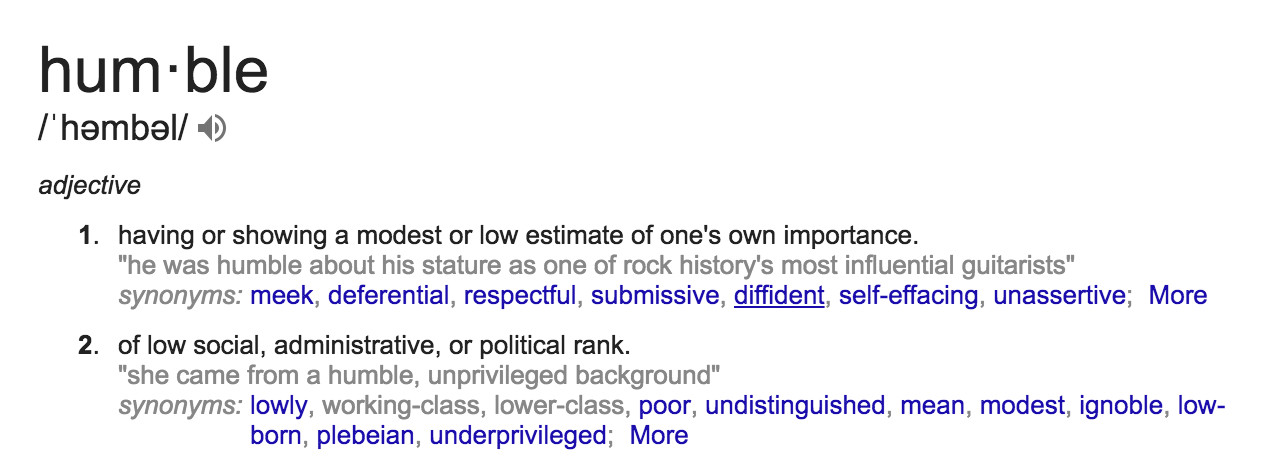
A while back there was an interview with the musician Justin Vernon (Bon Iver), where he talked about a small debate he had with Kanye West over the value of humility. I remember the lines quite fondly: “I got in a friendly argument with Kanye West about the word humble once,” he recalled. “He said, ‘Have you ever looked up the word humble?’ I was like, ‘Actually I don’t know if I have.’ And he showed me the definition of it, and it’s far more self-demeaning, kind of the problematic Midwestern ‘Sorry!’ mentality, than I realized.” He continued, “I took a lot out of that conversation. Ultimately, I think it’s great to serve others and everything, but I think there’s a certain point where it’s diminishing returns for the people around you if you’re not showing up and being who you are.” (source). I found this supremely affirming, and still do - regardless of what Kendrick Lamar now says.
For reference:
-
Shame as Joy's inversewonder if there's two separate emotions or states that have been lumped under a single word. I think there's a type of pride that is something like identification with a covetable virtue or characteristic because its covetable. And then there's another pride that is something like the ability to stand in front of oneself or others without concealing oneself - kinda like the opposite of what Levinas identifies (correctly imo) as the essence of shame. — csalisbury
This seems a good way to put it, though the reference to flourishing makes me think that 'negative' pride is pride loosened from its object; where one has pride in one's skills, one's accomplishments - pride to the extent that one has enabled, furthered, and contributed something to and of the world; when this pride becomes 'separated from what a body can do' and monumentalized into sheer memory ('representation'?) - that's when pride slips into its negative ("he lives in poverty, but he refuses to do work he considers beneath him; he was once a captain in the army, see...").
Also, situating pride as the opposite experience from shame qua Levinas ("the ability to stand in front of oneself or others without concealing onself") makes me need to refine the OP a little; if I want to say shame is the natural paring to joy, then I need to refine the phenomenology of joy insofar as joy is - and I'd be open to correction here - something that deindividuates: one loses oneself in joy, one forgets, in some manner, that one is a self; beatitude evacuates our person-ality, it's just smiles and warmth and the repose therein (pride, on the other hand, in maximally individuating: I am proud of what I have done or of who I am in having done the thing, 'without concealment'. Adorno once wrote a passage that still haunts me to this day:
"To happiness the same applies as to truth: one does not have it, but is in it. Indeed, happiness is nothing other than being encompassed, an after-image of the original shelter within the mother. But for this reason no-one who is happy can know that he is so. To see happiness, he would have to pass out of it: to be as if already born. He who says he is happy lies, and in invoking happiness, sins against it. He alone keeps faith who says: I was happy. The only relation of consciousness to happiness is gratitude: in which lies its incomparable dignity" (Adorno, Minima Moralia).
There's something both terrible and lovely in this, I think, even if a bit of an idealization. -
Shame as Joy's inverseIt's pride that one is basking in, not joy, and the higher the pride, the deeper the shame. Basking in ones strength, beauty, goodness, superiority, and then to have this challenged or brought into question transforms it to shame. The greater the pride, the deeper the shame. — All sight
I didn't think about pride, despite it being the natural paring to shame, actually. But considering it, it actually does seem like an interesting candidate to pair with sadness: if joy and shame are inversely related, pride and sadness might make a nice corresponding pair as well. Would have to flesh that out a bit, but preliminarily I don't see anything wrong with pride, prima facie. Pride, rightly wrought, strikes me a beautiful antidote to sadness. The 'sinfulness' of pride seems to me to be a particularly Christian POV, which is more than enough to render that framing utterly bunk, I think.
There are also issues of class I have in my head swirling around here; shame has always been the lot of the poor and the aspirational; it has an repressive effect. Those in power seem to rarely display shame; there's a reason why LGBTQ movements often fly under the banner of pride: there's a cooption of pride that is necessary and powerful, and it's a shame - hah - that it has the negative connotations that it does. -
Shame as Joy's inverseI imagine that the success of consciousness raising political activism has produced a counter ideology that seeks to eliminate shame, which renormalises that which has been exposed as a problem. — fdrake
Yeah, this is something I've noticed recently - a tendency to translate political problems into psychological terms (and thus take them out of the running from political contestation): "I am so over being made to feel bad about who I am, and I'm going to believe in myself and find my happiness; I will enjoy myself in the face of your attempts to guilt and shame me". But this is never at issue in 'consciousness raising' (or at least, it shouldn't be). Reminds me of a Guardian article a while back about the 'potent tears of white women' (https://www.theguardian.com/commentisfree/2018/may/08/how-white-women-use-strategic-tears-to-avoid-accountability):
"Almost every BW (black woman) I know has a story about a time in a professional setting in which she attempted to have a talk with a WW about her behavior & it has ended with the WW (white woman) crying,” one black woman wrote on Twitter. “The WW wasn’t crying because she felt sorry and was deeply remorseful. The WW was crying because she felt “bullied” and/or that the BW was being too harsh with her.”
Or else in the 'argumentation' thread, there were a few people who said that those who would shut down certain debates feel their 'identity threatened' or don't feel 'confident' or whathaveyou. Again, a case of political action being translated into psychological categories and 'feelings': "you only say that because your joy is being infringed upon". Which again, I think is just nonsense. And of course, something dreadful happens when this feeling is taken up as a theme in it's own right and made into an object of political affirmation ("I'm sick of being made to feel bad - never mind that my feelings are not the point; I will band together with those who feel as I do, and we will make a thing out of this"; It's reactionary (non-)politics through and though).
It's hard to blame anyone for this in particular, even those who actually engage in such mistranslation. Our political vocabulary is lacking, woefully. And feelings are easy, and shame and joy are particularly potent and easy to rally around. -
Shame as Joy's inverseI have no interest in discussing Levinas' ethics, I just found his formulation of shame to be particularly appropriate.
-
Abusive "argumentation"You have simply made a martyr. — Lif3r
I've always found this argument entirely disingenuous. By putting murderers in prision, we do not make them 'martyrs'. By locking away rapists we do not make rape a cause of martyrdom. The 'martyrs' argument is always selectively wheeled out by those who do not have the courage of their own convictions, playing a faux-neutrality that does nothing but give aid to horrible people. Let awful people be martyred. We'll 'martyr' their sympathizers too. As for this:
You have a duty to your fellow human beings — Lif3r
No one ought to give a flying fig about 'human beings', an abstract, useless category made to intellectualize the flesh and blood of the world out of existence; one has duties to the persecuted, the voiceless, friends and strangers in need. Not 'human beings', who are as miserable as they are wonderful by turns. Human beings don't exist. Only these people and those people in real, concrete situations do. And one 'has a duty' to them, far more than the armchair, paper cut-out notion of the 'human being'. -
Aristotle and Mind/Substance?The terms matter and substance are generally said to correspond to hulê (usually set alongside 'form' or morphê), and ousia ('being'), respectively. It's worth mentioning that 'substance' is regarded by many as a Latin mistranslation of ousia, insofar ousia does not really mean anything like 'substance' in the sense that we generally understand it. Further, ousia and hulê ('substance' and 'matter') play very different roles in the Aristotelian philosophy, and do not function as pairs in a distinction. As far as mind (nous) goes, it corresponds best to the category of potentiality (dynamis, and not either matter or substance): "It (nous) has no other nature other than that of being potential, and before thinking it is absolutely nothing" (De Anima).
-
Is the opposite of opposite, sameness?Why do they mean different things if they denote the same thing, then, if I may ask? — Posty McPostface
'Different', 'same', 'mean', 'denote'; these are all fraught terms if you're not clear what is being understood by them. The thing is, there's no answering your OP in the abstract. In itself the question is more or less meaningless - an 'idling engine' of language kinda deal. It's only in reference to what one is trying to do with the language one uses that the question can 'take on' sense. What motivates it? What context it is being employed in? Sans context sans sense. -
Is the opposite of opposite, sameness?In classical logics yes, in paraconsistent logics no:
"Classical rules which govern the valid procedures for assigning the values of true and false is expressed in the Aristotelian idea that the negation of the negation of A (not not-A) yields A. However, for paralogicians, it is possible that the negation of the negation of A does not yield A, or rather that it could yield A and something else. Double negations have strange properties in paralogic, but we have some familiar examples of their effects in our ordinary linguistic usage. For example, one of the characteristic rhetorical tropes of Wordsworth's poems is litotes or understatement, which often makes use of the double negation, as in "I am not unwilling." We know what it means to be willing and unwilling, but we also know that to say "I am not unwilling" is nowhere near the same thing as saying "I am willing." The Greimasian semiotic square produces an excessive term at the place of double negation, and [the] example of the "undead" is another case of it". (Rothenberg, The Excessive Subject). -
Abusive "argumentation"Isn't that a big brother attitude or is it parental prerogatives? — TheMadFool
there's a meta-battle for framing going on — Baden
'A meta-battle for framing' is a nice way to put it; and the challenge here is to avoid - at all costs - fixing the value of this meta-framing once and all: as if all aggression is only never negative and debilitating, as if all cordiality is only ever positive and helpful. But none of these meta-framings can be given in advance, and it's only with attention to - as you said - their context of deployment, that one can start talking, with any seriousness at all, about 'big brother attitudes' and so on. -
Abusive "argumentation"You asked if abuse is ever appropriate in argument. It is. Ideally, not so much in a place like this where the stakes are generally low and abuse is a largely disproportionate response, but as a matter of generality, there is no particular reason to bar abuse as a matter of argumentative principle.

Streetlight
Start FollowingSend a Message
- Other sites we like
- Social media
- Terms of Service
- Sign In
- Created with PlushForums
- © 2026 The Philosophy Forum