
Comments
-
Philosophical Quotes About ArtEh, enough with the pseudo-psychology. Anyway, I complained that you made an unsubstantiated claim, when all the established evidence shows otherwise. You asked for evidence, and I gave you citations. And the evidence is certainty more than can fit in a paragraph or two. Perhaps look up the evolution of feathers. Or how the Bower bird nest came to be. Or the how the club-winged manakin came to be. Or the evolution of duck sex. Duck sex is super interesting.
https://www.theatlantic.com/science/archive/2017/05/how-beauty-evolves/525741/ -
Philosophical Quotes About ArtEh, I've always liked Neitzsche' quip that thinking is not something that anyone does but is that which befalls them. I have no claim to mastery over my own thoughts. It's certainly the oddest cage you might come across.
All you have to do is provide a better quote than the one you provided which demonstrates that sexual selection is real. You're backtracking and making me look uneducated because you didn't provide a good quote. — Noble Dust
I provided a quote from an article which I linked to. It's blue and everything. Did you read the article? I could copy and paste the article, but I don't think it would make for a great forum post. -
Gender equalityIs something being a masculine or feminine ideal inherently a bad thing? — Mr Phil O'Sophy
Not at all. -
Gender equalityOne thing to keep in mind, when talking about things like career preferences, is also how those preferences were cultivated in the first place. If it is not seen to be a feminine ideal to be a STEM worker, how likely is it that those preferences will come to be in the first place?
So one must be careful about the status of 'explanation' here. Perhaps X and Y might explain certain things. But that X and Y serve as an explanation at all can itself be something open to critique. -
Philosophical Quotes About ArtMost of what I think and say is not my own! Almost all of what I know in philosophy or elsewhere is what I've cobbled together from others, and I certainly don't have the hubris to even try and pass it off as my own. How could it be otherwise? I neither think it desirable nor admirable to vie for any kind of lofty solitude in a field as interesting and rich as philosophy. And you asking this in a thread about quotes from other people? Come on.
And my point is that sexual selection - which is a mechanism of evolution - provides evidence that animals experience aesthetics. And sexual selection is well studied, much discussed, well documented subject of study. If you want to argue about the invocation of sexual selection as evidence, then by all means. But other than showing you where you can do your own research, I'm simply not going to give you an evolutionary biology 102 lesson. At least not without a fee! Will also accept a nice dinner. -
Philosophical Quotes About ArtBut these aren't my ideas about aesthetics. These are other people's ideas, supported by a bunch of evidence. I'm realying them to you. My gosh, if you want a third book, you can read Darwin's Descent of Man, where he lays out the theory of sexual selection. Or Grosz's own research, presented in the book the quote is from - or better yet in her Becoming Undone. Or you could do your own reading about sexual selection. It's like someone asking me to prove that natural selection is a thing. No, if you're unaware of it, then don't join the discussion, and certainly don't tell me I'm wrong. I'm not the one contesting Berdyaev on the basis of being entirely unfamiliar with Berdyaev.
-
Philosophical Quotes About ArtI cited a whole book! What more do you want?? How about Michael Ryan's A Taste for the Beautiful? That's two books.
-
Philosophical Quotes About ArtYes, the appeal to actual real life scientists sounds like an "I". Uh-huh. I gave you citations - a link to an article even - feel free to educate yourself.
-
Philosophical Quotes About ArtTo the contrary, the issue is not anthropomorphism but a vast underestimation of animals on your part. There is an answer to your question because there is ample evidence that birds - and other animals - discriminate between potential partners on the basis of aesthetics, and that this dicrimination is widespread and powerful enough to act as a mechanism of evolutionary selection unto it's own: sexual selection. Importantly, sexual selection operates on the basis on a genuine aesthetic choice, which means not only that animals are sensitive to beauty qua beauty, but that that sensitivity has had vast impacts on the very phylogenesis of animals. I quote from Richard Prum, an ornithologist who has written perhaps the best book I know on the subject, The Evolution of Beauty:
"Today, Darwin’s choice of aesthetic language can seem quaint, anthropomorphic, and possibly even embarrassingly silly. Clearly, Darwin did not have our contemporary fear of anthropomorphism. Indeed, he was engaged in breaking down the previously unquestioned barrier between humans and other forms of life. Darwin’s use of aesthetic language was not just a curious mannerism, or a quaint Victorian affectation, but an integral feature of his scientific argument about the nature of evolutionary process. Darwin used ordinary aesthetic language to make an extraordinary scientific claim: mate choices based on the subjective evaluations of animals drive the evolution of sexual ornaments in nature. By using the words beauty, taste, charm, appreciate, admire, and love, Darwin proposed that mating preferences evolved for displays that had no utilitarian value, other than the pleasure they evoked to the chooser." (Richard Prum, Beauty Happens).
Whoever the 'we' are that you invoke in your claim that 'that's all we know', it isn't the 'we' of biological science. It sounds a great deal more like an 'I'. -
Laws of NatureAnd perhaps should we not simply stabilize the usage of the term to resolve the issue of your OP? If Nature is not a stress-free system, not a place of well-regulated common practices repeated over and over again, as, it seems to me, all evidence should point to, then should we not agree that neither one or the other meaning of the term applies to it? — Akanthinos
True, true, but it's important to be precise: if we admit both senses, to the degree that nature is not 'well-regulated' in the 2nd sense ('efficient'), it is because it is not well-regulated in the 1st sense ('extension'). There's a logical priority here which one must be careful to attend to. -
Laws of NatureIt seems that rather that it is a criticism of the concept of Law in regards to the domain of natural philosophy or even just Nature itself, a qualification of how should be understood the extension of these Laws of Natures. — Akanthinos
Thank you for reading what I've actually written, rather than childishly fantasizing about projected 'ideologies' and 'political agendas'.
"Well-regulated" may, in a vacuum, refer to the extension of laws covering the specific situation, but it may also have a more mechanical usage of "efficient", "without operating deviations", so to speak. — Akanthinos
In this context it'd be the former sense of the phrase that's under consideration. -
Laws of NatureThe background to this thread was SX promising to show how the enemies of the left misuse the concepts of evolution to serve their political agendas. — apokrisis
You have, if nothing else - perhaps and especially because nothing else - a vivid imagination. -
Laws of NatureLaw can be exactly as extensive as the Legislator wishes it to be. — Akanthinos
Can be, but usually aren't, unless you're in Stalinist Russia. It's pretty simple: do IR laws cover each and every aspect of what happens between employers and employees? No. They lay down constraints, boundaries, beyond which one cannot cross. Anything inside those boundaries are fair game. That's the import of the comparison. -
Laws of NatureI can only encourage anyone who, like SLX, denounces the abuse of the terms of Law and legal usage in philosophy and science. — Akanthinos
To be fair, I don't think the use of legal terminology in philosophy or science is a priori suspect, only that, when and where it it used, it is used with caution, or at the very least close attention to the specificity of that use. In fact one of the things I liked about Cartwright's quote that I cited in the OP is that she argues that 'laws of nature' are more like 'human' laws and not less: they bear upon very specific situations, and for most action and behavior, the law(s) simply have nothing to say. That said, I share your suspicion regarding such uses in general.
And most of Apo's gaseous output here can be dismissed as irrelevant insofar as his usual second grade comprehension ability leads him to think that a discussion of the scope of laws is a discussion about their modal status. -
Laws of NatureThat doesn't explain much — T Clark
No, it doesn't - it's a completely empty set of words used by simpletons and dimwtis, so much so that one can predict exactly when and where it gets wheeled out. Especially by those with a proven track record of limited vocabulary.
Glad you found it useful. — Banno
Yeah, I was profoundly bothered by it at the time, but it nagged at me and it's helped me to think certain things through more clearly. -
Laws of NaturePomo neo-Marxist socialist politically correct er... some other empty epithets, I imagine.
-
Laws of NatureIf getting the world right implies a political agenda, then sure, guilty as charged, accepted with glee.
-
Laws of NatureEveryday we deal with the fact that what language expresses is not really true without any big problem. People can get tangled up in words and start to believe that have an independent existence, but most of us don't get lost like that. — T Clark
Yes and no. As in, you're right about the language thing, but the stakes are higher than just 'being careful with language'. Holding to a certain view of the laws will always entail holding a certain kind of cosmology or even philosophy. Those who think natural selection governs biology in detail will say stupid things like 'rape is biologically sanctioned' or some other equivalant sociobiological excrescence. Those who cannot understand the scope of 2nd law ought to argue, against all self-evidence, that no physical organization is possible. At stake too are deeper questions about contingency and necessity, nature and culture, and their specific interplay. So language is important, yes, but it is important as a specific index of a host of other, wider, cosmological issues.
Cartwright's next book, The Dappled World, actually programmatically lays out the implications of the approach: "This book supposes that, as appearances suggest, we live in a dappled world, a world rich in different things, with different natures, behaving in different ways. The laws that describe this world are a patchwork, not a pyramid. They do not take after the simple, elegant and abstract structure of a system of axioms and theorems. Rather they look like - and steadfastly stick to looking like - science as we know it: apportioned into disciplines, apparently arbitrarily grown up; governing different sets of properties at different levels of abstraction; pockets of great precision; large parcels of qualitative maxims resisting precise formulation; erratic overlaps; here and there, once in a while, corners that line up, but mostly ragged edges; and always the cover of law just loosely attached to the jumbled world of material things. For all we know, most of what occurs in nature occurs by hap, subject to no law at all. What happens is more like an outcome of negotiation between domains than the logical consequence of a system of order." (The Dappled World, p. 1)
A world as far removed from Platonic logos as one can imagine. -
Identity Politics & The Marxist Lie Of White Privilege?
Judith Butler's "Can One Live a Good Life in a Bad Life" (RP176) is unmissable, and Jason Moore's "Nature in the Limits to Capital" (RP193) is great too. Otherwise Linda Martin Alcoff's "Philosophy and Racial Identity" is an oldie but a goody. (RP 75) -
Identity Politics & The Marxist Lie Of White Privilege?Ahh, awesome! RP has hosted some of my favourite articles, glad to see they're doing well enough to go open access.
-
Philosophical Quotes About ArtHeh, the quote caps off a chapter where alot of it is explained - hence why it seems so condensed - but the gist of it is setting itself against representational accounts of art in which art is said to represent or redouble the world as if in just another form. The argument is that art is the world itself becoming-other, elaborating and extending itself: other than what is. Think of it as a way of short-circuiting and undermining, in the realm of aesthetics, the tired distinction between subject and object, with world-as-object on the one hand and artpiece-as-subject on the other. Grosz is also attempting to attend to what she sometimes calls the 'inhuman' in art, art in the animal world, or in the life-world more broadly:
"Art enables matter to become expressive, to not just satisfy but also to intensify—to resonate and become more than itself. This is not to say that art is without concepts; simply that concepts are by-products or effects rather than the very material of art. Art is the regulation and organization of its materials—paint, canvas, concrete, steel, marble, words, sounds, bodily movements, indeed any materials — according to self-imposed constraints, the creation of forms through which these materials come to generate and intensify sensation and thus directly impact living bodies, organs, nervous systems.
...There is much "art" in the natural world, from the moment there is sexual selection, from the moment there are two sexes that attract each other's interest and taste through visual, auditory, olfactory, tactile, and gustatory sensations. The haunting beauty of birdsong, the provocative performance of erotic display in primates, the attraction of insects to the perfume of plants are all in excess of mere survival, which Darwin understands in terms of natural selection: these forms of sexual selection, sexual attraction, affirm the excessiveness of the body and the natural order, their capacity to bring out in each other what surprises, what is of no use but nevertheless attracts and appeals. Each affirms an overabundance of resources beyond the need for mere survival, which is to say, to the capacity of both matter and life to exchange with each other, to enter into becomings that transform each". (Chaos, Territory, Art)
Don't have much to say about Berdyaev other than that the quote sounds much too hylomorphic, much too Platonic - art arriving from on high to transform formless, base matter - for my liking. -
Philosophical Quotes About ArtI posted part of this in the Quote Cabinet the other day, but since you asked!:
"Art is the opening up of the universe to becoming-other ... [It] is the way that the universe most directly intensifies life, enervates organs, mobilizes forces. ... What philosophy can offer art is not a theory of art, an elaboration of its silent or undeveloped concepts, but what philosophy and art share in common — their rootedness in chaos, their capacity to ride the waves of a vibratory universe without direction or purpose, in short, their capacity to enlarge the universe by enabling its potential to be otherwise, to be framed through concepts and affects. They are among the most forceful ways in which culture generates a small space of chaos within chaos where chaos can be elaborated, felt, thought".
Elizabeth Grosz, Chaos, Territory, Art -
The American Gun Control DebateThere is emotion, and then there's talk about gun laws after a massacre as 'mallet to starfish'.
-
The American Gun Control DebateI feel like Australia took a mallet to something as delicate as a Starfish — ArguingWAristotleTiff
No, a murderer took a gun to 35 of our citizens who were shot dead in real life. It was brutal and viscous, and there was nothing delicate about it. It wasn't a metaphor. The kind of thing that happens on the regular in the US. We stopped that.
Again, not a metaphor. -
Laws of NatureThe problem of induction is another problem altogether and largely irrelevant to this discussion.
-
Laws of Naturet seems to me that a good deal of the commentary around rationalising these laws is motivated by the 'god-shaped hole' that the absence of a creator has left; as if science ought to find it easy to step into the vacuum left by the discovery of the non-existence of God. — Wayfarer
I agree, which is why philosophers like Cartwright and physicists like Davis have argued that we either need to drop the reference to laws altogether, or radically revise - by way of deflating - our understanding of them, so as to better shed the dead theological skin in which they encase science. No God, No Laws is the paper I actually linked to in the OP, but another, perhaps more apposite one is Cartwright's "God’s order, man’s order and the order of Nature; [pdf]", in which she argues that biological laws are far better candidates for paradigms of scientific laws than are physical laws:
"Perhaps the traditional view of what counts as proper science with proper laws has been mistaken all along. Contemporary biology seems to have just what it takes to describe nature successfully and to put its knowledge to use ... Various authors conclude that rather than good old-fashioned proper laws biology offers instead: (1) laws that emerge historically, and (2) laws that are contingent. .... They also conclude that biology offers only (3) laws that are not exceptionless. Different kinds of cases lead others to propose that biology studies not laws that describe regular behavior that must occur, but rather mechanisms that, functioning properly and in the right places, can generate regular behavior."
I think these are all good moves, ones which sanction the fact that the 'fundamental laws' are, ironically, more exceptions than rules, limits cases and not paradigmatic ones. That the fundamental laws of physics are taken to be paradigmatic of science - and that people are so taken by promises of 'theories of everything' - speaks more to the vampirism and the hangover of unconscious and powerful religious impulses than it does about the real life practices of science. -
Laws of NatureAlso, how would this analysis fair when considering thermodynamics? I have in mind the 2nd law, in particular. It's extremely abstract, but doesn't really deal with entities as much (as I understand it), but does seem quite universal ((edit: I should use your terminology better. Not universal, but rather a cover-law)) in that it's often linked to the arrow of time. — Moliere
I used natural selection in my OP as an example of universal 'biological law' - all of biology is subject to it - which nonetheless does not shape all the minuate of biological existence. It is, as Apo says, a general law and not a particular one. The 2nd law actually provides another excellent example of this kind of universality as well: like natural selection, the 2nd law also exerts a kind of 'eliminative pressure': any system that is closed to incoming flows of energy will eventually find itself dissolute. But of course, there are heaps of things that are not theromydnamically closed (hurricanes, ecosystems, living things), and so are able to subsist in a 'metastable' state (a state other than that of the state of least energy):

On the face of it, these systems seem to violate the 2nd law, but they in fact do not. As the classic explanation goes, a local decrease in entropy is always 'paid for' by an increase in global entropy. The upshot is that the 2nd law, while never being violated, nonetheless - just like natural selection - remains 'blind' to a whole range of phenomena (so long as they don't fall below a certain input energy threshold; or, in the case of natural selection, so long as novel traits/changes in the environment do not make the species fall below a threshold of maladaptivity).
How would you differentiate entities from theories?
This is a complicated one, but the quick answer is that an entity is causative, while a theory is not. An entity is something that causes something to happen. The scientific anti-realist basically says that explanations are fine as explanations - they are organising elements for our understanding - but their truth is a whole other ball game, an 'extra ingredient'. Here, to quote again, is how Cartwright puts it:
"[Anti-realists] argue that explanation has truth going along with it only as an extra ingredient. But causal explanations have truth built into them. When I infer from an effect to a cause, I am asking what made the effect occur, what brought it about. No explanation of that sort explains at all unless it does present a cause; and in accepting such an explanation, I am accepting not only that it explains in the sense of organising and making plain, but also that it presents me with a cause.
My newly planted lemon tree is sick, the leaves yellowing and dropping off. I finally explain this by saying that water has accumulated in the base of the planter: the water is the cause of the disease. I drill a hole in the base of the oak barrel where the lemon tree lives, and foul water flows out. That was the cause. Before I had drilled the hole, I could still give the explanation and to give that explanation was to present the supposed cause, the water. There must be such water for the explanation to be correct. An explanation of an effect by a cause has an existential component, not just an optional extra ingredient. " -
Laws of NatureWhat you are saying amounts to having to decide if an "accurate description" is to be found in the theory or its measurements? — apokrisis
Not at all. What I'm saying amounts to: pay attention to how we use language, and specifically the varying or non-univocal motivations behinds those uses. Nothing more, nothing less. -
Laws of NatureA word on truth: I've been somewhat carried away by the discussion on truth even through the OP wasn't about the truth of the fundamendal laws as such. Nonetheless: I think one can grant Cartwright's point - that the laws in general are 'untrue' in the vast majority of cases - without for all that claiming that the laws themselves are 'false'. At stake basically are two different language games, one in which truth is indexed to descriptive veracity (Cartwright's), and another in which truth is indexed to contingency, or being-otherwise.
In the second sense of truth is basically this: are the laws otherwise than what we have discovered? The answer is no. It is true that F=ma, and not F=ma^2. On the other hand, it is not true that F=ma accurately and precisely describes the bahaviour of most moving bodies. These senses of truth are not in contradiction, because they bear on different domains, or rather, they attempt to respond to different questions (It is an accurate description vs. Is the law otherwise than stated?). The strangeness and unease which might accompany Cartwright's insistence on the 'untruth' of the laws stems from conflating - in a way Cartwright does not - these two uses of truth.
There's a point to be made about how this very nicely captures a Wittgenstienian take on truth - in which truth is what we do with it - but that's perhaps for another thread. -
Laws of NatureAll scientific generalization and abstraction, all generalization and abstraction of any kind, is "just a metaphor." Except at the most simplistic level, humans interact with the universe through metaphor. — T Clark
I disagree. Scientific modelling is a very specific process in which a system of inferences available in a formal system (the model) can be made to/ought to match the system of causal relations in a natural system. Cf. Robert Rosen's modelling relation:

Note that Rosen distinguishes a model from a simulation: whereas a model specifically aims to redouble causal relations by means of formal entailments, a simulation does not (the entailment relations in a simulation are a 'black box', one simply tinkers with the knobs until the simulation 'looks right'). Conway's 'game of life' would be one such example of a simulation. Or else something like Stéphane Leduc's famous 'models' of life (created using some clever chemistry) which look and sometimes even act like living things, are also mere simulations, and not models of life, and they are simulations because they do not replicate the causal relations involved in living things. Their 'parameters of change' are entirely different. An example of Ludec's work (which was a scientific bombshell when he published, although his name is forgotten today):
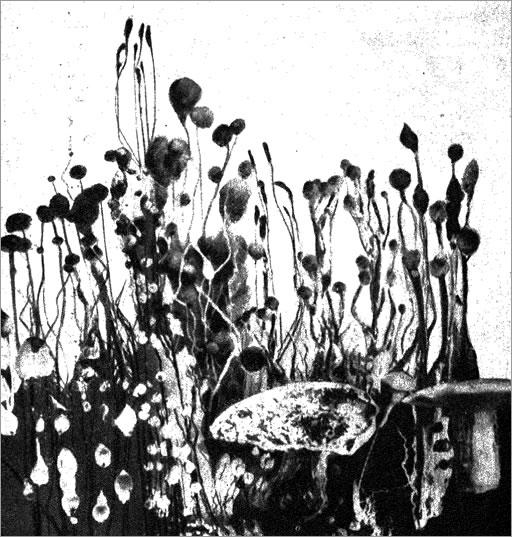
(Evelyn Fox Keller describes Leduc's work: "by employing a variety of metallic salts and alkaline silicates (for example, ferrocyanide of copper, potash, and sodium phosphate) and adjusting their proportions and the stage of “growth” at which they were added, Leduc was able to produce a number of spectacular effects—inorganic structures exhibiting a quite dramatic similitude to the growth and form of ordinary vegetable and marine life . By “appropriate means,” it proved possible to produce “terminal organs resembling flowers and seed-capsules,” “corral-like forms,” and “remarkable fungus-like forms.” (Fox-Keller, Making Sense of Life)
Rosen has a more mathematically rigorous way to distinguish between models and simulations, but the gist is conveyed I hope. The larger point is that to call scientific modelling a 'metaphor' severely understates what is involved in modelling, with metaphors being more akin to simulations.
Can you explain what you mean by "phenomenological laws." — T Clark
A quick example from Cartwright because I've written too much already: "Francis Everitt, a distinguished experimental physicist and biographer of James Clerk Maxwell, picks Airy's law of Faraday's magneto-optical effect as a characteristic phenomenological law. In a paper with Ian Hacking, he reports, ‘Faraday had no mathematical theory of the effect, but in 1846 George Biddell Airy (1801–92), the English Astronomer Royal, pointed out that it could be represented analytically in the wave theory of light by adding to the wave equations, which contain second derivatives of the displacement with respect to time, other ad hoc terms, either first or third derivatives of the displacement.’ Everitt and Hacking contrast Airy's law with other levels of theoretical statement—‘physical models based on mechanical hypotheses,... formal analysis within electromagnetic theory based on symmetry arguments’, and finally, ‘a physical explanation in terms of electron theory’ given by Lorentz, which is ‘essentially the theory we accept today’.
Everitt distinguishes Airy's phenomenological law from the later theoretical treatment of Lorentz, not because Lorentz employs the unobservable electron, but rather because the electron theory explains the magneto-optical effect and Airy's does not. Phenomenological laws describe what happens. They describe what happens in superfluids or meson-nucleon scattering as well as the more readily observed changes in Faraday's dense borosilicate glass, where magnetic fields rotate the plane of polarization"; [ Example of Airy modelling ]
The point of the distinction being that "In modern physics, and I think in other exact sciences as well, phenomenological laws are meant to describe, and they often succeed reasonably well. But fundamental equations are meant to explain, and paradoxically enough the cost of explanatory power is descriptive adequacy. Really powerful explanatory laws of the sort found in theoretical physics do not state the truth." -
Laws of NatureI would say that we use models to understand reality usually for some purpose. And some models appear to be so obvious and are so useful that we define them as to be laws. — ssu
I largely agree with this, as does Cartwright, for whom fundamental laws are indeed useful as explanatory tools, with the caveat that their explanatory power does not imply their truth, where truth is simply understood in the naive sense of corresponding to the facts of a phenomenon (what she refers to as their 'facticity'). Again the simple idea is that for the most part, F=Gmm′/r^2 - for example - simply is untrue as a description for almost all but a very small set of artificial behaviour.
To crystallize debate, perhaps a simple yes and no question can be asked: do fundamental laws provide accurate, true descriptions of most physical phenomena? It seems to me that the straightforward answer is no. And not even because of issues like Newtonian physics not taking into account quantum physics: on its own terms Netownian mechanics do not accurately describe phenomena. F=ma is almost universally untrue for any moving body one might care to measure in the real world. Which is again not to detract from it's explanatory power. -
Laws of NatureYeah, it's a careful line to tread. Cartwright's position - which makes alot of sense to me, is anti-realism about laws, but realism about (scientific) entities. The case for entity realism is perhaps another topic in itself, but as far as the status of laws goes, their usefulness is, on her account, largely epistemic: "I think that the basic laws and equations of our fundamental theories organise and classify our knowledge in an elegant and efficient manner, a manner that allows us to make very precise calculations and predictions. The great explanatory and predictive powers of our theories lies in their fundamental laws. Nevertheless the content of our scientific knowledge is expressed in the phenomenological laws" [which differ from 'fundamental laws', in their being context specific - SX].
She comes close to the famous scientific anti-realism of Bas van Fraassen, who is an anti-realist about entities, precisely because he believes that it's all just a case of organising and classifying our knowledge. But Cartwright's point is that if you pay attention to the peculiar status of laws, one can admit this without being an anti-realist about entities. @Banno put it once nicely in a post long ago - something like: the point of scientific equations is to add up nicely. It struck me as barbarous at the time, but I've come to see it as making a great deal of sense. -
Laws of NatureAnd it's because it's the 'scientific' way of understanding human nature, right? — Wayfarer
But it is not the scientific way of understanding nature. That's the point. You'd like it to be the 'scientific way' of understanding nature, because it provides more fuel for your anti-science proclivities. But so much the worse for those proclivities - and the pseudo-science it militates against. A pox on both houses. -
Laws of NatureTwo bodies with the property we call "mass" tend to move towards each other in a regular way which can be quantified, — T Clark
But the point is they don't, except in highly idealised situations, 'do so in a regular way that can be quantified'. Your statement is literally untrue for all but a very, very small number of situations, and situations almost definitely artificial at that. -
Laws of NatureSurely we can, and do, apply multiple laws? — jamalrob
Heh, I was waiting for this rejoinder, but didn't want to drop an even bigger quote than I did, because this is exactly what she addresses in the section right after (sorry for the long quote but it's just easier this way and I'm lazy):
"The vector addition story is, I admit, a nice one. But it is just a metaphor. We add forces (or the numbers that represent forces) when we do calculations. Nature does not ‘add’ forces. ... [On the vector addition account], Coulomb's law and the law of gravity come out true because they correctly describe what influences are produced—here, the force due to gravity and the force due to electricity. The vector addition law then combines the separate influences to predict what motions will occur. This seems to me to be a plausible account of how a lot of causal explanation is structured. But as a defence of the truth of fundamental laws, it has two important drawbacks.
First, in many cases there are no general laws of interaction. Dynamics, with its vector addition law, is quite special in this respect. This is not to say that there are no truths about how this specific kind of cause combines with that, but rather that theories can seldom specify a procedure that works from one case to another. Without that, the collection of fundamental laws loses the generality of application which [vector addition] hopes to secure.
In practice engineers handle irreversible processes with old fashioned phenomenological laws describing the flow (or flux) of the quantity under study. Most of these laws have been known for quite a long time. For example there is Fick's law... Equally simple laws describe other processes: Fourier's law for heat flow, Newton's law for sheering force (momentum flux) and Ohm's law for electric current. Each of these is a linear differential equation in t, giving the time rate of change of the desired quantity (in the case of Fick's law, the mass). Hence a solution at one time completely determines the quantity at any other time. Given that the quantity can be controlled at some point in a process, these equations should be perfect for determining the future evolution of the process. They are not.
The trouble is that each equation is a ceteris paribus law. It describes the flux only so long as just one kind of cause is operating. [Vector addition] if it works, buys facticity, but it is of little benefit to (law) realists who believe that the phenomena of nature flow from a small number of abstract, fundamental laws. The fundamental laws will be severely limited in scope. Where the laws of action go case by case and do not fit a general scheme, basic laws of influence, like Coulomb's law and the law of gravity, may give true accounts of the influences that are produced; but the work of describing what the influences do, and what behaviour results, will be done by the variety of complex and ill-organized laws of action." -
Laws of NatureCome on - just because the law of universal gravitation doesn't necessarily describe all the forces on a massive object, doesn't mean it doesn't tell us something important about how matter behaves. I'm guessing you disagree. — T Clark
There's not really much to disagree - or agree - with though. "Tells us something important". Sure, Ok, as far as a vague 'something important' goes. -
Laws of NatureThere are only general descriptions of how things behave. — T Clark
The curious thing about the laws is that they are almost entirely undescriptive. In fact, one of the most interesting things that Cartwirght demonstrates is that there is an inverse relation to how true a law is, and how much explanatory power it has. Her discussion of this point is worth quoting at length:
"The laws of physics do not provide true descriptions of reality. ... [Consider] the the law of universal gravitation [F=Gmm′/r^2] ... Does this law truly describe how bodies behave? Assuredly not. It is not true that for any two bodies the force between them is given by the law of gravitation. Some bodies are charged bodies, and the force between them is not Gmm′/r^2. For bodies which are both massive and charged, the law of universal gravitation and Coulomb's law (the law that gives the force between two charges) interact to determine the final force. But neither law by itself truly describes how the bodies behave. No charged objects will behave just as the law of universal gravitation says; and any massive objects will constitute a counterexample to Coulomb's law.
These two laws are not true; worse, they are not even approximately true. In the interaction between the electrons and the protons of an atom, for example, the Coulomb effect swamps the gravitational one, and the force that actually occurs is very different from that described by the law of gravity. There is an obvious rejoinder: I have not given a complete statement of these two laws, only a shorthand version. [There ought to be] an implicit ceteris paribus ('all things equal') modifier in front, which I have suppressed. Speaking more carefully ... If there are no forces other than gravitational forces at work, then two bodies exert a force between each other which varies inversely as the square of the distance between them, and varies directly as the product of their masses
I will allow that this law is a true law, or at least one that is held true within a given theory. But it is not a very useful law. One of the chief jobs of the law of gravity is to help explain the forces that objects experience in various complex circumstances. This law can explain in only very simple, or ideal, circumstances. It can account for why the force is as it is when just gravity is at work; but it is of no help for cases in which both gravity and electricity matter. Once the ceteris paribus modifier has been attached, the law of gravity is irrelevant to the more complex and interesting situations." (How the Laws of Physics Lie.
Wouldn't a materialist say that everything - from the behavior of subatomic particles, to consciousness, to the behavior of galaxies - is covered by, controlled by, the laws of physics? — T Clark
A vulgar, unreflective materialism, maybe. But I can imagine few things more theologically charged than the idea that 'there is a law that covers everything'; Materialism ought to - and can do - better than such vulgarities. The physicist Paul Davis writes nicely on this: "The very notion of physical law has its origins in theology. The idea of absolute, universal, perfect, immutable laws comes straight out of monotheism, which was the dominant influence in Europe at the time science as we know it was being formulated by Isaac Newton and his contemporaries. Just as classical Christianity presents God as upholding the natural order from beyond the universe, so physicists envisage their laws as inhabiting an abstract transcendent realm of perfect mathematical relationships. Furthermore, Christians believe the world depends utterly on God for its existence, while the converse is not the case. Correspondingly, physicists declare that the universe is governed by eternal laws, but the laws remain impervious to events in the universe. I think this entire line of reasoning is now outdated and simplistic".
https://www.theguardian.com/commentisfree/2007/jun/26/spaceexploration.comment
The paper I mentioned and linked to in the OP at the end by Cartwright ("No Gods, No Laws") similarly makes the case that physical laws can only make sense with the invocation of a God, which is all the more reason to treat physical laws with extreme prejudice. -
Laws of NatureIt could be an example of such an misunderstanding: the question after all is an empirical one - is there evidence to show that happiness evolved into life as a survival mechanism? And, even if there was, is there evidence to show that it remains a survival mechanism? It is well known that products of evolution - by whatever mechanism - have a knack of being coopted by other processes, for other ends than that which they were originally evolved for, which can in turn feed-back upon the evolution of that trait. Certainly, any a priori attribution of such and such a trait to survival and only survival is bad science through and through - which is to say, not a fault of the science, but of certain of its interpreters. And note that the way to correct this is through the science itself, not through anti-scientific screeds.
-
Feature requestsIs there way to impose a 5 or 10 minute no-post delay for users posting new threads? It would help alot with spam bots without impacting regular users too much (I ask having deleted 10 posts in a row of advertising).
-
Mirror, Mirror...*sigh*. Circumscribe: draw a circle around (scribe a circle?), clear a space for, without yet filling in that space. Via negativa: the way of the negative, the specification of what something is not, rather than what it is. This seems to be what the OP is doing.
Streetlight
Start FollowingSend a Message
- Other sites we like
- Social media
- Terms of Service
- Sign In
- Created with PlushForums
- © 2026 The Philosophy Forum