
Comments
-
Sociological CritiqueThat is how the faux 'authenticity' behind genocides... — TimeLine
But Zizek's point is that the authenticity of those who carry out genocides is anything but 'faux': it's the real deal. The point is that 'authenticity' is an entirely 'neutral' element, it can be put to use in any which way. The problem isn't the 'content' of authenticity: it's it's very form which can be appropriated in any which way.
See:
- on the discussion of greed and morality. Discussion of poetry @ 8mins; Discussion of failure of 'moral' approaches to political problems @ 12:30mins. -
Sociological CritiqueBut whats the point of an 'authentic consciousness' (a phrase which I'm afraid reeks of romantic moralism for me) in a society which can make neither heads nor tails of such an ideal? To ask Adorno's question: can one live a good life in a bad life? I'm not convinced one can answer this in the affirmative. Or to cite one of Zizek's well known themes: genocides are full of 'authenticity' - there is no ethnic cleansing without poetry. Authenticity is only as powerful as the conditions which allow it to flourish.
Also Antinatalism lol. -
Sociological CritiqueIs there an individual or are we collectively better off being saturated by such a system — TimeLine
But I don't see an either-or relation here: we are individuals to the extent that we belong to a 'system', or rather a series of systems that generally travels under the name 'society': the relevant question is one of relation - what kind of relation to society is it that we want to cultivate? Not: are we better off in a society or not? The latter question isn't one that can be entertained in any meaningful way, as far as I'm concerned. Else you end up peddling liberal sophistries about individuals set against society and so on - a total non-starter for any meaningful political discussion.
One way to illustrate what I'm trying to get at here is with another example maybe. Here is Corey Robin, a political scientist, talking about the discourse of 'norm erosion' that has become popular in talking about Trump these days:
"So we have a discourse of norm erosion that allows us to reel in shock at the way that Trump talks to senators, governors, and citizens, but that discourse has nothing to say about the very system, the very text, that produced this president that talks in this terrible and shocking way. Indeed, insofar as some of the peddlers of that discourse believe that these cherished norms ultimately issue from the system and the text itself, and that it is that system and that text that need protecting, one can say that the discourse of norm erosion actually prevents us from tackling the very system, the very text, that produced this president that talks in this terrible and shocking way."
The overvalorization of the individual partakes of the exact same problem: I mean, of course Trump is a complete monstrosity, but to focus on the personal failings of Trump is to miss the fact that there was an entire system which put him into power. And any intervention into the state of things ought to pitch itself at that system, not at Trump, per se. The liberal media obsession with Trump's personality does as much to feed into the very conditions that brought him into power as anything else. Part of why the media are having such a hard time grappling with the flood of sexual abuse allegations is in part this same attitude: the petty gossip-mag obsession with 'personalities' which blind us to system-level incentive structures that - however subtly and implicitly - enable such behaviour. -
Sometimes, girls, work banter really is just harmless fun — and it’s all about common senseWhat's the big point that I have been trying to emphasise? Context matters. — Sapientia
I think this is absolutely the case, and moreover, I think context is exactly what is lost in the reactionary responses like that of the OP article and other cries of witch-hunting and so on. It's crystal clear that the context of the recent up-swell against the pervasive harassment of women (not just 'in the office' but also - and importantly - in the street as well) has to do precisely with its overwhelming social ubiquity. In a time and culture where women are routinely judged by their sex to the detriment of their life experiences, it is just that routinization that is being fought against. That is the context, and it is precisely that context which is lost in the reactionary attempt to shift the level of analysis from the social to the individual. That 'work banter may just be harmless fun' thus may be true, but it is also entirely irrelevant, insofar as it aims to displace the focus on a social problem - obvious to anyone who has contact with sunlight and air - onto a sophistic focus on atomized, localized and context-free cases.
Also, there's something irredeemably pathetic in the sentiment expressed by some here that without the crutch of sexual harassment, they can't fathom how it is that anyone can get laid. Consider perhaps that this is total failure of imagination and an impotency of sexual prowess rather than anything even resembling an indictment on society. -
Sometimes, girls, work banter really is just harmless fun — and it’s all about common senseYeah, thanks for this. It's so exhausting trying to make some of these points and it's good to see those willing to do so.
-
MeToo, or maybe NotPeople aren't nice, when you get right down to it, and shitty, creepy behavior is going to be a fixture in human relations -- across the board -- for a long time to come.
After we have eliminated everyone who ever behaved in a shitty, creepy manner, who will be left? You? — Bitter Crank
Apologist trash. "Oh yes he treated you horribly, and placed you in a terrible position, but it wasn't assault though, so why is everyone making such a big deal about it?". -
Why can't I doubt that I am doubting?Yeah, and your presentation is circular is thus fallacious.
-
In the debate over guns I hear backtracking on universal human rightsThis clause actually forms a personal basis for gun ownership clearer than the 2nd Amendment, as it's not complicated by the strange language of state militias. That is, this is a general right to protect against intruders, not just against the government. If I present a compelling argument that I cannot be safe without a gun, am I not entitled to one? — Hanover
The entailment here is not this clear cut at all: that one has a right to the security of persons can equally translate into a right not to be surrounded by a society in which people have easy access to instruments of death. I'm not saying that this is how it should be understood, only that there is alot more ambiguity here than what I think you're suggesting. Arguably, a large part of the gun debate turns upon just this contested notion of what 'security' ought to look like. -
Why can't I doubt that I am doubting?Imagine a Universe where there is only doubt, and an ultimate doubter.
...In this scenario, the doubter can doubt everything, including him being in doubt.
1) Why? Because in case he does not doubt it, the Universe now has a belief established that he cannot doubt that he is doubting. — guptanishank
But this is just textbook circular reasoning with a bit of begging the question thrown in. It might as well read: "Imagine a universe where one can doubt that one is doubting. In this universe, one can doubt that one is doubting. Therefore, one can doubt that one is doubting". -
In the debate over guns I hear backtracking on universal human rightsYou have... peculiar powers of extrapolation.
-
In the debate over guns I hear backtracking on universal human rightsAh yes, I remember fondly the passages of Voltaire in which he proclaimed the human right to own guns; the eloquence of D'alembert in his passionate defense of rifles; Spinoza's more geometrico proofs of the divine right to arms. However could we have forgotten these pearls of Enlightenment ideals?
-
MeToo, or maybe NotThe MeToo campaign is not without its limits, but who said that it was ever meant to be about sexual assault, strictly defined? It always seemed to me to be about highlighting the extent and pervasiveness of the creepy-as-fuck things that men have done - and continue to do - to women, and to criticize the stories told for not somehow 'living up' to some arbitrary legal standard is frankly totally stupid. If your response to a campaign to show just how widespread shitty sexual behavior in society is is to wrangle over definitions, you've completely missed the point.
-
Sometimes, girls, work banter really is just harmless fun — and it’s all about common senseLike, I'm sorry cracking down on sexual harassment will deprive you of a bit of fun, but the actual harassment of workers on the job is more important than your occasional banter. — darthbarracuda
(Y) x 2 -
Do we behold a mental construct while perceiving?It should also be noted that it's a sign of absolute philosophical failure when discussion about perception glibly slides into discussion about 'experience' or knowledge more generally, without any attention paid to the specificity of perception. Or for that matter when people speak of sensation and perception as though they were the same thing. These last few pages in this thread have been one long litany of failire in that regard.
-
Currently ReadingThe Invisible Committee - The Coming Insurrection
The Invisible Committee - To Our Friends -
TPF Quote Cabinet"The injunction, everywhere, to "be someone" maintains the pathological state that makes this society necessary. The injunction to be strong produces the very weakness by which it maintains itself, so that everything seems to take on a therapeutic character, even working, even love. All those "How's it goings?" that we exchange give the impression of a society composed of patients taking each other's temperature. Sociability is now made up of a thousand little niches, a thousand little refuges where you can take shelter. Where it's always better than the bitter cold outside."
"I AM WHAT I AM." Never has domination found such an innocent-sounding slogan. The maintenance of the self in a permanent state of deterioration, in a chronic state of near-collapse, is the best-kept secret of the present order of things. The weak, depressed, self-critical, virtual self is essentially that endlessly adaptable subject required by the ceaseless innovation of production, the accelerated obsolescence of technologies, the constant overturning of social norms, and generalized flexibility".
"It's dizzying to see Reebok's "I AM WHAT I AM" enthroned atop a Shanghai skyscraper. The West everywhere rolls out its favorite Trojan horse: the exasperating antimony between the self and the world, the individual and the group, between attachment and freedom. Freedom isn't the act of shedding our attachments, but the practical capacity to work on them, to move around in their space, to form or dissolve them".
"I AM WHAT I AM," then, is not simply a lie, a simple advertising campaign, but a military campaign, a war cry directed against everything that exists between beings, against everything that circulates indistinctly, everything that invisibly links them, everything that prevents complete desolation, against everything that makes us exist, and ensures that the whole world doesn't everywhere have the look and feel of a highway, an amusement park or a new town: pure boredom, passionless but well ordered, empty, frozen space, where nothing moves apart from registered bodies, molecular automobiles, and ideal commodities."
- Quotes from The Coming Insurrection, The Invisible Committee.
My kind of self-help. -
The American Gun Control DebateHow can anyone take seriously the immediate recourse to fantasies of civil war and fairy tale comparisons to the Nazi state? As if these are the problems? As if these flights of fancy were the immediate points to be addressed? This displacement of reality for fantasy - as if the gravity of the real belonged soley to the latter - is insidious and politically asphyxiating. No one should be taking it seriously except as an example of how not to discuss these issues, of how to unmoor the reality of massive disproportionate death so as to float off into the imagination of conspiratorial delusion. Shameful discussion.
-
The Quietism threadPersonally I've never understood the coherence of 'quietism': it seems to me that any claim to what we can and cannot say must itself be grounded in account of 'the way things are' (broadly understood), without which no such claim could ever get off the ground. The whole position seems to be shot through with performative contradiction, but then again, I don't think I've ever come across a quietism that ever been rigourously formulated.
-
A question about time measurement. If I can see the pendulum swinging in sync why calculate the difference? — TheMadFool
Because difference is all that matters when trying to determine regularity. I should not have spoken of synchronicity, which seems to have misled you. Although if difference = 0 and stays as 0 (your pendulums are in sync), then your pendulums have regular swings. -
A question about time measurementHowever, what if A's is 2.000000009 seconds and B's is 2.0000000000000009 seconds? This imperciptible difference will compound over time and after, may be millions of years, A and B will be out of sync. — TheMadFool
You misunderstand: it's the difference between periods which must be constant to show that both pendulums swing at a regular interval. The actual frequencies of the pendulum swings - which do not at all have to match - are irrelevant.
Another thing is the assumption (is there a physics law for this?) that the pendulum swing will remain constant — TheMadFool
What are you talking about? The comparison of the pendulums is made in order to asses that constancy. There's no 'assumption' made. Pause and think before you type, please. -
A question about time measurementYou can use your eyes, for one. Or more precise apparatuses if avaliable or necessary. But this is a question of experimental design, not principle. And the principle is what matters.
-
A question about time measurementBy ''in sync'' you mean they move to-and-fro at regular intervals. — TheMadFool
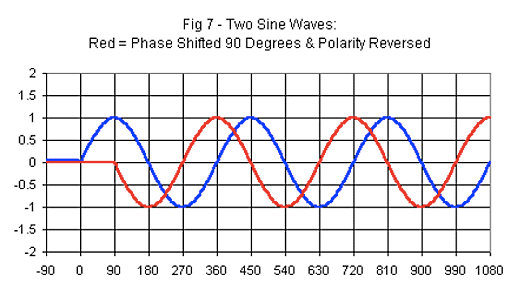
If the frequency of the pendulums is regular and one is, for example, phase shifted by 90 degrees, they should stay 90 degrees phase shifted (the distance between the waves should not change). If the distance remains the same, the frequency of the pendulums is regular, if it doesn't, the frequency of at least one of the waves isn't regular.
It's like asking how one can know if two lines are parallel. If you're in euclidean space, place them side by side perpendicular to a horizon, and no matter how far you draw your horizon, the lines should never meet. Then you know your lines are straight. No need to compare an infinate array of lines. -
A question about time measurementWell, that doesn't solve the problem does it? The phenomenon itself must be regular. — TheMadFool
What 'phenomenon'? All you want is regularity. If two measures are in sync, they're regular. You really need to stop with the pseudo-problem threads. -
A question about time measurementEr, all you need are two measures you think are regular in relation to each other. If one, or both are not in fact regular, at some point they will go out of sync. If they don't, you're good. And even if they are out of sync, if the divergence isn't too bad, all you have to do is recalibrate every once in a while - like we do with leap years.
-
Do we behold a mental construct while perceiving?Perhaps it can be put this way; questions of perception bear upon what one sees, not what one sees (or, in modality-neutral language: not what manifests, but what manifests).
-
Do we behold a mental construct while perceiving?“Is it the same tree we are looking at, even though our visual perceptions are wildly different?”
“Is it the same song we are listening to even though it would be sensed totally differently?”
Note in both how strange is the relation between the first half of these questions and the second half: in the strange and unwarranted assumption that identity (the same tree, the same song) is indexed to our perception or our senses. But not identity but perception is in question: that one sees or hears X differently ought to lead to a question about perception, about our sight and about our hearing - how is it that we see or hear X differently? What does this say about perception?
Instead, it leads here - somehow, inexplicably - to a question about the 'thing' - is it the same X we see or hear? But this latter question already assumes the very anti-realism it aims to sow. Yet it would not have even occured to have asked this latter question had the identity of X not already been its starting point. The illegitimate slide from perception to existence: almost imperceptible, but once you see it, it can’t be unseen. -
Has Neoliberalism infiltrated both the right and the left?I don’t think the passage is necessarily blaming neoliberalism for Trump so much as noting that both policy and person are simply cut from the exact same cloth. Trump is less a cause than a symptom; the surprise of his election was, or should be, more to do with just how deep the rot that enabled it has set in.
-
Has Neoliberalism infiltrated both the right and the left?Incidentally here is Brown writing on Trump as well: "We’re seeing mass thuggery, contempt for the rule of law, equality, civil liberties, and universal inclusion. We are seeing a deep, wholesale rejection of the most basic principles of democracy. This is what neoliberalism has wrought over four decades—this wide, deep rejection of democracy, not only social democracy but political democracy.
There are other aspects of neoliberalism at stake in the US elections. Yes, it’s incredible that a figure like Trump, with his unbridled narcissism and sociopathic tendencies and ludicrous chest-thumping, could become the Republican nominee. What isn’t incredible in 2016, however, is a wealthy real estate developer proposing his business acumen and business success as qualifications for the presidency. This is the quintessence of the transformation of political life and political meanings by markets and by economic meanings … Trump is offering himself as a businessman who would bring to the executive office his capacity to make deals and dominate the competition. He’s not offering knowledge of the Constitution; he’s not promising to represent the people, execute the law, or work with Congress. That his credentials in business and entertainment could become credentials for the presidency is totally in line with the neoliberal assault on democracy." (source [pdf]) -
Has Neoliberalism infiltrated both the right and the left?The most coherent and well formulated definition of neoliberalism I know comes from the political philosopher Wendy Brown, who refers to it as the "widespread economization of heretofore noneconomic domains, activities, and subjects”, such that it “extends a specific formulation of economic values, practices, and metrics to every dimension of human life.” Concomitant with this 'economisation of the noneconomic' is, for Brown, nothing less than a redefinition of what it means to be human: "neoliberal rationality disseminates the model of the market to all domains and activities - even where money is not at issue - and configures human beings exhaustively as market actors, always, only, and everywhere as homo oeconomicus.” (Brown, Undoing the Demos). This is pretty close to Monbiot’s understanding as well, as mentioned by Wayfarer wherein ‘citizens are redefined as consumers’.
Elsewhere, the political philosopher William Connolly emphasises the commitment to the active maintenance of market mechanisms across all domains as a signature of neoliberalism: “Neoliberals... often do not think that markets are natural; they think markets are delicate mechanisms that require careful protection and nurturance by states and other organizations. The state does not manage markets much directly, except through monetary policy, but it takes a very active role in creating, maintaining, and protecting the preconditions of market self-regulation. The most ambitious supporters want the state to inject market processes into new zones through judicial or legislative action, focusing on such areas as academic admissions, schools, prisons, health care, rail service, postal service, retirement, and private military organizations” (Connolly, The Fragility of Things).
One thing to note about these definitions is that neoliberalism is thus not just a newer, shinier label for capitalism, which has more to do with widening the circuits of commodification (turning all sorts of life processes into commodities for the extraction of surplus value), rather than extending market metrics to non-market domains. It’s the difference between ‘how can we make money from this?’ and ‘how can we measure this with market-like metrics?’. As Brown notes, this latter question may have nothing at all to do with money: "Importantly, such economization may not always involve monetization. That is, we may think and act like contemporary market subjects where monetary wealth generation is not the immediate issue, for example, in approaching one's education, health, fitness, family life, or neighborhood. To speak of the relentless and ubiquitous economization of all features of life by neoliberalism is thus not to claim that neoliberalism literally marketizes all spheres, even as such marketization is certainly one important effect of neoliberalism. Rather, the point is that neoliberal rationality disseminates the model of the market to all domains and activities - even where money is not at issue.”
As far as these understandings of neoliberalism go, Agu’s strange association of it with sexual promiscuity and identity politics seems, at best, complete misunderstanding, and at worst, utter fantasy. If anything, as authors like Connolly (Capitalism and Christianity, American Style) and Melinda Cooper (Family Values: Between Neoliberalism and the new Social Conservatism) have shown, neoliberal positions tend to hew closely to social conservative positions (as can be found in the work of neoliberal scholars like Gary Becker, Richard Posner, and Milton Friedman, not to mention in the policy initiatives of those like Reagan, Thatcher, the Bushes, and even - perhaps especially - the Clintons; on this at least Agu is right - Clinton is a neoliberal shill who deserves everything she got). The idea however that Trump stands like anything close to a bulwark against neoliberalism is a position halfway between madness and fantasy, with a good dose of hilarity thrown in. That anyone could believe this - and say it with a straight face - is living in wonderland. -
Do we behold a mental construct while perceiving?What you're arguing is that naive realism cannot be true, because the act of perception generates an appearance for us. The tree we see is an appearance. — Marchesk
No, no, no. The tree we see is not 'an appearance'. It doesn't make sense to say something 'is' an appearance. That's grammatical garble. The tree itself appears to us, and as such, we see the tree itself. That we see the tree's appearance does not mean that the tree 'is' an appearance. It simply means we see what can be seen of the tree, itself.
Stop opposing 'the actual tree'' and 'the appearance of the tree': there is no zero sum game here, the one does not preclude the other (which does not in turn mean the appearance of the tree 'is' the tree). The 'actual' tree appears, and that is what we see. -
Do we behold a mental construct while perceiving?But you think access is direct, and Street, from what I understand, think that kind of talk makes no sense, since all we perceive are appearances. — Marchesk
No, I think we neither see 'directly' nor 'indirectly'. We simply see the trees: which is not to say we see them 'directly' because it's not even in principle possible for 'seeing' to take place 'indirectly': the qualifier 'direct/indirect' is a defunct one that has no place in talking about perception, it's a distinction without an intelligible difference. -
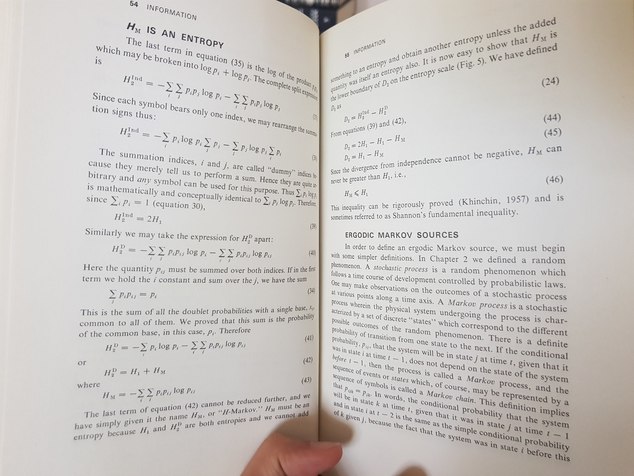
Currently ReadingSurprisingly yes, lol. She's basically using information theory to look at the differing distributions of DNA bases across different subphyla in order to see how measures of informational efficiency - measures of entropy! - can help us shed light on life and evolution. So far anyway. Now about to start a chapter on game theory. It's actually facinating.
-
Do we behold a mental construct while perceiving?Saying otherwise involves a separation of oneself from one's seeing. — Banno
Exactly. As if one could talk about perception in the absence of... perception. And then think one has some kind of genuine mystery on hand. To conjure a problem out of linguistic befuddlement. -
Do we behold a mental construct while perceiving?So the world around us is the result of a perceptual process, — antinatalautist
No. I said: appearance is the result of a perceptual process, not 'the world around us'. It's nothing but a petitio principii to assume that the one is the other. Like most others in this thread, you cross wires which ought to be held firmly apart.
Perhaps participants in this thread ought to better acquaint themselves with The Worst Argument in the World. -
Do we behold a mental construct while perceiving?Scott Aaronson has a wonderful essay detailing why the P = NP problem has all sorts of ramifications for philosophy, well worth reading, incidentally:
https://www.scottaaronson.com/blog/?p=735 -
Do we behold a mental construct while perceiving?On the direct realist account, perceived objects would have the same properties when nobody is perceiving them — Marchesk
But we're not taking about 'properties' in the abstract. We're talking about perceptual properties, which, by definition, are related to a perceiver. Again, you're confusing the one with the other.
Streetlight
Start FollowingSend a Message
- Other sites we like
- Social media
- Terms of Service
- Sign In
- Created with PlushForums
- © 2026 The Philosophy Forum