
Comments
-
Is American Business operated by Objectivist Principles?'free enterprise for the poor and socialism for the rich' — Saphsin
True when Vidal (or whoever coined the phrase) said it; still true today.
the idea that there's this clash between the market and the state is really the sickest joke in social theory — Saphsin
Indeed. As Marx said, the state is a committee for organizing the affairs of the bourgeoisie (meaning, the rich). The last thing a good capitalist wants is unfettered competition. Horrors!
The libertarian, Randian, objectivist approach is a call to live in the worst of the wild west. -
US Senate Rejects Gun Control BillsMayor: I'm starting a new thread: Can American Business Be called 'Objectivist'?
I really don't want it to be true (American business is bad enough as it is) and hopefully you and others can shed some light on the question. -
US Senate Rejects Gun Control BillsYour information on Austria is interesting and depicts a sharp contrast, indeed.
It would seem that Austria's political and governmental system is organized to provide tightly controlled stability. In the context of European history and social democracy, there are worse things to endure. A glance at some of the activities that Europeans were up to a few decades ago in Germany, Austria, and elsewhere (and more recently in the Balkans) would suggest a need for tightly controlled stability.
One of the things that tightly controlled stability means is that the folks running Austria are quite secure in their offices.
The people who run the United States are quite secure, as well. Different means, similar result.
Objectivism and Business
Retired commie pinko faggots like myself make poor representatives for the Big Business (or business in general), but characterizing business in the US as Objectivist is a rather gross over-generalization.
There are some people who mouth sentiments along objectivist lines, true enough. But to say that
- a great businessman is marked by his ability to sneer at the idea of public safety; bad people get their way through democracy; good people get their way through violence; the government has never invented anything or done any good for anyone; any and all natural resources are limitless; crime doesn't exist, including in areas of extreme poverty; all that matters in life is how good you are at making money... The USA is run by and large by these objectivist principles...
is the conclusion of a disappointed idealist.
There are a lot of disappointed idealists over here, too, who are appalled by the maneuvers of the right wing and super-PACS and the compliance of the "liberal" wing. The machinery exists for various political organizations to dominate the government. The well-funded right wing operatives have ascended because they paid attention to the machinery. They have worked at electing conservatives in state houses which determine reapportionment, and have gained electoral advantages--legally. They have dismantled law which has enabled them to ensconce themselves in large numbers in Congress (and state houses).
The left wing, aka liberal democrats, are perfectly capable of doing the same thing, and have done so in the past. One of the elements that makes it possible for either political wing to get their way when they put their minds to it is low voter turnout. When you have to worry about only your 25% of the electorate, the other half not bothering to vote, it's much easier to win.
50% of the American electorate have no one to blame except themselves for this state of affairs. They don't participate in the political system. IF they did, the results would tend to be more moderate. - a great businessman is marked by his ability to sneer at the idea of public safety; bad people get their way through democracy; good people get their way through violence; the government has never invented anything or done any good for anyone; any and all natural resources are limitless; crime doesn't exist, including in areas of extreme poverty; all that matters in life is how good you are at making money... The USA is run by and large by these objectivist principles...
-
Lefties: Stay or Leave? (Regarding The EU)both Germany and Italy are not so ancient, as they only became unified states in the 19th century — mcdoodle
You are right. The contradiction flitted through my brain as I described these two countries as ancient. It didn't find a perch. But the component parts out of which they are constituted do go back quite a ways. -
Is this good writing?Oh, it wasn't just you -- a Google search showed that some "critics" thought they were similar. Personally, I don't know why anybody would think they were alike, as far as the short sample was concerned. Besides, it's summer time and bees are nesting everywhere, trees, houses, bonnets, etc.
-
US Senate Rejects Gun Control BillsTrue, the NRA is a major contributor to the reelection campaigns of Senators and Representatives. But they are only one of many. It takes a lot of money to get into office, get a reasonably good committee assignment in Congress, and get reelected.
Nothing shocks me about "My United States of Whatever"... — Mayor of Simpleton
The US isn't exceptional, and neither is Austria, Switzerland, or any other State you might like to compare it with. People are pretty much equally corruptible, venal, and violent OR ethical, virtuous, and peaceable, everywhere. The modern history of Europe will show you that. -
US Senate Rejects Gun Control BillsThe sacraments of the Conservative Church of The Gun are buying guns, shooting guns, and voting for reactionary Republicans. The First Church of The Gun is not an ancient institution. The NRA has roots in the 19th century, but it mutated, flowered and fruited in the second half of the 20th century, especially after 1970.
Gun ownership was conflated with various conservative priorities (which had nothing to do with hunting ducks). Gun ownership, which was once a necessary option for hunters, was conflated with the needs of external military and internal police defense against communists, hippies, homosexuals, feminists, terrorists, recreational drugs, criminals, minorities... Protect the American Way -- get a gun, and use it if necessary.
Yes, there is an arms and ammunition industry whose stake IS private gun ownership, but these companies aren't huge as industries go -- none of them are in the S&P 500 (largest corporations). Smith and Wesson is capitalized at only $1.2 billion. The biggest gun interest is Walmart -- the largest gun retailer -- capitalized at $220 billion. (That said, I'd do away with the lot of them.)
There is a disconnection between The People, of whom an overwhelming majority favor limitations on gun commerce and possession, and elected officials -- whether they be Democrats or Republicans. The disconnection point is the ballot box, which is often avoided for local and state elections, and sometimes for national elections. "Why" is a whole nother thread.
The NRA, and its Conservative Church of The Gun is mobilized for legislative action. The opposition to the Conservative Church of The Gun is fretting about gun violence at home. No one has developed and fielded an organization devoted to mobilizing the majority to achieve rational gun policies.
It isn't that "Americans are crazy." We are no more crazy, or lazy, than any other electorate. What we are is the victim of our--for all practical purposes--one party system. Strong liberals haven't been nearly plentiful enough to outvote the wishy-washy liberals and committed conservatives. We are not crazy, we are stuck with a bad political system. -
Is this good writing?I'm ashamed to admit it, but I've never read O'Connor — csalisbury
There's no shame in having not read her in the past, but there is in not reading her in the future. Help is at hand! Free!
Everything That Rises Must Converge
and
A Good Man Is Hard to Find and other stories... -
Is this good writing?Reviewers, and MOS, think Means is similar to Flannery O'Connor. Here's the opening lines of A GOOD MAN IS HARD TO FIND:
THE GRANDMOTHER didn't want to go to Florida. She wanted to visit some of her connections in east Tennessee and she was seizing at every chance to change Bailey's mind. Bailey was the son she lived with, her only boy. He was sitting on the edge of his chair at the table, bent over the orange sports section of the Journal. "Now look here, Bailey," she said, "see here, read this," and she stood with one hand on her thin hip and the other rattling the newspaper at his bald head. "Here this fellow that calls himself The Misfit is aloose from the Federal Pen and headed toward Florida and you read here what it says he did to these people. Just you read it. I wouldn't take my children in any direction with a criminal like that aloose in it. I couldn't answer to my conscience if I did."
O'Connor's prose always flows with vernacular and conversational ease; Means' prose is studied (at least in the samples provided). I can't say how Means manages his stories (having read none). O'Connor ties beginnings, middles, and ends tightly together. Her interfering desire to visit her "connections" will lead to her and her family's demise at the hands of the Misfit. (Of the now dead grandmother, the psychopathic Misfit perceptively concludes the story, "She would of been a good woman if it had been somebody there to shoot her every minute of her life."
I'd have to read Means as carefully (and I hope, with as much pleasure) as I have read O'Connor to make a comparison. I know how O'Connor populates her stories, provides compelling and convincing dialogue, and lands a KO at the end.
How is Means' dialogue? Does one end up caring about the fate of his characters? Are his plots convincing? Do his stories endure in one's memory?
The vocabulary construction Means deploys in his opening is... a bit heavy.
declivity
hard shale and lime deposits (wouldn't "shale and limestone" suffice?)
forestation
eased
sea miles away
moon's gravity
deep yielding estuary
vised
There is entirely too much traffic in altered parts of speech; "vise" is not a verb. Is there something wrong with "pressed", "squeezed", "caught", "trapped", "locked" or whatever it was that was happening between his knees?
I can imagine a lover yielding deeply, but not deep yielding. I prefer my estuaries to just slosh back and forth, to suck up the sea, or throw out or ooze, whatever is possible.. "Deep-yielding" is a nice construction, but it is wasted on estuaries.
Declivity? When was the last time (apart from this discussion) you spoke, writ, or read this word? -
Lefties: Stay or Leave? (Regarding The EU)corporatist, centralised quasi-State — mcdoodle
"Quasi-state" - neither fish nor fowl. "State" in Europe has the heavy substantial meaning that "state" in the United States doesn't. Germany, France, Holland, Spain, Italy, and so forth all have ancient histories as States. Europeans have been (more or less) consistently peopled since the early medieval period--unlike American territory which cleared and re-peopled territories and then formed states--and relatively recently.
Sovereignty has been a long-term property of European states, so the European Union is much different than the federal union of American sates.
The implementation of the European union seems (based on my really fragmentary knowledge here) to have begun, and continued, as a complex bureaucracy. Analogously. it would be like the American Federal Civil Service rising to its present prominence as the continuing government without a Declaration and subsequent War of Independence.
If this all holds water at all, I can see why there would be a strong feeling within the electorate for not being an integral part of the bureaucratic structure of the EU, while remaining an important peripheral part of the EU.
Either outcome has upsides and downsides. Wish you all all the best -
Is this good writing?Is this good writing? — csalisbury
No, it's not. But any given sample of text prefaced by the question "Is this good writing?" is doomed to unfriendly and close analysis, which isn't the way we read fiction. Usually we open the book, start reading, and 20 minutes later we are still reading or we have moved on to other offerings.
Some people think Means is a very good writer; "Assorted Fire Events won a Los Angeles Times Book Prize, was nominated for a National Book Critics Circle Award, and received tremendous critical praise." Such high praise doesn't mean the book is any good, of course. The circle jerk of book critics is in the business of book making and selling. They have a lot of skin in the game. They might be right, or not.
Flannery O'Connor — Mayor of Simpleton
After I read the Amazon blurb, I thought of a Flannery O'Connor quote: "Everywhere I go, I'm asked if I think the universities stifle writers. My opinion is that they don't stifle enough of them. There's many a best seller that could have been prevented by a good teacher."
I don't know if David Means deserves to be stifled or not. A lot of fiction from the last few decades reads like wind easing through weeds, pressing on both sides of the track, and coming up stinking of seaweed.
Life is short and word processing equipment can fill up a lot of pages. The worst of it bears the stamp of a trained writer applying theory; it's more than boring; some of it is downright repellant.
Is this good writing? -
Lefties: Stay or Leave? (Regarding The EU)Coming down to the vote and polls are either too close to call, with maybe an edge for BREXIT.
It seems clearer to me, not that it matters, that BREXIT will be a mistake for the UK in both the short and long run. True, the stock markets aren't going crazy, but that may be for what reason? God only knows.
Europe is better off solidly united, and the UK is part of Europe culturally, geologically, economically, historically (the empire not withstanding) and militarily. Fortunately, Olde England seems to be on stable crustal bedrock, so it won't be going anywhere soon. It can't get away from Europe. The French will always be on the other side of the narrow channel.
From what little I can tell, the Stay campaign has not done a fabulously great job of presenting its case, but I haven't been there to hear it, I just get reflected noise. -
The incoherency of agnostic (a)theismI needed to vent and no one here seems to get it. Sorry if I violated any forum etiquette. — Sinderion
Violate forum etiquette? What might that be? Beats me.
I agree 100% with what you had to say.
A. Nobody can know what God/god is like, especially believers whose big book says God is ineffable. The Big Book God himself pretty much says "I know you, but you don't, can't, and won't know me". At least this side of the grave.
B. Right. What IS the appropriate attitude toward God? Callous indifference, or being on sufficiently good terms with God that you know exactly what God wants at any given moment, and being entitled to wield God as a big stick to beat non-or-insufficiently-enthusiastic-believers over the head with?
I used to think that fundamentalists, whether Hindu, Moslem, or Christian, Jewish or whatever were a threat to any well regulated secular society, or even well-regulated religious societies that aren't quite religious enough, in the minds of the fundamentalists. I still do, but now I'm beginning to wonder whether believers of any kind are not a threat to proper secular societies.
I've been religious (Protestant) and am earnestly working at being a non-believer. Some religious ideas are wholesome, but really, a lot of them are not wholesome. -
The incoherency of agnostic (a)theismFALSE. The null position is not having a belief. — darthbarracuda
Theoretically, I agree: the null position is not having a belief.
Practically, under what circumstances could one not have a belief (one way or the other) about god(s) or no god(s) in this god(s)-soaked world? Is anyone born into and matured in a society where the null position of "not having a belief" exists? Now, if a child grew up in a society where no one mentioned god(s) in any context, one could have a null belief.
It seems like people who believe that god(s) do not exist, would believe this as a reaction to the assertion that god(s) do exist. It amounts to almost the same thing but not quite. Is it a difference that makes no difference? -
Is "mind is an illusion" a legitimate position in Philosophy of Mind?Is there any way we can determine whether the mind is an illusion or not, and is there any way to tell whether "feels like" is or is not representative of something that exists?
I don't know whether we can determine such things, or not. If we can not, which seems to be the case so far, then it really isn't arguable. We'll just be going around in circles.
IF it is an illusion, its an enduring and ancient trick which continues to be very convincing. It seems like there must be some organic mechanism which produces either the mind, or the illusion of the mind. It's presumably somewhere in the brain, or maybe in many places in the brain. But such speculation doesn't answer the question, "If so, where the hell is it?"
Further research, time in other words, will tell. If in 25, 50, or 100 years we haven't found the locus of mind, then we might have to settle for illusion, or worse, what is to me totally unpalatable, that mind doesn't exist in the brain at all, but elsewhere. -
Where we standIf all the people in the US who don't like Trump and Clinton were to vote for a third party on the ballot as a protest, we might end up with a Socialist Worker Party president -- wouldn't that be a shocker -- especially for the SWP.
-
Some People Think Pulse Bar massacre shows gay progress to be fitful. Is it?You are right (of course). I was conflating the term hate "crime" with hate "speech". What the Supreme Court thinks is or is not a crime, is or is not allowable speech, is one thing -- but what advocacy groups count as a hate crime and as hate speech is something else.
On campus, for instance, some topics are verboten. Wearing a swastika pin would be counted as at least a hateful act, if not a crime, by several different Sensitive Sally groups. Burning a cross at a fraternity BBQ would probably start a riot by SS groups. Some topics on some campuses are supposed to be accompanied by a weather advisory so SS students can take cover.
I disapprove the category of "hate speech". If people have the right to speak, then they have a right to express views others will call appalling, which they too have a right to do. Several countries in Europe forbid expressing certain views about Nazis -- like, they were nice people, really, and didn't kill all that many people. Total rubbish, of course, but I don't quite understand why people there put up with such a rule.
I don't like the category of "hate crime" either. Assault, battery, arson, attempted murder, causing grievous bodily harm, and murder are crimes already. If you beat me up, that's a bad thing whether you were motivated by hate or by entirely utilitarian, practical objectives. You can call me all sorts of offensive terms (stupid jerk, asshole, son of a bitch, scum filth and dirt, etc.) and not be guilty of hate, but if you mention "fag", then you might be. It just doesn't make sense to me. -
Where we standThe UK doesn't seem to know whether they are leaving or staying. Confused old coots.
-
Can aesthetics be objective?Suppose I set up some objective criteria for landscape paintings.
- A successful landscape can include scenes of rivers, lakes, mountains, prairies, ocean beaches, deserts and hills
- Adults and children must be included in the picture
- animals must be appropriate to the scene - cattle can not appear on an ocean beach, polar bears can not appear among palm trees, whales can not be pictured in lakes, swans can not appear in paintings of deserts
- Green, blue, and yellow must be used prominently, with white, black, orange, pink, purple, and red used sparingly
We could apply the above criteria (and many additional ones) to any landscape we might find in a gallery, and decide whether it is a good painting or not. If our criteria also specify what is "beautiful", we can determine whether the painting meets the criteria of "beauty".
In Painting by Numbers Vitaly Komar and Alexander Melamid surveyed diverse groups of people to determine what they consider "beautiful paintings". They then arranged to produce a series of landscape paintings which did, and did not, meet the criteria.
The "made to order" paintings were then presented to the same set of diverse groups (but different individuals), who were asked to rate the paintings. Sure enough, people liked the paintings most that corresponded to their group's specifications.
For instance, some people put much more emphasis on animals and children in paintings. Others preferred mountains and water. Most groups strongly disliked abstract paintings. Figurative art was received much more positively. "they discovered that what Americans want in art, regardless of class, race, or gender, is exactly what the art world disdains—a tranquil, realistic, blue landscape"
If this theory holds water, and I think it does to some extent, then aesthetics can be judged at least somewhat objectively. I also think that what art sellers and art critics say about a work of art should be taken with several grains of salt. They may be lying in order to enhance the value of a canvas. -
Some People Think Pulse Bar massacre shows gay progress to be fitful. Is it?There are a host of issues in hate-crime statistics, arising from loose definitions. If you and I went to a bar together, and I grabbed a guitar and led the drunks in a rousing rendition of "Throw the Jew Down the Well (a la Sacha Baron Cohen in Borat) that should qualify as a hate crime, or at the very least, a crime against good taste. If I were to beat you up because I suspected you were a Jew, that would qualify as a hate crime. Maybe if I was a professor and a student thought I pronounced "Jew" in the alleged tone a concentration camp guard, that would probably not be a hate crime (just on the student's say so). And if I walked into a bar full of Jews and killed 49, that would be hate crime. Or terrorism, or mass murder, or a psychotic episode.
Are statements reflecting homophobia (in the psychoanalytic sense) hate crimes? I don't think so. Are making speeches about why homosexuals should not be allowed to marry a hate crime? I don't think so. Are making speeches about how homosexuals should be rounded up and executed hate speech? I'd count it as hate speech. Is some teenager driving past a gay bar and yelling "Faggots" committing a crime? I don't think so. If he gets out of the car, starts calling guys faggots, and appears to want to pick a fight, that might be a hate crime.
It depends on content, context, and suggested consequence.
Advocacy groups that specialize in hate crimes have a vested interest in counting as many acts as hate crimes as possible, else they lose their raison d'être. -
Some People Think Pulse Bar massacre shows gay progress to be fitful. Is it?Here are two graphs from the NYT regarding race and hate crimes. Not pointed out in the accompanying article, but shown in the graph, is that there were fewer hate crimes in 2014 than in 2005, a good thing.
Terrorism, hate, and violence without ideology are on a continuum, and it is of academic and policy significance where a particular crime is located. It may not make any difference to the victim, however. If he survives the bullet in the gut, and is paralyzed because it lodged in the lower spine, the motivation of the bastard who pulled the trigger won't matter that much.
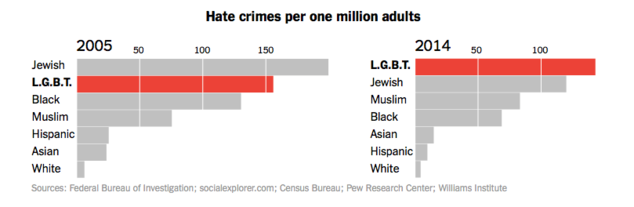
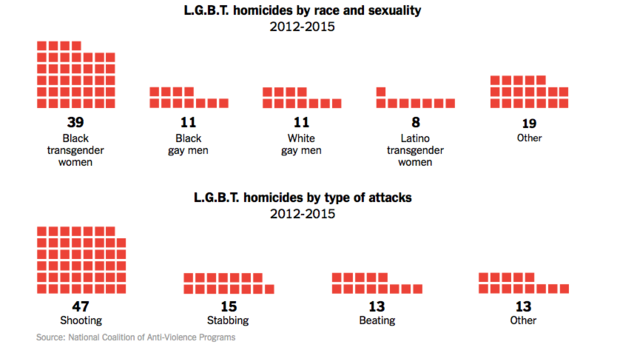
Gay liberation "destabilized" what traditionalists wanted carved in granite. Consequently, violence against gay men, particularly, has tracked their increasing visibility. Gays men were subjected to high rates of expulsion from the armed services during WWII, and when and where gay men became numerous and visible enough to shift the paradigm, attacks increased. The advent of Gay Liberation in 1969 and following led to a sharp increase in discrimination -- violent and otherwise. Over time, room for gay men to be part of the acceptable traditional role of men increased, at least provisionally. Butch was more acceptable than being too pouffy or fagotty of course.
The same process went for lesbians and transgendered persons. Except, of course, this is the moment where transgendered persons are becoming prominently visible, even if the total numbers of transgendered persons is not very large:
-
Since the Social Security Administration started in 1936, 135,367 people have changed their name to one of the opposite gender, and 30,006 also changed their sex accordingly, the study found. Of Americans who participated in the 2010 census, 89,667 had changed their names and 21,833 had also changed their sex. New York Times, June 8, 2015
"Transgender" has been applied to all sorts of sub-divisions, so the term has become less specific in meaning, and much harder to quantify. Still, the numbers aren't large (compared to at least 2 million gay men). -
Some People Think Pulse Bar massacre shows gay progress to be fitful. Is it?
I don't know where you live, but the exterior appearance of the Pulse Bar struck me as entirely normal. In many parts of the country, straight and gay bars alike are refurbished only on the inside. The exteriors are maintained in whatever state they were in to start with.
New bars, these days, aim higher on the design scale, even in the backwaters of the Midwest. And in the largest metropolitan areas, efforts to achieve curb appeal are apparent.
And sure, lots of bars are in dingy neighborhoods. The property taxes are cheaper there. Toni neighborhoods result in higher property valuations and more taxes and higher insurance fees. -
AfropessimismI would resign the chess board and recognize your victory IF one condition could be met:
IF I could show that your view of life was entirely and objectively true and my view was entirely and objectively false.
I can't, so... I do not resign the board.
That said, I have gained some respect for your argument. I don't like it, but for anyone so inclined it makes perfectly good sense. -
Some People Think Pulse Bar massacre shows gay progress to be fitful. Is it?A previous mass murder of gays, 1973 in New Orleans, has either been forgotten or people didn't know about it to forget. I can't remember whether I knew about it at the time. The New York Times ran a story on it this morning.
"...before Sunday that grim distinction was held by a largely forgotten arson at a New Orleans gay bar in 1973 that killed 32 people at a time of pernicious anti-gay stigma.
Churches refused to bury the victims’ remains. Their deaths were mostly ignored and sometimes mocked by politicians and the media. No one was ever charged. A joke made the rounds in workplaces and was repeated on the radio: “Where will they bury the queers? In fruit jars!”
Minneapolis did not have any such events in the early 1970s, but there were several brutal murders of gay men in Loring Park near downtown. The gay community organized a response: a demonstration (our anger), and set up safety patrols, and alerted the community (such as we could -- no gay papers, no internet). There was no outpouring of support from the larger community. It was a matter of most people thinking, I suppose, "This just isn't our problem."
In the beginning of AIDS, there was a similar response: "This isn't about us. It's not our problem. We don't do those sorts of things."
Now, every heterosexual Tom, Dick and Jane flocks to this park to watch the drag queen stage acts, buy rainbow trinkets, and look at each other. There's hardly room for the faggots and queers.
Back to Orlando: Some media are trying on an interpretation of the Pulse Bar massacre as specifically anti-latino. Was it? I don't know. It seems far more probable to me that it was an anti-gay attack and that the crowd that night was largely latino gays. On another night it might have been more anglo or black. I bet there are bigger and more crowded bars patronized pretty much exclusively by straight latinos in Orlando, and throughout Florida. If Matteen had wanted to attack latinos... there were plenty of targets.
I'm not quite sure what goes through the minds of producers who decide to seek out families of victims and then interview them about how this might really have been an attack on latinos. Is there some sort of aristocracy of oppressed groups that I wasn't aware of? -
AfropessimismThe world is the reality that it is — schopenhauer1
because...
There will always be unwanted pains in the world — schopenhauer1The world imposes on us the needs of survival and unwanted pain in a certain environmental and cultural constraints — schopenhauer1Our individual wills impose upon ourselves the need to transform boredom into goals and pleasure — schopenhauer1These "truths" are independent of one's general temperament — schopenhauer1One cannot choose to turn off their needs and wants- they are a part of their situation — schopenhauer1
and
The counterarguments that one can just think their way out of the situation seem to not work — schopenhauer1
I not only find each of your statements to be true (rearranged slightly) but taken together they are also true.
Does that make me a crypto philosophical pessimist? Maybe, but I am disinclined to take the additional step of concluding: Given that the world offers an inconsistently unsatisfactory arrangement, is it reasonable to voluntarily discontinue the species, non-breeding pair by non-breeding pair?
The key to my unwillingness to take this step is located in the phrase "inconsistently unsatisfactory". The world is also inconsistently satisfactory.
There will be unexpected pleasures in the world.
The world imposes on us the needs of survival and the possibility of realized dreams within certain environmental and cultural constraints.
"Our individual wills impose upon ourselves the need to transform boredom into goals and pleasure".
"These "truths" are independent of one's general temperament".
"One cannot choose to turn off their needs and wants- they are a part of their situation".
While granting the truth of your several points, it does not require a wholesale rejection of everything you said to place one's self CAUTIOUSLY on the side of philosophical optimism.
A Caveat:
For many people, possibly for most people, it is possible that global warming could make the world uninhabitable. If the following happens, Oceans rise; crops consistently fail where they were previously reliable; day-time temperature becomes intolerably hot to work outside; insect-borne diseases kill off animals, plants, and necessary insects; marginal areas become uninhabitable; inhabitable areas become marginal; inhabitable zones change faster than animals, plants, and insects can adapt (including humans); the cocoon of culture and civilization is inadequate to guide collective planning, and I were in a position to decide, I might conclude that further reproduction of our species was inadvisable.
But then, think back over the last 20,000 years of human life, a period in which we were then as we are now (modern humans): A million year ice age was coming to an end. (There had been about a mile-thick layer of ice over the northern half of North America, like where I live now.) Its melting revealed a landscape that had been scrapped down to bedrock or had been covered up with a geologically significant layer of mud. This is about the time people arrived in North America. They stayed to the west and south, out of necessity. The same conditions applied to Eurasia. We managed to subsist there, along with the Neanderthals. It was fucking cold, windy, unpleasant.
Philosophical pessimism must surely have been common at the time.
But you know, the ice melted; soil reformed; the philosophically pessimistic and grubby Neanderthals died out, along with the mastodons and giant predators that had been eating us. The weather warmed up and eventually life got quite pleasant again, at least compared to living in the tail end of the ice age. A few thousand years later, there was The Renaissance and The Enlightenment and here we are.
We survived ice; whether we will survive fire, don't know. -
AfropessimismSo is your answer that philosophical pessimism is simply culture? — schopenhauer1
Not quite that simple, no. The philosophical stance one takes is a combination of the cultural resources the culture makes available, one's personality, and one's personal experiences. A neolithic hunter-gatherer band member would have had language, a religious view point of some sort, close human companions, folkways, and the possibility of a more or less pleasant life.
Their "philosophy" might be a version of whatever will be, will be. Enjoy the good stuff and endure the bad stuff.
A given individual, though, might be inclined to react more negatively to the bad stuff, and derive less pleasure from the good stuff. He need not be "depressed"; maybe his nervous system just works that way. For him, his hunter gatherer life is not satisfactory. (His language might or might not afford him the terms needed to say that, but he could sure feel it.) He just feels bad about his life and doesn't especially look forward to the next hunt. "What's the point?"
So, yes, I think a neolithic society could produce somebody who was antinatalist in feeling, though probably not in concept. It wouldn't produce very many, probably, and if it did the band would probably be extinguished by a lack of necessary enthusiasm for the essential hunter-gathering tasks.
Neolithic people (the era ended around 3000 b.c.e.) were innovators, experimenters, explorers, and so on. -
Afropessimismwould they "get" the very notion of choosing to not exist to spare the next generation — schopenhauer1
Well, I don't know, of course. It's a very good question, though.
My view of philosophical pessimism is that it is a creature of neurological or psychological pessimism. Don't have any data at hand to prove it, but I think people are born either as predominantly optimists or predominantly pessimists. It's a "leaning" which will prefer certain kinds of thinking over other kinds of thinking. It's like people are born with one of two sexual orientations. If you are straight, the opposite sex looks more interesting to you. If you are gay, your own sex looks more interesting.
Psychological / neurological optimists and pessimists are drawn to thought systems that are most congruent with the mind's native style. This isn't quite as fixed as one might think.
Believe it or not, I used to be much more of a philosophical pessimist. It paired nicely with chronic depression which lasted a long time--maybe 25 years? When the depression lifted, which it did fairly abruptly, I became less pessimistic and more optimistic, whether I liked it or not.
Take Global Warming. I feel much less depressed about global warming, but I'm pretty sure we're totally screwed. We show every indication that we will NOT get ourselves together to set things right. This used to agitate me a great deal. Now it doesn't. I am, frankly, pretty surprised to find myself in this state. Maybe it was doing the arithmetic and discovering that I will probably be dead from old age in just 20 years (at the outside) well before the final heatwave begins.
I can understand people being reluctant or unwilling to bring children into a world that is in serious danger of being severely degraded in the foreseeable future. If predictions are accurate, life will be far, far more difficult in the future which one's newborn children will live. One's grandchildren will likely find an even more difficult situation.
You seem to feel that life has always been too unsatisfactory to bear children. -
AfropessimismIf I were to be accepted in a previously uncontacted tribal society — schopenhauer1
An interesting book you might enjoy, if you can find a copy: Keep the River On Your Right by Tobias Schneebaum, 1969. (Check out on line used book stores like Alibis or ABE.com.) Schneebaum (now deceased) traveled into the jungles of Peru in search of a particular tribe, the Arakmbut, who were presumed to be uncontacted. He found them, and stayed with them for a long time -- accepted. They turned out to be cannibals, and the book includes discussions of flesh eating.
There is no lesson in it about Schopenhauer or Hegel, but he does describe exactly the kind of experience you propose. In time there was more contact, the tribe caught numerous diseases to which they had not been previously exposed, and their quality of life took a nose dive.
I would imagine that their latter day view of life was a lot less sanguine and cordial than it was early on in their contact with Scheenbaum. He didn't seem to be the source of the viruses.
Or, is it a Hegelian thing? — schopenhauer1
Another tangent: Theoretically, all human populations should display the same frequency and type of mental illnesses. We share the same genes, and life is life (good bad and indifferent) wherever we live. But that doesn't seem to be the case. While schizophrenia does show up pretty much everywhere, as do other disorders, societies that industrialize experience a sharp rise in the incidence of these maladies. (At least, I think this is correctly stated. Going on old memories here...)
"Improvements" in the quality of life -- electricity, indoor toilets, better food, less disease... seem to be paired with a decline in the quality of life -- assembly lines, piece work, ruthless exploitation, low pay... The better things get, the worse they are. What Marx described for 19th century Europe and England occurs all over again in SE Asia. The interpersonal, family, community, religious structures that bind life and meaning together are ripped to shreds by factory life. Farm life was hard, factory life is worse.
Modern industrial life, conducted on its terms, drives people crazy. -
Some People Think Pulse Bar massacre shows gay progress to be fitful. Is it?Anyway, getting back to islamic jihadis shooting up gay bars...
Should there be more of such events, (and there might well be) all sorts of targets are likely to be chosen. This guy apparently found queers especially offensive, but somebody else might find straight strip clubs, or American feminists, or California porn studios, the government, or who knows, maybe the ACLU to be unbearable. Not to mention Christians and Hindus here. There is a well established 3-way antipathy among Christians, Moslems, and Hindus, depending on where one is. While they haven't all been killed, a good share of the Christians occupying the religion's homeland have been driven out. India is a mess of internecine hostilities. -
Some People Think Pulse Bar massacre shows gay progress to be fitful. Is it?I am sometimes curious as to what goes on on pedophile forums, for instance, but that's just not the sort of thing I want in my browser history — Arkady
I understand. Actually, I'd be surprised if there even was such a thing as a pedophile forum, these days.
One of the areas I would like to research as part of gay history is the North American Man Boy Love Association. I have zero interest in pedophilia, but there was a strain of pedophilia in the gay community, and it was an extremely divisive political issue back in the 1970s, early 1980s. Whether the principals of the organization are still alive, don't know. But as you say, digging this stuff up even if for academic purposes leaves a trail.
There was a three way fight among the lesbian-feminists, gay men, and gay pedophiles. The LFs didn't have much affection for gay men to start with, and suspected we were all GPs. Most of the gay men, whatever else they liked, couldn't stand the LFs. The GPs found company in some groups of GM, and were shunned in others. -
Some People Think Pulse Bar massacre shows gay progress to be fitful. Is it?
certainly includes radical islam, but I think the elephant also includes Christian and Hindu conservatives too. A plague comes from all their houses because religions define what is moral and immoral for a lot of people, and conservative religions have a fairly long list of immoralities, which include homosexuality, transsexuality, feminism, and so on.the elephant in the room — Arkady
In the mid-1970s it was the fundamentalist Christians who were preaching against gays in the U.S. Granted, they weren't proposing the lethality which ISIS 'justice' hands out, but they were bitterly opposed to gay rights. A lot of those conservatives are still around, and many of them are still very opposed. My knowledge of Hindu haters is sketchier, but they are capable of fairly violent actions too. In East Africa, for instance, some Christian groups are calling for the death penalty for being, and acting on, one's gay sexuality.
So while I loathe radical islam, I also loathe other traditions which in their conservative mode resemble radical islam all too much. -
Some People Think Pulse Bar massacre shows gay progress to be fitful. Is it?I don't know that Omar Mateen was a madman. So far I have heard that he was volatile and violent (that according to his ex-wife). Even if he suffered from mental illness (a madman) that alone (without more detail) would not fully account for his behavior.
I am inclined to disagree with the viewpoint of the New York Times, and some Gay Community political types who expressed sweeping conclusions about what the attack meant. I don't see a war on queers here. (That is not to say that in several parts of the world there isn't a great deal of overt hostility toward gays.) What I see is a one-man attack that was probably inspired by both personal feelings and by propaganda he watched on line.
I was just about too late for bulletin boards, and was definitely too late from on-line dating and Grindr. The trouble with Tinder and Grindr is that the scope for deception is wide. Many a hunter have excitedly followed the screen prompts and arrived at the right location to find that the delicious hunk or fair damsel they were expecting is actually a decade or two older, quite a few pounds heavier, and less socially sophisticated than they had been led to believe.
There might have been young thugs in the park, trolls in the adult book store, and several old fat guys at the baths -- but it was all quite clear from the get go. Its the WYSIWYG interface. (And quite often, mind you, real honest to goodness hunks were on the scene, and available!) -
AfropessimismI am all for the hastening of the non-West to become more Westernized and more technological as soon as possible, so we can all be on the same page to understand Philosophical Pessimism and antinatalism. — schopenhauer1
Right. As soon as an African mother has a pot to piss in, she starts reading Schopenhauer, wondering why she bothers to have children, and doesn't just get it over with by using her machete to chop off her own head. -
AfropessimismIt depends on which country is up for consideration. Congo? Kenya? Namibia? Mozambique?
Africa is a very, very large continent; too big to be written off; practically too big to make generalizations over.
There is good reason to be pessimistic about almost any area of the world; there are some reasons to be optimistic too. There is much more investment in Africa countries now than there was 10, 20, 30 years ago. That's good. Africa has mineral resources which are being exploited, sometimes to the benefit of very few, sometimes to wider benefit. It has reasonably productive land, it's population is not overwhelming large, and it has a moderate climate, more or less. With investment comes economic expansion which allows a larger number of people to improve their lives.
There is a difference in opportunities and problems between urban Africa and rural Africa. Nairobi's problems are not the same as rural Uganda's on the other side of Lake Victoria. Both types of problems are entirely as remediable as North and South America's problems, Europe's problems, and Asia's problems.
Africa is no more plague-ridden than SE Asia, India, or South America. Yes, there is malaria, which sickens and reduces the productivity of a lot of people, but malaria is an endemic disease in lots of places. Ebola pops up every now and then. Africa has AIDS. But then AIDS is pretty much everywhere. South America has the zika virus, but soon everybody else will too and there might be an epidemic of defective-brained children being born from Rio to Mumbai.
Development is usually assisted -- has been for a long time, everywhere. Money flows in along with expertise, things start changing, problems get solved, people do better. We don't want to be Pollyanna-ish about it, of course. People in rural Africa, disconnected from cities, will probably benefit later than people living in urban centers.
Some cities, like Nairobi, have huge slums -- largely resulting from the familiar rural to urban migration of people. But then, lots of cities in the developed world have some pretty bad places as well. -
If life isn't worth starting, can it be worth continuing?Had I come to this same discussion 20 years ago I would have found your position consistent with both my experience and philosophical view. Life seemed much more unsatisfactory then (not just for a few weeks; more like a couple of decades). Life seemed to be composed more of ruthless exploitation, hindrances, bastards, etc. I very much exposed to an acid rain.
It isn't that I now think that life is constantly sunny and sweet. I don't. I'm well aware that even if I feel more optimistic and positive, life hasn't changed for everybody else. There is still exploitation by ruthless bastards lurking around every corner, hindrances of all kinds, disease, suffering, and steady acid rain (so to speak) is still falling. I can't supply a full explanation of why life seems less malignant now than in the past.
Our larger social / political / economic system (not just in the USA, but in most of the world) is deeply corrupted and exploitative. Disease, destitution, disorder, and dying are as rampant now as ever.
I didn't will a change in feeling and thinking from "life is barely tolerable" to "life is OK, maybe even good" though I find the change is a relief. It just happened. Maybe the cold, wet rain and dark clouds will return. Don't know. -
The Ethics of Eating MeatMy local environment since WW2 has been turned over to mainly wheat production, in a cycle that involves the utter dependancy on heavy machinery for deep ploughing and the use of chemical fertilisers, pesticides and herbicides. — Hogrider
It's the same in the midwestern part of the United States -- well, most parts of the US. Corn (maize), wheat, soybeans. On some fields, the energy input required exceeds the energy output per acre. Cheap fuel has made this possible, that and government support.
Topsoil run off is relatively easy to control (minimum tillage, abandoning fields that are too steep, contour and terrace formation, etc). Not that we are doing a good job, but we do uno how. Worse is the runoff of pesticides, herbicides, and fertilizers. There is a large and growing dead zone in the Gulf of Mexico from eutrofication (loss of dissolved oxygen) as a result.
Corporate farming pursues short term goals; fuck the future.
BTW, animals aren't required to return the nutrients of plants to the soil. Yes, animal shit is a very good fertilizer, but green manure (raw vegetation) works well too. That's partly the idea of minimum tillage -- leave the chaff on the field where it falls; don't plow the field; plant through the vegetative mat.
Hilly areas are well suited to grazing because such ground should absolutely not be plowed, and cattle do enrich the soil without adding chemicals. They just chew, digest, shit, and produce milk and meat. Raising cattle in feed lots served by huge grain fields is a less ecological solution. There are many hilly areas in the country (UK, too) where bovine grazing shouldn't cause too many problems. Sheep and goats are short grazers -- biting off plants close to the ground. Pigs are totally incompatible with grazing land -- their rooting around destroys pasturage and leads to erosion. Goats have the narrow advantage of eating a wider variety of plants -- things that cows won't gladly eat.
What I am in favor of is reducing the quantity of meat and milk products consumed. Modest consumption of meat and fresh milk is sustainable. -
If life isn't worth starting, can it be worth continuing?I'm glad you can speak for most people. — schopenhauer1
As well you should be. :)
Look, is it any different claiming enough authority to say that life is generally good, than saying life entails too much suffering to justify bringing a life into the world?
Why do you object to me doing that? -
If life isn't worth starting, can it be worth continuing?I've learned to take your trash-talking on antinatalism in stride... — schopenhauer1
A wise policy.
Suicide ideation in this case does not mean that people are actually thinking of putting the knife to their wrist and taking a warm bath — schopenhauer1
I understand that suicide here is a "gesture" not a concrete plan to end it all. That's what makes it romantic. Were it a serious plan with an on-hand method and a timetable, it would be a psychiatric matter rather than a dramatic move.
...but rather the abstract notion that you have power over your very existence. — schopenhauer1
This is where I have difficulty, and this is the bin out of which all the trash talking emanates.
IF one believes that one gains (or acknowledges) power over one's very existence by the assertive philosophical gesture, THEN the affirming gesture that life is good, worth living, and good exceeds ill is as powerful a claim on one's fate as the gesture of suicide.
Asserting that "life is good" has the added advantage of easing the burden of living (and yes, at times life is a burden -- work, for instance, or prison, or illness, or war, or...). If life is viewed as a river of shit` and one might as well drown in it, it makes for a rather dreary passage.
I don't think we are entirely masters of our "fate". The assertion that one gains control over fate with the suicidal gesture is as deficient a force as the gesture that life is always a bed of rose petals. That is to say, it may be marginally helpful to the individual, and no more than that. Much of what happens in life happens with utter indifference to our wills.
In real life many people will not resort to suicidal gestures. Like some victims of the Nazi death camps, many will cling tenaciously to life, no matter what. It isn't that suicide is against their religion or some such excuse. They just don't think in terms of suicide. (And here I am holding nothing against the Nazi victims who did choose to leap onto the electrified fence or easily provoke a guard into shooting them.)
Most people endure and proclaim their endurance as their will without asserting that life is not a long suffering. They know full well that life entails suffering. But they (at least think they) are on top, not on the bottom. -
If life isn't worth starting, can it be worth continuing?What I don't know about these pessimists (including Cioran) is whether or not they actually did view suicide as a legitimate option for themselves. Were they suicidal? Were they just barely living? I suspect not. I suspect they derived a certain amount of pleasure from life. — darthbarracuda
Look: People who are suicidal and just barely living, don't write books about it. They are beyond caring whether the book gets written or not.
Your suspicion is precisely correct: they did derive a certain amount of pleasure--not only from life, but also from writing a book about suicide and the misery of existence -- a misery they, themselves, did not feel. Else, they wouldn't have got the damn book written.
David Benatar is a professor of philosophy and head of the Department of Philosophy at the University of Cape Town. Does that sound like somebody who has been just barely living? Similarly, Cioran was too productive and long lived to take his extreme pessimism too much to heart. His New York Times obituary reads like most NYT's obituaries: another quite successful person who made a significant mark in literary circles...
The source of his world view, he said in an interview published in 1994, was severe insomnia that began plaguing him as a youth and led him to give up his faith in philosophy after years of studying it.
I am much, much, much more impressed by people like Dorothy Day who worked a life time in very squalid conditions but whose writings are full of bright and realistic optimism, than people who occupy academic sinecures and write books about how squalid life is. -
If life isn't worth starting, can it be worth continuing?In what psychodynamic system is suicidal ideation more of a coping mechanism? — Bitter Crank
Short answer: a lot of them. Not a healthy coping mechanism, mind you, but a coping mechanism. — csalisbury
It's not so much that one is going to commit suicide, but that one can commit suicide that may be a sort of consolation. — schopenhauer1
I was definitely thinking of healthy psychodynamic systems. I will grant the possibility of suicide serving as a relief valve in extremis. "If it gets worse, I can..."; "I'll endure until Friday, and then... and such.
There is a Romantic literary notion of suicide, and a philosophical notion too, but I don't consider romantic moping about in the ruins as any sort of a psychodynamic system. Theories of personality certainly include suicidal ideation (and acts), but not as a normal strategy for persons.
Theories of personality assume the development of individual psychology from infancy forward, including inheritance and environment, experience, learning, physical disease, and so forth. The life on which the child embarks normally goes on until accident or disease brings it to an end--for at least "three score years and ten" as the Psalmist put it.
Suicide generally figures as a consequence of disease--the mind gone haywire. People suffering from mental illness don't turn to suicide in the sense of "deciding to end suffering"; rather, suicidal thinking is part and parcel of the illness itself. In severe mental illness, hallucinations urge suicidal acts.
Antinatalism, at least as it has appeared in on-line discussion forums, seems more like an adolescent game than a serious philosophical position (though some people are serious about it). To me it begs the sarcastic question of "why don't you commit suicide if being born was that bad?" I don't think antinatalism leads to suicidal ideation, unless one were otherwise heading in that direction.
Of all the sources of consolation one can find, suicide seems like one of the flimsiest.
BC

Start FollowingSend a Message
- Other sites we like
- Social media
- Terms of Service
- Sign In
- Created with PlushForums
- © 2026 The Philosophy Forum