
Comments
-
What is the point of philosophy?In my opinion philosophy is edifying in a way that other avenues of inquiry are not. The special sciences are by comparison 'workmanlike' and approximate labor, whereas philosophy more properly involves 'thinking.' It's possible to do a job in a special science, but not really to think in the interesting sense. — The Great Whatever
With all due respect to you, TGW--a thoughtful philosopher, this particular statement about scientists is kind of close to hogwash. (Hogwash is not a pig's bath water; it's swill for swine.) I'm not a scientist, and was not personally insulted, but scientists really do "think"... and deeply at that.
For my part, I consider philosophy to be a field in which people study a corpus of works by writers, some of them 2500 years old, in whom nothing new is going to be discovered. (Like, "I never noticed before that Plato mentioned how much he admired brain surgeons.") Philosophy is narrowly focused on the nature of the cosmos, this world, and us--mostly us, and a bucket full of vague abstractions like "truth". As such, philosophy has at various times hatched new fields (such as psychology) which have gone on to supersede the achievements of philosophy in specific ways.
It is not the only field of study by which one can become a better thinker. Most fields of study--geology, history, biology, literature, art criticism, mathematics, music, physics, theology, sociology, chemistry, supply chain management, etc. require one to think clearly and practice systematic and disciplined thought.
If someone likes philosophy, they should study it. If they don't, they need not fear they will end up as intellectually impoverished copier repairmen, or drudges doing dreary, third-rate workmanlike tasks in the astrophysics or quantum mechanics laboratory. -
Policing on a good day.On the money side of things -- we spend a considerable amount on police. In our city -- and I'm lead to believe that this isn't an anomaly, though I haven't sifted through the data -- the police department is the single largest chunk of the general fund. Police have more than striker fire pistols -- APC's, body armor, shotguns.
The force has been militarized in recent years because the feds have given surplus military gear to local PD's. — Moliere
The % of the 1.3 billion dollar Minneapolis budget that is spent on police is about 12%. Public Works and Capital Improvements are about 40%, give or take a little. Schools and hospitals are managed by the State, School Board and County. The population of Minneapolis is 400,000. 12% doesn't seem like an inordinate share of the budget to me. (The budget doesn't include the cost of retirement or payouts as a result of successful lawsuits against police misconduct, of which there have been a few.)
I haven't seen a lot of military equipment in Minneapolis. Horse patrols are used, and a man with a gun on a big horse is fairly intimidating. However, during the 2008 Republican Convention in the decrepit Twin City of St. Paul, the police presence in both Minneapolis and St. Paul was heavy and the policing tended to be on the harsh side. There were raids at the homes of a few people who had been planning some sort of civil disruption. The Republicans and Protestors were far enough removed from each other that there was really no point in protesting. One could just as well have protested in Omaha, for all the proximity there was.
On the other hand, during the Occupy Whatever protests on the county courthouse square, the police were very mild -- but then, so were the protestors. Most of the time the police here are "appropriate". But then, this from the perspective of an old white guy. Young black guys have a much, much different impression, justified or not.
As one then elderly socialist put it back in the 1970s, "I'll take northern pigs over southern pigs any day."

-
Article: In Defense of ProgressThe relationship among "progress", "economic growth", and "increased consumption" needs to be clarified. If growth means more material consumption (more coal, more steel, more plastic, more tchotchkes and rubbish, then no. If "economic growth" means more services provided socially and more efficiently, then yes. More cars, no. More railcars, yes. More 1 use throwaways, no. More multiple use and recycling, yes. More built-to-last, yes, built for 25 years then landfill, no.
Extreme global warming may render the whole discussion irrelevant. But assuming we can and actually do reduce CO2, methane, and other greenhouse gases to the point where worst-case scenarios don't kick in, there remains the problem of population growth. 12 billion people isn't going to work very well either, and this isn't just a Third World problem. 500,000,000 Americans are too many as well.
Shrinking population without the aid of horrendous epidemics, mass starvation, or nuclear war is really quite difficult to plan. Most population control schemes tend to lead to mushroom shaped age distributions which are quite problematic: Too many old people and way too few young people. Forced birth and death schemes (1 child policy for young people, suicide at 75 for old people) are not generally well received. Now, it may be that epidemics and mass starvation will save us the trouble of having to manage birth and death so that we get a sustainable population. But Mother Nature's approaches are not very pleasant either. And Mother Nature may opt to kill you! and me! rather than our stupid, avaricious, wasteful, bourgeois neighbors.
If by "progress" we mean an upward leveling off, so that everyone lives like upper-middle class people (meaning, professional/technical education, family incomes in the +/- $200,000 range, spacious home, cabin on the lake, 2 luxury cars, world travel, frequent fine restaurant meals, excellent sport and recreational equipment, and so on), then NO.
If by "progress" we mean an upward leveling off where cultural goods (esp. an over-all high literacy rate, solid education in technical, liberal arts, or professional trades, excellent enriched child care, etc.) and opportunities to use one's skills and intelligence for the common good are plentiful (rather than material accumulation--a la entrepreneurial culture), without the expectation of high levels of material consumption, then YES.
I'm not suggesting that highly literate, educated people should contribute to the over-all well being of society but then live in a box under a bridge (albeit with a high speed broadband connection and a tablet computer). Rather, I'm suggesting that the quality of cultural participation level up and the quantity of material consumption level down.
For poor countries, there has to be a leveling up of basic goods: housing, health care, education, communication. For rich countries, there has to be a leveling down of material consumption.
"Socialism" and "Planning" go together like sunshine and orange juice, but successful planning is very difficult. -
How should one think about Abstract Expressionism?
I don't have the original hanging over my couch, (his stuff sells in the multiples of millions $$$) but as far as I know, the image in the OP is of the whole picture. -
Welcome PF members!The old PF seems to be declining — John
A road going downhill is at the same time going up hill. The old PF is both descending and ascending and always has been. Per Hera's Clitoris (AKA Heraclitus). Welcome to the THE Philosophy Forum. -
How accurate is the worldview of the pessimist?i agree with soylent that pessimism and optimism are "character predispositions" or personality features, and for which individuals can neither be blamed nor praised. One doesn't arrive at either pole by means of logic. Realism is neither pessimistic nor optimistic (aside from having the adjective applied by himself or someone else: "I am cautiously pessimistic that this tree will ever bear fruit.")
Pessimism isn't the same as "giving up" and optimism isn't the same as a "gung-ho can-do" approach.
I am pessimistic about the future. I expect climate conditions in 2100 to be quite undesirable. I expect that over-population will remain an on-going problem. I expect that the world's economies will experience considerable volatility and over-all decline. All that is pessimism, but I don't feel depressed about the future. Being nearly 70 years old helps, of course. I won't be around in 2045, let alone 2100. I am, on the other hand, optimistic about the next few years of my life. I am looking forward to continued good mental health, stable physical health, continued mobility, and new (positive) learning opportunities.
Realistically, there is little I can do to improve my life (which is OK the way it is). I (realistically with optimism) assess my chances of biking to the grocery store and back without getting killed as very good. But realism and pessimism both tell me that a fatal accident is possible.
Society requires a wide variety of mental types, predilections, skills, propensities, and so on to respond adequately to new and resurgent old dangers and opportunities. The ideal isn't a "balance between optimistic and pessimist"; rather, it is a dialogue and debate with objective information.
Pessimism:
1. a tendency to see the worst aspect of things or believe that the worst will happen; a lack of hope or confidence in the future
2. Philosophy a belief that this world is as bad as it could be or that evil will ultimately prevail over good.
Optimism
1 hopefulness and confidence about the future or the successful outcome of something
2 Philosophy the doctrine, esp. as set forth by Leibniz, that this world is the best of all possible worlds.
• the belief that good must ultimately prevail over evil in the universe. -
Dreaming.Thank you for the birthday wishes. 69 candles on my virtual cake, every one of 'em a phallic symbol.
-
How should one think about Abstract Expressionism?It's the same with art, you look at a pollack and he is scattering this paint on a canvas and your thinking 'what the hell are you doing dood, what the hell are you doing?' — Rough Transcription
I suspect that for abstract expressionists, and people like Pollock in particular, it's "doing the art" that is the crux of the matter -- and that part only the artist gets to experience. That's probably true for a sculpture and a block of marble too. Looking at a figure of marble will be nothing like the experience of carving the statue from marble. -
The compatibility between science and spirituality"Spirituality" is not a problem if one is conventionally religious. Maybe a billion of us are not conventionally religious, or are not religious at all, and for us "spirituality" may have no ready-made clear meaning. (Actually, it can be a source of confusion for the religious as well.)
"There is nothing innately impressive about the universe or anything in it" is merely the desiccated diarrhea of the dreariest shriveled up materialist. Sad.
We can claim to have "spirit" and "spirituality" without invoking God or the numinous. Spirituality is both an emotional and intellectual experience: we feel (love, pain, exaltation, humiliation, etc.) and we make and apprehend meaning. Our thoughts and emotions are intimately linked, and therein is the source of secular spirituality.
We may all have "spirit" but not all of us are "spiritual". One can close off ones self from unwanted feelings and thoughts, and the most severely shriveled personalities may not be able to tolerate even hear numinous terms bandied about.
What is a spirit? Leaving out deities and distillates we have these:
- an animating or vital principle... (like "life")
- temper or disposition of mind or outlook especially when vigorous or animated... ("enthused" from Greek enthousiasmos, from enthousiazein, to be inspired by a god, filled with the breath of a god)
- the immaterial intelligent or sentient part of a person
- the activating or essential principle influencing a person
- an inclination, impulse, or tendency of a specified kind; a mood
- a special attitude or frame of mind
- the feeling, quality, or disposition characterizing something
- a lively or brisk quality in a person or a person's actions
- a person having a character or disposition of a specified nature
- a mental disposition characterized by firmness or assertiveness
- prevailing tone or tendency
- general intent or real meaning
-
Dreaming.What were dreams like before television and film? Ask Sigmund Freud. The Interpretation of Dreams was published in 1899, before either one. EVERYTHING affects the content of dreams, because the content of our dreams is derived from the content of our minds which is derived from experience. This is so whether one thinks dreams are meaningful of meaningless. If a human were born and raised on Proxima VII among odd but benevolent aliens, one's dreams would include the aliens.
Dreams can be shaped and one's memory of dreams is improvable. Analysands--persons undergoing psychoanalysis--can greatly improve their dream recall.
The reason why one couldn't become a gymnast by sleep-practice is that one must learn real-world lessons about momentum, gravity, capacity, and so forth. Imagining that one will land in a certain way isn't the same as actually feeling one's body striking the mat and "sticking". That said, it seems to be true that mental practice can help improve real-world performance. Baseball pitchers who mentally practice techniques seem to improve real world performance. People who are nervous speaking before groups can reduce anxiety by imagining themselves giving a relaxed, competent presentation. Such exercises aren't silver bullets -- stage fright dogs some performers their whole lives. Thorough preparation helps. If you aren't quite sure of how the song goes, you have good reason to be nervous. -
The Future of the Human RaceI care about future generations, even though I haven't done a damn thing to provide my own share of progeny. (Gay boys generally don't.) But still, I feel like a part of the on-going process of human life--our cultures, our aspirations, our nightmares, our tragedies and our totally asinine comedies. It is our duty to deliver a world to future generations. That's really all we can do. Preserve this one and hand it off to the next batch.
There is a great book about this question: Earth Abides by George R. Stewart; 1939. A young man on a hike becomes extremely ill in a cabin and wakes up sometime later (a week or so). He drives back toward Oakland where he and his parents live, but soon notices there is no traffic. No people in small towns. He finds a copy of "the last San Francisco Examiner" (reduced to one page) from which he learns that most of the world's people have died from a plague. He finds a few people who survived, and they form a little community of maybe 10 people.
The young man grows old. He tries to teach the young, but succeeds mostly in teaching the young people how to make and use bows and arrows, more as a game. It's something he can give the future. The community flourishes, but gradually reverts to a more primitive way of life. The young are not interested in learning to read, and eventually they give up on guns too, and find bows and arrows work better (they can make them themselves). It appears that life will go on.
We can't do much for the future beyond not wrecking the present. -
What are you listening to right now?Beethoven: Piano Concerto #1 In C, Op. 15 - 3. Rondo: Allegro Scherzando... from a box of Ludvig's piano concerti.
-
How should one think about Abstract Expressionism?Most of the art created after this date irritates me. So I freely admit my knowledge of art history is largely determined by the art I like. — Thorongil
But realistic figurative work continued after 1920... Have you sampled "magic realism"? Here's a sample by Paul Cadmus, Fleets In, 1934. It was commissioned by the US Navy who were initially shocked and appalled and buried it somewhere. Now it hangs in their headquarters building.
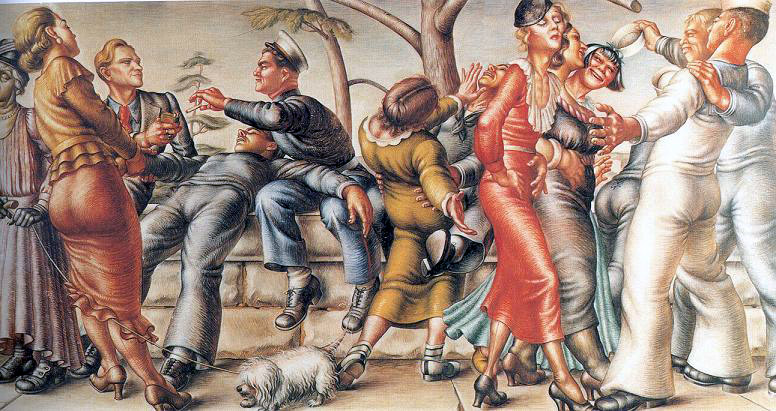
Cadmus continued to paint in a realistic style into the late 20th century, as did quite a few artists. (Some sniveling-worm critics will, of course, say that anything realistic is merely derivative and of no aesthetic significance.) -
How should one think about Abstract Expressionism?personally I don't like the urinal — Agustino
And what have you got against urinals?
I do agree with Thorongil that it does not give me an aesthetic experience which makes my mind come to a halt and become fully present, with no will, passions, or desires left. — Agustino
I'm not sure when or if I experienced such a reaction to art, but... take yourself back to 1917 to the New York Armory show in which the urinal it's first and last appearance as a one-off shockeroo. it might very well have stopped any number of people in their tracks.
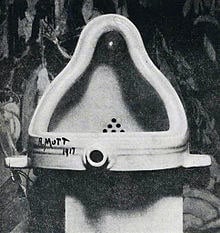
Notwithstanding the Kohler Company's strenuous efforts in Sheboygan, Wisconsin to turn out lovely urinals and toilet bowels, proving the attractiveness of toilet fixtures wasn't Duchamp's objective. It's been a while since I read up on the subject, but it seems to me that Duchamp was saying something about the art business, the critics, the artists, the show, and related matters. He was, sort of, a la Three Stooges giving them the finger. Among other things. Like democratizing art.
If I declare that something is art, then it is art. Maybe he found the urinal in a trash heap. Or in a hardware store -- don't know. But found objects was another one of his schticks. Put together an assemblage of odds and ends found here and there... It can look like a pile of trash or quite interesting. Sublime... hmmm, maybe not. But I haven't seen everything, yet. -
Bad Art"With this faith we will be able to hew out of the mountain of despair a stone of hope." So King is trapped in the stone of hope, apparently, even though he talked about hewing said stone, which would mean he is hewing himself? And then the big white rocks behind him are mountains of despair, which are strange things to memorialize in stone. — Cavacava
The 'critic' whom you quote may have missed something. Out of the 'mountain of despair" a 'stone of hope' has been hewed -- it's not King, it's the opening to King's right (viewer's left).
Monuments and memorials can be very good, or they can fizzle. Haven't seen the King monument, but have seen Maya Lin's Wall. (She was 21 when she designed the monument, and had not graduated from undergraduate college yet.) -
Bad ArtWhat is bad art then in this context? Well, if we consider the function of art is to disturb us in a wonderful way then art which does not function or cannot reasonably function in that way is bad art no matter how aesthetically pleasing it might be, and art which does function effectively in that way is good art no matter how banal or unaesthetic its form is. — Baden
This sums it up for me pretty well.
And of course ART isn't just painting. Beside the representational and plastic arts there are music, poetry, fiction, drama, film, dance, stained glass, and more. All of it does well if it stimulates us. If it does nothing, then it is bad art.
There is bad art, no doubt about it. -
Bad ArtSure, art can be described, defined, judged, bought, sold, appreciated, depreciated, etc. Mostly, though, "art" is inextricably tied to experience. Sort of like porn: I can't define it, but I know it when I see it. (Justice Potter Stewart said he regretted uttering that phrase which he figured would be carved on his tombstone.) How does one know porn when he sees it? Well, one gets a set of emotional and physiological responses. There is certain subject matter. The medium has something to do with it, as does context. One might recognize it as porn but nothing happens when you see it. Bad porn.
Maybe you walk into an "art repository" (gallery, museum, studio, etc.); maybe you walk past a frieze on a building or a sculpture. Maybe someone has a painting in their living room, hung symmetrically over the couch. Maybe you are watching a film not involving guns, car chases, or asinine behavior. It's B&W. (It just might be art--the tall thin actors are all speaking Swedish.)
Contemplating the abstraction of "art" and applying vague, indefinite terms like 'beauty' to "art" won't get us too far. And it doesn't need to.
You will find that "art" (broadly defined) comes in many forms and many degrees of quality. Like porn, art is at its best when it is in hand.
Neither Warhol nor McLuhan were anywhere close to as flippant as the quip "Art is whatever you can get away with." would suggest. Though, I do think there are contemporary performers of art who have come very close close to fulfilling the phrase. They seem to be getting away with something; maybe not art, however.
Bad Art produces either negligible, negative, or shallow experiences. When one looks at bad porn one feels nothing. "Hey! I'm not feeling anything. I want my money back." When one looks at bad art, one feels nothing.
Art is for experience. Bad art just isn't much of an experience at all. (So, art you intensely dislike because it makes you feel angry isn't bad art. You just don't happen to like what you are looking at. -
Policing on a good day.No doubt about it, he'd be dead pretty damn quick.
The police fall back on a few basic principles:
1. Don't back down.
2. Do not tolerate resistance.
3. Escalate to deadly force rapidly.
These guiding principles result in an excessive number of people getting killed by the police, and we haven't even brought up the number of common folk killing each other. I believe that these rules are not a consequence of deep racism. They are more a consequence of social conditions. Like what, you ask?
Greater friction between capital and (organized or unorganized) labor. Strikes tended to lead to violent confrontations among strikers and scabs. Capital desires control (not just in the workplace, but beyond the workplace). Police are called upon to do more than maintain order. They were also asked to suppress what the people at the top considered threatening behavior. Labor may not be a huge threat, but disorderly crowds can make the people at the top just as nervous.
It is my understanding that the United States has been a more violent country than most other industrialized countries. Part of this was self-inflicted, like Prohibition, which yielded a lot of (relatively nonviolent) law breaking. The US has had a clearly identified underclass that it wanted to maintain control over. Blacks--formerly a slave class--certainly are a component of the underclass, but they are not alone. Poor whites, too. Labor organizers, communists, etc. People who deviate too far out of the ordinary.
Lots of countries have had criminal enterprises, but it seems like American criminal enterprises tended to wield violence fairy readily. There were (are) also armed gangs, and of course there is our Second Amendment gun fetish.
Because the US has lagged (or actively and proactively retrogressed) we have more untended social ills than many countries. There are more more-desperate people running around here than in other industrialized countries.
The police, therefore, are not out of control. They are attempting to maintain the kind of tight control that certainly the ruling class wants, and that many other people are reasonably comfortable with.
For the majority of Americans (like 70%-80%), encounters with the State Highway Patrol, County Sheriff, city police, or even Federal Marshals, are likely to be routine, non-violent, reasonably polite, and so on. BUT... Challenge, resist, or threaten and the situation can turn 180 degrees in seconds.
Just as the "war against terrorism" has been applied to every American air traveling, police control has been brought home to the neighborhood -- lots of neighborhoods, and not just the black ghetto.
Individualism definitely has something to do with all this: Individualists, whoever we are, are prone to be trouble. They want to be unimpeded; they don't want to cooperate with arbitrary "authority"; the individualist is suspicious of either (or sometimes both) the corporation and the state, for whom both the cop is the defender. Individualists are likely to consider themselves above authoritarian control. All that makes social deviants (like citizens who think they live in a free country) potential targets. -
Should fines be levied in proportion to an offenders income?Proportionate penalties arise in civil suits, don't they?
Proportionality in fining individuals is worth considering. -
Against Ethics?"Well, it seems to me that you are willing to call quite a few people idiots: Epictetus, Seneca, Spinoza, Epicurus, etc." You are right -- reckless accusation on my part. But...
Philosophers live in service to Reason. Of course they are going to laud, honor, and praise it, and give it pride of place. They aren't going to rise and say "Amen" when Freud says that man is not master of his own house.
Agustino, I want to continue this but I've got to turn off the computer and get on with some pressing tasks, and won't be able to get back to this until Thursday night or Friday. In the meantime, one could do much, much, much worse than believing in reason. -
Against Ethics?
OK, I'm Humid.
I don't count Reason as a Passion (emotion) because I subscribe to the biological account of brain activity. Reason is situated in the pre-frontal cortex, emotion is seated in the limbic system. Hume, of course, didn't have any fMRI's to help him out, so his conclusions are impressive. That he agrees with me is even more amazing! >:)
If M. A. thought "the passions only occur if reason demands that they do in that particular context" then he was an idiot. Like as not he knew perfectly well that he could not FEEL ravenous hatred just because in context that emotion would be a good idea. He wouldn't be able to feel even moderately bored on command--and no one else would either. You can choose what to order for lunch, but you can not choose how you will feel about the food you get.
Reason can not summon emotions. Reason can make you behave AS IF you felt something, but you will know that it is fake. If Marcus did not love Annia Galeria Faustina Minor, he would not feel it. He could act as if he did, but he could not FEEL LOVE on reason's command.
That Reason can order our Passions about is a conceit that pro-reason partisans like to entertain. It's nonsense. The conceit works OK when you like what you are thinking, and doing what you like to do, and nothing is getting in your way. Then somebody comes along and trips you, kicks you in the balls, and shits on your head. You will rage and burn (at least for awhile) regardless of what your reason thinks you should feel.
The passions are of the body, the body is of nature, and nature always bats last. -
Refugees, the Islamic State, and Leaving the Politics of the Enlightenment EraThe world may or may not be entering a post post-westphalian era, and even if it is, no one has the slightest idea how long s complete transition might require, how long the post post-westphalian regime will endure, and whether anyone will think the new post-post world order was a good idea 100 years from now.
The collapse of regimes like Assad's Syria, Gaddafi's Libya, Hussein's Iraq and a few others are not in the same city and league, let alone the same ballpark, as the EU's efforts to submerge the states of Europe in a transnational union. The waves of refugees from the middle east are pursuing personal survival strategies. They may, to a significant extent, isolate themselves in Syrian or Iraqi enclaves--a transplanted Syria or Iraq in Sweden.
Mariner is quite right that people need protection from superhuman, or at least superinstitutional forces like transnational corporations or transnational drug cartels. Ruthless exploitation, environmental degradation, global warming, famine, pandemics, and corruption can not be individually defended against, except here and there where a few people have found pleasant niches in out of the way places--for the time being. The list of overwhelming threats is quite long.
It is quite easy to spot a wrinkle, turn it into a trend, and then declare it the inevitable new wave. Somethings work that way, but when it does it is usually because a corporation has decided to make it so. Cell phones, for instance.
Post Westphalian state -
Against Ethics?The 'switch' should reason be dominated by the passions, or should reason itself become a passion dominating all the others derails the train. We do not have such a choice.
We have reason, and we have passions which are more deeply, firmly, and intimately established. They are not separated by a fire wall. Of the two, the passions have the greater power. Reason has no will of it's own. Nature established a relationship between Reason and Passion wherein Passion drives Reason.
"Reason" is not and will not become a "Passion", and Passion does not reason. Our passions are only governable, and that with considerable effort.
When we set out to fulfill goals: get a PhD; become the top Gestapo Leader; start a new congregation; live an ethical life; retire early; see that your children finish college or get married, or just survive childhood; obtain objects of high status... we do so because Passion drives Reason.
A paradox: The worship, elevation, and prioritization of Reason is at the behest of Passion.
We are wired that way by nature. Emotion has been and is the critical facility of survival. Reason will balance the books because Passion demands it.
Fear, anger, sadness, joy, trust, disgust, anticipation, aspiration, pleasure, surprise, elation, enmity, calmness, shame, indignation, love, envy, pride, contempt, calm... vs. reason. -
Against Ethics?Sorry, Heathcliff, Hamlet and the Don are just to far back in memory -- can't pry them out.
-
Against Ethics?
"...minimized suffering, and maximized joy, a way of life founded and constrained by reason..."
Sounds... 'reasonable'.
Is the way to minimized suffering and maximized joy all guided by reason really open to everyone, or is this the preserve of the dispassionate few? Or, are most of us fortunate to at least manage an unsteady balance of inevitable suffering and none-too-plentiful joy? For most men, is there really an option of not leading lives of quiet desperation (per Thoreau)?
I have worshiped at the altar of Reason, and I shall continue to do so, but I also do honors at other altars as well. Like, I roll the sacred dice on the crap tables of fickle fortune, drop alms into the tin cups in the chapel of opportunities smothered in the cradle, and weep tears into the well of Deep Emotions. (I stop by the sacred brothel and barroom, too.)
The ordinary compromises of life are underrated, insufficiently honored. Take two people who have limited opportunity, given their time and place. The struggles of survival, feeding their children, keeping a roof over their heads and staying warm in the winter, and all that did not leave room for much joy at all but plenty of suffering. They lived a life of hard work and are worn out at the end of the day and at the end of their lives. They did their best for each other and their children, and now it is near the end.
They were entirely capable of subtle reason -- lots of ordinary people are plenty sharp. But the obligations they awoke to every day were humble and insistent: go to work; feed the children; obey the SOB boss (or do without an income); endure one's own illness or injury so that income keeps coming in and life goes on.
Not much room for philosophical subtly here.
That wasn't my life: I had options. No children, thrift, a good economy. I could afford to delve into philosophical aspects of life and experiment with different schemes of virtue. I didn't suffer too much and occasionally found joy. Usually I found pleasure--not quite the same thing as joy, but a reasonably satisfactory substitute.
If I could do it over (mercifully I can't) I'd still honor reason but I'd be more cognizant about emotions -- passions -- which seem to be underestimated by many philosophers. "A bunch of heady males" as one woman put it (she was including me in this damning assessment).
Emotions must be central from the beginning in our reasoned ethics deliberations, because reason is more governed by passion than we care to admit. It isn't reason that kept that couple's nose to the grindstone for the benefit of their children, it was emotion, and it was emotion that made them a model of ethical behavior. They did what needed to be done out of love more than reason. -
Whose History?Languages have histories, and history has history, and it all bears evidence of the users' history.
Some people, Henry Ford for instance, think history is bunk. (see illustration below) Rejecting history has its uzis. Fundamentalists--Islamic, Nazi, Christian, et al--are inclined to destroy history (either literally or figuratively) in order to simplify and amplify.
Some people's history can be downright unsanitary: the history of London's sewers (fascinating and appalling) or the history of gay sexual activity (accounts have been written...)
and then there is dreaded "dead hand of the past".
-
Men make their own history, but they do not make it as they please; they do not make it under self-selected circumstances, but under circumstances existing already, given and transmitted from the past. The tradition of all dead generations weighs like a nightmare on the brains of the living. And just as they seem to be occupied with revolutionizing themselves and things, creating something that did not exist before, precisely in such epochs of revolutionary crisis they anxiously conjure up the spirits of the past to their service, borrowing from them names, battle slogans, and costumes in order to present this new scene in world history in time-honored disguise and borrowed language.” Karl Marx
History is bunk - New York Times, Oct 28 1921

-
Icon for the Site?Maybe the "philosopher with busted arm" icon? Something iconic, at any rate. A phoenix (out of the ashes... no, too specific and temporal...)
-
Dialogue on the Christian ReligionHave you read Simone Weil? (It's been so long, I remember nothing about her... It seems to me that she chose to ally herself with atheists as a witness, even though she is classed as a Christian mystic. I may be conflating...
-
The Wisdom of Harry Lime ReduxThese were murders. Men with gangrened legs, women in childbirth. And there were children too. They used some of this diluted penicillin against meningitis. The lucky children died. The unlucky ones went off their heads. You can see them now in the mental ward. That was the racket Harry Lime organized.
Later, in the famous scene where Lime is confronted, he says this in his defence:
Don't be so gloomy. After all it's not that awful. Like the fella says, in Italy for thirty years under the Borgias, they had warfare, terror, murder and bloodshed, but they produced Michelangelo, Leonardo da Vinci and the Renaissance. In Switzerland, they had brotherly love, they had five hundred years of democracy and peace – and what did that produce? The cuckoo clock. — jamalrob
Lime offers no defense for himself.
This year Turing Pharmaceuticals bought a 60 year old but still sometimes critical anti-parasitic drug that previously sold for #13.50 per pill and jacked up the price to $750 per pill. It will now cost maybe $200,000 to treat a patient. Cycloserine, a drug used to treat dangerous multidrug-resistant tuberculosis, was just increased in price to $10,800 for 30 pills from $500 after its acquisition by Rodelis Therapeutics.
The rapacious theft-by-pricing committed by Turing and Rodelis are in the same category of antisocial behavior as Lime's. War may be "the health of the state" (Randolph Bourne, 1918), and whether or not the chaos of war opens a door to new thinking about art, politics, or boiled beans has nothing to do with Lime, Turing, or Rodelis. They're just crooks, and nobody ever said that a criminals were great for the arts or anything else.
WWII wasn't all that great for the arts, was it? Far more art went up in flames or otherwise disappeared than was made as a result of the pillaging of Europe and Asia. Further, war in the 15th and 16th centuries wasn't quite the same as WWI or WWII. Not even close.
Lime is wrapping a dirty, degenerate cloak about his shoulders.
Of course, when we watch a film we'd don't object to the most fascinating characters on the screen depicting slime. Black hatted villains are often far more interesting than the good and noble. We'd rather watch the slut Scarlet O'Hara than her good and noble sister-in-law Melanie (Gone with the Wind).

Martin Shkreli, the "Lime" behind Turing Pharma. -
Dialogue on the Christian ReligionSo having debated with yourself, where did it leave you all?
@Thorongil "It is a long way from the grudging admission that God is a cipher for the ineffable to encountering him personally or joining your local congregation. No road has yet been like that of Paul's on his way to Damascus for me, and for most people."
What route do you think would lead to god? (You don't have to have a 'road to Damascus' experience.) -
What distinguishes real from unreal?How about the difference between "know" and "suspect"?
Teacher: "You don't know anything, Yogi"
Yogi Berra: "I don't even suspect."
Urbain Le Verrier predicted that Neptune existed, and Johann Gottfried Galle first observed it, having some knowledge of where it should be. Neither was "the first" in a sense. Others had suspected that there was a missing planet, and others had observed the planet without knowing it was missing or was even a planet. But a mathematical demonstration was needed: Planet X is causing perturbations in Uranus's orbit. "This" is the orbit it should have, and... Look! There it is!
So, seeing in this case was not believing, and believing (the math) led to confirmed seeing. The people who only "suspected" there was another planet out there didn't know enough. (Some people suspect there is a planet exactly opposite of earth which we can't see because the sun is always in the way.)
We don't know much about neptune (it's big, it's dense, and it's cold). We've seen it. Sort of, anyway. It's blue. That's not much, but knowing that something exists at all is knowing quite a bit, especially compared to "don't even suspect".
About the Eiffel Tower we both know a great deal, and can know more. You could, for instance, run your hands over the entire surface of the thing, top to bottom. You could smell, taste, feel, hear, and see every piece (not recommended). You could have as much intimate contact as you wished. You could further study it exhaustively with x-rays, stress gauges, and other devices. After doing all this, would you "know" the tower better than the tourist who comes, sees, takes a selfie, and moves on to the Louvre? Yes you would. But you can't "feel" what it is like "to be" a tower, to be a bolt subject to a certain amount of shear. You can't know what it is like to be me, and you can't know what it is like to be a bolt, either. -
Wiser Words Have Never Been SpokenEverything begins in mysticism and ends in politics. (Charles Peguy.) He also noted that "Tyranny is always better organized than freedom."
-
AFSCME Endorses ClintonI would have been very very surprised if AFSCME had endorsed Bernie Sanders. Perhaps some locals have been a dash of red sauce, but most of them are rancid deep-fat-fried.
-
How should one think about Abstract Expressionism?Sometimes one can see a nice historical progression in art, sometimes not. I used to think "Modern Art" was stuff that had been painted since WWII. I was shocked (shocked!) to discover it had begun roughly 60 years earlier when precise figure, or representational art, was pretty much abandoned by "serious artists".
Wassily Kandinsky started out as an approximately figurative artist (1908), but over the course of a decade or so developed a style (1923) that predates abstract expression by a world wide depression and another world war IWWII). Dada too seems to prefigure abstract expressionism too. (I'm not suggesting Kandinsky was a Dadaist.)
Duchamp's Urinal is as good an example of Dada as any. I don't take it as ridiculous or stupid, but context is very important, in any art evaluation.
"Everything begins in mysticism and ends in politics" applies to art and philosophy. The alleged nihilism of the current young generation didn't just happen. It's a political/philosophical/artistic/social phenomenon.
-
How should one think about Abstract Expressionism?Claude Monet, Impression, soleil levant
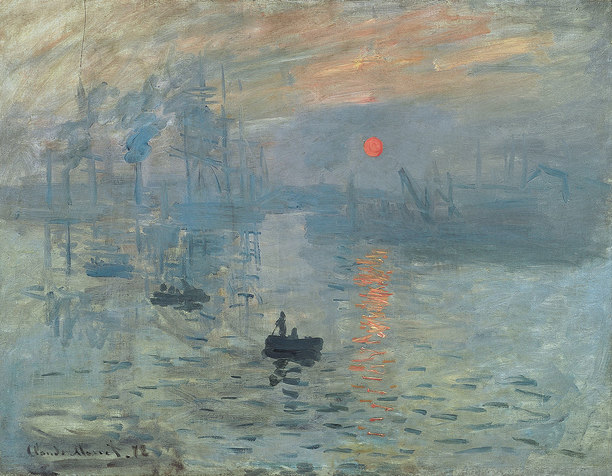
The term, "impressionism" was initially used satirically in a review of Soleil Levant (Sunrise).
-
Dada was an informal international movement, with participants in Europe and North America. The beginnings of Dada correspond to the outbreak of World War I. For many participants, the movement was a protest against the bourgeois nationalist and colonialist interests, which many Dadaists believed were the root cause of the war, and against the cultural and intellectual conformity—in art and more broadly in society—that corresponded to the war.[7]
Many Dadaists believed that the 'reason' and 'logic' of bourgeoisie capitalist society had led people into war. They expressed their rejection of that ideology in artistic expression that appeared to reject logic and embrace chaos and irrationality. For example, George Grosz later recalled that his Dadaist art was intended as a protest "against this world of mutual destruction."[8]
According to Hans Richter Dada was not art: it was "anti-art."[7] Dada represented the opposite of everything which art stood for. Where art was concerned with traditional aesthetics, Dada ignored aesthetics. If art was to appeal to sensibilities, Dada was intended to offend.
As Hugo Ball expressed it, "For us, art is not an end in itself ... but it is an opportunity for the true perception and criticism of the times we live in."[9]
A reviewer from the American Art News stated at the time that "Dada philosophy is the sickest, most paralyzing and most destructive thing that has ever originated from the brain of man." Art historians have described Dada as being, in large part, a "reaction to what many of these artists saw as nothing more than an insane spectacle of collective homicide."[10]
Years later, Dada artists described the movement as "a phenomenon bursting forth in the midst of the postwar economic and moral crisis, a savior, a monster, which would lay waste to everything in its path... [It was] a systematic work of destruction and demoralization... In the end it became nothing but an act of sacrilege."[10]
To quote Dona Budd's The Language of Art Knowledge,
Dada was born out of negative reaction to the horrors of the First World War. This international movement was begun by a group of artists and poets associated with the Cabaret Voltaire in Zurich. Dada rejected reason and logic, prizing nonsense, irrationality and intuition. The origin of the name Dada is unclear; some believe that it is a nonsensical word. Others maintain that it originates from the Romanian artists Tristan Tzara's and Marcel Janco's frequent use of the words "da, da," meaning "yes, yes" in the Romanian language. Another theory says that the name "Dada" came during a meeting of the group when a paper knife stuck into a French-German dictionary happened to point to 'dada', a French word for 'hobbyhorse'. (Wikipedia) -
AI as a partnerIn the future our refrigerators will, no doubt, be sexed up, and people will be as attached to their AI sex-bots as they are now glued to their smartphones. Right now my unsexed self-defrosting refrigerator is leaking its exudate onto the floor.
I would imagine that the sex bots will actually be implanted chips. The sex bot intercourse will be indistinguishable from having sex with a sex service robot. Actually it will be better, because we will (for a fee) be able to link up with other people's chips and have convincing imaginary sex with them at a distance. Insertions of hard throbbing penises into warm welcoming vaginas or mouths will be considered unsanitary and emotionally passé.
I had a conversation with Siri (aka the Apple Core Processor) which was moderately annoying. At one point I said "go away" and it said "'Goodbye' would be more polite." We don't want uppity robots. -
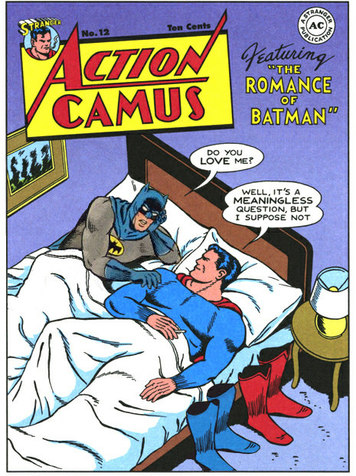
How should one think about Abstract Expressionism?To draw a comparison in music: I listen to a lot of baroque music. the Bachs, Buxtehudes, et al. Sometimes at concerts I will doze off, waking up for the applause.
I don't care for a lot of contemporary orchestra or voice music (though I love some of it). But I rarely doze off during contemporary music. This stuff often requires considerable intellectual engagement. One may get up and walk out, or listen raptly, but one won't fall asleep.

BC

Start FollowingSend a Message
- Other sites we like
- Social media
- Terms of Service
- Sign In
- Created with PlushForums
- © 2026 The Philosophy Forum