
Comments
-
Morality and Ethics of Men vs WomenI don't have sufficient knowledge to say, but academics who presumably do (men and women both) have asserted that matriarchies were few and far between, if they existed at all.
If you want to know whether a person/group is good/bad, all you have to do is give them power and see what happens post that. — Agent Smith
If I had that much power to bestow on others to see whether they would turn into tyrants or not, I wouldn't do it. -
Ukraine CrisisThe figure you site may very well be true. But surely there are significant losses on the Ukrainian side, soldiers and civilians alike. A lot o material damage Is being inited by the Russians. Even if they flat out lose, leave with tails tucked between their legs, the damage Russia has inflicted on Ukraine's structures will have to be repaired. The damage done to Ukrainian society will, of course, be more difficult to repair.
A total breakdown of the Ukrainian forces could still happen I guess, but it's not happening... — Olivier5
The Ukrainians have the 'home court advantage' -- no small thing. There is more adrenaline to fight hard for one's own land than to ruin someone else's.
Having about 7% of the population displaced to other countries is also no small thing, -
Ukraine CrisisWhat is our propaganda — Baden
Propaganda: zealous speech to persuade. "Their propaganda is all lies, our propaganda is full of truth." -
Ukraine CrisisAlso Madeleine Albright is dead and I would have preferred if she died violently and painfully but we can't always get what we want apparently. — StreetlightX
No, alas, and besides, you are too kind. -
Christian abolitionismTranscendentalism came several decades after the heat of the abolitionist movement — Shwah
When do you think the the transcendentalist movement began, and when do you think the abolitionist movement peaked? Seems to me they were both in business for a substantial period of time.split between the north and south on mostly lockean and rousseauian lines — Shwah
Once it became a war it was deemed a part of secular state's history and the christian basis seems to be completely skipped over. — Shwah
In the United States (and not only here) religion and secular affairs are not necessarily as separate as one might think. Go back to mid 1800s and this is even more true.
Major social movements (prohibition, abolitionism, women's suffrage, etc. pick up secular and religious strands and braid them together. The 'braiding' is one of the ways the movements gain maximum effectiveness. Same goes for Martin Luther King, Student Non Violent Coordinating Committee, and numerous other groups in the broad civil rights movement.
Christianity isn't dead yet (though it's not the same potent force it was 100 years ago), so other resources are now pressed into service more often.
Sunday closure... you talking about blue laws?
Blue laws are peculiar. just for example, in a recent effort to change the liquor laws in Minneapolis, the small liquor stores were in favor of Sunday closing -- not because they were all in church all day, but because they stood to lose more than they would gain by Sunday opening. Large liquor stores could afford the lower returns on Sunday.
In the small Minnesota town I grew up in 65 years ago) everything in town was closed except 1 small grocery store and a couple of gas stations. There was no competitive issue because other towns around followed the same rules. Now most things are open in this small town -- bars, what few stores there are, etc. -
Christian abolitionismYou are probably correct in saying that the northern abolitionists were primarily Christian. Certainly, not every American was Christian (or a theist of some other faith) but Christianity was a dominant social influence. Naturally, many Christians--North and South--honored Christianity in the breach rather than in observance.
Transcendentalism: Transcendentalism became a coherent movement and a sacred organization with the founding of the Transcendental Club in Cambridge, Massachusetts, on September 12, 1836, by prominent New England intellectuals, including George Putnam (Unitarian minister), Ralph Waldo Emerson, and Frederic Henry Hedge.
As I recollect, most transcendentalists were abolitionist, but took several different approaches.
The Methodist Episcopal Church very actively supported the union cause, while the "Methodist Episcopal Church South" split away to follow the Confederacy out of the Union. 75 years after the Civil war (1939) the two parts reunited becoming "the Methodist Church". After the merger with the Evangelical United Brethren, they became "the United Methodist Church".
The United Methodist Church will probably split again over the issue of gay clergy and gay marriage, This split is a multinational issue where the fault line is in the US and in Africa. -
What type of figure of speech is "to see""I see" said the blind carpenter as he picked up his hammer and saw. He lied, because he didn't see at all." An old idiom. My grandmother used to say this to me when I was a child (for no apparent reason). I'm 75.
"To see" is the infinitive form of the verb"see" which derives from ancient roots in the Indo-European language. "Old English sēon, of Germanic origin; related to Dutch zien and German sehen, perhaps from an Indo-European root shared by Latin sequi ‘follow’.
'Cat's pajamas' is a figure of speech. -
Matrilineal Matriarchy.Fact: GARTHER, n. Men invented this elastic band to keep women from jumping out of their stockings and desolating the country.
Ambrose Bierce understood why matriarchy ought always to be nipped in the bud. -
Fake News in PoliticsWere they ethical or unethical? Were they moral, immoral or amoral? How do you understand the issue of ethical responsibility and moral responsibility associated with the spread of fake news? — Thinker10
Closer to unethical, closer to immoral. might be amoral. However, there are two sets of agents here: First, there are the content producers. Content is to the Internet what products are to the world economy--never enough good stuff. Second, there are the content consumers. One might well ask to what extent gorging on garbage in the gutters of the Internet is ethical, unethical, moral or immoral, or amoral.
I expect people who have an undamaged brain to exercise some critical judgement about what they find in the gutter. (The Internet isn't all gutter, of course. Much of the content is excellent--present company included.)
It might seem unfair to judge indiscriminate readers harshly. Maybe they can't help it that they are stupid. Is it their fault that it's hard to judge plain fact from obscure, exotic fiction? Strong objection to their slovenly intellectual behavior is not too harsh. How so?
Even idiots or imbeciles are selective. Most east coast liberals, midwestern conservatives, and whacky west coasters did not believe the piles of juvenile fake news. The people who did believe it very much wished to read it, believe it, and repeat it. In their own fake world, anything might be true. When these morons step out of their fake world, say to deal with their family medical issues or the rotting roof on their house they usually proceed rationally (usually, not always).
Believing bullshit, whether it is your own bullshit or somebody else's is always a moral hazard. -
History of ideas: The Middle Ages - Continuity thesis or Conflict thesis?This being a philosophy forum and not a mechanics or agriculture forum, intellectual developments take center stage. However, the Middle Ages were not "Dark" Ages. Material culture developed during the Middle Ages, without which the high renaissance would have had a meagre existence.
This isn't to claim that the people of the Middle Ages were prosperous literate yeomen. Far from it; there was plague, for instance; crop failures which led to starvation; there were numerous upheavals unsettling everybody. Still, there was material progress.
Without a reasonably robust material foundation (for which intellectuals are generally not responsible) there would be no renaissance. -
Does just war exist?If one is an absolute pacifist, then no war can be just.
The Roman Catholic Church's definition of a just war is:
- the damage inflicted by the aggressor on the nation or community of nations must be lasting, grave, and certain;
- all other means of putting an end to it must have been shown to be impractical or ineffective;
- there must be serious prospects of success;
- the use of arms must not produce evils and disorders graver than the evil to be eliminated .
Presumably Catholic teaching should conform to the teachings of Jesus. I don't recollect Jesus saying that there must be serious prospects of success.
Would you kindly rank a few wars. Here are several wars; which of these were just/unjust?
American Revolutionary War
Mexican American War
American Civil War
WWI
WWII
Vietnam
Iraq
Afghanistan
Of these, I would rank the American Civil War and WWII as more or less "just". The Revolutionary War was probably not necessary. The Mexican American War was an expansionary war. WWI was far too bloody and too vague to be counted as just. Vietnam, Iraq, and Afghanistan were unjust wars, according to the principles of Catholic Just War doctrine.
The justness of the civil war to first preserve the union and secondly to end slavery is somewhat ambiguous. Maybe in the long run the Northern Union would have been better off without the Southern Confederacy--or maybe not. Slavery should not have occurred in the first place, but it did. How else to eliminate it?
WWII seems unambiguously to have been just (from the allied perspective). The two main Axis states--Germany and Japan--were intent on something between continental and world dominance. Other nations, like Britain, had achieved world domination. Was the British Empire a) better than b) worse than c) about the same as the intended Axis Empire?
WWII brought an end to the Japanese, German, and British empires. The US took its place as the dominant national power, a role we reluctantly shared with the USSR.
So: war can be just; it usually isn't. -
Does God have favorites?Of course God has preferences. God likes me more than he likes you, for instance. I can't help it. It's not my fault. I'm not in charge of God's preferences.
God likes Jews more than Gentiles. I'm an exception, not being Jewish but still one of God's faves. Gentiles outnumber Jews 533 to 1, so are far more likely to do things that God, who's kind of fussy, doesn't like. God, who numbers the hairs on our heads, clearly uses a very robust statistical package to keep track of the billions of sins committed every 15 minutes.
you haven't sinned very much, so rumor has it. I've sinned quite a bit--fact. But God still likes me better than you. God likes guys with enough balls to commit sins boldly more than namby pamby pussy-footers' pusillanimous half-assed sins.
God doesn't like wishy-washy wankers. I've always avoided being wishy-washy. God likes that.
Go and do likewise and God will like you too -- but still not as much as he likes me. -
Ukraine CrisisIf you think that's bad, you'll be shocked to learn the US government "stockpiles" dangerous pathogens all over the United States, including the last surviving smallpox viruses outside Russia. Not only that, but it partners with the Canadian government to do so in Canada. The UK, Germany, and France all do this to, as does Russia. — Count Timothy von Icarus
There is a big difference between "stockpiling" 1 small sample of an organism in a very cold freezer and "stockpiling" a few hundred pounds of the organism. There has been a debate in medical/scientific circles about whether the last surviving samples of the Variola virus (small pox) should be destroyed or saved--ever since the disease was eradicated in 1980.
There are some samples of the 1918 influenza virus (which was much worse than Covid-19) which were recovered from a frozen body in Alaska. It might be the case that some thawing human body mighty contain the smallpox virus. In that event, it would be good to have a sample for comparison purposes.
I'm not in favor of keeping a leading killer in the cooler. Eventually, mistakes will be made. The same goes for Poliomyelitis, a disease which (like smallpox) has no non-human animal reservoirs) has been all-but eradicated. Once it's gone, we would have little need for the actual virus.
Well, the claim is that emerging new biological threats, such as tuberculosis that is extremely resistant to antibiotics, need to be collected and safely stores. — Count Timothy von Icarus
Tuberculosis (TB) is hardly an emerging disease. Over the centuries it has been one of the leading causes of death in the world, and still kills about a million people a year. True enough, multi-drug-resistant strains of TB have arisen, along with multi-drug-resistant strains of Gonorrhea and various other disease-causing bacteria.
Anthrax is another disease that has appeared in long-frozen bodies, this time animal corpses. Anthrax Bacteria are very dangerous, though the disease can be treated in many cases.
I don't know which disease would be the ideal candidate for a biological weapon. Besides, nukes are so good at killing people, why invent a biological weapon that once set loose would be impossible to put back into the box. And if we decided that germs were too dangerous, there are always effective gases and high explosives. -
PropagandaPropaganda is just spin or lies designed to influence an audience - it might be for politics or for a religion. It need not involve nationalism. It's closely related to marketing. We can't stop people lying on behalf of a cause or product. Society is built on this fact. But perhaps we can try to make people more discerning. — Tom Storm
Correct. -
The New "New World Order"Amazing how Putin managed to do all that without anybody noticing.
I think an additional reason for the invasion is to wreck the economy of Ukraine, and control it so that it will not seek, and will not get, membership in either the EU or NATO. Whether that strategy will pay off for Putin remains to be seen. Putin would not want either organization to have an even larger presence on Russia's borders than they already have, -
The New "New World Order"it is much more difficult to get one's place in the history books (and/or elevate your country to "super power status) without invading other countries that are unlikely able to stop your own armies. — dclements
My guess is that the size of their entry in Who's Who or a history book is probably not their main motivation, but ego is certainly a factor.
The main thing is power and its attendant benefits -- cash, land, population, control, etc. How does this apply to Putin's case? He already has tons of cash, land, population, control, etc., so it isn't clear to me how wrecking Ukraine would benefit him and his various apparatchiks. Has he been taking steroids? Is he suffering from raging hormones? Is he mentally unstable? Is there some sort of obscure economic motive here? Ukraine is a major grain producer; so is Russia. Maybe Putin wants an even bigger share of food commodity markets? (I'm grasping at straws here) -
Ukraine CrisisWith satellite and drone coverage, there shouldn't be any doubt in anyone's mind about the whereabouts of the 40-mile convoy. The contents might be doubtful, but its location should not be.
Good, solid, verifiable, reliable information can be hard to find in many situations, but in the middle of conflict, it's out of reach at times in several ways. There is deliberate misinformation (propaganda); error-based misinformation (failure to fact-check); perception-based misinformation (looked like a duck, sounded like VP); missing information (things get lost). Bonafide information (aka the truth) may be disbelieved or rejected out of hand.
How many people in several categories have been killed so far? How many people have been injured, and how badly? There are always good reasons to inflate or deflate totals, and where an accurate count is desired all round, it may just be impossible to obtain. -
Ukraine CrisisThere are no unbiased news sources, as a general rule. So, be aware of the bias and then calculate how much to discount.
I wish I could access different channels — Manuel
Don't we all! There are a few news channels available on the Internet beside Fox, BBC, and CNN. Deutsche Welle, for instance. Various radio stations in countries stream their service on the Internet -- so you could listen to National Public Radio (US) too.
Ask Google for English (or other language) radio services in Europe or Mars... wherever. -
Genuine Agnosticism and the possibility of HellHere's a suggestion to consider:
Separate the question of whether God exists from the question of whether there is an afterlife. God may or may not exist. If God does exist, it isn't necessary for Heaven and/or Hell to exist. If God doesn't exist, then there is probably no heaven and hell (as Christians suppose there is).
God is not a Christian; neither is Jesus (he was a Jew). Christianity does not, and can not, be an accurate representation of who or what God is, Neither can any other religion. Religions contain a set of believe presented as the truth, but hey -- they are guessing. Atheists can't be certain that God does not exist--they are also guessing.
Unless you believe that God is the model of man, and possesses the same screwy quirks that we do--we don't know what God is like (if God exists).
A belief in God doesn't require the existence of heaven and hell (in my opinion), so again -- you can separate the two.
Neither the fall of man (Adam and Eve) nor the redemption of man (Jesus) is necessary. These are theological concepts cooked up a very long time ago. -
The Bible: A story to avoidThe Bible presented among Christian believers, is a collection of stories written by supposed divine inspiration. The stories within the Bible show us scenes of gore, rape, slavery, and so many more violent acts, yet Christians sit here and preach that we must do what the Bible tells us word for word. — Edward235
Some of it is alleged to have 'divine inspiration'. Some of it is purported to be history. Some of it is liturgy (e.g. Psalms). the Bible is a collection composed by various authors over time, revised, edited, and reworked. Only 23% of the Bible (New Testament) concerns Jesus, the Apostles, Paul, and the early years of Christianity. 77% concerns the Jews and Israel.
Yes, there are numerous stories recounting violence in the Bible. The promised land was secured by violence. "Kill them all." Deuteronomy 20:16-18. Was this a surprising innovation by God, or just standard operating procedure in armed conquest? More the latter, I would think.
Jesus Christ, whom Christians consider the fulfillment of the God's Word, said: “A new command I give you: Love one another. As I have loved you, so you must love one another." That is what the Christian is directed to do. Period.
The idea that the Bible is the inerrant word of God, to be taken literally from Genesis to Revelations is a recent innovation in the 2000 year history of the faith. This approach was developed as a reaction to the new insights developed by scholars in the 18th/19th century. Textual criticism and evolution both cast doubt on some biblical truths. In reaction, conservative believers hardened their view of the Bible from "authoritative" to the Bible is inerrant -- literally true, not questionable in any way, shape, manner, or form. In other words, Fundamentalism.
Most 'mainline' Christians (Protestant, Orthodox, and Catholic alike) reject Fundamentalism.
Some people have a low tolerance for ambiguity. Multiple meanings which can be revised according to interpretation bother these people a lot, whether it's the Bible or the Constitution, law, or ethics. They see things in black and white without any annoying grayscale. -
The New "New World Order"Conflict is a constant in the world order, new or old. There are political / economic / ethnic / religious / cultural fault lines all over the globe that regularly result in conflict, casualties, disruption, famine, various forms of collapse, and so on. This has been the case for decades, if not centuries. Just for example, the civil war in Sri Lanka between the Tamils and Sinhalese between 1983 and 2009. Most people in the world were not greatly bothered about it, but for the people who lived there a bad time was had by all. JUST one example among many.
The invasion of Ukraine by Russia bothers far more people than the Tamil Tigers vs. the Sinhalese ever could, A) This is taking place on NATO's steps, if not on its porch. B) Russia (and the former USSR) are/were big-name enemies to several big-name states. The people of Ukraine, unlike Iraqis or Afghans are democratic westerners. Thanks to Stalin (famine), Hitler (invasion and genocide), Chernobyl (reactors go boom!), and now Putin we have seen great suffering in Ukraine. We are more predisposed to think kindly of them than say... the people of Nagorno Karabakh.
At least 10,000,000 people were in the Ukrainian diaspora. They are a visible ethnic group in many places. There are roughy 2.5 million people of Ukrainian descent in Canada and the United States. Their presence in many countries makes their suffering, courage, and cause-in-general more accessible than that of Sudan or Yemen.
The remarkable unity displayed by EU and Nato member adds to the immediacy of their needs. If instead, only Cyprus, Portugal and Norway were helping the Ukrainians, we would probably care less about them. -
Ukraine CrisisSo it seems. As I said from the start, Western oil and defense companies are going to make a huge fortune from this: — Apollodorus
They will, true. But when do oil companies not make money? Oil is in demand everywhere, and the oil companies are located around the world wherever there is oil. War or no war, oil is generally a great business to be in. Suck it up and sell it.
In a dangerous world (created partly through the good offices of arms companies), when do defense companies not make money? Big ships may not be the thing this year, but drones are. ICBMs may be in the doldrums, but Stinger missiles are hot. Fighter planes are very expensive, but one can make money on mines.
Oil and Arms will be making money into the foreseeable future, regardless. -
Ukraine CrisisHere's a fuck up: Ukraine is a grain exporter to the Mediterranean basin, through its Black Sea ports, which Russia is busy closing off.
-
Ukraine CrisisAh, I wasn't thinking that trade relationships would or did trump security policy. I posted the chart just to give people like me a clearer idea of the Ukranian economy.
-
Ukraine CrisisHere is a chart from VISUAL CAPITALIST showing what Ukraine imports or exports, and from/to whom.
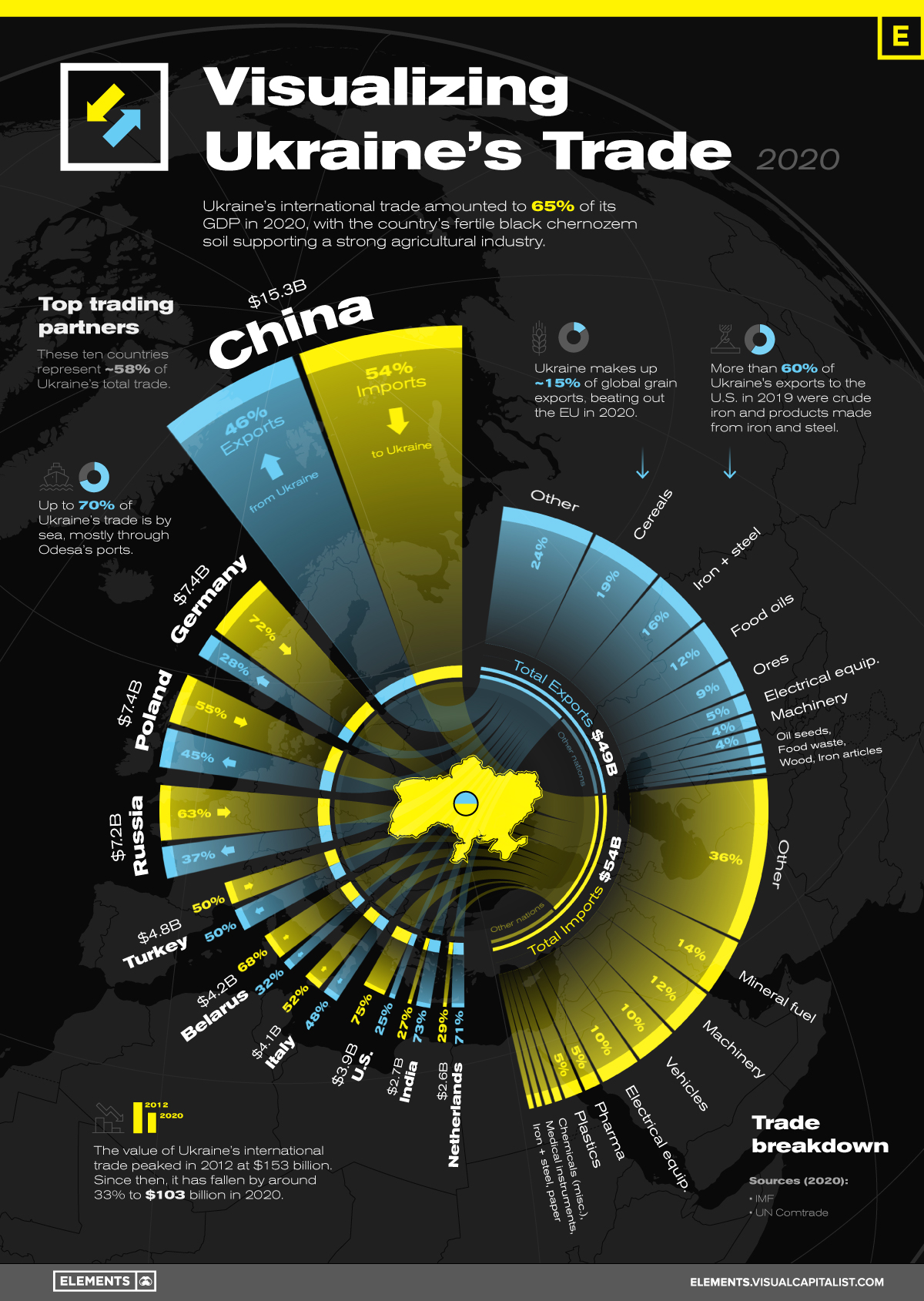
Ukraine’s Shift Away from Russian Trade Dependence
Since its independence from the former USSR in 1991, Ukraine has steadily shifted towards Western trading partners, especially as conflicts with Russia escalated in the 2010s.
After years of negotiations, Ukraine’s Association Agreement with the EU in 2014 facilitated free trade between EU nations and Ukraine, reducing the country’s dependence on trade with Russia.
Ukraine is one of the most important economic centers of the former Soviet Union, and it had long been the breadbasket of the USSR thanks to its fertile chernozem soil and strong agricultural industry.
Trade value between Russia and Ukraine peaked in 2011 at $49.2 billion, and since then has fallen by 85% to $7.2 billion in 2020. During this time, European nations like Poland and Germany overtook Russia in terms of trade value with Ukraine, and in 2021 trade with the EU totaled to more than $58 billion. -
Ukraine CrisisGood point. But entertainment is easier than instruction. I don't want to claim that in "the good old days" news media were all about instruction. What was the case, I think, is that instruction played a significantly larger role than it does now. That isn't to say there was no bias; just that news organizations were more serious about providing information, and not just amusement.
Of course, if it doesn't affect the viewer, disaster information is as entertaining as a sitcom. It is a pleasure (on one level) to view a horrible event than has no person consequences. 9/11 is a classic example: Fascinating event! I knew absolutely no one who would be or was affected. The forest fires in California were not entertaining, because I knew a couple of people who were directly affected, and we could both see and smell the smoke 1500 miles away. -
Ukraine Crisisthe sheer desperation and moral bankruptcy of the media enterprise — FreeEmotion
Always bear in mind that most of the media are for profit enterprises. They are not staffed by philosophers (like that would help) or public intellectuals. Reporters, commentators, hosts, producers, etc. possess varying levels of depth and insightfulness. If a big war had broken out between Myanmar and Thailand instead of between Ukraine and Russia, the same batch of people (more or less) would have descended on Bangkok and started to report back.
William Shirer, a CBS radio reporter, did such a great job reporting on WWII in Europe because he had been there for several years before it started. Eleanor Beardsley, NPR reporter, has reported from Paris for years. She was suddenly reporting from Kyiv / Kiev. I like Ms. Beardsley, but how much background can a reporter collect during the flight from Paris to Kyiv? Lyse Doucet, a BBC reporter (thick Irish accent, Canadian, apparently) bounces all over the world, disaster to disaster. Same show, different corpses. -
Ukraine CrisisWhy don't the Ukrainians flee to Russia?. — EugeneW
A small percentage are fleeing to Russia, mostly from the Donbas region immediately adjacent to Russia. Those living in Kviv or Lviv, for example, A) don't want to go to Russia and B) would have to travel eastward toward and through a battle zone. Travel westward toward Poland, Hungary, Slovakia, or Moldova makes more sense at this point. -
Ukraine Crisis“Why can’t we just let people believe some things?” one Twitter user replied. “If the Russians believe it, it brings fear. If the Ukrainians believe it, it gives them hope.”
You know already it because you posted this quote, but false fear and false hope do not make things better. Truth matters, even if it is an early casualty in warfare.
I'm not a 'news junkie' but I do try to stay well informed on what is going on. One can get reliable, stable information about Covid-19, for example, but one can just as easily hear wildly conflicting information which can't be easily harmonized. Dr. X says masks reduce transmission, Dr. Y says we can stop using masks now; Dr. Z there will be new and possibly dangerous variants in a couple of months. Dr. A says the Pfizer vaccine works on young children; Dr. B says everyone should get a booster; Dr. C. says the vaccine is uniformly ineffective.
The same thing is happening in Ukraine. "The Russian advance has stalled"; "the Russians will soon control Black Sea ports and shipping"; "Ukrainian regular troops and volunteers are fighting very effectively"; "the Ukrainians are likely to win"; "the Ukrainians are likely to lose"; and so on and so forth.
Conflicting views can be heard from one news agency, let alone ten news agencies.
When there is too much conflicting information, I tend to stop listening--not because I don't care, but because it's too difficult to parse out the facts. What really happened 3 days ago may be cleared up tomorrow. What happened 10 minutes ago will need time to clarify.
Battlefield managers can not wait several days to get clarity, of course. But we who are far distant from the battleground should not take every report we hear as settled truth. -
Ukraine CrisisAccording to Britain’s National Literacy Trust, 16.4% of adults in England, or 7.1 million people, can be described as having “very poor literacy skills” or as being “functionally illiterate”. — Apollodorus
As usual, the United States is worse:
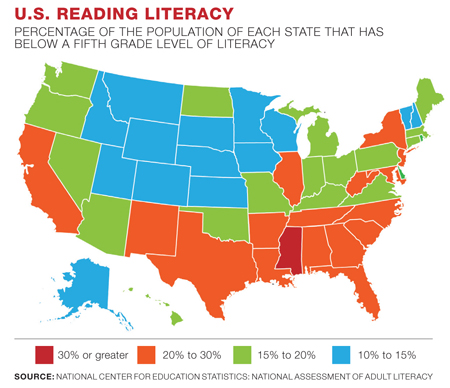
The state where I live, Minnesota, has a high rate of literacy, but even so, about 10% of adults are functionally illiterate. Illiteracy is certainly a handicap in several ways, not least in its effects on cognition. One's ability to access printed information is obviously limited. On the other hand, research doesn't show that individuals get a significant boost in quality of life by learning how to read.
The prospects of someone unable to read are not going to be vastly different once they learn how to read at an 8th grade level. With good material, a low ratio of teachers or tutors to students, and a reasonable amount of motivation, an illiterate person can acquire fairly good reading skills in less than a year.
The major benefit of reading is getting information, and it will take them many years to catch up on all the information that passed them by -- which is one reason learning to read doesn't make an immediate difference.
Besides the illiterate, there are many adults who don't read much even though they can read, and they often find it difficult to read and sort through complicated information--like an article on who is telling the truth, who is lying, who is faking it, and who is confused about what is going on in Ukraine. -
Ukraine CrisisSome disambiguation is needed here. A lie is not the same thing as a myth. A theory, true or mistaken, isn't myth. The idea that disease was spread through a 'miasma' or bad air is a mistake, not a myth. Misperception isn't a lie or myth: it's a mistake. "Is it a bird? A plane? A drone? No, it's Super Putin." Lies, misperception, hearsay, rumors, misinformation, unrecognized fact, wishful thinking, etc. are all part of 'the fog of war'.
Russian planes flying over Kiev? – FAKE — Apollodorus
I don't much care whether planes were flying over Kiev or not. Look, wars are not won by a scorecard of facts, fictions, lies, truths, myths, or the like. Wars are won on the ground (with or without air support). Who controls the territory when the war is over?
It would be better if everyone fact checked before they hit 'send', thought first and spoke later, didn't gush BS, observed more carefully, and so on. But hey, humans aren't like that.
Maybe the Ukrainians will fight fiercely enough to end with a draw. Maybe NATO and EU will supply weapons that tip the balance into a Ukrainian win. Maybe a meteorite will smash Moscow, causing Putin to lose focus.
My unhappy guess is that Russia will win on the basis of the preponderance of resources it can bring to bear. I don't like it, mind you. -
Ukraine Crisis@et al It won't interest anyone outside of the small circle of opera lovers, but... Never mind nukes. Anna Netrebko, very big-name Russian diva, just got kicked out of the Metropolitan Opera in New York for her continuing loyalty to Putin--probably permanently. A joint project with the Bolshoi was also dropped.
The line it is drawn, the curse it is cast
the first one now will later be last Bob Dylan
New York and London oligarchs and kleptocrats have been happy enough to have Russian oligarchs and kleptocrats buy the high up high end real estate they have built. The upper reaches of these properties are beyond the means of the normally rich, let alone the merely prosperous and barely getting by. I wouldn't object to the seizure of these assets and then used for some public purpose. -
Ukraine CrisisYes: MAD is still crazy after all these years.
I'm not so worried about V. Putin saving face as I am his being (or feeling) cornered or trapped by NATO, the EU and Ukraine. Russia is by no means cornered at this point, but it's conceivable that... say, if economic warfare intensified, NATO sent forces into Ukraine and Belorussia, the EU -- to the extent the it isn't coextensive with NATO -- sent more forces to join NATO, and maybe Turkey (part of NATO) mined the Bosporus and Dardanelles, Putin and his military might feel they were cornered, at least as far as conventional warfare was concerned. This is the danger point where a limited tactical use of even one nuclear weapon against NATO or against Russia could trigger a tit-for-tat exchange, and pretty quickly (say, in less than an hour) result in many atomic weapons being launched.
That could be the end of our species for a long time, or forever, and the end of many other species as well.
The American Defense Department's estimations of nuclear destruction (at least as far back as Ellsberg's revelations are concerned) were way too "sanitary". The calculated destruction on the basis of blast damage and fallout. What they left out of their estimation was fire (conflagration, really) caused by the blasts. The fire storms in target areas would likely significantly raise the levels of CO2 in the atmosphere (CO2 being the least of it). The vast amount of dust and soot might counteract global warming for a period of decades, but then global warming would suddenly rebound.
For the most part, people in the Industrialized North (Europe, North America, Japan, northern Asia) would not have to worry about all this because we would either be dead or wishing we were dead already. The Developing South would find its development brought to a screeching halt, and then be slammed into reverse. The most the Developing South could hope for is a less sudden demise. -
Ukraine CrisisIt didn't do anything with it's nuclear forces. — ssu
As far as I've read, they matched Russia's nuclear threat level. — Manuel
I took that to mean the guns have already been cocked and aimed long ago — Paine
Sadly, President Biden didn't personally inform me of his atomic intentions. But we certainly would not necessarily know that nuclear policy had changed even one iota. The missile silos are always manned, so one wouldn't notice the daily shift change. A key portion of our nuclear weapons are on board submarines, about which we know little (in terms of where they are, will be next, and who their launched missiles will obliterate. B52s? Some of them are still in service, but I don't think they have a role to play in nuclear warfare, any more. I could be mistaken about that. But I wouldn't expect to see the B52 fleet taking off and circling somewhere over northern Canada, waiting for final instructions.
-
Ukraine Crisisfoundation myth — Apollodorus
foundational lie — Olivier5
"myth" as in "mythos"
"myth" may be used as a fancy Greek term for a lie, but that isn't its only (or main) meaning.
a myth or mythology.
"the Arthurian mythos"
(in literature) a traditional or recurrent narrative theme or plot structure.
a set of beliefs or assumptions about something.
"the rhetoric and mythos of science create the comforting image of linear progression toward truth"
Lies, on the other hand, are deliberate and contrived for contemporary purposes
So a myth is not ipso facto a lie.
"The Pilgrims", a small band of separatists, play an outsized role in the American mythos--the Mayflower, Thanksgiving, etc. The Puritans did the heavy lifting of founding New England (and 'yankee culture'). It isn't a "lie" that the Pilgrims landed on Plymouth Rock, it is myth.
Myths, of course, are made over time. The desires of imperialists and colonists and later Americans to possess as much of North America as they could get, became the myth of Manifest Destiny, once that seemed attainable, and ever after. Thanks to Manifest Destiny, the map of the United States looks mostly complete (except for that empty space north of our border--joke).
Converting foundational myths to foundational lies is risky, because an important function of foundational myths is collective unity. A people can develop new myths, over time, to reflect new bases of collective unity.
Sophisticated urbanites, like those who populate The Philosophy Forum, never confuse myths with Real Politic. When the chips are down, the bombers will fly, the tanks will roll, the soldiers will march in the name of this or that Peace Loving People.
Putin certainly appears to be engaging in an embarrassingly crude property snatch. Urban sophisticates usually try some more polite, subtle, or underhanded method of stealing wealth. I guess that means Putin is not an urban sophisticate.
There may be a mythos that ties the Ukrainian and Russian people together, but the current war of is based on lies. -
What is the meaningful distinction between these two things?So, anyway, what do you think? — Xanatos
The flammability of depicting sex with children (not adolescents) is extremely high. It apparently does not make any difference, legally or philosophically, whether sex between children and not-children is a video, a drawing, a cartoon, an animation, or robotic. It's just plain verboten.
Depending on location, sex between adults and adolescents (and its depiction) may range from intensely inflammable to merely inappropriate. Sex between adolescents (say... older than14 years old) and older adolescents and adults occurs in the world, and has a long history. Many individuals and institutions are adamantly opposed to youth/adult sex, but then many individuals are adamantly opposed to relationships between people who have unequal power, or of different races, religions, and so on.
One problem I have with the severe criminalization of any behavior related to contact between adults and children (say, under 14--pedophilia) is that there is very little chance of changing child-sexual attraction in adults. It seems to be an essential part of those individuals' psyches. The behavior can be punished, but so far as I know, the attraction to young children can not be extinguished. Persons convicted of sex crimes (say, possessing child porn) may end up with amounts to a life sentence, because they can be shown to have been "cured" and safe.
I suppose pedophiles can and do learn to have nothing to do with children, but sexual urges being what they are, failures can occur.
I would think that altogether artificial forms of child porn (cartoons, cgi, etc.) would not amount to crime, but as far as I know it is entirely criminal. Pornography doesn't seem to generate sexual desires that don't already exist (heterosexuals looking at gay porn stay heterosexual).
Sexual activity between adults and children isn't desirable, but the reaction to any aspect of adult/child or adult/youth sexual content is fairly often hysterical. -
Ukraine CrisisWell, I think a certain degree of national pride or, at least, appreciation for one’s cultural heritage, isn’t a bad thing. — Apollodorus
I would go further and say that a certain degree of national pride (cultural heritage appreciation) is positive, desirable, even necessary. BUT, I would then undercut that by saying national pride (and sometimes cultural heritage) is a necessary delusion. What do I mean?
I love my country--not all of it uniformly, but I'm proud of America and am not embarrassed to be an American.
Yes, I know we were established as an imperial beachhead by the English Spanish, and French. Yes, I know we deliberately and inadvertently wiped out most of the native peoples who lived here prior to our arrival. Yes, I know we created a lot of wealth on the backs of slaves. Yes, I know we have been ruled by oligarchs, some more enlightened than others. Yes, I know we burnt a lot of coal, oil, wood, and gas and contributed more than our share to global warming.
But I still love my country, and I relish its cultural output--not all of it uniformly. Much of American culture was imported from elsewhere--like coffee which has never been grown here. Coffee is a very good thing.
Love of and pride in my country may be based on certain delusions, though, like: "In God We Trust", "E Pluribus Unum", "one nation, under God, with liberty and justice for all", and so on. No, I don't actually think that God prefers the United States over Australia or Mongolia. I doubt God exists at all, and as for liberty and justice for all... I rest my case.
But still being American has worked out pretty well for millions of people over the last 3 centuries. Of course, it worked out spectacularly badly for millions too--all the losers in the game. But I still love my country, and I wish it well.
The same can be said for a lot of Soviet citizens, Russians, German, French, Spanish, Italian, Chinese, Japanese, Arabian, Israeli, et al citizens. People tend to like where they live, and they all maintain a mix of realistic and delusional ideas about their homeland.
Were any of us absolutely honest, realistic, and totally non-delusional, we'd have to consider blowing our brains out forthwith.

BC

Start FollowingSend a Message
- Other sites we like
- Social media
- Terms of Service
- Sign In
- Created with PlushForums
- © 2026 The Philosophy Forum