
Comments
-
Personhood and Abortion.I think everything that's immoral should be illegal. — Thorongil
To hell with that!
I not only practiced homosexuality back when it was both immoral and illegal, I was also promiscuous. It was great. I have no regrets, morally or legally.
...promiscuous sex so that abortions are not as appallingly common as they are now — Buxtebuddha
Well, Buxtebudd, how common do you think abortions are? It would appear that they are at a 45 year low. This from the Guttmacher Institute:
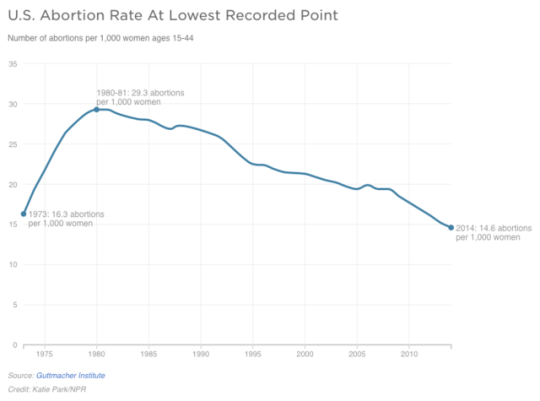
it is legal is a fallacious appeal to authority. The same is true tor trying to excuse abortion simply because it is currently legal. — LostThomist
Civil government has the authority to decide what is legal and what is not. This is a principle we all live by, including they (you) who think legality is an appeal to authority. The Pope has authority, and so does the State. Deal with it.
Not all religions consider that life begins at conception. Some religious believe that a newborn becomes a person when it draws its first breath. Some religious believe that personhood does not begin for days after birth--but while breathing. Every body begins at conception. Life comes later. Personhood comes later still.
Legally -- and legality matters -- in most jurisdictions personhood begins with one's live birth. Dead fetuses were not persons. Unborn but healthy fetuses are not persons either in many jurisdictions. I will grant that a 8 month old healthy fetus is at least 5 months past being "tissue" and will probably survive as a person, even if born prematurely,
If you have 3 fertilized eggs just laid by a hen, do you think you are killing chickens when you make an omelette? -
The police: no constitutional duty to protect you from harm. Now let's disarm youIf the government could not be sued then there never would have been DeShaney v. Winnebago in the first place, let alone a ruling on it by the U.S. Supreme Court. — WISDOMfromPO-MO
I didn't say the government couldn't be sued; I said it can't be sued WITHOUT its consent. When and where is this consent given? When suits are filed in Federal court they are either accepted or rejected. In many cases, the court accepts suits because they raise important issues, like Brown vs. The Board of Education, or Roe vs. Wade did. But if you file a suit because the FBI said you were a Moscow agent, and this ruined your business, you'll probably be told to take a walk. -
The police: no constitutional duty to protect you from harm. Now let's disarm youimagine the number of lawsuits there might be if the state takes away the right to possess a firearm — WISDOMfromPO-MO
Bear in mind a point that was raised earlier: The State has sovereign immunity. It can be sued only if it is willing to be sued. Sovereign immunity applies to state/provincial and county governments as well. If the Second Amendment is repealed, it won't be by the Federal Government. "The Constitution provides that an amendment may be proposed either by the Congress with a two-thirds majority vote in both the House of Representatives and the Senate and by 3/4th of the states (38) or a constitutional convention called by 3/4th of the states.
I don't believe most people need or benefit from possessing guns. I'm fine with hunting (assuming that the species hunted is nowhere close to extinction) and the bagged game is eaten by the hunter.
But it doesn't matter much what my opinion is on this. At least 100 million people in the US own at least one gun, and even if gun ownership is very stupid, the guns are not going to disappear tomorrow. We face several quite avoidable risks: auto accident, air pollution, disease, accidents in the home, drowning, and so on. Guns are one more avoidable risk. It's avoidable; that doesn't mean we will do anything about it. -
Practical Epistemology - My favorite sources of informationDespite the wonders of the on-line digital world, paper is still the best medium to present and store information over the long run. I love books, libraries, and bookstores. Short of fire and flood, paper resists many threats. Magnetic pulses don't affect them; ordinary cold and heat are nothing to books. Humidity can be a problem, but that's true for just about everything. Even so, manuscripts published before printing was invented have held up well.
-
Practical Epistemology - My favorite sources of informationI have varied and sometimes odd interests.
I have been interested in word meanings, word origins, word frequency lists, and reading difficulty levels for a fairly long time. I used to get this information from printed dictionaries and library books; now those books, and more, are available on line.
Google Ngram, Google Translate, and just plain Google.
Of course Amazon is a wonderful thing and I go there regularly. It is the Home Shopping Network for people who wouldn't get caught dead watching the Home Shopping Network cable channels.
I like the way Consumer Reports goes about testing and rating various products. Inquiring minds want to know whether there are any frozen dessert product brands that approach Ben and Jerry's in quality, aside from Hagen Daz. (Some haute cuisine local brands meet or exceed B & J's achievements.) The curious but impecunious still want to know whether you can get a good cashmere sweater for $125, even though they will never buy one. I like their sensory panel reports on various food products: "stale flavor notes and cardboard overtones".
The Minnesota Historical Society's Visual Data Base has been wonderful. It's a large (>60% on line) photo collection which one can search and view.
The Army Corp of Engineers provided me with critical information for a project I was pursuing. I wanted to know how long a large sandbar along the Mississippi River in Minneapolis could have been a gay cruising area. While the ACE didn't happen to know anything about the cruising, they gave me a topo map and some historical information from which I determined the answer: Definitively not before 1907 when the Meeker Island dam was built on the Mississippi in Minneapolis and probably not before 1940, when heavy barge traffic would have required regular dredging to main the channel. The "sand bar" is actually just sand from dredging operations piled up on a rocky shore area.
So... sometime between 1940 and 1960.
Google Street view is an amazing piece of technology.
Ordinary people can turn out to be fonts of esoteric knowledge. When I was working on AIDS transmission interventions in the 1980s, i needed to find out about where the busy glory holes were (technically, glory holes are the openings in glass refractories through which blobs of glass are removed to be blown into shapes and given fancy treatments). The kind of glory holes I needed facts about involved blowing something other than molten glass.
After pursuing a short list of leads, I found a guy who worked at the University of Minnesota in a professional capacity who was a regular at GH locations and was a very enthusiastic (and accurate, it turned out) informant. Who knew that a University hospital employee possessed systematized information about cock sucking in various university buildings?
Over the last 30+ years, the New York Times has been a steady source of science information. I feel like I completed a general science course or two just by reading their Science Section for all these years. NOVA and NATURE on PBS, along with a scattering of several-hour specials, has also contributed a college course worth of general science knowledge. One of the great things about science on print and television media, is that it's usually quite serendipitous. -
The Big Bang Theory and the Andromeda galaxyRight. I first heard about...50 years ago, and the steady state theory hasn't had any traction since then.
-
Heaven and HellWhat the hell are you reading? — René Descartes
Damned, Chuck Palahniuk's 2011 novel about hell. It's an absurd comedy, maybe like hell itself.
Palahniuk's other novels include Fight Club. -
Anti-intellectualism in America.Intellectuals today, on the other hand, are part of the "liberal," globalist, multiculturalist establishment, they support it blindly. — gurugeorge
It is getting worse. Leftists seem to reduce their support for the first amendment. They hate free speech. They want control to implement their utopia, even if it means to destroy every human beings in a holocaust ten times over. — Youseeff
Some intellectuals, especially a lot of intellectuals in certain liberal arts fields, fit these descriptions. But a lot don't. Granted, the exudate of the screwy POMO and nouveau leftish intellectuals is draining out of academia and seeping into some parts of ordinary life. -
Anti-intellectualism in America.The Wikipedia entry on Anti-intellectualism in America — Posty McPostface
I wasn't up to the task last night, and I don't have time today (errands, anticipated heavy snow fall starting this afternoon, cleaning to do list, etc.) and I may never be up to the task, BUT...
...the Wikipedia article itself should be examined carefully, because the claim of anti-intellectualism may itself have ideological and other biases.
I loathe fundamentalism so it is quite convenient for me to call it anti-intellectual. Is someone entirely devoted to business and making money anti-intellectual? Well, maybe -- and maybe not. Can someone who pursues a narrow field of science (like particle physics and numerous other examples) be anti-intellectual? Are civil engineers who design sewers anti-intellectual? Sure - it's possible, and maybe not, depending how one defines "intellectual" and "anti-intellectual". -
Anti-intellectualism in America.Cause or result? — Banno
That is a problem.
One piece of it is a need for certainty. Now that need can lead one to intellectual pursuit or intellectual flight. I suppose it depends on how much ambiguity about the truth one can stand. -
Anti-intellectualism in America.As the Wiki article noted, anti-intellectualism is not the sole province of the United States. Some Australians to the contrary, I don't think we can blame American anti-intellectualism on Transcendentalism. The Transcendentalists were not anti-intellectuals.
I don't know all of the sources, but I am sure fundamentalism (whether among pentecostals, Lutherans, or Catholics) is one cause. An inerrant Bible with an infallibly clear message doesn't require intellectual examination. If the Bible says God created the world in 6 days flat, well, that's that. Say no more about it. It wasn't the descendants of Ralph Waldo Emerson that brought the 1925 case against one Mr. Snopes for teaching evolution; Snopes was a high school biology teacher in Tennessee .
While the US has fostered a number of excellent educational institutions since Harvard was founded in 1636, but most Americans didn't need to go to college (or school at all) to make a living. There was land for the taking and most of the time an expanding economy. One could afford to have narrow intellectual horizons.
The United States, as much as most nations, harbors contradictions that do not bear close intellectual scrutiny--like, "All Men Are Created Equal". Many of our sacred beliefs are like pills that should not be chewed before swallowing. They are too bitter. Better to encourage the unexamined life.
The organs of public information, whether that be the local school system, the free press (including radio and television), or book publishers, et al have a vested interest in maintaining a common consent to the status quo. That what Chomsky references when he talks about "the manufacture of consent". Consenting the status quo is inherently anti-intellectual. That's why my English teacher told me not to take Thoreau's Civil Disobedience essay seriously. It undermines the common consent, and there's likely to be nothing but trouble in doing that. -
What happened to American Transcendentalism?There can be few things as frightening as watching a great nation crumble. — Banno
James Howard Kunstler has written movingly about what things like "peak oil" and our dependence on and faith in high-tech solutions to solve all the enormous problems really mean. The future is not good, and what he has to say applies not just to the United States but the rest of the industrialized world as well. Passing peak oil means a long-term economic contraction resulting from the gradual failure of the tremendous driver that cheap plentiful oil has provided. Coupled with declining oil production is rising population, probably unabated global warming, problems in food production, fresh water supply, and so on and on. Grim.
Rather than reducing the output of CO2, some of our technocrats want huge investments to find ways of canning CO2 and putting it back into the ground. Instead of reducing the number of high powered rifles available to angry, lonely young men, let's arm the school teachers. Rather than face up to a long term contracting economy, let's act as if we are facing an unprecedented economic boom. Stupid, stupid, stupid.
Yes, indeed: Watching a great nation crumble is frightening, whether one has a ring side seat or is looking on from a considerable distance. -
Should Persons With Mental Disabilities Be Allowed to VoteShould Persons With Mental Disabilities Be Allowed to Vote?
I thought it was obvious that they were voting in very large numbers. How else did Donald Trump get elected? -
Heaven and HellI enjoyed Damned, Chuck Palahniuk's 2011 novel about hell.
The narrator is a barely pubescent girl who dies and is whisked off to hell. Hell is dirty -- dusty popcorn balls on the sticky floors, oceans of spilt semen, mountains of aborted fetuses, etc. There are, of course, demons and tortures, but they don't seem all that bad. Many of the damned work in Hell's call center where they annoy people (who are alive, of course) at mealtimes to conduct tedious and pointless surveys about things like their toothpick preferences. As noted, it's always mealtime somewhere. -
What happened to American Transcendentalism?When I was in the 11th grade (English class was focused on American literature) I wrote a very enthusiastic essay about Thoreau's piece, Civil Disobedience. The teacher told me it was all right to read stuff like that, but we ought not take it seriously.
-
What happened to American Transcendentalism?Emerson and Thoreau would be wallowing in their graves — Posty McPostface
These days, even native English speakers seem to be losing the knack of using clichés properly. I find it very distressing. Posty McPostface, dead people either turn over in their graves (if something is just slightly appalling) or spin in their graves (if it's really bad). They don't "wallow in their graves". "Wallowing" is what irresolute people do when they can't make a decision. People who "wallow in the mire" loll about in the mud.
My sister referred to a federal employee who delivers mail to addresses in the country as a "rural deliverer". Said federal employee was the decreased husband of the woman who's funeral she attended today. I said, "you mean 'rural carrier'." She said, "Yes, but you don't have to be so fussy."
Yes, dear, I do. Somebody has to maintain standards. -
Heaven and HellI remember hearing the skit that Rowan Atkinson does here from a BBC recording quite a long time ago. The script was very similar, but it was somebody else doing it--different voice, different pronunciation, accent, etc. It's still at least moderately amusing.
-
What happened to American Transcendentalism?Well "Self Reliance" was an article of faith among the Transcendentalists, wasn't it? So, rugged individualism, I guess. I just don't see most rugged cowboys reading Emerson or Thoreau, these days.
In some ways it didn't disappear; it just became part of the cultural wallpaper. The transcendentalists were part of Unitarianism, and spawned Unity Church, Divine Science, and Religious Science. People read Transcendentalist authors in English Literature classes (it's part of American Romanticism). Thoreau's Essay on Civil Disobedience continues to be relevant.
Emerson thought the transcendental movement was pretty much over by 1850.
A core belief of transcendentalism is in the inherent goodness of people and nature. Adherents believe that society and its institutions have corrupted the purity of the individual, and they have faith that people are at their best when truly "self-reliant" and independent. WIKI
Transcendentalism emphasizes subjective intuition over objective empiricism. Adherents believe that individuals are capable of generating completely original insights with little attention and deference to past masters. WIKI
Some of the social issues which most agitated Transcendentalists, like the Mexican American War, the removal of American Indians from their lands (east of the Mississippi), and the Civil War were eventually rendered moot. Slavery ended, the Indians were removed, and we went on to fight other wars. -
The police: no constitutional duty to protect you from harm. Now let's disarm youThank you.
But then there is this illogical piece from the Fab Four:
When I hold you in my arms
And when I feel my finger on your trigger
I know nobody can do me no harm
Because:
Happiness is a warm gun momma
Like, had momma even consented to have his incestuous finger on her trigger? Talk about boundary issues, jeez. -
The Politics of ResponsibilityOne of the risks of addressing the wrongs of the past is adding to the level of antagonism felt by people who do not think themselves responsible for a given past wrong, but are asked to contribute (indirectly, of course) to a reparation scheme.
Many white people, for instance, are not beneficiaries of recent FHA programs, and neither were their forebears. The FHA programs were designed primarily for urban populations, and there was a minimal requirement of income and ability to repay the mortgage; the post-WW2 FHA mortgages may have been racially discriminatory, but they weren't handed out on the basis of white skin alone. A working class white family of a working man, his wife, and 4 children would probably have not qualified for the mortgage. People living in rural areas and small towns were also not beneficiaries. -
The Politics of ResponsibilityIn his book, The Color of Law: A Forgotten History of How Our Government Segregated America, Richard Rothstein takes the view that individual acts of injustice performed in the past can not be compensated, theoretically or practically. Compensation is possible and practical however, when an injustice has been performed by governments against distinct classes of people. His history concerns the Federal Housing Authority (FHA) which was created in the mid 1930s, and concludes in the present.
While the formal period of explicit discrimination in Federal housing policy has been over for 50 years, discrimination has continued.
Blacks were largely excluded from the post WWII economic boom and explicitly excluded from the post-war suburban housing boom. FHA lending rules explicitly excluded racially integrated areas, and forbade creating new integrated communities. Over time, new suburban housing appreciated in value, financially benefitting at least the first and second generation of occupants, Segregated housing became segregated education. Communities created as segregated have remained segregated and are protected from integration by simple economics. Those who didn't enjoy post war affluence, and were excluded from the new housing boom long since became incapable of qualifying as buyers in neighborhoods where good housing is too expensive.
How all of this came about, and which agencies were in charge is well understood. Similarly, it is well understood how banks and real estate agencies, and city/county governments continued segregation policies into the present. Individuals (the home buyers) are not at fault here. The legal and moral fault lies with the authors of Federal legislation (Congress) and agency-administrators who wrote and carried out policies.
The past can't be undone, but we can clearly identify the class who suffered the consequences of policy: the 3 or 4 generations of urban blacks who were selectively excluded from a critical opportunity to enhance the material well being of themselves and their children. What would compensation look like?
1. the provision of as high a level of quality education as is provided by prosperous white communities
2. a substantial subsidy to enable working black families to move into high-quality housing
3. a substantial effort to provide vocational education for black adults who lack hirable skills
4. a cash grant to black children completing high school, post high school vocational or college education -
The police: no constitutional duty to protect you from harm. Now let's disarm youHow do you account for the reality that the police actually do protect people from bad things happening to them? Granted, the police do not protect people from all bad things. There aren't enough police to do that, they can't be everywhere at all times.
So protecting the "general public" from harm is like public health protecting the people from sickness. It invariably involves individuals. The "general public" doesn't get shot, robbed, hit over the head, or murdered. Similarly, "the public" doesn't get sick. Individuals get sick, so they are vaccinated, one by one.
I'm still not convinced by your case. -
The police: no constitutional duty to protect you from harm. Now let's disarm youThanks.
But isn't it true that the function of the police isn't a Federal matter (except for federal marshals). -
The police: no constitutional duty to protect you from harm. Now let's disarm you"In general, court decisions and state laws have held that cops don’t have to do a damn thing to help you when you’re in danger. — WISDOMfromPO-MO
This is a fairly radical claim. More facts, please.
If you are in danger from the actions of another person, then they are committing a crime, and the police are (I believe) supposed to stop crime. That's how you get protected. -
The police: no constitutional duty to protect you from harm. Now let's disarm youIs it the case that the police are not obligated to protect citizens from clear and present dangers (vague potential dangers are another matter)? Something seems to motivate the police to act protectively. I regularly hear of police protecting the public. I doubt if they are performing the protective portion of their job because they have nothing better to do.
For one thing, the duties of police officers wouldn't be described in the constitution, anyway; wouldn't they be described in state law, and in the charters of cities and counties (or the laws cities and counties pass)? -
Survival or Happiness?As always uplifting and encouraging news from Herr Schopenhauer.
Not only does life suck, life is inherently sucktive, with sucktivity being an active agent, not only in human affairs (where it reaches it's highest most sucktive form) but in inanimate creatures as well. It all sucks.
Sick, sack, sock, suck. You should live in Minnesota where the weather especially sucks. We have some of the suckiest weather on earth (though not as bad as the deep south, where the weather sucks in the opposite direction, and everything mildews and molds as well). -
Survival or Happiness?Pleasure and pain are motivators, of course, but that is too simple. For one thing, they are inextricably alloyed together. In the rat labs simple pleasure or pain can be arranged, but once they are back in their cages, the rats' experience is more complicated.
Wouldn't it make more sense to either genetically or technologically get rid of emotions instead of doing nothing more than pushing the boulder from the Myth of Sisyphus to attain some fleeting sense of happiness that serves no real purpose other than increasing the probability that our genes get passed on? — MonfortS26
No, it would not make more sense to rid ourselves of emotions.
Sisyphus ended up with his futile endless labor as a punishment by the Gods.
You have already grasped that Sisyphus is the absurd hero." says Albert Camus. "He is, as much through his passions as through his torture. His scorn of the gods, his hatred of death, and his passion for life won him that unspeakable penalty in which the whole being is exerted toward accomplishing nothing.
Most of us aren't passionate enough to piss off the gods, and besides, his punishment took place in the dark underworld [afterlife] not here, above ground. It is the passions, the emotions, that save us from being like sisyphus in this world.
Camus asks. He adds:Where would his torture be, indeed, if at every step the hope of succeeding upheld him?
The workman of today works everyday in his life at the same tasks, and his fate is no less absurd. But it is tragic only at the rare moments when it becomes conscious. Sisyphus, proletarian of the gods, powerless and rebellious, knows the whole extent of his wretched condition: it is what he thinks of during his descent. The lucidity that was to constitute his torture at the same time crowns his victory. There is no fate that can not be surmounted by scorn.
The surest path to the long hill and the big round rock is the stupefying loss of passion--the emotions. What mortal, above-ground proletarians should do about their work life is a good question, which bears on whether we will have a chance at happiness (one of those emotions you want to get rid of) or mere survival. -
Guns and Their Use(s)So the argument that guns will play a role in some apocalyptic end game against a tyrannical government seems like a dead one from the start. — schopenhauer1
Indeed. -
Guns and Their Use(s)What Bitter Crank can add is that southerners were opposed to centralization. When railroads were introduced in the early 19th century, southerners didn't want to build railroads that would be part of trans-state systems, even if the states were their southern neighbors. So, they built short lines, mostly within states, not crossing state boundaries. This was a problem when the Civil war began. The UnionNorth had built centralized, more effective railroad systems, which helped them greatly.
Southerns long practiced a kind of local self-sufficiency. They practiced do-it-yourself justice (quite often lynchings). The are anti-federal government, more likely to be anti-black, anti-working class (even if they are southern trailer trash). Guns play into the picture, because if you are going to resist the state, you need to be armed. And here the state could just as well be the state, county, or city as the federal government.
Where does this come from? Two sources: The first contribution was by the Cavaliers who settled in the south, set up the plantations, established the social hierarchy. They were kind of a lawless bunch. The second was the plantation system, which created micro-states on the land. The owner of the plantation was lord and master to the slaves and everybody else.
Southern society was, by and large, organized along quite different lines than the agrarian or industrial north. -
Most important discovery ever? Anyone believe this?Do you find it consistent that everything you feel/think/do comes from the outside environment? If everything you feel/think/do comes from the outside, then who are you? Do you even exist? I bet you think you exist, even though you really don't have anything to do with you (since it all comes from somewhere else).
-
Most important discovery ever? Anyone believe this?I am now going to perform an external influence on you: Welcome to The Philosophy Forum. You are free insofar as you obey. Follow the rules set by the grim Moderators and all will be well.
-
Most important discovery ever? Anyone believe this?That there are external influences on our behavior was an important discovery -- made, as it happens, a long time before Nikola Tesla was born. At one time people believed that the stars were an influence. I agree with that -- the Andromeda Galaxy is on my case all the time. People thought that the fluids, or 'humors' in their bodies were influenced by various factors. People have thought that witches could cast spells and control your behavior. And God, of course, or the gods, and devils, angels, etc.
Modern (like Tesla) thinkers tend to think that physics and chemistry control our behavior. In a very real sense they do because bodies behave according to the rules of chemistry and physics.
On the other hand, most people believe that they have a will which they exercise free of outside influence some of the time, much of the time, or all of the time. It may not be the case that we have free will; it may not be the case that our behavior is externally determined, and it may not be the case that we can tell the difference.
As conscious social beings, responsible for our needs, wants, and behavior, it is existentially necessary for us to believe that our will is real. We will be held responsible for our behavior, whether we think we are externally influenced or not. "I am merely an automata" is nowhere on earth an adequate defense in court. -
Separating The Art From The Artist
Which raises moral problems as well. Minnesota Public Radio (MPR) dumped Garrison Keillor in an act of breathtaking ingratitude. Keillor is well fixed, reputationally and financially; we need not worry about his well-being. Garrison contributed his entire working life to MPR, and is a big reasons MPR is a leading player in Public Radio. Worse, in terms of "the optics" they dumped him when they no longer needed him. He had retired from the Prairie Home Show (and they abruptly dropped that name too, replacing it with the tone-deaf "Live From Here" moniker). They also dropped the daily 5 minute Writer's Almanac and rebroadcasts of the Prairie Home show.
Keillor's crimes fall into the category of "moody", occasionally harsh criticism of staff persons, difficult to work with. On a few occasions he made "inappropriate" overtures to female staff members. Pretty mild stuff.
So why did MPR sever the Keillor connection with an axe? High morals? I don't think so. They were scurrying to avoid any financial harm from the #metoo sex panic. The effect of #metoo went off the deep end very quickly. The quite disparate organizations which did the various severings are no more moral than any other corporate entity; they were not protecting morals, they were protecting their bottom lines, and throwing a disposable cape of high ethical standards over their shoulders while they did it.
Bill Cosby's behavior isn't in the same ball park as most of the people targeted and punished by #metoo. Drugging women to have sex with them is clearly much, much worse than what falls into the category of "inappropriate". It's clearly criminal. -
Separating The Art From The ArtistWagner is a good example though of the problem of separating the man and the music. He wrote both the librettos and the scores of his operas, designing the whole thing as a Gesamtkunstwerk, a "total work of art"--I just swiped that from Wikipedia; I don't know much about Wagner. He was, they say, an operatic revolutionary. For revolutionaries, the work and the man are usually just very deeply intertwined.
Parsifal was the Metropolitan Opera radio broadcast last Saturday. I had a nice long nap during the opera and when I woke up it was still going. There are parts of his operas that everybody likes, and long stretches where you really need to be a fan.
Switching fields, Frank Lloyd Wright is also difficult to separate from his work--the buildings--because he was so deeply committed them. (When he designed furniture for his houses, he wanted the owners to keep the furniture arranged the way he intended, not the way they wanted.)
On the other hand, I get the impression that the architects for Skidmore Owings and Merrill buildings (like the Lever House in New York or the Sears Tower in Chicago) would be quite separate from their works. -
Separating The Art From The ArtistIf I like Wagner's ring cycle, then the fact that he was a Nazi sympathiser should have no influence — Pseudonym
Wagner died in 1883. It's more like Nazis were Wagnerian sympathizers. -
Guns and Their Use(s)I am well. Thank you. And you -- are you and your family also well?
I would encourage you to avoid nihilistic thinking. Granted, it can seem like there are too damn many things going wrong in the world. But what we worry about usually becomes selective, and we start picking out the worst-case-scenarios to think about. Not a good idea. Bad for your mental health, and it doesn't help.
In the middle of everything that seems to be going wrong, there are also things that are going right. Good things happen to people--not all the time, not enough, the deserving get overlooked, but it just isn't all bad. Even Government, Banks, and Big Corporations do good things. Target, for instance, had blueberries on sale for $3 a pint, a couple of weeks ago. From Chile--yeah, I know--very unecological, air freight from Chile to Minnesota; but they were very good.
Brave New World is a good book. If you have not read it, you might want to read 1984, too. It's a grim book, but it will provide you with lots of rhetorical fuel for future posts. George Orwell was a very good writer. He wrote several books which are not novels that are enjoyable writing. The Road to Wigan Pier and Down and Out in Paris and London are two that I read and enjoyed. The subject matter is the depression of the 1930s and British domestic policy, but Orwell is just such a good writer its enjoyable to read. (I suppose you need to be in the right mood, but that's true of every book.) He worked in several kitchens in Paris during the Great Depression, and described how the restaurant staff hated the people who were buying the fancy food they prepared. Someone in the kitchen not infrequently spat on the food before sending it out to the dining room.
The Dispossessed by Ursula Le Guin is a science fiction novel that is (among other things) about a society organized along a strict anarchist model. It's a good story on its own, but her development of the society is quite thought provoking.
You might like the writing of James Howard Kunstler. He is... what? An environmental critic? He wrote a series of novels, one A World Made By Hand which is about survival after some sort of apocalyptic event, when electricity and oil products disappear. A History of the Future and The Harrows of Spring are two additional novels in the series. He also wrote The Long Emergency and Too Much Magic: Wishful Thinking, Technology, and the Fate of the Nation. The last two are about what a post peak-oil future means. -
Separating The Art From The ArtistIs the support of those who have
assaulted,taken advantage of others a feasible moral choice? — Cavacava
I would say it is an unavoidable choice. In the real world, people actually take advantage of others all the time: economically, socially, psychologically, politically, intellectually ... any way you can think of. As for assault, it certainly is not proper behavior. But, you know, it happens, both sexual assault and ordinary assault and battery. I'm just not in favor of black listing every person who has done something wrong. BECAUSE, Cavacava, there literally won't be anybody left to do the black listing before long.
BC

Start FollowingSend a Message
- Other sites we like
- Social media
- Terms of Service
- Sign In
- Created with PlushForums
- © 2026 The Philosophy Forum