
Comments
-
The Road to 2020 - American ElectionsPart of Trump's political genius is that he talks non-stop (thus dominating all forms of media) but you can never really know for sure what he's saying — Hippyhead
I'm not sure how much it matters.
Seems Trump has legitimized conspiracy theories.
There's this thing, "in chaos all are equal" (or however it is), that seems applicable here.
Works well when you're (out-gunned or) out-reasoned, and there are a bunch of people that want to revert Roe versus Wade for example.
Actually, given how Trump says one thing one day, and another (or the contrary) the next — demagogue'ish post-truth'ish bullshit — what he says at large doesn't seem to matter much; as long as he rattles the cage, stirs some (bull)shit, upsets the upsettable, appears different somehow, but doesn't alienate the discontent country guy and the Christian soccer mom (and such).
• Trump shattered his promise to ‘drain the swamp.’ The self-dealing would be epic in a second term. (The Washington Post, Sep 2020) -
The Road to 2020 - American ElectionsFiveThirtyEight's 2020 Election Forecast seems to suggest Biden.
I'm not sure how good those models-simulations are, though. -
The Epicurean ProblemWhat an odd thing to write, .
Children suffering terribly and dying uselessly from cancer ain't good.
Should we worry about you getting your hands on some Ebola and...? :)
By deeming everything good, it has kind of lost its meaning. -
The Epicurean ProblemThanks for the response, , and apologies for the late response.
Both wants and can, but doesn't?
FYI, here's an alternate layout of the opening post:
The Epicurean Problem
We observe children suffer terribly and die uselessly from cancer, while researchers work hard to prevent/relieve/cure as with "prior" (or historical) maladies.
Researchers at St. Jude Children's Research Hospital want to but can't prevent/relieve/cure children suffering terribly and dying uselessly from cancer (4 below).
(want ⇐ benevolent)
(can't ⇐ not (yet) capable, not (yet) knowledgable)
If Yahweh wanted to and could have His creation free of the terrible suffering and useless death of those children from cancer, then what do you think would be the case?
(wanted ⇐ omnibenevolent)
(could ⇐ omnipotent, omniscient)
1. unlike humans, Yahweh (almighty all-creator) is and wills good
2. what Yahweh wills is good, unlike humans at large
3. the children that suffer and die from cancer is good, e.g. "the greater good"
4. the will and sentiments of researchers at St. Jude Children's Research Hospital are contrary to 3 and unlike following Yahweh's example
5. activities of researchers at the Hospital are not good (and are without warrant)
Cease and desist? No more vaccines and whatever else medicine, prevention/relief/cure?
"The greater good" defense challenges the term "useless" above — the predicament is not useless but for an unknown greater good — to which the points 1-5 is a response.
By assertion, Yahweh has every warrant without exception; what warrant do researchers, doctors, etc then have (1-3 above)?
Premises 1 and 2 are fairly typical and figure more or less as definitions in divine command theory and theological voluntarism. -
The Epicurean Problem, "the greatest good" is where the halls of Hell are empty and Heaven is sprawling with infinite souls? :)
By and large, the universe doesn't care about us. Seems we're just dispersing energy entropically, made of stardust, riding on sunlight, like dinosaurs, covid-19, cancer and roses. Deities neither evident nor necessary.
Happy Thanksgiving. (y) -
The Epicurean ProblemI don't think that makes much of a case for Yahweh, . :)
If Yahweh created self-identity, then Yahweh would also not be Yahweh. Say, both all-creator and not all-creator.
We would not be able to speak of "something" like that, since "it" would also not be "itself" (and even saying that would be going a step too far by merely using the term "something" in such a fashion). Not schizophrenia, not even chaos, just baby-talk, like a kind of "illogical" intellectual suicide.
There cannot be anything in particular prior self-identity. It's meaningless, since "meaning" presupposes identity.
Incidentally, that's also where the presuppositionalists go over the top. Or it's one of their troubles anyway. -
The Epicurean Problem, "children suffer terribly and die uselessly from cancer" is both good (Yahweh, 3) and bad (doctors, 4)? Seems contradictory.
, objection to/affirmation of the opening post...? -
The Epicurean ProblemLet me just add, the opening post is not itself an alternate rendition of the Epicurean problem.
In a way, it's a response to "the greater good defense" of "the problem of suffering".
Yahweh supposedly has every warrant; what warrant do we (researchers, doctors) then have? -
The Epicurean Problem, ugh, "free will" is a can of worms.
Wasn't there some parallel thread about that, at least peripherally, recently?
I'm guessing that researchers and such will say they chose what they do. -
The Epicurean ProblemWho says Yahweh doesn't will the doctors...? And therefore their efforts are also good. — tim wood
Doesn't that violate Yahweh supposedly insisting on "free will"?
After all, the "free will defense" is used for blaming humans, Hitler, Manson, rapists, murderers, ...
Personally at least, I'd like to credit those researchers, doctors, nurses, etc.
Also seems a bit like the children then are collateral damage. :confused:
(Their suffering is not purely "academic".) -
Donald Trump (All General Trump Conversations Here)(y), the highlight of the quarrel.
Trump interrupting again, and Biden saying
Will you shut up, man? — Joe Biden to Donald Trump
:D
Should be played every time Trump rambles? -
Can this post refer to itself?Yep, your post refers to itself.
is self-reference inherently contradictory — Yohan
Not inherently.
It's just that, with self-reference, you have to be careful.
There are some further implications, like for self-knowledge.
• Self-Reference (Stanford Encyclopedia of Philosophy)
• Logical Paradoxes » 4. Paradoxes of Self-Reference (Internet Encyclopedia of Philosophy)
• Self-reference (Wikipedia) -
Donald Trump (All General Trump Conversations Here)If I remember right, during the last election debates, Trump more or less threatened Clinton (on TV) due to something about an email server they had at home that might have received confidential emails. Don't recall his words offhand, but something like "Oh we'll be looking into that alright".
Why ain't anyone taking a good hard look at Trump's tax stuff and reporting back? Isn't this kind of relevant for a leader of a civilized society? :brow: -
Let's talk about The ButtonIf the button would give relief to someone suffering from bone cancer, then yes; the rest, maybe not.
-
CoronavirusWell, that's just ...
LET ME BE CLEAR. I’M NOT IN COMPLIANCE. I’M IN DEFIANCE.
— Pastor Greg Locke; Jul 28, 13m:14s facebook av
THEY ARE TRYING TO SHUT OUR CHURCH DOWN. WE WILL NOT BE BULLIED.
— Pastor Greg Locke; Sep 1, 8m:31s facebook av
Is that ↑ what draws an enthusiastic crowd in the US?
Should they just be left to their own devices, and perhaps be asked to self-identify so others can keep a distance?
Reveal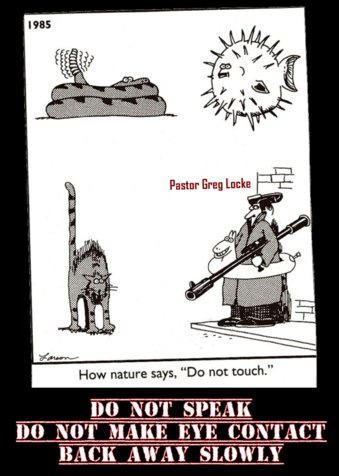
False claim shared by President Trump that only 6% of CDC-reported deaths are from COVID-19 is based on flawed reasoning (Pablo Rougerie; Health Feedback; Aug 29)
Still Confused About Masks? Here’s the Science Behind How Face Masks Prevent Coronavirus (Nina Bai; UC San Francisco; Jul 11)
How Well Do Masks Work? (Schlieren Imaging In Slow Motion!) (Jul 4, 8m:20s youtube)
Conspiracy theorist died Covid after trying to catch it to prove hoax (Jimmy McCloskey; Metro News; Jul 11)
Demagogue (Wikipedia)
Persecutory delusion (Wikipedia)
psychoceramics (Urban Dictionary)
-
Martin Luther (1483 – 1546)The worst thing to happen to Christianity as a whole. — Gus LamarchLuther's ideas were the initial crack that eventually destroyed christian hegemony in Europe and brought its secularization. A disgrace ... — Gus Lamarch
There's something more basic wrong here.
Those folk in these conflicts are supposedly talking on behalf of an almighty, caring deity, that could set the record straight in a heartbeat for all to see.
It sort of looks a bit like: if you're part of these conflicts, then you're part of the problem.
A presumption among them is that there already is a definite authority, except that authority is absent, quiet. No divine arbiter.
Kind of says something about the centuries of apologia.
All religions have their accepted dogma, or articles of belief, that followers must accept without question. This can lead to inflexibility and intolerance in the face of other beliefs. After all, if it is the word of God, how can one compromise it? At the same time, scripture and dogma are often vague and open to interpretation. Therefore, conflict can arise over whose interpretation is the correct one, a conflict that ultimately cannot be solved because there is no arbiter. — Eric Brahm
… religions create violence over four scarce resources: access to divine will, knowledge, primarily through scripture; sacred space; group privileging; and salvation. Not all religions have or use these four resources. He believes that religious violence is particularly untenable as these resources are never verifiable and, unlike claims to scare resources such a water or land, cannot be adjudicated objectively. — Hector Avalos… because religions claim to have divine favor for themselves, over and against other groups, this sense of self-righteousness leads to violence because conflicting claims of superiority, based on unverifiable appeals to God, cannot be objectively adjudicated. — Hector Avalos
It is a peculiar habit of God’s that when he wishes to reveal himself to mankind, he will communicate only with a single person. The rest of mankind must learn the truth from that person and thus purchase their knowledge of the divine at the cost of subordination to another human being, who is eventually replaced by a human institution, so that the divine remains under other people’s control. — Patricia Crone -
The Road to 2020 - American ElectionsWhat the heck is going on in the US?
QAnon (Wikipedia)
QAnon has gone from fringe conspiracy to full-blown cult (Julia deCook; openDemocracy; Sep 2020)
Velshi: QAnon’s conspiracy cult has infiltrated the White House (Ali Velshi; MSNBC; Sep 2020)
Seems like a kindergarten, Trump feeds his ego with Christian soccer-mum votes, ... -
David Hilbert’s thought experiment known as ‘Hilbert’s HotelThe Hotel doesn't derive a contradiction, it's not technically a paradox as such.
But it does derive counter-intuitive implications.
Oddly enough perhaps, some finites also derive counter-intuitive implications.
WL Craig and JP Moreland use terms like absurd about an infinite temporal past in particular.
(I'm guessing intuition is sometimes more or less the principle of sufficient reason.)
Bears noticing: ∞ ∉ R
No, infinites aren't just more numbers (apparently this keeps escaping many folk); you don't add subtract compare them all and call it a day; some rigor is required here, and we already know this. -
OilCapitalism is all about profit-maximization.
For a company, that's often in the scope of the sitting board and shareholders, so a bunch of (living) humans. I guess incentives toward broader concerns and ethics can be put in place, like with giving heavy fines/sentences for money laundering, or rewarding something.
Related to the tragedy of the commons. Might increase the risk of oil spills. :sad: -
What is "proof?"I guess, technically, in logic/mathematics, proof is truth-preserving reasoning.
But otherwise, a strong justification of something, perhaps meeting some epistemic standard.
A proof to the contrary, i.e. disproof, could be a counter-example.
So, proofs are usually supposed to give knowledge in some context. -
Case against ChristianityYet, it molded culture in a way that the two of them were intertwined. — Gus Lamarch
Or culture molded Christianity. -
Case against ChristianityChristianity is as brutal as Islam. — GregoryAnd yet, here you are, living on the world it helped build... — Gus Lamarch
Shaivism and Christianity are cultural phenomena. Culture isn't a Christian phenomenon. -
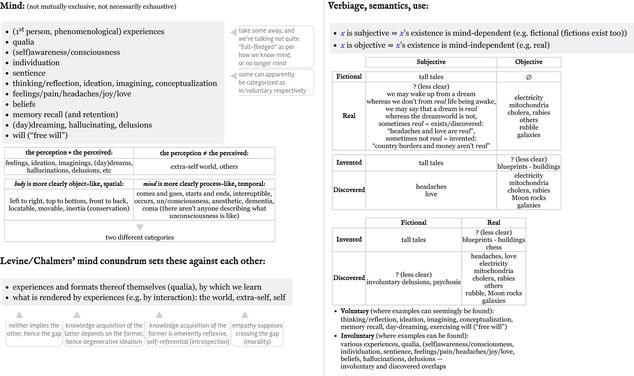
What is "real?"Incidentally, some time ago, I was trying to do an analysis of some common mind-verbiage, like
subjective - objective
fictional - real
voluntary - involuntary
invented - discovered
Too lazy to transform the original html to forum markup, so I'll just attach an image instead.
Not done though, quickly became a bit wishy-washy, isn't argumentative, more summarizing.
Anyone have suggestions, see errors, clarifications, ...?
-
God and timeYou tell me (everyone), , it's your story.
Last time: show your alleged contradiction or move on. -
God and timePeople know about liar's, unrestricted comprehension, curry's, principle of explosion, presuppositional error, what-have-you, . Once more:
Are you going to show the alleged contradiction or not, 3017amen? — jorndoe
The "atemporal god"?

-
God and time
-
God and timeAre you going to show the alleged contradiction or not, ?
I was both driving and not driving — 3017amen -
God and time
-
Case against ChristianityThe Bible does say things about slavery, @Gus Lamarch, just not the right thing.
What about mentioned discrimination, females, gay folk too? Just how much can be justified by a Bible reading should someone be intent on that?
The Bible does not define morals (many seem to pick-and-choose anyway).
You don't "follow" (to use your word), you develop autonomous moral agency (if you justifiably want to be/remain an autonomous actor at least).
But, hey, I certainly prefer this consequence over this/this. -
Case against ChristianityAlso, , there seems to be overlap between Ronald Hanko, Thomas Aquinas (← mentioned earlier), Ephesians 5:21-22 and 1 Timothy 2:11-12, for example.
I suppose a relevant question then is: would you go by the Bible as the truth of the matter (by definition), maybe try to make excuses for the Bible, or do the right thing in any case (even if not going by the Bible as the definition)? -
Case against Christianity[...] which the current socialists and leftists claim as the feats of their ideology, were also accomplished by the effort of Christianity. It must be really desperate to know that by deconstructing the Christian faith, you end up deconstructing yourself... — Gus Lamarchhistorical revisionism that favors your tantrum against Christianity — Gus Lamarch
:D You misunderstand. There's no desperation revisionism tantrum. There are a few historical facts that you (seem to intentionally) omit and now downplay (with a bit of raving). I'm not passing judgment in particular, but pointing out a few things your preaching missed; I can post more if you like.
By the way, if Christianity is the divine moral go-to, then why didn't the Bible say "slavery bad, don't"? See The Universal Declaration of Human Rights Article 4, for example.
What's with the "socialists and leftists" anyway? -
Case against ChristianityToday's stupidity and incompetence is the result of the secularization of Christianity, not of the christian faith. Christian faith with all its dogmas, laws, morals and values still exists and is there to be studied, the point is that with secularization, decadence arises and with it, nihilism. Without a homogeneous faith, which dictates how life should be lived - according to God - Man gets lost in his own sea of subjectiviness. — Gus Lamarch
Oh dump the blinders already.
History tells those who dare to study it [...] — Gus Lamarch
- Antisemitism in Christianity (Wikipedia)
- during Nazi times, some 94% of Germans were Christian, that's like 19 on a street with 20 people (Wikipedia), give that some thought
- Centuries of Christian anti-Semitism led to Holocaust, landmark Church of England report concludes (Gabriella Swerling; The Telegraph; Nov 2019)
- Victims of the Christian Faith (Kelsos via Church and State; Aug 2002)
- Flesh Inferno: Atrocities of Torquemada and the Spanish Inquisition (Simon Whitechapel; Apr 2003)
- Racism in Watchtower publications (John Cedars; Aug 2019)
- America’s Biggest Christian Charity Funnels Tens of Millions to Hate Groups (Alex Kotch; Sludge; Mar 2019)
- Are All Men Created Equal? (Ronald Hanko; Protestant Reformed Churches in America), apparently not, and, with such reasons, discrimination, and worse, are justified
"femina est aliquid deficiens et occasionatum" (woman is defective and misbegotten)
— Summa Theologiae (1274), Thomas Aquinas (1225-1274) - Study Shows White Evangelicals Want Christian Supremacy, Not “Religious Freedom” (Hemant Mehta; Dec 2019)
- Onward, Christian fascists (Chris Hedges; Jan 2020)
-
CounterfeitCounterfeit/fake refers to it having been made illegally moreso than its molecular arrangement, yes?
Been watching Good Girls, ? :) -
What is "real?"Real is sometimes contrasted by fictional, illusory, or erroneous.
Other times, real versus not real is used like discovered versus invented.
Other times still, real just means exists.
Then there are some cases that overlap with objective/subjective.
All seems very contextual (and Englitch is my 2nd language).
(y) -
Coronavirus:
CDC 6% COVID Death Rate?? | A Doctor Explains Here's how to actually interpret those CDC #COVID19 mortality numbers. (8m:53s facebook av) ← a trained medical professional explains
False claim shared by President Trump that only 6% of CDC-reported deaths are from COVID-19 is based on flawed reasoning (Pablo Rougerie; Health Feedback; Aug 2020) ← fact check
Misrepresentation is this → ← close to lying (or it's bullshitting).
jorndoe

Start FollowingSend a Message
- Other sites we like
- Social media
- Terms of Service
- Sign In
- Created with PlushForums
- © 2026 The Philosophy Forum