
Comments
-
Does Everything Really Flow? Is Becoming an Illusion?
Actually, my view is BothAnd. Our world is both a Holistic System that works as a unit, and a swarm of Holons that work independently. The "holistic view" is top-down, while the "holon view" is bottom-up. The bottom-up view is basically that of reductive pragmatic Science, but the top-down view is more like a philosophical objective perspective from outside the universe. Perhaps, what Thomas Nagel called "The View From Nowhere".I don't see why 'continual progression' should be any more empirically established in the real world, whereas our digitized categorizations of reality is not. Why do you think so? — SaugB
Your original question may be motivated by a scientific desire to slice the "flow" of Change (cause & effect) into ever smaller increments. For example, the study of Phase Transitions has not yet revealed any intermediate steps between liquid water and ice. But scientists continue to carve that instantaneous "traversal" into a series of middle stages. They may, in part, want to dispel the mystery in order to make it look less like "presto change-o" magic. Yet immaterial Energy remains a mysterious force for change that can't be dissected into particles. My guess is that It may be more like bits & bytes of mental Information.
The scientists probably expect, like Zeno, to find an almost infinite sequence of smaller causes and effects between Water & Ice. But I'm not so sure. The process of EnFormAction (causal energy) may actually be more like magic than our materialistic worldviews allow. But then, I don't believe in Magic, at least not in the Real physical world. :cool:
Both/And Principle :
My coinage for the holistic principle of Complementarity, as illustrated in the Yin/Yang symbol. Opposing or contrasting concepts are always part of a greater whole. Conflicts between parts can be reconciled or harmonized by putting them into the context of a whole system.
http://blog-glossary.enformationism.info/page10.html
Objective View : https://en.wikipedia.org/wiki/The_View_from_Nowhere
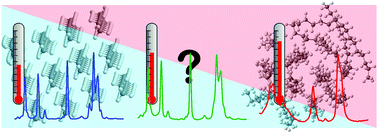
Intermediate Phases : https://pubs.rsc.org/en/content/articlelanding/2017/cp/c7cp01468f#!divAbstract
-
Does Everything Really Flow? Is Becoming an Illusion?
Whenever humans conceive of a continual progression as a series of steps, they implicitly digitize a whole system. For example, as someone pointed out above, the color spectrum is not inherently divided into the conventional colors of the rainbow. Instead, we tend to standardize "separate" colors for our own analytical purposes. Hence, the increments are somewhat arbitrary and relative to the perceiver. Is "Becoming" inherently a sequence of discrete stages, or is it hacked by humans into smaller segments for the sake of understanding the "elusive" middle?Rather, I was thinking of why, in any process we call 'becoming,' where there are at least three phases, with two end-points and a middle point, the middle phase gets passed over or traversed. Is it because it is elusive, as if in a sense it was never there? — SaugB
The Flow of a river is usually conceived by laymen as continuous, without your one-two-three steps. But scientists and philosophers can choose to analyze that holistic Flow into the movement of discrete particles. Is the scientist right and the layman wrong? What real world example of "something in between" being overlooked or trivialized provoked you to ask the question? :smile:
Goethe vs Newton Color Theory : https://en.wikipedia.org/wiki/Theory_of_Colours -
Does Everything Really Flow? Is Becoming an Illusion?
Your question sounds like Zeno's Paradox. He assumed that the "gap" traversed between any two steps in a race (movement in space & time) is infinitely divisible. Hence, motion (and Time) is impossible. If so, are our experiences of those distinctions illusory? Are we just imagining Space & Time? Is Change even possible?We have heard the philosophy that everything flows [eg, Heraclitus]. But, when 'this' becomes 'that,' it traverses something in between, — SaugB
Max Planck resolved his own paradoxical situation, in the measurement of minute quantum level increments, by defining the smallest possible increments in the Real world. Hence, he excluded the unreal Ideal notions of Eternity and Infinity. Idealistic Mathematicians noted that, if you continue dividing that "gap" into smaller pieces, they eventually become infinitely small, hence irrelevant to the measure of space or time. Thus, trivializing the paradox. But Realistic physicists took a different approach and observed that if you can measure the beginning & end points of the race, the total of all intermediate steps (gaps, increments) must be finite.
Therefore, like Einstein, I suspect that the solution to the stated problem depends on your perspective --- it's all relative. The paradox results from the assumption of Infinities in the Real world. But the physical solution is found, only if you ignore idealistic Infinity. So, are asking for an Ideal answer, or a Real answer? :nerd:
Zeno's Paradox Solved??? : https://www.forbes.com/sites/startswithabang/2020/05/05/this-is-how-physics-not-math-finally-resolves-zenos-famous-paradox/#3c8aa0b633f8
PS__"Flow" may be an interpretation, in the mind of the observer, of seemingly sequential sensations. So, the way Flow feels (continuous vs discontinuous) depends on your attitude, Realistic or Idealistic. Either/Or Paradoxes like this can keep puzzled philosophers occupied for thousands of years. -
Does Everything Really Flow? Is Becoming an Illusion?
In my hypothesis, that intermediate "duration" between energy peaks and valleys is not Time, but Timelessness ( a state that cannot be measured in Planck units). Again, that notion is too complex, and too far above my pay grade to explain in a forum post. And the math necessary to pin it down is beyond my untrained abilities. Besides, these Ideal notions are merely incidental to the purpose of my thesis, which is to understand, in a layman's overview, how & why the Real world works as it does : to dispel the mysteries.But is it not true that given there was a duration, no matter how short, between the hot entity staying hot and then becoming cold, something actual happened in that duration to that entity? — SaugB
Anyway, I would say that the gap between waves of energy is not "actual", but Potential. In my not-yet-fully-formed thesis, the default state of BEING is timeless, eternal, Potential. So, our space-time temporal Actual world is an exception to the rule. Hence, it didn't just randomly happen as a matter of course. Instead, it was Caused by Intention or Purpose (which implies the power to produce change). Again, I don't expect that "nonsense" to be understandable from the current perspective of empirical Science. It's just a way for me to think about notions that are beyond Real, beyond Good & Evil, beyond Hot & Cold.
Regarding the problem of Continuity, if you look closely at Causation, as Hume did, there is no obvious empirical connection between the Cause and the Effect. So, I would guess that the Link is Mental, and part of the meta-physical process of En-formation, or EnFormAction. Those are terms coined specifically for my thesis of Enformationism. And you won't find them in the dictionary.
BEING is static Potential, until an intentional decision to act is made. So, the result of causal Entention is dynamic "Becoming". However, I wouldn't think too hard about such out-of-this-world concepts --- it might warp your mind, and make your brain smoke --- as it has with mine. :joke:
EnFormAction :
Ententional Causation. A proposed metaphysical law of the universe that causes random interactions between forces and particles to produce novel & stable arrangements of matter & energy. It’s the creative force (metaphorically : Divine Will) of the axiomatic eternal deity that, for unknown reasons, programmed a Singularity to suddenly burst into our reality from an infinite source of possibility : BEING.
AKA --- The creative power of Evolution; the power to enform; Logos; Change.
http://blog-glossary.enformationism.info/page8.html -
Does Everything Really Flow? Is Becoming an Illusion?
Your example of color change reminds me of physical Phase Transition. The perceived shift in color is caused by a change in wavelength, and the gap "traversed" between one peak and another is insubstantial Time. Hence, those frequencies of on-off blinking (max/min; yes/no; something/nothing; positive/negative; hot/cold; energy/entropy; potential/actual) are increments of Planck Time. So there is no physical "substance" in between color states --- just the Potential for being, that I call Intention, Causation, Time in action.But, when 'this' becomes 'that,' it traverses something in between, such as when the color yellow becomes red it traverses orange. And whatever is traversed is not the end-point of that becoming, by definition. So, how do we attribute existence to that traversed thing — SaugB
However, Phase Transitions, such as water to ice, are assumed to result in intermediate physical forms. But scientists haven't been able to detect any "in between" substances". The H2O is still the same stuff, only its energy state and physical properties (functions) are different. So, I'm guessing that, like color phases, it all boils down to "on/off" or "being/non-being" or "something/nothing". And that digital "1/0" process is also found in Shannon's definition of "Information". So, what comes between the 1 and the 0? : Potential (the power to be, to exist).
Therefore, I agree that "all things flow", but the seemingly continuous process of causation and evolution is ultimately digital, or quantized as waves of maximum/minimum energy (100% -- 0%). And those change-causing waves are what we call "Energy", or what I call "Information" or "EnFormAction" in my thesis. But, don't worry if this unconventional notion doesn't make sense. It's based on my personal esoteric theory of Cosmic Information.
This is probably more than you asked for. But, in this post, I'm selfishly applying my hypothetical theory to your question about "Flow", which I hadn't considered previously. I apologize for intruding on your thread. :yikes:
Mind-Energy-Information : http://bothandblog2.enformationism.info/page70.html
Planck Time : Planck units are not based on properties of any prototype object or particle (the choice of which is inherently arbitrary), but rather on only the properties of free space.
https://en.wikipedia.org/wiki/Planck_units -
Naive questions about God.
MIne too! But when has that ever stopped us from philosophizing? :smile:Above my paygrade, friend. Good luck :up: — TheMadFool -
Naive questions about God.
That is one way to imagine the hypothetical fundamental non-entity I call "G*D". It's like a continuous unbounded unlimited Field of Potential (BEING), within which particles (worlds) emerge -- as-if by magic -- and then disappear again, without diminishing the Power of the Field. This is not a traditional anthro-morphic deity, but a philosophical hypothesis to explain how our natural world seemingly emerged, complete with laws & energy, from nothing --- nothing but infinite Potential. Nothing is more "fundamental" than Existence (BEING).As in the proposed case of covariant quantum fields, the Fundamental can't have any parts, and so needs to be such as a 'wave' or a 'field', being simple and continuous. Of course, the notion of a 'God' person/system is as far off in the wrong direction as it could be. — PoeticUniverse
PS__Don't you think this concept of BEING has poetic potential? :cool:
Entity : a thing with distinct existence.
Non-entity : an amorphous indistinguishable field of potential
Potential : Possible, as opposed to Actual; capable of being or becoming. Potency. -
Naive questions about God.
That is indeed the nature of Wholes in the real world. But my notion of the hypothetical super-natural creator of Reality (Nature) is just the reverse. My metaphysical G*D is not a thing, or a collection of things, but the eternal-infinite Potential that I call BEING (the power to exist). In that case, the inexhaustible power is never diminished by creating novel things (holons).How does one understand the whole without understanding the parts? The very definition of a whole is that it's made up of parts. — TheMadFool
Of course, this imaginary Ideal entity is merely a theoretical device, intended to explain how and why our Real world is what it is. I have no scriptures or scientific evidence to support that philosophical hypothesis. Yet, I use it as an axiom for my Enformationism worldview. :nerd:
Holon : simultaneously a whole and a part
https://en.wikipedia.org/wiki/Holon_(philosophy)
NOTE : Pace Koestler, In my custom-built scenario, the holons do not "add-up" to the "Holarch". Instead, they are saturated with BEING, and they are separate from the "Holarch" only in the eyes of limited space-time perceivers. -
Naive questions about God.
That's also how I view my meta-physical, non-anthro-morphic G*D : as a unique singular Whole, not a vast collection of parts. Dawkins seems to be a reductionist trying to understand a holistic concept. :smile:Darwin clearly mentions that the beginning was simple and taking that to its logical conclusion, God must've been, necessarily, simple; in fact God has to be the simplest of all and ergo, requires no further explanation. — TheMadFool -
Does personal identity/"the self" persist through periods of unconsciousness such as dreamless sleep
That's merely a superficial observation of a mystery, not a theory of "how it works". Scientists know a lot about Phase Change, but still can't say for sure what "embedded" intermediate steps transform one physical state into another, with novel physical properties. Likewise, it's obvious that there is some connection between neural substrates and mental consciousness, but they can't say exactly what the physical-to-metaphysical link is. I have my own personal layman's hypothesis, and it seems pretty straightforward, but I'm not about to submit it to a Neuroscience Journal.So you say. But I wouldn’t agree. It seems pretty straightforward that the whole of the brain is simply embedded in the business of constructing a self vs world relation. . . . Phase transitions are well understood. — apokrisis
Mysterious Phase Change : https://www.sciencedaily.com/releases/2018/03/180308143153.htm
That assertion seems rather harsh, but I too have reservations about the traditional notions of Panpsychism. Something similar is going-on in the world, but I have a different concept of how the process works. And that worldview is based in part on Natural Holism, as described by Jan Smuts in Holism and Evolution.Panpsychism simply apes the failings of material reductionism. So it is a failure to in fact understand the holism of nature. — apokrisis
Holism : https://en.wikipedia.org/wiki/Holism
I'm not familiar with Pansemiosis. But, if it's like most of Peirce's writing, it would go right over my pointy little head anyway. However, as I get time, I'll look into it. Peirce's "signs" may be similar to my own "Enformation". But I wouldn't say that its "primary mission is to communicate divine glory". :smile:Instead of Panpsychism, the general philosophical stance here would be Pansemiotic. That is, a pragmatic physicalist account in the tradition of Peircean semiosis. — apokrisis
Pansemiotics : The term provides a means of describing the theological view that “the whole universe became [in the Middle Ages] signs of divine revelation”, as in the Old Testament statement, “The heavens declare the glory of God” (Psalm 19:1), as if everything in the universe is united in this primary mission to communicate divine glory.
https://richardcoyne.com/2018/03/10/pansemiotics/
Systems Theory :
A system can be more than the sum of its parts if it expresses synergy or emergent behavior. Changing one part of the system usually affects other parts and the whole system, with predictable patterns of behavior. More parts, means more interrelationships, and more complex properties & activities, including mental functions.
http://blog-glossary.enformationism.info/page18.html -
The Religion Unmarred By Violence: Jainism.
I didn't call Jains "hyper-idealistic", I called them "idealistic". It was not intended as a put-down, but as a description of their uncompromising Dharma. The "hyper" part was added by you, to indicate your extremist (black vs white) perspective from the lofty moral mountain-top. :joke:In other words, me calling you a hyper-pragmatist and you labeling the Jains as hyper-idealists is part and parcel of this moral revolution. — TheMadFool
I didn't know much about their religion before we started this thread. But I've been doing a quick overview, and discovered that Jainism and Buddhism have much in common. The primary difference seems to be that Buddhists rely on Meditation to purify their minds, while Jains rely on physical Asceticism to purify body & mind. One requirement for physical purity is that monks and nuns are required to literally pull-out (not shave) all of their hair. That is just one example of what I refer to as going to extremes in pursuit of an ideal. Is the billiard ball look still "in" for balding males in the West? :grin:
I noted that one worldly advantage of an ascetic religion may be that their individual frugality tends to lead to communal wealth. Incidentally, the Sikh community in India is also noted for their high moral standards, but not for non-violence. Since weapons are sacred to them, they are often employed as armed guards. With so many paths to purity, how can I keep-up in this "moral revolution"? :smile:
Jain Wealth : https://www.newsbytesapp.com/timeline/india/14876/75508/people-in-delhi-punjab-richest-in-india-report -
Does personal identity/"the self" persist through periods of unconsciousness such as dreamless sleep
The current dominant model of the brain says that it consists of an array of "modules" with specialized functions. But no-one has come up with a plausible theory of how those independent modules work together to produce the unique singular perspective we call the Self. Perhaps the best hypothesis comes from Holism, that integrated collections of parts naturally unite into a whole system with new functions & properties that are not found in the components. One physical example of that phenomenon is Phase Transition. Another hypothetical example, that is not accepted by reductionist scientists, is the notion of Panpsychism, in which all minds in the universe work together as a Global Mind. Unfortunately, there is currently no means to communicate with such a god-like mind, other than those of Mysticism. :smile:So the claim that the brain is "constituted" of processes is actually the much larger claim that the process itself has a holistic unity of its parts. — apokrisis
Modular Mind : One example of modularity in the mind is 'binding.' When one perceives an object, they take in not only the features of an object, but the integrated features that create a whole.
https://en.wikipedia.org/wiki/Modularity_of_mind
Holism : the theory that parts of a whole are in intimate interconnection, such that they cannot exist independently of the whole, or cannot be understood without reference to the whole, which is thus regarded as greater than the sum of its parts. Holism is often applied to mental states, language, and ecology. ___Wiki
I agree that most notions of Panpsychism are Mystical rather than Empirical. Yet, modern concepts of Process Philosophy, sound panpsychic, but try to incorporate the latest findings of Neuro-Science into a realistic theory. Ironically, their blend of Physical and Meta-physical (mental, rational) evidence typically concludes with some notions of Panpsychism and a god-like Mind. :nerd:That is what makes any panpsychic talk flawed. Panpsychism is an argument that piggybacks on conventional materialistic reductionism. And neurobiology has already moved on from that with its holistic notions of "process". — apokrisis
Process Philosophy : Process philosophy is characterized by an attempt to reconcile the diverse intuitions found in human experience (such as religious, scientific, and aesthetic) into a coherent holistic scheme. Process philosophy seeks a return to a neo-classical realism that avoids subjectivism. . . . . Most process philosophers speculate that God is also an actual entity
https://iep.utm.edu/processp/ -
The Religion Unmarred By Violence: Jainism.
"Hyper-pragmatism" is not pragmatic, it's idealistic. That's one problem with "hyper-idealists", they tend to view pragmatic moderates through a reverse telescope that makes them look farther away than they actually are. :smile:Well, in my humble opinion, the refutation of your position lies in the past; looking backward serves the critical function of revealing, showing you, the evidence against your hyper-pragmatism. Perhaps I'm guilty of the straw man fallacy but convince me that you're not committing an argumentum ad antiquitatem. — TheMadFool
Regarding the "argumentum ad antiquitatem", all I can say is that I respect most religious traditions of the past for their relevance to their own place & time. But the world today bears little resemblance to the isolated cultural pockets that most religions evolved in. So the solutions of yesterday need to be updated to suit the ethical milieu of today. Secular Humanism is one attempt to provide the benefits of traditional religions without the negatives that result from blind faith and magical thinking. Of course, no man-made system of ethics will ever be perfect, hence the necessity for a compromising consilience of Pragmatism and Idealism. :cool:
Pragmatic Idealism : This term sounds like an oxymoron, combining practical realism with otherworldly fantasy. But together they describe the BothAnd attitude toward the contingencies of the world. Pragmatic Idealism is a holistic worldview, grounded upon our sensory experience with, and knowledge of, how the mundane world works, plus how Reality & Ideality work together to make a single whole. As a personal philosophy, it does not replace scientific Realism — and doesn't endorse fantasies of magic, miracles & monsters — because every thing or fact in the “real” parts of the world is subject to logical validation or empirical testing prior to belief.
http://blog-glossary.enformationism.info/page17.html
Dalai Lama on Secular Humanism : There are those who state that religion is not necessary for moral behavior at all. The Dalai Lama has said that compassion and affection are human values independent of religion: "We need these human values. I call these secular ethics, secular beliefs. There’s no relationship with any particular religion. Even without religion, even as nonbelievers, we have the capacity to promote these things."
https://en.wikipedia.org/wiki/Secular_ethics -
The Religion Unmarred By Violence: Jainism.
Yes. If you have a need for absolute moral purity, then go for it. But most people are not so angelic. I do my best, but it's never good enough to qualify me for heaven. :smile:Your whole idea that Jain morality is too idealistic unravels at this point; after all, it's only that for you and others who think like you. No? — TheMadFool
Like Steven Pinker, and Michael Shermer, I see historical evidence that cooperative human morality is gradually progressing, despite the inherent US vs THEM attitudes built into us by the evolutionary algorithm of competitive "survival of the fittest". However, I don't look backward for traditional religions to pave the way for a more peaceful future. They played their part in the past, but modern societies are much more diverse, with more moral pitfalls, for their simplistic idealistic doctrines to have much impact. Buddhism is a good model for non-violence, but it focuses on the individual, and idealizes a self-centered monastic lifestyle. Not a recipe for world-wide revolution in morality.Do you see where this is going? The rest of the world is just playing catch up with the Jains. — TheMadFool
Even my own personal BothAnd philosophy is a drop in the bucket for moral change. So I doubt that any one religious or philosophical model will do the trick. Instead, continued application of Reason (as suggested by SP and MS) to control our innate Emotions, may create a less competitive Us/Them environment to allow whole societies to become more peaceful. Given time, humanity may evolve into a tranquil egalitarian Star-Trek-like culture, instead of a Star-Wars-like continuation of the status quo. Does that sound too idealistic to be possible? :nerd:
Rational Moral Progress : Like Steven Pinker, in the Better Angels of Our Nature, Shermer thinks that too many people are pessimistic about the notion of moral progress in humanity, and about the prospects for the future of civilization. One indicator of that dark mood is the pounding waves of post-apocalyptic and natural disaster movies since the turn of the 21st century. Most of them either blame Science for the problems (alien attacks, nuclear war, global warming), or show no confidence that Science can solve them.
http://bothandblog2.enformationism.info/page62.html
The BothAnd Principle : http://www.bothandblog.enformationism.info/page5.html
Note the conflicting Goldwater quotes. -
Does personal identity/"the self" persist through periods of unconsciousness such as dreamless sleep
The OP was asking if, when Consciousness stops during sleep, we are in-effect dead for the duration. But that notion is based on a poor understanding of Consciousness. By far, the majority of brain functions are Sub-Conscious, and awareness is a small percentage of our total mental operations.Our identity is constituted by all those processes, and when they stop, we no longer have a unitary identity, or at least much less of one. — bert1
Long before our modern neuroscience could detect brain processes during sleep, some people were afraid that sleep or any other form of un-consciousness was a step toward the totality of death. But Sleep and Death are related only by analogy. The Little Death myth was due to taking a metaphor literally. To the contrary, sleep is an essential aspect of living. Cheers! :smile:
The Little Death : https://en.wikipedia.org/wiki/La_petite_mort -
Does personal identity/"the self" persist through periods of unconsciousness such as dreamless sleep
I have been losing consciousness nightly for 75 years, and yet my Self is still living. That's because Consciousness is not the same thing as Self or Life. All of those are ongoing processes, not material substances that evaporate. I was also non-conscious for billions of years before my birth, and suffered no serious complications from that prolonged non-life. Death is merely the end of the process of Living, and incidentally the end of all other related processes such a Consciousness. After death you are not likely to be conscious of anything. So why lose sleep over it?Is unconsciousness during sleep something that a person should realistically fear? — AJ88
The philosophical cartoon raises a hypothetical question, that has no effect on the real world -- only on the minds of those who take them too seriously. :joke:
Consciousness : Conscious-ness is an immaterial quality like red-ness : it doesn't exist in the molecular or atomic level of neurons, but on the metaphysical level of whole systems.
http://bothandblog2.enformationism.info/page32.html
Self/Soul :
The brain can create the image of a fictional person (the Self) to represent its own perspective in dealings with other things and persons.
1. This imaginary Me is a low-resolution construct abstracted from the complex web of inter-relationships that actually form the human body, brain, mind, DNA, and social networks in the context of a vast universe.
2. In the Enformationism worldview, only G*D could know yourself objectively in complete detail as the mathematical definition of You. That formula is equivalent to your Self/Soul.
3. Because of the fanciful & magical connotations of the traditional definition for "Soul" (e.g. ghosts), Enformationism prefers the more practical term "Self".
http://blog-glossary.enformationism.info/page18.html -
Why do scientists insist in sustaining multiple languages?
Maybe the solution to the babble of languages at CERN is to provide everyone with a Babel-fish. :grin:Is choosing an universal language and sticking to it really so hard? — Seth72
Babel-fish : https://hitchhikers.fandom.com/wiki/Babel_Fish
Babel-fish : https://en.wikipedia.org/wiki/Babel_Fish_(website)
-
The Religion Unmarred By Violence: Jainism.
Yes, the Golden Mean is relative to the mode and range of the values under consideration. I this case, I am relating the Jain morality to my own personal context in 2020 America, not to penguins in their frozen wasteland. Compared to all the other meat-eaters in my cohort, I'm pretty average. I killed a few animals in my youth -- mostly fish and squirrels. but very few since then -- mostly roaches & flies; no humans. My personal meat consumption is moderate, so my carbon debt is fairly low.You're in favor of the Arisotetelian golden mean but isn't the idea of extremes something relative. — TheMadFool
Also, since I don't consider animals raised for fur & meat & milk equal in moral value to humans, I don't believe that "fur is murder". But, like most of my fellows, I draw the line at animals raised for pets. They may not be morally equal to humans, but they have value to humans that I must respect. Moreover, relative to non-Jain Indians, about 31% are vegetarian and 9% ovo-vegetarian. So, in their own context their values are pretty far off the mean. :cool:
https://www.google.com/search?client=firefox-b-1-d&q=vegetarians+in+india
PS__I don't have any animus toward Jains. I'm just not inclined to go quite so far in search of absolute moral purity. Above average purity is OK for me. Does that laxity make me evil? :joke: -
The Religion Unmarred By Violence: Jainism.
Apparently, you don't know who Barry Goldwater was. As presidential candidate in 1964, he was the Donald Trump of his day, and had been characterized as "a right-wing extremist who would plunge America into a war and do away with Social Security and other essential social programs . . ." Of course, that was a political "spin" by his opponents. But for progressives and liberals his espousal of extremism was reminiscent of Hitler : "Martin Luther King, Jr., saw “dangerous signs of Hitlerism” in Goldwater’s programs." And of course, Liberals can also be extremists.But this speaks in my favor??!! You describe Jainism as an extreme point of view and you quote someone who sees extremism as a positive force for change, good change. — TheMadFool
But the point here is that I was not endorsing his view of "extremism as a positive force for change". Instead, in his case, it was a force for countering the "extremist" Liberal changes in the 60s. I'm not in favor of extremism from Left or Right or zealous religions. Like Aristotle, I prefer moderation in all things --- including moralistic dogma. :smile:
Goldwater Extremism : https://www.niskanencenter.org/on-the-saying-that-extremism-in-defense-of-liberty-is-no-vice/ -
The Religion Unmarred By Violence: Jainism.
I can quibble with the notion that "every new idea" is extremist. Many are quite moderate, but are rejected due to the polarized & uncompromising attitudes of the times. Yes, some seemingly extreme or unorthodox ideas have become "the new normal". My own Enformationism worldview may seem to be extreme --- in its blend of Eastern & Western philosophies, along with Quantum paradoxes --- relative to both rational Materialism and emotional Spiritualism. But I like to imagine that its moderate & consilient attitude toward the world will eventually become the new Standard Model for future Science and Philosophy.Good distinction my friend but you're ignoring it. Every idea is at one point in its history is/was/will be extremist but some, not all, have managed to become, how shall I put it, the new normal — TheMadFool
By contrast, as with many religious doctrines, I view Jainism as uncompromising & extreme in its black & white worldview. How can you have too much non-violence, you ask? Remember presidential candidate Barry Goldwater's assertion “Extremism in defense of liberty is no vice. Moderation in pursuit of justice is no virtue”? I suspect that Hitler would agree. But Aristotle's Golden Mean finds beauty, truth, harmony, symmetry & proportion in the middle way between extremes. This flexible rule applies in both personal and interpersonal dealings. That means you and I can get along, even though you are an animal-loving strict vegetarian, and I am an animal-loving casual meat-eater. :cool:
BothAnd Philosophy : From a philosophical point-of-view, I think the current “Mexican stand-off” in politics & religion results from a few extremists on left & right imposing their adamant Either/Or worldviews upon the more moderate masses, with the effect of almost eliminating the middle ground of peace & harmony. So, my proposed solution to the polarization problem is to adopt a moderate & inclusive Both/And attitude toward the world and its vicissitudes.
http://bothandblog5.enformationism.info/page2.html -
The Religion Unmarred By Violence: Jainism.
I never said that "there are things too idealistic to implement". What I did say was "It's an idealistic idea, but hard to implement in the real world.". You were generalizing my specific skeptical response to the notion of modern people in the West adopting the extreme "idealistic" values of ancient Jains : "an obsession with purity". Thoreau, Gandhi, and M. L. King were all inspired by non-violent ideals. But they all found that implementing those "impossible dreams" takes time . . . lots of it. The Golden Rule is an ancient ideal, and modern people are still inspired by its implications for an ideal society. But innately selfish human nature (the Selfish Gene) is resistant to top-down control. Maybe, in a Utopian future, when humans are replaced by vegetarian robots, violence will become extinct. :joke:Your idea of "incremental moral progress" is a good explanation for why there's change in the world but it refutes your belief that there are things too idealistic to implement. — TheMadFool
The bottom line is, I was not objecting to Idealism, but to Extremism. However, I didn't think you were suggesting that Americans actually convert to Jainism, but that we can add their example to those of Jesus, Thoreau, Gandhi, and King, to serve as inspiration for our personal values. With that I can agree. But I am not convinced that animal-loving vegetarians are inherently non-violent toward humans. I have included the image below, with tongue in cheek, merely to illustrate that the ideals of Non-violence and Vegetarianism are valid moral positions --- equivalent to the general moral imperative, Thou Shalt Not Kill --- but subject to various interpretations in practice. My interpretation is moderate, not extremist. :joke:
Impractical Jains : In a religion that entails a strict vegetarian diet, daily meditation, and taking vows that most would see as impossible to uphold, it may prove difficult to see how Jainism can relate to the modern concept of nonviolence.
https://engagedscholarship.csuohio.edu/cgi/viewcontent.cgi?referer=https://www.google.com/&httpsredir=1&article=1018&context=tdr
Vegetarian Violence : "But any intuition that vegetarianism and humanitarianism go together was shattered in the 20th-century by the treatment of animals under Nazism. Hitler and many of his henchmen were vegetarians, not so much out of compassion for animals as from an obsession with purity, a pagan desire to reconnect to the soil, and a reaction to the anthropocentrism and meat rituals of Judaism". ___Steven Pinker, Better Angels of Our Nature

-
Platonic tradition
I'm generally familiar with Plato's ideas, but I'm not a scholar. Where did Plato discuss the topic that you are calling "the One". I did a Google search and found nothing relatable. How is "the One" different from the "Logos". My interest is primarily in the notion of "pure potentiality". In my own thesis I call that abstract concept "BEING", the power or potential to exist. from which all "beings" come to be. I hadn't thought of BEING as "wanting to be" (Washburn), but in order for Potential to become Actual, there must be some Motivation and/or Intention. If so, The One, begins to take-on some characteristics of a universal creative deity. Is that what Plato had in mind?First, there is the One. Which is pure potentiality
Second, there is the Intellect. Whether it comes from the One or not is a mystery. It is the Demiurge
Lastly, there is the Forms and the gods, and finally earth. — Gregory
Also, where did the sequence of "One", "Intellect" (demiurge?), Forms, Gods, and Earth come from? Was this hierarchy from Plato, or from later commentators --- or from your own interpretation? -
The Religion Unmarred By Violence: Jainism.
What "ideas" are you referring to? I don't suppose that you think cave-men were making utopian plans for turning their caves into high-rise cities. Anthropologists, who study the few remaining "primitive" peoples, have found that they tend to live very pragmatically, one day at a time, with "little thought for the 'morrow". Incremental technological improvements, such as better arrow-heads, resulted from the practical work of hands-on craftsmen, not arm-chair theorists. And incremental moral changes were often inspired by hundreds of "enlightened" Religious Founders. But the implementation of their perfectionist Ideals (Heaven on Earth; Nirvana -- the peace of nothingness) into a Utopian society is still, after thousands of years, an impossible dream.After all, the ideas that drove this change from hunter-gatherer to civilized man would've surely been impractical and too idealistic back in 30,000 BC. — TheMadFool
I apologize for the mild sarcasm. Any "ideals" of human societies in general seem to be mostly for short-term improvements that, over time, add-up to major changes in how societies inter-act with each other, and with their environments. I suspect that the very idea of "Progress" and "Ideals" came into existence with the early philosophers (8,000BC), and as a result of the enhanced opportunities afforded by the power of complex civilized living (10,000BC). Clearly, the pyramid builders had idealistic motives, but very narrow Pharaoh-centric applications.
The modern notions of idealistic entrepreneurs is also typically narrowly focused on specific applications. Elon Musk may have stars in his eyes, and spreads his idealism across a variety of ventures, but he is also pragmatic enough to focus on each step up the stairway to the stars. Again, I'm not denigrating the inspiration of Idealism, but merely noting that without incremental Pragmatism, those "sky castles" never get built. :joke:
"Genius is one percent inspiration and ninety-nine percent perspiration. Great accomplishments depend not so much on ingenuity as on hard work." ___Thomas Edison.
“Ideas are a dime a dozen. People who implement them are priceless.” ___Mary Kay Ash
The explanation for how impractical ideals resulted in practical results is summed-up in the Edison & Ash quotes. :smile:Again, you need to offer a good explanation of the tangible change that has occured over human history. The too-idealistic, too impractical philosophy of yours fails to explain facts as they stand. — TheMadFool
Again, I'm not proposing a fatalistic philosophy. Back to the context of this thread, I'm merely noting that expecting humans to live like Jains --- sweeping their path to avoid stepping on ants, and wearing a mask to avoid inhaling a gnat --- is not a practical path to a non-violent society. Instead, we will have to continue the incremental moral progress that has been going on for thousands of years. :nerd:Again, your too-idealistic, too-impractical philosophy — TheMadFool
The Moral Arc : "[Hume] also said that “reason is, and ought to be, the slave of the passions.” But Shermer argues that those truths cannot deter us from imagining a better reality, and like MLK, working to implement that dream against all odds."
http://bothandblog2.enformationism.info/page62.html
Progressing or Backsliding? : "One prominent sign of human moral progress is the expansion of the “circle of sympathy” beyond family, tribe, and state, to encompass all of humanity, and of the world in general. This is the goal of philosophical Humanism, . . ."
http://bothandblog2.enformationism.info/page42.html
Paradigm Shifts : "But all Paradigms require a foundation in some eternal truths, even if they are assumed for their theoretical value, not their proven truth value."
http://www.bothandblog.enformationism.info/page71.html -
The Religion Unmarred By Violence: Jainism.
Ideals are great as hypothetical goals to aim for, but they are by definition, not Real, or realistic, in the sense of practical. The Garden of Eden was an idealistic myth, where Lions apparently age veggies, despite having teeth unsuited for that kind of food. But the myth-makers were not concerned with such mundane practical matters. Likewise, the Jains did not take into account that human digestive systems are best suited for an omnivorous diet. Or that, according to anthropologists, the large human brain was a result of pre-humans who flourished on a diet that included meat protein. Ideals are like Infinity, we may approach it, but never reach it.Well, something inside me tells me I should agree with regarding some ideas like Ahimsa being too idealistic but then how does one make sense of the difference between humans and other animals? I mean how come, considering the fact humans are basically animals, we've made so much progress in the moral department? if you ask me, expecting good, moral behavior from animals is, by your standards, just too idealistic and yet here we are - Jesus, Buddha, J. S. Mill, Kant, etc. We were, at one time, apes and it would've been the heights of idealism to expect an ape to write the Bible and yet we have. — TheMadFool
The fact is that humans are not mere animals. They are animals-plus. That "plus" allows humans to make moral choices --- such as to eat meat or not --- that animals cannot. I doubt that most animals can even conceive of Ideals. Yet humans can imagine such heavenly standards of perfection for narrowly-defined cases. In the real world though, such high goals require trade-offs. For example, if Lions were originally vegetarians, they must have fallen short of Edenic perfection, and somehow evolved digestive systems adapted to meat eating. But in that case, they would lose the ability to eat grass, which requires multi-chambered stomachs. Moreover, even perfectionist humans --- like Peter Singer --- have lost the ability to eat grass, and are forced to eat a limited range of foods that their puny teeth and single-chambered stomachs can handle. How does he know that carrots don't have feelings, and silently scream when roughly plucked from the bosom of Mother Earth? If he was really an Idealist, he might become a Breatharian, and live upon a diet of feelingless air for nourishment.
By my standards, Idealism is a state much to be desired, but only Jesus (reportedly) ever achieved that level of moral perfection. And it was not reported that he abstained from the flesh of animals. So, was that paragon actually immoral, or merely human? Your use of "apes" to describe the Bible-writers is disingenuous. They may have been anthropoids, but they certainly were not apes. Instead they were apes-plus, who aspired to ideals beyond their reach. I too, can imagine impossible Ideal standards, but I don't deceive myself that they are within my grasp. :joke:
Breatharian : https://en.wikipedia.org/wiki/Inedia
Jesus -- imperfection? : Another perspective characterizes Christ's perfection as purely spiritual and moral, while his humanistic traits are subject to flaw, potential, and improvement as part of the current human condition.
https://en.wikipedia.org/wiki/Perfection_of_Christ
Ah, but a man's reach should exceed his grasp, Or what's a heaven for? ___Robert Browning -
Life after death: how reason can prove that its possible
I am not religious, but I am also not an Atheist. So, I'm not prejudiced against the idea of life after death. To the contrary, as a child, I was taught to bank on an afterlife, despite the paucity of evidence outside the Bible. But that "karmic" reward was contingent, and making the wrong choice would be horrible beyond imagination. Yet, many semi-religious afterlife proponents discount the possibility of eternal punishment, when they imagine a do-over in a new Body, or as a bodyless Soul. When we are imagining future possibilities though, it would be unreasonable not to take into account the equally important negative prospects.I would contend that all of us, whether we are religious or not, can know at least two things about death:
First, we know what it can be like to not be alive (which is the state we were in before we were born) and;
Second, we know what it can be like to not be dead (which is the state that we are in now). — TVCL
It's easy to convince grieving survivors that their loved ones are merely "sleeping", and will eventually wake up. But that metaphor does not really apply in the first case you mentioned. Before we were born, we were not sleeping, we were non-existent. So the most logical assumption would be that after death, we would return to the original state. Of course, we can imagine many other paths into the "unknown territory" of the future. But the logician Bertrand Russell noted --- long before humans had any means to visit that unexplored realm --- that it's possible there is a tiny teapot in space between Earth and Mars. Yet, in the absence of objective evidence it would be more reasonable to deny or discount that remote possibility, because, at this time, it could not be proven right or wrong, except as an item of blind Faith.
Regarding what might count as evidence of life-after-death, most of the recent accounts are based on weak non-empirical anecdotal evidence. So, if your prior inclination is leaning toward an afterlife, you will more easily accept such hopeful stories as valid evidence. But skeptical scientists typically put more weight on reproducible objective empirical evidence, and subjective opinions are discounted, pending further developments. Unfortunately, new evidence is typically evaluated in the light of an unproven hypothesis or theory.
As the quote above says, we know two things about Death (from inference, not experience), and Life (from first person experience) but we know nothing about Afterlife, except as speculation based on the inherent human desire to continue living as long as possible. Ironically, the Bible put a limit on that possibility, threescore & ten years, yet I am still alive well beyond that boundary. So, I could easily imagine that I could outlive the statistical inevitability of Death, and enjoy immortality. But, while I can't categorically deny that possibility, I am not optimistic about its actuality. Therefore, going against my youthful training, I am not making plans for an afterlife. Yet if I wake-up in Heaven, I'll be pleasantly surprised. And if I wake-up in Hell, I'll have no choice but to "live" with that possibility. :pray:
Karmic Reward : denoting good or bad luck, viewed as resulting from one's actions.
1 Thessalonians 4:13
But we do not want you to be uninformed, brothers, about those who are asleep, that you may not grieve as others do who have no hope.
Russel's Teapot : https://en.wikipedia.org/wiki/Russell%27s_teapot
What counts as evidence ? : "At the same time, evidence means little in itself. To make sense of evidence, we need theory, an understanding of context, prior experience and a critical mindset. . . . Evidence is always gathered in a particular context, which means that evidence in itself can never be treated as a "universal truth".
https://cebma.org/faq/what-counts-as-evidence/ -
Does Genotype Truly Determine Phenotype?
I don't have time to go into detail on Genetic Science, so I'll just mention that in Systems Theory, Reductive complexity (sheer numbers) is distinguished from Holistic Complexity (interrelationships). Reductively & numerically, a pile of sand may be "complex" (thousands of grains), but add a cement binder (links between grains), and the resulting concrete is a holistic system that is much stronger, and more complex, than its component parts.and taking into account that increasing complexity in organisms generally means complexity in phenotype, it should be the case that more complex the organism, the greater its genome size. — TheMadFool
Early Geneticists, based on their assumption that simple numerical size of the genome was the most important factor in the resulting physical & behavioral expression, discovered that some dumb simple organisms had more genes than homo sapiens. So the intelligence aspect of the human phenotype must derive from something "more than" the sum of its parts : Holism. The "more than" is the links (interrelationships) between isolated parts, e.g organization. :smile:
Holism : https://en.wikipedia.org/wiki/Holism_in_science -
Why do we assume the world is mathematical?
That was a common assumption until the advent of Quantum theory. Ironically, though the theory is based on quantized phenomena, it was eventually stymied by the "measurement problem" and "the Uncertainty Principle". Moreover, Big Bang theory was obstructed by the breakdown of mathematical Natural Laws (and the perspective-dependent measurements of Relativity Theory) at the point labelled as the "Planck Time & Space" --- beyond which our quantifications become meaningless.In my opinion absolutely everything can quantified. — turkeyMan
So, it seems that our quantitative measurements are limited by an impenetrable boundary of mystery. You can't quantify Infinity. But philosophers and cosmologists can speculate beyond the beginning, because they are not bound by quantification. In the time before time, conventional space-time Quantities don't apply, but they can assume that pertinent timeless Qualities may still be valid.
Hence, I would qualify your assertion to say that "almost everything" in this world can be quantified, except for such minor details as Life & Mind & Infinity. :cool:
Measurement Problem : https://en.wikipedia.org/wiki/Measurement_problem -
Reality As An Illusion
Good point! A poster on another thread --- discussing FreeWill not gods --- replied to my reply, first by rejecting my links to "expert" opinions, and then by insisting that Philosophy must be governed by empirical science :What's intriguing is that for a meme to "infect" its host mind, the host mind must be receptive to the meme otherwise it'll be rejected. As an analogy the the key (meme) must match the lock (host mind) and only then will unlocking (meme-host mind match) take place. In the context of this current discussion, the host mind's receptiveness (the way the lock is constructed to match particular meme keys) contributes to the illusion the host mind lives in. — TheMadFool
"There is no scientific discovery that involves or demonstrates gods, and I can guarantee that if there is any "expert opinion" to be found by following your link, it has nothing to do with science. Science is not a study of opinion. I can also guarantee that if the link contains any scientific information, that information has nothing to do with gods."
So, he made it clear that he is not "receptive" to philosophical speculation, even by credentialed scientists. Apparently, his belief system "lock" is already blocked by the meme of Scientism. So, I asked him why he bothers to post on a Philosophy forum. He didn't attempt an answer. But I suspect that he views philosophy as the theoretical branch of empirical Science, not as an independent method for critically examining even the dogmas --- yes, and even "illusions" (phlogiston, etc) --- of mainstream Science. Ironically, the "soft" sciences, such as Psychology, are still primarily philosophical. :smile:
Scientism : excessive belief in the power of scientific knowledge and techniques.
Science vs Philosophy : "those who post comments to my entries often show two interesting and complementary attitudes: a fundamental distrust of (if not downright contempt for) philosophy, coupled with an overly enthusiastic endorsement of science."
https://www.psychologytoday.com/us/blog/rationally-speaking/200911/the-difference-between-science-and-philosophy -
Free will and ethics
The Buddha came to the same conclusion. So, he showed people-driven-by-desires, how to break free from the tyranny of evolutionary appetites. Self-control is indeed difficult. But it's not true that we cannot control our urges, it's just that many people don't have the moral character to take charge of their own lives. In that case, they may be acting unethically, not because FreeWill is an illusion, but due to moral weakness. If you'd like to see an alternative view, check-out my reply on the FreeWill thread linked below.I have for now settled with the argument that we cannot control our desires which guide our decisions, thus we are not really free. Now my question is what does the absence of freedom mean for ethics and how can our actions be judged if we cannot really control them. — Leiton Baynes
When does freewill start? https://thephilosophyforum.com/discussion/comment/444760 -
When does free will start?
I agree, but you missed the point. I was not equating Science and Atheism. I was simply making allowances for Theist scientists, such as Francis Collins. But those who are indeed Atheists are the ones who tend to discount evidence of design in Evolution. I suspect that Molecular Geneticist Collins would have a different opinion. My point was that some scientists do see Natural Selection as an intentional device for directing Evolution.There's no such thing as an "Atheist Scientist". If someone is attempting science yet involving gods or no gods in their work, then they're not doing their job properly. Someone may or may not believe in gods, and also someone may or may not be a scientist, but the two are in no way connected. — whollyrolling
Francis Collins : advocates the perspective that belief in Christianity can be reconciled with acceptance of evolution and science
https://en.wikipedia.org/wiki/Francis_Collins
PS__Ooops! Sorry, I forgot that you don't like links to expert opinions. :gasp:
So you don't accept information from people who make it their business to know these things? Do you accept ideas from the non-expert laymen on this blog? If not, why bother to post here? Would it matter if I said the same thing in my own words, right there in the forum reply --- just for your convenience? :cool:It doesn't matter to me what blog post said what.I'm not here to go fetch info from some blog. — whollyrolling
PS__I now see why you so often miss the point of these forum posts : it seems that your mind is already made-up, and you don't want to be confused by alternative opinions. :yum: -
Reality As An Illusion
Those "illusions" are Memes, and the brain/mind is very good at "creating, sustaining, and swapping them". Some Memes are reliable facts, but many are malicious gossip or deceptive propaganda. But only the term is new. Human minds have been dealing with those factual and illusory beliefs for millennia. So, don't give-up in despair. Each culture has developed techniques, such as Greek Philosophy, for discriminating useful knowledge from worthless or dangerous Memes.Well, how does the mind take part in creating, sustaining or swapping, illusions? — TheMadFool
Socrates claim to "know nothing" was simply a rhetorical device to indicate that humility regarding your own knowledge-base was advisable in the search for Wisdom. The basis for Wisdom is discernment of Illusions from verities, and Good from Evil. :smile:
Memes : an element of a culture or system of behavior that may be considered to be passed from one individual to another by nongenetic means, especially imitation.
Memetics : Memetics is the study of information and culture based on an analogy with Darwinian evolution. Proponents describe memetics as an approach to evolutionary models of cultural information transfer. Memetics describes how an idea can propagate successfully, but doesn't necessarily imply a concept is factual.
Socrates : "all I know is that I know nothing"
https://reasonandmeaning.com/2019/11/03/socrates-i-know-that-i-know-nothing/ -
A fun puzzle for the forums: The probability of God
I asked what alternative "X" you would propose. I may or may not be in the market for "X", but you haven't explicitly said what it is. Except to denigrate Reason as a tool for Cosmology. Is Faith in Science or Revelation your "X"?Ok then, so you have a methodology which you believe to be qualified, and therefore aren't in the market for an alternative. — Hippyhead
Cosmology : the science of the origin and development of the universe.
I assume that, by "this process", you mean Philosophy. If so, you may think that Empirical Science has made old-fashioned philosophy obsolete. Some prominent scientists would disagree.At what point do you feel it would be reasonable to question the usefulness of this process? Another thousand years perhaps? Something else? — Hippyhead
What's your problem with rational dialogue on unsettled questions? Hey, It works for me! :joke:
Philosophy Obsolete? : https://www.forbes.com/sites/startswithabang/2020/06/30/no-science-will-never-make-philosophy-or-religion-obsolete/#45bddf5d5ef0
Physics Needs Philosophy : by Carlo Rovelli, theoretical physicist
https://blogs.scientificamerican.com/observations/physics-needs-philosophy-philosophy-needs-physics/ -
When does free will start?
If you are really interested in navel-gazing, without becoming a Buddhist or Hindu, you might enjoy Robert Wright's book, Why Buddhism Is True. Don't let the title throw you. The book is not about Buddhism, but about self-knowledge & self-control. And he examines a variety of traditional methods in the light of modern Psychology, and Evolutionary theory.Sometimes I will lie down and just stare at a wall for about an hour. I think it's a mixture of mulling and focusing, but a yoga instructor friend told me once it is not meditation.I really don't know what meditation is then, what the difference between self-hypnosis and meditation is, and how these types of things relate to understanding oneself and one's own free faculty. — Gregory
Self-hypnosis is intended to be a non-religious method for self-control, such as to quit smoking. And Buddhist meditation is just one of many methods for deep introspection. What you were doing may be more like a monk in his cell, "praying without saying". I'm not sure what this has to do with FreeWill though. Maybe choosing to meditate has evolutionary benefits for creatures that are smart enough to know that they often instinctively do things that are not in their personal self-interest, regardless of their genetic fitness. So over time, they developed a variety of methods for controlling their subconscious primitive urges. :naughty: :pray: -
When does free will start?
Good point! I suspect that most of our behavior is habitual and subconscious. So we exercise our "FreeWill" by attending to the proposed actions, and evaluating their consequences based on past experience. The evaluating module of the mind may be what we call "Character", which is also mostly a habit of making good choices. Those virtuous habits (distinguishing good from bad) are learned in advance to be ready at a moments notice. So, the overriding veto is almost instantaneous, and barely conscious. Then, we can construct more elaborate reasons for our behavior after the fact. :smile:More correct is that it reveals that habit can be overridden by attention. — apokrisis
Free Won't : Libet concluded that participants were using conscious choice to veto the muscle flex at the last moment.
We have free will to abort an action. So, we may better think of volitional action in this case not as free will, but as "free won't." We can stop an action initiated by our brain nonconsciously.
https://www.psychologytoday.com/us/blog/dont-delay/201106/free-wont-it-may-be-all-we-have-or-need -
Theism is, scientifically, the most rational hypothesis
I agree that the Trinity doctrine is a muddled rationale derived from theological attempts to make sense of a few unrelated biblical passages. It may also be a polytheistic carryover from the religions of pagan Rome. I wasn't basing my comment on Aquinas' arguments, but on my own reasoning, which is based on a non-religious concept of a First Cause. One world, one Cause. :smile:That's one of Aquinas's argument. "One world, therefore one God" basically. I don't find it convincing at all, especially considering that the Trinity muddles the whole question (is the Son our father too?) — Gregory -
Reality As An Illusion
I agree. Many people assume that what you "see" is what's out there. But they forget that "what you perceive" sub-consciously (the Territory) is typically converted into a conscious concept (the Map). Yet we faithfully follow the map, as-if it were the terrain, ignoring the fact that a simplified map omits the fine details of the specific topography. That is basically what Don Hoffman is talking about in his book, An Argument Against Reality.interpretation of perception — TheMadFool
But, I'm not worried about that "possible illusion", because it's all I've ever known, and everyone else is in the same fog-shrouded boat. Except for a few Enlightened Ones, who may still be unable to "see" the true terrain, but are merely aware that "there's more to the world than meets the eye". :smile: -
Theism is, scientifically, the most rational hypothesis
I'll just offer the opinion that multiple "gods" is a suitable explanation for Multiverses, but not for a Universe. :smile:Also, why God? Why not Gods? — Gregory -
A fun puzzle for the forums: The probability of God
The "God questions" I was referring to were philosophical queries, not religious statements of Faith. Intuitive Faith is typically impervious to Logical Reason. Most of the God questioners on this forum are either open to the notion of some kind of supernatural deity, or closed to such non-empirical beliefs. So, they use rational methods, not to prove or disprove the existence of a ghostly god, but to rationalize their own position on the question.If you should conclude and publicly state that you sincerely feel that reason is irrelevant to God questions, I would be happy to present alternatives. — Hippyhead
I will state publicly, that Reason is relevant to philosophical god-questions, but irrelevant to religious god-beliefs. My own non-biblical notion of G*D was derived by rational methods, but began as an intuitive feeling that our space-time world is not self-existent, hence some kind of First Cause is logically necessary. The specific nature of that unseen implicit Creator is debatable though, so on this forum we discuss the various logical alternatives. What is your alternative to a pre-Big-Bang origin for our universe? Is that concept based on Reason or Intuition or Speculation? :smile:
First Cause Alternative : Is such a multiverse merely speculation? Certainly it is not as widely accepted by scientists as quantum physics or the Standard Model of particle physics. But it is motivated by real science, and it does follow from the equations of cosmology that optimally explain the origin and structure of our universe.
https://www.space.com/31465-is-our-universe-just-one-of-many-in-a-multiverse.html
Note : My personal eccentric notion of First Cause was "motivated by real science, and it does follow from the equations of cosmology that optimally explain the origin and structure of our universe". But it was also Enformed by Information Theory & Evolutionary Theory & Quantum Theory. Yet, it was sparked by an intuitive feeling that Reductive science can only determine what causes are effective in the real world, so a Holistic approach is necessary to deal with speculations on Causes that are out-of-this-world, such as the self-caused Multiverse, or the organizing Platonic Logos, or Aristotle's all-powerful Unmoved Mover. -
When does free will start?
That was not the point. Of course, mainstream Chaos theory asserts that there are orderly patterns within disorderly systems. It's what they call Deterministic Chaos. And the same principle applies to Evolution. But, in their writings on Evolution, atheist scientists tend to emphasize its randomness to avoid any implications of intention or design behind the evolutionary algorithm. They de-emphasize the onward & upward direction of evolutionary progress, because it sounds too much like a goal-directed process. :smile:I'm not sure many scientists think anything is completely without order, or they wouldn't be obsessed with demonstrating order in what seems at first chaotic. — whollyrolling
That question was discussed in the blog post and article below.And how can choice be related to a thing called 'free will' while we undergo automatous physical processes in our brain prior to thinking something? — whollyrolling
Conscious Choice : http://bothandblog2.enformationism.info/page72.html
Free Won't : Libet concluded that participants were using conscious choice to veto the muscle flex at the last moment.
We have free will to abort an action. So, we may better think of volitional action in this case not as free will, but as "free won't." We can stop an action initiated by our brain nonconsciously.
https://www.psychologytoday.com/us/blog/dont-delay/201106/free-wont-it-may-be-all-we-have-or-need -
A fun puzzle for the forums: The probability of God
If Reason is irrelevant to God questions, what would you suggest : Intuition? Or is it a waste of time to philosophize about such abstract concepts as First Cause? I suspect that the majority of those who believe in God, or gods, do so on the basis of tradition and intuition. Only a few philosophers, driven by reasonable curiosity, actually try to reason out the "Whys" of existence. I'm retired, so these forum speculations beyond reality are an affordable hobby for me. :smile:Or by imagining that our reasoning powers are relevant to everything everywhere. — Hippyhead
Gnomon

Start FollowingSend a Message
- Other sites we like
- Social media
- Terms of Service
- Sign In
- Created with PlushForums
- © 2026 The Philosophy Forum