
Comments
-
Postmodern Philosophy : what is it good for?
Yes. I'm quoting myself again. That's because the thread has veered-off into some nitty-gritty philosophical analysis, and has revealed a polarized attitude toward Postmodernism. Some hate it, some love it. But, although its influence seems to be primarily among intellectual elites, PM appears to have made a lasting impression on human culture.I view PM as a cultural course correction, that has influenced the world in a manner similar to Marxism. It raised consciousness of some issues, but didn't offer a viable alternative to the core of the 17th century Enlightenment's legacy : the novel method of acquiring practical knowledge that we call "Modern Science" — Gnomon
I must admit that, coming from a Modernist worldview, I didn't understand Postmodernism at first, and simply ignored it as a temporary fad in philosophy. But I now see it as a necessary step in the evolution of human understanding. FWIW, here's view of PM from a broader academic & scientific perspective.
Excerpt from Scientific American magazine article by Annick DeWitt, who calls herself a Worldview Researcher :
In the West, we have over time seen massive shifts in our collective worldviews, which academics have frequently described as a move from more traditional, generally religion-based worldviews to more modern worldviews, in which science, rationality, and technology have become central. This change is often understood to have started with the Scientific Revolution and the Enlightenment, and has gradually resulted in a more (philosophically) materialistic understanding of reality.
Much more recently, particularly since the 1960’s, we have seen the rise of more postmodern worldviews, which emphasize other-than-rational ways of knowing, such as moral, emotional, and artistic ones, as well as values beyond the material, such as creativity, self-expression, and imagination. This perspective was largely forged by cultural elites within academia and the arts, and coincided with the rise of emancipatory movements for causes such as the environment and the rights of minorities, women, and gays. Now some academics are talking about another, newly emerging worldview, which is sometimes referred to as integral or integrative. This worldview is characterized by an attempt to bring polarized perspectives together and integrate them into a larger, more unified understanding of reality.
https://blogs.scientificamerican.com/guest-blog/understanding-our-polarized-political-landscape-requires-a-long-deep-look-at-our-worldviews/ -
Causality, Determination and such stuff.
Many years ago, I visited the Seattle World's Fair, and came across a large display of a Galton Box or Quincunx, [image below]. The adjacent sign says : "when the falling balls are observed one-by-one the path of each is unpredictable, but taken many by many they form an orderly predictable pattern". This is a graphic illustration of order within randomness. The overall bell-shaped pattern at the bottom is predictable, and seems to be predestined by statistical laws of Probability. However, one of the white ping-pong balls was painted red, and it landed in a different location after each randomized ball-drop. That exception to the rule seems to imply that there is Freedom Within Determinism.The standard philosophical prejudice is that given an accurate enough account of the position of the box and a given ball, a competent physicist will be able to tell us which of the bins across the bottom the ball will land in. . . . . The notion that the universe is determined fails. — Banno
Obviously, ping-pong balls have no freewill, but the Galton Machine reveals a tiny glitch in statistical determinism : there are exceptions to the Normal or Average pattern. Therefore, philosophers who interpret Physics as Fatalistic are wrong. Instead, I take this graphic illustration of Probability to mean that there is a possibility of Individual Freewill Within General Determinism. The future course of the physical universe was indeed fixed at the moment of the Big Bang, with all laws & constants established, and with an unbroken chain of cause & effect. And yet, self-conscious reasoning humans seem to be able to manipulate the laws of Nature to their own ends. Scientists call it "Technology", but I call it "Freewill" : the ability to deny Destiny. :nerd:
Rationalism vs Fatalism : http://bothandblog2.enformationism.info/page67.html
Determinsm : “Determinism is a long chain of cause & effect, with no missing links.
Freewill is when one of those links is smart enough to absorb a cause and modify it before passing it along. In other words, a self-conscious link is a causal agent---a transformer, not just a dumb transmitter. And each intentional causation changes the course of deterministic history to some small degree.” ___Yehya
Galton Quincunx Machine :
.jpg)
Galton Box in Motion : https://en.wikipedia.org/wiki/File:Galton_box.webm -
Objective Vs. Subjective Truth
The problem there is, how do you know what is true for All? Of course, Science strives for Objectivity, by eliminating impossible or contradictory opinions. But most scientists will admit that the body of knowledge we call "science" is essentially a collective opinion, and is constantly adapting to new information. So Truth, with a capital "T", remains an elusive goal of human endeavor. Hence, for all practical purposes, we rely on small "t" subjective truth. And that includes scientists & experts, whose opinions should be closer to Truth, but still not technically Objective. God only knows the ultimate absolute Truth, everybody else is just guessing. Rules of Reason have been invented to guide us on the long & winding road to the pinnacle of Truth. :smile:I think truth must be objective, this is what is true for everybody. — Maya -
Metaphysics Defined
Aristotle called Metaphysics "first philosophy". And it was a legitimate field of inquiry in Philosophy, and most religions, especially the Catholic Church, until the advent of empirical Science in the Enlightenment era. Since then, it has been rejected as unscientific reasoning by hard-nosed Materialists, and left to Theologians and Philosophers to argue endlessly about. Today, the term is usually applied to anything spooky & poorly understood. But the concept of something "beyond physical" refuses to go away, and has had a resurgence since Quantum Physics revealed the mushy foundation of materialist Science.When can one define metaphysics? Is it possible to define metaphysics when possible?
I am interested in how one can even begin the process of legitimate metaphysics? — Shawn
So, I have developed my own personal theory & definition of Metaphysics, as summarized in the link below. If you find it of interest, we can delve deeper in the notion of Meta-Physics for the 21st century. Briefly, the term can apply to anything immaterial or incorporeal, such as Mind, Soul, Spirit, Numbers, Whole Systems, and Universals. :smile:
Meta-physics :
The branch of philosophy that examines the nature of reality, including the relationship between mind and matter, substance and attribute, fact and value.
1. Often dismissed by materialists as idle speculation on topics not amenable to empirical proof.
2. Aristotle divided his treatise on science into two parts. The world as-known-via-the-senses was labeled “physics” - what we call "Science" today. And the world as-known-by-the-mind, by reason, was labeled “metaphysics” - what we now call "Philosophy" .
3. Plato called the unseen world that hides behind the physical façade: “Ideal” as opposed to Real. For him, Ideal “forms” (concepts) were prior-to the Real “substance” (matter).
4. Physics refers to the things we perceive with the eye of the body. Meta-physics refers to the things we conceive with the eye of the mind. Meta-physics includes the properties, and qualities, and functions that make a thing what it is. Matter is just the clay from which a thing is made. Meta-physics is the design (form, purpose); physics is the product (shape, action). The act of creation brings an ideal design into actual existence. The design concept is the “formal” cause of the thing designed.
5. I use a hyphen in the spelling to indicate that I am not talking about Ghosts and Magic, but about Ontology (science of being).
http://blog-glossary.enformationism.info/page14.html
Aristotle's Metaphysics : https://plato.stanford.edu/entries/aristotle-metaphysics/ -
The destiny behind free will: boom this is deep stuff!My problem with the Christian position on hell is that God creates humanity knowing the majority of them will end up in hell. He might surely have reason to allow it (so the saved can have greater spiritual benefits), but I thought creation reflects his nature. It seems to me that his nature is defective if he can't create a world where everyone goes to heaven and has all the spiritual benefits they could imagine. I'm working on this question from an atheistic perspective — Gregory
Yes. The Calvinist Predestination interpretation of creation never made any sense to me. And Hell is obviously a scare-tactic invented by provoked prophets & preachy priests to control their incorrigible straying flocks. That's the imaginary stick to curb "bad" behavior, and Heaven is the hypothetical carrot that we strive for. Yet, it still seems unlikely that the world created itself. And according to our current understanding, it began in an unformed state, neither good nor bad. Since humans arrived on the scene though, we have learned how to modify Nature to suit our needs & desires. And, seeing that we can make things better, some of us have imagined a perfect happy ending, to compensate for the imperfections of daily life : Utopia or Heaven.
With that as a background, my pragmatic Panendeist worldview assumes, from circumstantial evidence, that a (non-biblical) Creator, or First Cause or Logos, programmed the physical universe to function as a living organism, evolving via a trial & error learning process toward some, yet to be determined, final state *1. However, for us temporary creatures, the process of living & learning is more important than the end product of this cosmic "experiment", or "game" *2. The Programmer or Experimenter put us in this iffy situation, so there is no reason to expect to be "saved" from our assigned role in the game . The experiment is not about us as individuals --- we are simply means to an end *3. Yet, as a team, we can try to make it a win-win game --- good for all --- instead of win-lose : Heaven for me, Hell for you.
I don't know what the final score of this ongoing creative process will be, but it seems to involve the gradual emergence of more & more intelligent creatures, capable of contemplating their own provenance . Unlike an ant farm though, we are entities with a sense of self, so humans can choose a path that is determined not just by instinct, but by reason & self-interest. A talent for self-improvement seems to be essential for our minor roles in this cosmic research project. Hence Religion (moral), Philosophy (mental), & Science (technical) advances are indications of progress in cultural evolution. And that historical trend of positive growth in individual & collective mental & moral function is a sign of Progression-of and Intention-behind the mechanism of evolution. *4
In my view, the "nature" of an eternal immaterial creative Principle (Logos) is neither Good nor Evil, but includes the omni-potential to create a natural system with choices that can be construed by us "lab rats" (or "players" or "actors") as positive or negative, relative to personal needs and desires. And as a species, humans seem to be still on the uphill side of the learning curve. You can call this worldview “Science Fiction” if you like. But, for me it's merely a way of understanding how & why the world works as it does. The "Problem of Evil" is for humanity to work out as best they can. And each of us must play our role to the best of our ability, by contributing to a positive outcome.
An omnipotent deity should indeed be able to create a perfect unchanging world, but that would be Heaven. And nothing notable would happen there --- no drama, no room for improvement --- just strumming harps all day. Would you sign up for that . . . forever? Unfortunately, that's not an option. So I simply work with the situation I find myself in. And, all told, it's not so bad . . . for me at least. :yum:
*1 Evolutionary Programming : http://blog-glossary.enformationism.info/page13.html
*2 “It's not whether you win or lose, it's how you play the game.” ___Grantland Rice
*3 Means to an end : However, Panendeism assumes that, in a literal sense, the universe is G*D, or at least made of god-stuff (information). If so, humans are integral parts of G*D. And each of us has a meaningful role to play in the evolution of G*D. But our physical bodies are not built for eternity. So, this brief spark in the dark may be as close as we will ever come to eternal life. No Heaven, no Hell, just Now. Each person's final destiny is indeterminate, but Now is determined by your next choice.
*4 Moral evolution : for those skeptical or cynical of moral progress, check out Steven Pinker's Enlightenment Now, The Case For Reason, Science, Humanism, and Progress.
Note : Sorry, I got on a roll, and started preaching. Can I get an amen! :cool: -
Why does the universe have rules?
My guess : You can't have a dynamic universe without organization. And that requires a single whole system with lots of sub-functions. What we call "Laws" are merely structural patterns that link the parts into a whole system. Those inter-relationships are stable, but flexible, in order to allow change. So, the "consistency" of the universe is due to its logical structure, but the "dynamic" aspect of the universe is due to the energy (change) flowing through the structure, both physical and logical. On the macro level of human observation, large-scale structural change occurs via evolution. But on the quantum scale, and on the cosmic scale, the universe, as a system, remains essentially the same over time.But why? Why have any consistency to anything? Why not have a gravitational force that changes constantly or a conservation law that works "most" of the time. — Benj96
Change only occurs in the moving parts of the "machine", so to speak. The system itself would fall apart if its laws (structure, organization, mechanism) were inconsistent. The "moving parts" are the things we observe evolving over time. Presumably, our world system will eventually "fall apart" when all the dynamic Energy is converted into static Entropy. Then the structure of the universe, like a dead body, will decay back into the unreal potential*1 from whence it came. :nerd:
System : 1. a set of things working together as parts of a mechanism or an interconnecting network.
2. a set of principles or procedures according to which something is done; an organized scheme or method.
Mathematical Logical Structure : https://en.wikipedia.org/wiki/Structure_(mathematical_logic)
*1 Potential : what I call EnFormAction, the power to create and to cause change -
Postmodern Philosophy : what is it good for?
Wow! I never expected the plaintive OP to get such reaction. But it has veered off into some very technical and arcane discussions. Anyway, I'll add my 2 cents worth, in a more general sense. I view PM as a cultural course correction, that has influenced the world in a manner similar to Marxism. It raised consciousness of some issues, but didn't offer a viable alternative to the core of the 17th century Enlightenment's legacy : the novel method of acquiring practical knowledge that we call "Modern Science". :nerd:So, in this thread I'm trying understand the appeal of the blatantly antiscience, and vaguely anti-reason, Postmodern philosophy. — Gnomon
Anti-Modernism :
Modernism inherited the scientific methods & attitudes of the Enlightenment, but focused more on technological expertise than on philosophical wisdom. Thus, its rapid material progress was at the expense of spiritual values, and often left some large segments of society behind in the rush for the next great thing.
Postmodernism was an attempt to level the playing field for less-developed nations, and for the forgotten people of various genders, colors, and locations. Ironically, its academic language was often lost on the very ones it was intended to raise up.
Age of Re-Enlightenment :
Perhaps the BothAnd successor to Postmodernism will be called the “Re-Enlightenment”, as old verities are re-discovered.
http://bothandblog2.enformationism.info/page14.html -
Architectonics: systemic philosophical principles
My BothAnd Blog presents many applications of the BA Principle. Yet I doubt you want to read all 107 essays. Those posts cover most of the categories you mentioned, and especially Religion. But here are a couple that discuss the BA approach to polarized Politics :Can you give a few examples of views on different subjects that your BothAnd principle entails, e.g. the kinds of subjects I gave examples of in the other thread (ontology, epistemology, philosophy of mind, will, ethics, politics, etc). — Pfhorrest
BothAnd vs Postmodernism : Perhaps the BothAnd successor to Postmodernism will be called the “Re-Enlightenment”, as old verities are re-discovered.
http://bothandblog2.enformationism.info/page14.html
Both Equality and Freedom : "Cultures are always trying to reconcile these contradictions, and this process fuels change." ___Yuval Hariri
http://bothandblog.enformationism.info/page3.html -
Architectonics: systemic philosophical principles
In the process of developing my Enformationism worldview, I realized that it entailed a principle that many people would find absurd or incommensurable, because it denies that humans have access to absolute Truth on any topic. I call it the BothAnd Principle.In this thread I'm interested to hear if other people have their own core principles that they think entail all of their positions on all of the different philosophical sub-questions, and if they think that there are common errors underlying all of the positions that they think are wrong. — Pfhorrest
It's an inclusive philosophical perspective that values both Subjective & Objective information; both Feelings & Facts; both Mysteries & Matters-of-fact. Lacking supernatural revelations, all of our rational philosophical "positions" are merely approximations of ultimate Truth. It's an acknowledgement that in human affairs, we are most likely to find useful truths within the arc of Aristotle's Golden Mean. In Architectonics this principle is represented as an arrow of Force following the path of least resistance; which is how Nature operates. Yet in human affairs, it's often disparaged as weakness or acquiescence to fate. But the alternative is perpetual war & conflict. BothAnd is not Fatalism, but Pragmatism. :nerd:
BothAnd Principle : http://blog-glossary.enformationism.info/page10.html
Ambigamy : Like the BothAnd Principle, Ambigamy embraces ambiguity as a natural fact of life to be dealt with rationally and pragmatically.
"Ambigamists embrace the tension between opposites, faith and doubt, romance and skepticism, being partial and impartial, loving and tough, yin and yang. They don't try to reconcile opposites with some middle ground universal solution."
https://www.psychologytoday.com/us/blog/ambigamy
-
The destiny behind free will: boom this is deep stuff!
Yes. I agree that we have freedom of choice, but only in a very limited range. Sometimes we have to choose the lesser of evils, not from a range of desires. Elsewhere, I have expounded on the notion of Freewill Within Determinism, but here I'll just refer to an inherent paradox in the Christian notion of Freewill Despite Predestination. This is my reply, and later commentary on a Quora question about that article of faith. :chin:I think free will works in this way: we always follow our strongest desire, but we are free in our choices. — Gregory
Freewill vs Predestination :
http://enformationism.info/phpBB3/viewtopic.php?f=3&p=108&sid=38deb1140c94fe0303d1ba2f954b9c95#p108
Paradox of Freewill :
http://bothandblog5.enformationism.info/page13.html -
What criteria should be considered the "best" means of defining?
Yes. The subject of definition definitely determines how it can best be defined. In philosophical discussions you are most often defining abstract concepts that may have personal subjective connotations. In that case, simply referring to a standardized dictionary entry will miss the mark. Here's a webpage with a list of suggestions for presenting ideas. :smile:It seems there are many ways to discern a good definition but is there a best way? And what role does the subject of definition play on how it ought to be defined? — Benj96
Define your terms : Expertise has no value to an audience that doesn’t understand
https://www.presentation-guru.com/the-best-way-to-explain-complex-concepts-part-1/ -
Postmodern Philosophy : what is it good for?
Ha! I suspect that some wives consider their clueless left-brain husbands to be mentally deficient when they give the wife a box of tampons for her birthday. That's a joke I recently heard. :joke:I suppose the irony would be that the left brain my-way-or-the-highway persona would be considered deficient and/ or not normal in their way of thinking — 3017amen -
Does this prove that God exists only because we decide that he does and we don't want to believe oth
Be careful how you use the term "indisputable" on a philosophy forum. :joke:I have an almost indisputable explanation regarding God and how He (or rather the idea of Him) came to be. . . . If I decide that an invisible spirit exists and several other people agree with me, then we have all simply made the decision to believe it, even though this invisible spirit does not actually exist. — BBQueue
I doubt that ancient people arbitrarily "decided" to believe in invisible spirits. Instead, I think it was a rational conclusion, based on the primitive scientific understanding of the times. They had no concept of abstract Energy, so they created a metaphor based on the only Causal force they were familiar with : conscious intentional human agency. At first, their Nature Spirits were fairly anonymous, like ethereal wood sprites or fairies. But over time, myths arose to make them more human-like and relatable. So, the spirit world began to resemble mundane human societies, complete with war-lords and kings.
But they took their myths as seriously as we do our notions of invisible Energy, that can only be known by its effects. The main difference is modern scientists don't personify their spooky Forces ("spooky action at a distance") like gravity. They believe such intangible causes "exist", just not in a material form that we can detect with our natural senses. But we now have the advantage of advanced technology to do the detecting for us. So, those ancient beliefs in supernatural spirits, were no more irrational than our modern belief that a ghostly cell phone signal is passing through the walls of our house, in order to bring the phone to life. :cool: -
Jung, Logos, Venus and Mars
I haven't heard it put that way before, but I agree. :smile:The way I see it, Stoicism in the philosophical sense isn’t so much about a ‘stiff upper lip’ or enduring pain without expressing feelings at all (that’s a limited view), but about learning to be aware of feelings BEFORE we express them, rather than after, and evaluating the effectiveness of options for expression in terms of the timing, language, situation, target, etc of our interaction. It’s an awareness that there is more going on than simply stimulus-response, and that we can always strive to see the bigger picture and understand why people are motivated towards judgement, desire or inclination. — Possibility -
Postmodern Philosophy : what is it good for?
Yes. That's the point of my BothAnd philosophy. I'm open to more holistic thinking, which is partly why I was looking into the PoMo movement, to see if they knew something I needed to know. But I am mostly a left brain thinker. So, the PM writings that I've seen just make no sense to me. Maybe I need "Queer Eye for the Straight Philosopher". :joke:And so, another frontier was left to discover/uncover, which as you rightfully suggested, a more wholistic approach to both philosophy, logic (inductive reasoning/synthetic a priori knowledge, etc.), and psychology was embraced. It's not one over the other, as needed, both are good. — 3017amen
BothAnd : Individuals may have strong beliefs & principles. But interpersonal endeavors require more flexibility. So, this blog is an argument for Relativism, Negotiation, Compromise, & Cooperation.
The usual alternative to these wavering wimpy ways is the unyielding dominant stand-point of Absolutism, Conflict, and Competition. Royal and Imperial political & religious systems tend to adopt an autocratic stance of “my way or the highway”. Whereas, In more democratic and egalitarian systems, the marketplace of ideas will determine truths and values.
http://bothandblog5.enformationism.info/page6.html -
Postmodern Philosophy : what is it good for?
No. I was merely wondering if the emphasis on ineffable Emotion over explicit Reason in PM reflects a "feminized brain" in male homosexuals, who became leaders of the PoMo movement. It's just a matter of mild philosophical (not prurient) curiosity, not an attempt to validate a left vs right brain hegemony, or to demean women and gays. If most PM promoters were hard-core heterosexual males, I'll have to find a different theory to explain the Postmodern communication "gap".I'm not sure I'm following you there. Can you elucidate a bit more on that? In other words, are you implying (as a heterosexual or gay person as you suggested) that both brain hemispheres should be discouraged from use, or somehow not a virtuous ideal? — 3017amen
As discussed in the Venus vs Mars thread, the communication problems between husbands & wives seems to stem from their different ways of expressing ideas and feelings. The wives tend to assume that their husbands should "feel their pain", without having it expressed in precise words. Women seem to be better at such holistic non-verbal Empathy than men. Of course, these are generalizations, with many exceptions that prove the rule.
The Psychology Today article below, summarizes the different cognitive styles as "Men systematize, women empathize". I would translate that into : men tend to analyze strong feelings into sub-structures looking for reasons, while women are more likely to accept their emotions as unexplained black boxes. For example, the woman may feel anxiety without knowing what caused it. So they just want relief or at least sympathy. Whereas, the man immediately looks for underlying causes, which tends to seem remote & cold to someone just wanting a hug of reassurance.
If gay men do indeed have feminized brains, as some have suggested, then their manner of expression may be more holistic than analytic. Which would make it less understandable by left-brain macho males. Hence, the anti-PM animosity expressed in sharp words by the male posters on this thread. :cool:
Feminized Brain : https://www.quora.com/Is-there-a-difference-between-a-female-brain-and-a-feminized-male-brain -
Postmodern Philosophy : what is it good for?
Yes. I can understand that what eventually became the "Postmodern" movement was intended as a correction to unwarranted assumptions and reliance on cold Reason to the exclusion of warm Emotions. Much of the negative criticism was well-founded. But, I don't understand the alternative vaguely-defined non-rational methods that seem to have replaced the analytical methods of Logical Positivism.Gnomon, I believe part of Postmodernism movement/Existentialism (19-20th Century) and Phenomenology (20th) were developed in response to the limitations or gaps left from Logical Positivism. — 3017amen
To me, the Enlightenment's Scientific method & mindset is flexible enough to adapt and evolve as the circle of knowledge expands *1. Even its attitude toward homosexuals and "differently-abled' people has become more politically-correct in recent years (especially since Nazi science was discredited). So, Modern Science is inherently self-correcting, but changed cultural attitudes take time. I assume that some disadvantaged & marginalized people felt an urgent need for a more inclusive Science. But, why kill the goose that laid the golden egg of material progress, just because moral progress lagged behind?
In the Venus & Mars thread, the notion of different thinking styles was raised. So, I'm wondering if the philosophical "reasoning" styles of Postmodernists, have more in common with Venus than with Mars. By that I mean, ineffable subjective feelings are given more weight than well-defined objective reasons. Just for the sake of argument, I'm wondering how many of the prominent PM philosophers were "gay" (pardon the assumption of a feminized brain). If their thinking styles a were closer to female than male, that might explain the communication gap between PoMo and Modernist philosophers, who seem to be mostly heterosexual males *2. Is this thought experiment treading in dangerous waters? :gasp:
*1 My own personal worldview is intended to expand the circle of Science --- to update its outdated materialistic paradigm --- not to undermine its rational power.
*2 The female philosophers I'm familiar with don't seem to have any problem expressing their feelings & reasons in logical & categorical syntax & semantics. So they must be well-versed in man-speak. -
Jung, Logos, Venus and Mars
You are describing the "communication gap" that marriage counselors and self-help gurus have been talking about for years. It's the basis of the Mars/Venus metaphor. And it's also the reason for Jung's categorization of anima/animus. If men tend to express their ideas in abstract "rational" terms, and women express their feelings in concrete "emotional" terms, there will often be a failure to communicate.When I mention differences in language and conceptual structures, what I’m referring to is this sense that we are expressing feelings, but they’re not being interpreted as wants and needs. Rather they’re taken as personal attacks: criticism or entrapment or anger or bitterness. And when those wants and needs expressed but not heard fail to be validated, are turned against us or dismissed as overreaction, etc, then we eventually give up on expressing those feelings. And then the relationship breaks down, and the partner is left wondering why these feelings were never ‘communicated’. This occurs as much (sometimes more) with men as it does with women. — Possibility
"He/she doesn't understand me" is a common complaint. So understanding the innate biological differences underlying mental behavior is necessary to bridge the gap. Many shaky marriages are salvaged because the female feels the problem. and works to learn the language of the clueless male. :joke:
Mars/Venus : https://en.wikipedia.org/wiki/Men_Are_from_Mars,_Women_Are_from_Venus
“I know that you believe that you think you understand what you thought you heard me say, but what you don't realize is that what you heard is not what I meant.” ___ Alan Greenspan? -
Jung, Logos, Venus and Mars
Actually, for most humans, Complexity does lend itself to simple classification. So our innate complex non-binary & non-linear personas tend to "confuse" the average human, who finds simple black & white categories easier to deal with. The human brain seems to have evolved to form simple categories (definitions), in simple slowly-changing tribal social environments. Those who don't fit neatly into conventional binary categories, typically adapted by wearing persona masks in public.This complexity doesn’t lend itself to a simple binary or even linear distinction, and any attempt to shoehorn individuals into neat compartments is bound to confuse. That’s humanity for you. — Possibility
It's only in our modern cosmopolitan & democratic societies that binary thinkers have been forced to deal with graded shades of race, gender, and religion. For those we call "prejudiced", socializing with non-conformers is not worth the effort. So, they try to act as-if that confusing complexity does not exist. And calling their subjective true-view "unjust", just confuses them all the more. Hopefully, as time goes by, the primitive natural human brain will catch-up to our rapidly-changing modern cultures.
Personally, I am an introvert in an extroverted world, so I've learned over the years to wear a somewhat extroverted persona. But, when I'm alone, which is most of the time, I retreat into my innate turtle shell. Some casual acquaintances, seeing my chatty & hand-waving mask, wouldn't recognize my hidden & isolated "true self". :smile: -
Jung, Logos, Venus and Mars
Yes. We all adapt our "true selves" to our social situation by wearing suitable personas. Unfortunately, homosexuals, being persona non grata in most traditional societies, probably begin to lose their essential sense of self while hiding behind a more acceptable mask. Unfortunately, some "flaming gays" are so driven by their biological "Venusian" essence that the mask doesn't fool anybody. So, in order to survive, I suspect that they "act the fool" in order to appear as inoffensive as possible. :cool:He theorized about a few 'archetypes' concerning men and women, one of which he called The Persona: — 3017amen -
What do you experts say about these definitions of abstraction?
That seems to be the original meaning of the term "to abstract"; probably an analogy with the act of removing the flesh from the bones of an animal. Over time, the physical skeleton came to metaphorically represent some metaphysical essence (Soul??), or logical structure of the thing or concept being abstracted.One way of looking at the term abstraction is this: you take away all the unnecessary details. Then you will find the universal. — musicpianoaccordion
If you truly remove all irrelevant details, you will find that which is common to many real objects. For example, anatomists have discovered that there are commonalities of bone structure in almost all vertebrate animals. The hand of a human contains bones that map onto the flippers of a dolphin. From this evidence, they reason that there is something universal underlying all vertebrate structures.
From that basic contemporary knowledge, we can infer that the "essence" of those skeletons was encoded as abstract information (rules for organization) and stored in genetic material that reproduces itself over millions of years. But, if you abstract even further back, you could say that the potential or mathematical "logic" of bone structure was encoded in the hypothetical original Singularity, and stored in the space-time energy that emerged in the Big Bang.
But if you are really into the notion of reductive reasoning, and continue the cutting-away process of abstraction --- in search of what's universal to our physical universe --- you will face the question of what is more essential, more abstract, than the Singularity. In other words, what came "before" the Bang? Some people call that pre-BB abstraction "multiverse", while others call it "God". But what are the essential qualities or properties of that de-fleshed logical structure?
Unfortunately, the essence of the M'verse can be abstracted further back, exhaustively, into the black hole of Infinity. Which is why some prefer to stop that endless regression of abstraction at a hypothetical "black box", that can be assumed to be the ultimate logical order and structure (necessity) of everything in the world. :nerd: -
Yes, No... True, False.. Zero or One.. does exist something in the middle?
Yes, in mathematics, it's called "Probability", or "Fuzzy Logic". In philosophy it's called "the Excluded Middle" of a continuum, and in ordinary parlance it's called "Maybe".. Only if the postulates are directly contradictory, is there no middle ground. But that kind of certainty is hard to come by. Which is why philosophers argue a lot. :smile:I would like to ask if, in terms of truth, do we only have true or false, zero or one, yes or no, or does exist something else in the middle describing something between the two. — mads -
How come ''consciousness doesn't exist'' is so popular among philosophers and scientists today?
The gist I got from Dennett is that the subjective experience of consciousness is real, but it's the result of physical processes, not an objective metaphysical entity (e.g. Soul). So, the semantic debate comes down to definitions of "physical" and "metaphysical"; which philosophers and theologians have been gnawing on for millennia. So, I have adopted a personal worldview which reconciles those seemingly incompatible semantic concepts. It's based on the common denominator between Materialism and Spiritualism as worldviews : multi-functional Information. :smile:But Dennet, although not a sofisticated guy, he actually does not deny the 1st person experiences, nor consciousness. — Eugen -
Postmodern Philosophy : what is it good for?
Yes. That's what I meant by the observation that PoMo may have driven the Left and Right farther apart than usual. Trump seems to be the very self-interested anti-liberal capitalist power that the PMers were warning about. Ironically, his ambiguous use of language and lack of concern for Truth, may be embarrassing for traditional Conservatives. Perhaps arch-liberals and arch-conservatives have some sophistry tactics in common, merely serving different interest groups.If truth is irrelevant, and power is what is to decide, then it is the powerful who make the decisions. And they will do so in their own favour. Hence, the outcome of a PoMo approach is not radical change, but arch conservatism. — Banno -
Postmodern Philosophy : what is it good for?
Does that mean the PoMo movement has resulted in driving the political Left and Right farther apart? I hadn't thought of the cynical "fake news" notion as a reaction to Postmodern pushing from the Left. :chin:Truth became up for grabs, alternative facts entered the right-wing political mainstream, and now we're post-truth altogether, with nationalism, moral objectivity, and populism getting by on "What's truth anyway?" Which is a shame, because the whole point of pomo was to call bullshit out. — Kenosha Kid -
Postmodern Philosophy : what is it good for?
I assume you mean, that you start with a general concept and weed-out irrelevancies, in order to reach a meaning that is specific to the situation at hand. The definitions of assumptions I was talking about were the first step on that journey. :smile:Thr issue is, that's not were you start in philosophy, it's where you finish. — Banno
"The beginning of wisdom is the definition of terms" ---Socrates
“If you wish to converse with me, define your terms.” ___Voltaire -
Postmodern Philosophy : what is it good for?
That seems to be their fear, that I would exclude too many possible meanings in the interest of clarity. But I was inviting them to present their own definitions, so we could find common ground. But, the very idea of analytical definition seemed repugnant. I am open to the concepts of subjectivism & Holism, but communication between parties requires us to strip away most of the irrelevant shades of meaning, and to work with the kernel. :smile:Hence, starting with a definition is likely to be problematic, since the discussion itself will consist in developing that very definition. — Banno -
Postmodern Philosophy : what is it good for?
That may explain why my innocent attempts to define my personal meaning of relevant terms were rejected as promoting some hidden agenda. My only agenda was to make sure we were both talking about the same thing. :smile:such constructivism reframes every apparent attempt to describe reality as actually an attempt to change how people behave, which is the function of normative claims. On such a view, no apparent assertion of fact is value-neutral: — Pfhorrest -
Postmodern Philosophy : what is it good for?
That reminds me of Plato's negative attitude toward Sophistry. They seemed to be like lawyers, who are not interested --- or don't believe --- in Truth, but use complex language as a weapon to win us-vs-them competitions. :smile:I think postmodernism is poorly defined in general, but the closest thing that fits the label is exactly this kind if “reverse scientism”, reducing talk of descriptive truths to attempted power grabs. I consider it, along with regular scientism, a kind of (for lack of a better word) “cynicism”, that inevitably leads to nihilism, which as you say if self-refuting. — Pfhorrest -
Postmodern Philosophy : what is it good for?
Although I don't speak the language of DoubleSpeak, I still think there must be some kernel of insight or wisdom that appeals to liberal-minded academics. I can see why it might appeal to marginalized people of oppressed sexes and races. But I don't understand why it has to be expressed in such vague language and paragraph-long sentences. I can be sympathetic with social justice and skepticism toward the "inhumane & materialistic" worldview of Scientism. But PM seems to go to the opposite extreme. Is this a new secular religion for the downtrodden masses? I doubt that the masses uderstand arcane academic abstractions.Who else can't read this without adding an emphatic shout of "Absolutely nothin'"? — Banno
The posters who raised these questions in my mind, did not identify as PM, but seemed to find some kinship with my own inclusive worldview, and scientific speculations. So in order to find some common ground for communication, I tried to discover their reason for avoiding analytical definitions, in the traditional manner of philosophical dialogue. For an obviously highly intelligent person to think in such abstruse terms, there must be something that PM is "good for". :nerd:
I'm not going to identify them, and they didn't represent themselves as PoMo. That was my best guess as to their motivation. :cool:But again, who are the post moderns of whom you speak? — Banno -
Postmodern Philosophy : what is it good for?
Where did you find that PoMo review written in PM doublespeak? :razz:p0m0 amounts to a relativism so radical it refute itself, — 180 Proof
Doublespeak : deliberately euphemistic, ambiguous, or obscure language.
Term from the book 1984 -
Postmodern Philosophy : what is it good for?
Last night I saw a YouTube video by philosopher Stephen Hicks, who seems to specialize in analyzing PM from a scientific and analytic perspective. He connects it with far left politics (including Socialism). Which may explain why I don't hear much about it, here in the far right deep South. Here's a quote from Amazon books :PM never had much influence in my part of the world, so I had to do some quick Google research in order to begin to understand what the "PM posters" were talking about --- since they carefully eschewed defining terms. — Gnomon
Explaining Postmodernism : philosopher Stephen Hicks provides a provocative account of why postmodernism has been the most vigorous intellectual movement of the late 20th century. Why do skeptical and relativistic arguments have such power in the contemporary intellectual world? Why do they have that power in the humanities but not in the sciences? Why has a significant portion of the political Left - the same Left that traditionally promoted reason, science, equality for all, and optimism - now switched to themes of anti-reason, anti-science, double standards, and cynicism? Explaining Postmodernism is intellectual history with a polemical twist, providing fresh insights into the debates underlying the furor over political correctness, multiculturalism, and the future of liberal democracy.
https://www.amazon.com/Explaining-Postmodernism-Skepticism-Socialism-Rousseau/dp/0983258406 -
What's the use of discussing philosophy without definitions?
The answer to your OP question seems to hinge on the definition of "philosophy". And that is the implicit topic of my previous post. Some hold to Aristotle's definition of "First Philosophy" as Metaphysics (being, wisdom, theology). Which, ironically, leaves Physics as "Second Philosophy". But since the enlightenment era, Science has split-off pragmatic Physics as its own domain, and left mushy Metaphysics to feckless theoreticians and theologians.What's the use of discussing philosophy without definitions? . . . . I used to think this was the common vieuw among rational people discussing philosophy, but seeing several topics in this forum that don't seem to abide by this, I'm starting to doubt it. So I think that the answer to the question I posed ought to be 'none', but perhaps I'm wrong about this. — Tomseltje
But then the 20th century notion of what's-what was turned upside-down by Relativity, Quantum Theory, and Big Bang Cosmology. And, 21st century polarized politics has taken Relativity to an extreme, undermining the ground under most of our traditional definitions. So, if all things are relative to some individual perspective, there is no firm foundation for our opinions. In which case, we merely form political interest groups to compete with others that don't share our commitments. Whereas God was long assumed to be the arbiter of objective Truth, in a multi-cultural god-less world, it's everyman a "law unto themselves"
So, what did you mean by "philosophy" : empirical science, or religious theology, or Postmodern politics, or merely general curiosity about reality? I have only skimmed the prior posts, but they seem to fall into the usual narrow attitudes toward what qualifies as a philosophical definition and as acceptable facts. Hence the discussion quickly veers off into separate chat rooms of those holding compatible views, versus those "idiots who don't know what they're talking about". Is this philosophy, or merely political debate? :chin: :roll: :confused:
First Philosophy : http://serious-science.org/what-is-first-philosophy-9029 -
Jung, Logos, Venus and Mars
I don't know if Jung was that dogmatic about his pigeonholes of human nature and psychological types. But he was an Analytical psychologist, and categorizing is what they do. It's a way of simplifying something that is too vast and vaguely understood to be dealt with as an undifferentiated whole. He was basically inventing his own brand of scientific/empirical Psychology, as opposed to the former philosophical/literary theories of mind, from scratch.I never really bought into the idea that men and women were that diametrically opposed (men from mars; women from venus). And that's what intrigued me about Jung's interpretation, — 3017amen
Be that as it may, most non-scientists prefer to think in terms of simple dichotomies, such as Male/Female. But modern cosmopolitan societies have smashed together so many incompatible notions of human nature, that the ancient binary designation of M/F now seems quaint. The PC terminology is still evolving, but today there seems to be an infinity of sub-categories between M & F. When I was young, there were only three possibilities : Male, Female, and Other (queer). But today that "Other" slot has a whole alphabet of subtle non-binary designations : e.g. LGBTQ+. And the implication, in some liberated circles, is that Gender is merely a biological suggestion, and that Sexual Identity is a personal lifestyle choice.
So, it's not surprising that you can no longer see the male/female thing in black & white terms, as Jung did. But the Logos vs Eros and Mars vs Venus conceptual categories are still useful as a starting point for understanding alien ways of thinking and behaving. Men's & Women's advice columnists have for years struggled to answer timeless gender mysteries, such as "why can't a man be more like a woman?", or "what does a woman want?" Yet, ultimately, only in a long-term long-suffering marriage, can wives & husband learn to read the opaque mind of their significant Other. Short-term "partners" should be content to enjoy the sex, and don't worry about "what she/he's thinking". :smile: -
What's the use of discussing philosophy without definitions?
I have also been puzzled by some poster's aversion to defining terms. But I gradually came to suspect that it's due to a recent (20th century) split in the philosophical community that has been labelled as Analytic vs Literary, or Modern vs Postmodern. It may also be viewed as Reductive vs Holistic. I try to integrate analytical objective methods with holistic subjective intuition in my own personal worldview. But to see them as implacable enemies seems to require a desperate Win-Lose Good vs Evil attitude toward the world.What's the use of discussing philosophy without definitions? — Tomseltje
Postmodernism was just beginning to become a "thing" in my part of the world as I graduated from college. At the time, and in my field of Architecture, I found the PM approach incomprehensible. So I went out into the real world, and treated it as a passing fad. Until, 40 years later, I began to see PM terminology and attitudes popping-up on this forum. So, I'm assuming that some posters were influenced in college by the holistic Literary doctrines of PM. Am I wrong in attributing the ambiguity of some forum "arguments" to Postmodern influences?
In the last few weeks, I've made an attempt to understand where these PM posters are coming from. But they don't seem to be able to explain their avoidance of defining terms, except to imply that to "carve reality at its joints" is an arrogant or hubristic assumption that the continuum of reality can be broken down into reductive parts by those who are embedded in the system. As I noted, if that is so, then Science is impossible and Philosophy is fictional. Instead, the PM attitude seems to be more Political, in the sense that "truth" is whatever the powers-that-be say it is. Hence, PM philosophers seem to be trying to tear-down (deconstruct) the bastions of Modernist oppression, including Science and Capitalism.
After some extended dialogues with what I'm calling "PM philosophers" I got the feeling of ennui that I associate with the play Waiting For Godot. It's a sense of Nihilism, meaninglessness and pointlessness of life. That may not be the way they feel, but it's my frustrated impression of a vague undefined disorganized worldview. Yesterday, I watched a Netflix movie, Everything Beautiful is Far Away, that gave me the same Godot feeling. There was no plot to speak of, just aimless people wandering in the desert for no apparent reason, except they didn't like to live in the polyglot multicultural confusion of the city. What little dialogue that passed between them was focused on pragmatic issues like food & water, or a hypothetical (mythical) lake of water in the desert as a possible destination.
Is this undefined worldview just a minority trend in philosophy, or is it the wave of the future? Am I a dinosaur who believes in a rational world where motley people can communicate and coexist? Should I try to read Wittgenstein and Foucault? Or is it too late for me? :worry: -
God Almost Certainly Exists
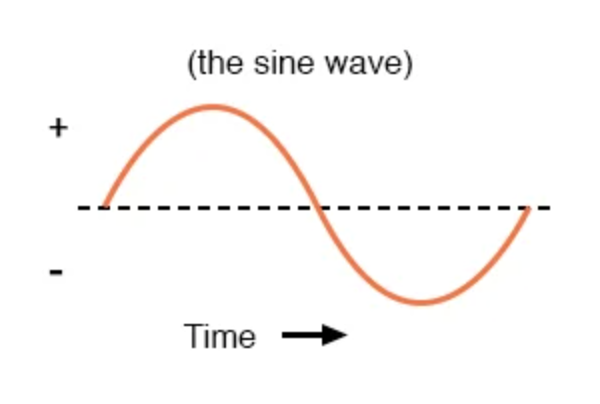
As I understand it, Information can be both permanent (eternal) and temporal (transitory). I illustrate that BothAnd notion by looking at Shannon's boiled-down basic Information, containing no specific meaning. It's defined as a string of 1s and 0s, something or nothing. I imagine that static dichotomy set in motion as an oscillation of spacetime (waveform) varying between [1] (maximum, and [-1] (minimum, with an average baseline of (0) no signal. Reality though, is a complex waveform, that contains the kind of Information that our senses interpret as Meaning (Mind, ideas), or as Thingness (physical objects).Certainly seems that information is fundamental. A key question is that is information transitory, permanent or a mixture of both? For anything to exist at all in the universe, it seems there must be permanent information associated with it - the first cause is permanent. What about spacetime though? Does it contain permanent information (eternalism) or transitory information (presentism)? It could also be something in-between like growing block theory - information is permanent once created. — Devans99
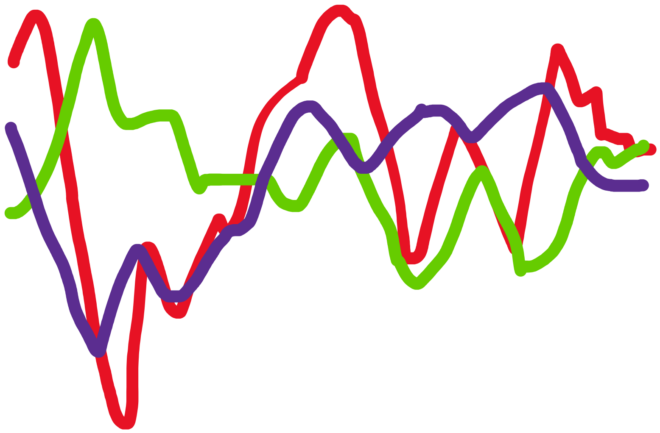
So the waveform of our universe defines an ontological continuum that varies from positive Reality (actual) to Nonexistence (nothingness) to negative Reality (potential). The positives & negatives describe physical-temporal existence that comes & goes : Life & Death; while the zeros describe a state equivalent to Timeless Eternity. In my thesis, I interpret the baseline nothingness as the normal state of Ontology (BEING), which is also the eternal state of Logos, the Enformer. An act of Creation (Enformation, Causation) causes the neutral state to transition into positive-but-transitory existence (real, actual, Energy), which soon dissipates into (unreal, potential, Entropy). I go further to imagine fast oscillations (lightspeed) as Energy, and slow oscillations as Matter.
I'm sure this Enformationism "explication" sounds speculative & far-out, but your question was also pretty unconventional, and called for conjecture. I feel sure a physicist (Paul Davies) could translate my analogies & metaphors into mathematical equations. But, this is about as far as my layman's interpretation of Information can go into essential Ontology. :nerd:
PS__I wouldn't recommend that you waste your time debating abstruse Ontological concepts, such as existence of God. You wouldn't convince anyone that you are right, and they won't respect your unconventional erudition.
ESSENTIAL WAVEFORM OF CREATION
COMPLEX WAVEFORM OF PHYSICAL EXISTENCE
-
God Almost Certainly Exists
Apparently you are not alone in your apathy toward a rationalized worldview. Most people on this and other forums prefer to express how they feel about a particular topic, than to present a logical argument, supported by specific pertinent evidence. Most people's belief systems are based on hand-me-down Faith, instead of personal Reason; hence prove to be narrow, incoherent, and inconsistent when probed by Socratic dialogue. They live in a "reality tunnel" of religion or ideology.I'm not much in to systematising philosophical positions; explication what you call a worldview. — Banno
I'm used to such wishy-washy worldviews on general forums. But it's disappointing on a philosophy forum. I suspect that such insipid thinking may be due to the recent teaching of Continental and Postmodern philosophies in universities. Those doctrines tend to be apathetic toward the "grand narratives" and discriminating definitions of Modernism, hallmarks of reason.
Personally, I would say that writing a reason-based blog allows one to "take a firm stand" rather than wallowing in the mud of mushy feelings & opinions.Nailing one's flag to a blog tends to set one's feet in mud... (that was dreadful!) — Banno
I like to do both : exploring and mapping the world, in order to navigate life with a clear up-to-date worldview. :smile:The fun for me is in the exploring, not in the mapping. — Banno
Worldview : One can think of a worldview as comprising a number of basic beliefs which are philosophically equivalent to the axioms of the worldview considered as a logical or consistent theory. These basic beliefs cannot, by definition, be proven (in the logical sense) within the worldview – precisely because they are axioms, and are typically argued from rather than argued for.[19] However their coherence can be explored philosophically and logically.
https://en.wikipedia.org/wiki/Worldview -
God Almost Certainly Exists
Yes. What happens here is philosophical dialogue. Many of us on this forum have no formal philosophical training, but are autodidacts. It's way of learning about other people's ideas on topics of interest. Did you think the OP was making a formal argument, or inviting a contentious debate? Are you learning anything new? :smile:As opposed to, say, what happens here? — Banno
Dialogue : As a narrative, philosophical or didactic device, it is chiefly associated in the West with the Socratic dialogue as developed by Plato, . . .
https://en.wikipedia.org/wiki/Dialogue
Debate : A debate is seldom a learning device, but merely two preachers pontificating to different choirs.
That's why I have put my personal scientific & philosophical worldview into the form of a non-academic thesis : Enformationism. I am not content to hold unscientific beliefs or emotional feelings on important matters.The discussions in these general forums rarely achieve any depth. — Banno
Since I am now retired, I have followed up that step-by-step exposition, supported with references and side notes, with topical essays on a variety of related subjects. The basic theory has been expanded in recent years, into a personal philosophy, on my Blog, and in a Forum. In my posts, I also offer suggested reading tips for further exploration. My original primitive views have evolved over the last 12 years.
So, if you want more "depth" on my briefly expressed opinions it is readily available on all digital media. Anyone who is interested in a different perspective on the god question, and many other topics, can continue this dialogue on the BothAnd Forum. :nerd:
Enformationism : http://enformationism.info/enformationism.info/
BothAnd Blog : http://bothandblog3.enformationism.info/page23.html
BothAnd Forum : http://enformationism.info/phpBB3/viewforum.php?f=3 -
God Almost Certainly Exists
No. That's why philosophical speculations on ultimate truths and causes are always couched in metaphors. Plato's Forms are not real things, but ideas that we can grasp by analogy. Professional philosophers would be out of a job, if your assertion was true. Even hard-nosed scientists speculate on ideas without hard evidence (e.g. Dark Matter), and their theories are presented in metaphorical language : Dark Matter is like . . .This is because our language has nothing to grasp, nothing to work with. The best we can do is silence. — Banno -
God Almost Certainly Exists
Debates only decide who's boss, not who's correct. Besides, the opposing opinions in this thread are using different criteria : scientific empirical vs rational theoretical. God is not an empirical fact, but a theoretical opinion. Note that the OP says "almost certainly". So, we could debate until the gods come home, and never reach a final truth.I would be happy to enter into a formal debate with anyone who is willing to defend the argument in the OP. — Banno
That's why we are merely sharing various opinions on the God topic, not trying to convert unbelievers. We are also using primarily inductive (scientific) reasoning, not deduction from scriptural authorities. Yet, as Hume noted, the Inductive process is open-ended. So, speaking for myself, I don't take my "probable" opinions on faith, but merely as steps to get closer to Truth. :cool:
Induction - closer to truth : the truth of the conclusion of an inductive argument is probable, based upon the evidence given.
https://en.wikipedia.org/wiki/Inductive_reasoning
Hume on Causation : since empirical evidence if always partial and incomplete, he advised skepticism toward provisional scientific "facts".
https://www.iep.utm.edu/hume-cau/#H5
Closer to Truth : https://www.closertotruth.com/

Gnomon

Start FollowingSend a Message
- Other sites we like
- Social media
- Terms of Service
- Sign In
- Created with PlushForums
- © 2026 The Philosophy Forum