
Comments
-
Qualia and Quantum Mechanics, The Sequel
FWIW, here's a link to the book review on my blog : http://bothandblog6.enformationism.info/page21.htmlI'm currently working on a book review of Donald Hoffman's, The Case Against Reality, which makes a similar attempt to explain human consciousness in a manner that takes the paradoxes and abnormalities of Quantum Theory to be natural and normal. He doesn't deny Reality, but merely presents a model to help us make sense of why Consciousness doesn't seem to fit into our current understanding of physical Nature. — Gnomon -
Mathematicist Genesis
I wasn't referring to the Logicism of Analytic philosophy, but to the Greek notion that there is some absolute Truth, equivalent to Ideal Proportions, which can be expressed mathematically in ratios. I don't know how that might apply to your forum game, except to serve as an ideal goal, approachable but never attainable --- I.e. asymptotic to infinity. It's a barrier, but it also leaves a lot of room for experimentation.Logicism failed, but set theory is nevertheless the foundations of contemporary mathematics. That's not identical with logicism. — Pfhorrest
PS___Sorry to butt-in with irrelevant comments. But I had been thinking about the relationship of Logic to Math. My personal pragmatic definition of philosophical Logic has been "mathematics with words". Which means that it is less pure & abstract & absolute. So, maybe the Greek Logos was actually referring to the mathematics of Proportion (e.g. positive vs negative; good vs evil), and its association with human language is secondary. I'll leave you alone now. :yikes: -
Mathematicist Genesis
I'm afraid I won't be of much help in developing the detailed aspects of your game. Russell and Whitehead began their Universe of Discourse with Set Theory as the foundation of Logic, but ended-up running into the impassible boundary (incompleteness theorem) of space-time limitations.To begin with, there is the empty set, and the empty set is without contents and void. — Pfhorrest
So, in the interest of surpassing that inherent constraint on human reasoning, I'd recommend starting with something that transcends the actual Universe, such as the Greek notion of LOGOS. Of course, our knowledge of Logos is limited to imaginary abstractions such as the concepts of Eternity and Infinity. But, at least, the game will acknowledge that the game-board has its limitations. So that all moves will be <= ထ. :nerd: -
Human Nature : Essentialism
See my response to Mapping the Medium.In my view, many intuitions about soul will most likely have some kind of scientifically derived validity, or else where would the pervasiveness of these ideas have come from in the first place? — Enrique
Yes. In the infancy of humanity, the concept of an immaterial Soul was a serious philosophical explanation for both Animation and for Action-at-a-Distance. But the task for modern philosophy is to reconcile those ancient rationalizations with the empirical evidence uncovered by Science. Which is exactly why I have developed the Enformationism thesis.We've had satisfying ideals for millennia! — Enrique
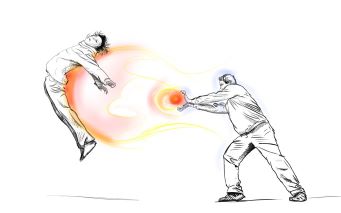
For example the notion of invisible causal Spirit/Chi/Prana is what we now know as Energy. But some of the imaginary effects of spirit/energy --- such as martial arts masters "throwing" Chi --- are now seen as adolescent fantasies : super-hero powers. It works like magic in stories, but when's the last time you actually saw someone in your presence knocked-down without touching?
-
Human Nature : Essentialism
Thoughts, presented in Enformationism terms, inspired by your comments :If our 'self', through brain development, is a combination of 'some things old, some things new', mentally and physically, and consciousness is not a material aspect of that, it seems logical that the immaterial portion of the contributions (that which is 'experienced' through interaction with otherness) would revert to being immaterial when the 'material' is sloughed off. — Mapping the Medium
That reasoning is how ancient people constructed the notion of an immortal Soul, as distinct from the mortal body. But, although Consciousness is essential to the Soul/Self, it is not a thing but a process. It's not made of matter or stuff. Instead, Consciousness is a product of Information Processing. Mind is what the brain does.
Although Information can occur in both physical and metaphysical (mental) forms, it is not a material object, but the power to cause change. We are most familiar with that aspect of Information in the form of Energy. In humans, information-processing extracts self-relevant meaning from various changes in the environment. That influx of meaning (significance) is what we call "consciousness". And Self-consciousness is the essence of human nature : your persona.
Since Consciousness is a process, it can start and stop. When Consciousness stops, the Self/Soul dis-organizes, and the body dies. But the energy (EnFormAction) is always conserved. It continues to flow through the world. So, you could say that the Information that formed the Self/Soul re-enters the main stream of EnFormAction (G*D-Mind in action). Like a drop in the ocean, it is no longer a distinct object.
The Form of your Self/Soul is equivalent to the meaningful data in a computer. It's mathematical or personal relationships, not physical stuff. So, just as the geometrical relationship of three dots continues to exist (in potential) after the dots are erased, your personal Form-data may remain in G*D-Mind after its incarnation is deceased. But it lacks the space-time instance that made it a self-referencing Subject in the first place.
After-thoughts : Unfortunately, while the concept of an immaterial Soul is reasonable, most people still think of it in material terms. For example, ghosts are imagined as a person whose body is now transparent ectoplasm instead of red meat. Dead loved-ones are imagined as-if they are still living in another space-time location (heaven or parallel world). Mediums talk to the dead via mental telegraphy instead of sound waves. But such mind-mind communication of information is notoriously imperfect. Although no wires are involved, and distance should not be a problem, mind-readers and mediums seem to struggle with a lot of noise & static & entropy. Which is why Claude Shannon developed his theory of Information. You would think that by eliminating the physical constraints of communication, we wouldn't have to say, "can you hear me now?" So, I remain skeptical about our ability to communicate directly from Consciousness to Consciousness, without a physical substrate to act on the material world.
Information : http://blog-glossary.enformationism.info/page11.html
G*D-Mind : refers to some sort of universal meta-physical source (mind-field) of Information/Energy/Meaning that we know only by reasoning from our experience with the physical world. Not a localized persona, but a general Cause of all change, including the difference-that-makes-a-difference known as "Information". -
Qualia and Quantum Mechanics, The Sequel
The notion that quantum queerness has something to do with the "hard problem" of Consciousness has recently become almost mainstream in Science. But too many of those "bizarre" theories --- such as Penrose's microtubules --- are still stuck in a Newtonian worldview of Gear-like Mechanisms & Kinetic Energy & Cartesian Locality. But a few researchers in quantum physics and consciousness are beginning to cross the forbidden zone into areas that used to be reserved for pseudo-scientific Paranormal studies. The difference is like Steam-Punk versus Star Trek.my new favorite quack topic, quantum consciousness — Enrique
The common concept in both New Age philosophies and Quantum Consciousness is a worldview that used to be called "Panpsychism". I have been cautiously exploring this mysterious realm --- beyond mundane space-time and physical cause & effect --- while trying to avoid being sucked-in to the charming deceptions of magical thinking. Magic is the ancient science of gaining control over nature by appealing to gods & spirits & animated forces to intervene on your behalf. But, in effect, it merely gives the magician power over the mind of the postulant.
So, I have developed a personal worldview that carefully treads the tight-rope between materialistic Science and spiritualistic Religion. In that thesis, the role of supernatural spiritual forces is played by mundane Information : the functional contents of minds & computers, and the mathematical mechanism of Energy & Force. That's why I call my philosophical cosmology, Enformationism.
In order to make sense of such quantum paradoxes as "non-locality", I have had to accept the ancient notion of Infinity, where spatial coordinates do not apply. Then to understand "quantum leaps" and "supra-luminal" trans-location, I turned to the concept of Eternity, where linear Time has no bearing. Hence, metaphysical Infinity-Eternity is "primary" over physical Space-Time.The consistent violation of Newtonian physics . . . . suggests that the most accurate theoretical paradigm is one regarding the properties of non-locality in substance as primary. — Enrique
Although our senses are adapted to the negative direction of evolution, that we call Entropy, our sixth sense of Reason causes us to look for an explanation for the pockets of positive evolution that produced Life & Mind. My preferred term for what scientists call "Negentropy" is Enformy, which is defined in a manner that fits neatly into my general worldview of Enformationism.its entropic properties on an earthbound scale, which our sense organs have been evolutionarily adapted to find almost reflexively intuitive. — Enrique
In order to explain the positive effects of apparently random evolution, I have developed a theory of Phase Changes caused by the positive energy of Entropy.phase changes — Enrique
The quantum-field-like substance of Causality is what I call EnFormAction. But it is conceived as entirely Normal & Natural, and amenable to scientific investigation. Yet, to philosophers and scientists with a Newtonian bias, and a Materialistic worldview, Enformationism sounds like a slippery-slope to Spiritualism and Paranormal forces.and the mind taps into this more pervading, quantum-like substrate of causality as it perceives, experiences and is affected by the so-called paranormal. — Enrique
I'm currently working on a book review of Donald Hoffman's, The Case Against Reality, which makes a similar attempt to explain human consciousness in a manner that takes the paradoxes and abnormalities of Quantum Theory to be natural and normal. He doesn't deny Reality, but merely presents a model to help us make sense of why Consciousness doesn't seem to fit into our current understanding of physical Nature.
Sure it does. Follow the paradoxical rabbit down the black-hole into Enformation Wonderland. :nerd:It don't get any bizarrer than that! — Enrique
Enformationism : http://blog-glossary.enformationism.info/page8.html
Enformy : http://blog-glossary.enformationism.info/page8.html
EnFormAction : http://blog-glossary.enformationism.info/page8.html
Phase Changes : http://bothandblog3.enformationism.info/page23.html -
Are we hardwired in our philosophy?
You are probably correct that we tend to end-up near where we started out. The acorn doesn't fall far from the tree. But it's in the details where we make personal choices. My general worldview seems to fall somewhere in between the philosophical positions of my parents --- neither were extremists, but neither of whom showed any interest in philosophical dialogue. Yet they would both be disappointed in my current religious posture, for different reasons. So, their influence on my religion was not enough to cause me to choose one side or the other : liberal protestant or conservative protestant. Instead, I choose to opt out of religion altogether, even though I assume that there is some creative force behind the natural world of the senses.So your choice of philosophers doesn’t seem to be so much a choice as finding yourself in a comfort zone. — Brett
From that compromising BothAnd position --- neither Heaven's Gate nor Hell's A**hole --- I can have it both ways : pragmatically natural, but also somewhat spiritual. While the world-ship is being chaotically rocked from port to starboard by left/right extremists, my stable position amidships*1 is the most comfortable place for my placid introverted nature. Yet that stress-free position also seems to be the most reasonable, as recommended by philosophers and religious founders throughout the ages. So, my instinctive comfort zone is also my reasoned choice. And I act as-if that was an unforced judgment --- a free choice.
*1 Extremists would call it the coward's refuge instead of a rational position.
*2 Paradox of FreeWill : http://bothandblog5.enformationism.info/page13.html -
Are we hardwired in our philosophy?
Probably both. It's the old Nature vs Nurture conundrum. I have seen many scientific observations which imply that our basic physicality and personality are pre-set by our inherited genes : Genetic Determinism. But I've also seen some studies indicating that the "accident" of Caesarean birth makes a noticeable difference in a baby's personality (e.g. calm vs anxious), due in part to differential effects on the immune system. And natural left-handers can be taught to become right-handers. So, we are obviously not born with a blank slate, but with a basic operating system that affects all subsequent development. Some behaviors, like duckling imprinting, seem to be hardwired. But other behaviors and preferences, especially in humans, are affected by experience and learning in a specific environment.I was wondering how we find the philosophers or philosophy we engage with? Are we choosing it or are we hardwired? — Brett
So, by the time we reach adulthood, our basic philosophical worldviews are mostly settled. After that, we merely try to work-out the few paradoxes and contradictions that remain unresolved after hardwiring and experience have established the foundation. That "working out" is what we call Philosophy. Even the most open-minded philosophers will have a hard time seeing their innate bias though. Yet, as long as we are aware of the pitfalls of prejudice we can work around our blind-spots. For example, those common logic traps have been marked like a mine-field by our predecessors in the form of philosophical Fallacies, Therefore, with personal resolve and some guru guidance, we can expand the boundaries of genetics and culture enough to make reasoned choices of our own. But of course, some are more successful than others at navigating the mine-field of fallacy.
My genetic setting seems to be of the calm, optimistic type (liberal). Yet it is also easily distressed by disorder (conservative). My mother was a laissez faire child-raiser, but my father was more authoritarian, and my religion taught me to be a good person, yet anxious about my eternal destiny. As a result of all these conflicting external influences on my hardwired nature, I now tend to both instinctively and deliberately choose philosophers and philosophies that fall somewhere in the moderate middle, between conservative duty and liberal opportunity. Is that "free" choice illusory, or effective, or a cop-out? Who knows? But my choices are what makes me, me. :cool: -
Human Nature : Essentialism
Most philosophical and religious traditions assume that each human individual has a unique essence (a Soul) that defines him and distinguishes him from other humans and animals. Opinions on the exact nature of that essence are various though. For example, the Buddha referred to the notion of "I" and "me" as an illusion. He didn't deny that we have a self-image, only that it is an actual thing. Instead, it is a personal & cultural belief, an image of something immaterial, that in Western traditions is envisioned as some eternal unchanging invisible substance like a ghost made of supernatural ectoplasm.But that's not the kind of analysis of Essentialism I was looking for. So, my search continues. — Gnomon
For the Buddha to call the Self-image an "illusion", was merely to disparage its role in human suffering. But in Evolution, the emergence of a self-image also gave humans the power to change their environment to suit their personal desires. The Soul represents me as an agent with power over nature, like a little god. But, as the Buddha observed pessimistically, that power is a two-edged sword. If we desire to be warm in winter, we can make fire to ward-off the suffering of cold weather. But that same useful tool can cause the suffering of too much heat, if it gets out of control. Nevertheless, it's a two-sided coin that can be biased by optimism to land on the bright side of desires fulfilled, thereby allowing us to persevere despite setbacks.
I doubt that anyone can deny that humans, and some animals, have a self-image. As demonstrated by Descartes, my reasoning Self is the only thing I know for sure. But, is it a will'o'wisp of fleeting imagination, or something more durable that can survive death? Is the Soul a gift of God, or of Evolution? Is it a spark of divinity, or merely a tool for genetic survival? These are some of the Essential questions that I was looking for insight on. -
Human Nature : Essentialism
I assume we make an exception to the rule of binary genders for people like Ellen, because we realize they are not talking about objective morphology, but about subjective emotions and psychological self-image. When Americans see an Asian looking person, they may assume their religion is Buddhism. But that's simply an example of racial/cultural ignorance and prejudice, because religious beliefs are not limited by physical morphology. Likewise, gender identity is a belief, not a physical fact.the reasons that they aren't what they say they are is their morphology and the behaviors that go along with that morphology, then why do we make an exception for one's sex? — Harry Hindu
If I meet a person who claims to be a Martian Priestess of Barsoom, the PC thing to do would be to welcome the priestess to our little pale blue dot, without criticizing her idiotic illusion. But, if we get into a philosophical discussion of Barsoomian theology --- which involves a trinity of genders --- a frank, but respectful, critique might be appropriate. :smile: -
Human Nature : Essentialism
Biological science does indeed assume two fundamental genders. But it also has found genes that don't fit neatly into the simple binary assumption. Besides, Social science has documented a wide range of cultural attitudes toward gender roles. And the science of Ethology has found that the boundaries of animal gender roles are flexible. Moreover, academic Ethical studies of animal behavior have applied human political values to non-humans, with the usual room for savage debates.Not science, politics. I already showed that science proves that two genders are the biological realities. — Harry Hindu
For most practical purposes, I assume that the human essence is either male or female. But when politics and human rights get involved, I must be more flexible to be fair. Is TV host/hostess Ellen male or female? I can only say that she/he is whatever she/he says she/he is. Whew! Political correctness is confusing for us simple-minded folks. :cool:
Male or Female? : http://newsroom.ucla.edu/stories/male-or-female
Scientific Study of Animal Behavior : https://en.wikipedia.org/wiki/Ethology
Ethical Animal Studies :https://en.wikipedia.org/wiki/Animal_studies -
Human Nature : EssentialismBerllinksi is allied with (actually a senior fellow of) the Discovery Institute which is the central ID organisation in the states so his disavowal of ID seems disingenuous. — Wayfarer
As I said before, Berlinski seems to be a contrarian by nature --- it's the essence of his personality. In the book, he describes his younger self as a "high-school bully" --- probably because he was smarter than the other kids. In an interview by Evolution News --- a Discovery Institute publication --- he was challenged to share his "hunches and suspicions about spiritual reality". His response was "No. Either I cannot, or I will not." So I suppose, as a teacher of Logic, he is confused or agnostic about such non-logical multi-valued issues.Options — Gnomon
I also assume that his reasons for criticizing of materialistic evolution theory is similar to mine : no place for Qualia. But, I don't know for sure, because he never articulated his view beyond accusing evo proponents of being "corrupted by a partisan, a political agenda, and so do not count as truths at all". Apparently acceptance or rejection of the concept of progressive evolution is "a matter mostly of taste." But that's not the kind of analysis of Essentialism I was looking for. So, my search continues. -
Human Nature : Essentialism
Yes. Years ago I intuitively realized that the evolving world seemed to be directed by some kind of "active agency", rather than by random accidents. Yet the biblical myth of creation was a bit too naive & archaic to reconcile with modern knowledge. However, materialistic Science has no answer to philosophical Qualia questions. So I looked to the notions of Formal & Final Causality to fill-in the blanks.Philosophically, a lot of the problems arise from the rejection of formal and final causality at the beginning of early modern science, and the attribution of active agency to matter. There’s your materialist program in a nutshell. — Wayfarer
Since I had long ago lost faith in biblical inerrancy, I have pieced together a modern Evolution Myth of my own, based on our current knowledge of the central causal role of Physical/Meta-physical Information in the world. Enformationism is a consilience of ancient Intuition and modern Science, of both Physics and Metaphysics, of both Creation and Evolution. That BothAnd philosophy is guaranteed to offend extremists on both sides of the Science vs Religion divide. :smile:
Active Agency : EnFormAction --- http://bothandblog2.enformationism.info/page29.html -
Human Nature : Essentialism
If you are talking about the "essence" of a human person in the sense of a distinctive Self or Soul, I suspect that Berlinski would disagree. But since he didn't attempt to define his own notion of Essence in philosophical terms, I can only guess what his position is from his troll-like put-downs of Darwinists, rather than positive assertions. That's my main disappointment with the book. I was looking for an intuitive understanding of where he would draw the line between one essence and another, not a mathematical exposition.*1Individual essence is also problematic, because again - it would entail there being a set of necessary and sufficient properties for being that individual. There is no such set. — Relativist
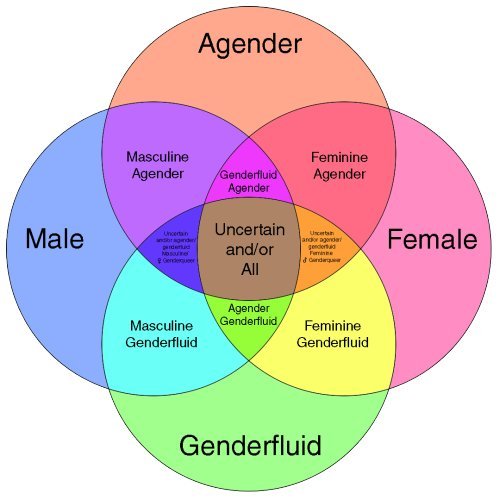
For example, he discusses Quantitative mathematical Set Theory to define what's wrong with the Qualitative biological Species theory, and the annoying "politically-correct" rainbow gender categories of LGBTQ. His counter-argument was so technical that I failed to follow the implications. I suppose he would describe his two-value gender range as "scientific", and dismiss multi-value Queer categories as political Neo-Marxism, rather than democratic fairness.
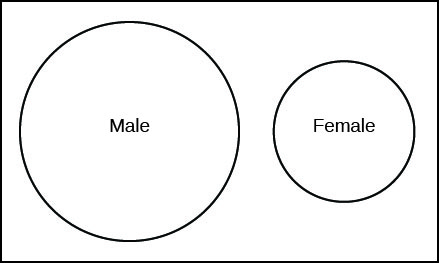
I could better follow his oblique references to Venn diagrams, but again he seems to limit the real-world options to Either/Or; ignoring the human tendency to make finer-grained distinctions based on both rational analysis, and personal feelings. Where would Ockham draw the line? :shade:
CONFUSING GENDER DIAGRAMS, after science and politics got involved
SIMPLE TRADITIONAL GENDER CATEGORIES, back in the golden age
*1 Berlinski sometimes seems to be more interested in demonstrating his genius than in communicating to a general audience. For example, he adds some short addendum chapters entirely in foreign languages. And seems to think the fact that he lives in Paris makes him a more genuine intellectual than his American roots would indicate. -
Human Nature : Essentialism
Apparently, Berlinski believes that mainstream biologists are biased in favor of atheistic interpretations of the genetic evidence. Hence, not to be trusted. But, since he claims to be a non-theist, it's hard to see how he arrives at his non-Darwinian rendition, which he supports mostly by criticizing the opposition.Genetic arguments for human nature are philosophically neutral in regards to categories in the relevant philosophical sense. — Walter B
I personally, have a non-theist, non-accidental understanding of biological evolution, but it's not the neither fish-nor-fowl [neither-theist-nor-atheist] view of Berlinski. It's based on the positive evidence of progressive enformation.
Enformation : noun - The creative power of Evolution; the power to enform; Logos; Change. -
Human Nature : Essentialism
I'm reading the book, Human Nature, in order to get a different perspective on Essentialism from the usual Darwinian concept of continuous evolution, and emerging species. Berlinski is an academic intellectual, and a secular Jew, not a religious fundamentalist --- even though he works with the Discovery Institute, a fundamentalist Protestant think tank known for its publishing of Intelligent Design arguments. He supports his critiques with long strings of mathematical logical symbolism, and technical language not appropriate for general audiences.Do you like Berlinski's book? How good are his criticisms of Chomsky, Pinker and the rest? — Walter B
Berlinski claims that he does not support the theory of Intelligent Design. But he is famous for attacking the theory of random Evolution (which I also have a problem with). Specifically, in this book he attacks, not specifically atheists, but anyone who is optimistic about positive human evolution. He seems to accept the Genesis notion of "fixed kinds", although he apparently does not accept its divine authority. In general, Berlinski has no use for religion, but he seems to be a contrarian by nature. So he objects to the tone of certainty in the writings of evolutionists -- but not to the Bible-bias of Intelligent Design proponents.
His criticisms of evolutionary optimists are very detailed, but mostly boil down to "I see no evidence to support the notion of evolutionary progress". As a writer on arcane mathematical topics, he feels confident that his negative interpretation of Pinker's statistical evidence is rational & scientific, while Pinker's optimism is emotional and pseudo-scientific --- based on a prior commitment to an atheistic Darwinian worldview. I'm not a strict atheistic Darwinist, but I'm also not a theistic Intelligent Design defender. Instead, I have developed my own worldview that is somewhere in the Aristotelian mean between extreme positions. So, I enjoyed reading Berlinski's exposition of one extreme view, but my cautiously optimistic position is closer to that of Pinker. -
Human Nature : EssentialismI'm still reading the book by David Berlinsky, Human Nature, so I've come to realize that he's not primarily concerned with most of the sex/gender topics discussed in this thread. Instead, he wrote a series of essays criticizing the implicit worldviews of several prominent writers on Scientific/Progressive interpretations of Human Nature in past and future history. The list includes Steven Pinker, Yuval Hariri, and Noam Chomsky, among others.
For example, his first direct attack is on Pinker's, The Better Angels of Our Nature, which found historical evidence that human-on-human violence has declined since the Enlightenment Era, when humans began to rely more on human Reason than super-human Revelation to establish moral boundaries. Both writers are secular Jews, but one is a social scientist, and the other a philosopher/mathematician. Yet, Berlinski ridicules Pinker's copious research and his interpretation of statistical trends. Pinker's reading of the numerical tea leaves is optimistic, in the sense that evolution is heading in a positive direction, while Berlinski's translation of the arcane numbers is just the opposite : "Things could not be getting better, gentler, or kinder, because they are not changing at all." That seems to assume the doctrine of Original Sin. which is ironic for a secular Jew.
Berlinski's negative bias also seems to be the opinion of religious Fundamentalists, who are expecting the imminent annihilation of a sinful world. In other words, the world started at the apex of perfection, and has gone downhill from there. By contrast, Pinker and his lot see the slope going uphill, from vicious amoral ancestors toward a better breed (maybe even AI or robots) that have learned from their mistakes. So one writer views Human Nature as inherently bad and worthy of global genocide, while the other sees innate imperfections, but also potential for improvement via Reason rather than by destruction of this failed experiment, and a do-over in a New World.
Humans can't seem to agree on Human Nature : are we essentially Bad, or essentially Good, or a bit of both? My wishy-washy worldview (BothAnd) agrees with the latter. Nobody is forced by human nature to "break bad", nor to sprout wings of angels. Instead, we are like pioneers blazing a trail into the wilderness, and making life-or-death choices without knowing what paradise or desert lies over the next mountain. But are our choices made freely, or by destiny? :chin: -
Human Nature : Essentialism
Good point. The argument between Conservatives (religious & political) and Progressives seems to be about the scientific deconstruction of what one side views as a proper & fitting Natural Hierarchy, not just of sexes, but of species and various other demarcations of reasonable categories. The conservative side seems to prefer simple authoritative distinctions (special creation), while progressives prefer some leeway to interpret those classifications as they see fit. That may be why, as I said in the OP, my brief online review turned-up far more objections to the concept of continual evolution from a conservative perspective.Darwin didn't dispose of the idea of two sexes, nor did he blur the line between species in general. His theory blurred the line between man and nature - taking humans from their place as special creations of God and firmly placing them in the natural world. — Harry Hindu
[note : I'm neither conservative nor liberal, but a bit of both. So, I'm trying to see where & why extremists draw their true/false, good/bad lines.]
Of course, that evaluation depends on your personal perspective. Right & Wrong are human moralistic categories. The moral authority of Nature is a rhetorical tactic labeled by philosophers as the Naturalistic Fallacy. And it is opposed to the Super-naturalistic Fallacy of monotheism. Nature-in-general is amoral, but Natural Selection seems to have an agenda of some kind. Pros and Cons can argue endlessly about what that the selective criteria might be : local adaptive efficiency or a teleological purpose, etc.This is just wrong. — Harry Hindu
Ironically, that's exactly why anti-evolutionists look to a divine creator to explain such rational (as opposed to random) organization. :smile:Under this scenario, we wouldn’t expect to see species falling into a nested hierarchy of forms that is recognized by all biologists. — Jerry Coyne - Why Evolution is True -
Human Nature : Essentialism
Actually, Google is all-knowing. What would you like to know?What can be said to one who is all-knowing? — Wayfarer
What would you like to say? I'm listening. :smile: -
Human Nature : Essentialism
I'm not a Spiritualist in the sense you intend. Instead, I am an Enformationist, in the sense that reality is not haunted by spooky spirits, but caused & motivated by the natural power to enform (commonly known as energy). From my perspective, the "natural or spiritual laws that apply to human beings" are all various forms of Information, which is the fundamental force & substance of the universe.I am not in the habit of discussing human nature with spiritualists, but I suppose that if you believe that human nature exists, you can describe a series of natural or spiritual laws that apply to human beings. Can you give an example? Even if it's from Aristotle. — David Mo
Information = Energy = Matter : One of the more radical theories suggests that information is the most basic element of the cosmos.
https://bigthink.com/philip-perry/the-basis-of-the-universe-may-not-be-energy-or-matter-but-information
Information : Knowledge and the ability to know. Technically, it's the ratio of order to disorder, of positive to negative, of knowledge to ignorance. It's measured in degrees of uncertainty. Those ratios are also called "differences". So Gregory Bateson* defined Information as "the difference that makes a difference". The latter distinction refers to "value" or "meaning". Babbage called his prototype computer a "difference engine". Difference is the cause or agent of Change. In Physics it’s called "Thermodynamics" or "Energy". In Sociology it’s called "Conflict".
http://blog-glossary.enformationism.info/page11.html -
Human Nature : Essentialism
Aristotle asserted that physical objects are compounds of Matter and Form. My understanding is that he was making a distinction between the physical properties that our senses detect, and the metaphysical properties (the design pattern) that are known via our extra sense of Reason. That kind of dualistic either/or analysis is amenable to my BothAnd philosophy. But the BA principle is ultimately monistic, because it unites space-time Physics and Metaphysics into a single eternal principle : the creative power to enform, to create --- which I call EnFormAction.I don’t think you comprehend hylomorphic dualism — Wayfarer
So, my worldview agrees with Aristotle that what we perceive with the physical senses is Matter, and what we conceive with metaphysical Reason is Form (information; essence). Matter is the unique substance of individual things, but Form is the common substance of all things (EnFormAction). This is similar to Einstein's equation of tangible Matter (stuff) with intangible Energy (causation).
So, when I said, "even matter is a form of Plato's timeless Forms", I was agreeing with Aristotle's hylomorphic analysis, while adding my own synthesis of space-time Dualism into eternal-infinite Monism.
Hylomorphism : A thing’s form is its definition or essence—what it is to be a human being, for example.
https://plato.stanford.edu/entries/form-matter/
Forms : Platonic Forms are Archetypes : the original pattern or model of which all things of the same type are representations or copies. Eternal metaphysical Forms are distinguished from temporal physical Things. These perfect models are like imaginary designs from which real Things can be built.
http://blog-glossary.enformationism.info/page13.html
EnFormAction : Metaphorically, it's the Will-power of G*D, which is the First Cause of everything in creation. Aquinas called the Omnipotence of God the "Primary Cause", so EFA is the general cause of every-thing in the world. Energy, Matter, Gravity, Life, Mind are secondary creative causes, each with limited application.
http://blog-glossary.enformationism.info/page8.html
BothAnd Principle : The Enformationism worldview entails the principles of Complementarity, Reciprocity & Holism, which are necessary to offset the negative effects of Fragmentation, Isolation & Reductionism. Analysis into parts is necessary for knowledge of the mechanics of the world, but synthesis of those parts into a whole system is required for the wisdom to integrate the self into the larger system. In a philosophical sense, all opposites in this world (e.g. space/time, good/evil) are ultimately reconciled in Enfernity (eternity & infinity).
http://blog-glossary.enformationism.info/page10.html -
Human Nature : Essentialism
That's also why I am a Deist. All religions of the world are based on philosophical attempts to explain both the regularities and the vagaries of Nature, of Reality. Typically, pre-scientific societies took the predictable aspects of nature for granted. But the unpredictable or disorderly behaviors of nature were attributed to magical beings (gods, principalities), who as haughty nobles of the imaginary spiritual realm, were easily offended by insignificant inferior humans who were disrespectful of their power and position.I'm not an atheist, I think all beings have a spiritual nature, but I'm also a critical thinker, and all public accounting for this spirituality has thus far been at its best respectably inadequate to explain the reality, and at its worst employed as malicious deception, in science, philosophy and elsewhere. — Enrique
Unfortunately, their notion of spirituality was tainted by fear of those invisible magicians, who could, for no apparent reason, punish humans who were insufficiently slavish and sycophantic. So, while they expressed their common spirituality toward equals as morality, toward their betters they prostrated their unworthy selves in worship, just as they would suck-up to their human kings who were above the law of morality. Their attempts to explain natural processes in terms of magical spirituality made allowances for divine deception (maya) and for priests who felt licensed to use magic tricks of their own to keep the masses in a state of fearful awe. That is the tradition of authoritarian religion that Deists rejected, as they turned to human science instead of divine revelation for understanding of mundane reality, including its spiritual aspects that I call "Metaphysics" to contrast with mundane Physics.
Metaphysics : http://blog-glossary.enformationism.info/page14.html
That is also the inclination of Deism, which is not a religion, but a philosophical attitude toward spirituality (metaphysics), which was ignored by materialistic scientists.My opinion is that we should in general incline towards basing culture on human agreement by way of reasoned collaboration rather than dictatorial authority. — Enrique
Yes. Skepticism is necessary for any philosopher who wants to avoid being deceived by the smoke & mirrors of religions. And Science is the best method we have developed for understanding physical reality. But it has never been able to replace Religion as the source of information on metaphysical reality.I think scientific skepticism is the foundation for furthering human quality of life by way of strategic theoretical and technological progress, — Enrique
My Enformationism thesis is, as you say, a thought experiment intended to inform my personal worldview as a replacement for the religion of my youth. It attempts to avoid the magical obfuscation of occult mythology, and instead find a more accessible understanding of how the world works on both physical and metaphysical levels. Unfortunately, it is counter-intuitive for both materialistic scientists and religious mystics. So, I have found that philosophers are more amenable to metaphysics, and more likely to grasp the common ground of Enformation as the universal "substance" of the real world, that bridges the gap between Mind & Matter, Soul & Body, Religion & Science.regard your philosophy as a cool thought experiment, — Enrique
Enformation : 1. When spelled with an “I”, Information is a noun, referring to data & things. When spelled with an “E”, Enformation is a verb, referring to energy and processes.
2. the Enformationism thesis . . . says that mental Information is the new fundamental principle of science, and the key to a new/old way of thinking about reality.
http://bothandblog5.enformationism.info/page36.html -
Human Nature : Essentialism
I knew that Aristotle had some vague concept of a Soul, but was not aware of the term "active intellect" or "agent intellect". I can see that these terms could be referring to some human essence, which distinguishes us from animals, but may not imply an immortal soul in the Christian sense.I think the most famous example is Aristotle’s passage on the active intellect. It is as the article notes, a debated passage, but contains many aspects of Aristotle’s hylomorphic (matter-form) dualism - for which read this brief blog post. — Wayfarer
"EVERYTHING in the cosmic universe is composed of matter and form." ___Aquinas
Aquinas more specifically equates the essence of human nature with the immortal Soul. But I go a step further, to assert that even matter is a form of Plato's timeless Forms, So I could say that everything in the universe is composed of "Information", which I define as the creative power to Enform, (aka EnFormAction).
EnFormAction : As the holistic expression of the human Self (Soul), it is the essence or pattern that defines you as a person
Note : If you find this definition hard to imagine, just remember how the Star Trek Transporter read the information (data describing a person's mind & body) into a pattern of bits that could be transmitted to another location. -
Human Nature : Essentialism
So you're saying that the regularities of Nature, that Science depends on, are not universal laws, but merely conditional habits? I suspect that position is derived from rejection of the concept of a lawmaker. The difference between a "law" and a "habit" is that laws are imposed from above, while habits are accidental due to local conditions. "Norms" are imposed values rather than free choices. That's why the early scientists labeled their observed consistencies in physics with a term that implied a moral right/wrong distinction mandated by an absolute ruler. "Habits" are regular tendencies that have no moral justification. So a habitual world would be amoral, with no clear good or bad, no right or wrong. In that case, every man (or particle of matter) is a law unto himself.I don't think we can consider natural phenomena "normative principles", but rather accidents of local conditions — Enrique
Normative Law : In law, as an academic discipline, the term "normative" is used to describe the way something ought to be done according to a value position.
https://en.wikipedia.org/wiki/Normative
If "principles do not obtain" in Nature, it's because there is no "prince", no ultimate authority. So cultural laws are the only rules that do obtain. That is the Atheist/Humanist position. And it's also half of my own BothAnd position. The other side of my consilient morality is the understanding that Natural Laws (not habits) were ruling the world for eons before humans came along. The eventual emergence of Life and Mind are due, either to the harmonious organizing principles of Nature, or to the erratic accidents of randomness. I view Natural Selection as an imposed set of values on physical evolution, and Cultural Selection is the application of human values to meta-physical evolution.But radical skepticism is refutable because all the life forms on this planet are related and adapted to a relatively similar environment. Metaphysical principles do not obtain, but we're still all in this together. — Enrique
BothAnd Principle : http://blog-glossary.enformationism.info/page10.html
Meta-physical : mental phenomena as contrasted to physical
http://blog-glossary.enformationism.info/page14.html
Yes. If Evolution was dependent on randomness alone, there would be no values, and no progress, no reason. But the addition of Natural Selection (choices based on fitness criteria) converts random change to directional change. I view that as a sign of Rationality in the evolutionary process. So Evolution is characterized by both Freedom and Fate; both Law and Autonomy.Rationality creates values — Enrique
Selection : adj. -- chosen in preference to another or others; selected. choice; of special value or excellence. careful or fastidious in selecting; discriminating. carefully or fastidiously chosen; exclusive
https://www.dictionary.com/browse/select
Your post is in agreement with half of my view, but this post is a clarification of the other half. Specifically, my worldview is deistic, in that the world is being created via evolution, but without divine intervention in the process.Should add that I doubt this is really in contradiction to your basic view, merely a clarification. — Enrique -
Human Nature : Essentialism
Please give me a reference to one of those examples. I'm not concerned with the religious implications; just the philosophical reasoning.There are plenty of examples. — Wayfarer
Actually, I view the limits to human reasoning as a feature, not a design defect, or a malfunction. The experiment in space-time & uncertainty would be pointless if humans were eternal omniscient gods.That would roughly correspond to the Doctrine of the Fall, then. — Wayfarer
People communicate with their dogs via behavior not language. But the reasoning behind the behavior is basically the same. If the dog food is kept in a cabinet, and the dog sniffs around and scratches, then it ain't hard to read the canine mind. :cool:Tell it to your dog :razz: — Wayfarer -
Human Nature : Essentialism
Don't overthink it. The intended goal may be general, but the final outcome will be specific. That's the case in any learning endeavor. You begin with a desire or intention to learn something new, but you can't say exactly what that will be. For example, deity A might create Adam in his own image, in which case the result will be predictable : a Mini Me. But deity B might create a creative process just to see what will happen if the evolutionary "mechanism" has an element of freedom (chaos; randomness) built into it. In that case the final state will be unpredictable, and deity B will ultimately learn something new.I am struggling to see how you can have both of these: — Siti
Perhaps you are assuming that both deity A and B are omniscient. But an omnipotent deity can create a system with uncertainty (freedom) as a major factor. That would be like creating a stone that even the most powerful deity can't lift. Yet it's not a paradox, or a logical contradiction, if the limitation is ententional (necessary for the venture). Of course, the uncertainty would only be temporary. When the time-limited experiment has run its course, deity B will know the answer, and will have learned something in the process (dynamic omniscience).
That example misses the point of "aboutness". The term refers not to Self but to Other. Elephant A can have an idea (representation) about elephant B, or even about a future state of elephant A (other point in time). Likewise, Intentionality is inherently about something that is not here & now. It is a motivation toward something desired but not yet possessed. For example, eternal deity B wants to know how a hypothetical space-time process will turn-out, but the only way to know for sure is to run the experiment.But I don't see how these could ever be separated from one another...an "elephant" with no "elephant-about-ness" — Siti
Aboutness : Are representations of the world part of the world they represent?
https://plato.stanford.edu/entries/intentionality/
No. Entention (aim, purpose, motivation) must come before Completion (conclusion, resolution, realization). If intent and goal coexist, then there's no need to move toward the target. In humans, the best intentions often fail to be realized.Entention, it seems to me must, of necessity, emerge together with the emerging reality — Siti
What you describe is exactly how I imagine Creation Ex Nihilo. Your "array of non-existing unrealities" sounds like what I call primordial Chaos. Eternity/Infinity is equivalent to Omnipotential. Without space-time limits all things are possible. But if an abstract Platonic Form is "entracted" from potential to actual it becomes real. It is converted from "non-existing unrealities" (Platonic Ideals) to existing realities (physical things).I want to say that what we normally conceive of as abstractions (ideas "drawn out" of reality) are really "entractions" ("pulled in" to reality from a genuinely infinite array of non-existing unrealities — Siti
Chaos : In ancient Greek creation myths Chaos was the void state preceding the creation of the universe or cosmos. It literally means "emptiness", but can also refer to a random undefined unformed state that was changed into the orderly law-defined enformed Cosmos. In modern Cosmology, Chaos can represent the eternal/infinite state from which the Big Bang created space/time. In that sense of infinite Potential, it is an attribute of G*D, whose power of EnFormAction converts possibilities (Platonic Forms) into actualities (physical things).
http://blog-glossary.enformationism.info/page12.html
Again, that describes eternal Chaos, but not the ententional IDEA of space-time reality. It seems that your basic problem with my Enformationism worldview is the necessity for Transcendence, for something prior-to space-time reality. You can't imagine an infinite dimension space. But that may be due to your commitment to the worldview of physical Science. Yet, even pragmatic Science is baffled by paradoxes at the extremes of physical reality.I cannot imagine the primordial "IDEA" having been anything other than "no idea at all" - or rather - "every possible idea no matter how ridiculously improbable" — Siti
For example, when a sub-atomic particle makes a quantum leap into super-position, it can't be found here or there --- it can't be defined in space-time measures. So where is it? Likewise, when matter is sucked into a Black Hole, it is presumed to be converted back into energy, and then into pure information. But scientists still debate where that information goes. Some posit that it disappears down the funnel into an alternate reality. But, besides being un-grounded speculation, that notion contradicts the Law of Thermodynamics, which asserts that energy (information) cannot be created or destroyed within a closed system. It implies that our system has sprung a leak. A logical, but not physical, solution to these paradoxes is that the disappearing matter transcends space-time by returning to infinity-eternity (non-locality) from whence it originally came. "Ridiculously impossible"! Perhaps, but that's true of all paradoxes. :nerd:
Escape from a black hole : https://www.scientificamerican.com/article/escape-from-a-black-hole/ -
Human Nature : Essentialism
Following the Socratic method I assume. :smile:I'm going to gadfly you regarding the notion of "normative natural laws". — Enrique
You may have misinterpreted my use of "normative". What I had in mind is that in Evolution, natural laws are limitations (norms) on the freedom of randomness. Those laws provide criteria for Natural Selection to choose from the options thrown up by mutations. And mutations that go outside the norms will be judged unfit. If a mutant mouse is physically too large for its mouse-scale niche it will be deselected in the next round of reproduction. But, over time, descendants of slightly larger than normal mice might eventually be fit for the Capybara niche. The principles that lead to humans and Capybras are the same. Only the environmental niches are different. There are "anthropic" niches and "rodent" niches.I can't think of a single supposed "natural" principle that isn't anthropic, essentially perceptual. — Enrique
The environment is a physical limit, while laws are metaphysical norms. For example, evolutionary programmers allowed their program to design an antenna for a specific communication niche. The "environment" was an unusual kind of radiation pattern. And the metaphysical "norm" (program parameters) was established by programmers as a narrow range of fitness scores that would be acceptable for their intended purpose. Ultimately, the parameters (laws) were "anthropic" in the sense that they were selected to suit human needs. But the final physical shape of the antenna was not predictable by the programmers. Only the anthropic metaphysical function was predetermined; the weird shape was formed to fit its designated niche.
But perhaps you think that natural laws evolved accidentally. In which case they are simply 'habits" of evolution. Yet if so, our universe seems to be addicted to those mathematical norms.
Perhaps you are talking about human imposed norms, which are limited in power. But Natural norms are so "stifling" that they were called "laws" to reflect the absolute life-or-death power of human kings. So, Natural Norms do indeed determine the course of evolutionary change, but only to the extent that Natural Selection enforces them. But who is the law-maker, and whose standards are normative?Norms do not determine the course of evolutionary transition, they are a symptom of arbitrarily stifled evolution as the product of forces exacted on organisms by their conditions. The only parameters to evolution are imposed by environment, and the concept of a "natural law" can become one of those parameters. — Enrique
Capybara Niche : https://en.wikipedia.org/wiki/Capybara
Ecological Niche : https://en.wikipedia.org/wiki/Ecological_niche
Evolved Antenna Design : https://en.wikipedia.org/wiki/Evolved_antenna
Normative : human laws are artificial norms, while laws of Nature are natural norms
https://en.wikipedia.org/wiki/Normative
Habits of Nature : https://www.sheldrake.org/research/most-of-the-so-called-laws-of-nature-are-more-like-habits -
Human Nature : Essentialism
Can you refer me to the "pagan philosophy" that argued for a transcendent rational soul on "impeccable rational grounds"? Or will you give me your own synopsis of how transcendent Reason is related to immanent material Reality?But I am firmly of the view that reason transcends any Darwinian account, as it is something more than, and other than, an evolutionary adaptation (such as tooths, claws, feathers). — Wayfarer
In my personal worldview, immanent human Reason is indeed a pale reflection of transcendent Logos, which is presumably an essential quality of the hypothetical First Cause. But our severely limited reasoning ability is compromised by the emotional needs of the evolved human body. So, human Reason is both a divine endowment and an evolved development. However, being a developmental phase, it is not a fixed essence. Reasoning ability may be the defining quality of homo sapiens, but it's a quality that we share to some degree with other intelligent creatures.
Crow's reasoning ability : https://www.theguardian.com/science/2014/mar/26/crows-reasoning-ability-seven-year-old-humans -
Human Nature : Essentialism
No. The Enformationism worldview does not imply predestination or essentialism. Instead, it views evolution as Ententional*1 in the sense of modern Evolutionary Programming (EP)*2, in which the final outcome is unknown. EP is a learning process, not a defining act. The only essence of evolved creatures is EnFormAction*3, which is essentially Creative Energy, which causes change in a certain direction. The entention is to reach a future state (godlike??), but the specific paths, and intermediate states, are left to chance, yet guided by specified parameters (normative natural laws) and initial conditions (the setup).If its an "intentional program" then "essentialism" is the only option, nothing is really genuinely the result of constructive (creative) evolution but rather an inevitable and pre-programmed consequence of the original "idea" — Siti
EP is a counterintuitive concept because it is not top-down design, as humans do, but bottom-up design, as evolution does. I view Evolution as a gradual optimization program guided by programmer-selected criteria, not as a magical act producing instant perfection, such as the Genesis Creation. So humans were not created with the fixed essence of a "sapiens" Soul, but have gradually homed-in on a form of intelligence (Reason) that is adaptive to current conditions, and will continue to evolve to suit future environments. Therefore, the current form of human nature is not "inevitable and pre-programmed". It is merely a phase --- a step in the direction of the intended goal ("original idea"). The "form" of each stage is not a fixed essence, but a temporary phase.
For all I know, the next step in evolution may be Artificial Intelligence, whose Essence could be radically different from the human kind. For example, AI should have no need for sexual reproduction, no Male or Female essence. And the "races" of AI would not involve skin color or geographic origin. This is indeed "constructive (creative) evolution". And the only consistent Essence throughout this process of learning to be "the best you can be" is EnFormAction, the creative urge.
*1 Entention : "Ententional" is an adjective that applies to the class of objects and phenomena that refer to or are in some other way "about" something not present.
https://en.wikipedia.org/wiki/Entention
*2 Evolutionary Programming : simulated evolution as a learning process aiming to generate artificial intelligence
https://en.wikipedia.org/wiki/Evolutionary_programming
*3 EnFormAction : the creative power to enform; to cause transformations from one form to another.
http://bothandblog2.enformationism.info/page29.html
http://bothandblog3.enformationism.info/page23.html -
Human Nature : Essentialism
Are you saying that Reason is a divine "endowment" and not an evolutionary development? The "nonsense" statement said that "animals are capable of reasoning that is much closer [but not equal] to human capacities". Before Darwin, most philosophers assumed that there was an unbridgeable gap between animal minds and human Reason. So the story goes, God must have bestowed rational souls only upon the descendants of Adam --- hence Essentialism.This is nonsense. The motivation for it is to provide humans with an excuse not to recognise what the endowment of reason amounts to. It arises from a fear of being human. And it's not a matter of 'valuing tradition and religion'. By virtue of reason and language, humans are able to comprehend ideas and principles that no animal will ever understand, the fact that chimps use communication devices and crows can count to five notwithstanding. And mankind can see beyond reason, into the domain of transcendent reality. — Wayfarer
Ironically, the Genesis account makes it seem that humans obtained their Reason, not in accordance with God's Will, but despite it. Until they ate the magic apple, Adam & Eve were essentially senior animals in the continuum of animated beings. Only after the intervention by Satan were the innocent-babes-in-the-garden able to see beyond the here & now, to the consequences of their behavior -- to knowledge of good & evil. You could say that imagining the probable future gives us access to a "domain of transcendent reality".
It may be true that no non-human animal will ever understand abstract ideas and principles. But Darwin has shown how an insignificant species of mammal could, given long stretches of time, evolve into the most significant species on Earth. He also described a mechanism by which simple rat brains, via a continuous incremental progression, could evolve into larger, more complex, dolphin and human brains. The only thing Darwin couldn't explain is how living thinking bio-chemical beings could have developed from inert matter. But even the otherwise unlikely emergence of Life & Mind can be understood as inevitable if evolution is an intentional program of En-formation via Cause & Effect dating back to a Rational First Cause. In that sense, I can agree that human reason is an endowment that matured only after billions of years from the initial investment (evolution).
En-formation : the process of enforming, creating forms.
To Enform : verb 1, To form, to fashion, to create https://en.wiktionary.org/wiki/enform -
Human Nature : Essentialism
Yes. The ancient Greek philosophers observed that humans were superior in some way to animals, but obviously not in physical attributes. Since all autonomous creatures were presumed to be animated by Spirit, they concluded that metaphysical Soul (Reason) was the defining characteristic of humanity. In the pre-scientific era, that "fact" was probably not even debatable. But today, closer scientific observations, from a Darwinian perspective, have revealed that animals (e. g. chimps & porpoises) are capable of reasoning that is much closer to human capacities. Hence, the gap has been narrowed; which has raised some ethical questions that were not taken seriously in the past.So, the point is, the questions around 'essentialism' and whether or not there is something which is essentially human, are themes which figure in both conservative and radical analyses of late modernity. — Wayfarer
For those who value science and progress, that blurring of the distinction between human and animal essences may seem inevitable and progressive. But for those who value tradition and religion more highly, the notion that souless animals are on the same developmental continuum with ensouled humans, is absurd and sacrilegious. Therefore, one side emphasizes the similarities, while the other argues for the differences. And both have "facts" to support their case. So it seems that hierarchical Conservative values require human superiority and domination, while holistic Liberal values require a more egalitarian relationship, as found in the worldview of vegetarians. Yet moderate philosophical values may acknowledge that there is truth in both views, and attempt to apply their facts judiciously.
Apparently, the same polarized opinions are found in moral judgments of fellow humans. Some find it reasonable to label fellow humans as sub-human (Jews, Blacks, Queers, Gypsies, etc), while others are appalled at such self-serving hubris. The challenge for my own values is to acknowledge the meaningful differences in people, while respecting the significant similarities. That's what I call the BothAnd principle.
BothAnd Principle : http://blog-glossary.enformationism.info/page10.html -
Human Nature : Essentialism
Insightful observation! Scientific Facts are supposed to be value neutral, whereas the application of those "facts" as "oughts" is a value judgment based on a particular worldview. That's true of both Conservatives and LIberals though. The judgments may be logical, but the worldviews might be prejudiced by limited experience or by indoctrination. So what ought-to-be will vary depending on innate or received values.What is typical of this situation is that conservatives seem to make a statement of fact, but in reality it is a value judgment. — David Mo
Conventional wisdom says that Conservatives get their values primarily from authoritative scriptures or traditions, while Liberals get theirs from personal experience and inner feelings. Both value systems are retained in memory as beliefs (i.e. facts or truths). The usual distinction that I've seen says that Conservatives judge people as typical of their social or political group (group essence), while Liberals judge them as unique persons (individual essence). But in my experience, it's hard to tell where to draw the C/L line. Maybe that's because I prefer to judge people by what they do, rather than what they are; not as representatives of a group, or a sun sign, or a personality type. or a blood type . . . :chin: -
Why Does God Even Need to Exist?
For animals there is no need for an absolute BEING to explain our contingent existence. But humans are not content to live in the here & now. We explore possibilities beyond the limits of our physical senses. So, all cultures have produced conventional answers to childlike questions, such as "who made the world?", "where did we come from?"; "where do we go when we die?"Why would we need a god to exist? What is wrong in believing in the true calculated spontaneity of science, that we simply just came into existence? — Athen Goh
Philosophers of all ages and cultures have concluded that ultimate questions are not answerable in space-time terminology. So they imagine The Source to lie beyond or behind the sensory world. Yet their necessary BEING (e.g. Brahman, Logos, Allah) is essentially a Black Box, with no physical attributes, but unlimited creative power.
Nevertheless, religious leaders, with flocks to shepherd, have always been forced to translate such an amorphous abstruse concept into space-time metaphors with human characteristics that non-philosophers can relate to. Unfortunately, the variety & incompatibility of those humanoid personalities can lead to conflict over interpretations of their intentions and their will, even of their mode of being (Trinity).
That's why I rationally accept the necessity of the singular Philosopher's God, and reject the contingency of the variety of Personal Deities. Something "just simply came into existence", but it wasn't me. And the Big Bang theory indicates that it wasn't the space-time world either. So " believing in the true calculated spontaneity of science, that we simply just came into existence" is just as much a leap of Black Box blind faith as any god belief.
Philosophical Theism : https://en.wikipedia.org/wiki/Philosophical_theism
The God of The Philosophers : https://reasonandmeaning.com/2015/06/05/jb-sci-and-rel/
Necessary BEING : https://en.wikipedia.org/wiki/Metaphysical_necessity
BEING : http://blog-glossary.enformationism.info/page10.html -
Human Nature : Essentialism
Yes. Conservative personalities are not all the same, but they generally tend to be uncomfortable with change & complexity, preferring predictability & simplicity. Yet when translated into political or religious positions, the variety of personal expressions gets compressed into a few black & white creedal beliefs. And likewise for Liberals.I believe that recourse to human nature is conservative, irrespective of the fact that this link can sometimes be broken. — David Mo
An innate conservative may be confused by the alphabet soup of LGBTQ genders, wondering "why don't you behave normally?". But if asked why they are so afraid of novelty and variety, the conservative could only quote Lady Gaga : "I was born this way".
I was probably born with a somewhat Liberal laissez faire personality , but was raised in a Conservative, Fundamentalist environment. So my adult personality is a sort of conflicted Moderate mish-mash. Apparently, your genetic destiny can be influenced by your cultural situation, and vice-versa. :brow: -
Human Nature : Essentialism
What the "bo" will tell you is that, for the practical purposes of reproduction, the gender rainbow is reduced down to three colors : 1. male, 2. female, 3. other. Apparently, they have no religious or political scruples about "other", which is not practical, but just for funsies. Perhaps the fun aspect is not an evolutionary adaptation, but just a "spandrel".The world simply doesn't work like that (even if a couple of billion humans think it does) - if anyone doesn't believe me, they should pop down to the local zoo and ask a bonobo. — Siti -
Human Nature : Essentialism
Thanks for the warning. I do intend to stay out of gender politics, and any other bi-polar forms of human interaction. At the moment I'm just trying to get some background on Essentialism, to inform my reading of the book on Human Nature. :cool:The politics surrounding whether x, y, or z is determined by essentialism or constructionism is a swamp one does well to stay out of. — Bitter Crank -
Human Nature : Essentialism
That may be true. But as I said, "After a brief review, I get the impression that today the notion of fixed categories in nature is held primarily by Conservatives, both political and religious". Of course, the majority of people will have attitudes somewhere in between the extremes. Can you point me to some card-carrying Liberal/Progressives who espouse the rigid categories of Essentialism?This is an essentialist view. It isn't the sole property of conservatives. There are progressives who are also essentialists and conservatives who are constructionists. — Bitter Crank -
Human Nature : Essentialism
Just for the record, I was putting words in the mouths of non-theists, who treat Nature as the ultimate moral authority --- as in the Naturalistic Fallacy. Unfortunately, it's not that simple, because the power of Nature has recently been diluted by the power of Culture.How can one violate the laws of nature? I think you're framing nature Nature as another god. — softwhere -
Human Nature : Essentialism
Bula!I'm pretty sure human gender identification is a bit of a continuum rather than either an essentialist dichotomy or an infinite array - like a rainbow - you can easily pick out a red bit, but where exactly is the boundary between red and orange? — Siti
Good point. I suspect that Essentialists believe the simplest categorization is the truest : Male/Female (two values) versus the confusing loosely-differentiated Rainbow genders (continuous shades of values). Their justification might be Ockham's Razor --- comparing a simple dichotomy to a perplexing infinite array. Yet this is not a question of absolute Truth, but merely of political justice. In a modern Democracy, to restrict people to either/or choices is an unwarranted limitation on their freedom. But many humans seem to prefer a Theocracy, which makes an unquestionable distinction between right & wrong, hence no need to guess, and perhaps make the wrong choice.
I have just started reading the Human Nature book, so it remains to be seen if Berlinski's argument is one of prejudice (purity) or merely of accuracy (clear categories). Strict Conservatives, such as Christian Puritans and Muslim Jihadists, seem to be afraid of the harsh consequences of an error in judgment. Whereas, looser Liberals are more willing to exercise their own reasoning, and don't cower in fear of lightning bolts. Is it better to be safe than sorry? :worry: -
Human Nature : Essentialism
Yes. "Innate is better" is a nutshell version of the Naturalistic Fallacy. But that seems to be a very common assumption ("pervasive and persistent"; "ubiquitous and irresistible") throughout history, even among philosophers and scientists. Aristotle's appeal to the authority of nature (Causes) has been assigned that judgmental label by some modern philosophers.The second problem is ethical. Even if it were possible to distinguish innate from acquired, there is no rule that innate is better. — David Mo
Apparently what has changed in recent years is our attitude toward Nature itself, since Darwin discovered its fallibility and amorality. Ironically, the current Climate Change debate seems to be a face-off between ancient and modern attitudes toward Nature. Some view it as fragile and in need of protection, while others treat it as all-powerful (i.e. God's Will in action), and impervious to human damage. Hence, both sides view their behavior as ethical. Relative to the topic of this thread, Naturalism would find homosexuality to be, not only unnatural, but unethical. So, who's to say what's right : Darwin or God?
Aristotle's Fallacy : The naturalistic fallacy appears to be ubiquitous and irresistible. The avant-garde and the rearguard, the devout and the secular, the learned elite and the lay public all seem to want to enlist nature on their side,everywhere and always. Yet a closer look at the history of the term “naturalistic fallacy” and its associated arguments suggests that this way of understanding (and criticizing) appeals to nature’s authority in human affairs is of relatively modern origin.
https://www.jstor.org/stable/10.1086/678173?seq=1#metadata_info_tab_contents
Gnomon

Start FollowingSend a Message
- Other sites we like
- Social media
- Terms of Service
- Sign In
- Created with PlushForums
- © 2026 The Philosophy Forum