
Comments
-
The 'hard problem of consciousness'
I read Emperor's New Mind long ago, but much of it was over my head. Years later, I'm beginning to vaguely see what he was aiming at : Consciousness is not a material phenomenon, but a non-algorithmic mathematical (logical relationships) aspect of reality. Perhaps it can be traced back to the original LOGOS, the logic of the universe, giving it form and meaning. I doubt that Penrose thought in terms of the Platonic principle of Cosmic Reason as the essence of Consciousness. But he seems to be using immaterial mathematical metaphors which point in that direction. :smile:Ever read The Emperor's New Mind by Roger Penrose? — J
Tried and failed. The maths was beyond me. I’ve often enjoyed Sir Roger’s talks on other topics. I’ve recently written a Medium essay about his views on QM. — Wayfarer
"Penrose argues that human consciousness is non-algorithmic, and thus is not capable of being modeled by a conventional Turing machine, which includes a digital computer." ___Wikipedia
"Penrose hypothesizes that quantum mechanics plays an essential role in the understanding of human consciousness. The collapse of the quantum wavefunction is seen as playing an important role in brain function." ___Wikipedia
"The wavefunction is the ontological state of existence of systems in the universe. The wavefunction refers to the probabilistic knowledge that : (a) one physical system attributes to another physical system or (b) a fundamental element of consciousness attributes to a physical system."
https://philosophy.stackexchange.com/questions/106658/what-are-the-arguments-for-or-against-the-wavefunction-being-a-subjective-vs-an
"Non-algorithmic mathematics involves metathought, which is the use of intuition, intention, and control. This is what distinguishes humans from machines, as machines are only endowed with an object-language, while metathought is described by a metalanguage." ___Google AI overview
What is logos in philosophy?
logos, in ancient Greek philosophy and early Christian theology, the divine reason implicit in the cosmos, ordering it and giving it form and meaning.
https://www.britannica.com/topic/logos
PENROSE IMPOSSIBLE TRIANGLE : to measure is to extract meaning

-
A model of everything
By "that" do you mean becoming consciously aware of Nothingness? I don't remember any transition from unawareness of zeroness to the wordless experience of absence. Like "Infinity" & "Void" it was just a label for an abstract concept that I have no sensory experience with, but philosophers and mathematicians have to deal with.↪Gnomon
What I find interesting to know, can you relate to that yourself, from own experience? — Carlo Roosen
However, I do remember becoming aware of the philosophical significance of the common word "Zero". It was the 2000 book ZERO, The Biography of a Dangerous Idea, by science writer Charles Seife. Referring to the notion of Zero, he said "it is infinity's twin. They are equal and opposite, yin and yang". So I think, in any Theory of Everything, we must take account of Nothing. :smile: -
A model of everything
The phrase bolded above reminded me of articles I had recently seen while browsing the net. They refer to how we process the number Zero. Obviously, Zero is not a natural Perceptual experience, but an artificial Conceptual notion. So, until the last few centuries, words would indeed "fall short" of expressing the concept of nothingness.There are also things we do not attach words to—non-conceptual experiences. If we try to describe some of our deepest experiences, words will fall short. Our consciousness is larger than our conceptual reality. — Carlo Roosen
Yet, after thousands of years of counting and calculating, humanity now has a word for something that is not a thing. One article said that the human brain takes more time to process the concept of Zero than any other number. Perhaps because Zero doesn't seem to fit the notion of numbering. But now we can include Nothing in our conceptual Model of Everything. :smile:
"For a brain which has evolved to process sensory stimuli, conceiving of empty sets is an extraordinary achievement,"
https://www.sciencedaily.com/releases/2016/04/160421133944.htm
"The brain has more neurons that prefer zero than other small numbers, which allows it to more accurately represent the empty set"
___ Google AI overview -
A Functional Deism
Perhaps Deism is an aesthetic philosophy that sees beauty & design in the world, and speculates on its provenance. Not to serve physical needs, but to fulfill metaphysical desires for meaning & understanding. On the other hand, materialistic Science is not concerned with Beauty, but Utility. So, the role of theoretical Philosophy is "outside the scope" of physical necessities, but does serve the "human desire" for virtue & pleasure & happiness, and our homo sapiens need-to-know.This philosophy is perhaps bleak because there is no covenant with the divine, and therefore there is no promise of personal fulfilment. But this religious belief also necessarily implies that there is a whole universe (or possibly multiverses) of beauty and goodness completely outside the scope of my own personal desires. — Brendan Golledge
You haven't posted for a while, so I hope your original enthusiasm for Cosmology and Ontology has not been deterred by the nasty trolling attacks on philosophical speculations that transcend the practicalities of Immanentism and challenge the Faith of Materialism. This is not a Science symposium, it's a Philosophy forum. As biologist Stephen Jay Gould suggested, maybe we should consider them as Non-Overlapping Magisteria and different fields of study.
For example, Deism sees evidence of Design in Nature, but can't prove the existence of a Designer. Likewise, Science sees evidence of Dark Matter in the universe, but can't demonstrate what or where it is. Like the God-Hypothesis of all religions, Gravity & Dark Matter are hypothetical*1 causal forces, that work via "spooky action at a distance". But, for Newton & Einstein, such conjectures filled a need for understanding how & why the world works as it does. Like Gravity and Dark Matter, G*D serves as a conjectural causal principle in the universe. The only evidence for all these forces is circumstantial, not material. Astrophysicists have been faithfully searching for Dark Matter since the 1930s, and like G*D, it's still missing*2.
Analogous to Dark Matter theories, Deism accepts the notion that the universe is self-organizing, but makes no factual claims about Who, What or Where the Organizer is. Just as gravity is portrayed as warping empty space, G*D is an exotic notion that has to be accepted as an axiom in order to explain the observed organization of the universe. Newton's 17th century Gravity was an invisible inangible brute force. But 21st century Information (Enfomy*3) is more like a teleological computer program. An infinite deity is no more illogical than the concept of Zero or Void.
Forum trolls*4 seem to lump Deism into the same sh*tpot with the religious "opiate of the masses" in 15th -17th century Europe. But in Deism there is no opiate, no dogma, no faith, no covenant, just Reason & Science. Yet trolls, scarred by their own experience with authoritarian religions, cannot grasp that distinction. Modern religions are careful to accept the practical value of skeptical Science, but draw the line at having their own "revealed facts" placed under the microscope. Deism's scientific facts are empirically demonstrated. And its philosophical conjectures are open to rational argument.
Deism and Materialism are both based on metaphysical*5 Axioms that can't be proven*6. Axioms in philosophy and science are general statements that are not provable, but are generally assumed to be true or self-evident. They are accepted because they serve as the foundation for many other, more empirical facts. For some true believers though, the Axiom itself may become an article of Faith, instead of a placeholder.
Quantum Physics, with its ineffable mysteries, may have opened the door to a revival of the G*D hypothesis, to serve as an axiomatic foundation for all other attempts to explain how & why the world works as it does. For example, the commonly accepted Unified or Universal Field Theory is incompatible with Materialism*7, but serves as a framework for all of the superstructure of Physics. Deism*8 also has a mystery, and a missing First Cause, at the origin of the material universe. Yet, unlike the Dark Matter believers, Deists have accepted that it's futile to look for the metaphysical cause of all worldly effects inside the ongoing effect of Cosmic Evolution. Like Gravity, it's just an axiom. :smile:
*1. "Yes, gravity is an assumption in science because it cannot be proven. While we have never observed gravity change, we cannot prove that it will not change in the future."
___Google AI overview
*2. 85% of the matter in the universe is missing :
We have not yet found the elusive particles we believe dark matter consists of
https://phys.org/news/2024-08-universe-scientists-closer.html
*3. Enformy :
In the Enformationism theory, Enformy is a hypothetical, holistic, metaphysical, natural trend or force, that counteracts Entropy & Randomness to produce complexity & progress.
https://blog-glossary.enformationism.info/page8.html
*4. "A forum troll is someone who posts inflammatory, off-topic, or aggressive comments on online forums to intentionally upset others. Trolls are bullies who want to enrage online communities, not engage with them." ___Google AI overview
*5. "Materialism is the metaphysical theory that all reality is composed of matter, meaning everything, including mental states and consciousness, can be explained by physical processes and interactions, essentially denying the existence of any non-physical or spiritual entities." ___Google AI overview
*6. "Metaphysical : of or relating to the transcendent (see transcendent sense 1) or to a reality beyond what is perceptible to the senses.
Metaphysics is the study of the most general features of reality, including existence, objects and their properties, possibility and necessity"" ____ Wikipedia
*7. "Yes, universal field theory is incompatible with materialism because the most fundamental aspects of the material world cannot be understood in terms of material substances." ___Google AI overview
*8. Enlightenment Deism consisted of two philosophical assertions: (1) reason, along with features of the natural world, is a valid source of religious knowledge, and (2) revelation is not a valid source of religious knowledge. ___Wikipedia -
The 'hard problem of consciousness'
Could it be argued that modern (enlightenment) Science is an attempt to improve observational accuracy for the purpose of learning to manipulate reality in service to human survival and thrival? Hence, not eliminative Materialism (matter only), but inclusive Realism (matter + mind). For example, the Webb telescope extends the range of our vision, not for practical survival purposes, but for theoretical knowledge that may have some specific survival advantages, if we humans ever encounter predatory aliens from foreign galaxies. In the meantime, that knowledge may be useful only for general philosophical applications : Ontology & Cosmology. :joke:He argues that our perceptions of reality are not accurate reflections of the world as it truly is. Instead, he proposes that evolution has shaped our perceptions to prioritize survival. According to Hoffman, organisms that perceive the world in a way that maximizes fitness, rather than accuracy, are more likely to survive and reproduce. This leads to the conclusion that what we see, hear, and experience is not an objective representation of the world as it is, but a kind of 'user interface' designed to hide the complexity of reality and present simplified, useful representations to aid survival. — Wayfarer -
The 'hard problem of consciousness'
Thanks for the novel approach to the categorical conundrum : Hard (theoretical ; philosophical) Problem as compared to the Easier (empirical ; scientific) Problem.levels of description
Up to this point, nothing immaterial has happened. We operate exclusively in the field of physics and physiology. . . . . In truth, it is not a causal relationship, but a correlation between two different levels of description of the same phenomenon — Wolfgang
All causation is a correlation between Cause & Effect. But some (snapshot) relationships are static and statistical, with no change in (physical) state. A state change requires energy, and a source. The difference between physiology and psychology is A> state change (physical energy) and B> categorical shift (mental information). :smile:
"Correlation is a statistical measure that shows the relationship between two or more variables, while causation means that one event is the result of another. Correlation does not automatically imply causation, and causation always implies correlation." ___ Google AI overview
Third person is objective. First person is subjective. Objective looks at external physical things (objects). Subjective looks at internal metaphysical concepts (ideas). Even if a physical Cause of observed change is not obvious, we still infer (from common experience) that some Cause was necessary. (e.g. Where did that bullet come from? We automatically look in the direction of the bang). :smile:Typically, we start with a description of the visual process from a third-person perspective - in other words, we describe what is objectively observable. Then, suddenly, and often unconsciously, we switch to first-person perspective by asking why we experience the process of seeing in a certain way. — Wolfgang
"The problem of causality is a philosophical issue that involves the difficulty of determining which events are causes and which are effects." ___ Google AI overview
From experience with the physical world we learn (assumption) to look for a cause for every change in state. The only exceptions are found in the uncertainties of quantum physics, in which an effect may seem to precede the cause. :smile:"Why does consciousness feel the way it feels?", which already contain in their formulation the assumption that there must be an objective explanation for subjective experiences. — Wolfgang
"The idea that every effect has a cause is known as universal causation. However, some physicists and philosophers question whether cause and effect are as straightforward as they seem". ___ Google AI overview
"Why?" questions correlate Objective with Subjective. Philosophical vs Scientific. Any answer is not empirical/objective but theoretical & personal. Theoretical opinions may be accepted without empirical evidence if they feed a need. The ability to see complementary or contrasting colors (redness vs green) allows us to discriminate a predator from the vegetation. Example : wetness is not an objective observation, but subjective qualia. Is that walking surface slippery? :smile:we ask questions that are tautological in themselves and therefore fundamentally unanswerable. — Wolfgang
Animals without language, also lack a philosophical ability to ask why? So, they seldom confuse What Is with What Ought to Be. :smile:the majority of philosophical problems are based on linguistic confusion. — Wolfgang
The human ability to predict the future state of a physical system is the core of both Science and Philosophy. The difference is that Science uses that information for practical (material) purposes, while Philosophy uses that premonition for psychological reasons (feelings & meanings). :smile:This evolutionary perspective shows that consciousness is essentially an adaptive function for optimizing survivability. — Wolfgang -
A Functional Deism
For me, Deism is not a religion of any kind. It is instead, a philosophical position that is an alternative to both biblical Religion and scientific Materialism. At this moment, I don't know a single Deist or Shaman in my area. And I have never joined with other worshipers of Nature*1 to dance around trees in the moonlight. However, if that is 's definition of Deism, I can understand why he likes to label me a "New Age nut". That common misunderstanding is why I don't normally identify myself as a practicing Deist ; just an amateur Philosopher.Here FWIW, a definition of Deism
deism
noun: a movement or system of thought advocating natural religion, emphasizing morality, and in the 18th century denying the interference of the Creator with the laws of the universe. — tim wood
I can't speak for , but my own definition of Deism is simply a philosophical worldview*2, not a worship of Nature or natural phenomena. Since I, long ago, realized that the Bible is not the Word of God, and lost faith in Revealed Religion, I discovered that Deism was a valid alternative, in which the Creation (Nature) is the revelation of the Creator (First Cause). Instead of studying the Bible, I now study secular Science. FWIW here's my own personal definition of Deism*3. :smile:
*1. What is an example of a natural religion?
What religions are based in nature? Many religions are based in nature, including pantheism, theism, panentheism, deism, polytheism,animism, totemism, shamanism, paganism, Saridharam, sarnaism,Kirat, and Wicca.
https://study.com/academy/lesson/nature-religion-overview-history-facts.html
*2. Philosophical Deism :
Aspects of Deism in Enlightenment philosophy. Enlightenment Deism consisted of two philosophical assertions: (1)reason, along with features of the natural world, is a valid source of religious knowledge, and (2) revelation is not a valid source of religious knowledge.
https://en.wikipedia.org/wiki/Deism
*3. Deism :
An Enlightenment era response to the Roman Catholic version of Theism, in which the supernatural deity interacts and intervenes with humans via visions & miracles, and rules his people through a human dictator. Deists rejected most of the supernatural stuff, but retained an essential role for a First Cause creator, who must be respected as the quintessence of our world, but not worshipped like a tyrant. The point of Deism is not to seek salvation, but merely understanding.
https://blog-glossary.enformationism.info/page12.html
*4. Deist :
Deism can be described as a rational, science-based worldview with pragmatic reasons for believing in a non-traditional non-anthro-morphic deity, rather than a faith-based belief system relying on the imaginative official myths of a minor ancient culture. So a Deist does not live by faith, but by reason. However, on topics where science is still uncertain (see Qualia), Deists feel free to use their reasoning powers to develop plausible beliefs that lie outside the current paradigm.
https://blog-glossary.enformationism.info/page12.html
Note --- The "current scientific paradigm" is Materialism, which is useful for Chemistry, but not for Psychology or Cosmology. For example, cosmologists have been searching in vain since the 1990s for the Dark Matter particle. Hence, faith in Dark Matter is waning : "we have every reason to believe dark matter is everywhere. Yet we still don't know what it is." {Scientific American, Sept 2024}
Note ---Substitute "God" for "Dark Matter" and you may see a parallel to the "god is dead" notion in the 20th century. -
A Functional DeismSo while it does not say, "You're an idiot," you yourself have instead said, "I'm an idiot," and apparently proud to be. — tim wood
No, but I'm embarrassed. Like a parent looking in the back seat to see what the ruckus is all about, you caught me pinning the arms of little brother who has been punching me to get a rise out of the parents. :yikes:
You weren't supposed to see that "explanation" of 's hidden meanings in abstruse jargon. Like I looked up the foreign phrase, even though my high school Latin allowed me to guess that the implication was a disparagement of Deism, as belief in a worthless negligent deity. The "coming from him" interpretation was based on years of personal experience with 180's sarcasm, scorn & sneering. Since I am one of his favorite victims, I try to warn newbies not to engage him in a serious dialog --- if your worldview involves any violation of his Immanentism belief system : "beyond or above the range of normal or merely physical human experience".
Apparently, you didn't notice that the Latin phrase was "defined" with tongue in cheek. When I was a newbie on this forum, I found 180 to be very intelligent and well-educated in philosophy. And our philosophical worldviews seemed to be generally compatible --- from my perspective. Except that any implication of Transcendence from the material world seems to trigger some flashbacks of his childhood religion (nun or priest abuse?). Provoking him to lash-out at the provocateur.
180 proof and I have a long history of his trolling my posts with lots of over-my-head philosophical jargon ; often couched with supercilious implications of stupidity toward anyone who could believe in supernatural beings. So, I no longer engage him in dialog. He seems to think that only blathering idiots could take seriously anything that transcends space-time, and especially anything reminiscent of traditional gods. His typical insult is to label me a New Age nut, due to my frequent references to Holism. I don't take such affronts seriously, though. So, they don't hurt my feelings. But someone new to his veiled ad hominem attacks may think he's trying to make a legitimate philosophical argument. :cool:
Excerpt from my post above to Brendan :
"As he {180} said, "The member {gnomon] to whom I replied knows what all those terms mean." For example, "Res ipsa loquitur, coming from him, simply means "you're an idiot". -
A Functional Deism
Will you elaborate on your topic, to explain why you refer to it as "functional" Deism? Is functional merely the opposite of useless? Or do you mean that G*D has some specific function in the evolving space-time world that presumably began, for no apparent reason, with a cosmological Bang? :smile:I am a deist because I find cosmological arguments convincing. Someone replied that deism was a completely useless belief. — Brendan Golledge -
A Functional Deism
Deism is a philosophical axiom, not a religion. However, probably due to its religious associations and implications, several posters take issue with your first choice : an uncaused, hence eternally existing, general power of causation or generator of change*1. For them, a space-time limit on philosophical Causation is not self-evident. But Entropy does place an ultimate limit on physical Causation.Therefore, there are only 3 choices:
1. There exists a cause without a cause
2. There is an infinite regression of causes with no beginning
3. Causality is circular (maybe like someone going back in a time machine to start the big bang) — Brendan Golledge
Some philosophers are content with the First Cause/Prime Mover hypothesis of empirical astronomical Cosmology : an ex nihilo Big Bang with no known or knowable precedent. Others, like David Hume, don't take Causation for granted, but conclude that it is an artificial concept. And some don't consider Causation to be a concern : things just happen for no apparent reason. So, don't bother reasoning with them, since they don't accept your Axioms.
And don't bother reasoning with . As he said, "The member to whom I replied knows what all those terms mean." For example, "Res ipsa loquitur, coming from him, simply means "you're an idiot". As you noted, he doesn't make rational arguments, just ridiculing accusations. Since he doesn't agree with your Axioms*2, anything you say will be absurd nonsense to him.
And don't assume that Common Sense has any special validity on this forum. Philosophers can logic chop*3 any concept into infinite bits of non-sense. For example, in Set Theory, the Axiom of Choice*4 says that you can take one element of an old Set and construct a new Set, "even if the collection is infinite". So, when a thread reaches a point where the points are near infinite, its time to bail out. Or to limit your responses to those who seem to be on the same page.
There are a few posters on TPF who are willing to civilly discuss plausible, but debatable philosophical concepts like "First Cause" or "Deity" without resorting to political (us vs them) debates and supercilious Troll taunts. Dialog but don't debate. :smile:
*1. What is the meaning of uncaused first cause?
But remember that in this argument, “first cause” just. means “uncaused cause” - or, “something which causes other things to exist but was not itself caused to exist.” And there appears to be no contradiction in the idea of there being more than one uncaused cause.
https://www3.nd.edu/~jspeaks/courses/2009-10/10100/LECTURES/3-second-way.pdf
Note___ The statement in bold does violate the principle of Occam's Razor. A single Cause of the Big Bang should be sufficient. "Uncaused" implies self-existent, and some assume as an axiom that the hypothetical Multiverse is self-existent.
*2. Plausibility of Infinity and Transcendence :
Anything outside the set of Space-Time is philosophically conceivable, but scientifically non-empirical.
*3. Logic Chopping :
(fallacy)
Using the technical tools of logic in an unhelpful and pedantic manner by focusing on trivial details instead of directly addressing the main issue in dispute.
https://www.logicallyfallacious.com › logicalfallacies
*4. Axiom of Choice :
Informally put, the axiom of choice says that given any collection of sets, each containing at least one element, it is possible to construct a new set by choosing one element from each set, even if the collection is infinite.
https://en.wikipedia.org/wiki/Axiom_of_choice -
A Functional Deism
Like any philosophical worldview, Deism is subject to personal idiosyncrasies and interpretations. For example 's Monist Immanent Pandeism is generally compatible with my own Monist Transcendent PanEnDeism. Yet, for some unarticulated reason (emotion), he finds my view distasteful, and responds to my amateur scientific & cosmological arguments with sophistic ad hominems, plus rude trolling gibes and supercilious taunts. Go figure! :cool:↪Gnomon
wow it sounds like you had almost the exact same idea as me years ago — Brendan Golledge
Monist Immanent Pantheism :
Pantheism is the belief that everything composes an all-encompassing, immanent God, or that the universe (or nature) is identical with divinity. Pantheists thus do not believe in a personal or anthropomorphic god, but believe that interpretations of the term differ.
https://en.wikipedia.org/wiki/Monism
Immanent vs Transcendent :
PanEnDeism is inclusive in that the hypothetical deity is both immanent and transcendent. Immanent as the ongoing Cause of Evolution, and Transcendent as the First Cause of our contingent space-time world. -
A Functional Deism
I sometimes refer to my philosophical worldview as "Deism", or more specifically as PanEnDeism. Yet the "moral implication" of our world derives not from some divine Ideal that we are supposed to fulfill. but from its inherent opposing forces (positive vs negative ; good vs evil) that force us to make moral choices.I suppose the only difference between a materialistic worldview and my deistic worldview is the moral implication. If everything simply exists without known cause, then there is no moral implication. But if everything was made as it was for its own sake (like a giant artwork), then that morally implies that it is good, and that we ought to pay attention to it and appreciate it. So, my "religious" belief does not really accomplish anything other than a moral orientation. It makes no material claims that could not also be discovered in a purely materialistic worldview. — Brendan Golledge
There may be a reason why the creation was not an all good paradise from the beginning. But as we know it --- from our perspective somewhere in the middle of the evolutionary process --- that duality of causes is perhaps its dominant feature, for both scientific and philosophical purposes. Nevertheless, we imagine that the Cause of the Creation was something like a single purposeful Mind. However, I must assume that the purpose of the Creation was not to create an all-good perfect paradise by divine fiat, but to allow the cosmic system to work-out its own destiny.
The "moral implication" of our ever-changing world is not for its Creator, but for its sentient creatures. :smile:
The Case for Deism :
Consequently, my proposed alternative deity is neither the all-good God of obsequious flattery, nor the evil incarnate of various Satanic fables; neither the bestower of blessings upon the faithful, nor the author of eternal damnation on those of other faiths. But merely the awesome enigmatic creative force behind all aspects of reality. The hypothetical G*D of the real world is not Good or Evil, but the Potential for all possible states.
https://bothandblog.enformationism.info/page25.html
Deism vs Atheism :
Atheists & Humanists agree with Deists that most traditional religions, while useful for melding groups of unruly individuals into cohesive societies with standardized ethical systems, have gone astray from practical real-world truth in their search for idealistic other-worldly certainty. They observe that the social bonds of racial & religious tribalism also create rifts between tribes that are rife with strife. But more specifically, Atheists part ways with all forms of Theism on the touchy subject of supernatural deities that are imagined to rule the world, and whose existence must be taken on faith. While Neo-Deism has no use for a pantheon of cloud-dwelling Olympian deities or hordes of dirt-dwelling demons, it still has a role for a single ultimate principle of causation that created the universe, and governs its evolution. That abstract principle may or may not be personal, and may or may not be self-conscious; but it is essential to the existence & evolution of the natural world; hence must logically be a priori, in the sense of First Cause.
https://bothandblog.enformationism.info/page39.html -
A Functional Deism
Ha! That Incompleteness Theorem may be G*D's invisibility cloak. But it's true only for "formal systems of logic", and chat room Philosophy is an informal system. So, we can prove our informal language theories-of-everything to our heart's content. Which may be why Faith is such a powerful mental attribute. For example, Materialism is more of an Axiom than a formal theory*1. As is Deism. Both propose to explain everything by reference to an assumed universal fact.I think in principle, it's probably impossible for us to find a theory of everything. This is because of Geodel's theorem, — Brendan Golledge
Pandeism (all is spirit) and Materialism (all is matter) postulate a universal substance within the universe, that explains everything else in the world. But PanEnDeism assumes that G*D is not so much a Substance, but a Cause*2. And the prevailing materialistic TOE, the Big Bang, assumes implicitly that Cause & Laws (e.g. Energy & Gravity ; Change & Organization)) existed eternally prior to the beginning of the material empirical world. Likewise, for Deism, Causation and Control are necessary attributes of any meaningful G*D. Hence the Deist logic : no G*D, no Energy or Order to make the plethora of material things. No G*D, no organized evolving world. QED. :halo:
*1. Is Materialism true? :
In general, materialism isn't 'empirically robust'. Indeed, it's empirically uncorroborable, because it doesn't make testable predictions.
https://www.reddit.com/r/askphilosophy/comments/1opsr8/is_materialism_really_as_empirically_robust_as/
*2. Acquinas' Cosmological Argument :
The cause is God, the effect is the world :
https://www.bbc.co.uk/bitesize/guides/zv2fgwx/revision/2 -
A Functional Deism
All of the god-models you mentioned are merely frustrated attempts to answer the "why are we here" and "where is here" questions with non-religious (philosophical or scientific) representations of "things unseen". PanDeism and PanEnDeism merely mean that "G*D" is the whole of which we humans are like single-cells trying to imagine the whole body. The "we are dreamers within a dream" concept is suggestive, but we can't pinch ourselves to wake up. The cosmic "programmer" model is a plausible notion, that makes some sense to modern people, but is not much different in essence from ancient concepts of a gigantic invisible puppeteer pulling our invisible strings. After all, the model is not the deity, and we are shooting at a black cat in the dark. So all our attempts to understand something that is not observable with our physical senses is "mere Philosophy", and all moot, since we have no empirical evidence to support our mythical models.I don't think I entirely understood the comment about pandeism. It looks like you were arguing that we are all a dream in the mind of God, and it was somehow connected to physics. I suppose I already liked to imagine that God was something like a programmer and that we are the programmed world. I suppose that's very similar to being in the mind of God. — Brendan Golledge
Some philosophers, for whom traditional religious myths are passé, attempt to create theories that sound more like scientific models. For example, the notion of a "non-planck" universe sounds sciency, but only reduces G*D to an imaginary negative-dimension speck of matter, smaller than the smallest possible particle, hence deliciously mysterious. Likewise, "Acosmism" is a sort of negation of the knowable world, which denies its mundane reality in favor of a titillating paradox like the infinite unmanifest absolute. Ultimately, all our attempts to visualize something inherently invisible are going to be infinitely debatable. Consequently, we can't be dogmatic about any of our hypothetical god-models. But the alternative to such philosophical speculation is to smugly accept the absurdity of a world with no known reason for being.
For thousands of years, philosophers have been looking for clues at the scene of the crime : the physical universe. But the perpetrator is cleverly hidden behind an invisibility cloak. Is that inaccessibility a deliberate attempt to deceive us, or is it a logical necessity of a physical world created by a metaphysical deity? Deism has no final answer to the big "Why?" question. But we can amuse ourselves by exploring all possible solutions in a chat room. It's your turn to play detective. :cool: -
A Functional Deism
Thanks for the essay. I too have an unconventional understanding of The Universe, Nature, Evolution, and my role in it. But as soon as you use the word "God" you may encounter harsh push-back prejudice from those who are disappointed in the imperfections of our pale "Blue Dot" in the blackness. And even "Deism" may be viewed as faith in a do-nothing-deity. Years ago, I spelled it "G*D" to subtly indicate that it's not your grandfather's deity. For Atheists though, it's all the same old fairytale BS. And for those who follow traditional religions, its basically the same old materialistic Atheism with a veneer of deity. So I now use a variety of labels to indicate a generic loosely-defined god-concept. For example, ancient functional philosophical terms, such as "First Cause", "Prime Mover" and "Potential" sound more like scientific terminology than religious doctrines.I've written essays about God before, and it seems hard for most people to understand it. — Brendan Golledge
I was raised as a fundamentalist non-catholic Christian. But I began my non-religious sojourn as an Agnostic. Eventually I found Deism to be somewhat more positive, in that it acknowledges that something important is going on, that is beyond the Reductive scope of empirical Science. However, the dominant mono-theistic religions seem to "believe that God is omnipotent and omniscient, then that must mean that he made creation exactly the way he wanted it from the very beginning". And yet, they all have to make doctrinal compromises to accommodate the obvious imperfections of the "creation" as we humans experience it. For example, a secondary evil god is presumed to have spoiled God's perfect paradise by introducing FreeWill into robotic animal behavior. But that pragmatic storyline adjustment undermines the ideal Omnipotent doctrine, with Duality, and Trinity.
Your admission that, "my "religious 'belief' does not really accomplish anything other than a moral orientation", may simply mean that you rely on rational Philosophy, instead of doctrinal Religion, for your moral compass. I agree that, "there are only 3 choices: 1. There exists a cause without a cause." Modern Cosmology is built upon the open-ended assumption of a sudden Big Bang emergence without a prior Cause. And philosophers, without empirical or biblical evidence can infer the logical necessity for an abstract First Cause of some indefinite kind, to fill the causal gap at the beginning of the ongoing chain of causation that we now refer to as Evolution. As you say, "Whatever option you choose is outside the scope of ordinary [scientific] logic". So, we fall back onto old-fashioned philosophical inference and hypothesis to add a few dots . . . . to the ellipsis at the beginning of space-time.
Since we Deists have no scriptural "word of god" to rely on, our revelation can only be the "Creation" that we can study using scientific methods. Having no direct communication with the First Cause, we can't even know for sure if it is a Person with a human-like mind. So, I agree that "the first cause isn't even a person". However, from the perspective of the Creation's thinking creatures, the world is both Physical/Material and Metaphysical/Spiritual*1, both Mechanical and Animated. Yet, by "spiritual" I only mean "philosophical".
Obviously, the pre-Bang First Cause cannot be a space-time physical object. So I agree with the "idea that math is somehow closely related to God". And, "God is then, perhaps, an infinity of abstract potential". However, as atheist physicist Steven Hawking wrote, "If we do discover a theory of everything...it would be the ultimate triumph of human reason—for then we would truly know the mind of God.". So, until then, we will have to be content with un-provable speculations, such as "he created the material universe in order to instantiate himself in particulars". In which case it might be, "my purpose to play a part in the evolutionary game".
You lamented that, "This philosophy is perhaps bleak because there is no covenant with the divine, and therefore there is no promise of personal fulfilment". The only "covenant with God" we humans have may be the innate urge to explore and understand the "artwork", in order to know the artist through the art. In that case, the only "personal fulfillment" may be to set our own goals and to produce our own "works of art". Like Virtue, Art may be its own reward. If the lack of a promise of Paradise is "bleak", then at least we can take some pride in our little "work of art", by which we individuals create a "good" Person, and as collectives create better Societies. I'll reserve the question of Progress for later posts, only if the thread tends in that direction. :smile:
*1. What does it mean to be spiritual? :
Spirituality means knowing that our lives have significance in a context beyond a mundane everyday existence at the level of biological needs that drive selfishness and aggression. It means knowing that we are a significant part of a purposeful unfolding of Life in our universe.
https://www.rcpsych.ac.uk/docs/default-source/members/sigs/spirituality-spsig/what-is-spirituality-maya-spencer-x.pdf?sfvrsn=f28df052_2
PALE BLUE DOT
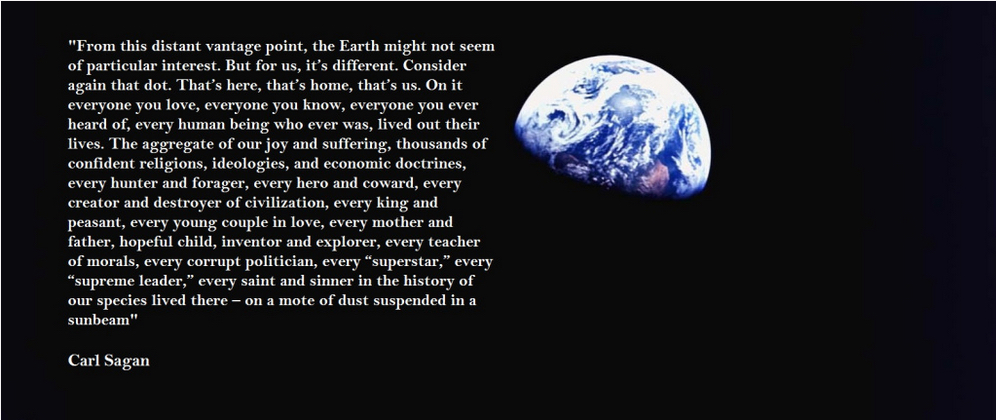
-
The relationship of the statue to the clay
Yes. In Mind and the Cosmic Order, Charles Pinter seems to be making the point that is suggesting : that common sense equates the Material Object with its Meaning. "This is quite an amazing insight, and it demonstrates how far our native intuition can diverge from reality. We are convinced beyond a shadow of doubt that every material object has substance and form. That is, an object's form inheres in the object itself, and is an aspect of the matter of which the object is made. Once again, we are misled by common sense. Actually, an object's form is an aspect of the object as an undivided whole, viewed from outside the object." Pinter also summarizes : "Form does not inhere in brute matter but emerges in Gestalt observation".Maybe form and formlessness are dependent on one another for meaning. It's one concept. — frank
A Gestalt (holistic) observation sees not just the superficial object, but its internal structure and its interdependent context (the big picture). But Common sense --- e.g. Flat Earth and Materialism --- sees the obvious, but is blind to the implicit meaning or significance or value. On the other hand, a holistic perspective (philosophical sense?) sees the logical structure within the superficial substance, and its conceptual context. If so, then as Wayfarer implies, the isolated object, apart from its interrelationships, is Formless. However, a Gestalt view will observe both formless shape and enformed meaning. :smile:
Note : The modern definitions of Substance and Form are influenced by post-enlightenment reductive Materialism. Their ancient philosophical meanings were more holistic. -
The relationship of the statue to the clay
Ironically, I had just read a book review in Philosophy Now magazine, before I noticed this post. The book author discusses the "neoliberal consumerist worldview", and the reviewer noted : "in postmodern culture the value of art is financial rather than aesthetic". The illustration showed a stainless steel sculpture by Jeff Koons, which sold for $91 million dollars in 2019. What did the buyer get for his financial fortune : a> a tchotchke to put on a shelf for the aesthetic amusement of his friends, or b> a steel object emulating a child's plastic balloon? Is "The Rabbit" merely a material thing (Hyle), or an aesthetic idea (Morph) in the form of a visual joke : steel art emulating plastic plaything?I think both form and content are missing from the blob Bob received. Can we take a closer look at the relationship between these things? — frank
Aristotle's Hylomorphism*2 has been interpreted in various ways. The Hyle (wood) component is obviously a material object, but the Morph (Form) component is defined philosophically as "immaterial". Yet Materialists may not distinguish between the tangible (stuff) of the Thing and the Idea (meaning) of the Thing. Is the aesthetic value of the Rabbit in the stainless steel, or in the irony of a child's toy on a museum pedestal? Did the buyer pay for the physical Matter or the metaphysical Form? Which is the "content", the steel or the joke? :joke:
*1. A financial investment, or a sight gag (wink, wink)?
2. Hylomorphism is a philosophical doctrine developed by the Ancient Greek philosopher Aristotle, which conceives every physical entity or being as a compound of matter and immaterial form, with the generic form as immanently real within the individual. ___Wikipedia
*3. Steel Manufacturer Pays More Than $100 Million to Reduce Emissions from its Dearborn, Michigan Facility
https://www.epa.gov/newsreleases/steel-manufacturer-pays-more-100-million-reduce-emissions-its-dearborn-michigan
PS___
a> Does the stainless steel Rabbit have more or less Content (material or financial or aesthetic value) than the plastic inflatable Rabbit?
b> The language on such topics gets confusing. Is the steel mill (*3) paying for negative Material (hyle ; pollution) and positive Content (form ; ethics ; purity ; public image ; legal status )? -
Empiricism, potentiality, and the infiniteI have observed more than a few people argue that potency/potential is best left out of natural philosophy because it is, in principle, not empirically observable. Only act can be observable, hence, being good modern empiricists, we have no need for potency.
Well, I can understand this argument, even if I don't agree with it. However, it seems to me that the same exact sort of argument can be made against the infinite/continuous. After all, the infinite is, in principle, unobservable. We cannot have measurements consisting of an infinite number of decimals for instance.
Yet modern empirical thinking does not seem to have the same attitude on the infinite. Certainly, there are arguments for finitism, and it seems to be an idea that is getting more popular in physics, but no one says that it must be the case because the infinite is unobservable.
Indeed, that continuous mathematics is useful is often taken to simply imply an unobservable continuum. But this sort of reasoning seems to work just as well for potency, no?
So what's the difference?
Or is the "observability" thing really just a red herring? — Count Timothy von Icarus
I suspect that an "observability" argument against Potential is indeed a "red herring" to disguise the metaphysical worldview of Materialism*1 as a matter of Fact instead of Faith. A response to my discussion of Voltage as Potential (not yet real) current, elicited, not a counterargument, but an ad hominem accusation of heresy : "pseudophilosophy is defined by a lack of epistemic conscientiousness"*2. Ironically, all my links to definitions of electrical Potential were to scientific sites, not philosophical or pseudoscientific sites.
Therefore, I'm guessing that the motivation behind that accusation of was in defense of the Materialism belief system*3*4, that you seem to be questioning. As you noted, "Potential" is similar to "Infinite", in that both scientific concepts are based, not on empirical observation, but on rational inference. Although those terms refer to something that is not observable or measurable, they are used frequently in scientific documents refering to "things" that are not-yet-real, or observable.
So, what's the difference between Empirical Observable here & now facts, and Rational Imaginative placeless & timeless theories? Potential is like Infinity, in that it is not observable via the physical senses, but inferable by means of mental (immaterial ; mathematical) Reasoning. Infinity is not Real or Physical, but Ideal and Meta-Physical. Likewise, Materialism is not observable, but must be taken on faith. :smile:
*1. Materialism is the view that, because only physical matter and its properties exist, minds are merely manifestations of matter and are reducible to physical features. Metaphysical materialists claim that all things except minds or ideas are ultimately physical or bodily.
http://people.tamu.edu/~sdaniel/quest4.html
*2. Pseudophilosophy : Analogous to pseudoscience, can there be such a thing as pseudophilosophy, in which one makes claims with philosophical pretensions which on closer inspection turn out to be bullshit?
https://psyche.co/ideas/pseudophilosophy-encourages-confused-self-indulgent-thinking
*3. Materialism is Metaphysical :
# To say that materialism is a form of ontological monism means that it identifies what is real in terms of the practical (pragmatic) value of things.
#" Metaphysical dualists (e.g., Descartes) argue that the two kinds of things in the world—namely, spiritual things (minds, ideas) and material things (bodies)—cannot be explained in terms of one another".
# "Philosophical dualists like Descartes argue that mind and matter are fundamentally two different aspects of the same non-mental and non-physical substance."
http://people.tamu.edu/~sdaniel/quest4.html
*4.Materialistic Monism :
Materialistic monists believe that the physical, material world (not the mental world) is primary. They believe that consciousness is essentially part of the material world too, because it arises through our interaction with the material world.
*5. Materialism in academia is a fundamentalist belief system :
The metaphysics of materialism is a belief system held in large swathes of academia in the same manner, and often for the same reasons, that religious beliefs are held in fundamentalist organizations,
https://www.essentiafoundation.org/materialism-in-academia-is-a-fundamentalist-belief-system/reading/
-
Empiricism, potentiality, and the infiniteI have observed more than a few people argue that potency/potential is best left out of natural philosophy because it is, in principle, not empirically observable. Only act can be observable, hence, being good modern empiricists, we have no need for potency. — Count Timothy von Icarus
As you said, "only acts can be observed", but Potential for a future Act can be imagined, and even calculated mathematically. Ironically, Wonderer1 sees no need for spooky spiritual Potency, because he has a Mathematical term for the before/after relationship of Causation : Difference*1. He seems to think that mathematics is empirical, hence more real than metaphysical Potential. So, he asserts that Voltage can exist in the absence of Current flow*2. Which is true in the metaphysical sense of a calculated, but not measured, Difference. In Aristotelian terms, Voltage is a Formal (theoretical) Cause, not a Material (empirical) Cause*3.I'm no mathmatician, but it seems to me that in a practical sense we need at least the mathematical ideas of infinity and continuums. I'm not seeing a similar need for potency. — wonderer1
In a storage battery the Voltage is not measured empirically, but calculated mathematically*2. You can hold a AA battery in your hand without getting shocked, because your skin is too resistive for such a small Potential to flow*2. Hence, you can have Potential (metaphysical ; ideal) Voltage without any (physical ; real) current flow. Voltage, as a mathematical definition, is a theoretical Cause without material Effect.
In what sense does Potential exist : space-time or infinity ; reality or ideality ; actual or theoretical? In what sense does Mathematics exist : material or metaphysical?*4 :smile:
*1. How to find voltage without current?
How to Calculate Voltage Across a Resistor (with Pictures)
With basic algebra, we can change Ohm's Law to solve for voltage instead of current: I = V / IR = VR / IR = V.
https://www.wikihow.com/Calculate-Voltage-Across-a-Resistor
*2. Voltage without Current :
Voltage can exist without current, as it is the cause of flowing charge. Current does not exist without voltage, as voltage is the main cause to flow current except theoretical superconductor.
https://www.toppr.com/guides/physics/difference-between-voltage-and-current/
*3. What is a voltage source with no current?
Voltage sources provide an almost-constant output voltage as long as the current drawn from the source is within the source's capabilities. An ideal voltage source loaded by an open circuit (i.e., an infinite impedance) will provide no current (and hence no power).
https://en.wikipedia.org/wiki/Current_source
*4. Mathematics is Metaphysics :
Whereas the natural sciences investigate entities that are located in space and time, it is not at all obvious that this is also the case for the objects that are studied in mathematics.
https://plato.stanford.edu/entries/philosophy-mathematics/ -
Was intelligence in the universe pre-existing?
Thanks for that quote, in the context of Cosmic Intelligence. I read Davies' book many years ago. And it had a lasting effect on my personal worldview, both scientific and philosophical. As a scientist, his use of "God" in the title wouldn't be taken seriously if he was referring to primitive & traditional concepts of world-creating deities. Yet, he admitted that "there are many mysteries about the natural world that would be readily explained by postulating a "natural Deity". Which seems to be the implication of the OP....The upshot of these considerations is that the gravitational arrangement of the Universe is bafflingly regular and uniform*. There seems to be no obvious reason why the Universe did not go berserk, expanding in a chaotic and uncoordinated way, producing enormous black holes. Channeling the explosive violence into such a regular and organised pattern of motion seems like a miracle. Is it? Let us examine various responses to this mystery: — Paul Davies, God and the New Physics
The Big Bang Theory was originally described in terms that sound like a physical event that we typically call an "Explosion". But the actual explosions we observe or create could be characterized as Instant Entropy, and depicted as the vanishingly-brief flash of light emitted from New Years Day fireworks. Such an explosion converts stored Potential Energy into Kinetic Energy then back into the Nothingness of total Entropy. In an attempt to avoid that nothing-to-nothing flash-in-the-pan*1 implication, some scientists preferred to portray the event as-if a gradual & orderly "Expansion" , i.e. Evolution. Even so, no scientific theory has an explanation for the source of that cosmic causal Energy, or for the physical Laws that control & coordinate the evolutionary expansion of undefined Potential into the "organized patterns" of a self-defining Cosmos . . . . instead of the dissipated dust of expired Entropy.
Darwin's Theory of Evolution was an attempt to explain the emergence of living & thinking organisms from a purely material & mechanical system of Causation & Selection. Yet, he seemed to assume, as an unarticulated Axiom, that the necessary god-like Power & Logic existed eternally. Henri Bergson also had no explanation for the how & why of Evolution. But he recognized the necessity for some kind of Intelligent Design*2 in the title of his book : Creative Evolution. Unfortunately, our lack of direct evidence for a pre-bang Intelligence, limits any explanation for the original Cause & Laws --- necessary to program the Evolutionary Mechanism with logical rules (if-then, and/or) --- to rational Philosophical Speculation. Therefore, the OP question cannot be answered with empirical scientific facts. We can only apply our human form of Logic & Intelligence to continue the search for answers to Ontological questions. :cool:
*1. flash-in-the-pan : a sudden spasmodic effort that accomplishes nothing
*2. What is the most accurate definition of intelligence?
Although contemporary definitions of intelligence vary considerably, experts generally agree that intelligence involves mental abilities such as logic, reasoning, problem-solving, and planning.
https://www.verywellmind.com/theories-of-intelligence-2795035 -
Empiricism, potentiality, and the infinite
I think you have hit upon the prohibitive problem with the word "potential" : Metaphysics. It implies the creation of something new that does not yet exist in physical form : Counterfactual.Well, the concept of potential is used all the time in practical matters, e.g. the counterfactual analysis that makes up a great bulk of the work done in the sciences, engineering problems, "potential energy," potential growth in economics, attracting "potential mates" in biology, etc.
It's really more in the realm of metaphysics or something like the amorphous "metaphysics of science" that the prohibition on talking about potentialities seems to hold. — Count Timothy von Icarus
As you noted, materialistic Science is OK with the notion of Potential in cases where the before & after can be measured, in theory. For example, a AA battery is rated for 1.5 volts, but that future current is imaginary in the sense that it cannot be measured until a hypothetical circuit is completed by some external Cause. So, what is rated is unreal Potential*1 instead of real Actual voltage.
Ironically, the Potential of a physical battery refers to something physically non-existent, hence literally Metaphysical : knowable only by Reason, not by Senses*2. When defined mathematically, as in Quantum Field Energy*3, it's a statistical scientific notion. Although the storage medium (empty space) is immaterial, the math makes sense. But when defined philosophically, it's a taboo religious concept, in which the storage medium is presumed to be supernatural. :nerd:
1. Potential :
Unrealized or unmanifest creative power. For example the Voltage of an electric battery is its potential for future current flow measured in Amps. Potential volatage is inert until actualized by some causal trigger.
https://blog-glossary.enformationism.info/page16.html
2. Metaphysical :
an idea, doctrine, or posited reality outside of human sense perception. In modern philosophical terminology, metaphysics refers to the studies of what cannot be reached through objective studies of material reality. . . . Thus, metaphysical claims stand today between the absolutist claims of science (scientism) and the complete relativism of postmodernism and deconstructionism.
http://www.pbs.org/faithandreason/gengloss/metaph-body.html
*3. Quantum potential energy and non-locality :
It is a form of energy which cannot be localized in space. It represent the energy associated with the spatial curvature of the square-root . . . . The quantum potential energy has the units of energy but it does not share the characteristic properties of neither potential nor kinetic energies as understood in classical physics.
https://hal.science › file › quantumpotentialenergy -
Identity of numbers and information
Please note that I wasn't talking about analog Computers (continuous vs digital values), but analog Information*1 (semantic meaning expressed by figurative analogies). Shannon found a way to reduce the Uncertainty of "noisy" Analog Computers, including human brains*2, by using Digital Information in which the Natural Language meaning is converted into synthetic Mathematical symbols. In that process, the real world meanings (analogies ; metaphors ; similes ; nuances) are ignored in favor of abstract numerical values, and must be reconstructed later, opening the possibility of misconstrual.To that end, he [Shannon] ignored the inconsistent variable analog . . . concrete semantic forms of Information. (bolded words were omitted in your misinterpretation)
Gnonsense. Shannon worked on analog computers before essentially inventing digital logic. His communication theory was very much about communicating uncorrupted digital data through the noisy analog world. So no, he didn't ignore the analog.
What is with your obsessive need to propagate misinformation? — wonderer1
Ironically, cutting edge computers are now learning to communicate with human programmers in natural language instead of artificial codes*3. How do you think the programmers will deal with the inherent Uncertainties of human language? Your misinterpretation of my human language post is a prime example of self-misinformation. :smile:
*1. Analog Information :
information processing called analog-form information, or simply analog information. Until the development of the digital computer, cognitive information was stored and processed only in analog form, basically through the technologies of printing, photography, and telephony.
https://www.britannica.com/topic/analog-information
*2. Analog Brain
The mammalian brain, comprised of neuronal networks, functions as an analog device and has given rise to artificial neural networks that are implemented as digital algorithms but function as analog models would.
https://www.frontiersin.org/journals/ecology-and-evolution/articles/10.3389/fevo.2022.796413/full
*3. Why Natural Language is the New Language of the Digital Era
The days of writing lines of code to achieve tasks are gradually giving way to the era of conversation. Natural language processing (NLP) and machine learning have reached a point where machines can not only understand what we say but also grasp the context and nuances of our conversations.
https://www.linkedin.com/pulse/why-natural-language-new-digital-era-anuya-kamat -
Identity of numbers and information
Shannon took an ancient term referring generally & loosely to meaning in a mind*1 --- or as you noted, "frameworks for interpretation --- and adapted it for use in mindless computers*2. To that end, he ignored the inconsistent variable analog concrete semantic forms of Information, and focused on the consistent absolute digital abstract mathematical (either/or ratios) that could be exactly defined as something or nothing (1 or 0).While personal meanings are not in themselves information, but rather frameworks of interpretation. I think the conflation of information and interpretation is one of the main confusions of this topic. — hypericin
Human meanings are subject to vague personal interpretation and mis-interpretation, while computer bits & bytes are impersonal & precise. However, those numerical values can later be translated back into human (natural language*3) meanings, but at the risk of mis-interpretation. Anything that can cause an information processor (computer or brain) to create meaningful internal Forms (images ; configurations) is a source of Information. :smile:
*1. Information :
Knowledge and the ability to know. Technically, it's the ratio of order to disorder, of positive to negative, of knowledge to ignorance. It's measured in degrees of uncertainty. Those ratios are also called "differences". So Gregory Bateson defined Information as "the difference that makes a difference". The latter distinction refers to "value" or "meaning". Babbage called his prototype computer a "difference engine". Difference is the cause or agent of Change. In Physics it’s called "Thermodynamics" or "Energy". In Sociology it’s called "Conflict".
https://blog-glossary.enformationism.info/page11.html
*2. Information is an abstract concept that refers to something which has the power to inform. At the most fundamental level, it pertains to the interpretation of that which may be sensed, or their abstractions. . . . Information is not knowledge itself, but the meaning that may be derived from a representation through interpretation ____Wikipedia
*3. Natural Language :
a language that has developed naturally in use (as contrasted with an artificial language or computer code). ____ Oxford Languages -
Identity of numbers and information
I'm not qualified to engage in this profound thread, but your "epiphany" suggested a relationship between Numbers and Information that is not covered by Shannon's engineering theory, yet may be implicit in Plato's broader philosophical worldview.At the time I had this epiphany, the insight arose, 'so this is why ancient philosophy held arithmetic in high esteem. It was certain, immutable and apodictic.' These are attributes of a higher cognitive functionality, namely rational insight. Of course, I was to discover that this is Platonism 101, and I'm still drawn to the Platonist view of the matter. The philosophical point about it is that through rational thought we have insight into a kind of transcendental realm. — Wayfarer
Shannon's digital Information is defined in terms of pragmatic, physical, immutable, apodictic distinctions. But Plato's ideal Numbers*1 were non-physical, non-sensible things in a realm beyond time and space (transcendent). Ironically, the latter may be more applicable to mundane human use of Information with analog values, personal meanings, and perhaps even fractal dimensions, that don't lend themselves to yes/no digitization.
Quantum Physics has analyzed reality down, not to atoms of value & meaning, but to oceans of value (the Quantum Field) that lie, not on a simplistic linear number line, but in a "transcendent" state-of-being where "real" particles of Matter are temporary, conditional, and statistically probable. Could Plato's ideal non-sensible mathematical realm correspond to that hypothetical abstract mathematical sphere-of-Influence that physicists call "the universal quantum field"*2?
In Plato's Cave allegory, material things in the sensible world are merely shadows of an illuminated-but-unreal domain. Likewise, our social meanings and linguistic information consist of imperfect analog values that are close enough to absolute True/False to be useful for communication. Not Identical, but relative.
Conservative Physicists probably don't think of the Quantum Field as "transcendent", so exploring that possibility is left to Liberal (new-agey ; mystical energy) Metaphysicians*3. Personally, I doubt that there are any practical real-world applications of transcendental preternatural information, such as access to "unlimited knowledge". But the theoretical philosophical implications of perfection may be of interest to those who like to reason beyond immanent Materialism and utilitarian Mechanism. :smile:
*1. Mathematical Platonism :
the doctrine that there exist abstract objects—objects that are wholly nonspatiotemporal, nonphysical, and nonmental . . . . based on the postulation of unchanging and eternal realities known as forms.
https://www.britannica.com/topic/mathematical-Platonism
*2. The Universal Field Theory is not a physics theory in a classical sense. It is rather a philosophical theory explaining Why and How physical phenomena appear.
https://theuniversalfieldtheory.com/
*3. What is Quantum Transcendence? :
I just googled QT and got this hit.
https://www.1to1coachingschool.com/QEC_What_is_Quantum_Transcendence_Coaching.htm -
Is the real world fair and just?
Although, professional philosophers, who get paid for their learned opinions, might be loathe to admit it, most of our amateur "reasoning" on this forum consists of justifications for believing as we are naturally inclined to do. As Lady Gaga sang about homosexuals : "I was born this way". I didn't reason myself into an optimistic worldview with a god-like Enformer to make things "work together for good".Of course, this all begs the question too much if carefully examined, at least to me. — schopenhauer1
Instead, late in life, I found a Holistic explanation for why the apparent positives & negatives vary depending on your location on the curve, and on your personal attitude. While some feel the weight of Entropy holding them down, I feel the inner Energy pushing me forward. Those who "carefully" examine the news of the day will go to bed depressed. Stoicism is not Pollyanna Optimism, but thick-skinned Pragmatism.
Some thinkers seem to view the world from a me-centric perspective, but I see no reason expect the world to conform to my personal preferences. I suppose I was born this way : able to sleep in a bed of roses, smelling the soft sweet petals, while ignoring the occasional thorn-pricks . On the other side of the philosophical hill, a few pessimists, laboring on the uphill slog of the Normal Curve, justify their one-sided worldview by imagining that there is no upside to this dynamically-balanced good/evil world. So, they justify their dismal worldview by labeling the "goodys" as Idiots, blind to the obvious Truth that is clear to all "right-thinking" people. Does that self-righteous attitude remind you of religious fundamentalists?
Meanwhile, Sisyphus just does his unavoidable task of keeping the ball (Life) moving. Whenever you are looking for evidence, there is always something better or worse on the other side of the hill. Like Sisy, I don't examine life too microscopically ; you might miss a chance to smell the roses along the path. Meanwhile, I'm just biding my time, waiting for rigor mortis to set-in. What was the question again? :smile:
What is the moral of the story Sisyphus?
Sisyphus's eternal labour underscores the importance of embracing the present moment and finding joy in the process, regardless of the outcome. Despite the repetitive and seemingly futile nature of his task, Sisyphus persisted in his efforts, finding purpose and meaning in the act of pushing the boulder up the hill.
https://www.thepilgrims-school.co.uk/the-myth-of-sisyphus
THE NORMAL CURVE OF A WORLD OF POSITIVES & NEGATIVES

THE SNOWBALL EFFECT OF OPTIMISTS

-
Is the real world fair and just?
If you are "purely speculating", the notion of an infinite eternal Multiverse is just as viable as that of an intangible self-existent deity, or the Flying Spaghetti Monster, . . . . and just as unfalsifiable. Hence an infinite nonsensical hall-of-mirrror-gods might raise more questions than it answers. But it offers no rational solution to the Perennial Question or the Central Mystery that causes humans to seek for philosophical answers : i.e. wisdom.So that being said, I can only add at the moment regarding this philosophical deity, is that if I was purely speculating, I can propose that this universe is indeed one of an infinite variety, each with a tiny variation of a variation of a variation perhaps, which indeed, would be infinite beyond anyone's wildest notion and unfathomable for human comprehension. I don't know what that means for determinism, for the block universe, versus partial block, etc. — schopenhauer1
I don't know how "pure" Schopenhauer's speculation was, but his notion of Cosmic Will at least has something in common with human aspirations*1. And sounds like Kant's ding an sich, or a God "by any other name". One purpose of Science is to make the world somewhat more predictable, and controllable, than coin-flipping. And an intentional Mind/Will similar to our own would be more comprehensible than infinite God-verses "playing dice" to determine human fate*2. Apparently, Schop was content to be a closet-Pessimist ; I'm not. :smile:
*1.Vindicating Schopenhauer :
Schopenhauer’s metaphysics is characterized by a partition of the world into two categories,
which he called ‘Will’ and ‘Representation’ (I shall capitalize both terms to differentiate their usage in Schopenhauer’s sense from other denotations of the words). Representation is the outer appearance of the world: the way it presents itself to our observation, on the screen of perception. The Will, on the other hand, is the world’s inner essence: what it is in itself, independently of observation.
Schopenhauer’s Will is roughly equivalent to Immanuel Kant’s thing-in-itself, or noumena,
whereas Schopenhauer’s Representations are equivalent to Kant’s phenomena. However, unlike Kant—who thought of the noumena as fundamentally unknowable—Schopenhauer thought that there is a way to know the noumena : when it comes to our own selves, we are not limited to perception—that is, Representation—but have direct, immediate, first-person access to what it is like to be us. As such, there is precisely one case in which we do know the thing-in-itself simply by being it: our own selves. By introspecting, Schopenhauer thought we could make valid inferences about all the noumena.
.
After all,since our own bodies are made of the same atoms and force fields that constitute the world at large, by pinning down what it is like to be us we can infer what it is like to be the world at large as well. And when he introspected into his own self, Schopenhauer found something he thought appropriate to call ‘Will.’
____https://blog.apaonline.org/2020/03/12/vindicating-schopenhauer-undoing-misunderstandings-of-his-metaphysics/
*2. Schopenhauer On The Idea Of Fate :
In Schopenhauer’s essay Transcendent speculation on the apparent deliberateness in the fate of the individual (I KNOW, that’s a title and a half), he explores the idea that our sense of free will changes as we age. His basic premise is that we are more likely to believe in fate, destiny, providence, or predetermination as we get older because we have seen the different acts of our life come together.
https://rcabbott.medium.com/amor-fati-schopenhauer-on-the-idea-of-fate-dab38711be7f
Note --- "Governments are instituted among men" to avoid being subject to the Will of one man. But governments are intended to give each of us a fair chance at "happiness", not a royal road for anyone in particular. -
Is the real world fair and just?
Thanks, but on an open forum like this it's not easy to avoid crossing invisible linguistic lines. I am not familiar with Wittgenstein "language", but I am well-versed in Judeo-Christian idioms. And I have some knowledge of philosophical terminology dating back to the Greeks. So, my use of the non-traditional spelling "G*D"*1 --- along with a variety of other terms, such as "First Cause" --- is a reference to what became known, derisively, among enlightenment era Catholics, as the "god of the philosophers", (an oblique reference to Spinoza). What I'm referring to is the perennial conundrum*2 for abstract thinkers since the first language emerged among men.I hate to bring in Wittgenstein here, but some of his ideas can be useful in these debates. That is to say, you must try to not mix "language games" of the personal god variety and the philosophical god variety. — schopenhauer1
That still unsolved mystery dates back to the clear-sky Mesopotamian Astronomers --- perhaps the first mathematical scientists --- who wondered why most stars wandered aimlessly across the "firmament", but others moved in neat cycles that appealed to the order-seeking human eye. Since such circles are not found in Nature, apart from human constructions, they attributed the controlling influence to humanoid gods, and developed a geometric language for discussing the mystery. But the inherent problem of epi-cycles confounded even the mathematically talented Greeks, until one man on a cloudy-sky island, intuited a mathematical controller that he called "gravity" (heaviness), which is a Quality, not a material object, or deity.
A couple of centuries later, another singular thinker introduced a new, counterintuitive, way to think about Gravity, as the influence of "warped space". Which is just another spooky way of talking about the "remarkable effectiveness" of immaterial Mathematics in the material world. So, what ancient Astrologers attributed to humanoid gods, we now just take for granted as the organizing power of Nature, imagined as a pure abstraction. Yet even Einstein felt the need to use taboo "G" terms to describe something that is immaterial, but effective in organizing the material world into the "endless forms most beautiful" that Darwin saw in Nature, and attributed to an unspecified "creator"*3.
Thus, the language of Science has evolved over the millennia. But keeps coming back to the Central Mystery of philosophy : the cause of all order & beauty in the world. Yet some, who think of themselves as philosophers or scientists, are afraid of certain taboo terms, and still run away from the ghostly invisible Causes of the world. And blame their aversion on the historical tendency of the common people to think in Materialistic & Humanoid language, instead of the Mathematical & Holistic abstractions of philosophy. They think they can define the problem away, by calling it "Religious BS". :nerd:
*1. G*D :
An ambiguous spelling of the common name for a supernatural deity. The Enformationism thesis is based upon an unprovable axiom that our world is an idea in the mind of G*D. This eternal deity is not imagined in a physical human body, but in a meta-physical mathematical form, equivalent to Logos. Other names : ALL, BEING, Creator, Enformer, MIND, Nature, Reason, Source, Programmer. The eternal Whole of which all temporal things are a part is not to be feared or worshipped, but appreciated as the organizing mind of Nature.
I refer to the logically necessary and philosophically essential First & Final Cause as G*D, rather than merely "X" the Unknown, partly out of respect. That’s because the ancients were not stupid, to infer purposeful agencies, but merely shooting in the dark. We now understand the "How" of Nature much better, but not the "Why". That inscrutable agent of Entention & Causation is what I mean by G*D.
https://blog-glossary.enformationism.info/page13.html
*2. What is the perennial problem of philosophy?
The problems connected with the meaning of life, a providential order, political ideals, control over how we live, and the justification or criticism of legal and moral practices are perennial and philosophical.
https://archive.philosophersmag.com/perennial-philosophical-problems/
*3. Darwin's Creator :
There is grandeur in this view of life, with its several powers, having been originally breathed by the Creator into a few forms or into one; and that, whilst this planet has gone cycling on according to the fixed law of gravity, from so simple a beginning endless forms most beautiful and most wonderful have been, and are being, evolved.
http://www.age-of-the-sage.org/darwin-quotes/grandeur-view-life.html
-
Is the real world fair and just?I think that 'holism' per se is not enough to answer this objection.
Also, IMO 'energy' is a property rather than a 'physical substance'. A rock is not 'made by' mass-energy but has mass-energy. Unfortunately, I think that even physicists themselves sometimes indulge in some confusion about this.
We can't say that 'fundamental physical reality' is 'energy' because 'energy' is a property. — boundless
Yes, Ontology is the most debatable aspect of Philosophy*1. Anything created from scratch is indeed dependent for its existence on the Creator. But I don't see how the self-existing Ontological creator --- what I call eternal/infinite Potential --- could be dependent on the space-time creature. Anyway, we're getting into some esoteric & metaphorical concepts here, that might snidely label as "BS". And, as he might pointedly point-out : "it's way over Gnomon's little pointy head".
In the links below*2, Energy is described as a "property of a system", and Holism is about Systems, not things. So, systemic properties can only be rationally inferred, not physically observed. Hence, we don't know what Energy is, in a material sense, we only know what it does. Likewise, we don't know what G*D is, only what it does : to serve as a hypothetical explanation for the existence of everything in our world. :smile:
*1. Varieties of Ontological Dependence :
A crucial notion in metaphysics is that of one entity depending for its existence upon another entity—not in a merely causal sense, but in a deeper, ontological sense
https://plato.stanford.edu/entries/dependence-ontological/
*2. Is this correct 'energy is a property of matter?
No, energy is a property of a system, and work is done when the system energy is re-distributrd among the bodies of mass in the system. . . . .
Yes and no. We do not know what energy is. It is invisible. We only find it as a number that emerges from specific calculations.
https://www.quora.com › Is-this-correct-energy-is-a-pro...
SNIDELY WHIPLASH

-
Is the real world fair and just?
Yes. To portray G*D as a "composite", of which we humans are the parts, seems to be a materialistic/physicalist notion. It views G*D as a mechanism with interdependent interacting parts. A machine (e.g. a watch) is indeed dependent on its constituent parts. Take away one cog and the machine no longer functions properly.But if G*D is not simple, i.e. if G*D is composite, then it necessarily depends on the parts. If those parts were to 'separate', G*D is no more. BTW, G*D being simple doesn't mean that G*D has no properties, just that G*D has no parts. — boundless
But my hypothetical god-model is more meta-physical, and imagines G*D as Enfernal (infinite/eternal) Potential, and our space-time world as one of infinitely many possible Actualized systems. Potential is not a thing that can be divided into smaller things. Instead, Potential is more like a Whole which is more than the sum of its parts. The "more than" is not more Parts, but more Potential. Just as physical Energy is not a material object, meta-physical Potential is infinite and inexhaustible.
So, G*D/Potential is simple in the sense of not being composed of many inter-dependent mechanical elements. A quantum physics metaphor is the hypothetical Universal Energy Field*1 (or Vacuum Energy*2, or Dark Energy). It's a mathematical continuum, not a material mechanism. Since the field of empty space is boundless, and its "grid points" are only mathematically defined --- no extension in space or time --- the Field is not diminished or increased by the popup particles that we interpret as electrons, etc. :smile:
PS___ Since our language is Materialistic, that Holistic notion may be hard to wrap your mind around, but It was presented back in 1926 by Biologist Jan Smuts in his Holism and Evolution.
*1. The Universal Field Theory :
The U F T is not a physics theory in a classical sense. It is rather a philosophical theory explaining Why and How physical phenomena appear.
https://theuniversalfieldtheory.com/
*2. Vacuum energy is an underlying background energy that exists in space throughout the entire universe
https://en.wikipedia.org/wiki/Vacuum_energy
VACUUM ENERGY IMAGINED AS STORMY SEA OF POTENTIAL ENERGY
Nothing there until Potential is Actualized
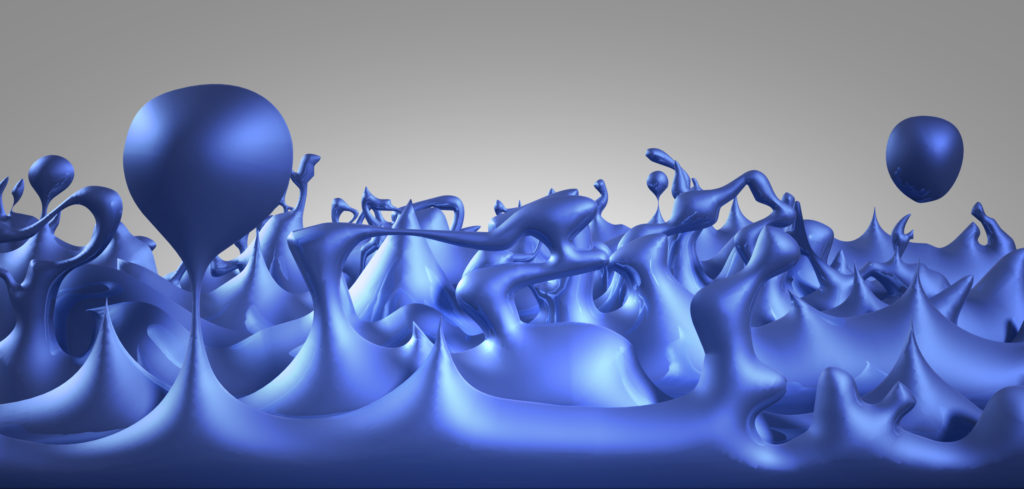
-
Is the real world fair and just?
I don't agree with that arbitrary conditional hypothetical if-then scenario. It seems to be placing restrictions on what an omnipotent deity can or cannot do*1. If there are no parts or aspects, then what is G*D*2 the Whole of? That negative definition of Perfection seems to be a bunch of nothing : no boundaries, no parts, no change. no properties, no place for an evolving world with imperfect creatures. Nothing to do : Eternally Boring.I think that the argument goes like: if God weren't simple, i.e. it God was composed of parts (which themsleves are entities) then it could not be eternal, or at least God would be contingent. God would be ontologically dependent on its parts.
In other words, God's ontological necessity and eternity requires an ontological simplicity.
Anyway, maybe you could say that some aspects of God/Whole evolve and some aspects do not, in order to accept both a panendeistic world view and God's eternity and necessity. But I am not sure if this helps. — boundless
The idealistic concept of a perfect deity --- who is also good, merciful, and loving? --- is a nice neat geometric notion, with no content : an ideal empty sphere that is infinite & unbounded. And it leaves open the question of how such timeless perfection could possibly create a space-time world where good & evil are in constant combat. To maintain their ideal geometric deity definition, the philosophical argument of Theodicy was forced to blame the creatures (victims of evil) instead of the Creator of the Cosmic System. Which is also how monotheistic Judaism was transformed into polytheistic Christianity. Henceforth, theology had to reconcile the existence of dueling dual (or a Trinity) gods, forever fighting over the fate of the creation.
I can't make sense of either argument, A> Monotheism :God is a perfect faultless Whole, and He/r relationship to the imperfect faulty Parts is all top-down. Hence God's perfection is uncontaminated by the limitations of space-time and good/evil. B> Polytheism : God is all good, but He/r evil twin is competing for the crown of world ruler. And spoiling the ideal simplicity of indivisible Oneness. Therefore, I can't accept the notion of G*D as Necessity without Possibilty.
On the other hand, I can only guess that G*D is not frozen into a boundless timeless changeless blocktime popsicle, but is instead a dynamic entity capable of creating an imperfect world internally without compromising He/r own boundlessness or wholeness. Just as a human mind can imagine a Utopian or Dystopian world without reducing its own unity & wholeness, a G*D-mind could move imaginary chess pieces around without compromising its own integrity. As some have expressed the idea : G*D is dreaming our world, so our "real" existence is imaginary or fictional from the perspective of the dreamer. :smile:
*1. How can you define Infinity or limit Eternity? :
Einstein liked inventing phrases such as "God does not play dice," "The Lord is subtle but not malicious." On one occasion Bohr answered, "Einstein, stop telling God what to do."
https://history.aip.org/exhibits/einstein/ae63.htm
*2. G*D :
An ambiguous spelling of the common name for a supernatural deity. The Enformationism thesis is based upon an unprovable axiom that our world is an idea in the mind of G*D. This eternal deity is not imagined in a physical human body, but in a meta-physical mathematical form, equivalent to Logos. Other names : ALL, BEING, Creator, Enformer, MIND, Nature, Reason, Source, Programmer. The eternal Whole of which all temporal things are a part is not to be feared or worshipped, but appreciated like Nature.
I refer to the logically necessary and philosophically essential First & Final Cause as G*D, rather than merely "X" the Unknown, partly out of respect. That’s because the ancients were not stupid, to infer purposeful agencies, but merely shooting in the dark. We now understand the "How" of Nature much better, but not the "Why". That inscrutable agent of Entention is what I mean by G*D.
https://blog-glossary.enformationism.info/page13.html -
Is the real world fair and just?
The definition of God as "simple & unchanging" may or may not be true ; but it's irrelevant to you & me. I have no way of verifying that "standard position". But, in the evolving space-time world, where you and I are operating, Complexity and Change are the context from which we vainly try to imagine a First Cause capable of producing an evolving world. Presumably, enfernal G*D does not evolve, but He/r space-time creation may be a machine for evolving little gods.Well, I wasn't talking about my ideas on the matter. But anyway, the 'standard' philosophical position about God (even for the classical theists) is that God is simple, unchanging and transcends time. Spinoza accepted this kind of view. If you say that 'Deus' changes, then yeah I think that my objections do not apply strictly speaking. Still, by 'statistical' you don't mean 'probabilistic'. Probabilism is just as incompatible as determinism to free will/agency (choices are not random). — boundless
I disagree about the relevance of Probability to Free Will*1. Calvinistic Classical Physics assumed that the fate of the world is pre-determined by the absolute Will of God. But Quantum Physics has undermined the philosophical certainty of that presumption. According to 21st century science, the physical foundation of reality is Relative, not absolute, and Uncertain, not pre-destined, and Organic, not Mechanistic. The Probability "gap" in quantum physics is anywhere a mind makes a measurement. No minds : no gaps in Determinism.
So, either G*D screwed-up and left some accidental statistical gaps in the mechanism of Fatalism. Or Sh/e programmed our little bubble of space-time with teleological options that allow some brainy organisms to choose from the Possibility menu as it suits their own purposes. The link below points out that Determinism is a debatable guess about ultimate reality, while indeterminate statistical Probability is as close to certain knowledge as human science can get*2. :smile:
*1. Is FreeWill Fake Agency? :
After those scenic side-tracks, he finally gets around to “unpacking free will”. For his analysis, you can read the article. Here, I’ll only mention a couple of points. 1) “Trying to account for choice at the level of neurons . . . wouldn’t provide any causal account”. That would be like looking for Meaning in the circuits of a motherboard. 2) “Voluntary behavior . . . Is an emergent phenomenon at the level of the entire organism embedded in physical reality”. That’s what I call “Holism”, or “Systems Theory”. Finally, he looks at “Freewill as Phenomenal Experience”, and says “Although this naïve view has largely been abandoned by serious thinkers, it can still be useful : what difference does it make if you believe that free will is an illusion? Would you no longer make any choices at all?”. In his considered opinion, “free will is a puzzle but it is not an illusion”. To that, I say “amen”.
https://bothandblog7.enformationism.info/page26.html
*2. Probability vs Determinism :
Determinism coexists as easily with probability as it does with ignorance. This is because determinism is an ontological* matter while probability is an epistemological one.
https://www.quora.com/If-determinism-is-accurate-does-probability-exist -
Is the real world fair and just?
Ha! You'll have to ask the Deus why He/r system of Cause & Effect is not strictly dictatorial & deterministic, but statistical, and frivolously creating novel arrangements of matter & energy as a basement hobby. Apparently you think the Deity is incapable of internal change, or oblivious to the little independent-minded creatures running around inside the Whole. Either our evolving world is accidental or intentional, or Deus is just having a bad dream.As to "how", I must assume that the binding chains of natural Cause & Effect have some "gaps" or "loopholes" that can be exploited by Autonomous Agents — Gnomon
Ok. But how these 'gaps' arise in a pantheistic/panentheistic/pandeistic/panendeistic system? — boundless
All I can do is guess : that the evolutionary system was intentionally designed to produce living & thinking creatures, with abilities that allow for some self-determination. Or, that our universe is a divine experiment gone disastrously awry. Why would an eternal/infinite/omnipotent Being have unruly pockets of space-time scrambling around in He/r bosom? Why would an absolute Entity allow little bubbles of evolving matter to grow inside He/r womb? How could Omniscience/Omnipotence have statistical "gaps", unless they were designed to provide opportunities for creativity?
During my fleeting time here in sub specie aeternitatis, I could try to speculate about timelessness and thinglessness. But I can't imagine such non-sense, except by means of analogies & metaphors drawn from personal experience, and the imaginings of other matter-bound speculators. Perhaps, , as an authority on Spinozism, can provide a definitive answer to your question.
Speaking of speculation, Einstein's Relativity gives us one way to construct analogies of the Whole vs Part perspectives. My sensation of autonomous & independent action in space-time might appear to be static & dependent to Enfernal (infinite/eternal) Being. :nerd:

-
Is the real world fair and just?
From the perspective of the Whole, the parts may or may not have any freedom, depending on the rigidity of rules that bind the parts. But from the perspective of the parts, our degree of freedom is relative to the other parts. Since I am unable to speak for the Whole, I can only judge based on the current state and history of human actions. As to "how", I must assume that the binding chains of natural Cause & Effect have some "gaps" or "loopholes" that can be exploited by Autonomous Agents. Otherwise, we would all be locked-in rocks.Still my question is: how can we have some degree of autonomy if we are not separate from the Whole? — boundless
In his book Freedom Evolves, Daniel Dennett concluded that some degree of Free Will*1 is compatible with Natural Law. He refers to certain "abilities" of homo sapiens that allow us to make choices that are not dictated by physical laws. Among those abilities are Logic and Language. Regarding the rigidity of natural law, I'll just mention that Thermodynamics is based on statistical averages not specific instances*2, and Quantum physics is also statistical, not mechanical. So some slack (statistical loopholes) in the chain of Cause & Effect seems to be allowed.
In Biology, a cell, which is a part of an organism, can have some degree of autonomy*3, if it creates its own constraints : such as a cell wall. Humans create their own "constraints" in the form of Cultural Laws that do not contradict Natural Laws. :smile:
*1. Free Will :
Dennett's stance on free will is compatibilism with an evolutionary twist – the view that, although in the strict physical sense our actions might be determined, we can still be free in all the ways that matter, because of the abilities we evolved.
https://en.wikipedia.org/wiki/Freedom_Evolves
*2a. Limitation of statistics are :
Statistics is not concerned with individual observation.
Statistics do not analyse qualitative phenomenon.
Statistical generalisation are true only on average.
https://www.toppr.com/ask/question/what-are-thelimitation-of-statistics/
*2b.The Second Law of Thermodynamics is a statistical law of large numbers.
https://www.compadre.org/nexusph/course/The_2nd_Law_of_Thermodynamics_--_A_Probabilistic_Law
*3. Autonomous :
An organism is autonomous because it creates the set of constraints responsible for its own constitutive activities that maintain its existence.
https://link.springer.com/article/10.1007/s10539-021-09829-8
PS___ Pay no attention to dogmatic Spinozist . He doesn't make philosophical arguments, just haughty assertions and Trump-like political attacks. :joke: -
Is the real world fair and just?
That's not what I'm saying. I assume that all actualities/realities can be traced back to the beginning of space-time. Beyond which we can only conjecture. And the Cause of that sudden appearance of limited spatial volume and temporal change from whatever came before that beginning (Enfernity??) is what we humans typically call "G*D" or "Multiverse".↪Gnomon
In other words, are you saying that God/Whole determines all the possibilities but the actualities are determined or co-determined by the rational agents?
And maybe also by other phenomena?
In other words, God 'fixes' all the possible histories but the actual one is co-determined?
I'm not sure how this doesn't lead to a theistic or theistic-like perspective (i.e. that God creates and sustaines but at the same time the creatures maintain an identity that is distinct from the Creator), but I'll wait your answers before delving into this. — boundless
During the expansion of space-time most emergent Actualities result from natural energy exchanges. But, since the recent advent of homo sapiens, some novelties in the world have been caused by human choices. That's what we call Culture as contrasted with Nature. Therefore, you could say that Cultural Evolution has been "co-determined" by rational agents. But I would not say that all actualities, or all phenomena, or all "actual histories" are determined by the "demi-gods" of the world.
I don't view that co-creator scenario as Theistic, but it is Deistic. It's specifically PanEnDeistic*1. And the causal agency in the world is what I call EnFormAction : causal energy + formal definition + actualization. The "hidden" source of that creative power is unknowable, except by inference from circumstantial evidence. So, any characteristics of the postulated Enformer are knowable only by philosophical speculation and rational deduction*2. Would Spinoza disagree? :smile:
*1. God Models :
Theistic : Direct revelation of divine will to humans.
Deistic : Indirect revelation of divine source via empirical observation of the creation. The Deity is assumed to have created an autonomous world that can run itself without divine intervention.
PanEnDeistic : First Cause is known by reason, not by revelation. Space-Time Reality exists within the scope of Enfernity (Infinity + Eternity). The material world and its inhabitants are participants in divine essence, but are not identical with the divine. We living thinking beings are distinguishable parts of the Whole Being, and not identical to the whole. For more information, Google "Mereology".
*2. Reason :
According to the German philosopher Immanuel Kant, reason is the power of synthesizing into unity, by means of comprehensive principles, the concepts that are provided by the intellect.
https://www.britannica.com/topic/reason
Note --- The necessary existence of a First Cause is a prime example of "synthesizing into unity" from observation of its knowable parts. -
Is the real world fair and just?
Yes. I think we can have it both ways. But no, unlike Spinoza, I don't think G*D/Whole/Enfernity/Logos is changeless. A static do-nothing deity could not be creative, and our evolving world would not be compatible with an inert cosmos-creator. I don't have any empirical knowledge of anything outside of our space-time world. So anything I might say about Enfernity (eternity-infinity) is pure speculation. But, I would interpret Enfernity as unlimited & boundless, hence free to change in all possible ways. For all I know, a boundless Supreme Being might have created an infinite number of universes, with all possible modes of existence. But I don't waste my time trying to make sense of such literal non-sense.The problem IMO is that you seem to want it both ways. On the one hand, the Whole, i.e.God in your view, is ultimately changeless. On the other hand, you seem to think that change is ultimately real for us and that we are free.
But my question is: how can our perception of change be veridical if the Whole (of which we are mere aspects or maybe 'parts') is changeless? how can we have free will, i.e. a degree of autonomy, if we are mere aspects/modes/parts of God, who is changeless? — boundless
Instead, I prefer to imagine the First Cause of our universe as an unlimited Pool of Potential, within which anything is Possible, but only certain things are Actual. And the process of Actualization is what we call Creation or Evolution. So, in the space-time world we actually know something about, homo sapiens seems to be the current highest-ranking mode of existence. But evolution is still on-going, so who-knows what kind of creature might, in the future, replace humanity at the top of the food chain (AI ; aliens)? At this point in time though, earthbound humans seem to have a much higher degree of freedom to choose from the menu of options the world has to offer. For example, brainy dolphins eat only fish, while we omnivores eat veggies, fish, beef and chicken.
That's not the FreeWill of an all-powerful deity, but it's enough to allow our species to be the dominant force in the real actual world. As the most invasive species, we even make our own night light to show aliens or gods where we live. In the 21st century, the whole Earth is our habitat, including the moon, and maybe Mars. So, we are not "mere modes of God", but the only "aspects" of God that rule the Real world with our god-like magical technology. :smile:

-
Is the real world fair and just?
Is there a downside to accepting that "feeling" of change in the objective world and the practical effects of willful behavior? I feel older and wiser than I did at 18. Am I just naive, or deceiving myself that I can be an agent of change in the world? When I imagine that I'm driving my car to the grocery store, was that destination destined by God or Fate 14b years before I was born? If my free agency is a mirage, will I go hungry waiting for the world to bend to my will? :snicker:Evolution and FreeWill are only illusory relative to Omniscience. ---Gnomon
But note that as I said, something can 'feel' very real but at the same time can be illusory. — boundless
PS___ My personal experience of change is not "dreamlike", but realistic. By contrast, my dreams are dreamlike and unrealistic.
Henri Bergson on Evolution :
Bergson begins with the entity we know best : the Self. “The existence of which we are most assured and which we know best is unquestionably our own”. Then he discusses Evolution : “ Change is far more radical than we are at first inclined to suppose. For I speak of each of my states as if it formed a block and were a separate whole”. Yet, “The truth is that we change without ceasing, and that the state itself is nothing but change ”.
Creative Evolution from a post I'm currently working on -
Is the real world fair and just?
I don't make any claim to be a "Spinozist". That would be absurd, since I have never read any of his work first hand, and I don't regard him as my Guru. I merely identified with his break from traditional religion without rejecting the logical necessity of a non-empirical preternatural First Cause of some kind. Since my "critic" did claim to be a Spinozist, I just noted that my personal worldview seemed to be generally compatible with Spinoza's, yet making allowance for advances in historical and scientific understanding since he wrote his "radical enlightenment" manifesto. :smile:Well, that's not Spinozism anymore IMO, lol. But of course, you still have a right to call your philosophy a modification of Spinoza's (there are after all analogies) or even say that it is 'Spinozist'. — boundless
I don't waste much time trying to imagine what Omniscience would be like. Since I have no direct or scriptural "revelation" to go by, I can only guess that Block Time might be something like omniscience.Well, the problem of 'omniscence' is, indeed, a difficult one. If God (whatever S/He or It is) already knows everything, how we can avoid an 'block time' and also the conclusion that free will is a mere illusion? It's indeed a quite difficult question. — boundless
Regarding Free Will, I can only agree with Einstein's comment on past-present-future Time --- that it's a "stubbornly persistent illusion" --- which 99% of humans accept as a pragmatic assumption. :joke:
Since, unlike Einstein, I am incapable of imagining omniscience, I would say that an ever-changing world is not an illusion but an empirical Fact of human understanding. To deny real world Change might be a sign of dementia, or of extreme Idealism. Why do we persist in such an illusion? Because it makes sense to our senses. Only philosophers waste time trying to imagine non-sense. :cool:Einstein maintained that the distinction between past, present and the future is an illusion, albeit a persistent one, but nevertheless considered the 'now' as the main problem of physics. If the passage of time is illusory, why we do have such a 'persistent illusion'? Our immediate experience is a strong argument against the block time, after all. — boundless
Evolution and FreeWill are only illusory relative to Omniscience. Relative to mundane human understanding it's an undeniable verity. Since I have almost 8 decades of personal experience, I can't deceive myself that Aging & Death are figments of imagination. From my imaginary personal perspective, Death looks like a skeleton in a black hoodie holding a mean-looking scythe. :wink:So, you seem to agree that free will is an illusion, after all. And also the cosmic evolution is merely pespectival and ultimately illusory. If so, your philosophy is closer to Spinoza's than I thought before.
I thought that you asserted that the cosmic evolution is 'real', not illusory. Apparently, I misinterpreted. — boundless
-
Is the real world fair and just?
It may be amusing to you because you have seen images of Earth from above the Firmament, and no God in the picture. That's because God was standing behind the camera. :joke:↪Gnomon
The juxtaposition of the multiverse versus the limited universe of the ancient Near East is amusing. — schopenhauer1 -
Is the real world fair and just?
Yes. I'm aware that Spinoza's 17th century worldview predated both 19th century Darwinian Evolution, and 20th century Big Bang theory. So I have updated my own worldview to include those challenges to the standstill world of Spinoza-God. Perhaps God's omniscient view of the world is like Einstein's Block Time*1, in which all possibilities exist concurrently, yet unchanging. But humans, observing only from inside the world system (limited perspective), can only see one snapshot at a time, then merge those stills into an ever-changing illusory movie. For all practical purposes, I assume the "persistent" illusion of ever-changing Time is true. But for philosophical interests, I can imagine a god's-eye-view of the Cosmos, as illustrated in the image below*2 {note --- Enfernity is my mashup of Eternity and Infinity}. Of course, these imaginary metaphors should not be taken literally. :smile:Ok, I think that your view shares some similarities with Spinoza's but isn't compatible with it. After all, there is no 'real' cosmic evolution in Spinoza's view. Change is an illusory appearance that we percieve because of our limited perspective. In the highest way of seeing the world, there is no change. — boundless
PS___ The small gray circles represent hypothetical multiverses that only an infinite-eternal God would have "time" to create. Again, not to be taken literally.
*1. Block Time or Eternalism :
In the philosophy of space and time, eternalism is an approach to the ontological nature of time, which takes the view that all existence in time is equally real, as opposed to presentism or the growing block universe theory of time, in which at least the future is not the same as any other time. . . . .
It is sometimes referred to as the "block time" or "block universe" theory due to its description of space-time as an unchanging four-dimensional "block", as opposed to the view of the world as a three-dimensional space modulated by the passage of time.
https://en.wikipedia.org/wiki/Eternalism_(philosophy_of_time)
Again, this is a matter of perspective. From God's perch outside the physical universe, all things, including humans, are totally dependent on the Source, the Potential, the Omnipotent. But, from a human perspective inside our little world bubble, rational creatures have developed some independence from Absolute Determinism. We "little gods" are indeed dependent relative to God/Omniverse, but independent relative to our local environment, as indicated in image *3. That doesn't make us Autonomous substances, but Relative instances. We are Free only relative to other creatures. :wink:I see your point here. But Spinoza would deny any kind of autonomy for human beings. He would say that if we have free will, we would have some kind of independence from God and, therefore, we would be individual substances — boundless
*2. GOD EXISTS IN ENFERNITY
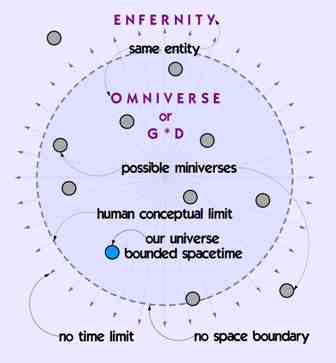
*3. GOD OUTSIDE SPACE-TIME
-
Is the real world fair and just?
That is of interest to me. Especially because, on this forum, the harshest critic of my personal worldview, Enformationism, also claims to be a Spinozist. I wouldn't call myself a Spinozist, since I only know of his ideas via second hand accounts. I told him (the critic) that my philosophical world model is, like Spinoza's, more akin to Science than Religion, but it also assumes that cosmic Evolution is not aimless & accidental, but governed & directed by logical/mathematical internally-coded laws similar to a computer program.Anyway, as I said, I was presenting Spinoza's thought (as I understood it). I was actually a Spinozist in 2011-2013, but now my views are quite different. For instance I am neither convinced by his metaphysics (especially I quite disagree with his complete denial of any kind of free will) nor by his convinction that philosophy is 'liberating'. I do find his views fascinating and they did left a strong impression in me. — boundless
I know nothing of the implicit lawmaker/mathematician/programmer --- or He/r telos --- but I like Plato's notion of Logos as a label for the ordering principle of the universe. Apparently, even such a non-theological notion as Logos or First Cause or Prime Mover is too close to his despised Catholic dogma for his comfort. And any intimation of transcendence (i.e. pre-big-bang) offends his Immanentist beliefs.
Since at least one species of gradually evolved creatures has developed a somewhat objective & rational understanding of world events, I conclude that A> the ability to stand outside our emotion-driven animal nature, and B> the power to generate unique personal ideas (abstract representations, images, models, goals) of our own, allows us to become local centers of Will within the universal "Willpower" (motive force) of the universal thermodynamic system, otherwise dominated by destructive Entropy. Which, in effect, makes us humans the "little gods" of the world. Hence, we have begun to create sub-human creatures of our own, such as complex machines and artificial intelligence, that execute the will of their programmers.
How do you think Spinoza would judge such a 21st century update of his own 17th century worldview? :smile:
Enformationism :
A philosophical worldview or belief system grounded on the 20th century discovery that Information, rather than Matter, is the fundamental substance of everything in the universe. It is intended to be the 21st century successor to the ancient worldviews of Materialism and Idealism. An Update from Bronze Age to Information Age. It's also a Theory-of-Everything that covers, not just matter & energy, but also Life & Mind & Love.
https://blog-glossary.enformationism.info/page8.html
Enformy :
In the Enformationism thesis, Enformy is a hypothetical, holistic, metaphysical, natural trend or force, that counteracts Entropy & Randomness to produce complexity & progress. Physicists inappropriately labeled that positive force as "Negentropy".
https://blog-glossary.enformationism.info/page8.html
Gnomon

Start FollowingSend a Message
- Other sites we like
- Social media
- Terms of Service
- Sign In
- Created with PlushForums
- © 2026 The Philosophy Forum