
Comments
-
Marx's Value TheoryI think there's some additional work that needs to be done at this point, the details could be glossed over and you could understand Marx's value theory regardless, but because I'm trying to take an algebraic approach to Marx's value theory when a mathematical problem presents itself I have to address it.
Given the elementary form of value, it makes sense to ask questions like "if 1 coat trades for 1 pair of trousers, and if 2 yards of linen trade for 1 suit jacket, if I have 1 coat and 2 yards of linen can I trade both for 1 pair of trousers and a suit jacket?'. The question here is whether there is any algebraic structure to the set of possible trades involving multiple goods.
My account has changed a little, the basic ideas were right but I flubbed some of the detail. In order to make sense of multi-commodity trades, let's look at the difference between buying beef mince from a butcher in a specific weight (called BM), and buying beef mince from a supermarket in a wrapped packet (called SM).
If I was writing a shopping list, the only possible amounts of SM which could be obtained are non-negative integer multiples. This is to say that I could buy 1 packet, 2 packets, 3 packets and so on, or indeed 0 packets and buy none. SM comes in discrete amounts.
Whereas, on the same shopping list, I could buy non-discrete amounts of BM. 50 grams, 53.1 grams, 100 grams, 1.23456kg and so on. GM comes in amounts which are infinitely divisible.
I think these properties exhaust the possible amounts commodities could be bought in: either you have a discrete amount or you have an infinitely divisible amount (in principle but not in practice). If it turned out that there was a smallest denomination of every given commodity of which every possible amount was a multiple, the discrete amounts alone would suffice. But I don't think it's fair to make this assumption given that things like meat can be bought in approximated fractions of any given amount.
I will call the collection of amounts which a commodity can come in the amount-structure of a commodity. Just like a shopping list, it's required to be able to write down any amount possible of the commodity, but also to be able to add on or scale the amount by a number to adjust for different recipes or different numbers of people eating and so on.
Commodities like SM which come in discrete units I will call discrete commodities, commodities like BM which come in approximated infinitely divisible amounts I will call continuous commodities. I'll now discuss the amount-structure of SM.
If I buy an SM, then buy another SM, this is the same as buying 2 SM. Similarly, if I wanted to buy 1 SM but needed to scale up for more company, I could buy 2*1SM and get 2 SM. This says that the amount-structure of discrete commodities, henceforth called the discrete amount structure, has two mathematical operations contained in it which interact: addition of other amounts of SM, and multiplication of all amounts present by some non-negative integer. This means that dealing with SM is exactly the same as dealing with the non-negative integers under addition and multiplication. Such additions and multiplications obey the distributive law c*(a+b)SM = ca + cb SM and are commutative and associative. There can be no subtraction or division of amounts, since -1SM and 0.5SM are not possible numbers of commodities to buy (respectively). There are two identities, if I multiply an amount by 1, it remains the same., similarly if I add a 0 amount. So the discrete amount structure for a single commodity is a commutative semiring with multiplicative (1) and additive (0) identity elements.. It also needs to be assumed that SM = 1 SM, which is essentially a notational convenience.
If I buy a weight X of BM, then I could scale it up by 1.5 and still have a buyable amount of BM, 1.5X BM. I could also divide X by 2 and have a buyable amount, 0.5X BM. I could double then halve the amount of BM and receive the original amount. I still cannot buy -1 BM however. Addition and multiplication also follow the distributive law together. These together mean that the continuous amount structure has a commutative semigroup with identity (0) as its additive component, and a commutative group (with identity 1 and multiplicative inverses) when ignoring 0 (which has no multiplicative inverse).
The last thing which needs to be clarified before proceeding is what it means to write down, say, 1 coat + 1 pair of trousers; to demarcate the possible combinations of the commodities. For a set of commodities with the same amount structure, defining the set C of commodities present in their canonical amounts (like 1 SM 2 paragraphs above) and equipping it with free addition - writing symbols side by side with a plus between - suffices. This can be thought of as writing down two items on a shopping list from the possible things which can be bought from the store. It is also the case that the order things are written down don't matter. This makes (as before) the set C the commutative free semigroup under addition.
These observations give the tools to go a little further. What if in addition to SM I would like to buy a coat? Well, the amount structures are the same, so I could say I will buy 1 SM + 1 coat, where + is understood as agglomerating the objects into a shopping list. I could add any amount of coats or an amount of SM and still obtain a viable shopping list of goods. If I wanted to double the amount of coats and triple the amount of SM I could do that too. So what should be formalised is essentially many labelled copies of the same amount structure occurring side by side without influencing each other (eg, ruling out things like 1SM + 2 coats = 3SM). The appropriate definition then is very much like a module over a ring, but since there aren't additive inverses for the discrete amount structure it can't be a ring. Regardless, it will follow some of the same rules:
We have a set of discrete commodities DC, each of which has the same amount structure M (the non-negative integers). The addition and multiplication, from the previous discussion, follow the laws:
(A) r*(x+y)=r*x+r*y, for all r in DC and x,y non-negative integers
(B) (r+s)*x=r*x+s*x, for all r,s in DC and x non-negative integers
(A) formalises that adding the amounts before you buy them to obtain the intended amount is the same as buying distinct amounts which sum to the intended amount.
EG: SM*( 1 + 2 ) = 1 SM + 2 SM
(B) formalises that you can scale your entire shopping list up by any non-negative integer and this is the same as buying that multiple of each item.
EG: (SM + coat)*2 = 2*SM + 2*coat
This structure will be called (DC,+,*).
An analogous argument holds for the continuous amount structure on the set CC and it also satisfies A and B but with x,y rational or real. That structure will be called (CC,+,*). This allows the aggregation of arbitrarily many discrete and arbitrarily many continuous commodities, but does not solve the riddle of their interaction; the structure of writing down 1 SM + 0.5 BM still needs to be fleshed out.
If it helps, writing down examples for the continuous and discrete cases individually looks exactly the same as doing calculations with vectors; if there are N distinct discrete commodities in the expression, the amounts of each will be written in front of each commodity. Additions work component-wise. Similarly for the continuous commodities.
The analogy with vector spaces suggests that sandwiching the structures DC and CC together in parallel, like the dimensions of vectors are sandwiched together, is an appropriate strategy. This means that continuous commodities will never add to discrete commodities and start mucking up the appropriate amounts which can be bought. The thing I'm aiming at is a closed mathematical structure that allows addition and multiplication in the right way. To be sure, multiplication by a scalar is more involved than with vector spaces because things like 0.5 coats make no sense. This means scalar multiplication also needs to be somehow partitioned to act on discrete and continuous commodities separately; or alternatively removed entirely as it cannot act on discrete and continuous commodities at the same time for non-integer scalars.
A tentative guess I have for this structure is to take (DC,+,*) and (CC,+,*) as generators for the overall structure of commodity amounts, and simply define that structure as the collection of formal sums of arbitrary elements in DC with CC, and to define addition as 'component-wise' addition in DC and CC respectively - and just leave overall scalar multiplication undefined. To be sure, this would allow the production of lines like:
0.5BM + 2CM+BM+CM= 1.5BM+3SM
and like calculations. Addition and multiplication of the whole thing by non-negative integers (the discrete amount structure) can be easily defined too since the addition in both is commutative; ie the semigroup action construction, 2SM = SM+SM from before, but now 2*(1.5BM)=1.5BM+1.5BM=3BM too. I suppose that will have to do. -
Marx's Value TheoryWhat would the exchange relations look like in a mode of production that satisfied the elementary form of value? This breaks down into two questions:
(1) What would the exchange relations look like in a mode of production that satisfied the elementary form of value alone with no additional constraints?
(2) If (1) does not look like the capitalist mode of production, what additional constraints are required to more accurately model the form of value in capitalist production?
The logical space of exchange relations which satisfy (1) is very broad, and does not even need to have a stable numerical equivalence of values over repeated exchanges. This can be shown thusly:
If we have 4 commodities, x=1 coat, y= 1 pair of trousers, z=1 yards of linen,2z=2 yards of linen. Assume they trade concretely like:
(1) 1 coat is worth 1 pair of trousers|xTy
(2) 1 pair of trousers is worth 1 yard of linen|yTz
(3) 2 yards of linen is worth 1 coat|2zTx
then make it satisfy the symmetry condition (flipping the relations around):
(4) 1 pair of trousers is worth 1 coat| yTx
(5) 1 yard of linen is worth 1 pair of trousers| zTy
(6) 1 coat is worth 2 yards of linen| xT2z
Say I start with z = 1 yard of linen.
z->y->x->2z is a possible sequence of trades, using zTy, yTx, xT2z. This means we could start with 1 yard of linen and end up with 2 despite only going through trades of equivalent value. To be able to say that 1 yard of linen is worth 2 yards of linen through the medium of exchange should tell us that something is very different from how exchange works under capitalist production. IE that the elementary form of value alone and without additional constraints is not a good picture of how value works in capitalist societies, at least most of the time.
It is within the potential of the elementary form of value to amplify (or diminish) the value owned through trade of things held equivalent, which is to say that considerations of value magnitude are only done relationally through T and not through an equation of numerical magnitudes of the same unit. The ability to alter held values in this manner is unlikely to survive in a stable community which has common knowledge of how much of one thing trades for another. Thus the situations this raw elementary form of value could hold sway in are those that have sufficiently rapid fluctuations in the relative values of commodities (fluctuations more rapid than the actions of trade) or when some part of the system of exchanges occurs isolated from another.
Another thing to note is that the elementary form of value doesn't need to have anything which resembles money in any way; all commodities are as good as any other as the repositories of value. Under the conditions above, if there were a common currency for the system of exchange it could literally be used to buy more of itself through a series of favourable trades, supposedly of equal 'value'.
Such a mitosis of money has precedents in the real world. However, the mitosis in reality leverages temporal instabilities in the trade relation - which are juxtaposed without temporal indices in the elementary form. The elementary form above should hence be thought of as the elementary form at a given time and place because the determination of its features depends more on accidental irregularity than essential regularities. -
Marx's Value TheoryThis is 'old ground' for the thread, but it is presented in a lot more detail (and with one of my misconceptions cleared up).
SUBSECTION A: The Elementary or Accidental Form Of Value
{
Marx's pictogram of this constituent of the value form
x commodity A = y commodity B, or
x commodity A is worth y commodity B.
20 yards of linen = 1 coat, or
20 Yards of linen are worth 1 coat.
}
SUBSUBSECTION 1: The two poles of the expression of value. Relative form and Equivalent form
This part of the account locates two components of the value form; the relative form of value and the equivalent form of value; and exhibits a structural symmetry between them. The equivalent and relative forms of value are a necessary constituent of the form of value. The relative and equivalent form together specify the behaviour of the value form whenever we say that x has the same value as y. Whenever we can say that x has the same value as y; ie whenever the relative and equivalent form are jointly in play; we can say that the elementary form of value is at play too. Additional structure will be applied to the elementary form of value, yielding more constrained (yet algebraically more rich) forms of value.
Note that underpinning this account is the commensurability of commodities under the analysis of socially necessary labour time (and its direct price, a term which has its conceptual origin here, though it is not used explicitly by Marx).
The whole mystery of the form of value lies hidden in this elementary form. Its analysis, therefore, is our real difficulty.
In a similar sense to which the analysis of capital pivots upon the analysis of the commodity, the analysis of the exchange value of that commodity pivots on the understanding of the elementary form of value - which then leads to the exegesis of richer forms of value that can subsume the elementary form.
Here two different kinds of commodities (in our example the linen and the coat), evidently play two different parts. The linen expresses its value in the coat; the coat serves as the material in which that value is expressed. The former plays an active, the latter a passive, part. The value of the linen is represented as relative value, or appears in relative form. The coat officiates as equivalent, or appears in equivalent form.
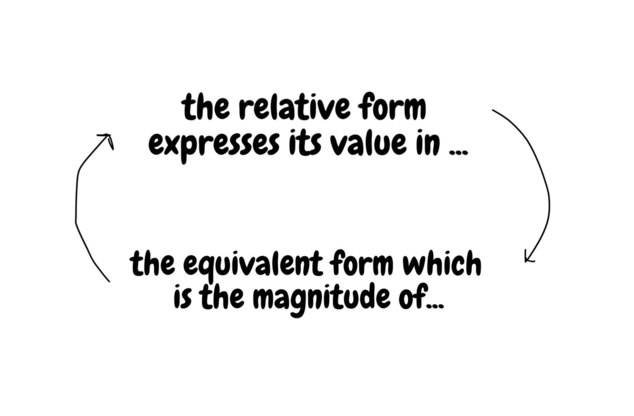
At this point, I will introduce the relation T. T is a relation on a set of commodities C. Whenever x is related in way T to y, I will write xTy, Formally, a relation on a set X is a set of ordered pairs of objects from X. In this way, T will be a relation on C. Read 'T' as 'is worth the same as', so xTy is read 'x is worth y'.
Marx begins with an example of the linen and the coat; say 2 square yards of linen is worth 1 coat. Then we have, abbreviating, (2 linen)T(1 coat). This is the relative form of value for 2 linen, and 1 coat is serving as the equivalent.
The next paragraph asks the question of whether (2 linen)T(2 linen) gives the value of linen in linen.
The relative form and the equivalent form are two intimately connected, mutually dependent and inseparable elements of the expression of value; but, at the same time, are mutually exclusive, antagonistic extremes – i.e., poles of the same expression. They are allotted respectively to the two different commodities brought into relation by that expression. It is not possible to express the value of linen in linen. 20 yards of linen = 20 yards of linen is no expression of value. On the contrary, such an equation merely says that 20 yards of linen are nothing else than 20 yards of linen, a definite quantity of the use value linen. The value of the linen can therefore be expressed only relatively – i.e., in some other commodity. The relative form of the value of the linen presupposes, therefore, the presence of some other commodity – here the coat – under the form of an equivalent. On the other hand, the commodity that figures as the equivalent cannot at the same time assume the relative form. That second commodity is not the one whose value is expressed. Its function is merely to serve as the material in which the value of the first commodity is expressed.
Marx answers 'no'; "It is not possible to express the value of linen in linen. 20 yards of linen = 20 yards of linen is no expression of value. On the contrary, such an equation merely says that 20 yards of linen are nothing else than 20 yards of linen, a definite quantity of the use value linen.".
It is certainly true that the value of linen will always be the value of linen, irrelevant of what that value is, just as it is true that the value of a coat will always be the value of a coat. Marx suggests that because '2 linen is worth 2 linen' does nothing to express the value of linen relative to anything else, that it cannot be an expression of the relative value of linen; simultaneously, x cannot serve as the equivalent form for x. I grant that this is true; it is completely uninformative about the value of linen to say that it is worth linen.
When two distinct commodities were brought into the exchange relation in section 1, the qualitative particularity of each could not serve as the quantitative measure for both as equal; all concrete particularities of labour were agglomerated into human labour in the abstract. Marx suggests that this account; by which two distinct commodities were exhibited in their equivalence; would not work for the same commodity to exhibit it in equivalence with itself; the commodity is itself in every way. The meeting of a commodity with itself in exchange may be seen as a degenerate, impossible case that undermines Marx's argument of the relation of time and value. See just below to ground this point in the text:
It is not possible to express the value of linen in linen. 20 yards of linen = 20 yards of linen is no expression of value. On the contrary, such an equation merely says that 20 yards of linen are nothing else than 20 yards of linen, a definite quantity of the USE VALUE linen.
My claims:
(1) Marx suggests that this account; by which two distinct commodities were exhibited in their equivalence; would not work for the same commodity to exhibit it in equivalence with itself; the commodity is itself in every way.
(2) the qualitative particularity of each could not serve as the quantitative measure for both as equal; all concrete particularities of labour were agglomerated into human labour in the abstract.
(1) is rooted in the use of 'are', bolded and italicised, in the above quote.
(2) is rooted in the last clause of the bolded sentence, with reference to the 'USE VALUE' of linen which I capitalised. Linen meets itself, so it still meets itself as an amount of a concrete particular.
This comes down to the question of whether T is reflexive; whether for all x: xTx. Perhaps Marx would answer no, but I would like to argue that this additional assumption does no damage Marx's account, and is worthwhile on the basis of its utility in formalising his value theory.
While it is true that linen meeting linen would not allow the derivation of the relationship of human labour in the abstract to value, in terms of the socially necessary labour time of linen, if a meeting of linen with another commodity had already been posited, the concrete particularities of linen as a use value would still be excluded from the relation expressing its value. This is to say, we may say xTx and 'x is the same as x' can mean different things. Specifically, xTy says 'x is worth y'; a numerical equality of something in each in some unit of measure; whereas 'x is the same as y' is a full identity of all properties.
So yes, I am in agreement with Marx on both points; that xTx tells you nothing about the specific value of x, and that xTx could not be analysed in the same way to argue for abstract labour's magnitudinal relation to time. But I believe that if we consider xTx, xTy, yTx and yTy together, we still exhibit the relative form of x in y; in which y is the equivalent (xTy). And the relative form of y in x; in which x is the equivalent (yTx), so in (xTx) and (yTy), the commodities can already be understood not to meet as identical use values, but to meet as numerically identical exchange values. The instances of the relation xTx and yTy are still value uninformative; and this property aligns well with the reflexivity of T. Just as with usual mathematical equality, x=x, we don't immediately derive a conceptual contradiction regarding relative and equivalent forms because x=x for all x, we treat x=x as an uninformative tautology about the value of x.
So from now on, I will assume that T is a reflexive relation, and that this does no damage to Marx's account.
Marx continues:
No doubt, the expression 20 yards of linen = 1 coat, or 20 yards of linen are worth 1 coat, implies the opposite relation. 1 coat = 20 yards of linen, or 1 coat is worth 20 yards of linen. But, in that case, I must reverse the equation, in order to express the value of the coat relatively; and so soon as I do that the linen becomes the equivalent instead of the coat. A single commodity cannot, therefore, simultaneously assume, in the same expression of value, both forms. The very polarity of these forms makes them mutually exclusive.
The two sentences are important for the mathematical structure of T:
No doubt, the expression 20 yards of linen = 1 coat, or 20 yards of linen are worth 1 coat, implies the opposite relation. 1 coat = 20 yards of linen, or 1 coat is worth 20 yards of linen.
This is literally the meaning of the symmetry of a relation: if xTy then yTx. If x is worth y then y is also worth x. This establishes that T is symmetric. It is now reflexive and symmetric. But it is worth lingering a little here to highlight some extra mathematical structure that Marx is aware of.
But, in that case, I must reverse the equation, in order to express the value of the coat relatively; and so soon as I do that the linen becomes the equivalent instead of the coat.
If C = {x,y}, and xTy, then T on y is:
from symmetry and reflexivity. Look at what happens when we reverse the order in which elements are brought under T, calling this new relation T*
it's exactly the same relation as T, just with the order of the last two pairs flipped. So:
those familiar with some order or category theory may notice that T is self dual. This means it is the same as before when the order of all pairs is flipped. Writing this out in words might make the (for me, squee inducing) conclusion clearer:
T is: (1) x is worth x
(2) y is worth y
(3) x is worth y (x relative, y equivalent)
(4) y is worth x (y relative, x equivalent)
T* is: (1) x is worth x
(2) y is worth y
(3) y is worth x (y relative, x equivalent)
(4) x is worth y (x relative, y equivalent)
the part of the relation dealing with the relative and equivalent forms of value inverse their order when the order of the pairs are reversed. This means that the notion of relative form is dual to the equivalent form in the category theoretic sense, and the relation of values T is self dual as a consequence of that (and of symmetry).
Whether, then, a commodity assumes the relative form, or the opposite equivalent form, depends entirely upon its accidental position in the expression of value – that is, upon whether it is the commodity whose value is being expressed or the commodity in which value is being expressed.
And it seems Marx was aware of this duality of structures - assuming the relative or equivalent form are just positional accidents which imply the other accident. The structure Marx diagnoses of the elementary form of value is unperturbed by the assumption of the reflexivity of the 'is worth' relation. -
Marx's Value TheoryMarx recaps the 'spectral objectivity' of value in commodities and sets up what is at stake in providing a theory of value.
Commodities come into the world in the shape of use values, articles, or goods, such as iron, linen, corn, &c. This is their plain, homely, bodily form. They are, however, commodities, only because they are something two-fold, both objects of utility, and, at the same time, depositories of value. They manifest themselves therefore as commodities, or have the form of commodities, only in so far as they have two forms, a physical or natural form, and a value form.
This paragraph is an elaboration of the idea that commodities are composites of use and exchange value; the elaboration being that exchange value has some formal characteristics apart from the aforementioned relationship with socially necessary labour times. This formal structure of value in commodities is the ground upon which the magnitudes of value make sense...
The reality of the value of commodities differs in this respect from Dame Quickly, that we don’t know “where to have it.” The value of commodities is the very opposite of the coarse materiality of their substance, not an atom of matter enters into its composition. Turn and examine a single commodity, by itself, as we will, yet in so far as it remains an object of value, it seems impossible to grasp it. If, however, we bear in mind that the value of commodities has a purely social reality, and that they acquire this reality only in so far as they are expressions or embodiments of one identical social substance, viz., human labour, it follows as a matter of course, that value can only manifest itself in the social relation of commodity to commodity. In fact we started from exchange value, or the exchange relation of commodities, in order to get at the value that lies hidden behind it. We must now return to this form under which value first appeared to us.
and situates the structural analysis of value, initially, within an account of exchange as the exchange of commodities...
Every one knows, if he knows nothing else, that commodities have a value form common to them all, and presenting a marked contrast with the varied bodily forms of their use values. I mean their money form. Here, however, a task is set us, the performance of which has never yet even been attempted by bourgeois economy, the task of tracing the genesis of this money form, of developing the expression of value implied in the value relation of commodities, from its simplest, almost imperceptible outline, to the dazzling money-form. By doing this we shall, at the same time, solve the riddle presented by money.
which comes to underpin the application of prices to them. Thus...
The simplest value-relation is evidently that of one commodity to some one other commodity of a different kind. Hence the relation between the values of two commodities supplies us with the simplest expression of the value of a single commodity.
we begin with the simplest example of exchange; exchange of one commodity for another. -
Marx's Value TheoryGoing through section 2 again, I got some details about the elementary form of value wrong - symmetry of the trade relation is baked in from the start. The elementary form of value consists of otherwise unstructured symmetric pairs of pairs, so instead of just being the minimal reflexive relation, it's the minimal reflexive+symmetric relation of trades seen from either side - another feature of it is that the relation is not consistent with a strict ordering on trades. There's also a discussion to be had over whether stipulating that the T relation is reflexive is a harmless embellishment, a decent exegesis or occludes part of Marx's account, which I will do. The expanded form still appears to consist in the transitivity condition and the money commodity still appears to function like the canonical representative of a value equivalence class, though the formal equality of these ideas with Marx's turns on whether it's OK to treat the trade relation as reflexive.
So yeah, there's some work to do - clearing up previous misconceptions and discussing the introduction of orders that respect the value relation and the commutative monoid of commodities. What I wrote previously - especially the bits after the elementary form - I believe is largely fine.
note to self: sum like vs mean like orders in prospect theory -
Marx's Value Theory
I mean what are they? I don't understand if it's criticism; I never claimed that the 2008 crisis was brought about through the crash of a commodity market, nor did I deny the self reinforcing feedback mechanisms that can amplify the rate of devaluation of financial assets. -
Marx's Value Theory
I'm having a real hard time gauging what the intentions behind your posts in this thread are. -
Marx's Value TheoryCommodities come into the world in the shape of use values, articles, or goods, such as iron, linen, corn, &c. This is their plain, homely, bodily form. They are, however, commodities, only because they are something two-fold, both objects of utility, and, at the same time, depositories of value. They manifest themselves therefore as commodities, or have the form of commodities, only in so far as they have two forms, a physical or natural form, and a value form.
Marx recaps: commodities are only commodities only insofar as they have use and exchange values. Use values are always a product of concrete, social labour, exchange values are always a product of human labour in the abstract - the coincidence of both of these features is the mark of the commodity.
The reality of the value of commodities differs in this respect from Dame Quickly, that we don’t know “where to have it.” The value of commodities is the very opposite of the coarse materiality of their substance, not an atom of matter enters into its composition. Turn and examine a single commodity, by itself, as we will, yet in so far as it remains an object of value, it seems impossible to grasp it. If, however, we bear in mind that the value of commodities has a purely social reality, and that they acquire this reality only in so far as they are expressions or embodiments of one identical social substance, viz., human labour, it follows as a matter of course, that value can only manifest itself in the social relation of commodity to commodity. In fact we started from exchange value, or the exchange relation of commodities, in order to get at the value that lies hidden behind it. We must now return to this form under which value first appeared to us.
Not an atom of value is found upon dissection of the commodity - no assay of a material item will provide more insight into the composition of its value than staring at it blankly. Rather, value is found in the social relations which surround the thing and become embedded into it as the manifestation of a social function. The value of a commodity consists in the social relations which underpin its production and exchange, thus the conceptual analysis of the value of a commodity is to be embarked upon by analysing social relations of exchange and the abstract features of production.
The aim of the investigation is to find that social mechanism, and its mathematical/logical grammar, which imbues the commodity with value and facilitates it to be exchanged with others of equal value. There is somewhat of a 'left turn' here in the analysis, the initial focus on exchange as the exchange of commodities is now being leveraged into an analysis of the values which permeate that exchange and lend it its features in capitalist production.
Every one knows, if he knows nothing else, that commodities have a value form common to them all, and presenting a marked contrast with the varied bodily forms of their use values. I mean their money form. Here, however, a task is set us, the performance of which has never yet even been attempted by bourgeois economy, the task of tracing the genesis of this money form, of developing the expression of value implied in the value relation of commodities, from its simplest, almost imperceptible outline, to the dazzling money-form. By doing this we shall, at the same time, solve the riddle presented by money.
Marx highlights a problem which the economists of his time, and the conventional wisdom you will still find in economics textbooks, pay no attention to. Everyone and their dog knows that everything has a price, and since prices are all we see pricing is seen as a subjective act, as an affectation of a supply/demand model, or as the empirical subject of a willingness to pay study. These are the usual recourses to explain why everything has a price and why it has the price it has. Marx seeks to ask a deeper set of questions; what is it about an economy that allows everything to have a price? What is it about an economy that is facilitated by money? How does money obtain its value? To say that the value of money is determined by a pricing mechanism is as well as saying the sleep inducing effects of tramadol are caused by its soporific properties; that is to say nothing of note and coat it with different words. The question of pricing mechanisms as they work in capitalist economy is a lot different from the questions regarding what allows value to obtain of commodities and money in the first place. The question of value underpins the question of price.
Whenever an economic crisis comes - most recently in 2008 - we see talk of 'bubbles bursting'. Economic bubbles arise from the over pricing of an asset suddenly collapsing towards its true price. What allows us to distinguish the over priced asset from the truly priced one? Well, the true price is invariably lower than the over priced asset - but if we were to concede to an account of political economy that begins solely with a pricing mechanism, an asset can only be seen as over valued with relation to a sharp drop in its price, until the price drops the pricing mechanism has the final say. Even highly sophisticated econometric methods, such as the analysis of asset growth using wavelet methods to screen for impending crashes, or the thresholding of instantaneous variance in stochastic volatility models to mitigate unpredictable large losses attempt to describe the precursors in the price mechanism which may signal the over valuation of an asset. But of course, this is a symptom of the properties of the economy which underly the proximity of changes. And we would be as well as saying that the increase in body temperature due to a fever was really due to the increase in bodily temperature, as we would in saying that instabilities in price curves and the pricing mechanism are the systemic cause of the popped bubble.
Again, this state of affairs is a rather strange one; if a close friend suddenly starts behaving very differently, we definitely could give the following account: the friend behaved different before, the friend behaves different now. But if all we had to judge on was the relation of short term behavioural changes, we might as well say that the friend was behaving normally before, and now they are behaving normally despite the observed difference. Of course, anyone truly interested in their close friend would wonder things like: 'what has brought about this change contrary to their personality?' or 'what has caused their personality to change?'.
Just as with the bubble; 'what about the previous trend popped the bubble?' or 'what forced the dominance of the post bubble trend?'. Systematic investment; all our skin in the game; demands we be able to ask these questions; and a theory of value accompanied by a theory of price is one way to make room for them. These are important questions, politicians, business owners, economists and members of think tanks require, use and supply analyses of them; people pay a lot of money to get these questions to have the answers they want. People pay a lot of money to anyone willing and skilled enough to try answer these kind of questions.
The tensions underpinning changes in price effect us all, and if it were so 'lawless and irregular', we should be more surprised at the often successful efforts of the rich and powerful to harness these 'lawless irregularities' for their overwhelming benefit. -
Marx's Value TheorySection 3
THE FORM OF VALUE OR EXCHANGE VALUE
Marx has spent a lot of time setting up the notion of value as it occurs within commodities, and how it facilitates exchange of somehow 'equal' commodities. The abstract equivalence (sortal & numeric) of socially necessary labour time and the direct price of a commodity has been laid bare, but what hasn't been part of the account is the structure of value and how this structure prefigures and is embodied in exchange. Maybe a useful distinction here to set up where Marx is going is exchange in the abstract and concrete acts of exchange; so far, the realities of trade and the social relations around it have played little part in the determination of commodities as equal subjects of exchange, even less so how the social relations in an economy mathematically/logically structure exchange.
We know so far that commodities of equivalent value can be exchanged, and we know that the magnitude of value is embodied in the direct price as expressed in socially necessary labour time; but we don't know the structure of value which facilitates this equation for exchange at large. That is to say, extra work needs to be done to reveal the structure of value within the commodity that allows it to be (always-already) equivalent to another of equal value. That is, Marx needs to spend some time exhibiting exchange in the abstract; its general features without reliance on specific trades, the general properties of trade that are essential to specific social organisations of trade. He then needs to fold this exchange in the abstract into concrete acts of exchange of equivalent value; showing how the logical structure of value reproduces itself through commodity and money flows.
The first part of the above; dealing with exchange in the abstract; is of determining the value-form of value in capitalist societies. The second part is in showing how the value form is carried forth in the concrete acts of exchange. Exchange in the abstract is the topic of section 3, the concretion of it is more fully developed in chapters 2 and 3 - dealing specifically with exchange then the circulation of commodities through money.
So, Marx has already demonstrated that socially necessary labour time, and thus direct price, inheres in commodities through the productivity of their corresponding labour. What is at stake in section 3 here is the logical/mathematical/algebraic structure of that inherence. It is half of the core of Marx's value theory, the other being the analysis of concrete exchange as it plays out under capitalist rules.
Much of section 3 is recapitulated in chapter 3 section 1 in order to relate it to concrete exchange and circulation; so a very dense exhibition of Marx's value theory was the original intention for this thread. Since the thread has been of interest to some posters, I decided to continue it - so the analysis of the next section will consist of more thorough exhibition of Marx's theory of value. Of course, it will come along with my usual mathematical embellishments. -
Marx's Value Theory
Ironically enough you don't have to wait that long in volume 1 to get to parts dealing with the content of this post. It begins in chapter 3 with the circulation of commodities and money. -
Marx's Value Theory
There's another 2 volumes left of the account frank. Marx doesn't restrict his view to commodities eventually. There's analysis of debt, speculation, credit, stores of value, different coupled productive spheres etc etc. I think you're attributing limitations to the account which aren't there, and I'm not going to go through them - at least not before I'm finished going through what I said I would in volume 1.
So yes, the analysis so far is limited. It's about 20-30 usual book pages into a 2.5k page work - with lots of accompanying relevant essays. -
Marx's Value Theory
I'm unsure if you've actually been reading what I write. Lots of the posts I've made highlight that 'society' for Marx is a placeholder. -
Marx's Value Theory
It is, and it varies greatly from one country to the next. Another feature of labor that goes into commodity creation is a society's physical infrastructure, roads that facilitate the transfer of supplies, that sort of thing. So again, the direct price (or labor time) is actually scattered far and wide.
Yeah. I agree with this, but I think it's a part of the account. Read the bits I wrote on the decomposition of commodities into labour sources and assembly times again if it's unclear.
Also, something being hard to estimate or get a handle on has never stopped economists from trying. I think direct price is actually a very useful tool in thinking about production in general - it's relatively time stable and definitely linked to the real costs of production and profit rates; and I also think Marx's analysis of the value form( s ) (his 'theory of value', thread title), is extremely persuasive. -
Marx's Value TheoryThe brevity of the second section suits its function as an interlude between the analysis of use and exchange values - and their linkage with concrete and abstract labour - in the first section, and the analysis of the social and logical/mathematical structure of trade in the third section. The second section serves this end by recapitulating the notion of human labour in the abstract and showing how concrete and abstract labour become linked in the commodity through productivity.
The single major term which is introduced here is human labour power, which is useful, productive exertion. Another major highlight in the chapter is that in order for a commodity to have an exchange value, its use value must be a social use value; that is useful to the aggregate. -
Marx's Value TheoryCoats and linen, however, are not merely values, but values of definite magnitude, and according to our assumption, the coat is worth twice as much as the ten yards of linen. Whence this difference in their values? It is owing to the fact that the linen contains only half as much labour as the coat, and consequently, that in the production of the latter, labour power must have been expended during twice the time necessary for the production of the former.
A simple restatement of the proportionality derived above. Direct price is proportional to the quantity produced and inversely proportional to the productivity of labour.
While, therefore, with reference to use value, the labour contained in a commodity counts only qualitatively, with reference to value it counts only quantitatively, and must first be reduced to human labour pure and simple. In the former case, it is a question of How and What, in the latter of How much? How long a time? Since the magnitude of the value of a commodity represents only the quantity of labour embodied in it, it follows that all commodities, when taken in certain proportions, must be equal in value.
Again, use value and concrete labour align on the axis of quality, value and abstract labour align on the axis of quantity. Also see previous discussion of why socially necessary labour time manifests in direct price. The 'equality in value for certain proportions' component of this prefigures the discussion of the value form in the next section.
An increase in the quantity of use values is an increase of material wealth. With two coats two men can be clothed, with one coat only one man. Nevertheless, an increased quantity of material wealth may correspond to a simultaneous fall in the magnitude of its value. This antagonistic movement has its origin in the two-fold character of labour. Productive power has reference, of course, only to labour of some useful concrete form, the efficacy of any special productive activity during a given time being dependent on its productiveness. Useful labour becomes, therefore, a more or less abundant source of products, in proportion to the rise or fall of its productiveness. On the other hand, no change in this productiveness affects the labour represented by value. Since productive power is an attribute of the concrete useful forms of labour, of course it can no longer have any bearing on that labour, so soon as we make abstraction from those concrete useful forms. However then productive power may vary, the same labour, exercised during equal periods of time, always yields equal amounts of value. But it will yield, during equal periods of time, different quantities of values in use; more, if the productive power rise, fewer, if it fall. The same change in productive power, which increases the fruitfulness of labour, and, in consequence, the quantity of use values produced by that labour, will diminish the total value of this increased quantity of use values, provided such change shorten the total labour time necessary for their production; and vice versâ
Some of this is an echo of the distinction between concrete and abstract labour. But, concrete and abstract labour become linked conceptually and conceptually to value in the sense of real abstractions through the productivity of concrete labour. The productive power of concrete labour producing a given commodity scales inversely to its socially necessary labour time. Productivity provides the means of embodiment of abstract labour within its concretions; the concrete conditions of production distributed over every commodity.
A consequence of this is the decoupling of material wealth magnitudes in terms of use-value satisfaction and material wealth magnitudes in terms of exchange value - it costs less to obtain something which is produced more quickly, an a horde of a rare use value with high exchange rate can become devalued when the socially necessary labour time for the items in that horde decreases in the aggregate.
The decoupling of use and exchange, the intermingling of concrete and abstract labours in productivity, and the destruction of specificity in magnitude of value comparisons pave the way for the analysis of the value form - how a commodity becomes branded with value, how that value expresses underpinning social conditions of production, and how the magnitude of that value is linked to other commodities and human labour in the abstract. Marx puts it thusly (footnote A):
Now we know the substance of value. It is labour. We know the measure of its magnitude. It is labour time. The form, which stamps value as exchange-value, remains to be analysed. But before this we need to develop the characteristics we have already found somewhat more fully. -
Marx's Value Theory
As in every other response to you in this thread, so far the discussion concerns value and value production. It is true that even the production of commodities has logistical, engineering and bureaucratic real price overheads which give the social and technical texture to the production of commodities; perhaps even logistics should be considered as part of the direct price. Regardless, the concern so far is direct price and its relationship to labour in commodity production. -
Marx's Value TheoryMarx is still summarising the implications of his arguments relating concrete labour to use and abstract labour to exchange, and the properties of abstract labour to the magnitude of exchange value.
Just as, therefore, in viewing the coat and linen as values, we abstract from their different use values, so it is with the labour represented by those values: we disregard the difference between its useful forms, weaving and tailoring. As the use values, coat and linen, are combinations of special productive activities with cloth and yarn, while the values, coat and linen, are, on the other hand, mere homogeneous congelations of undifferentiated labour, so the labour embodied in these latter values does not count by virtue of its productive relation to cloth and yarn, but only as being expenditure of human labour power. Tailoring and weaving are necessary factors in the creation of the use values, coat and linen, precisely because these two kinds of labour are of different qualities; but only in so far as abstraction is made from their special qualities, only in so far as both possess the same quality of being human labour, do tailoring and weaving form the substance of the values of the same articles.
He is restating the implication that when two commodities enter into the exchange relation, their use values and features of concrete labour are not relevant to the value equivalence; only that they are the results of usefully productive exertion (labour power) and the duration of that labour power matter (up to proportion/isomorphism). In exchange in capitalist societies, commodities meet as the congelations of homogenous human labour in the abstract. In production for exchange, the commodities have this abstract equivalence socially embedded within them. -
Marx's Value TheoryThe next paragraph features a methodological reduction of labour in the abstract to simple labour in the abstract. While this was already set up with human labour in the abstract removing all specifics of labour; like goal and skill; it's important to be able to consider human labour in the abstract as a homogenous lump for the purposes of analysing value, since human labour in the abstract as a homogenous lump is what imbues a commodity with its value (direct price).
Productive activity, if we leave out of sight its special form, viz., the useful character of the labour, is nothing but the expenditure of human labour power. Tailoring and weaving, though qualitatively different productive activities, are each a productive expenditure of human brains, nerves, and muscles, and in this sense are human labour. They are but two different modes of expending human labour power. Of course, this labour power, which remains the same under all its modifications, must have attained a certain pitch of development before it can be expended in a multiplicity of modes.
Marx briefly notes that the historical accumulation of skills in skilled labour; of the vagaries and necessities of the transformation of nature to suit humanity; prefigures the development of social roles associated with types of skilled labour. Regardless, once labour entangles itself with social roles and skills, the products of those labour can be 'brought to market' and held equivalent in terms of value.
But the value of a commodity represents human labour in the abstract, the expenditure of human labour in general. And just as in society, a general or a banker plays a great part, but mere man, on the other hand, a very shabby part,[14] so here with mere human labour. It is the expenditure of simple labour power, i.e., of the labour power which, on an average, apart from any special development, exists in the organism of every ordinary individual. Simple average labour, it is true, varies in character in different countries and at different times, but in a particular society it is given. Skilled labour counts only as simple labour intensified, or rather, as multiplied simple labour, a given quantity of skilled being considered equal to a greater quantity of simple labour. Experience shows that this reduction is constantly being made.
Marx notes that skilled labour might be, and usually is, waged higher than simple labour. Regardless, Marx insists that because a given amount of skilled labour will always be equivalent to a given amount of unskilled labour in terms of the commodity value produced, it suffices to consider simple labour; simple labour is labour done with the average skill and average expenditure within a sphere or production (society). The argument here mirrors the previous arguments in thread (though they occur later in the book) of the isomorphism between direct prices and socially necessary labour times, and of proportion as an isomorphism of ordered fields. That is, dealing with skilled labour of a given sort, in the aggregate, requires only the scaling of that labour to unskilled or generic labour. Marx insists that this reduction, rather than being simply a methodological posit, is actually occurrent in capitalist societies. The evidence for this is of the different amounts people are payed for labours of different skill. Someone who builds computers from scratch will typically have a higher wage (within the same society) than someone who attaches washers to a product in a factory assembly line.
Marx concludes the argument thusly:
A commodity may be the product of the most skilled labour, but its value, by equating it to the product of simple unskilled labour, represents a definite quantity of the latter labour alone.[15] The different proportions in which different sorts of labour are reduced to unskilled labour as their standard, are established by a social process that goes on behind the backs of the producers, and, consequently, appear to be fixed by custom. For simplicity’s sake we shall henceforth account every kind of labour to be unskilled, simple labour; by this we do no more than save ourselves the trouble of making the reduction.
reaching the same conclusion. -
Marx's Value TheoryMarx turns the discussion from the production and trade of use values to the production and trade of (exchange) values. Marx is using his argument about the relationship of human labour in the abstract to value; and of the socially necessary labour time to the magnitude of value, so if you are unsure of how those work at this point it's worthwhile to go back and study them more.
Let us now pass from the commodity considered as a use value to the value of commodities.
By our assumption, the coat is worth twice as much as the linen. But this is a mere quantitative difference, which for the present does not concern us. We bear in mind, however, that if the value of the coat is double that of 10 yds of linen, 20 yds of linen must have the same value as one coat. So far as they are values, the coat and the linen are things of a like substance, objective expressions of essentially identical labour. But tailoring and weaving are, qualitatively, different kinds of labour. There are, however, states of society in which one and the same man does tailoring and weaving alternately, in which case these two forms of labour are mere modifications of the labour of the same individual, and not special and fixed functions of different persons, just as the coat which our tailor makes one day, and the trousers which he makes another day, imply only a variation in the labour of one and the same individual. Moreover, we see at a glance that, in our capitalist society, a given portion of human labour is, in accordance with the varying demand, at one time supplied in the form of tailoring, at another in the form of weaving. This change may possibly not take place without friction, but take place it must.
Most of this paragraph is a restatement of previous things. The most interesting parts are that a professional can do different types of concrete labour during one job; like tailoring and weaving, or making trousers and suits, and furthermore the social division of labour (ideally) apportions labour with regard to demand and supply. Again, Marx is aware of the troubles of linking the amount of labour with demand and supply, and the two, if they follow laws, follow them only in the aggregate on the backdrop of the usual 'lawless irregularities' of capital. -
Marx's Value TheorySection 2: THE TWO-FOLD CHARACTER OF THE LABOUR EMBODIED IN COMMODITIES
Marx begins this short section with a quick recap.
At first sight a commodity presented itself to us as a complex of two things – use value and exchange value. Later on, we saw also that labour, too, possesses the same two-fold nature; for, so far as it finds expression in value, it does not possess the same characteristics that belong to it as a creator of use values. I was the first to point out and to examine critically this two-fold nature of the labour contained in commodities. As this point is the pivot on which a clear comprehension of political economy turns, we must go more into detail.
He reiterates that the commodity is composed of use values and exchange values. And labour is composed of concrete and abstract labour. Labour, when it results in a commodity, results in a composite of use values and exchange values; which mirror the labour done as concrete and abstract labour respectively.
From the bolded sentence, Marx believes that the production of commodities, and the nature of commodities, is a central topic for the understanding of capital.
Let us take two commodities such as a coat and 10 yards of linen, and let the former be double the value of the latter, so that, if 10 yards of linen = W, the coat = 2W.
The coat is a use value that satisfies a particular want. Its existence is the result of a special sort of productive activity, the nature of which is determined by its aim, mode of operation, subject, means, and result. The labour, whose utility is thus represented by the value in use of its product, or which manifests itself by making its product a use value, we call useful labour. In this connection we consider only its useful effect.
Marx introduces the notion of useful labour; which is defined as labour that produces a use value; a good which satisfies some want or need (whose use is realised in the consumption of the good). He proceeds to analyse the trade of goods as the trade of use values.
As the coat and the linen are two qualitatively different use values, so also are the two forms of labour that produce them, tailoring and weaving. Were these two objects not qualitatively different, not produced respectively by labour of different quality, they could not stand to each other in the relation of commodities. Coats are not exchanged for coats, one use value is not exchanged for another of the same kind.
x with use value y is not exchanged for some u with exactly the same use value y. This is because the trade of use values requires that each trader stands to gain materially form the trade. The qualitative distinction of the use values, again, mirrors the qualitative distinctions between the acts of concrete labour that produced them. Because of the reality of this quantitative distinction, again, the properties of human labour in general are what facilitate the equivalence of x with u as tradable goods.
To all the different varieties of values in use there correspond as many different kinds of useful labour, classified according to the order, genus, species, and variety to which they belong in the social division of labour. This division of labour is a necessary condition for the production of commodities, but it does not follow, conversely, that the production of commodities is a necessary condition for the division of labour. In the primitive Indian community there is social division of labour, without production of commodities. Or, to take an example nearer home, in every factory the labour is divided according to a system, but this division is not brought about by the operatives mutually exchanging their individual products. Only such products can become commodities with regard to each other, as result from different kinds of labour, each kind being carried on independently and for the account of private individuals.
It is here that Marx introduces the division as labour as a necessary constituent of capitalist production. The division of labour arises as a logical condition of the qualitative plurality of concrete labours. This type of labour produces a shoe, this other type of labour produces a hat. Note that the division of labour is simply a necessary constituent of commodity production, not a sufficient condition for commodity production. Which is to say societies can make use of a division of labour, and indeed have, without adopting the capitalist mode of production. This means that the division of labour does not necessarily produce commodities, nevertheless the way labour is divided under capital is a necessary constituent of it.
There are two threads of argument which buttress this point; on the derivation of the division of labour from the nature of commodities. Firstly, that commodities stand in a relation of abstract/value-numerical equivalence with each other in trade requires that goods are produced not just for use value, but for exchange value. The requirement of exchange of goods to satisfy wants and needs is embodied in the production of socially useful commodities (which are a fortiori tradable).
The coupling of the division of labour under capitalist production occurs through the production of commodities from three related sources of social necessity:
(1) From the opening paragraph; if someone had all the use values they needed or desired, they would not need to trade any of them for any other use values.
(2) This, then, suggests a social distribution of use values whereby each, or most, must be obtained through trade of some sort.
(3) (1) and (2) together suggest that an individual's concrete labour is consists in producing a narrow range of use values for trade. Thus their skills become professionalised and wants are satisfied through trade.
All together they implicate the social division of labour into the exchange mechanism of capital, and moreover into the production of commodities. Since Marx thinks the production of commodities is an essential feature of capitalist production, so too does he think that the division of labour in producing those commodities is essential.
Another note is that "for the account of private individuals." in the last line is suggestive that each individual owns the product of their labour, however it is also consistent with the idea that not every individual owns the product of their labour. This prefigures probably the most well known idea from Marx - workers not owning the products of their labour.
Regardless, since the division of labour is a necessary but not-sufficient condition for the production of commodities; Marx continues describing general features of trade under social organisations of labour that require its division.
To resume, then: In the use value of each commodity there is contained useful labour, i.e., productive activity of a definite kind and exercised with a definite aim. Use values cannot confront each other as commodities, unless the useful labour embodied in them is qualitatively different in each of them. In a community, the produce of which in general takes the form of commodities, i.e., in a community of commodity producers, this qualitative difference between the useful forms of labour that are carried on independently of individual producers, each on their own account, develops into a complex system, a social division of labour.
Marx states that under a social organisation of labour where use values are often obtained through trade, that social organisation will bear a division of labour. Different people will make different things as afforded by their skills and desires.
Anyhow, whether the coat be worn by the tailor or by his customer, in either case it operates as a use value. Nor is the relation between the coat and the labour that produced it altered by the circumstance that tailoring may have become a special trade, an independent branch of the social division of labour. Wherever the want of clothing forced them to it, the human race made clothes for thousands of years, without a single man becoming a tailor. But coats and linen, like every other element of material wealth that is not the spontaneous produce of Nature, must invariably owe their existence to a special productive activity, exercised with a definite aim, an activity that appropriates particular nature-given materials to particular human wants. So far therefore as labour is a creator of use value, is useful labour, it is a necessary condition, independent of all forms of society, for the existence of the human race; it is an eternal nature-imposed necessity, without which there can be no material exchanges between man and Nature, and therefore no life.
Because humans have needs which require myriad interactions with their environment; food, clothing, shelter etc, labour which acts on nature is an essential feature of satisfying those requirements; an essential feature of being human. Irrelevant of the social organisation, people will still be doing labour to produce use values to the extent that they have the wants and needs serviced by those use values. The fortune of humankind will always be tied to the vicissitudes of their labour. Regardless, this does not preclude the production of use values to take different social forms; as with capitalist production, use value comes along with exchange value.
The use values, coat, linen, &c., i.e., the bodies of commodities, are combinations of two elements – matter and labour. If we take away the useful labour expended upon them, a material substratum is always left, which is furnished by Nature without the help of man. The latter can work only as Nature does, that is by changing the form of matter.[13] Nay more, in this work of changing the form he is constantly helped by natural forces. We see, then, that labour is not the only source of material wealth, of use values produced by labour. As William Petty puts it, labour is its father and the earth its mother.
Of note here is that the 'material substratum' of nature strictly speaking does not have value; since no labour has been done to it. The 'material substratum' facilitates the satisfaction of need and want; of the creation of use values; through its own proclivities, nevertheless the perpetual unfolding of nature is not a human labour; and thus when untouched by humanity has no value. This observation grounds that the iterative decomposition of commodities as detailed here bottoms out in the valueless collection of goods (the kernel of the decomposition operator) and the sum total of labours in each stage of the hierarchical production of commodities. Here's a picture of how it works. The commodity C1 is produced through the assembly of C2 and C3, C3 is produced through the assembly of C4 and C5, C2,C4,C5 are all directly transformed from raw goods. -
Marx's Value TheorySection Summary: THE TWO FACTORS OF A COMMODITY: USE-VALUE AND VALUE (THE SUBSTANCE OF VALUE AND THE MAGNITUDE OF VALUE)
Commodities have two types of value in them.
Use value and exchange value.
Use value is what the commodity is used for. Exchange value is what the commodity is exchanged for.
Use value arises from the material properties of an object shaped by concrete acts of labour, exchange value arises from the abstract properties of an object in their relation to human labour in the abstract.
Human labour in the abstract denotes the general properties shared by all labour; which are that they are effortful time expenditure. Concrete labour denotes the specific properties of labour in the production of a given commodity.
Use value/concrete labour and exchange value/abstract labour are structurally similar. Use and concrete labour are aligned with qualities, exchange value and abstract labour are aligned with quantities.
Exchange value has a magnitude, and because the only magnitudinal property of labour in general is its duration, the magnitude of value must depend on the magnitude of duration for producing that commodity.
The privileged duration which gives the commodity its specific value (direct price) is the socially necessary labour time for its production.
The socially necessary labour time for a commodity is, roughly, the minimal duration for its production given a specific organisation of production for that commodity.
The value (direct price) of a commodity is proportional to the amount of it and inversely proportional to its socially necessary production rate per unit time.
In order for a commodity to have an (exchange) value, it must have a social use value; that is it must be able to be used generically by those who have a want or need for it. -
Marx's Value TheoryMarx finishes the section as he usually does; folding the concepts he exhibited of x into the material expression of x. Before it was value and physical money tokens, here it is use value and exchange value into the commodity. The motivation for this is also the same as usual; the real abstractions Marx has developed are embedded into the entity which is governed by those real abstractions.
A thing can be a use value, without having value. This is the case whenever its utility to man is not due to labour. Such are air, virgin soil, natural meadows, &c. A thing can be useful, and the product of human labour, without being a commodity. Whoever directly satisfies his wants with the produce of his own labour, creates, indeed, use values, but not commodities.
This is very important; things can have use without having value. An item which has a use in terms of its concrete capacities of labour is much different from one which has use only for exchange; whose power in exchange is determined by the abstract labour it congeals. Thus abstract and concrete labour are structurally symmetric to exchange and use value.
To reiterate; use value depends on utilising a thing for its material properties brought about through concrete labour, exchange value depends on utilising a thing for its abstract properties brought about through abstract labour.
In order to produce the latter (values), he must not only produce use values, but use values for others, social use values. (And not only for others, without more. The mediaeval peasant produced quit-rent-corn for his feudal lord and tithe-corn for his parson. But neither the quit-rent-corn nor the tithe-corn became commodities by reason of the fact that they had been produced for others. To become a commodity a product must be transferred to another, whom it will serve as a use value, by means of an exchange.)[12] Lastly nothing can have value, without being an object of utility. If the thing is useless, so is the labour contained in it; the labour does not count as labour, and therefore creates no value.
However, in order to be exchangeable with respect to the expanded form detailed earlier; the use value of a commodity must satisfy a common need; use values insofar as they are produced in capitalist societies are always social use values. Good for and available to the generic human who would use them. Rather than knitting a hat for your friend.
This implies that the presence of value (abstract labour) is grounded in the presence of utility (concrete labour). Again, Marx 'folds' the abstraction into the concretions which constitute its aggregate. Labour in the abstract is derived from the general properties of concrete labour.
Thus ends the first section, "The Two Factors of a Commodity". -
Marx's Value TheoryMarx continues to give some examples which back up the relationship of socially necessary labour time and prices. He highlights that socially necessary labour time is a property of the aggregate conditions of production:
The value of a commodity would therefore remain constant, if the labour time required for its production also remained constant. But the latter changes with every variation in the productiveness of labour. This productiveness is determined by various circumstances, amongst others, by the average amount of skill of the workmen, the state of science, and the degree of its practical application, the social organisation of production, the extent and capabilities of the means of production, and by physical conditions.
and states that the aggregate property of socially necessary labour time is an ideal average of the 'lawless irregularities' of concrete productive conditions. It is another example of how Marx thinks his account holds of capital.
An interesting coincidence is that since competition acts to minimise the difference between the minimal labour time and the modal labour time for a commodity; this characterises the state of productive equilibrium of the distribution of production times as a literal statistical attractor of distributions.
Marx makes some remarks about how changes in socially necessary labour time over time manifest in changes in direct price.
For example, the same amount of labour in favourable seasons is embodied in 8 bushels of corn, and in unfavourable, only in four. The same labour extracts from rich mines more metal than from poor mines. Diamonds are of very rare occurrence on the earth’s surface, and hence their discovery costs, on an average, a great deal of labour time. Consequently much labour is represented in a small compass. Jacob doubts whether gold has ever been paid for at its full value. This applies still more to diamonds.
The same is still true today; eg the lettuce shortages and price increases in response to the May->July heatwave in Europe. Interestingly today, synthetic diamonds are relatively cheap but natural diamonds are still very expensive. The impurities in natural diamond are seen as making it more valuable than the much purer synthetic diamonds bought in bulk by experimental physics departments worldwide. However, this difference in opinion just masks the difference in labour times to create the same quantity of natural and synthetic diamond - it is no surprise that natural ones remain more valuable because of the amount of labour it takes to extract one from the earth compared to the productive efficiency afforded to synthetic diamonds.
Another feature in this account is the decomposition of commodities into other commodities and their sources of labour. See here for a mathematical exhibition of the decompositions.
According to Eschwege, the total produce of the Brazilian diamond mines for the eighty years, ending in 1823, had not realised the price of one-and-a-half years’ average produce of the sugar and coffee plantations of the same country, although the diamonds cost much more labour, and therefore represented more value. With richer mines, the same quantity of labour would embody itself in more diamonds, and their value would fall. If we could succeed at a small expenditure of labour, in converting carbon into diamonds, their value might fall below that of bricks. In general, the greater the productiveness of labour, the less is the labour time required for the production of an article, the less is the amount of labour crystallised in that article, and the less is its value; and vice versâ, the less the productiveness of labour, the greater is the labour time required for the production of an article, and the greater is its value. The value of a commodity, therefore, varies directly as the quantity, and inversely as the productiveness, of the labour incorporated in it.
The major highlight here is that the productiveness of a productive process of a commodity is the rate of its production per unit time; which scales inversely with the socially necessary labour time per commodity; which then scales inversely to the value. Going the other direction, the more of a commodity which is produced, the more the value of that commodity. This is summarised as follows:
-
Marx's Value Theory
Read the long post I made reconstructing Marx's argument for why labour time is determinative of direct price. There are also plenty of other posts where I'm highlighting reasons why direct price can diverge from real price.
We see then that that which determines the magnitude of the value of any article is the amount of labour socially necessary, or the labour time socially necessary for its production.[9] Each individual commodity, in this connexion, is to be considered as an average sample of its class.[10] Commodities, therefore, in which equal quantities of labour are embodied, or which can be produced in the same time, have the same value. The value of one commodity is to the value of any other, as the labour time necessary for the production of the one is to that necessary for the production of the other. “As values, all commodities are only definite masses of congealed labour time.”[11]
The first bolded bit is essentially a restatement/summary of Marx's developments so far. The magnitude of value (in direct price, for @frank) is explained by the magnitude of labour socially necessary for its production. Marx is also aware that the socially necessary labour time can change due to adopting productive innovations.
It's worthwhile staying for a little bit and working with this idea of social necessity. What makes a labour time socially necessary? A tentative definition of a socially necessary labour time is as follows:
(1) A labour time t is socially necessary for producing commodity x if all productive processes that yield x have the same duration.
But, as Marx highlighted, it can change. So how does the socially necessary labour time behave in Marx's cotton loom example?
For some time, there will be productive processes that have not adopted the looms, and some which will have adopted the looms. Going from (1) this implies that there is no socially necessary labour time so long as there are productive processes which yield x with different durations. But clearly, Marx expects the socially necessary labour time to half after the adoption of cotton loom halved the production time.
So there's some dynamic here. The invention of a more efficient productive process does not have to decrease the socially necessary labour time for x if it is not adopted. I have an analogy to demonstrate this: assume we have an industrialist Nostradamus isolated in his tower inventing productive processes so advanced they would reduce the socially necessary labour times in general by 80%, but he never leaves his tower or communicates his discoveries. Nostradamus, then, would have no effect on the socially necessary labour times despite providing the schematics for a huge reduction in all of them. This implies that socially necessary labour time changes require the real adoption of productive changes, rather than simply theoretical developments. To be sure, productive developments must be invented before they are adopted, but their adoption is what matters.
This implies that the socially necessary labour time of x is a property of the aggregate conditions of production of x; that is, a statistical property of the distribution of labour times for x.
But a bit more work is needed to translate the idea that the socially necessary labour time is a statistical property of the distribution of labour times for a given commodity into an actual statistical property of the aggregate.
Relying on Marx's cotton loom example, it doesn't seem a stretch to say that once the cotton loom was adopted in general, the socially necessary labour time for cotton was decreased. At the start of the adoption, fewer productive processes will have used the cotton loom than at the end. This implies that when a labour saving device begins to be adopted, it eventually brings down the socially necessary labour time in proportion to the amount of labour saved. To be sure, when the aggregate conditions of production for cotton started using cotton looms, the socially necessary labour time will have decreased in accordance with the new productive method. This gives us two notions which are useful for describing the transition of socially necessary labour times:
(A) A distribution of labour times for real productive methods for a commodity x is in productive equilibrium if the mode of that distribution equals the minimum of that distribution.
(B) A distribution of labour times for real productive methods for a commodity x is in productive disequilibrium if the mode of that distribution is greater than the minimum of that distribution.
When cotton looms began to be adopted, (B) is the case; there are few productive processes producing at the minimal labour time and most of them still use the old one. The forces of market saturation and decreased production costs giving higher rates of profit incentivise the adoption of the productive innovation; those that do not adopt it suffer comparative disadvantage. As more and more productive processes for x adopt the labour saving innovation, we trend towards (A). This is when the aggregate conditions of production reflect the new minimum rather than the old mode.
This contrast between productive equilibrium and productive disequilibrium cashes out in terms of comparative disadvantage in profit rates for those who don't adopt the new method; thus there is a compulsion to adopt it. This compulsion, arising from the incentive to increase profit rates and avoid comparative disadvantage therein, is a component of the social necessity of the labour time. The costs of production minimise by minimising the direct price.
So, with (1) and (A) in mind, we end up with a better characterisation of socially necessary labour time.
(2) For a commodity x whose real productive processes are in productive equilibrium (A) the socially necessary labour time is the minimum (and modal) labour time to produce x.
Edit: I think there are more facets to the social necessity of a given labour time than this, but I think it's a good enough account to proceed. What the above tries to capture is how the magnitude of the socially necessary labour time arises and under what conditions is it changing. The coincidence of the mode and minimum is a condition where less efficient productive processes are heavily disincentivized, you will be out produced on all fronts if you don't satisfy the minimum, so there is an element of social necessity in the equation of minimum and mode. Perhaps there are others, and I suspect the story is more complicated if, say, two countries have isolated sets of productive processes for the same commodity (no trade), so the aggregate could possibly be in productive disequilibrium even when both countries are in productive equilibrium. Two features that arise from this is the importance of international trade deals and the geographic specialisation of labour for maximising profit rates.
Edit2: a more mathematical framing for the above is that seeking to remove comparative disadvantage or gain momentary comparative advantage through more efficient production acts to minimise the expected difference of minimum and mode of the distribution of labour times. -
Marx's Value Theory
I've written a lot about the distinction between real price and direct price. Real price is what something costs in money - a tin of Eldorado tuna costing about 8NOK here. Direct price is what something costs in labour. Supply, demand and purchases don't immediately influence the direct price in labour, but they can immediately effect the cost.
For Marx, only commodities have a direct price as they are the only things which are a product of labour. Nevertheless anything and everything can have a real price. Like unworked land, oil drilling rights, counselling or hiring a lawyer. -
Marx's Value Theory
Lastly, I don't see an analysis of commodity production which characterises it as the sole producer of values as something completely at odds with an analysis of the re-appropriation of value through money repayments of debt. -
Marx's Value Theory
Another part of my response should have been; financial operations don't typically come along with the sale of commodities; they don't produce profit through the direct extraction of surplus value, rather they re-appropriate already created value through purchase. Things like land or oil extraction rights or shares or improvements in mental health from therapy are not commodities for Marx, regardless of the fact they're on sale. -
Marx's Value TheoryNext Marx addresses a common confusion, reiterating the distinction between concrete labour and human labour in the abstract.
Some people might think that if the value of a commodity is determined by the quantity of labour spent on it, the more idle and unskilful the labourer, the more valuable would his commodity be, because more time would be required in its production. The labour, however, that forms the substance of value, is homogeneous human labour, expenditure of one uniform labour power.
It's homogenous because it's had all the things which make labour non-generic have been stripped away; and this was necessary because the specifics of the labours didn't matter to the magnitude of the value of commodities.
This does something methodologically too; because exchange value abstracts away from the specifics of labour, it characterises human labour in the abstract and its inherent calculability as a systemic property of capitalist production. So, methodologically, the analysis of value has to 'zoom out' to the total productive behaviour of, for Marx, society. Today, we should update this to the global sphere of production.
I don't think this update does too much to the account, as 'society' is largely a placeholder. 'Society' functions as the playground of the relevant social and productive relations. Now the entire world does.
The total labour power of society, which is embodied in the sum total of the values of all commodities produced by that society, counts here as one homogeneous mass of human labour power, composed though it be of innumerable individual units. Each of these units is the same as any other, so far as it has the character of the average labour power of society, and takes effect as such; that is, so far as it requires for producing a commodity, no more time than is needed on an average, no more than is socially necessary.
If we have a total of values for a society, the individual values which constitute it are a proportion of that value; and those values have a magnitude of value in accordance with their proportion. The specific magnitude of value that a commodity congeals is whatever labour is deemed socially necessary within it. Socially necessary labour time as an abstraction has two functions here:
(1) It provides the link between human labour in the abstract and the conditions of production; stuff in general is produced in whatever time it is required to be.
(2) It comes along with a specific value magnitude; the required time.
The labour time socially necessary is that required to produce an article under the normal conditions of production, and with the average degree of skill and intensity prevalent at the time. The introduction of power-looms into England probably reduced by one-half the labour required to weave a given quantity of yarn into cloth. The hand-loom weavers, as a matter of fact, continued to require the same time as before; but for all that, the product of one hour of their labour represented after the change only half an hour’s social labour, and consequently fell to one-half its former value.
It should be noted that 'the labour' underpinning 'the labour time' in the first sentence is human labour in the abstract; generic labour done by the generic person. Marx is highlighting that human labour in the abstract has a kind of average skill and intensity associated with it; individuals in a factory may differ in speed of work, regardless the production has a socially necessary required time to produce a given number of its goods.
What interests me here stylistically is the seamless transition between describing human labour in the abstract to something which could be well understood outside the context. If someone were to say 'Toyota halved the required time to produce their cars, they're doubling their income by reducing costs', it'd make sense. Regardless of the reliance on the agency of a company (Toyota) which only as an aggregate produces cars - which are individually produced by labourers and machines. I think going from concrete labour to human labour in the abstract is very similar to the move implicit in understanding the sentence 'Toyota halved the required time'; of labour devoid of its contextual richness, reduced to the exertion of an aggregate.
While I agree that Frank's interjection is more or less entirely irrelevant, I do wonder - and this is a stray thought that I haven't fully thought all the way through - if this holds for so-called debt capitalism: when the commodity being sold simply becomes a vehicle for debt, and where the goal is to keep the debtor in debt for as long as possible in order to squeeze interest out of them in the long-term (allowing a commodity to then be sold below cost price in the short term so as to recoup the losses in interest payments in the long term); one can imagine a model where the commodity then is always sold below cost and it is time which becomes the source of value, as it were. Would this kind of thing - even as an idealized model - affect the analysis here?
I think this is a good point, the production of commodities for sale is only one part of the way profit can be made under capitalist production. I think ultimately this comes down to the ability to commodify and size up the price of anything. That is to say, I believe most financial operations take place in the internal tension of value creation and price. Marx knows you can hang a price on anything. There's some material directly about speculation later too.
One interesting thing I've seen bandied about in this kind of discussion - of capital as debt capital - is that financial operations are highly destabilising; crashes, hyperinflation etc occur as part of the financial operations of capital. It's part of the usual economic narrative to attribute the capacity for financial transactions to destabilise an economy to the unsustainability of their relation to demand, supply, and the real profits of the companies (or real repayments of the debtors) the speculation is based on. I think a similar move would be available to Marx; just as finance capital is an inherent part of capital, so too is the destabilising tension between it, value production and wage labour.
I don't know what you're talking about at all, sorry. -
Marx's Value TheoryInstead of my reconstruction of Marx's argument, he continues:
Let us now consider the residue of each of these products; it consists of the same unsubstantial reality in each, a mere congelation of homogeneous human labour, of labour power expended without regard to the mode of its expenditure. All that these things now tell us is, that human labour power has been expended in their production, that human labour is embodied in them. When looked at as crystals of this social substance, common to them all, they are – Values.
We have seen that when commodities are exchanged, their exchange value manifests itself as something totally independent of their use value. But if we abstract from their use value, there remains their Value as defined above. Therefore, the common substance that manifests itself in the exchange value of commodities, whenever they are exchanged, is their value. The progress of our investigation will show that exchange value is the only form in which the value of commodities can manifest itself or be expressed. For the present, however, we have to consider the nature of value independently of this, its form.
A use value, or useful article, therefore, has value only because human labour in the abstract has been embodied or materialised in it. How, then, is the magnitude of this value to be measured? Plainly, by the quantity of the value-creating substance, the labour, contained in the article. The quantity of labour, however, is measured by its duration, and labour time in its turn finds its standard in weeks, days, and hours.
I think I've highlighted the relevant points of it before, and explaining how 'x expresses y' or 'x is embodied in y' work through real abstractions is something I've done a lot too. So I'll skip it here, especially since I reconstructed the argument above (with some embellishments).
One really interesting part of this bit is that just as the structure of value is calculable, so is the structure of time conformable with that value structure. We split time periods into days, hours, minutes etc; and the division of time facilitates both the management of and ease of measurement of labour. Again; value is inherently calculable. We can keep track of it and do algebra with it.
Trouble, trouble, trouble!
I don't think I'll ever make a better pun than Taylor Swiftism. :( -
Marx's Value TheoryAnyone who thinks aggregate economic trends reduce entirely to psychology and culture must be completely baffled by the accumulation of wealth, redistributive measures, the entanglement of race, gender, poverty and crime. Even the most incompetent politician or business owner tries to influence the conditions of production and exchange systemically. This while acknowledging that all of these things come down to the objective features of social arrangements.
Being less informed about how things work than incompetent politicians and business owners is not a perspective that should be promoted. I think I'll start calling it Taylor Swiftism. -
Marx's Value Theory
I don't really see the point in what you're saying, it doesn't function as a criticism. It's like saying that studying organic chemistry is useless because of its insufficient emphasis on the organic chemistry of dolphins. Regardless, Marx does write at length about business, private property, business cycles and speculation (which was a thing back then too!) elsewhere in the book.
Don't worry frank, the dolphins will come later. -
Marx's Value Theory
Eh, I still find it convincing for the most part. On the back of a commodity which is sold below its direct price, in order to generate a profit other commodities must be sold sufficiently above their direct price. This is just how to make a profit when using that strategy. That for a given owner of a profile of commodities, some of which are sold below their direct price, others must be sold more above their direct price to still create a surplus despite the loss. This still conforms to the analysis so far. Relabel commodity with commodity profile and you're done - the profit being the sum total of profits minus loss of those commodities which are being sold below their direct price.
In a world where every commodity, or even most commodities, were sold below their direct price I'd think your criticism was more convincing. Especially considering when you aggregate things as above (and as, say Nintendo probably did for the Wii, analysing in terms of yearly/quarterly etc total surplus or loss ) it works just the same as before. -
Marx's Value TheoryAgain, pay attention to the homogeneity of labour in the abstract; it is labour done by the everyperson and only insofar as the general properties of labour can it relate to and determine value. Also, Marx's reference to this labour as a 'social substance' reinforces that value is produced through the social organisation and facets of production and labour in general. Abstract labour and value are social stuff embedded in commodities intrinsically as a feature of capitalist production, and lay there intrinsically so long as production is capitalist production. — fdrake
I don't mean to suggest that the causality is one way here - I think it's also part of the account that so long as commodities are exchanged as equivalents the mode of production is capitalist. The social structure of exchange is just as important as the social structure of production in capital; and the two reinforce the other socio-economically. Try to reorganise production, it will happily collapse back into capitalist production through wealth concentration so long as commodities are bought for money; try to do away with money, you will be isolated from the fruits of production. -
Marx's Value TheoryLet us now consider the residue of each of these products; it consists of the same unsubstantial reality in each, a mere congelation of homogeneous human labour, of labour power expended without regard to the mode of its expenditure. All that these things now tell us is, that human labour power has been expended in their production, that human labour is embodied in them. When looked at as crystals of this social substance, common to them all, they are – Values.
Again, pay attention to the homogeneity of labour in the abstract; it is labour done by the everyperson and only insofar as the general properties of labour can it relate to and determine value. Also, Marx's reference to this labour as a 'social substance' reinforces that value is produced through the social organisation and facets of production and labour in general. Abstract labour and value are social stuff embedded in commodities intrinsically as a feature of capitalist production, and lay there intrinsically so long as production is capitalist production. -
Marx's Value Theory
Direct price is the lower boundary assuming sale of that commodity for profit. This is exactly the assumption I made. If it's not sale for profit of that commodity the lower bound doesn't hold. -
Marx's Value TheoryMarx concludes his derivation of the distinction between use and exchange values:
As use values, commodities are, above all, of different qualities, but as exchange values they are merely different quantities, and consequently do not contain an atom of use value.
Which prefigures his argument for the alliance of labour and exchange value.
If then we leave out of consideration the use value of commodities, they have only one common property left, that of being products of labour. But even the product of labour itself has undergone a change in our hands. If we make abstraction from its use value, we make abstraction at the same time from the material elements and shapes that make the product a use value; we see in it no longer a table, a house, yarn, or any other useful thing. Its existence as a material thing is put out of sight. Neither can it any longer be regarded as the product of the labour of the joiner, the mason, the spinner, or of any other definite kind of productive labour. Along with the useful qualities of the products themselves, we put out of sight both the useful character of the various kinds of labour embodied in them, and the concrete forms of that labour; there is nothing left but what is common to them all; all are reduced to one and the same sort of labour, human labour in the abstract.
Breaking it down, since it's an important logical step in his value theory.
If then we leave out of consideration the use value of commodities, they have only one common property left, that of being products of labour.
Marx believes the 'if' there is vindicated by the qualitative independence of use and exchange values. He then asks 'what are the common properties left of two commodities x and y which are exchanged for one another in a definite amount?', and concludes quite sensibly that the only share property left is that they are both products of human labour. I think, instead of treating this as an argument from exhaustion, IE that Marx has surveyed the entire manifold of shared properties barring material properties of both commodities x and y and found that the only non-material property is that they are products of labour, we treat this as an argument to best explanation with a few motivating features.
Firstly, we already have that exchange is a social relation, and so the equivalence of two commodities in value reflects a social property. Secondly, we have that both commodities were produced; they were made. Something which satisfies both of these conditions is labour. Labour is a socially organised phenomenon that all commodities are brought into the world by; it transforms raw goods into commodities. So it's not ruled out by the ruling out of use values, and it is a shared non-material property of both commodities; they are products of labour.
That commodities are products of labour and also that the material constitution of the commodities does little to influence their equivalence exchange value also constrains the notion of labour which is suitable to facilitate the equivalence of exchange values.
But even the product of labour itself has undergone a change in our hands. If we make abstraction from its use value, we make abstraction at the same time from the material elements and shapes that make the product a use value; we see in it no longer a table, a house, yarn, or any other useful thing.
Imagine you are a potter and you're tasked with making a salad bowl and a plate, the salad bowl has to be deeper than the plate to facilitate tossing and the overall bulk of food expected to be in a serving dish; the plate can be much thinner than the bowl because it will be a vessel for less food than the salad bowl, and the food manipulated on it will be done with finer tools like forks and knives. All that changes between clay-arranged-platewise and clay-arranged-bowlwise are the concrete circumstances of labour in their production. The concrete circumstances of production are what shapes resources into use values.
However, the concrete circumstances of production are precisely what have been abstracted away when considering the shared properties of the commodities that may facilitate their equivalence in exchange value.
One further reason such an abstraction makes sense is that, insofar as commodities are different use values, they represent qualitatively incommensurable uses and are the result of qualitatively incommensurable labours. With reference to later; the only thing the expanded form of value preserves is value; it destroys all specificities that are not value determinative.
This only leaves a ghostly image of labour; a trace of labour devoid of specificities; a generalised labour that appears as labour only insofar as labour has been done. This is human labour in the abstract, the texture of value. What can be said of such an abstract form of labour? Well, this could be facilitated by looking at labour phemomenologically.
What commonalities are there between the potter making a plate and the potter making a bowl? Well, the potter is using clay, but that is a property of the material constitution of the commodities they make. The potter shapes the bowl to be deeper than the plate; but the different spinning and moulding patterns are concrete features of labour and therefore cannot facilitate this abstract equivalence. The bowl and the plate are both made of clay; but the bowl and a knife would be equally exchangeable in certain quantities, of equal value, independent of the material constitution. The bowl and the plate, made through the variation in thickness and depth on the potter's wheel, are as alien from one another as the bowl and the knife insofar as exchange is concerned. Being of common material constitution didn't help, neither did being involved in the same household activity (eating). The only things which remain are quantitative properties under which various qualitatively different labours can be held equivalent; just as they are held equivalent in value.
What property of every concrete labour is immediately given a magnitude? We have a choice between that labour was expended tout court, and of a magnitude of that exertion. Such a magnitude, however, must be indifferent to the intensity of work; as work intensity is a concretely qualitative feature of labour. It is indexed to a particular productive processes, rather than a generalisation over productive processes. So we may be able to say that labour is 'light' or 'back breaking', but this only provides an ordinal measure of the exertion; it brings productive processes into qualitative contrast as much as it brings them into a rough ordinal agreement. How much of back-breaking commodity x is worth light commodity y? The analysis of exertion intensity does nothing to answer this question.
The same argument could be applied to the average expenditure of calories in different productive processes; but such an average over all productive processes renders each of expectation proportional to...
The labour's duration, and that duration signals exertion over the duration. We find in this spectre of labour simply that a person exerts themselves over time. Dealing with the intensity of labour results in dealing with the duration of labour by proxy. So we're now left to analyse how the amount of abstract labour congealed in the commodity is determinative of its exchange value.
Edit: I believe Marx would have folded the energy expenditure/work intensity away into the concrete specificities of labour. The important thing to note about such properties is that they allow the results of productive processes to be partitioned into classes of equivalent value - the ordinal measures do that minimally but do not allow intra or inter class comparisons of differing magnitudes. The caloric expenditure does allow bringing different productive processes into equivalence classes of intensity, but we end up with essentially the same model as Marx does following this path. Caloric expenditure becomes average caloric expenditure over all people and productive processes per unit time, then the amount for any particular process is proportional to the duration. And the duration is what Marx works with.
Literal proportion, as highlighted before, is an isomorphism of ordered fields, so it makes absolutely no difference to the mathematical developments I've expressed either.
Supply and demand fluctuations affect real prices but not direct prices. Direct prices are a reflection of the minimal amount of labour (or modal amount of labour depending on whether we're in productive disequilibrium and the two fail to coincide) required to make that commodity in the sphere of capitalist production. Real prices are whatever the bloomin' thing costs, and only reflect direct prices insofar as those direct prices provide the greatest lower bound for the sale price of that commodity assuming sale for profit.
fdrake

Start FollowingSend a Message
- Other sites we like
- Social media
- Terms of Service
- Sign In
- Created with PlushForums
- © 2025 The Philosophy Forum