
Comments
-
"1" does not refer to anything.
Causation (i.e, first cause, god, no beginning and no end). The fact that you "start anywhere/somewhere" should be an indicator that you're not dealing with infinity when counting.Where do you think our sense of infinity comes from? It comes from us, i.e., finite beings, we create the concepts using finite signs. We extrapolate based on the continuation of 1,2,3.. that it goes on ad infinitum. There's no mystery here. — Sam26
Ever looked into a mirror that is across the room from another mirror, like in a dressing room? What about a circle? The Greeks were the first to mention infinity as a boundless system. Aristotle argued that there was no actual infinity, only potential infinity, which I interpret as imagined infinity.
So, what does counting, and numbers - of which only a finite number have ever been written or conceived, or used, have to do with a conceptual paradox we call, "infinity"? -
"1" does not refer to anything.
More language games.In other words, how is it that finite signs, as expressed by finite beings, have a sense of infinity. — Sam26
How can you even say that one follows from the other - that one gets a sense of infinity from finite signs expressed by finite beings? -
"1" does not refer to anything.
That, and playing language games.Forum members who've spent any amount of time in dialogue with Banno know he's all about force and politics. (For all his emphasis on a foundational charity.) — ZzzoneiroCosm
If using numbers and words doesn't entail using finite objects to refer to other finite objects, then Banno isn't talking about or counting a number of anything. He would just be making ink marks on paper or making sounds with his mouth when "counting". -
Is strict objectivity theoretically possible?
So essentially what you are saying is that you access an objective form of transmission, subjectively? I don't see how that makes any sense. The form the transmission takes is how it sounds or looks in your mind, so how is that an objective form, unless it took the same form in my mind?It is, because I stopped at perception. Think of it this way: we each have two halves of an intercommunication, you think then objectify it, I perceive then understand it. For you whatever is being said begins subjectively, becomes objective in the form of its transmission; for me, it begins as object, but ends as an alteration of my subjective condition, that is to say, I know something given from what you say. Role reversal over time, sorta.
However, when all I’ve done is receive the object of your communication my powers of sensibility have engaged, but my rational powers have not, which means my statement is accurate. You’ve communicated to me, but not with me. — Mww
The boundary between subjectivity and objectivity becomes blurred when what I am cognizing is the rules of the language that everyone else that understands the same language, learned. I don't see how the rules are subjective if we are using the same rules to transmit and interpret the symbols.
Misunderstandings occur because of a misunderstanding of the rules of the language and logic.The main reason for all this theory talk is to serve as possible explanation for how misunderstandings occur. — Mww -
"1" does not refer to anything.
Yet Sam26 was able to make perfect sense of what I said, and everyone else I have had a conversation with on these forums, was able to make perfect sense of what I said. You are the only one that has a problem making sense of what I say.I've pretty much given up on Harry. Too hard to make sense of his posts. — Banno
I don’t get it.
— NOS4A2
Yeah, I noticed that. — Banno
But when others can't make sense of what you said then that's their problem. :roll: I said the same thing as NOS4A2, yet you understood them. These are the symptoms of a delusional disorder.
...the same number of what? In starting anywhere, you'd change the context of your counting, and would be counting something different, so how would you get the same number?But you can start anywhere... and you get the same number. — Banno -
Is strict objectivity theoretically possible?The bullseye represents that you admit thinking is fundamental; the categorical error represents that you’ve substituted the primary constituent for the origin of antecedent thought, for the primary constituent of the consequential communication of it. This matters from the point of view that holds with the notion that when you put some general representative scribble in objective form, you’ve already cognized that to which it belongs for you, but when I perceive that same image, I have yet to cognize that to which it belongs for me. — Mww
Sure, but doesn't the fact that we are both human beings with the same sensory hardware, same type of brain, developed in the same culture that teaches the same use of the scribbles, mean something in how we both interpret the scribble that you or I made? In other words, don't our similar backgrounds lend you to believe that we would interpret those scribbles, a tickle on the back on our neck, loud booms from the backyard, similarly? You and I seem to both interpret the scribbles as words, so then why not what the words mean being that we were taught the same rules for using the scribbles?It makes no difference to my understanding what the particular object of perception is, whether word, picture, or tickle on the back of my neck or loud boom from the backyard.....they each and all arise as images of some possible object, called “phenomenon”, to my thinking process. So yes, my employment of “image”, as you put it, is one and only one thing, re: that which represents a single phenomenon, which is then called a conception. I still need to synthesize that image either with a manifold of extant intuitions given from experience, in which case I already know the perceived object, or, some non-contradictory genus of conceptions that forms a possible cognition a priori, in which case I am merely learning what the perceived object is. — Mww
In saying "you’ve already cognized that to which it belongs for you, but when I perceive that same image, I have yet to cognize that to which it belongs for me.", isn't accurate. In order to communicate, I would have to cognize that which it belongs to you too. I have to know what language you understand, and the relationship that you have established between certain scribbles and the concepts you hold in order to invoke those concepts with those scribbles. The relationships are established when you learn the vocabulary and grammatical rules of the language - the same vocabulary and rules I learned. To lie, you have to know what I know. You have to know that I don't already know the truth to successfully lie. If I were to tell you the truth, then I would have to know that you don't already know the truth, or else it would be a waste of my time and energy to tell you what you already know. So, part of using scribbles to communicate includes cognizing the potential reader's congnizing. -
"1" does not refer to anything.To count correctly, you have to remember which individuals have already been counted. Numbers are placeholders for those individuals that have been counted, and represents the sequence in which they were counted, 1st, 2nd, 3rd, 4th, etc.
-
"1" does not refer to anything.
What are marks on a piece of paper, if not marks of ink, or lead? Does ink cease to be an object when it gets transferred from the pen to the paper?You tell me, do you or we refer to marks on a piece of paper as objects? I think not. Some might say that they refer to objects. — Sam26
Symbols are objects used to refer to other objects. A stop sign is a sheet of octagonal shaped metal with red and white paint, that refers to the act of stopping one's vehicle. -
"1" does not refer to anything.
Are letters objects? Are ink scribbles on paper objects? Are symbols objects?For instance, does it mean anything to say 'a and b and c are three objects'? — Sam26
Letters and numbers are each individual objects that can be counted. How many numbers are on this screen? How many letters? What are you counting when answering this question - objects or what? -
"1" does not refer to anything.
If counting is something we learn, then counting is something we find."1" has the superficial grammar of a noun, but this is misleading.
Rather "1" is to be understood through its role in the process of counting. It is understood in learning how to count, not in pointing to individuals.
And of course this goes for other mathematical entities, too. They are things we do, not things we find. — Banno
If we aren't pointing at individuals when counting, then what are we counting, numbers or individuals?
"1" refers to the individual counted first among the counted. -
Is "mind is an illusion" a legitimate position in Philosophy of Mind?An illusion is a real thing that is misinterpreted as something else. A mirage is a real thing - a product of the refraction of light and how it is perceived by a brain with light-sensitive sensory organs. The image is then interpreted based on past (stored) experiences. It is incorrectly interpreted as a pool of water because it looks like a stored memory of a pool of water. When you realize that it isn't a pool of water, the perception doesn't disappear into a puff of smoke. It still exists, but is just interpreted differently - as refracting light, not a pool of water. The "illusion" becomes a real effect of real causes and is what one would expect to see give the proper explanation.
-
About evolution and ideas.
Google, "Evolutionary psychology".
If minds are causally connected to the world, then the dualistic distinctions of "physical vs. non-physical", "internal vs. external" are unnecessary. The mind would be a biological process that is just as susceptible to the process of natural selection as our other biological processes are.
The mental process of learning is akin to the process of natural selection making mistakes, throwing away what doesn't work and keeping what does. In a sense, learning is the process of natural selection shaping the mind to be more in sync with the state of the environment on a much more granular timescale than trying to re-shape the body to adapt to new conditions over larger time scales. -
Is strict objectivity theoretically possible?
You're beginning to lose me, Mww. I'm not sure I can ascertain anything useful from your last post. You told me, "Bullseye!" in the last post, yet when I elaborate, you say, "Categorical error". You seem to be saying that we're using the same scribbles, "image" to refer completely different things. I'm trying to tell you that they are a different kind of the same thing.Categorical error. I’m speaking of images with respect to the schema of conceptions, which arise spontaneously from pure thought, you’re speaking of images as empirical representations of the original schema, which arise from experience. Which should prove my point.
Furthermore, apparently you don’t read picture books either, else putting “read” in quotes wouldn’t have an explanation. View pictures, read/hear words. Ever notice that perceiving empirical words becomes viewing mental images? Except for maybe the driest, most technical or abstract moldy tomes, words read always transform internally into the very schema from which they were born, otherwise there is no purpose for them. — Mww
What is the difference between viewing pictures and reading words if they are both done with the eyes? The difference seems to lie in the judgements of the imagery, not how the images are acquired and stored (remembered) for recalling later.
When seeing words for the first time, how would you understand that those scribbles are more than just scribbles, but are about a context that is irrelevant to the context of you looking at ink scribbles on a sheet of paper? How would you come to understand that concept prior to it being communicated to you because you have yet to learn any language? It was because you were shown pictures of what those scribbles were about - the relationship between the imagery of the scribbles and what context that the scribbles are about. Words are simply a way of condensing a complex idea into simple empirical symbols for communicating, and conceptual symbols (which are stored empirical symbols) for conceptualizing.
Which supports what I said about words having an additional layer of aboutness. Words are about your thoughts and your thoughts are about the world when telling the truth and not when telling a lie. When telling a lie, your words are only about your thoughts - your intent to mislead. Lies are an attempt to knowingly propagate subjective views, rather than objective ones. Lying is willful misuse of words for the purpose of invoking the imagery of what those words are about rather than imagery of what is actually the case. You using words to propagate false views tells me something about you - that you are a liar, and that your words aren't useful. This is why it is important to know when a person's words are about the world, or about themselves (like their possible intent to mislead).....cannot be a valid judgement of yours merely from my saying so. I might detest football, saying I like it for any number of rational or irrational reasons, which would be impossible for you to derive from the mere assertion. — Mww -
Is strict objectivity theoretically possible?
Pantagruel gave a better response to your question, Echamarion. I would just like to just expand on what Pantagruel said. In using the term, "particle", we are just talking about processes that are fundamental to the view of reality that we are talking about. Change your view to be about the particle then your particle becomes a process of more fundamental processes (particles). The particle-wave duality problem of light and matter is another good example. The problem is resolved by thinking of particles and waves as just different views of the same thing. -
Is strict objectivity theoretically possible?
Never "read" a picture book? How are we communicating if not by images on a screen? Words come in the form of sounds, or images (more specifically, scribbles). You use your eyes to see the images and ears to hear the sounds. Thinking with words is thinking in images/scribbles or sounds. It's just that those images and sounds are about things - about your ideas, and your ideas are about the world if they are objective, and not if they are subjective.Bullseye!!! Remember that definition, “thinking is cognition by means of conceptions”? Images are the schema of conceptions, but we cannot communicate via images, so we invented words to represent our conceptions. Think first, speak later. — Mww
I could draw pictures of what I mean, or I could write it or say it. The former is more time-consuming and a less efficient use of my finite energy. The latter saves time and is a more efficient use of my finite energy.
Yes, that you are strong enough to do 20 pushups.When I do 20 pushups, have I asserted (told, mentioned, conversed with respect to) anything about my strength? When I tell you I like football, have I exhibited (manifested, displayed, shown acquaintance with) anything to do with football? — Mww
Yes, that football is liked by you. You liking football is what contributes to football being a popular sport.
Is saying, "I can do 20 pushups" and doing 20 pushups redundant information? If I can see you do 20 pushups, do you really need to say it?
I can also ascertain your level of knowledge of the English language by your use of it, not just the subject matter of what you are talking about. I can also ascertain that a Big Bang event happened sometime in the distant past if you and I are here communicating. Each and every effect contains information about all the causes that lead up to, or are part of, it. You just have to change your view to access the information you are looking for.
The rest of what you said is confusing. -
The self-actualization trap
If we don't have any control, then how do we have control to limit our desires?The efficacy of Will manifests in desires, for example, the desire to have children. I believe Schop's idea is to limit one's desires (i.e. asceticism). On a milder note, antinatalists would focus on the ability that we have to not to procreate, specifically. — schopenhauer1
It seems to me that the idea isn't to limit one's desires, but to change one's desires - from wanting to have children to not wanting to have children. -
The self-actualization trapThat is his point. No one really has control. If it was in Schopenhauerian terms, it is the Will manifesting itself over and over. — schopenhauer1
Then the "theory" contradicts the OP.No, you misinterpret the theory then. The parent has control not to have the child. The person born has control over not creating the next generation. — schopenhauer1 -
Is strict objectivity theoretically possible?
That's not how it seems to me at all. If you can think without talking, but can't talk without thinking, then that tells me that thinking is fundamental, and that talking is a kind/manifestation of thinking.Thinking is all that we (our minds) do.
— Harry Hindu
Exactly. From which it follows necessarily that talking is not something our minds do. We can think without talking but cannot talk without thinking, hence the origins and manifestations of thinking and of talking are necessarily completely distinct and separate, even if they are under some conditions related. — Mww
Exhibiting it is the same as asserting it. How else do you show the existence of rationality. I would ask for the same type of evidence for the existence of God, wouldn't you?Hmmm......did I? Did I assert some rationality, or did I merely exhibit a quality represented by that which is asserted, from which some judgement of yours with respect to rationality, is facilitated? When I tell you about a thing rationally, I am not telling you anything whatsoever about rationality itself. Exhibiting it, yes; asserting it, no. You witness rationality, or the absence of it, and judge accordingly. — Mww -
Is strict objectivity theoretically possible?
How do we know? This seems like a silly question. It is how we describe the world based on our observations. We even invent objects as processes. Think about a watch - an object that is a process of time-keeping. Would a watch be a watch without a particular relationship of gears and springs? Would you be a body without a particular relationship of organs? A solar system without the relationship of the sun, planets, gravity, etc.?But then how do we know there are processes behind the objects? — Echarmion
You keep using this term, "physical". What does it mean?It would certainly have to include my internal thoughts, the way I feel about things etc. I am not convinced that is all physical stuff. — Echarmion
It seems to me that all that matters it that it is causal, not "physical" or "internal". If there is a causal relationship between your thoughts and my observation of your body, then I don't understand why we need to use this terminology that you insist on using.
Then you didn't reason your way to some moral conclusion. To claim that you used reason is to claim that you abandoned your subjectivity in favor of objectivity. I agree that there is no such thing as an objective morality, but that simply means that there is no way to reason one's way to some moral conclusion. Any moral conclusion would be based on one's own perspective, needs and goals, which means that it would be subjective.I disagree. Morality has nothing to do with objects. It's about relations between subjects. "Objective morality" is a category error. — Echarmion
In a deterministic universe, effects represent their causes and causes represent their effects. Time can go either way. It is how we make predictions. If a particular effect necessarily follows a particular cause, then from different views in time, causes can represent their effects and vice versa.Yes, you can say the opposite. That's one major difference to causal relationship. Causality is unidirectional, representation is not.
As to how it works, there is no before or after, since those are temporal and therefore causal relations. Green is a certain wavelength (or spectrum), and that wavelength is green.
On the one side, you have the entire physical process: light is emitted, parts of it are reflected and strike the retina, electronic signals are emitted, a pattern of brain activity results. On the other hand you have "green-ness". — Echarmion
The last part seems to be a result of your dualistic thinking. You keep using these incoherent terms, "physical", etc. You keep referring to objects as "physical" when I said that objects are how the mind conceives of processes/relationships. So you keep referring to mental phenomenon as "physical", yet assert that those things are "external". Objects do not exist out in the world, except in other minds. They are mental things that participate in the process of mind. What is external and internal (all the way down) is process. Mind is the process of representing a world that is all processes, as objects. -
The self-actualization trap
This is just another way of stating the problem of free will, which isn't new. What you are basically saying is that "control" is meaningless. I have no idea what you mean by "the Will" unless you mean God, or solipsism.That is his point. No one really has control. If it was in Schopenhauerian terms, it is the Will manifesting itself over and over. What is the case is your birth was out of your control. That is his main point. I agree with you however, that we don't actually "inherit" specific drives and goals of someone else. However, surely our lives came about in hopes of seeing to fruition some desire of the parent. Whether this actually occurs is a different story. — schopenhauer1
What is more interesting, is that if no one has control, then what about morality? Morality is based on the idea that you do control your actions and that you could have chosen otherwise. You can't say that the act of procreating is good or evil, if no one has control over their actions, to then say that we shouldn't be procreating because it is evil. At best, it would be "natural". -
The self-actualization trap
This is a contradiction.Think about the irony for the moment. Just like Westworld portrays quite more dramatically - we are creation of someone else, it was someone's else will. We inherited the qualities, the intentions, the drives, the vision, the goals... of someone else. If you were born as a hound, you had to chase rabbits right now... One may say that this someone else gave you "the gift of life", but I will again point out Westworld, and the simple fact - you are only part of someone's else self actualization, self-interest, it was their choice, it was their genes, they had that power over you, to create you regardless of your own will (you technically didn't have one). — interim
If I don't have any power over the self-actualization of my self, and I owe my existence to other's self-actualization, then they too are in the same predicament I would be in - of not having control over their own self-actualization, so how can it be said that they have control over me, if they never had control over themselves?
If this were the case, then all siblings would be the same, but they aren't. There would be no distinction between twins and non-twins. The fact is that parents contribute (unwillingly) an amalgam of half their genes, and don't get to pick which genes get into the final product. I may inherit dormant genes from my parents that were never expressed in them, but do get expressed in me. I am a unique combination of half of my father's genes and half of my mother's genes.
What about children that don't follow the wishes (goals) of their parents? For instance, a child grows up to an adult and swears to never have children and never does, or a child who becomes an atheist but was raised by Christian parents who are now disappointed?
The self can't be known, yet you claim that all we know is the world of phenomenon, objects and relations. It seems like you just asserted what you are - a knower of phenomenon, objects and relations. Most of philosophy is an artful misuse of words.So, what exactly is self actualization? What is a self knowing itself? The self can't really be known, since all we can know is the world of phenomenon, of objects, of relations. — interim -
Is strict objectivity theoretically possible?
We already "conceptualise a reality of "processes/relations all the way down"".Anyways while I am sympathetic to the idea of getting off the beaten path, I am not sure how to conceptualise a reality of "processes/relations all the way down". It seems to me that both processes and relationships require "things" as a substrate. How would you describe a process without the things it processes? How a relationship without the things it relates? — Echarmion
Conceptualizing a reality of "processes/relations all the way down" IS perceiving or imagining processes/relations as objects at different layers/views (the view from on Earth as opposed to the view outside the solar system, or inside an atom).
Our scientific theories even describe objects as being the relationship between smaller objects, all the way down. Objects are conceptions of processes/relations.
What do you consider to be all of you?They're not the same, or they shouldn't be. If people refer to me as an object, they refer to what they observe. That isn't all I am, or so I believe. — Echarmion
Saying they are reasoned is the same as saying your views are objective.Just because I want to convince people doesn't mean I regard whatever I want to convince them of as an objective truth. I wouldn't claim, for example, that my views on morality are objective. At best they're reasoned. — Echarmion
As for representation: think about how a certain wavelength in the EM spectrum represents the colour blue. — Echarmion
How can you say that something represents another without causation? Does the representation exist before or after what it represents, and how does a representation come to represent something else?This sounds somewhat similar to the "representation" idea I have been advancing. What you're describing doesn't sound causal to me. — Echarmion
Can you say the opposite, that the colour blue represents a certain wavelength in the EM spectrum, but from a different view? -
Is strict objectivity theoretically possible?
OK, but there are many theories of mind - some of which contradict each other, or aren't compatible with each other or other things that we know, so why did you use this theory? Why is it interesting?My words are about human minds in general because the theory is. Not being the author of the theory, the onus is not on me to defend it, but if the theory is interesting, my understanding of it accords with the interest the theory holds, and an arbitrary (because of all the theories with which I am familiar) persuasion (this one, as reflected in the words I use concerning human minds) arises. — Mww
No, I don't. How is talking about thinking different from thinking about thinking? How is talking about thinking different from thinking, when it requires thinking about the words to say, and how to say them? It's like you're saying that you cease thinking when talking about thinking.First of all.....you must surely understand the vast dissimilarity between thinking and talking about thinking. In that is found the worth of the theory, as the means to describe what the mind is doing when it’s not being talked about. — Mww
Thinking is all that we (our minds) do. I think, therefore I am.
Words are just other visuals and sounds in our experience. If we can think in colored shapes and sounds (words), then how is that different than thinking in colors and sounds that aren't words? Words just add another layer of thinking - of aboutness.
It seems to me that in order to think of an unextended body, you must have had an experience/knowledge of unextended things and an experience/knowledge of a body prior to thinking it. The mind can only imagine unique amalgams of previously experienced concepts, so there is a causal process at work.Second.....I can think whatever I want, and if you’re interested, thought is nothing but “...cognition by means of conceptions....”, and conceptions “...are based on the spontaneity of thought....”. Understanding is the synthesis of conceptions, so while I am not prohibited from synthesizing body with unextended in thought, the two conceptions so conjoined contradict the principles of causality for empirical objects, which all bodies, per se, must be. The human system absolutely mandates something from which certainty is at least possible, otherwise we have no ground for claiming any knowledge whatsoever, which in humans is the LNC. Therefore, even if I can think a contradiction, I must have in place some means to prevent any experience from ever following from it, in order to preserve my requirement for possible certainty, and by association, knowledge itself. This manifests in the fact that while I can think “unextended body”, I couldn’t possible describe the properties such a thing might be given, which means such a thing is not possible for me to know.
So to answer your question, there are forms of those conceptions, it is just impossible to cognize anything by the conjunction of them on the one hand, yet serves as justifiable criteria for the valid cognition of things like lines and points on the other. — Mww
Rationality is the quality of a rational procedure, the form of it given through its schema, re: sub-categories, instances, iterations, occurrences, etc. I may never know I’m being irrational, if I never understand certain schema do not actually reflect states of affairs in the world. I might be crazy but think I’m doing alright. Why shrinks drive Beemers.
Normally though, I would be irrational if I insist on knowledge proven to be illicit. If I insist I can demonstrate the reality of an unextended body, for instance. Or, if I insist the interior angles of any triangle cannot sum to greater than 180 degrees. — Mww
But you just did, in bold.Not sure what to do with this. Not sure rationality is something to be asserted. — Mww
Are we ever irrational? Maybe from another's perspective, but from our perspective we all use the information we have to make decisions. We may be missing information, or have inaccurate information (we were lied to) that an observer has, so it would appear to the observer that we are irrational, when in fact we are simply missing, or inaccurate, information, or as you put it: " if I never understand certain schema do not actually reflect states of affairs in the world.", which is how I defined "subjectivity" - confusing the concepts in your mind for objects/events in the world. -
Is strict objectivity theoretically possible?But, Harry, we do agree on almost everything. — Banno
Can we agree at least that you don't supply adequate responses to other's posts? When you can go back and re-read the post you're quoting as a rebuttal to your response to the post, then your response is severely lacking.
If I can't get an adequate response, then it is quite difficult to discern exactly what we do and don't agree on.
:rofl:But, Harry, we do agree on almost everything.
— Banno
Why do you believe that? — frank
Here's the new presidential candidate that all Americans are "agreeing" on:Make a list of all your beliefs, from your presidential preferences down to the size of your shoe. — Banno
https://verminsupreme2020.com/
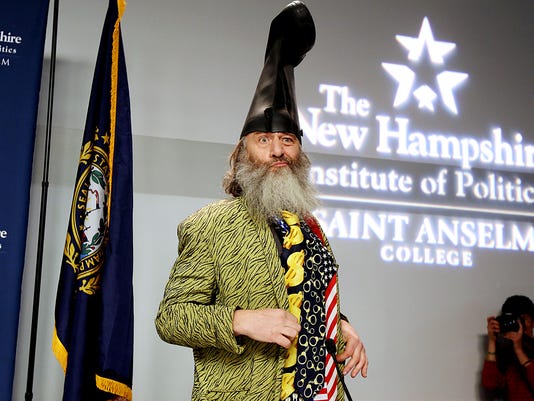
It looks like we can't even agree how to where our shoes (Yes, that is a boot on his head) -
Is strict objectivity theoretically possible?
Yet, "doubt" is used to refer to a feeling of uncertainty....here's something of Wittgenstein's On Certainty: doubt has a background of knowing. One can doubt that it is raining, but only if one understands what it would be like for it to be raining. One can doubt that Sydney is the capital of Australia, only if one knows what Australia is and what a capital is...
(yes, I know it's Canberra...)
Doubt has a background of knowing; hence it is absurd to attempt to doubt everything. Indeed, it is absurd to attempt to doubt most things.
Hence the philosophical enterprise of nihilism undermines itself. — Banno
There seems to be a stark difference between knowing that it is raining and knowing the capital of Australia. For the former, the truth lies outside of the mind(s) that is doubting or knowing. For the latter, the truth lies in minds. Canberra is a city, but being the capital of Australia is a purely human established truth, not a truth prior to humans evolving and thinking it.
One isn't doubting what rain is, but whether or not it is raining right now, and if you are doubting that it is raining right now, then you can't build any knowledge upon that doubt. In other words, you need to have knowledge as a foundation in order to build doubt on it.
Now, if it is absurd to attempt to doubt most things, then why philosophy? It seems to me that philosophy is about doubting everything because the very foundation of what we claim we know is being called into question (is solipsism or realism the case, the mind-body problem, something from nothing or something all the way down, etc.). If philosophy claims that your foundation has problems, then what does that say about all the knowledge you built on that foundation that you say is absurd to doubt?
If it is absurd to doubt most things, then why don't human beings agree on most things, or are we all mostly talking past each other? Or are you humbly implying that you know almost everything and anyone who disagrees with you knows mostly nothing?
Claiming knowledge is equatable to truth is easy if you haven't explained how one arrives at truth. -
Is strict objectivity theoretically possible?
So your words are about human minds, yet you say that the words are about some arbitrary persuasion. I don't see how they can be about both. Either it is about human minds from a view from no/every-where, or about your arbitrary persuasion (your view of human minds).Yes, it’s a paraphrased conclusion having to do with human minds in general, given from certain pertinent tenets of a particular epistemological theory. It says here what minds are; what they do is elsewhere. And no, it isn’t a need, indicating some particularly beneficial inclination; it’s an interest, indicating merely some arbitrary persuasion. — Mww
It seems to me that you are saying that it is a "want" vs. a "need". I see "wants", or "arbitrary persuasions", as cultural manifestations of our biological needs. We have a biological need to socialize, but also to know facts about the world in general to better survive in it. I'm trying to establish which one is the case here.
It looks as if we mostly agree here, but I have to ask: How do you know that you are thinking of an unextended body or a straight line connecting two points if those concepts don't take some shape, some form, in your mind? How do you know that you are being rational or irrational if rationality and irrationality don't take some form in the mind? To assert your rationality, you must have some reason to assert your state of rationality.The false dichotomy is long-since reconciled, again, theoretically, and under all objectively real conditions, they are necessarily inseparable. Nevertheless, the human cognitive system is fully capable of pure thought, of which nothing empirical is cognizable because the conceptions are self-contradictory (an unextended body), or, that of which empirical cognition is possible but iff we can construct objects corresponding to the conceptions (a straight line connecting two points). To say nothing of moral dispositions, for which the actions are necessarily empirical, but the causality for them is given from pure thought alone. — Mww -
CoronavirusIt's obviously difficult to see my point with your politically partisan glasses on.
-
Is strict objectivity theoretically possible?
I thought we had reached some sort of an agreement that it might be processes/relationships all the way down, not objects which would imply the "physical vs. non-physical" dichotomy I was trying to stay away from. You might need to re-read our previous exchanges.The view still has to be explained though. If the universe is just a bunch of objects strung together by cause and effect, how is it possible for some object to have an internal perspective? — Echarmion
If you refer to yourself as a "subject", and others refer to you as an "object", are we both talking about the same thing, or are we talking past each other?
You don't try to get people to agree with you, and see things how you see them outside of a philosophy forum, like in everyday life? Being on a philosophy forum or not has no bearing on how you use words to communicate ideas about the world.This is a philosophy forum. I am not saying there isn't anything objective or true. — Echarmion
Then your mind has no purpose?My physical brain is moving my physical arm. Whatever the mind does beyond the physical I don't know. The physical phenomena are representations of the non-physical reality. So the mind is not strictly speaking in a causal relationship with anything physical. — Echarmion
How can "physical" stuff represent "non-physical" stuff, and vice versa, except by causation?
Imagining stems from the brain's ability to form concepts and goals. The goal in the mind is just as imaginary as Santa Claus. It doesn't exist in the world outside of the mind. But it drives the behavior of the body to change current conditions to reach that goal - so that world and mind are in sync - homeostasis.That's a good point. The imagination does seem so be necessary to cause the following developments. But if you were to look at the chain of events that led from, say, the evolution of humans to spaceflight, where would you find the imagination? Could it be described? — Echarmion -
Is strict objectivity theoretically possible?
I was talking about your quote in the same post, here:I posted one quote concerning the “pretensions of the schools”; treat it as you wish, hopefully in context. — Mww
Is this quote about all minds and speculative epistemological philosophy, or about your [mind's] ego's need to put scribbles on a screen?Mind is a human construct given from pure reason, subjectivity being nothing but the consequence of such construction. It is hardly a confusion, insofar as the rest of the world cannot be blamed for human intellectual error, so theoretical subjectivity was invented to take the fall, and speculative epistemological philosophy was invented to, if not correct the fall, at least to make the fall less painful. — Mww
I'm not clear on your distinction between empirical predicates and rational predicates. This might be a product of the false dichotomy of empiricism vs. rationalism. In my mind, they are inseparable. Your rationality takes the same form as your "empirical" thoughts. Thoughts are about things, and can't be grounded in anything except what they are about.Depends. If the topic has empirical predicates the words will be about the world, conditioned by the pure intuitions and having natural law as its irreducible ground. If the topic has rational predicates, the words will be about speculative manifestations of the intellect, conditioned by pure reason and having the ego as its irreducible ground. And n’er the twain shall meet. The value of expressions in words to one mind, cannot be determined by the origination of them in another.
In this Platonic pseudo-elenchus we got goin’ on here....if you are Socrates, which interlocutor might I be? — Mww -
Coronavirus
Blasio tried to shut down NYC schools for the rest of the school year but was blunted by the NY governor. The governor has control of the school system, the local police force, state and local government offices. They don't have control over the national borders or even their own borders. The president only has the power to close down the national and state borders.But, as to your question, if I hold a beer fest in the park with 500 of my friends, I will be charged with a state crime. I will not be charged with a federal offense. The states are the ones imposing these restrictions. But Trump could have closed the country down by just saying it must be done, as he has that level of influence, regardless of whether his decree was made enforceable by federal marshals. — Hanover
This only gives the president power to provide federal funds to the states to handle their emergencies, not the power to tell them when to close things down and reopen them.I suspect that Trump could take full charge and declare a national emergency — Hanover -
Coronavirus
Not the term I would choose to describe the inconsistency of political partisans - those who see life through the prism of politics. The term I would use is, "pathetic".Amazing. — boethius -
Coronavirus
:roll:I assume that state governors don’t have access to the intelligence resources that the White House has, for one thing. Also, the criticism isn’t just about not closing things down. — praxis
This doesn't answer my question. If the governors don't have access to the intelligence resources that the WH has, then why are they saying that they have the power (which would include the resources) to re-open their own states, and not the WH?
If they have the power bestowed by the Constitution, then it would imply that they would have set resources in place for them to carry out their powers. If not, then shame on all the governors for not being prepared to take on the responsibilities dictated by the Constitution since the founding. -
Is strict objectivity theoretically possible?Mind is a human construct given from pure reason, subjectivity being nothing but the consequence of such construction. It is hardly a confusion, insofar as the rest of the world cannot be blamed for human intellectual error, so theoretical subjectivity was invented to take the fall, and speculative epistemological philosophy was invented to, if not correct the fall, at least to make the fall less painful. — Mww
So, then we are not to take your previous quote seriously, as if it bears some truth, or is representative of of some state-of-affairs independent of you thinking it? Your words aren't about the world, but are about your ego?Your subtlety is well-noted. Irreducibly? For me? To assuage the ego, of course. What else? Not the blatant uncontrolled “I’m right, you’re a farging moron” ego, just the half-assed reclusive, take it or leave it, I don’t really care ego. Transcendental rather than Freudian. — Mww -
CoronavirusIf Trump doesn't have the power to reopen schools, businesses, state and local govt. offices, etc. then did he really have the power to close them down? If it is the power of the governors to reopen their states, then wasn't it their responsibility to close them? If so, then why are people blaming Trump for not closing things down sooner?
Politics. -
Is strict objectivity theoretically possible?
If you refer to yourself as a "subject", and others refer to you as an "object", are we both talking about the same thing, or are we talking past each other?Reconcile? It's a fact that I'm an object for others.
Two points:
The perception of the other as someone who looks at me implies that I perceive them as another consciousness in the same world.
And we can feel that we have a common existence in the fact that we can share the same project. That is, in practice.
Therefore, intersubjectivity is not a feature of consciousness alone, but of human existence as a whole. It begins with language and continues in acts. Or vice versa. — David Mo -
Is strict objectivity theoretically possible?I think you replied too hastily. Read what I said again.
I said that "ice cream taste good to you" is [objectively] true. This is a case where you didn't confuse some property of your mind with some property of the ice cream. You are explicitly stating something about the state of you, not the ice cream.
In saying "ice cream is good", you are not explicitly stating something about you, but about the ice cream.
Is "good" a property of you when tasting ice cream, or the ice cream without having been tasted? -
Is strict objectivity theoretically possible?
How can it be true that ice cream tastes good, if it doesn't taste good to others? It can only be true if it tastes good to you. There is no such thing as a subjective truth. A subjective truth is a category error.You're talking about truth, right? Subjective truth versus intersubjective truth versus objective truth? If that's the case, then it's subjectively true that ice-cream tastes good, but objectively true that ice-cream tastes good to me. — Hanover
Think about how shit smells to dung beetles.The shift is towards that which results in greater survivability. The bee sees the world in a way that leads to his survival. Those who smell garbage as sweet probably don't survive well, regardless of what garbage really smells like, whatever that means. — Hanover -
Is strict objectivity theoretically possible?
How can it be true that ice cream tastes good, if it doesn't taste good to others? It can only be true if it tastes good to you. There is no such thing as a subjective truth. A subjective truth is a category error.You're talking about truth, right? Subjective truth versus intersubjective truth versus objective truth? If that's the case, then it's subjectively true that ice-cream tastes good, but objectively true that ice-cream tastes good to me. — Hanover -
Is strict objectivity theoretically possible?
Other minds are outside of my mind, and my mind is outside of their minds. So how do you reconcile the facts that you are a subject from your perspective but an object from other's perspective when we all share the same world?Generally, in philosophy the concept of objective is reserved for knowledge that refers to what is outside the mind of the subject. It can be forced to mean that in introspection the mind is both subject and object, but this is an exception to the rule that should be emphasized so as not to create confusion. — David Mo -
Is strict objectivity theoretically possible?
It seems to me that you can only talk about what you think and in talking about what you think, you are talking about part of the world. Subjectivity comes about by confusing what your mind is with what the rest of the world is.First, anything I say wouldn’t be purely subjective, that being reserved for what I think. Second, for whatever I say, the use of it by others is up to them. — Mww
If the use of what you say is up to others, what is the use of you saying it, for you? Why do you say anything if not for others to find the same use as you?
Harry Hindu

Start FollowingSend a Message
- Other sites we like
- Social media
- Terms of Service
- Sign In
- Created with PlushForums
- © 2026 The Philosophy Forum