
Comments
-
Ukraine CrisisFoxes and sour grapes, again. When the Russian are booted out of Ukraine, you will say that Ukraine was not strategically important! :-) — Olivier5
This seems to me completely delusional.
And again, I stated my position before these offensives: taking Kherson would be a turning point.
I have not changed my goal posts.
The pro-Ukrainians changed their goal posts as soon as the Kherson offensive failed, but for months were talking about taking Kherson, praising the brilliant Himars attacks on the bridges that would make Russia unable to defend Kherson etc.
If the Ukrainians take Kherson, then I would view that as step one.
There was zero talk of the region around Kharkiv as having any importance before this offensive, the idea it's important is entirely retroactive. Before this re-definition of things what was important was: Kherson, Donbas and also the Nuclear plant, and all talk was on those 3 important things.
Ukraine achieves nothing on those important things ... so goes and does something no one was claiming was important to do and declares a major victory.
And, it's a broken record at this point, just a couple months ago Ukraine "pushed to the border" in Kharkiv region and that was somehow a major victory. -
Ukraine CrisisIt seems to me people are attributing a little too much to this offensive. The fact that the captured territory was defended by tripwire troops implies it was not of any importance to Russia. — Tzeentch
Agreed.
Losing Kherson would be both bad militarily (likely thousands, if not tens of thousands, stuck and captured troops) as well as intensely embarrassing.
Retreating from around Kharkiv is certainly some embarrassment, but if it's not important area to hold then Russia can easily reverse the embarrassment with an important victory elsewhere.
Russia has clearly stated its main war objective is conquering the Donbas, which the Kharkiv region is not a part of. So, if Russia goes on to complete conquering all the Donbas then it can declare "winning" this key military objective.
The only goal, in my opinion, that Ukraine has achieved is that it has signalled to the West to still be capable of offensives, in the hopes to garner more aid. An army that cannot conduct offensives is broken and has in essence already lost - an impression that certainly must have crept in with Western leaders after the failed Kherson offensive. — Tzeentch
I believe this is an excellent summary of both my and @ssu debate and position on this subject. Definitely important to show at least some offensive potential.
However, it's entirely possible the withdrawal from around Kharkiv was pre-determined and also pre-determined it would be followed by attacking Ukrainian's electricity grid as militarily "logical" to both home and diplomatic audience (rather than out of the blue). -
Ukraine CrisisTo followup my post above comparing to Isreal.
Perhaps a good diction for this sort of analysis, is defining military-diplomatic victory, which I would say Isreal definitely achieved in its various confrontations and negotiations with Arab neighbours, in contrast to purely military victory (such as defeat of Nazi Germany by the allies).
The Isreal example is a good example of what to do when you cannot simply defeat your opponents: win battles and negotiate acceptable resolutions.
Isreal did not continuously declare "we will not negotiate!" throughout all these conflicts with neighbours. Neighbours, useful to keep in mind, that had far more extreme rhetoric and really would have completely annihilated Isreal if they could, than Russia has against Ukraine.
That's called: statecraft.
Isreal did not throw temper tantrums and announce completely unrealistic demands in negotiations it rebuked as cowardly.
Isreal made consistent reasonable demands (such as the right to exist) as well as offers of compromise acceptable to opposing countries (despite anti-Isreal rhetoric 1000x more extreme than anything Putin has said about Ukraine), resulting in negotiated peace with Egypt, for example, that involved withdrawing from the Sinai (only way to make peace with Egypt).
Whether one approves or not of Isreal policies vis-a-vis the Palestinians, through force and diplomacy they have achieved key objectives, but it would be foolhardy to dismiss or minimise Israeli diplomats and statecraft in those achievements.
So, it's when people say Ukraine does not need to negotiate and can "win" militarily, which is when I point out that without diplomacy "winning" means conquering and defeating your enemy; otherwise, the war just continues forever. -
Ukraine CrisisCould the Russians hold Donbas and Crimea if they settled into just those regions? — jorndoe
Crimea seems truly completely unfeasible for Ukrainians to ever reconquer, without NATO supplying systems like an entire fleet of ships and hundreds of fighter aircraft.
With enough NATO support (and Ukrainian willingness to fight to the death as NATO proxies) I would guess it would be possible to push Russia out of Donbas.
However, the risk for NATO of even trying to do that is Russia resorts to tactical nuclear weapons.
NATO policy is very clearly to give enough support to Ukraine that they don't outright lose, but not enough that they can "win", even in very limited definitions of achieving some key war goals.
The situation, however, is very unstable.
However, the dream of a long war that bleeds the Russians may not survive Russia finally implementing NATO's Shock and Awe playbook of disabling the electricity infrastructure.
It was not clear to me how long Ukraine can hold out without electricity (both militarily and civilian endurance). True, people have withstood significant hardship without electricity in past wars, as @ssu points out ... but that was before electricity was a critical need to pretty much all modern social and economic activities. -
Ukraine CrisisNo, this is only what it means for people who want to invade other people's land. But for people not bent on invading other countries, winning a war can mean something else, to be defined in each specific case. — Olivier5
Hmmm... has then Israel won any of it's wars against it's neoghbors? It still has them around and never have Israeli soldiers entered Damascus, Amman or Cairo. — ssu
Sure you can define "win" in some way that doesn't involve defeating your enemy, why for the context I'm talking about I put "winning" quotations.
The context where "winning" comes up and where I define "winning the war" as meaning defeating Russia, is addressing the idea of Ukraine not requiring a diplomatic resolution to the war but can achieve victory through military force.
For, even Ukraine pushed Russia back to the border ... that wouldn't be an end to the war, the war would still be on.
And Isreal is a good example of this; without defeating their opponents the war isn't actually over. It's only in hindsight that it makes sense to call the 6 days a war over 6 days, and a win for Isreal. Had fighting re-intensified then it would have been just the first engagement in a larger war.
For example:
Following the war, Egypt initiated clashes along the Suez Canal in what became known as the War of Attrition. — Wikipedia - Six day War
After following other Arab nations in declaring war, Mauritania remained in a declared state of war with Israel until about 1999. — Wikipedia - Six day War
Is the kind of thing that happens when a military battle or campaign is "won" without actually defeating the enemy. States of war continue and the word choice quickly becomes debatable.
6 Days War was initiated by Isreal attacking Egypt pre-emptively ... so according to the definition of repulsing an invasion is a "win", Egypt actually won that war. Obviously, Israelis may argue very differently.
Point is that military conflicts that do not end with one side being defeated are only ultimately ended diplomatically; states of war simply persist even without fighting, and it doesn't make sense to say the war is over ... but a "state of war" persists.
War refers to both military conflict as well as a diplomatic relationship between nations or groups (that may not involve fighting all the time).
Now, in the case of Mauritania's state of war with Isreal that persisted for decades, it doesn't matter all that much because Mauritania did not have practical means to invade and attempt to defeat Isreal any given day. These sorts of state of war is symbolic, but nevertheless there is still technically a war.
However, the Ukraine-Russia situation is very different; pushing back Russia to its borders would not result in a situation such as Isreal and Mauritania where the persisting state of war could be said to be symbolic and there is no real threat. Russia would still be a considerable threat to Ukraine and could re-invade at any moment, the war would not be "over" and Ukraine would not have "won".
To force Russia to accept Ukraine's terms would mean going and defeating Russia, you know: "winning".
The alternative to winning in a military sense to end a war, is a diplomatic resolution (how most wars end); a diplomatic resolution is not a surrender, and so neither side is defeated and neither side "lost the war". Of course, one side will have lost more than the other, but this will always be debatable and each side will point to some evaluation criteria that implies they won, and certainly didn't do as badly as the other side claims.
For example, I have heard Americans mention many times that they sort-of-kind-of won in Vietnam because they killed way more Vietnamese.
In the case of this war, even if Ukraine pushed Russia back to the border and then a diplomatic resolution that ended the war ... at what cost in lives, trauma and infrastructure and economic development? If the West does not rebuild Ukraine as sort-of-kind-of-promised, is that "winning"? We can debate it.
However, this would be fairly hypothetical debate of what clear "winning" would be in a diplomatic resolution after pushing the Russians out of Ukraine, as Ukraine's current stated "war goals" is re-conquering all of Ukrainian territory including Crimea, which really seems completely unfeasible.
Currently Ukraine does not have enough military potential to push Russian's out of their enclave West of the Dnieper which would be a miniature version and far easier task than pushing Russians out of Crimea. And, definitely Ukrainians would push Russians back across the Dnieper if they could; it's a major strategic pain the enemy having a large bridgehead across a water body. -
Ukraine CrisisAdditionally, for sure Ukraine cannot defeat Russia in any of the proposed definitions of "winning" and has never been in a position to be able to.
The conflict is one between Russia and NATO with Ukraine serving as proxies using NATO weapons, NATO training and NATO intelligence.
And, as I've stated, I believe NATO can defeat Russia in a conventional conflict and can supply Ukraine sufficiently to produce some lighter form of battle field victory, even without Nukes which NATO could provide to even the playing field but obviously chooses not to (for the same entirely good political reasons that Russia doesn't nuke Ukraine).
My position is not that NATO does not have the capacity to push the Russians back to the border using Ukraine as proxy soldiers.
My position is that NATO chooses not to. -
Ukraine CrisisYou seem to be of the opinion that Ukraine could not win this war. It can, and it will! — Olivier5
That's obvious.
First, "winning" the war would mean defeating Russia, which is pretty obviously Ukraine is not capable of invading and conquering Russia. That's what "winning a war" means.
For example, allies "won" against Germany by conquering Germany in WWII.
Even if they pushed Russia out of Ukraine that's still not "winning" a war, the war would still be on and Russia could re-invade anytime which is not an end to war in a "winning" state.
There could be military victories followed by a truce that people would consider a win, but there is basically zero chance of that, it would just be a frozen conflict.
Second, retaking Crimea does really seem not feasible from a military point of view, so even Ukraine's "winning light" definition, really does not seem militarily feasible.
Third, Russia could nuke all of Ukraine at anytime, so even if Ukraine did either of the above it's not because Russia "cannot" defeat them military, but because Russia chose not to for political reasons (obviously good political reasons, but not a straightforward military defeat).
Now, what diplomatic resolution to the war would be some sort of "win" is always up for debate, but if we're talking about winning wars in a military sense the conditions are clear: defeat the opposing military, conquer their territory or force surrender in the process of doing that. -
Ukraine CrisisNope. Anyone serious hasn't said that. — ssu
Have you followed Western media?
However, if you're simply stating that the "retired generals" and other talking heads in major Western media aren't serious, but propagandists, then of course I agree.
With every tenth Ukrainian being a refugee, the GDP having crashed and the possibility of hyperinflation would be devastating politically in peacetime. — ssu
I'm not talking about those things, but the electricity grid which is required for things like the train system.
Even if Russia's objective isn't to take of all of Ukraine, basically just the Novorossiya-part, it is an existential fight for the Ukrainians. — ssu
So even if Russia's objective is not to threaten the existence of Ukraine ... it's still an existential fight for Ukraine?
That Russia has now postponed those referendums to join Russia tells very clearly to Ukrainians what is at stake. And there's still the option that Putin goes for martial law. — ssu
I'm not sure I understand what you mean here about postponing the elections. I'd interpret that as simply due to practical considerations of the war intensifying or then a diplomatic message that the status of these regions can still be negotiated (if would be more problematic, even perhaps impossible, for Russia to hold elections that declare independence, Russia recognises that independence and then "gives back" the territory; that would no longer make any legal sense).
For us Europeans, living in our comfortable peacetime, energy shortages can be a huge issue. — ssu
Electricity is not just about comfort. Having all sorts of systems running smoothly throughout the war was of critical strategic benefit to Ukrainians, not only in making military operations far easier but also less civilian problems to deal with.
Yes, generators are easy to run for military systems.
However, standing next to a generator is the "most likely to be killed" spot according to my military training. You can place them farther from your encampment but voltage and just the weight of cables places severe limitations on that.
Generators produce significant and persistent IR signatures.
Being able to conduct a war with access to the civilian grid all over the battle space is a major strategic asset (all sorts of systems either need to be plugged in or require battery recharge). Of course, it was a strategic asset gifted by the Russians that they've now clearly ungifted.
Grids are insanely fragile to explosions.
Point is, we are not seeing the war clearly "swing" in Ukraines favour (such as taking Kherson I would agree Russia would be clearly embarrassed, although that still would be a clear sign Ukraine could continue East of the Dnieper).
There are pros and cons for each side in recent developments.
Even ignoring the grid, to evaluate Ukrainians gains we need to know the losses, which don't. If they lost significant and unsustainable armour and troops to take territory that Russia tactically withdrew from, then that's not a victory.
As usual I think we agree, you are making the case developments are good for Ukraine (but we lack information to really know) and I am criticising that position but recognise things are clearly not "100%" in Russia's favour.
I have always accepted that surprises are possible in any way, just I (personally) could not see how offensives without armour would be possible to do, which the current events support (significant armour was used, so a critical question is whether armour attrition rates are sustainable not only for Ukraine but for NATO as a whole). -
Ukraine CrisisThere you are going on against a lot of military analysts, to whom it's their actual job to analyze these. — ssu
The same analysts that said Russian troops have low morale and will completely collapse ... like 2 days into the war?
Doesn't take an analyst to see Russia still holds Kherson.
I states that Kherson was the litmus test of Ukrainian military potential, it is still in Russian hands ... so I'm not so impressed.
If Kherson fell, then I'd completely agree things are clearly bad for Russia, but that didn't happen. I see no reason to change my analysis to the idea that Kharkiv region was the real prize all along.
There's nothing really in the Kharkiv region, you just have to cross it to take Kharkiv which the Russians have never tried to do, and it's gone back and forth precisely because the Russians have no reason to defend it fiercely and what they are trained to do is tactically retreat and bombard enemy forces.
It's these back and forth manoeuvres around Kharkiv which is where Russia is doing exactly their military doctrine, so it's difficult to say doing what you say is a good idea is somehow an embarrassment.
The reason Russia trains this way is because Russia is massive, so it's better to retreat, bombard as you go, regroup and then counter attack (hopefully) enemy formations that have overstretched their supply lines (see: Napoleon, Hitler).
Really? — ssu
We're not in disagreement. I agree being able to do any offensive is better than being able to do zero.
However, Kharkiv region itself is not critically strategically, unless you want to take Kharkiv. But anything else you want to do you can easily go around, unlike Kherson that is a critical bridge head for the Russians West of the Dnieper and controls the canal bringing water to Crimea (although I assume you'd need both sides of the river to shut that off again, but obviously taking one side is the first step to taking two sides).
What's critical in the current situation is Kherson for the reasons above, and Donbas for the political reasons that is where Russia declared it wants to liberate.
And I made clear I'm not saying this is a "good development" for Russia in some topsy-turvy reasoning. Any general would prefer not losing any ground and not losing any troops, no denying that.
However, development isn't all that great for Ukraine either.
What's a critically strategic battle is something like taking Mariupol or Donetsk; Russians say they're going to take it, Ukraine says they're going to defend it; the commitment of both armies to the battle is clear and the stakes are clear. That's power: you say you're going to do something, then you do it and no one can stop you. Ukraine said they would take Kherson, started something, were stopped. Now they say that was the pan all along, but that still presupposes they don't have the power to take Kherson.
From the Russian point of view, had they lost Kherson that's a major embarrassment they can't spin, so they commit serious troops there. Places that are less important will just be retreated from, counter attacked later if there was reason to.
That's pretty normal strategy.
But I agree that doing any offensive at all is better than doing nothing.
And it is still clearly bad thing even from Russia's perspective, as they've now escalated to Shock and Awe NATO playbook of destroying the electricity grid.
So, yes, militarily speaking that Ukraine can do any offensive is certainly good for Ukraine, but losing the power grid (potentially permanently) is bad for Ukraine.
Also of note, my prediction that Ukraine could not do any offensives at all was without armour in the "javelin hysteria" phase of the war, but these offensives had heavy use of armoured vehicles.
And this is still an important consideration, as it's unclear to me how much armour Ukraine has and can get. If these offensives heavily attrit their armour and if that can't be replaced, then we are not seeing sustainable gains (even if the attacks on the grid aren't a problem). -
Ukraine Crisis↪ssu Pity poor boethius who thought this could never happen. — Olivier5
What are you talking about?
I stated taking Kherson is the litmus test of Ukrainian counter offensive potential.
It is obviously vulnerable and obviously strategically critical, as holding Kherson West of the Dnieper is a major strategic pain (Russia can constantly threaten counter offensive West of the river, which would be significantly harder if they were stuck on the East side of the river).
Ukraine had a serious offensive there that did not work. It's now said that it was a "faint" to attack around Kharkiv, but that doesn't seem the case to me.
Furthermore, if you could take Kershon you would for the reasons above, there would not be a strategic reason to not take it and hitting the brides is an obvious first step for a serious effort to take it.
The last times Ukraine suffered a strategic defeat, they would take land around Kharkiv, which is not strategically important and the Russians simply tactically retreat to the Russian border, re-advance later, as their war doctrine instructs.
Just a few months ago Ukraine "fought to the border!" and raised a flag, and this seems like
more like a repeat of that .
Kharkiv is simply not a strategically important offensive.
Of course, that they can do any offensive is still meaningful, obviously more than zero; however, armies are tested fighting over strategically important locations and everything else is "tactical retreat" and does not mean so much in itself.
Granted, it's not a good thing to lose territory, so Russia has responded by hitting power plants and taking down half the grid in Ukraine. In terms of pure military analysis, this sort of infrastructure is pretty important for Ukraine's war effort.
Ukraine has not just "won the war" as some parts of the internet seem to think.
Far, far from it.
Could they win?
Yes, with enough NATO support it's possible. But NATO does not give that "enough support".
My position is not "Ukraine can't win", but, as I've made clear many times, my position is US and NATO policy is to support Ukraine just enough to prop it up but not enough to win.
A sign of a "winning" army would be taking Kherson (which I have not said that Ukraine "can't possibly take it", just pointed out that whether they do or not is the best signal of their military potential), and that they couldn't take Kherson so instead attacked land Russia policy is clearly to just retreat from whenever attacked is very much compatible with the hypothesis that US and NATO will not support Ukraine enough to actually win.
Now, the reason the Russians tactically retreat from around Kharkiv whenever there is an offensive there is because it's not strategically important area. The area around Kharkiv only strategically matters in taking Kharkiv, which the Russians have never tried to do -
Ukraine CrisisExcept giving military and financial aid to Ukraine. Which actually rarely happens. — ssu
That's not "standing" with someone, it's supplying arms.
How isn't the ANNEXATION of Ukrainian territory clear evidence of this? — ssu
Because there's an important port in Sevastopol which an anti-Russian government supported by literal Nazi's would threaten, and Crimea was Russian not long ago and is filled with ethnic Russians.
Of course, you can argue Russia should not have annexed all of Crimea to protect a military base, but it's clearly a large and credible motivator and is not related to absorbing all of Ukraine.
Or the Russification that Russia is doing in the occupied territories? — ssu
Again, what's at issue here is that the idea that Putin and the Kremlin's goal is now, and has been all along, to annex all of Ukraine and destroy all of Ukrainian culture. That's the proposition being contested.
I'm pretty sure you've mentioned yourself several times that the preferred outcome of the first phase of the invasion was regime change to a government friendly to Russia, which is what fits the troops committed and the rolling tanks to the capital and soft hands on Ukrainian infrastructure.
A total war of annihilation would have looked very different.
And again, if Russia's goal was total destruction of Ukraine and Ukrainian culture it could easily use nuclear weapons to largely accomplish that.
If you retort that: ok, ok, ok Putin and the Kremlin's priority isn't the total destruction of Ukraine, as it has the tools to do that and has not done so, and there's all these other goals and conditions to consider ... but, but, but they'd still love to own Ukraine if they could by magic.
Ok sure, I'm sure Putin and the Kremlin would like to own the entire world if somehow it was magically feasible. However, in the real world, if you claim someone has an objective, they have the tools to achieve that objective, and they don't ... then that's clearly not their objective and speculating about what people would wish, or rather, or prefer if they could somehow magically have it, isn't very useful.
I'm sure Trump would have preferred to own the whole world too if it was magically feasible, but claiming that was Trump's objective as president is dumb. -
Ukraine CrisisI won't post the bat-shit insane things the neo-Nazi's have said, as I don't want to deal with Nazi apologetics just right now.
Maybe in a few days.
Still, after all these months, no one has actually answered the question of how many Nazis with power and influence would be too many Nazis with power and influence. -
Ukraine CrisisA circle jerk of factoids and propaganda is not a philosophical discussion.
You can say "Russia's bad" and "Russia could withdraw" all you want, but if there's no political or military plan to do so, what's the point.
And, the only person who has actually proposed a military "tough way" plan to "force" Putin to back down, is myself. Of course, that's not interesting to any pro-Ukrainian interlocutor, because the fantasy of supplying arms as literally "Standing with Ukraine" is so entertaining.
In a situation like this your arms dealer is the same as your drug dealer.
Feels good every hit. -
Ukraine Crisis#StandWithUkraine
Again, no one is actually "standing" with Ukraine, except a few foreign fighters.
If Norwar and other NATO countries were actually standing with Ukraine, then Ukraine could easily be defended.
Which then brings no the retort that that would start WWIII.
Ok, but if "Standing with Ukraine" that way may start WWIII, then doing so in a substitute way has the same risk.
Solution, no matter how "bad" Russia is, arm Ukraine just enough to reduce Russia war aims ... but not enough to actually be any sort of loss.
Currently Russia has nearly all of the Donbas, Crimea, Kershon, and Ukraine has not been able to budge Russian lines West of the Dnieper.
Literally since day one of the war we are told Russian military morale is bad and will collapse any day, sanctions are hitting and Russian state will collapse any day.
On a related note, here is a recent opinion piece by Fiona Hill and Angela Stent in Foreign Affairs: The World Putin Wants:
Vladimir Putin is determined to shape the future to look like his version of the past. Russia’s president invaded Ukraine not because he felt threatened by NATO expansion or by Western “provocations.” He ordered his “special military operation” because he believes that it is Russia’s divine right to rule Ukraine, to wipe out the country’s national identity, and to integrate its people into a Greater Russia. — SophistiCat
We see statements like this, but never see any evidence.
People in the West are living in a fantasy world where the war can be won on social media.
Meanwhile tens of thousands of Ukrainians have been killed, many more traumatised and displaced, as a consequence of social media bloodlust.
The narrative doesn't even make any sense, since if the first phase of the war was a disaster for Russia, then easy to negotiate a peace on good terms.
Of course, Russia would never give back Crimea, so if your bloodlust extends to that, then at least have the decency to append "with hundreds of thousands of lives spent doing it". -
Sanna MarinIn Kekkonen's and Koivisto's time yes, but in the 1990's the tabloid press started to be "normal" even in Finland by European standards. For the last thirty years they would go for the jugular when these kind of pictures / videos come out. And now, in our time, the "old media" just has to respond what already has happened as is already discussed in the social media. — ssu
Oh yes, I totally agree it would be an issue for a male, especially prime minister, but some woman see it differently. But how bad an issue, and also what would be a comparable situation is difficult to judge.
I'm not sure just how well that "boys will be boys" thing will go in the post me-too environment. — ssu
The power of boys will be boys is fading, but I would not say it is close to impotent.
But I think we are largely in agreement on the issue.
Apparently the PM has now been chastised and pledged an end to partying. -
Sanna MarinAnd of course, if it would be a male PM, however good looking, he would be out. I think just a photo of a male intimately dancing with a female singer when his wife and daughter are at home would be enough. Nobody would believe the "we're just friends" answer. — ssu
My woman friends claim it wouldn't even be an issue if it was a male politician. There's a bunch of examples of male politicians getting blackout drunk on official visits and so on, but my counter-point is they weren't Prime Minister, but things like cultural minister (representing Finnish drinking culture).
However, a male getting drunk and frisky at a party I don't think would be automatically interpreted as cheating. Easily have a "boys will be boys" narrative around it, but I do agree the leaving your wife alone with the child to go party would be viewed as classic douche archetype ... but that's not necessarily so damaging politically. -
Sanna Marin(Some of Sanna's friends using the prime ministers residence information room to get cool photos. She first tried to say the pictures were taken at the toilet. Notice the same "Finland" sign and Sanna himself has acknowledged that they are genuine, which she regrets.) — ssu
First I need to point out to everyone how confusing it is to be in Finland until you realise Finn's will use he / she pronouns interchangeably in reference to the same person in the same sentence.
So many stories I'm like: this couple has a really complicated relationship.
Above all, last year when the first partying videos emerged from the prime minister's official residence, her polls did actually go up. Because then it really was just about singing and dancing. — ssu
Basically in complete agreement with your whole analysis.
The issue is really about the video not being "just" dancing. If she was just busting moves, even awkward one's, it would be an endearing video showing she's "just like us".
But the video, how things look and all the details you mention, is not just dancing.
Of course, legal complaints are spurious, but a pretext to just keep talking about the video, make sure everyone sees it a bunch.
As some random reddit poster pointed out, that I unfortunately forget where, there's an older crowd in Finland that frowns upon this sort of dancing and partying. However, there's also a middle-age and younger crowd that doesn't do this kind of partying as either they think it's stupid or they would like to, but don't have that kind of money and friends, and have fomo about it.
Not everyone does this sort of crazy, out of your mind clubbing.
Of course, count me in. -
Ukraine CrisisI think you and me will have to wait about 30 years before we have a reasonable view of what likely happened. — ssu
Sure, it might be so.
So your " completely open to speculation of essentially any plausible motive", yet you have decided that NATO expansion "is clearly a main driver of the hostilities and tensions". — ssu
Obviously NATO expansion is a plausible motive and clearly a main driver of hostilities and tensions over the decades since the end of the cold war.
It's clearly a main driver of events.
Well perhaps "a main driver" is better than "the main driver". — ssu
Exactly why I say "a" instead of "the", as other plausible ideas of motives still feature NATO expansion as a main driver, and certainly legitimate to some degree, but serving more as pretext for the real main drivers (such as imperialism or Putin's legacy and the like). And even if one were to posit that invasion would occur regardless of NATO expansion in the counter-factual, the fact NATO does expand makes it at least a main driver of the events we actually see.
I would not find it credible a theory that proposed NATO expansion has nothing to do with it and is not a main driver of events. Certainly Russian policy vis-a-vis NATO expansion (or then because they will invade anyways) is also a main driver, but the speculative part we're considering is what's exactly the motive behind the Russian policy.
The point I was making in my last post is that the context is still NATO expansion over decades, these are facts, so any explanation of motive needs to account for this (whether some sort of good faith, bad faith, or even nefarious "Russia engineered NATO expansion" somehow), to contrast with a popular Western framing that presents the invasion as essentially out of the blue (no invasion of Georgia after the NATO announcement, no coup in 2014, no civil war against ethnic Russians since, no advanced Baltic missile bases to protect against Iran and so on).
Well, if it was just NATO membership, Russia wouldn't be annexing parts of Ukraine. It is as simple as that you cannot deny that. You simply cannot. Regime change yes, annexation no. — ssu
For certain there are other considerations. NATO expansion I mentioned as main driver since the end of the cold war, at least of the particular events as they particularly occur. Of course, the counter factual of no NATO expansion is completely legitimate to argue would be "Russian imperialism unleashed" as much as mundane EU integration.
Regime change has obviously failed. However, Russia did offer to completely withdraw for recognition of Crimea, neutral Ukraine, independent Donbas (within Ukraine) and Russian speaker rights protected.
There are several interpretations of the annexations, ranging from leverage to still try just to achieve above, to Crimea being a completely legitimate critical security issue that then needs water, to the plan was to start annexing more and more of Ukraine whenever the opportunity arises.
By annexing territories of other sovereign countries. Right. :roll: — ssu
Definitely you can say the reaction is unjustified, I go to some length to explain that.
For example, I would certainly agree I have provoked more than a few people on this forum from time to time, and if one of them came to my door and shot me, I would not agree that's reasonable or justified, but it is still true I provoked them.
Provocation does not entail some moral fault. Pretty much any protest is provocative vis-a-vis police and whoever's being protested against.
However, the only evidence available is that NATO / Ukraine does something provocative, and then Russia reacts to that provocation. Saying annexing territories is totally "out of line" is of course a legitimate line of argument.
Where provocation is relevant is in terms of evaluating pre-planning which is the narrative I have issue with. If you go to a bar and get provoked and get into a fight, even if totally overreacting and committing crimes where the provocation is legal, it still demonstrates you didn't go to the bar with the intention of getting into a fight. Of course, unless you go to a bar that you know you'll get provoked in so as to have an excuse to punch a guy.
We've had this discussion in this thread of what Crimea meant for Russia, how Crimea is now seen as integral part of Russia and how it is now seen by Putin an illegal act and so on. — ssu
I have zero problem with the idea that Russia "wanted" Crimea anyways. The debate (between plausible theories) could be framed as whether Russia is using events as an excuse to overreact and Annex territory or then had no such plan but feels it necessary as events unfold. I.e. is the 2014 coup a genuine surprise and the annexation of Crimea a snap reaction to secure critical defence positions, or was it the plan all along and simply waiting for the reason to do so.
Professor Mearsheimer does not exclude this latter scenario, just that there's actual evidence supporting it. However, even if Russia is reacting, again, doesn't mean Russia is the victim or that the reactions are justified.
If your are blind to the fact that Russia wants to dominate all of it's former states and does want parts of Ukraine, if it can, then there's not much to change your view. — ssu
I have zero problem accepting such a premise.
The question is what to do about it.
I go to some length to develop the feasibility of having implemented (more difficult now but could still be arranged as a "peace keeping" thing) a military standoff with Russia by sending in NATO troops, thus daring Putin to attack NATO. Sending boots on the ground in Ukraine is obviously not directly attacking Russia, it would still be Russia starting a conflict with NATO if it were to attack Ukraine and whatever soldiers are there.
Of course, as a some sort of ballsy Western cowboy move, probably would result directly in WWIII as other posters have mentioned.
However, accompanied by a diplomatic theory more sophisticated than kindergarten name calling, with enticing compensatory offers to Russia (Nord Stream 2 and so on), not only would I expect that to work, but I still, even now, would evaluate it as more stabilising and less risky than the current policy (which, as we've seen, gets us super close to WWIII anyways as well as a chaotic and destructive war, in itself a risky thing).
What I have issue with is the "well, we won't actually take risks ourselves to prevent the war using 'force', the only language Putin understands and respects according to our narrative, so we'll just pour arms into an incredibly unstable and destructive process that affects the entire globe in terms of food and energy prices, triggering the first event we could consider global famine."
If protecting Ukrainian sovereignty is a moral imperative, then y'a gotta do what y'a gotta do and send in troops to do that protecting.
If avoiding WWIII is the moral imperative and a conflict with Russia over Ukraine is a pathway to that ... then gotta compromise and basically let Russia have major concessions concerning Ukraine to avoid war; and indeed, concessions would involve ceding territory, such as Crimea, and accepting the risk Russia may take more land later.
It boils down to simply both principles being in conflict and you can't have both; you can't minimise conflict with Russia to avoid probability of WWIII but then also stop them militarily taking what they want to take.
Pouring in arms is a worst of both worlds in my opinion: widespread destruction, Ukraine loses territory, and still incredibly unstable situation (globally) that can lead to WWIII anyways. -
Ukraine CrisisAgain the "Putin attacked Ukraine because of NATO-membership" argument? — ssu
That's not what I nor Philip short is stating.
The thesis is clear:
Nearly six months after Russia’s invasion of Ukraine, there is still widespread disagreement in the west on Vladimir Putin’s motives. — Philip Short - has written authoritative biographies including Putin
We don't really know what the motives are, there is widespread disagreement, and several narratives have come and gone about it in the Western press.
I'm completely open to speculation of essentially any plausible motive.
I think everyone agrees that one single reason doesn't explain a decision to go to war and obviously Russia wouldn't like Ukraine to be a member of NATO. However this idea that this was the most important reason (or only reason) depends on the idea that Ukrainian membership was possible/realistic/imminent. — ssu
Again, neither I nor the author I cite is claiming this.
However, it's pretty clear that declaring Ukraine and Georgia will join NATO some day is the trigger that set's in motion the violent events that follow starting with the invasion of Georgia. Professor Mearsheimer point about that is that there is simply no evidence of any plan to invade Georgia nor Ukraine before declaring they would join NATO.
It is clearly a main driver of the hostilities and tensions.
The significant escalation in 2014 is again only after a violent coup against a "moderate" (from the point of view of Russian relations) and the rise of anti-Russian neo-Nazi groups who then start a forever war in Donbas against separatists, refuse all settlement proposals.
No one is claiming Russia engineered the coup, and there's literal audio evidence of USA "choosing their man" as president. Russia, Ukraine and EU came to a resolution before things got further out of control, then several peace processes failed, and people were being shelled and dying for 8 years.
Now, what to make of this context is of course up for debate. One can speculate that somehow it was Russia that engineered all these things to get to this point of invading Ukraine. But, it would speculation and there is no evidence for it.
The only prima facie interpretation of the context available is that Russia is reacting to clearly hostile moves. Ok, even if one accepts that, one can argue Russia has no right to react to such hostile moves, they're not "all that hostile" considering it's not realistic Ukraine will join NATO even if NATO is publicly saying that's the goal and Ukraine places it in their constitution.
However, the context is just facts and what the facts have issue with is a narrative of Russia suddenly and without provocation invading a weaker neighbour who then valiantly "stand alone".
There's of course lot's to debate; one can accept declaring Ukraine and Georgia will join NATO is a provocation without accepting that is reasonable or moral basis to invade, or even wise to invade even it if was just and reasonable to want to.
One can argue that somehow "this is what Russia wanted all along!" and has engineered events to go this way, knowing Ukraine would refuse all reasonable proposals for peace they keep proposing reasonable resolutions at every step of the crisis in a sort of bad faith prediction of the counter-party bad faith; it's certainly possible, I don't put anything past the cloak and dagger under world, but there's simply no existing evidence for that. -
Ukraine Crisis↪boethius You are still on mute — SophistiCat
Again, if this is true, how are we talking.
Furthermore, my last post was simply quoting a literal "authoritative biographer of Putin" explaining basically the same thing.
So, please, explain how this biographer's article in The Guardian is propaganda and demagoguery.
LOL. Just watch.... — Olivier5
Watch Ukraine retake all the Donbas and Crimea?
Watch Ukraine march on Moscow?
Watch what? -
The collapse of the wave functionThat's a fresh perspective - I don't recall coming across it till date. Awesome! — Agent Smith
To be clear, it's not my perspective but the pretty standard view among professional physicists (that I have talked to or have heard lecture).
The Feynman lectures are the total classic:
This 5 minutes excerpt explains incredibly well how the different interpretations of a theory on one level don't matter, but to find new ideas for a new theory matter very much:
And if you really want to understand straight from the great genius (that we really don't understand what's really going on), the following lecture is "the classic":
Throughout the lecture, he returns to the analogy of Mayan priests who know how to calculate and predict a lot of celestial phenomena, by just continuing the numerical pattern they've inferred from observational logs. They could do it, make predictions that came true, but (presumably) at that time would have zero idea what's really happening in the sky, and one speculation is as good as another, as much from the expert priest as from the laymen. -
Ukraine Crisis↪ssu This is a common tack among demagogues and propagandists: emphasize (or fabricate) uncertainty, throw up not one but many alternative narratives. Anything is possible, there's too much propaganda on both sides, we will never know the truth, it's all so confusing... When your position is weak, just upset the board. — SophistiCat
By confidence the following was published today in The Guardian:
Nearly six months after Russia’s invasion of Ukraine, there is still widespread disagreement in the west on Vladimir Putin’s motives.
This is of more than academic interest. If we do not agree why Putin decided to invade Ukraine and what he wants to achieve, we cannot define what would constitute victory or defeat for either of the warring sides and the contours of a possible endgame. — Philip Short - has written authoritative biographies including Putin
Why, then, did Putin stake so much on a high-risk enterprise that will at best bring him a tenuous grip on a ruined land?
At first it was said that he was unhinged – “a lunatic”, in the words of the defence secretary, Ben Wallace. Putin was pictured lecturing his defence chiefs, cowering at the other end of a 6-metre long table. But not long afterwards, the same officials were shown sitting at his side. The long table turned out to be theatrics – Putin’s version of Nixon’s “madman” theory, to make him appear so irrational that anything was possible, even nuclear war. — Philip Short - has written authoritative biographies including Putin
Then western officials argued that Putin was terrified at the prospect of a democratic Ukraine on Russia’s border [...]
The invasion has also been portrayed as a straightforward imperialist land grab. [...]
In fact, Putin’s invasion is being driven by other considerations. — Philip Short - has written authoritative biographies including Putin
Bill Burns, now the head of the CIA, who was then the US ambassador to Moscow, wrote at the time in a secret cable to the White House: “Ukrainian entry into Nato is the brightest of all red lines for the Russian elite (not just Putin). In my more than two-and-a-half years of conversations with key Russian players, from knuckle-draggers in the dark recesses of the Kremlin to Putin’s sharpest liberal critics, I have yet to find anyone who views Ukraine in Nato as anything other than a direct challenge to Russia’s interests … Today’s Russia will respond.”
All just "propaganda" a literal biographer of Putin pointing out we don't know Putin's objectives?
Casually mentioning successful "'madman' theory" a la Nixon:
The madman theory is a political theory commonly associated with US President Richard Nixon's foreign policy. Nixon and his administration tried to make the leaders of hostile Communist Bloc nations think he was irrational and volatile. According to the theory, those leaders would then avoid provoking the United States, fearing an unpredictable American response.
Some international relations scholars have been skeptical of madman theory as a strategy for success in bargaining.[1][2] One study found that madman theory is frequently counterproductive, but that it can be an asset under certain conditions.[3] — Madman Theory - Wikipedia
Though, of note, I like how some experts are "skeptical" about appearing insane and doing so is perhaps counter productive ... sometimes. -
Ukraine CrisisBut they have not. And that's the important issue here. — ssu
I'm not saying they haven't, I'm just pointing out that there's no reason to assume it's some miscalculation or mistake. There's negative consequences to conscripting people into an offensive war, especially with the economic pressure of the sanctions.
Furthermore, it's part of the Kremlin's narrative to the domestic audience that they are not trying to "conquer" Ukraine, just dealing with neo-Nazis and protecting ethnic Russians.
With the information we have, we can at least quite confidently say that Russian morale isn't high and Ukrainian moral isn't on the verge of collapse. — ssu
Sure, but there's nothing to indicate Russian morale is on the verge of collapse or affecting the war outcome in any significant way. Battle is still raging and Russia is still taking new territory. Russians are obviously presented with a very different version of the war as well, with major recent victories.
Even if it is anecdotal and perhaps some reporting is biased, there's enough to understand that there are moral (and other) problems in the Russian side. — ssu
There have been reports of Ukrainian units refusing to fight, even posting videos saying so, as well as recent interviews with foreign fighters talking of major corruption, weapons disappearing, pointless suicide missions, etc.
But anecdotes really don't say much about the current war situation.
For sure there will be units with low morale in any military nearly anytime, even in peace time. But there's so far no evidence of Russian morale affecting battle outcomes in any significant way.
I'm not so sure about that. We do know something about how Russia works. Don't think it's all speculation. Starting with the US knowing that Russia would invade, there are things that are known. What Putin thinks inside his head we naturally have no idea. — ssu
But that's what speculation is, saying "we know something about how Russia works" and therefore such and such events must be explained by what we already "know".
Evidence, hard evidence, is required to actually know something about anything, and even moreso when it comes to spooks who are constantly trying to deceive each other and certainly us.
I have so far encountered no evidence that Putin, the Kremlin, the FSB, believe the current state of sanctions and the war is a bad thing compared to the pre-2022 status quo (the basis of comparison). Certainly things can always be better, but it seems to me Putin and the Kremlin and FSB committed to this schism with the West by preparing for it for 8 years.
Why that's relevant is that decisions and diplomacy depend on a model of the counter-parties decision making. If the West assumes "sanctions are bad" and Putin and the Kremlin are squirming under them ... when they aren't, even exactly what they want (as kicking the West out unilaterally would not be an easy sell domestically), then it produces bad strategy. Or, likewise, if the West assumes the war is a net-negative (a miscalculation) for the Kremlin but they see it as a net positive, again results in bad strategy.
Of course, could be a giant miscalculation and they are in a panic, sweating bullets, sanctions about to destabilise the entire economy as army morale collapses, and wanting to find a way to end the war, save face and all that. I've just encountered no actual evidence for any of that.
It is speculative what is the current mental state of Russian decision makers. Nothing wrong with speculation of course, but it is dangerous to assume speculations are facts simply because they are convenient to believe, leads to terrible decision making. -
Ukraine Crisis↪SophistiCat Yes, this came first apparent when Putin's own intelligence service raided the FSB headquarters responsible for Ukraine after the war had started. Likely they had told simply what Putin wanted to hear (a trap in that intelligence services can fall into). — ssu
Again, wild speculations by Western media.
The raid could be that someone sold information to the Americans (they did "know about" the invasion), or were anyways spied on, or then not but how to know without an investigation?
Or, throwing shade on the FSB perhaps suits the Kremlin as a scapegoat for a bloody war that FSB told them was likely, but that's what the Kremlin wants.
Or then simple intelligence failures having nothing to do with a supposed assessment of Ukraine likelihood of fighting.
There can be a long list of reasons on the jump to conclusions mat.
I think we'll know the details later even better, but likely the intelligence service painted a rosy picture of this invasion just going so well as the occupation (and annexation) of Crimea. We have to remember that the most successful military operations that the Soviet Union and Russia have pulled off were so successful that they aren't called wars: The occupation of Czechoslovakia 1968 and the occupation of Crimea 2014. Hence the Russia have this urge for these armour attacks going straight to the Capital and simply eliminate the enemy leadership. — ssu
Certainly that is the preferred outcome, but we have no knowledge of how likely they thought this outcome would be, but we can be pretty sure they did not think it 100% as otherwise they would have only gone for the capital and not bothered taking Kershon (and the critical waterway to Crimea) and surrounding Mariupol, all in a few days.
A bloody war, with extreme sanctions and nearly total cut with the West may suit Russian and Chinese leadership interests, or then at the least an acceptable outcome and clearly preferred over the pre-2022 status quo.
Obviously just rolling into the capital and the war over in a couple of days, is preference number one for any military (as you point out for the US in Iraq). However, there is zero indications that the invasion was premised on such an eventuality and plenty of indications the Kremlin was committed to intense warfare if need be.
It also simply doesn't seem plausible that the Kremlin would assume taking Kiev in a day or two a slam dunk, as the Ukrainians are already supported by NATO powers and the CIA is advising at various levels, Ukraine has been fighting since 2014, political class as well as many regular people has been very radicalised to want a war with Russia, and therefore there maybe both intelligence and military surprises.
The war is always mythologized as Ukraine "standing alone" against a larger power. But that is obviously untrue, US and NATO made many commitments to Ukraine, already supplying arms and training and intelligence, so there's zero reason to assume the scenario presented itself to the Russians as simply a smaller country totally alone and should be foregone conclusion to just "knock out" with a column of tanks to the capital (which was not their strategy, they also took critical strategic positions in the South). -
The collapse of the wave functionI can tell you this though, quantum physics to my reckoning is in dire need of philosophical nuance; something like that. Warning; pure speculation on my part. — Agent Smith
I think it's more how quantum mechanics is usually presented to a general audience, there is usually a "philosophical agenda", such as multi-world's theory, or new age-spiritualism, or proving or disproving God and so on.
The problem is more that quantum physics has essentially zero philosophical content: as much compatible with free will as determinism, miracles "can happen" as much as they are extremely unlikely to happen, could be all a simulation and a way to simply compress the data of the simulation and so on and so on.
Since quantum physics does not "reveal" real reality, just keeps tabs on observations, one can project anything one likes to imagine onto what is "really happening", which quantum physics does not actually comment on.
Probably the most knowledgeable and the best lecturer (that we can observe on film), trying to connect with a general audience today on modern physics is Professor Suskind.
-
The collapse of the wave functionAdditionally, if we were pure intellects discussing the equations of quantum physics, it would be unlikely that we'd posit the existence of a macro world that can be experienced in a pleasant way at all.
We do not assume experience because our physical theories predict it, but because we experience. -
The collapse of the wave functionWhile it seems hard to determine whether measurement (the first sense, vide supra) alone causes the so-called collapse of the wave function, it doesn't seem impossible to do so. Oui? — Agent Smith
There may not even be a wave function to collapse. Pilot wave theory, for example, is fully deterministic formulation of Quantum mechanics.
Deterministic theories have hidden variables we can't see ... so how do we know they are there? We don't.
Likewise, maybe a measuring device causes collapse even when we're not looking ... but how would we know without looking? We can't.
If one simply takes the basic equations of quantum physics, one can simulate them forward indefinitely, there's zero reason to assume measurements have to happen at any time or anywhere.
Indeed, there's no reason to assume the variables that evolve in super positions and entanglements are in some way strange at all. If we ignore our experience: it's just math and numbers that go from one state to another. Nothing more strange than solving any equations whatsoever.
The only reason we assume there's some "definite" reality is because we are only aware of one definite reality, and therefore the other possibilities determined by the equations and some initial conditions, have to "go away".
However, if for some reason we weren't aware of reality, just pure intellects considering the mathematics of quantum physics, we would not likely postulate measurements needs to happen at all.
The whole troubling thing to the discoverers / inventors of quantum mechanics is that the state of knowledge of the system and absurd logical consequences of assuming our state of knowledge was how reality worked ... was how reality worked.
For these purposes of understanding how strange this is, it's good to visit the first and simplest examples, such as quantum tunnelling. Our state of knowledge could be that the electron could be in region A or region B, but zero probability of being in region C that connects A and B. Naive realism would conclude that our theory is obviously wrong, and there must be some chance, even small, of finding the electron in region C as it quickly passes from A to B. This was the expectation, and people spent a lot of effort expecting to prove that "yes, yes, electron can be found in the space in between", but this test and all tests pitting naive realism against quantum mechanics failed.
For, the first interpretation of the electron being in a probability distribution of locations was simply that it's somewhere flying around ... just we don't know until we look, is fundamentally disturbed if the electron can be in separate regions, since it cannot fly (at least in a continuous sense) between disconnected regions.
In short, there's been a long series of unintuitive conclusions ... that even the discoverers thought must be wrong! Starting with Plank, who believed his quantising black body radiation was just a clever hack to be able to solve the equations in a way that matched up with reality. Which is not an unreasonable expectation as we use mathematical hacks all the time that clearly have nothing physical about them.
To discover energy states really are quantised was truly shocking.
Point is, whenever naive realism is "versus" quantum state of knowledge arguments, the latter has always won in the past. So, the measurement in the detector, in the wires, in the ram and on the screen is not determined until we look ... who knows, but the history of quantum physics does not support the habit of any fast and easy conclusions that are simple to "see". -
Climate change denialThe rate of warming we see is not due to natural variation. This is well established. A graphic display of the data is helpful -- it's undeniable. It's warming at an alarming pace, and it's doing so because of human activity -- the burning of fossil fuels, deforestation, etc. — Xtrix
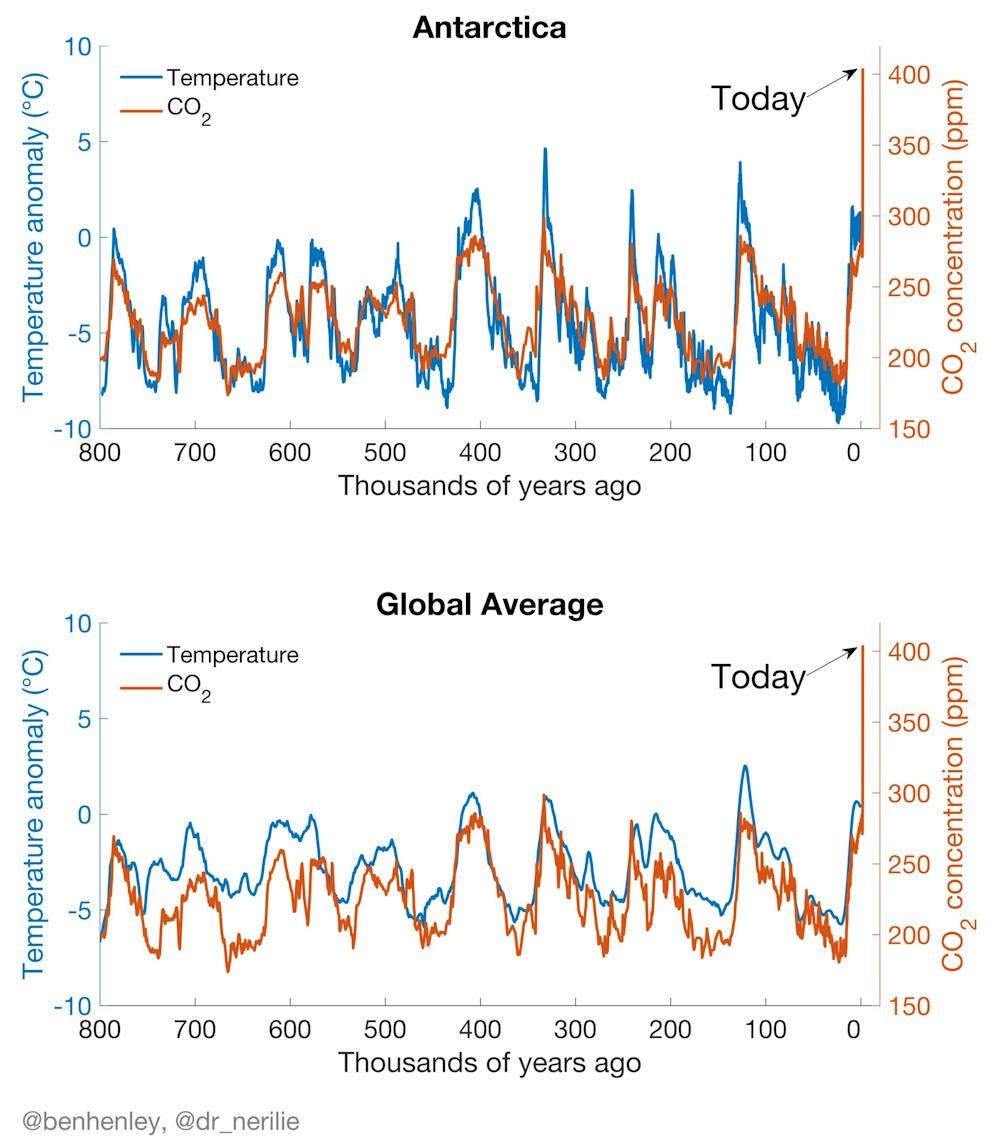
Indeed a graph is indeed helpful.
For people that are unsure what to make of it:
We breaking out of an over 2 million year pattern that nearly all complex species and ecosystems are currently adapted too, the pace of change is also unprecedented, going into the complete climate unknown.
But to make matters worse, even though there are large up's and downs with glaciation and inter-glacial periods (within a long term pattern ecosystems are adapted to), the pace of change of these glaciations and inter-glacials is about 1 degree per 1000 years at the fastest, resulting in steep but still noticeable slopes on 800 000 year time line ... whereas today it is vertical line.
So, not only are we going somewhere we really don't want to go, we're going there faster than the climate has ever shifted in millions of years.
To make matters worse, in the previous glacial-interglacial shifts, nothing came along and "softened up" the ecosystems causing wide spread damage before and during the relatively gentle temperature rise or decrease, so ecosystems were at their full capacity to deal with the (extremely slow, relative to today) change.
We are running 2 global climate experiments while at the same time just straight up destroying ecosystems directly with logging, fishing, agriculture, urban sprawl, damning, pollution of all sorts. -
Ukraine Crisis↪boethius You're on mute. — SophistiCat
Ok, great, but how are we talking if I'm on mute? -
The collapse of the wave functionThe collapse of the wave function in quantum mechanics is sometimes loosely described as caused by “observation,” which implies consciousness can physically affect the universe by causing the collapse. However, “measurement” is more accurate that “observation” because measurement apparatus itself rather than consciousness causes wave function collapse. — Art48
It's now in vogue to say "measurement" than "observation", but that seems more to do with new age spiritualists wildly speculating in a word salad of quantum and consciousness and universe and so on.
However, it is not accurate.
The whole point of Schroedinger's cat in the box, is that we don't know the state of the cat until we look. If we put some measuring device inside the box, to measure the cat's breathing for example, then we don't know the state of the measuring device until we look.
Indeed, the whole point of the cat in the thought experiment, is to measure the state of the poison, which measures the state of a geiger counter, which measures the state of radioactive decay.
"What's actually in the box when we don't look" is not answerable, and our state of knowledge will be a probability distribution of the possible states ... until we look.
If you say "no, no, no, the box has a definite state because of this measuring device; look, we can open the box and read out the measurements" the whole point is that doesn't prove what the state of the measuring device was before looking.
There's many interpretations available, including fully deterministic formulations of quantum mechanics, but wave collapse isn't excluded either.
However, the "local collapse" proponents just don't seem to get the whole point of Schroedinger's cat thought experiment, which is that we don't know until we look. If we don't look at a measuring device, we don't know what it's measured and we don't know if it's in a superimposition of having measured different things. The only way to verify it's in a definite state is to go look ... which of course doesn't prove what state it was in before looking.
Although it seems incredibly bizarre that consciousness is the only real "measurement" standard (the only one we can consciously verify anyways), and the implications would be even more bizarre, naive realism has always failed in quantum mechanics.
Not to say that local collapse isn't a candidate for how the "world really works", but my feeling is that it's mostly used as a naive realist crutch, whereas the history of quantum mechanics is the systematic removal of all such crutches; so, mostly obstructs people's understanding of quantum mechanics by providing something easier to visualise (that there is a "definitely real" measuring apparatus and all the weirdness of quantum mechanics is confined to small systems being measured).
For all these reasons, one of the most popular interpretations of quantum mechanics among working physicists is "shut up and calculate". -
Ukraine CrisisI really don't know why you bother — SophistiCat
You bother to posit some factoid as "real truth", or such is the implication, completely ignoring the issue has already been discussed.
I bother to point out your factoid is based on nothing; the whole "someone close to the Kremlin" or "anonymous CIA officials", or "FSB told me so" etc. are a confidence level of information of precisely zero.
What we learn from de-classified intelligence is that things are completely fucked up and almost nothing could have been deduced from public information at the time. What people in the FSB really thought, Putin thought, what they think now; we really don't know.
Reddit believing as a collective whole they can psychoanalyse all these people ... not a substitute for real knowledge.
And you're bothered that I bother to point it out?
As for updating my analysis of the situation:
It seems Russia is slowly taking all of the Donbas region, and the much talked about Ukrainian counter offensive against Kershon did not move the Russian lines much at all.
We've seen some "high value" targets been damaged or destroyed, such as the bridge to Kershon and then the recent ammo depots in Crimea, but these have very little affect on the actual war.
Main purpose of these attacks seems mostly for media diversion purposes, as Russia steadily takes ground in the Donbas.
Once again, the new "shiny" weapons system "finally getting to Ukraine", the HIMARS, had little effect on the actual military situation.
As I mentioned some weeks ago, taking Kershon is essentially a litmus test for the offensive manoeuvre potential of the much hyped "million man army" in combination with the legendary HIMARS.
Without offensive manoeuvre potential, Ukraine can only steadily lose territory.
As @Olivier5 keeps reminding us, no one wants WWIII, so it seems this situation where Ukraine can only lose territory at immense loss of life and cost will continue.
My guess is the Russian plan is to take all of the Donbas, declare their current objectives "achieved", switch to a defensive posture, and then it will be extremely difficult for Western media to keep up the narrative that Russia is somehow losing / has lost.
As far as the map goes, it's extremely slow but Ukraine has not been able to actually hold any fixed lines, so in the current dynamic is only a question of time.
At that point, Europeans maybe too tired of the war and the media narrative will switch to Ukraine needing to accept defeat and compromise with Russia. Or, could just be shelling back and forth for years as a new normal. -
Ukraine CrisisWhat are you talking about? Sending NATO troops and planes and warships into this war would literally be WW3. What do you think Putin will do when NATO troops get close to Moscow? — Olivier5
It would not be "literally WWIII"; I spend some effort to explain how a "tough" standoff could result in a diplomatic solution.
Maybe actually read what I wrote.
However, let's assume this premise is true, then it follows that arming Ukraine "enough" to actually push back the Russians may likewise start WWIII anyways ... so, can't have that, just enough arms to Ukraine to cause damages to Russia but not enough that they escalate to tactical nuclear weapons.
Which is exactly what we see.
However, the truth is that the principle of "can't send NATO troops" or "can't send too many arms", to avoid WWIII, is simply used as a manipulation tool to calibrate the arms and intelligence support to maintain the war by propping up Ukraine, but not nearly enough support for Ukraine to have a chance of winning.
When you start a large conventional war and don't call it even war, you have this. Putin had the balls to put the Russian Armed Forces to make an all out attack on Ukraine, but he hadn't the balls to put the Russian society into war mode. You reap what you sow. — ssu
Obviously they would make it an "official war" if they wanted to, and they've talked about doing so.
However, paying people to fight is a lot more stable politically and they have increased revenue from fossil fuels sales, so can easily pay.
Similar news and that some Russian troops don't want to serve in Ukraine (see here) or some officers have been even officers have been prosecuted for sending conscripts to the Ukraine war (see Russia Prosecutes 12 Officers Over Conscript Deployments to Ukraine) just point to one obvious issue: low morale among the Russians fighting troops in this war. — ssu
Again, we don't really have any statistically relevant data on Russian troops morale ... and low-morale in armies is pretty common and often goes up and down, total collapse being a pretty big outlier.
Moreover, is Ukrainian morale any better?
For such observations, even if true, to be useful, we'd need to compare both sides. If Russia has lost some number of armoured vehicles, the context of Ukrainian losses are needed to make sense of such a figure.
At least, in terms of evaluating the current military situation. If morale is equally bad on both sides, though neither likely to collapse, then perhaps no difference at all really will result anyways.
If the goal is to damage the Russian military regardless of damages to Ukraine in the process, then the context of Ukrainian losses
Smart-looking but dead. Shoulda been putin.
Employ a drone attack. — Changeling
Yes, please elaborate on your military and geo-political analysis that killing Putin with a drone attack is both feasible and a good idea.
Or, go to reddit to circle jerk virtue signalling fantasies.
Speaking of FSB, here is the next installment of WoPo's investigative articles on pre-war intelligence: FSB errors played crucial role in Russia's failed war plans in Ukraine — SophistiCat
As I've repeated many times throughout this thread, we really have zero credible information on the Kremlin's or FSB internal dialogues and aims.
However, it's already been discussed here at length this idea of a Russian intelligence failure. They secure the South and clearly had a plan B to the first plan and methods of attacks (level everything with artillery), successfully prepare for and withstand sanctions, this does not really demonstrate a failed war plan.
I'd be willing to believe a quick Ukrainian capitulation was viewed as more probable (and maybe it was more probable, the current situation being realistically less likely than the counter-factual; as simply because something happens doesn't mean it was the likely outcome), but the Russian's clearly had a plan B.
There's an incredible amount of myth making on the part of Western media about Putin, or the Kremlin, or the FSB, or the Russian generals internal debates and monologues, but we really have basically zero information. We do not really know what they even really trying to achieve.
For example, part of this mythology of "miscalculation" is that Putin didn't expect the West to steal Russia's money held in Western banks. Certainly sounds had having some 350 billion dollars stolen from state assets.
However, maybe demonstrating to the developing world that their assets aren't safe in Western banks is exactly what Putin wanted, and is worth spending 350 billion dollars to undermine confidence in Western institutions.
Indeed, a critical component of resisting Western sanctions over the long haul is getting the non-Western world to implement alternative payment systems with Russia, and seeing 350 billion dollars get stolen without any due process of any kind is a big motivating factor.
What Western mainstream journalists / propagandists consistently forget in their analysis / propaganda is that the rest of the world is far closer to Putin politically than it is to the Western "ideals" (which the West hardly represents anyways). Most powerful people in nearly every country would be more concerned about their own assets and state assets being stolen by the West, for genuine philosophical "differences" or then pretextual bullshit, than they are of Ukrainian sovereignty. -
Are blackholes and singularities synonymous?There's no reason to assume blackholes are singularities to begin with.
It's a common view in physics that a theory of quantum gravity would explain how a singularity is avoided.
Singularity is a cool word mathematicians uncharacteristically coined and people like saying it.
In the case of "the singularity" of AI, the analogy doesn't even make any sense.
In terms of physics, what we can say is that if anything is actually infinite in some characteristic, we cannot measure that as no machine can count to infinity, so there would be no way to verify if a black hole has a point of infinite density even if it was there.
Electrons could have infinite density when measured at a "point" for example; indeed, it's often assumed all the mass of a particle is at a point, so it wouldn't break anything if that were actually true. Whole universe could be infinite in expanse. But no tool can measure infinity so any infinite quantity cannot be verified even if it exists.
Long story short, there are no singularities in "science", as understood as verifiable facts, but they only appear in mathematical models of some situation, generally understood as representing a problem with the theory, not a prediction. -
Ukraine CrisisThis is not a realist option, rather it's a recipe for WW3. Yet another proof that your position has very little to do with realism. — Olivier5
It is realistic, it's exactly what the Cuban Missile crisis was, which no one really criticises US decisions about.
And, I explain that Ukraine in NATO could be compensated to Russians so they don't even consider WWIII. And, considering the high stakes, everyone would accept pretty much anything given to Russia in such a context, as obviously peace is preferable to war.
You could go in with a "statecraft" plan, even tell it to the Russians over the crisis hotline, see if they signal they agree with the steps about to be taken (or maybe reconsider if they don't).
Anyways, the only thing not realistic in the strategy to protect Ukraine by protecting Ukraine ... is US does not have the statecraft capacity for high-stakes diplomacy, as corrupt plans require the purge of all dissenting voices internally (leaving corrupt and/or morons running things), and the US does not care about Ukraine even if they did have such statecraft capacity left.
Ukraine is tit-for tat for the US disastrous invasion and retreat from Afghanistan. US mouth pieces even kept on saying that before and immediately following the war: "we can give Russia their Afghanistan! We can give Russia their Afghanistan" ... just like the USA gave the USA the USA's Afghanistan ... Russia has become somehow to blame for everything American does to itself.
Take "meddling in elections": even if 200 000 USD on facebook adds was significant somehow and, even assuming it was somehow state sanctioned trolling, why does regulation allow Facebook selling political adds to foreign entities to begin with?
Follow the money. -
Ukraine CrisisYour position is very remote from any realism. — Olivier5
Realism has nothing to do with:
You have argued here that rooting for and supporting the Ukrainians was more morally disgusting than bombing the Ukrainians. — Olivier5
Which I have not argued. I asked: what about the US bombing the Iraqi's (and plenty others) with exactly analogous or then very similar justifications.
However, given the Russian's perception of self-defence (at least as much as the US vis-a-vis Iraq -- and it's simply legitimate to say Russia is genuinely more at risk from Ukraine than US was at risk from Iraq), there is at least this moral component on the Russian's side.
NATO pursuing a policy that essentially maximises destruction in Ukraine, short of nuclear weapons, is not "supporting Ukraine" but rather doing everything to possible to destroy Ukraine. Which, US diplomats and military mouth pieces don't really hesitate to say that's the policy, as that's the policy which also maximises harm to the Russians.
Imagine I am your commanding officer, and I ask you to defend a position to the death. I cannot possibly say this is justified in supporting your own self-defence. Obviously, the only possible justification is fighting to the death holding one position will help the defence of others. US representatives regularly say the justification for "supporting" Ukraine is not that they'll win, or that the outcome is somehow better for Ukraine, but that it is beneficial to avoiding other parties, including themselves, from need to fight the Russians later. A highly debatable presupposition to begin with, but clearly the argument put forward.
It also shows that realism has little to do with your motivations, because a realist would never bother with such skewed moralism, aware as he would be that it won't convince anyone. — Olivier5
I just explained at length the realistic option to protect Ukraine by "supporting Ukraine" which is to form a formal military alliance inside or outside NATO and send boots on the ground to do, or be prepared to do, actual fighting to protect Ukraine.
I made clear that if there was some "Cuban missile" style standoff where some grand bargain is reached or Russia "bluffs" we're continuously told about are actually successfully called (rather than Russia doing exactly what the West claims Russia is bluffing about), hats off to high-stakes statecraft ... if it works.
It is the in between, neither strong nor conciliatory that I have issue with. "So, because you are lukewarm—neither hot nor cold—I am about to spit you out of my mouth." I remember hearing somewhere ... a long time ago. -
Ukraine CrisisObviously, the best way to avoid that is to avoid war in the first place. — boethius
Once the war started, Ukraine made lot's of strategic and tactical choices to maximise suffering of it's own people, essentially holding them hostage in war zones for the purpose of garnering international public sympathy.
The worst of such offences is handing out arms to civilians, which makes them legitimate military targets.
A weapon in the hands of a civilian during a war is a false sense of security that will get them killed and hyperdrive gang violence.
The NATO policy of pouring arms into Ukraine, as I mentioned months ago, will undermine European security for decades to come. These weapons are already in Europe. The two traditional barriers to sophisticated weapons coming to Europe: they're being hard to get and so super expensive (therefore only affordable by groups Western intelligence likely knows about, and most well financed groups are mafia's of one form or another that aren't so interested in causing random mayhem) and then the actual transport to Europe giving opportunities of interception, do not exist with these weapons: they are cheap, available to all sorts of random groups that can come into existence literally today and completely dedicated to random mayhem (especially if Ukraine doesn't "win" and the West is obviously to blame for that), with the weapons already in Europe and require little smuggling expertise or expense to transport them anywhere on the continent (maybe why UK has been more enthusiastic for war).
Furthermore, lowering both the cost and the costs and risk of transport, lowers the barrier to completely "rational" organised crime. It makes no sense to spend millions in both capital outlay, transportation, and "levelized cost of crime" considering the risk of capture, on a robbery, assassination, or gang violence of which the benefits are lower.
Lower the costs and risks of acquiring and transporting the weapons and this significantly widens the scope of profitable crime.
To make matters worse, security systems and protocols of yesterday were thought out and designed for the threats of yesterday.
It is only a matter of time before a civilian aircraft is downed by a stinger missile, as well as unbelievably violent robberies take place with advanced weaponry.
There is no doubt as to the extreme lethality and effectiveness of the sophisticated weapons delivered to Ukraine. NATO flooding the black market with its most sophisticated shoulder operated weapons is complete insanity.
When you actually do military service you realise quickly that an automatic assault riffle, as destructive as it is and capable of civilian massacres that we regularly see ... is basically a prop compared to the other weapons systems involved in a modern military engagement. -
Ukraine CrisisFair enough. And what has been your position then, if not support to Russia's war effort? — Olivier5
I will go back and quote myself outlining again and again my position, but for now I will just summarise it again.
My first priority is to avoid death, suffering and trauma of children.
Obviously, the best way to avoid that is to avoid war in the first place.
There seems to be a genuine incapacity to understand the realist position I and others have defended here as well as presented by John Mearsheimer.
NATO playing "tough" could have avoided the war.
Almost no one criticises the American response to the Cuban missile crisis. But only because it worked. Had it resulted in nuclear exchange (even with the exact same political decisions, just things randomly got out of hand in such a tense standoff), people might have a lot of criticism.
What Mearsheimer point out is the simple truth that US / NATO is simply not willing to actually play tough, before, during or after the war, proven by the fact that it doesn't.
US and NATO declare some sort of Ukrainian pathway to join in 2008 ... so why didn't that happen?
Had they played tough, such as letting Ukraine in after 2008 in a midnight "super diplomacy" deal, or before 2014 ... or anytime after, maybe the war would have been averted.
Had US / NATO done some "tough" move, made a standoff, some deal is reached and Russia backs down. I would be totally for it. I am not criticising Ukraine in NATO if that averted war.
And, other things could be offered the Russians: Nord Stream 2, pulling back forward operating missile bases to "protect against Iran", no Ukrainian military forces on the Russian border, lifting all sanctions, Russian language protection, UN supervised vote of status of Dombas and Crimea etc. (not a requirement 2008-2014, when guarantees for Sevastopol and Russian minority rights would likely have been enough).
Nuclear war is not a foregone conclusion for the simple fact of letting Ukraine in. It's in anyways unlikely as Russia also doesn't want full scale nuclear war, and it's always possible to imagine some compensation to Russia that would convince them to not use tactical nukes in Ukraine, daring the US to respond with strategic nuclear strikes (again, unlikely because US also doesn't want nuclear exchange).
The reason this scenario isn't talked about is just that it's so obvious that US doesn't care about Ukraine enough to put in that kind of standoff and diplomatic energy. US and other NATO countries don't give a shit about Ukraine.
Which results in the terrible policy position of supporting Ukraine just enough to maximise Ukrainian suffering. This is not a morally or politically sound position.
And US at. al. don't even really hide it, they speak plainly that the goal is to "fight Russia in Ukraine so as not to fight them here," totally absurd (as Russia is not about to invade the US if "Ukraine falls") and basically admits to Ukrainians being cannon fodder in this strategy.
The reason to focus on the policy position of my own government and political blocks is that's the policy I'm morally responsible for as a citizen.
I'd also only get into some debate of the Russian moral and political justifications, if my pro-US interlocutors demonstrate how Russia's war in Ukraine is not as justified as the US war in Iraq and Afghanistan, torture programs, or violating sovereignty of other countries with both over and cover operations all the time without hesitation, in the name of "US interests".
And this is not whataboutism fallacy.
First, whataboutism is not a fallacy in the first place. It is a completely legitimate question to say "what about this other thing" to see how a position deals with it.
In a good faith debate a "what about this other thing" question is simply going through some other example to understand the principles of a position and how they operate, for better mutual understanding.
In a bad faith debate, "what about this other thing" is not a fallacy, just a waste of time or then deflecting from legitimate questions one has already received. For example, had I not answered your question of what my position, and simply said "what about the US!" then that would be bad faith and hypocritical, as I am demanding satisfaction of a question when I already in debt to perfectly legitimate one's myself.
In particular, whataboutism is bad faith when deflecting from internal criticism. For example, democrats defending obvious democrat corruption by saying "what about the Republicans". Republicans have nothing to do with democratic party integrity and the best way to fight Republican corruption is to provide a less corrupt example. The sub-text is alway "but we need to be corrupt to win!" ... but "win what?", well, obviously the fruits of corruption.
US proponents are in debt to the question of "what about Iraq," (as well as many other wars / covert actions) and in the US' own justifications of its action, Russia is justified by far according to those standards. Ukraine presents a far greater security threat to Russia than Iraq did the US. The whole there are bio labs that can't fall into enemy hands, seems far greater evidence of WMD's than US had concerning Iraq; if the Ukrainian biological WMD's don't exist ... well neither Iraq nuclear weapons or capacity to build them. Russian soldiers and officers have certainly done some torturing on their own initiative, but there is so far no evidence it is an institutional decision ... whereas US simply legalised torture and built large and sophisticated torture operations; I'm certainly willing to believe Russians do have institutional mandated torture programs, but that just brings them to parity.
Then there's the neo-Nazi question. Certainly not-invading Ukraine is appeasing these overtly Nazi organisations. The argument is they don't have enough influence in Ukraine to satisfy such an argument ... but what's the standard, how many Nazis is too many Nazis with too much power and influence.
Russia uses propaganda ... US uses propaganda.
That being said, if I the question was put to me after somehow responding to all these questions and demonstrating that Russia cannot easily justify its war effort according to the US' own standards set for itself, or then from simply a anti-Russian and anti-US position, certainly Russia could have done more to avoid war. There is a faction in Russia that wanted this war as much as the analogous faction in the US. These factions together pushed things towards war and not peace. They are morally culpable, but so too the less violent factions on both sides that did not oppose the process playing out in slow motion over several decades.
Why?
They were bribed not to intervene in the process in a way that might change the outcome. -
Ukraine CrisisSo if sanctions aren't really hurting Russia but are hurting the most vulnerable in our own societies, why continue with them? — Benkei
I believe the logic is that the whole narrative of fighting a war without actually fighting it, only makes sense if there's at least the suffering part.
Look! We're suffering for the war effort! We're so committed!
Of course, the people making this policy don't suffer, and they clearly do not care about those that do. I think this is pretty obvious in the fact that whenever the subject of nuclear war comes up, White House et. al., are unhesitating in declaring we can't have that (therefore no no-fly zone, no "offensive weapons" etc.) but a total collapse of the Russian state would also be a likely nuclear war scenario: therefore, there was never any genuine belief sanctions would accomplish that.
It also seems to me improbable that there was any belief that the sanctions would "work", rather the goal is a new cold war theatre which requires a new iron curtain. -
Ukraine CrisisMine is a pragmatist, real politics-based position. — Olivier5
Again, supporting NATO supporting Ukraine's war effort, is supporting Ukraine's war effort.
Support is support, regardless of the justification and regardless of whether it's indefinite support or not.
If I support a political candidate, doesn't mean I'm committed to support indefinitely nor that if I reevaluate my support somehow that retroactively removes the support I provided in the past.
Your position is obviously support to Ukraine's war effort since starting on this thread.
Yes, please, explain your reasons for it, that's the purpose of discussing, and obviously many, many people in the West support Ukraine's war effort, so it's good for the purposes of discussion that someone represents that position.
Furthermore, realist, pragmatic and strategic decisions are still for the purposes of some moral objective.
None of these are amoral things, just analytical frameworks on how best to achieve moral objectives in the real, messy world where nothing is ideal and compromise is always necessary (simply limited resources forces us to compromise on what moral objectives are practical to pursue).
Realism, pragmatism and strategy are analytical tools to try to understand what the actual consequences of different actions are likely to be. Actual likely consequences are clearly relevant to decision making.
However, real consequences in a complex world, don't somehow make the moral objectives irrelevant, just bring to the for difficult decisions.
For example, in WWII, the allies broke Enigma and so could know when ships would be attacked, when and where.
Many ships were not warned or told to change course because it would risk statistically tipping off the Nazi's that enigma had been broken and they may do a full reset of all the code books, change wheels and so on.
Obviously the goal was to save lives, but a realistic, pragmatic, and strategic analysis concluded some lives needed to be knowingly sacrificed to optimise the covert information advantage over the longest possible time frame.
Someone could have spoken up for the fact it's the Germans that are morally responsible for the attacks and the deaths, they're duty is to save lives and so they must warn everyone they can, and if the German's change their codes and then kill more people it's their moral issue and doesn't matter.
The difference between such a naive fool and the mathematicians that worked out a formula of who to save and who let die, is simply the time frame under consideration. What achieves the goal (saving lives) in the short term may be counterproductive to the same goal over the long term. -
Ukraine CrisisIt's a case for the US and EU to support the Ukrainian war effort, for as long as the need it — Olivier5
That's clearly pro war. Why call it something different?
Supporting NATO supporting the Ukrainian war effort ... is clearly supporting the Ukrainian war effort.
boethius

Start FollowingSend a Message
- Other sites we like
- Social media
- Terms of Service
- Sign In
- Created with PlushForums
- © 2026 The Philosophy Forum