
Comments
-
Our 3D Prison?Have you read "Flatland." It deals with some of these intricacies.
https://www.amazon.com/Flatland-Romance-Dimensions-Edwin-Abbott/dp/B0875SRH84/ref=sr_1_1?crid=3TGN15CI0WCZS&keywords=flatland+edwin+abbott&qid=1674664998&sprefix=flatland%2Caps%2C124&sr=8-1 -
What is the root of all philosophy?...is there a common root for all such endeavors? — Bret Bernhoft
I can only speak for myself. The root of my interest in philosophy is a need for self-awareness. -
Intent and Selective Word UseIn summary, we will choose our words based on our feelings and intent, in an unavoidable process that necessarily biases our perspective and conclusions. — Judaka
I think it would make more sense to say:
We will choose our words based on our feelings and intent, in an unavoidable process that necessarilybiasesreflects our perspective and conclusions.
Which is really the whole purpose of language. -
Top Ten Favorite FilmsI figured his films deserve mention given that they have had a dominating influence on American comedy the past 20 years — Joshs
I really stopped watching movies much just about 20 years ago, so, although I'm familiar with the names, I haven't seen any of the movies you listed.
As for Dudley Moore, I really liked the original "Bedazzled" with Peter Cook as the devil. Didn't like Arthur or 10. What else was he in? -
Top Ten Favorite FilmsEternal Sunshine of the Spotless Mind — frank
Forgot about this. This and Truman Show are the only Jim Carrey movies I really like. -
Top Ten Favorite FilmsCharlie Chaplin, Billy Connolly, Robin Williams, Stan Laurel, Buster Keaton. Would that team work, for example? — universeness
I agree with most of your list, although I've never loved Laurel and Hardy. I've seen Billy Connolly on TV and doing standup, but the only movie I remember seeing him in is The Last Samurai. Let's see, who would I include?... Bill Murray, Nicholas Cage, Woody Allen, Jim Carrey, Tom Hanks, John Cusack, Monty Python guys.... Ok, my favorite comedies:
Moonstruck - I can't believe I haven't mentioned this before
Diner - Should have mentioned this before too
The Navigator + other Keaton movies
High Fidelity
Groundhog Day
Annie Hall
Manhattan
Say Anything
The Three Stooges Meet Donald Trump Jr.
The Truman Show
Raising Arizona
The Graduate
Singing in the Rain
Caddyshack
Get Shorty
The Princess Bride
The Shop Around the Corner -
Top Ten Favorite FilmsSermon over. — Tom Storm
When I like a movie, I try to think back and figure out why. Often, it has to do with character - George Smiley in Tinker, Tailor, Soldier, Spy; Phillip Marlowe in The Long Goodbye; Rick Blaine in Casablanca; Wyatt Earp in Tombstone - people who might seem weak, or frivolous, or cynical, or brutal - but who when tested have a deep moral center.
And that's my lecture. -
Is pornography a problem?I was reading that several states are implementing legal requirements for robust proof of age measures for pornography sites. That makes a lot of sense to me.
-
Top Ten Favorite FilmsFavorite actions films? Mine is Raiders of the Lost Ark. — Tom Storm
I'm surprised. You're such a popular culture curmudgeon. I have no problems with suspension of belief, but the story just didn't hold together for me. Last straw - the face melting scene. Not because it was creepy, but because it came from nowhere in an otherwise more or less realistic movie. An almost literal deus ex machina. -
Top Ten Favorite Filmswould never recommend unless someone wants to watch a cheesy 80's sci-fi film with me. — Moliere
I don't agree. Although, as I noted, it has sentimental value for me, I think it's a pretty good movie too. I don't love the science fiction and movies considered great. I liked the first three Star Wars, but wouldn't put them on my list of favorites. Ditto with Indiana Jones. Didn't like Alien and didn't watch the rest. Didn't like the Lord of the Rings movies, Blade Runner, or Harry Potter. Didn't like any of the Star Trek movies much.
Which reminds me of two of my favorite movies I left off my list:
Things to Come - 1936. Really striking cinematography. Raymond Massey. I think it reflects the fact that people in Europe knew a war was coming, but the one in the movie was even worse than WW2. Well made. It has that 1930s, futuristic, art deco vibe.
Primer - Made for $7,000 using the director's parent's credit card. By far my favorite time travel movie. After I saw it I said to myself - Yes, that's how it will happen if it ever does. -
Top Ten Favorite Films
-
Top Ten Favorite FilmsIt's a mad mad mad mad mad mad world
Duck Soup — universeness
Caddyshack - Cinderella story
Woody Allen:
Manhattan
Midnight in Paris
Take the Money and Run
Everybody Says I Love You
Annie Hall - my favorite scene
Lots of good silents by Buster Keaton.
The Navigator - This is my favorite.
Steamboat Bill Junior
Seven Chances. Tell me you didn't laugh at this:
I've always loved this scene from Modern Times
-
Top Ten Favorite FilmsWesterns
The Magnificent Seven
Tombstone
Little Big Man
Cat Ballou
Appolusa
Hidalgo
Destry Rides Again - James Stewart. Some scenes here were parodied in Blazing Saddles.
The Warriors Way - A kung fu, western, fantasy about carnival freaks, cowboys, and a kung fu master. Kind of like a surrealist Kung Fu, the television show. Really neat, funny movie.
The Good, the Bad, and the Ugly - I'm surprised no one has mentioned this. Also:
A Fist Full of Dollars
For a Few Dollars More
Once Upon a Time in the West -
Top Ten Favorite FilmsBrazil
— Tom Storm
Hated it. Just too, too, too much. Same with Imaginarium.
Not everything needs to be illustrated with cartooney exaggeration. — Vera Mont
Actually, I liked the too, too much. I remember laughing. I kept thinking it was over. Then something else bad happened. After all, it was made by a member of Monty Python. What can you expect? -
Top Ten Favorite FilmsSometimes a Great Notion — unenlightened
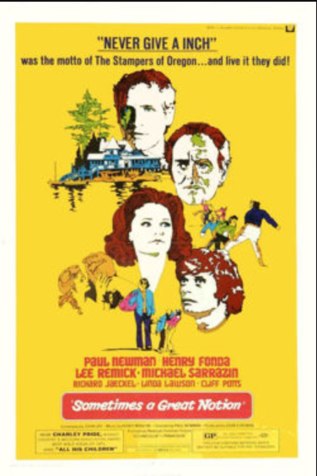
I guess it was given a different name, Never Give and Inch, but I remember seeing it as Sometimes a Great Notion. -
Top Ten Favorite FilmsEducating Rita. — unenlightened
Yes. Made me realize I'd left out Michael Caine:
The Man Who Would be King
Educating Rita
Billion Dollar Brain
Hannah and Her Sisters
Noises Off
Should have been on my list.Goodfellas — Bradskii
Great movie. The only movie with Jack Nicholson I really like.Chinatown — Bradskii
Hated the book so much I wouldn't watch the movie.No Country For Old Men — Bradskii
Disturbing movies - Really like them. Really never want to watch them again.Ex Machina — 180 Proof
Ex Machina
On the Beach
Manhunter - Pre-Anthony Hopkins Hannibal Lecter
Let the Right One In - Swedish version. Wikipedia calls it a "romantic horror movie." Well...no... calling it romantic is like saying Psycho is a movie about plumbing. Also - they're like 12 years old.
Miracle Mile - Really believable and scary movie with Anthony Edwards. Now this is a romantic horror movie. Also had Tasha Yar from Star Trek the Next Generation.
Crimes and Misdemeanors
I forgot about his. A really good movie. Not like anything else I've ever seen with Jason Robards.A Thousand Clowns — Joshs
How about some musicals
The Bandwagon
Cabaret
The Wizard of Oz
An American in Paris
Singing in the Rain -
Top Ten Favorite FilmsAaaargh! I keep being reminded of ones I should have put on my list. Here's some books that were the basis of movies that are good:
- Little Big Man - Berger. Should have been on my movie list
- Last Picture Show, Lonesome Dove - McMurtry is a great writer
- Elmore Leonard - All his books are great. Some of his movies stink. My favorite adaptation is the TV show Justified.
- Princess Bride - Goldman. Even more ironic and funnier than the movie.
- Tinker, Tailor, Soldier, Spy and Smiley's People - Le Carre
- In Cold Blood - Capote
- Billy Bathgate - Doctorow
- Manhunter - Harris. This is the original Hannibal Lecter movie made in the 80s with Brian Cox as Lecter. The book is Red Dragon. The movie Red Dragon was a remake.
- The Martian - Weir.
- The Name of the Rose - Eco
- Smilla's Sense of Snow - Hoeg
- Starship Troopers - Heinlein - Good dumb movie. Good dumb book.
- Stardust - Gaiman
-
Top Ten Favorite FilmsI also liked "Pride and Prejudice". The scene in which the fallen nobleman proposes to the chick (I can't remember any names) and she starts sobbing is the emotionally most laden scene in any movie I've seen. I howl in tears as I cry every time I get to that scene when I watch that movie. Which happened about twice, I'd say. — god must be atheist
Are you thinking of "Sense and Sensibility?" The 1990s version has Emma Thompson, Hugh Grant, Hugh Laurie, Kate Winslet, Alan Rickman...
The Truman Show — Jamal
Should have been on my list.
The Fall — Luke
Is this the one with Lee Pace about the injured stunt man? If so, I agree. It really liked it.
Groundhog Day — Luke
This should have been on my list too.
Midnight in Paris — Vera Mont
Woody Allen has his ups and downs. This was definitely one of the ups. -
Top Ten Favorite Films1. Life of Brian.
2. Holy Grail.
3. Snatch.
4. 2001 A Space Odyssey
5. A Clockwork Orange
6. Bullets over Broadway.
7. Michael Clayton.
8. Jason Bourne (the first three of the Quatregy).
9. Fargo.
10. Badlands. — god must be atheist
Didn't see Michael Clayton or Bullets Over Broadway I liked the rest except 2001. I should have put Fargo on my list. -
Top Ten Favorite FilmsNot in order:
Wizard of Oz
Casablanca
The Graduate
Tinker, Tailor, Soldier, Spy - the 1980s version with Alec Guinness. Ok, it's a TV series. So sue me.
LA Confidential
The Donald Trump Jr. Story
The Last Starfighter - It has sentimental value. I remember watching it while holding my infant son (now 37) as he screamed for the whole movie film at a drive in theater.
Tombstone
Annie Hall
Manhattan
Raising Arizona
Caddyshack
The Long Goodbye
Say Anything
More than 10.
Doesn't this belong in the Lounge? -
Carlo Rovelli against Mathematical PlatonismLong gone. I revived this thread because it was relevant to the point I was making elsewhere. Prior to that the last post was 4 years ago. — Wayfarer
This is just a reminder of how good Streetlight was and how much he contributed to the forum. -
Evolution and the universeAnd yes, it's just a description. — Bradskii
Doesn't seem like you and I disagree much. Things don't have to follow a scientific law, it just so happens they do. -
Causes of the large scale crimes of the 20th CenturyHumans are killer apes. :wink: If I had to guess, I'd say people had diverse reasons for doing vile things, mild and terrible, even within the one egregious phenomenon like Nazism. Perhaps a web of interrelated factors. But I think it's fair to say that tribalism and our obsession with identifying ultimate truth, whether it be in politics or religion, along with our ready willingness to kill to defend such truths, seems to be at the root of many of these matters. — Tom Storm
It seems that the great majority of mass deaths of innocent civilians have been caused by the desire for power, land, and profit. Kings want to be emperors. Governors want to be president. Millionaires want to be billionaires. Same as it ever was. -
Causes of the large scale crimes of the 20th Century"There are various estimates of the number of victims of the Spanish Inquisition during Torquemada's reign as Grand Inquisitor. Hernando del Pulgar, Queen Isabella's secretary, wrote that 2,000 executions took place throughout the entirety of her reign, which extended well beyond Torquemada's death.[20]" — jorndoe
From what I could see, including in the Wikipedia article you linked, there are differences in opinion about how many died resulting from the inquisitions actions. I think there would be agreement that the numbers were much less than those killed in the conquest of the new world, which was taking place at about the same time. -
Evolution and the universeHow is that idealism? You meant realism, yes? — Mikie
I call it idealism because it claims that there is some sort of abstract entity in the universe independent of actual phenomena. Something that we can't see or sense that somehow causes things to happen. Do these abstract entities control the behavior of matter and energy? I thought phenomena were caused by interactions between matter and energy.
I'd concur. For example, a body will remain at rest or continue in motion at a constant speed until it is acted upon by some force. — Bradskii
Why do I need some explanation for why something doesn't change it's motion? Even if I look at Newton's second law, it says that bodies will change their velocity if acted on by a force. The force causes the change, not some law. All the so-called law does is describe how it happens. -
Causes of the large scale crimes of the 20th Centuryimagine if Torquemada had acquired logistics/resources we know of today, more power. I'm thinking cruelties would have been higher accordingly. — jorndoe
Looking on the web, it seems as though the number of people executed by the inquisition in a period of 300 years was in the low thousands. -
What is your ontology?I agree that reality/existence in day to day living can be taken at face value. This is the nature of culture, common ideation and the interpersonal utility of language.
It's surface level - vague, imprecise, unquestioned, unassumed and therefore useful in a day to day context.
However existence is not just surface level. It stems from the furthest/most distant origins. The most primitive, the beginning of all things. All encompassing.
Trying to apply specificity to a macroscopic scale is much more difficult then applying vaguery to the everyday microscopic scale. — Benj96
I think this undervalues the importance of everyday reality. All the other ontologies only have meaning in the context of this way of seeing things. They all have to take it into account. The fact that so many don't is a sign of a lack of insight.
It's also more than surface level. It encompasses everything that humans experience in all but the most extreme and exotic environments. It's also not in any way vague or imprecise. An apple is exactly an apple. I can measure it's location, motion, volume, mass, electric charge, sweetness, shape - all its properties, within precise tolerances. If it's unquestioned, that's because it works so well in so many situations. -
Causes of the large scale crimes of the 20th CenturyIn terms of scale, the greatest crimes of humanity against itself were during the 20th Century. — frank
I wonder if this is true. As @BC notes, wars that have killed millions of people, mostly civilians, have been taking place for centuries, millennia. I assume World War 2 had the highest casualties, but there are other, earlier wars that have killed 10s of millions. Those numbers are even higher when counted as a percentage of the people alive at that time.
I do think that the 20th century allowed the mechanization of war. Changes in weapons and transportation made it much more efficient. Communications has improved so we can know more about the bad things that have happened. -
What is your ontology?What is your explanation for existence? Why it occurred, what purpose or meaning it may or may not have? What are your ethical, epistemological or personal views related to existence? — Benj96
I don't see ontology as an explanation of existence, it's a description of the nature of existence, reality. It's a metaphysical concept. I've given my lectures on metaphysics before. At some level, we all have the same view of the nature of reality, the same ontology. The regular old day to day nature of reality we all experience all the time. Everyday reality. Maybe the right name is realism, I'm not sure. This reality is full of apples, Volvos, femurs, tree frogs, salt water, Cheetos, and Australia. Forgot cucumbers. Most people don't question whether or not their children are real or an illusion created by a Cartesian demon on a regular basis. Most people don't question whether their coffee is real or only the reflection of an inexpressible noumena.
It's only when we turn to philosophy that there is any mystery to ontology. I think we all pick them one based on our personality and temperament. I also think we apply different metaphysics and epistemology in different situations and at different times. -
What if cultural moral norms track cooperation strategies?Assuming this empirical finding is correct and given its above limitations, do you think this observation about the function of moral norms could be culturally useful for resolving disputes about moral norms? And if not, why not? — Mark S
It's important to me that I respond in a way consistent with your intent for this discussion, but I have a hard time "assuming this empirical finding is correct," because I don't really understand it. It does not resemble any theoretical approach to morality I have any experience with. I don't really understand what "Cultural moral norms are arguably heuristics (usually reliable but fallible rules of thumb) for subcomponents of strategies that solve cooperation problems," means.
I'll just leave it at that. -
Hindsight AnalysisReligion, sports, war, politics, business, news, cultural commentary, you name it, it's everywhere. — Judaka
I don't disagree with the points you've made, I just want to make sure a distinction is made between justifiable and unjustifiable uses of what I guess you could call "forensic analysis." -
Hindsight AnalysisI'm talking about unproven logic formed during the environment created by hindsight being taken as validated by offering a reasonable, or unreasonable explanation of why something occurred. — Judaka
I'm ok with this, but I can't really think of examples where it applies. Take your example of Monday morning quarterbacking. Trying to blame someone for a single possible mistake in a game is probably silly and unnecessary. But evaluating performance when trying to decide whether to fire a coach might include incidents like that in an overall judgement.
On the other hand, there was a NE Patriot game this year with one play that had a disastrous result. The sportscasters felt they were qualified to blame Bill Belichick, one of the winningest coaches in NFL history, for the decision. I agree with you on something like that. -
Hindsight AnalysisThese so-called critical thinkers are at the mercy of what they're exposed to, they'll conclude in favour of whatever was the most recent outcome, based on whatever material comes their way. No need to convince with arguments, just show occurrences that conclude the way you want. The public will naturally process everything the way you wanted them to anyway. — Judaka
When something goes wrong, you get new information that might have affected the decisions you made if you'd known it before. Say an engineer designs a building with reinforced concrete floor beams. A couple of years later, after the building is complete and has been operating for a while, cracks are found in some of the beams. Examining the beams indicates that they are failing because bending stresses exceeded the allowable strength of the concrete or the amount of reinforcing steel. Based on observations you make hypotheses about what the failure mechanisms were. You rerun the calculations to see if the beams were designed correctly. You take samples of the steel and concrete to see if they met specifications. Based on that information, you make a determination about what went wrong. -
What should be done with the galaxy?why the galaxy needs to be valuable? I want the opposite. I wish the Galaxy is never occupied by us and it stays there, not caring about time neither the human's existence. — javi2541997

-
Evolution and the universeI read about it in Simon Conway-Morris' book, Life's Solution. — Wayfarer
I put it on my reading list.
Scientific materialism arises precisely in the attempt to apply scientific method to the problems of philosophy. Science is predominantly a method of acquiring knowledge but is not a worldview per se. In fact part of the implication of scientific scepticism is that it should not be taken as a worldview. — Wayfarer
Materialism is a metaphysical worldview. Science is a method or series of methods to gather knowledge. Materialism or something similar are, or at least have been, the absolute presuppositions, basic assumptions, which are the foundation for the scientific methods. -
Evolution and the universeThis is categorically wrong. In thinking that red, for example, only exists if there is someone around who decides it's red. But we don't do that. What we decide is that objects that emit a wavelength around 700nm we shall describe to each other with a particular sound we can make with our vocal chords. And scratch a few runes on a suitable material to represent that sound. But whether anyone observes the colour of the object, it still emits wavelengths at that frequency. — Bradskii
I'll say it again - the existence of objective reality is only one way of looking at the world. It's metaphysics. If you can't see that, or at least understand what @Wayfarer is trying to say, and it's clear that you don't, there is no way you he can come to any common understanding. You will bash each other for hours and days and never get anywhere. -
Evolution and the universeThe objective reality you propose is a creation of the mind. Of course the moon and the universe existed in some way before your existence, but the way in which it existed is entirely unintelligible, completely meaningless.
Imagine that all life has vanished from the universe, but everything else is undisturbed. Matter is scattered about in space in the same way as it is now, there is sunlight, there are stars, planets and galaxies—but all of it is unseen. There is no human or animal eye to cast a glance at objects, hence nothing is discerned, recognized or even noticed. Objects in the unobserved universe have no shape, color or individual appearance, because shape and appearance are created by minds. Nor do they have features, because features correspond to categories of animal sensation. This is the way the early universe was before the emergence of life—and the way the present universe is outside the view of any observer.
— Charles Pinter, Mind and the Cosmic Order — Wayfarer
This is just a bad translation of the Tao Te Ching without the poetry or soul. It shares with the Tao Te Ching the fact that it is metaphysics. If you insist that this is the only way to see things, you are just repeating the error you are arguing against.
Donald Hoffman: The idea that what we’re doing is measuring publicly accessible objects, the idea that objectivity results from the fact that you and I can measure the same object in the exact same situation and get the same results — it’s very clear from quantum mechanics that that idea has to go.
I know you disagree with me on this, but, for me, conflating theuncertaintyformlessness described by Taoism with that described by quantum mechanics is mistaking a metaphor for reality. Up here at human scale, we don't live in a quantum world. We can know pretty exactly where baseballs are and how fast they are going at the same time. To say that the world we live in everyday is somehow less real than that found at the scale of subatomic particles makes the whole idea of reality meaningless, ridiculous.
Treating quantum mechanics as a single-user theory resolves a lot of the paradoxes, like spooky action at a distance.
Yes, but in a way that a lot of people find troubling. The usual story of Bell’s theorem is that it tells us the world must be nonlocal. That there really is spooky action at a distance. So they solved one mystery by adding a pretty damn big mystery! What is this nonlocality? Give me a full theory of it. My fellow QBists and I instead think that what Bell’s theorem really indicates is that the outcomes of measurements are experiences, not revelations of something that’s already there. Of course others think that we gave up on science as a discipline, because we talk about subjective degrees of belief. But we think it solves all of the foundational conundrums.
These don't seem like similar statements to me at all. I wonder if they would to Chris Fuchs.
T Clark

Start FollowingSend a Message
- Other sites we like
- Social media
- Terms of Service
- Sign In
- Created with PlushForums
- © 2026 The Philosophy Forum