
Comments
-
Skill, craft, technique in artI think at the heart of the craft/skill/art discussion is meaning. There isn’t, or at least doesn’t seem to be, much personal meaning in craft items like chairs or pencils, whereas artworks typically are designed with personal touches. Artists intentionally choose certain colors, sounds, shapes, etc. beyond strictly what is needed for the item to be functional/useful. These choices metaphorically instill a part of the person into the item. They create meaning beyond the item’s functionality. — Pinprick
Which brings us back to the original question - how much does skill matter in art? If personal meaning is the standard by which art should be judged, then it doesn't seem like skill would matter much.
So, if you just make a wooden chair because wood is all you have available and size it so that it seats comfortably, and don’t add any decorative details, then it is a craft work. Now, that isn’t to say that others won’t find your chair aesthetically pleasing, but that isn’t what makes something an artwork. — Pinprick
There’s also the possibility to have a mixture of both; a functional chair that also contains embellishments meant to please the eye. This is more of a gray area, and is probably determined by how it is marketed or used/displayed. — Pinprick
This is a picture of furniture designed by Frank Lloyd Wright for one of his houses.

For me, this furniture is not "embellished."
I'll come back to this - I don't really disagree with what you're getting at, but I think you're oversimplifying. -
Skill, craft, technique in artThere isn’t, or at least doesn’t seem to be, much personal meaning in craft items like chairs or pencils, whereas artworks typically are designed with personal touches. — Pinprick
The chords/rhythms/textures I choose when I make music are in fact very personal to me, without me even trying to make them so. — Noble Dust
I'm stealing some images from "Beautiful Things," still one of my favorite threads after all these years.






This doesn't necessarily mean you're wrong, but I think it shows your view is too narrow. -
Religious speech and free speechI suppose it says "in god we trust" because they can't trust each other? — Banno
Nationalist bigotry. To hell with the kangaroos. You're all back on the list when we drop the big one. -
Religious speech and free speechyou are old enough to remember the "Impeach Earl Warren" billboards. (youth: Earl Warren was a liberal Chief Justice long long ago. — Bitter Crank
I do remember them, although I didn't really know what they meant, being 10 or 11. That's why I laugh at the current pushes to impeach Thomas, Kavanaugh, and Barrett. Same as it ever was. -
Religious speech and free speechTell me why. — Tom Storm
There may be a good case to show the US doesn't have separation of church and state, but that isn't it. It's trivial. I think we do a reasonably good job, but I'm not particularly interested in starting a long conversation, but that bullshit reason pissed me off. -
Religious speech and free speechIt's hard to see how America has meaningful church and state separation when even the fucking currency has In God We Trust emblazoned upon it. — Tom Storm
This is baloney. -
Religious speech and free speechAs one expects, it depends on whose ox is getting gored by whom. — Bitter Crank
Conservatives feel just as strongly and as bitterly about marriage equality as liberals do about abortion. They said the same types of things about the courts as liberals are saying now. -
The Metaphysics of MaterialismSorry, I took that to mean "as of the observations of 1905," not as "only things published before 1905." The attempt to do physics without math was driven by the Quine-Putnam indispensability argument, which came after 1905, but has nothing to do with quantum mechanics or changes to physics after 1905. — Count Timothy von Icarus
I was just trying to get a handle on how most materialist scientists and philosophers saw things before quantum mechanics and other advances were made. -
The Metaphysics of MaterialismThere might be issues with point 4. There have been attempts to redefine physics fully in terms of relationships so as to avoid the necessity of numbers being "real." — Count Timothy von Icarus
As noted in the OP, the purpose of this discussion was to discuss the absolute presuppositions of a materialist view before 1905, before much of modern physics. -
Skill, craft, technique in art@Noble Dust @Tom Storm
I really enjoy choral and some orchestral music. The interplay of all those voices, human and otherwise, can be engrossing and moving. When you have large groups of singers and musicians performing together, what is most important for the quality and enjoyability of the experience? Does the skill of individuals matter or is it only the way everyone plays in the group? Assuming there are no unskilled participants, does only the average quality matter? Can you hear the difference a single singer or musician makes? Or is it mostly in the direction by the conductor? -
Skill, craft, technique in artwhy don't you put your aesthetic musings to work and join in the short story contest as a commentator? — Noble Dust
I used to love short stories. When I was young, there were many books of science fiction stories that I liked. Somewhere along the line I stopped reading them. Not sure why, but I don't find them satisfying now. -
Fitch's "paradox" of knowabilitySee here for an explanation in ordinary language. — Michael
Thanks. -
Skill, craft, technique in artSimilarly, there have been many more technically able guitarists than Frank Zappa or Robert Fripp, but the music of, say, Yngwie Malmsteen and Steve Vai leaves me cold. Could this be because Zappa and Fripp had other skills, not particularly involved in guitar technique, that they brought to bear on their guitar playing (harmonic awareness, note choices, etc., that they got from being composers and having a natural all-round musical knowledge and musicality)? Or do we in this case want to reach for the arty stuff to explain it: conceptual vision, emotional investment, or imagination?
Some painters are terrible at painting hands but great at other things. Can we only say they are great once they've finally managed to master hands?
It becomes apparent that craft, skill, and technique are not the same thing, or can at least encompass a range of different and overlapping kinds of abilities. One answer is that craft (and possibly technique) is the set of traditional techniques that are handed down by training, whereas skill seems to be something wider or more general. — Jamal
I was thinking some more about this. This from Collingwood:
...the picture, when seen by some one else or by the painter himself subsequently, produces in him (we need not ask how) sensuous-emotional or psychical experiences which, when raised from impressions to ideas by the activity of the spectator’s consciousness, are transmuted into a total imaginative experience identical with that of the painter. This experience of the spectator’s does not repeat the comparatively poor experience of a person who merely looks at the subject; it repeats the richer and more highly organized experience of a person who has not only looked at it but has painted it as well. — Collingwood, R. G.. The Principles of Art .
That way of seeing art makes sense to me. Although this is an over-simplification, perhaps the distinction we're trying to make is between the quality of the artist's effort to share the experience as opposed to the quality of the experience itself. -
Skill, craft, technique in artYou're just craft snobs — Tate
Whether or not that's true, I think we are getting at in important issue here. -
Skill, craft, technique in artI sometimes stop to wonder why this is my favourite mug or t-shirt or sword. — Jamal
I have a fairly intense reaction to some daily objects, e.g. those glasses I showed. I think they look beautiful. The pastel colors go well with the thinness of the glass. I love the way they feel in my hand and they way they feel when I lift them to my mouth. I love the way I can feel their weight and balance when I only look at them. Just writing about them here I can feel how the glass feels on my tongue as the cool lemonade goes in my mouth. I can taste the lemons. I love that they are easily breakable.
And then there's my New England Patriots sweatshirt which I love because my son gave it to me when he was 15.
What it might say is that conceptual art is a mistaken or ill-conceived separation of the two, that it's the exemplar of a belief in the false equation, art = [craft, skill, and technique] + [vision, emotional investment, imagination]. And this belief could be the result of the inflated status of the artist as creator, which is an ecomonic and sociological phenomenon. — Jamal
Conceptual art can be fun and interesting. Some can even be moving and intellectually disorienting. But much, most, of it feels sterile to me. Lots of head but no heart. -
Skill, craft, technique in artIt becomes apparent that craft, skill, and technique are not the same thing, or can at least encompass a range of different and overlapping kinds of abilities. — Jamal
I think that's right. That's why I included all three because I don't think any one addressed everything I wanted to question.
I wouldn't want to say that art = [craft, skill, and technique] + [vision, emotional investment, imagination], because it seems simplistic and reductive, but it might be a way of looking at it. — Jamal
Yes, this is where I came in. My question is can you have good art without good skill, craft, technique. Or maybe which matters more. -
Skill, craft, technique in artUltimately, in a grand sense, there are no rules in music, whereas something like writing has to adhere to or at least be aware of the rules of grammar. I guess you can argue that in music you need to adhere to or at least be aware of the rules of harmony and rhythm, but I would even call that into question, personally. Music has the potential for reinventing itself way outside of the lines of its usual definition, I think. — Noble Dust
The distinction you are making between literature and music as art or as craft don't make much sense to me. All music has rules. Maybe different types of music have different rules, but still... If it doesn't, I think it just becomes conceptual art, which to me is like the liar's sentence of art.
Cool story. I like the idea of being willing to let good glassware go. The transience and it's relation to your aesthetic appreciation of it; your emotional tie to it...the transience of the emotional tie. Interesting. I need to think about it. — Noble Dust
Sometime I'll tell you my aesthetic theory of Christmas tree ornaments. -
Skill, craft, technique in artNice silverware and cups are not art, no. Craft appears to be judged more on it's use; art on it's aesthetic appeal. Again, I'm contending that skill is key to art, but skill doesn't just mean technical ability. — Noble Dust
Craft, as an activity separate from art, aims to produce useful objects, which are more or less fit for purpose and more or less beautiful. Art aims to produce objects solely for aesthetic appreciation (which are therefore more difficult to judge).
Craft, as a part of art, is the application of traditional skills that the artist has been trained in. Or more loosely, it is the skill or technique involved in making a work of art. How important is it? I'd say very important, but it's more complicated than a linear scale of skillfulness. — Jamal
I don't necessarily disagree with either of you, at least broadly, but the Collingwood quote I put in the OP set me thinking. According to him, some of the greatest art ever made isn't art at all, or at least was not considered such by those who made it. Here's more from Collingwood:
If people have no word for a certain kind of thing, it is because they are not aware of it as a distinct kind. Admiring as we do the art of the ancient Greeks, we naturally suppose that they admired it in the same kind of spirit as ourselves. But we admire it as a kind of art, where the word ‘art’ carries with it all the subtle and elaborate implications of the modern European aesthetic consciousness. We can be perfectly certain that the Greeks did not admire it in any such way.
The bold is mine. So how does that change things. Perhaps it doesn't for you, but I think it at least puts some strain on Jamal's distinction between craft as work product and craft as skill. -
Fitch's "paradox" of knowabilityThere are paradoxes that are not self-referential. — Banno
This is true, but Fitch's paradox is self-referential. Actually, after looking at it more, including SEP, I'm not sure it is. It seems more like a tautology, or at least a trivial statement, a language game. Calling a particular statement a truth means the same thing as saying it is true. If I know something is true, it isn't unknown. -
Skill, craft, technique in artI wonder if this is because I appreciate the craft, but don't respond emotionally to the art. — Tom Storm
I think the prime example for me is jazz. I used to listen to it quite a bit because there were people where I worked who liked it. I could tell it was good from listening - complex rhythms and melodies and very skilled musicians. People I like and respect love it. Also, jazz DJs are just about the best around. I enjoyed hearing them talk about it more than I did listening to it. -
What Makes Someone Become the Unique Person Who They Are ?My children were the people they came to be the minute they were born - temperament and personality. I've talked to a lot of other parents and most agree. You can fuck children up, but you can't change who they are.
-
Skill, craft, technique in artWith other arts it is so variable with different segments. For example, someone trained in classical music may look down on the music of Oasis or Ed Sheeran, for example, but some may not. There is popular culture and so many genres and it is likely that each have different criteria for evaluating skills. — Jack Cummins
Sorry it took me so long to reply.
I think many people can separate what they like from what they respect. There's music I don't especially enjoy listening to - jazz, rap, some classical - but I can still see that it has value and the musicians have skill and talent. Clearly many popular musicians are very skilled, e.g. the Ricky Scaggs song I played.
Even with fiction books there are so many different ways of thinking about skill and technique, with the tension between popular, the many specialist genres, as well as classical fiction and literary fiction. There may be a change in emphasis on technique and skill as more people are publishing their own work online. — Jack Cummins
I often will say that something is well-written but when I step back, I can't really say why. That goes for my own writing. I know when I'm satisfied with what I've written, but I can't tell you why. My own reading is usually genre fiction. In terms of skill, story, and heart, I'll put John LeCarre's George Smiley books up against any modern literary writer. -
Skill, craft, technique in artNow the reason I say it isn't just about emotion is that I can listen to 100 pop songs and none will hit target. But a Waits song will. — Tom Storm
Love Waits. My favorite:
-
Skill, craft, technique in artOk, I think I'm starting to get a sense of "craft". Craft seems separate from artistic. — Noble Dust
I think Collingwood's point is that there are people who don't see them as separate. Or maybe who think there is no art and only craft. Or for whom the distinction never crosses their mind. And while it's easy for me to think of something not skillfully made as art, it's hard for me to think of something that isn't as craft.
I know people that love beautiful glassware, cabinetry, motorcycles, etc. — Noble Dust


I love what they call the "decorative arts." I always loved that section of the Boston Museum of Fine Arts. Furniture, silver, stained glass, clothing.
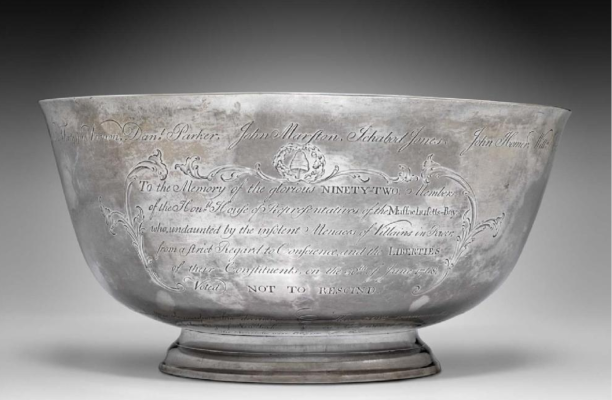
Is that art? That's the question at hand. If we use my criteria - art is something presented to be judged aesthetically - maybe not. But that brings us back to my original question - how important is skill to art? I'm confused. This is fun. Just what I wanted to talk about.
I'm not the type of person who appreciates that; I've been a musician since I was a kid, so my appreciation of aesthetics tends to be pretty heavily focused on art for arts sake. — Noble Dust
@Tom Storm wrote earlier he sees good writing as craft. I agree. Can't the same can be said for music?
I guess I do like good glassware. But when I break a piece, I'm annoyed for a day or two, and then I forget it existed. — Noble Dust
For me, one of the best things about glassware is that it's breakable. In order to love it, you have to be ready to let it go. I made a Christmas tree ornament for my daughter. It's a small cardboard box. Inside is a broken glass ornament. If you shake it you can hear the pieces jangle. On the cover is a label that says "Is this art?" When I gave it to her I gave her a picture of what was inside. Now, whether or not that is art, I think it is clearly not craft, except maybe in the sense we mean it when kindergarteners make napkin rings from old cardboard toilet paper tubes. -
Fitch's "paradox" of knowabilityFitch's "paradox" of knowability — Luke
How is this any different than the liar's sentence: "This sentence is false?" It's a grammatically correct sentence that no one would ever speak in real life. Or can you think of a reason for anyone but a philosopher, a13-year-old boy, or a 13-year-old philosopher to say or write it. We've discussed that many times here on the forum. My conclusion - self-referential "paradoxes" are just word games with no intellectual or philosophical significance. -
Skill, craft, technique in artSorry, but I ignore people who think dictionaries and wiki are philosophical arguments. — Jackson
You keep saying you're not going to pay attention to me any more, but then you keep sticking your $0.02 in. -
Skill, craft, technique in artAs I said, reducing aesthetics to beauty is wrong. — Jackson
You can make any word mean anything you want it to mean by waving your hand at it. Generally, though, when you use a word it makes sense to use it as it is commonly understood. Otherwise you're just talking to yourself.
Aesthetics, or esthetics (/ɛsˈθɛtɪks, iːs-, æs-/), is a branch of philosophy that deals with the nature of beauty and taste, as well as the philosophy of art (its own area of philosophy that comes out of aesthetics).[1] It examines aesthetic values, often expressed through judgments of taste.[2] — Wikipedia
Aesthetics may be defined narrowly as the theory of beauty, or more broadly as that together with the philosophy of art. — IEP
dealing with the nature of beauty, art, and taste and with the creation and appreciation of beauty — Merriam-Webster -
Skill, craft, technique in artI've pondered this for some years. My imperfect answer is that such objects are craft works, not art works. One area where this gets tricky is in what is often called 'art of the ancient world'. Two items spring to mind - an Egyptian sarcophagus made of cartonage, painted, colourful and decorative; and an Athenian painted vase vase. They are both objects primarily designed to have a function - a coffin and a jug respectively. They they are now admired solely for the art they reveal. Are they everyday crafted objects which have transcended their status is some way? Or are do they embody a kind of dualism of purpose - equally both art and craft? — Tom Storm
I brought Collingwood into this discussion because of the distinction between art and craft he made and because he writes that ancient Greeks didn't think about art the way we do. That makes me think of some ancient Chinese writing where they look to skilled butchers and other craftsmen as embodying spiritual values. Since the subject of this thread is the role of skill in art, the question that comes to mind is what, beyond skill, makes craft. -
Skill, craft, technique in artSo, you don't care. ok. — Jackson
There you go, being all grouchy and sarcastic and dismissive and stuff. -
Skill, craft, technique in artOh. Why do you think art is only about beauty? — Jackson
I don't think that's all there is to it, but I think the definition I gave makes sense. Lot's of others don't agree. We've had long discussions of that in the past. -
Skill, craft, technique in artWhat you do you mean by "aesthetics?" — Jackson
"Of or concerning the appreciation of beauty." -
Currently ReadingSilence and Beauty, Makoto Fujimura
— 180 Proof
Interesting choice, he was a big influence on me as an artist back in my Christian daze. I still respect him, and his art is incredible. — Noble Dust
I looked him up. I really like the paintings I saw. They all looked like book covers for dystopian science fiction novels. -
Skill, craft, technique in artTrue, but in classical music, for example, interpretation is so key. Especially in what I consider the golden age, the late romantic to early modern period; the music of that era is so malleable that interpretation becomes everything. A lot of the music from that era is so damn hard to play that a faithful interpretation is just rare. Pogorelich is an example of a master who, in my opinion, played Ravel properly and was able to coax out the emotional content while also being a virtuoso and able to play impossible music properly. — Noble Dust
Classical music was one of the main things I was thinking about when I started this thread. It seems like the place where skill and art come as close as possible. I don't have much to say because it isn't my music. The most I can say is "Me like. Sound purty." I was hoping someone would bring it up. -
Skill, craft, technique in artSo if craft is important to you, it's probably because you already like well executed things. — Tom Storm
Can you define "craft"? I still don't understand this word. — Noble Dust
I love bridges. Well-built stone structures - Machu Picchu is the most beautiful thing in the world. 2000 year old Roman aqueducts. New England is a good place for that. I like things that are like stone walls - arguments laid out like bricks to build a wall of evidence. That's one of the reasons I loved "Origin of species." When I write non-fiction, I try to write like that. I love houses. Small towns. Big cities. Things made with workmanlike economy for practical purposes without cutting corners. Structures that grow organically and fit in with their neighbors. Things that are beautiful because they are well-made. I guess that's what craft means to me. I think this is what Pirsig meant when he said art is high-quality endeavor.
For me craft focuses on skill - a work is loosely or strictly based upon a pattern or formula (eg, song writing, journalism, ship building, making a table). Making a pair of boots is a craft - there is a pattern to follow. Some craftspeople go a step or two further and can make a pair of boots a thing of beauty. Perhaps this is high craft, some might even call it art at that level. But none of this is exact and this is only my working definition. — Tom Storm
This gets to the heart of it for me. If you believe, as I do, that art is anything made to be judged aesthetically, how do you classify things that are made to be useful, comfortable, and reliable for which aesthetics is secondary at most? -
Skill, craft, technique in art
Let's see. The guy sitting in the middle back with the big wig is clearly Trump. The guy standing over him with his glass raised is Giuliani. The guy on the floor in front is Jeffrey Clark. Not sure who the rest are. I guess I don't recognize them because they all plead the 5th and didn't show up in the videos. I think this is the meeting when they were all asking for a pardon.
T Clark

Start FollowingSend a Message
- Other sites we like
- Social media
- Terms of Service
- Sign In
- Created with PlushForums
- © 2026 The Philosophy Forum