
Comments
-
Objectivity and Detachment | Parts One | Two | Three | FourHow does one "verify" that Hannibal won the Battle of Cannae through a double envelopment, for instance? Or that the Germans started World War II with a false flag attack? Or that St. Augustine was a Maniche in his youth? Or that St. Thomas' studied in Paris? — Count Timothy von Icarus
Verificationism, also known as the verification principle or the verifiability criterion of meaning, is a doctrine in philosophy which asserts that a statement is meaningful only if it is either empirically verifiable (can be confirmed through the senses) or a tautology (true by virtue of its own meaning or its own logical form). Verificationism rejects statements of metaphysics, theology, ethics and aesthetics as meaningless in conveying truth value or factual content, though they may be meaningful in influencing emotions or behavior.
Verificationism was a central thesis of logical positivism, a movement in analytic philosophy that emerged in the 1920s by philosophers who sought to unify philosophy and science under a common naturalistic theory of knowledge. The verifiability criterion underwent various revisions throughout the 1920s to 1950s. However, by the 1960s, it was deemed to be irreparably untenable. Its abandonment would eventually precipitate the collapse of the broader logical positivist movement. — Wikipedia
To the question ‘What is your aim in philosophy?’, Wittgenstein replied, “To show the fly the way out of the fly-bottle.” By this he meant that the work of philosophy “consists essentially of elucidations” (4.112). This provokes the further question ‘Why then are the ideas of the Tractatus so obscure and controversial, as for instance in paragraph 6.522 quoted above, which says values “make themselves manifest”?’ A. C. Grayling, for instance, has complained:
“If it were true that value somehow just ‘manifested itself’, it would be puzzling why conflicts and disagreements should arise over ethical questions, or why people can passionately and sincerely hold views which are quite opposite to those held with equal passion and sincerity by others.”
– Wittgenstein: A Very Short Introduction
On the contrary, I don’t find the idea of different manifest values being held by different people at all puzzling. It is in the very nature or essence of values (as distinct from verifiable facts) that they are contentious. There is simply no objective truth to be had about a judgement of value. So it would be extremely odd if the values – be they moral, aesthetic, religious, or whatever – that manifest themselves to us as individuals were to be the same for everybody. In such a weird case they would cease to be ‘values’ as we understand them.
The declared aim of the Vienna Circle was to make philosophy either subservient to, or somehow akin to, the natural sciences. As Ray Monk says in his superb biography Ludwig Wittgenstein: The Duty of Genius (1990), “the anti-metaphysical stance that united them [was] the basis for a kind of manifesto which was published under the title The Scientific View of the World: The Vienna Circle.” Yet as Wittgenstein himself protested again and again in the Tractatus, the propositions of natural science “have nothing to do with philosophy” (6.53); “Philosophy is not one of the natural sciences” (4.111); “It is not problems of natural science which have to be solved” (6.4312); “even if all possible scientific questions be answered, the problems of life have still not been touched at all” (6.52); “There is indeed the inexpressible. This shows itself; it is the mystical” (6.522). None of these sayings could possibly be interpreted as the views of a man who had renounced metaphysics. The Logical Positivists of the Vienna Circle had got Wittgenstein wrong, and in so doing had discredited themselves. — Wittgenstein, Tolstoy and the Folly of Logical Positivism, Stuart Greenstreet -
PROCESS PHILOSOPHY : A metaphysics for our time?I appreciate that.
I'll try and articulate a point about my view of panpsychism or panexperientialism. I have a great deal of admiration for Whitehead —especially his critique of the Cartesian division, and how he brings process and experience into the heart of metaphysics. It makes panexperientialism a compelling alternative to materialism.
That said, there’s a subtle but crucial issue that I think still needs to be addressed. Panexperientialism still treats experience as an object of theory, rather than recognizing that experience is necessarily first-person. Experience is never something we ‘know about’ in the same way we know about objects or processes. It is always undergone, always first-personal.
So - my understanding of the 'primacy of the subjective' is that it is not something that can be treated objectively, which is why I'm critical of Philip Goff's sense of panpsychism. From an earlier thread:
I think his mistake is to believe that 'experience' is something that can be known in the third person. In other words, experience is not an object of cognition, in the way that an electron or particle or other object can be. We don't know experiences, we have experiences; so any experience has an inescapably first-person element, that is, it is undergone by a subject. So we can't objectify 'the nature of experience' in the way we can the objects and forces that are analysed by the natural sciences.
Now, in one sense we can be very clear about our own experiences - we certainly know what an unpleasant or pleasant experience is, and we know that some experiences have specific attributes, across a vast range of experiences. But in all cases, we know those things experientially - we know about those attributes, because they are the constituents of our experience, in a way very different from how we know and predict the behaviour of objects according to physical laws. — Wayfarer
Pan-experientialism is subject to the same kind of criticism. Experience as an object of third-person knowledge overlooks the fact that experience is always undergone rather than observed. This suggests that instead of categorizing experience as an explanatory variable in a metaphysical system, we should see the inquiry itself as leading to a fundamental shift in perspective—one that recognizes the impossibility of objectifying the subject at all. That is where the 'way of unknowing' becomes not just a mystical doctrine, but a necessary epistemic move. It also ties in with the philosophical theme of epistemic humility, 'he that knows it, knows it not'.
I think that short-circuits many of these questions about what kinds of things are conscious, without, however, falling back into any kind of reductionism.
Wonderful that after your whimsical poem about elms and oaks, Prothero directly addresses the question of whether trees feel. -
PROCESS PHILOSOPHY : A metaphysics for our time?Thanks, very helpful.
It is very convenient to bifurcate nature and say one part is “real and objective” and the other is “merely subjective” but it shirks the real task of natural philosophy and speculative philosophy. — prothero
That pretty well sums it up!
The important point here is that subjective experience need not involve, and can be detached from, consciousness. On the one hand, Whitehead catergorically insists that "apart from the experiences of subjects there is nothing, nothing, nothing, bare nothingness." But he also continually reminds us that most of this "experience of subjects" is nonconscious. — prothero
Very subtle and important point. I think the common misconception is to believe that consciousness refers only to what one is consciously aware of, the contents of discursive thought. It goes far deeper than that, as Whitehead is intuiting. -
Donald Trump (All General Trump Conversations Here)Trump is an agent of Putin
One of the reasons that the footage of US President Donald Trump’s clash with Ukrainian President Volodymyr Zelensky was so compelling to Western audiences was the sheer unfamiliarity of such a scene.
Leaders routinely have arguments behind closed doors, but this one was very deliberately broadcast. The host not only inflamed US Vice President J.D. Vance’s provocations of the Ukrainian leader, but he made sure to keep the media in the room for the full 50-minute drama. As Trump said in the closing line: “This is going to be great television.”
But to Vladimir Putin and Xi Jinping, and anyone else familiar with Marxist-Leninist political management, it was instantly recognisable. This was a “struggle session”. That is, an orchestrated ritual humiliation of a political enemy, conducted in public, often with crowd participation. A common feature is that the target is denounced by people they thought were close to them.
The struggle session had its origins in the writings of Soviet leader Josef Stalin on the subject of criticism and self-criticism. It was later embraced by China’s Mao Zedong against suspected “class enemies”.
Mao’s youthful zealot Red Guards notoriously employed violence, torture and even murder in struggle sessions during the Cultural Revolution. The reformer Deng Xiaoping banned the struggle session.
But now Trump has introduced it to US foreign policy. Putin would have recognised and relished the performance in the Oval Office: the ritual, public humiliation of the man who has inspired millions in defying Putin and embarrassing his army. Conducted by Zelensky’s most important ally to date, the United States. But why would Trump do it? The world has long puzzled over his affinity for Putin, the former KGB colonel who seeks to neuter the US, dominate Europe and destroy the West. The attraction is inexplicable.
But the evidence now is incontrovertible: We should accept that Trump acts as an agent of Putin.... — Peter Hartcher, Sydney Morning Herald -
The Musk PlutocracyNothing is next. There is no next. That’s the point!
— Wayfarer
Do you mean that I'm caricaturing the situation and there are good reasons for saying that things are not so simple as I represent them? I wouldn't argue with that. But things do seem to be heading that way. — Ludwig V
No, I mean that if a real authoritarianism sets in, there will be no way to overturn it by democratic means. Remember Trump said during the campaign if you voted for him this time you wouldn’t have to vote again in the future. -
"Underlying Reality" for HusserlIt depends what you mean by apodictic — sime
The meaning of ‘apodictic’ is not subject to qualification. Something cannot be relatively apodictic.
The point at issue is that sentient beings are, in fact, beings. -
Objectivity and Detachment | Parts One | Two | Three | Four‘If what is right and wrong depends on what each individual feels, then we’re outside the bounds of civilisation’ ~ Walter Lippmann (Journalist), quoted by David Brooks, speech to the Alliance for Responsible Citizenship.
-
PROCESS PHILOSOPHY : A metaphysics for our time?I posted a link to a long article on Whitehead on the previous page, along with some excerpts. Here is another that I would like to understand.
Subjectivity as a Fundamental Feature of the Whole of Reality
Whitehead, on the basis of his interpretation of the modern conceptual framework, derives the task of sketching a metaphysics in which nature does not bifurcate and in which there is no division of nature and mind and their respective knowledge fields of the material and the mental. Such a metaphysics requires not only a radical reconstruction of the concept of nature, but necessarily includes an equally radical reframing of subjectivity. For Whitehead assumes that it is precisely the modernist conception of subjectivity (and thereby objectivity) that has contributed decisively to the bifurcation of nature. His interpretation of modernity as a historical–discursive formation characterized by the bifurcation is therefore crucial to his radical reconstruction of the concept of nature.
Such a reformulation of the concept of nature includes for Whitehead not least the dissolution of the opposition nature/subjectivity or else nature/experience: instead of excluding the subject and experience from nature and thus opening the door to bifurcation, for Whitehead subjectivity is a fundamental feature of the whole of reality. According to the Philosophy of Organism, everything that exists feels; every atom and every flower feels. A statement, as Melanie Sehgal notes, “that sounds strange only against the background of a concept of experience implicitly oriented towards conscious, human perception, as it characterizes modern philosophy” (Sehgal 2016, 209f., my translation). Reality must be described as a hierarchy of consistently given, though varying, degrees of subjectivity. This is also the reason why Whitehead can state “that apart from the experiences of subjects there is nothing, nothing, nothing, bare nothingness” (Whitehead [1929] 1978, p. 167). If such a relocation of subjectivity into nature is linked to the goal of correcting the materialist–mechanistic conception of the ‘natural’ world as it derived from the bifurcation, subjectivity can also no longer be a “privilege of higher developed entities, let alone an ontological distinction of man” (Wiehl 2007, p. 30, my translation). On that note, Whitehead vehemently rejects modern anthropocentrism, which locates subjectivity outside of nature: “Pansubjectivism,” Reiner Wiehl elaborates, “thus means in Whitehead not only the implementation of the subject in nature and the natural sciences, but equally also a naturalization of subjectivity” — Source
I too have come to accept that 'the subjective' is irreducible, and that reality is subjective, in this radical sense. But I'm a little uneasy about the apparent pan-psychism of this excerpt. I still can't see how non-organic nature possesses a 'degree of subjectivity'. Any guidance appreciated. -
"Underlying Reality" for HusserlI have an aphorism on my profile page which is trying to express a similar idea, 'Reality comes into existence through beings'. I'm not perfectly happy with it, but the idea that it attempts to express is that apart from the experience of beings nothing exists. See the Schopenhauer excerpt on this page, How Time Began with the First Eye.
Also:
Our experience of time depends on the flow of cosmic time that we measure through our experience of time, and only life can know life. Like the ouroboros, the serpent swallowing its own tail, we are in the universe and the universe is in us. This is the strange loop.
Merleau-Ponty puts his finger on the strange loop when he writes in Phenomenology of Perception: “The world is inseparable from the subject, but from a subject who is nothing but a project of the world; and the subject is inseparable from the world, but from a world that it itself projects.” This statement is meant to clear a path between two extremes. One is the idea that there is a world only for or in consciousness (idealism). The other is the idea that the world exists ready-made and comes presorted into kinds or categories apart from experience (realism). Instead of these two extremes, Merleau-Ponty proposes that each one of the two terms, the conscious subject and the world, makes the other one what it is, and thus they inseparably form a larger whole. In philosophical terms, their relationship is dialectical.
The world Merleau-Ponty is talking about is the life-world (lebenswel), the world we’re able to perceive, investigate, and act in. The subject projects the world because it brings forth the world as a space of meaning and relevance. But the subject can project the world only because the subject inheres in a body already oriented to and engaged with a world that surpasses it. The bodily subject is not just in the world but also of the world. The bodily subject is a project of the world, a way the world locally self-organizes and self-individuates to constitute a living being.
You may want to say that the universe—the whole cosmos or all of nature—subsumes the life-world, so the strange loop pertains only to us and our life-world, not to us and the universe altogether. But quarantining the strange loop this way won’t work. It’s true that our life-world is a minuscule part of an immensely vaster cosmos. The cosmos contains our life-world. But it’s also true that the life-world contains the universe. What we mean is that the universe is always disclosed to us from within the life-world. The life-world sets the horizon within which anything is observable, measurable, and thinkable. So the life-world and the universe themselves are caught up in a strange loop. — The Blind Spot, Evan Thompson, Marcello Gleiser, Adam Frank, Pp 198-9 -
The Musk PlutocracyWhat happened on the 'Valentine's Day Massacre' at the NSAA is typical of the reckless endangerment of critical Government programs through the haphazard mass firings of employees and the chaos that will ensue. Because in this case the subject was radioactive materials and nuclear weapons, DOGE/MAGA quickly backtracked and withdrew the sackings. The same about-face won't happen for other vital but lower-profile agencies, such as food safety, weather forecasting, and social security, because, who cares? They're all sucking off the public teat, that money would be far better directed to tax cuts for the ultra-wealthy.
Amid the tumult of mass firings, the Trump administration’s dismissal of workers who maintain America’s nuclear weapons delivered perhaps the greatest shock. These are people with highly sensitive jobs, the Energy Department would later acknowledge, who should have never been fired.
Almost all the workers were rehired in an embarrassing about-face, a prominent example of how the administration has had to reverse dismissals in multiple instances where its scattershot approach caused deeper damage to agencies than anticipated.
Yet late the night before Valentine’s Day, the Trump administration perfunctorily fired 17 percent of the National Nuclear Security Administration’s workforce, over the strenuous objections of senior nuclear officials.
The employees of the National Nuclear Security Administration are stewards of a sprawling government system that keeps 5,000 nuclear warheads secure and ready. They make sure radiation doesn’t leak, weapons don’t mistakenly detonate and plutonium doesn’t get into the wrong hands.
“The president said workers critical to national security would be exempt from the firings. But then there was an active decision to say these positions are not critical to national security,” said an official at the nuclear agency, who spoke on the condition of anonymity to avoid reprisals. “It is so absurd I don’t even know what to say.”
The episode proved to be among the biggest blunders of Trump’s first weeks in office as he deployed the blunt instrument of the U.S. DOGE Service, overseen by billionaire White House adviser Elon Musk, to radically slash government payrolls. (Gift link) — DOGE Fires, then Recalls, Workers Essential to Maintenance of US Nuclear Weapons

-
The Musk PlutocracyHence the repeated references to a ‘constitutional crisis’, although, really, Trump’s election was already one, as he had patently and obviously engaged in a plot to overthrow the 2020 election. It’s utterly absurd that Trump were allowed to run for President. It beats me why he wasn’t disbarred under the constitutional clause banning insurrectionists from public office.
Anyway there was a major victory for the courts late last week when Trump’s peremptory firing of the an inspector general was struck down:
A U.S. judge on Saturday declared President Donald Trump's firing of the head of a federal watchdog agency illegal in an early test of the scope of presidential power likely to be decided at the U.S. Supreme Court.
U.S. District Judge Amy Berman Jackson in Washington had previously ruled Hampton Dellinger, the head of the Office of Special Counsel who is responsible for protecting whistleblowers, could remain in his post pending a ruling. — Reuters
There are numerous other suits being contested. MAGA is making noises about possibly defying or ignoring legal injunctions. It hasn’t happened yet but the writing is on the wall, although what action could be taken in response, and by whom, is far from clear. (Wouldn’t it be great to see Musk arrested and taken into custody for contempt of court?) Trump and Musk are utterly and flagrantly in breach of accepted practice and constitutional norms, they’re far outstripping the so-called ‘check and balances’ in the system by simply trampling them. -
"Underlying Reality" for HusserlI would regard the presumption that other beings are like myself as apodictic. I wouldn’t be so egotistical as to believe otherwise. And real life is not a hypothetical exercise.
-
Ukraine CrisisIn 2019, President Trump tried to extort President Zelinsky by withholding Congressionally-mandated military aid to Ukraine, which was attacked and invaded by Russia, to coerce him to say he was opening an investigation into the Bidens. Zelensky showed his mettle and resisted; Trump was impeached.
Fast forward to yesterday, Trump (who could not handle the job alone and needed the assistance of a henchman) again sought to bend President Zelensky to his will to extort Ukraine out of its natural resources (and afterTrump conceded key negotiation points to Russia BEFORE negotiations even began). And once again, Zelensky resisted. But without any congressional repercussions for Trump.
Instead, we are now an international pariah. — Andrew Wiesemann
And let's, at this point, remember the episode which made Zelenskyy an internationally-respected figure, when the US Embassy offered to helicopter him out of Kiev, in February 2022, and he responded:
I don't need a ride, I need ammo
Before proceeding to bleed the invaders of half a million attackers.
He's the kind of leader America could use. -
Logical Arguments for God Show a Lack of Faith; An Actual Factual Categorical SyllogismYou're making lliterally sense. The Greek myth of Sisyphus is that of a legendary or mythical king who was sentenced to punishment in Hades by having to roll a boulder up a hill for all eternity only to have it roll back down every time. This is a factual statement. What you're going on about, I have no idea, but let's leave it that, as this exchange is becoming Sisyphean.
-
Logical Arguments for God Show a Lack of Faith; An Actual Factual Categorical SyllogismYou gotta look at the situation from the Grecoan Ideal... not yours. — DifferentiatingEgg
I referenced the Greek myth. Let's see what the Brittanica has to say:
Sisyphus was, in fact, like Autolycus and Prometheus, a widely popular figure of folklore—the trickster, or master thief. Clearly, he is everlastingly punished in Hades as the penalty for cheating Death, but why he is set to roll a great stone incessantly is a puzzle to which no convincing answer has yet been given. It appears to belong with other Greek imaginings of the world of the dead as the scene of fruitless labours.
'The scene of fruitless labors'. And how, precisely, does this map against 'happiness'? -
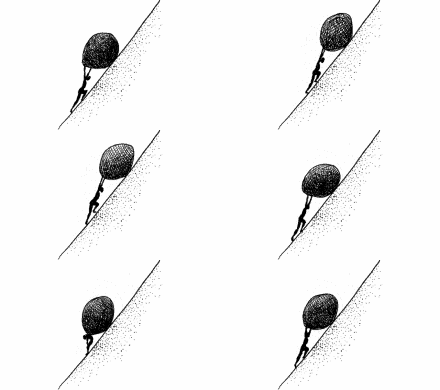
Logical Arguments for God Show a Lack of Faith; An Actual Factual Categorical SyllogismThe appeal to Nietszche as an authority doesn't impress me. By 'sisyphean' I simply mean the common interpretation of engaging in strenuous and apparently endless activity for no visible result. Indeed a sisyphus gif was for a long time a part of my work email sig.
-
Logical Arguments for God Show a Lack of Faith; An Actual Factual Categorical SyllogismErm... that's the Christian mythology of Sisyphus — DifferentiatingEgg
There is no 'Christian mythology of Sisyphus', it was a Greek myth. Sisyphus was described as the cunning and deceitful king of Corinth (Ephyra in early sources). While he was a ruler, he is not depicted as a "noble" in the sense of living up to an ethical or heroic ideal but was often portrayed as a trickster and an archetype of human cunning and defiance. Unlike figures such as Heracles, who underwent divinization (apotheosis), Sisyphus was punished for his defiance rather than rewarded, that punishment being condemned to rolling a boulder endlessly up a hill, only to have it roll back down again. That's what I meant by the reference. Albert Camus' The Myth of Sisyphus recast him as a heroic figure as an embodiment of human resilience and defiance against absurdity but I never found it persuasive. -
The Musk PlutocracyComments on January 6th revisionism belong in another thread. Maybe the Trump thread - Count Timothy, as you're a mod, perhaps you might be so kind as to move them there. This thread is about the Musk Plutocracy which is providing ample material for discussion in its own right.
-
Logical Arguments for God Show a Lack of Faith; An Actual Factual Categorical SyllogismDo you see the distinction between this process of repeated contextual variation and a meta-proclamation of truth? — Joshs
I see it, but I believe it is pointless, in a way, sisyphean. But then, my meta-philosophical stance is oriented around the possibility of a cosmic philosophy, that is, a philosophy that situates the reality of human existence in the context of the cosmos.
Plato was clearly concerned not only with the state of his soul, but also with his relation to the universe at the deepest level. Plato’s metaphysics was not intended to produce merely a detached understanding of reality. His motivation in philosophy was in part to achieve a kind of understanding that would connect him (and therefore every human being) to the whole of reality – intelligibly and if possible satisfyingly. — Secular Philosophy and the Religious Temperament, Thomas Nagel
I realise we'll never be on the same page in any of this, but I appreciate having an intelligent person to explain it to. -
The Musk PlutocracyHaving bludgeoned the Congress into pathetic submission, MAGA is now setting its sights on the judiciary, the last remaining bastion of constitutional democracy.
“The only way to restore rule of the people in America is to impeach judges,” Mr. Musk wrote this week on X, his social media platform, in one of multiple posts demanding that uncooperative federal judges be ousted from their lifetime seats on the bench.
“We must impeach to save democracy,” Mr. Musk said in another entry on X after a series of rulings slowed the Trump administration’s moves to halt congressionally approved spending and conduct mass firings of federal workers. He pointed to a purge of judges by the right-wing government in El Salvador as part of the successful effort to assert control over the government there. — NY Times
We must impeach to save democracy is directly suggestive of 'We had to destroy the village in order to save it', from William Caley, officer in charge of the Mai Lai massacre, -
The Musk PlutocracyOne of today's headlines: "DOGE presses to check federal benefits payments against IRS tax records -
Officials with Elon Musk’s group say they want to search for fraud. Privacy law bars the IRS from disclosing tax information to other parts of the government."
In Australia, there was a massive scandal over a similar scheme, dubbed Robodebt, were automatic matching technologies were used to pursue purported social security debts, often without any human oversight. The resulting debacle caused more than a few suicides and ended a few careers. Of course, none of that would matter to Elon Musk, as he'll just chainsaw anyone who stands in his way, with Presidential permission. -
"Underlying Reality" for HusserlI don't know enough to say whether it's Husserl's thought, but I cross-checked it with my AI buddy Chuck (a.k.a. ChatGPT4) which responded 'Overall, the passage is a well-articulated summary, and while it could be more precise in distinguishing Husserl’s phenomenological approach from traditional epistemology, it correctly conveys his main insights into the problem of other minds.'
Anyway it makes perfect intuitive sense to me. Even though I don't know other people in the same way I know myself, I know they are persons like myself. 'Husserl explores this through the concept of empathy (Einfühlung). He suggests that we "appresent" or co-present the other’s mind: we perceive another body as similar to our own and, by analogy, attribute to it a consciousness like ours.' I've often opined that empathy is the natural antidote to solipsism. -
Ontology of TimeHey! I found this book going on about organicism and new metaphors in biology. Thought it would be interesting for you. — substantivalism
Does look interesting, albeit (groan) yet another book. I don't know if you've had much interaction with the sometime contributor here, Apokrisis, but he has a lot of interesting things to say about biosemiotics, a field I didn't even know existed until he came along. That has lead me research into that field, and also into the phenomenology of biology, subject of books by Hans Jonas and Evan Thompson. Also Terrence Deacon's 'Incomplete Nature'. I think there'd be some crossover to that book you're mentioning. I notice:
The reverse of the positivist claim seems to be the case: the positivist program is the useful device but a richer conception is required to generate or understand science.
Surely rings true for me. Positivism, especially the Vienna Circle type, is that attempt to restrict the scope of philosophy within the bounds of science, which of course came to grief with the realisation that the setting of those bounds was itself a matter for philosophy. -
Logical Arguments for God Show a Lack of Faith; An Actual Factual Categorical SyllogismUnconditioned meaning foundational to perspective? — fdrake
I think it's a key term which has to all intents dropped from philosophical discourse. That it was arguably last sighted in Hegel, with his depiction of the Absolute, but by then entangled in prolific thickets of arcane scholarly verbiage that overgrew its actual meaning.
There's a journal article I've found, The unconditioned in philosophy of religion, Steven Shakespeare, Nature, 2018 (open access). I've looked at it, but not a lot of it stuck - maybe I'll take another look, although it is developed in a direction I didn't much understand or like. But it is at least an attempt to conceptually separate 'the unconditioned' from the almost-inevitable tendency to say 'oh, you mean God', with all of the implications.
But my intuitive sense is that the difficulty for all of this is that the unconditioned is as a matter of principle beyond the scope of discursive thought (meaning, to all intents, out of bounds).
I'm sorry, but I'm not an admirer of Nietszche. It probably puts us in different worlds, but it can't be helped. -
Logical Arguments for God Show a Lack of Faith; An Actual Factual Categorical SyllogismIt seems to me you're describing a psychological difference, — fdrake
Yes, I can see how it would seem like that. But again, we're no closer to the sense in which religious revelation purports to connote insight into the unconditioned.
I want to say "I love you all," but I'm not quite sure I believe that. But I wonder what would happen if I had faith that I could have faith in that? — DifferentiatingEgg
Learn by doing, I would suggest. That would be quite a challenge, although one which at least some Christians seem to exemplify. -
Objectivity and Detachment | Parts One | Two | Three | FourRight, which is to say that something can be verifiable even if it is not verifiable according to some particular metric. For example, a Buddhist claim can be verified, but not with a microscope. — Leontiskos
Hence my frequent referral to 'domains of discourse'. By that I mean, specific cultural rubrics. I've looked into the origin of that term, and originally it was derived from mathematics, but I'm using it in the sense that different cultures and sub-cultures exist within a rubric of meanings and implicit understandings, and that it's necessary to understand something of that background in order to interpret them.
Buddhism is an example, as it developed, up until quite late, in a completely separate cultural sphere from the Christian West. For many of the key terms of Buddhism such as karma, Nirvāṇa, saṃsāra, and dharma, there are no direct equivalents in English or indeed in the Christian cultural framework. So understanding it in its own terms requires some assimilation of its terminology and the cultural and spiritual setting within which they're meaningful.
Case in point: the term 'enlightenment' itself which seems to pivotal to the entire culture. It was used to translated the Pali/Sanskrit term 'bodhi' by T W Rhys Davids, a British translator and founder of the Pali Text Society, formed in what was then Ceylon in 1881. 'Bodhi' is a noun derived from the root 'budh-' meaning awakening or enlightenment—specifically, the insight into the true nature of reality in Buddhist thought. It's the same root word used to form 'Buddha.'
Rhys Davids chose the term 'enlightenment' at least in part because of its resonances with how the term had been used in European culture in respect of the European Enlightenment. Rhys-Davids (and his wife, who was also involved in the Society) presented Pali Buddhism as being compatible with science in a way that Christianity was not (although they both disparaged Mahāyāna Buddhism as having been corrupted by superstition.) But I think one consequence of this is that the European and Buddhist uses of 'enlightenment' are in many ways incommensurable, resulting in confusion as to what it actually means. Buddhism was often said by its early 20th century exponents to be a 'scientific religion' with the principle of karma being compared to Newton's laws of action and reaction. But I think that was fanciful. (One of the reasons Evan Thompson gives for not being Buddhist in his book on that, is the persistent myth of the 'scientific' nature of Buddhism.)
So, after that rather long digression, how can Buddhist claims be verified? One could easily dismiss the whole story as myth, and many do. But I think the preponderance of archeological and archival evidence indicates that he was a real historical figure. So as to whether the Buddha was enlighented, that amounts to asking whether the Buddha was really a Buddha ('Buddha' being a term for a class of beings.) So if one accepts that such a teacher actually existed, asking whether he is enlightened is rather like asking whether a standard meter is, in fact, a meter long. But that is not, as you say, something to be validated by scientific instrumentation.
As to whether Buddhist principles can be verified by anyone other than a Buddha, it might be pointed out that the Buddhist sangha (monastic associations) are the oldest continually-existing religious orders in the world today. Again, some might believe that this is a long history of self-delusion but I don't think that credible.
None of which means that specious claims of enlightenment are not common.
I'm not sure where Janus fits into this. — Leontiskos
I will say that there many here who advocate a kind of articulate positivism and pragmatism, along common-sense lines. Positivism is a powerful influence in modern thought. The dictionary definition is 'Positivism - a philosophical system recognizing only that which can be scientifically verified or which is capable of logical or mathematical proof, and therefore rejecting metaphysics and theism'. It's the default for a lot of people. They will recognise the possibility of veridical religious experience, but insist that they are subjective and meaningful only to those who have them, and cannot be conveyed, nor form the basis of any real philosophy. Thereby vitiating the whole tradition of Buddhist philosophy, among others.
(Although, there is another terminological note: 'philosophy' is derived from the Greek term philo- love and sophia -wisdom, hence, love of wisdom or love~wisdom. It has been argued that Indian wisdom teachings are distinct from Greek philosophy proper, on those etymological grounds. The Hindu schools of what we call 'philosophy' are called 'darshana', derived from 'seeing' or 'seer'. Buddhism self-description of the Buddha's teaching is a 'sasana', meaning a 'dispensation'. But in any case, there are sound scholarly comparisons of the themes of Buddhist teachings presented as philosophy, notably by Mark Siderits. And of course the vast corpus of Buddhist philosophical commentaries, spanning millenia and cultures, in a diverse array of languages.) -
Donald Trump (All General Trump Conversations Here)As such, he is a problem, and as a problem, best approached clinically. The obvious question being how such a problem is solved, but that not-so-easy to answer. — tim wood
He should have been impeached when the opportunity arose, obviously, and would have been, but for Mitch McConnell's gutlessness. The Republican Party is utterly culpable in this matter. They put a criminal in the oval office, one who is hellbent on destroying constitutional democracy, and he then let the world's richest man loose with a chainsaw.

NY Times comment on yesterday's spectacle: 'It was a sickening spectacle: the man who tried to upend democracy bullying the man who is fighting for democracy.' -
Logical Arguments for God Show a Lack of Faith; An Actual Factual Categorical SyllogismYes. Some beliefs are more significant to people than others. This remark says nothing about the phenomenology of revealed truth. — fdrake
Again - relativises the subject by categorising it as belief. The question was not whether one believes it were true. For the purpose of the argument, suppose it actually were true - put yourself in the position of one who believes it is. This is intended to convey its non-contingent nature. Were it true, it would be something of absolute importance, not one among other of a shifting web of 'faith convictions' and 'beliefs'. It would be as urgent as the requirement to breath.
There is no meta-interpretation. — Joshs
Speaking of convictions..... -
Ontology of TimeAs you may know, this question of how we retain previous moments as we listen, and project future moments, is integral to a composer's skill. — J
This analogy is not about music or composition. It's about the fact that music comprises individual sounds which, by themselves, are not music. It is the awareness of the sequence of sounds. This analogy is then applied to the awareness of duration. What ties together the succession of moments into duration?
we hold these separate moments together in our memory. We unify them. A physical clock measures a succession of moments, but only experiencing duration allows us to recognise these seemingly separate moments as a succession. Clocks don’t measure time; we do. — Aeon.co -
"Underlying Reality" for HusserlPerhaps 'cares' is the wrong word, but the organism persists, it heals from injury, and it reproduces. Something which minerals do not. The point being, even at this rudimentary stage, a form of intentionality is apparent.
-
Ontology of TimeJulian Barbour is an independent scholar who also argues that time doesn't exist. I haven't listened to the whole presentation, but it might be of interest to you. He also has published a book on the subject.
-
Logical Arguments for God Show a Lack of Faith; An Actual Factual Categorical SyllogismA world transforming, singular, experience aligns the nature of the divine with the perceptual. What you see is what you now believe. In effect, the reinterpretation is a way of seeing the same world another way, like whether a Necker Cube goes into or out of a page. — fdrake
Although whether one has, or is, an immortal soul, might be rather more significant than an optical illusion. -
Ukraine CrisisIt has been pointed out, that while Associated Press and Reuters have now been banned from White House briefings, that the official Russian state media had a reported in the Oval Office today, to conveniently broadcast Trump and Vances brow-beating of Zelenskyy to the whole Russian federation. How convenient for them.
-
Logical Arguments for God Show a Lack of Faith; An Actual Factual Categorical SyllogismAre you suggesting no discussion about faith is meaningful without first adopting the definition that it is a revelation of something otherworldly? — ENOAH
Not at all. Discussion can be meaningful but ‘revealed truth’ is essential to it. -
Objectivity and Detachment | Parts One | Two | Three | FourI'm just as capable as he (Socrates) was as he was of critical thought It's a pity the same cannot be said of you. — Janus
This esteemed rabbi was on his death bed. Many of his former students and admirers filed in to pay their respects and sing his praises - his learning, his mastery of the Torah and so forth. After they left, his wife said to him, ‘why do you look so downcast, Moshe? They all said such nice things about you.’
‘My humility’, he said morosely. ‘Nobody mentioned my humility.’ -
Logical Arguments for God Show a Lack of Faith; An Actual Factual Categorical SyllogismI know what you mean, and I agree, faith which claims to have such revelation into some otherworldly superior reality is not supportable. — ENOAH
But that is precisely what revealed truth means. It is the entire meaning of the Bible. It doesn’t mean you have to believe it.
But in reality, faith is as contingent and fallible as any other belief we hold, shaped by history, culture, and personal experience — Tom Storm
For secular philosophy. -
Objectivity and Detachment | Parts One | Two | Three | FourBut he cautioned against 'ontotheology' which I understand to consist in the absolutization of the human. — Janus
not as I understand it - ontotheology was the concentration on beings instead of Being, but writ large as the ‘supreme being’
I'm attempting to do a similar thing here. — Janus
But you are not Socrates ;-)
Wayfarer

Start FollowingSend a Message
- Other sites we like
- Social media
- Terms of Service
- Sign In
- Created with PlushForums
- © 2026 The Philosophy Forum