
Comments
-
The Argument from ReasonLogic is abstract. Reality is not. Any abstract argument should be applied to reality with care. — I like sushi
Modern science has gotten many spectacular results from the interpretation of data in the light of mathematical abstractions. That is the subject of Eugene Wigner's famous paper, The Unreasonable Effectiveness of Mathematics in the Natural Sciences. An excellent illustration is Dirac's discovery of anti-matter, which was formulated purely on the basis of mathematical projection, and not empirically validated until years later. -
The Argument from ReasonAnd incidentally, see my response to the very post that you reference. You think that response is also 'anti-intellectual'?
-
The Argument from ReasonIt's disappointing to see such anti-intellectualism here. — wonderer1
It's not 'anti-intellectualism'. You haven't actually addressed the topic of the OP - what you've tried to do, is shift the discussion to discussion about neural networks and evolutionary psychology. Perhaps you could demonstrate how viewing the question in those terms, casts light on the basic contention, which is about the relationship of physical causation and logical necessity, and the sense in which rational inference can or can't be reduced to, or understood in terms of, the physical sciences. -
US Election 2024 (All general discussion)House Censures Adam Schiff Over His Role Investigating Trump.
Complete waste of time, as has no chance of passing the Senate, only serving to illustrate the mendacity and corruption of MAGA Republicans.
Adam Schiff said, for his part, “You honor me with your enmity. You flatter me with this falsehood. You who are the authors of a big lie about the last election must condemn the truth tellers, and I stand proudly before you.” -
The Argument from ReasonAny ‘theory’ that is given will necessarily be one that is ‘physical’/‘material’.
Wayfarer: On further thought, I’m rather intrigued by why you would say that, and why it appears obvious to you.
I like sushi - Because a theory only has meaning if it can be tested. — I like sushi
Right - but that only applies to empirical theories, which the argument from reason is not. It's closer in nature to Kant's transcendental theories (i.e. given that we know X, what must be the case in order that we know it.)
Is there an argument from "because" having two senses to there being two realms, one ruled by Physics or Something and one ruled by Reason or Something? If that's even what we're going for. — Srap Tasmaner
That is exactly what is at issue. There's a detailed discussion of this issue in this .pdf file, The Argument from Reason, Victor Reppert, Pp 356- . I won't try and re-state it again, but it is distinguishing between physical cause-and-effect and logical ground-and-consequence, and saying that the latter can't be reduced to, or explained in terms of, the former. -
The Argument from ReasonAre the countless neuroscience discoveries, medicine, psychiatrics, etc. all just correlations? Of course not. — Philosophim
But they don't entail what you say they entail. Have you ever encountered the book The Philosophical Foundations of Neuroscience, by Hacker and Bennett? Can you say anything about that? Up until I mentioned the term 'brain-mind identity theory' had you ever heard it? Do you know who those philosophers are that I mentioned, and what they say?
From my perspective, everything you write on the forum comprises wholly and solely what Philosophim thinks is obvious, accompanied by a strong sense of indignation that someone else can question what, to you, are obvious facts. This is your response to everything I address to you.
We're in philosophy. — Philosophim
Have you ever written a term paper in philosophy? Ever actually studied it? Because I can see no indication of that. You never mention any philosophers, or philosophical arguments, apart from your belief that everything is matter-energy and the mind is the product of the brain, which, to you, is obvious. -
The Argument from ReasonYou know I've already provided that link, right? — wonderer1
Sorry, I forgot you had mentioned it. -
The Argument from ReasonLet's not dissolve the entire dialogue in the acid bath of post-modern relativism.
The SEP entry would be a good starting point https://plato.stanford.edu/entries/intentionalitypeople have widely varying concepts in mind when using the word "intentionality" — wonderer1 -
The Argument from ReasonAlso, you didn't ask ChatGPT the question I proposed which was, "Do the outputs of ChatGPT have intentionality?" — wonderer1
Let's do that.
Do the outputs of ChatGPT have intentionality?
ChatGPT: No, the outputs of ChatGPT do not have intentionality. ChatGPT is a language model that generates responses based on patterns it has learned from the training data. It does not possess consciousness or subjective experiences, and its responses are not driven by internal goals or intentions. ChatGPT generates text based on statistical patterns and associations in the training data and attempts to provide coherent and relevant responses to the input it receives. -
The Argument from ReasonWhich of course any well informed materialist would agree with — wonderer1
OK then, give us a well-informed materialists' account of the significance of intentionality.
As for whether output - written text - has any kind of ‘intentionality’, I would say, clearly not. Written text means nothing without being interpreted.
there is no such thing as an original — Joshs
Now we're on solid po-mo territory. Oh, wait..... :yikes: -
The Argument from ReasonThanks, although I suspect I'd have to read a lot more of that milieu to understand the drift (and must admit, feel little compulsion to do so.)
Do you mean Lloyd Gerson? — Tom Storm
Yeah sorry :yikes: I find him a very difficult read, because so much of his work is addressing other scholars and historical questions of interpretation. So I've only read snippets - come to think of it, that applies to many of my sources - but really got a lot from a lecture of which I also have the hard copy. That lecture conveys the gist of what was to become his latest book. I have this quotation from it in my scrapbook:
Aristotle, in De Anima, argued that thinking in general (which includes knowledge as one kind of thinking) cannot be a property of a body; it cannot, as he put it, 'be blended with a body'. This is because in thinking, the intelligible object or form is present in the intellect, and thinking itself is the identification of the intellect with this intelligible. Among other things, this means that you could not think if materialism is true… . Thinking is not something that is, in principle, like sensing or perceiving; this is because thinking is a universalising activity. This is what this means: when you think, you see - mentally see - a form which could not, in principle, be identical with a particular - including a particular neurological element, a circuit, or a state of a circuit, or a synapse, and so on. This is so because the object of thinking is universal, or the mind is operating universally.
….the fact that in thinking, your mind is identical with the form that it thinks, means (for Aristotle and for all Platonists) that since the form 'thought' is detached from matter, 'mind' is immaterial too. — Lloyd Gerson
which, as it happens, beautifully supports 'the argument from reason'. -
The Argument from ReasonLogical necessity never holds between one belief state and another; it only holds between the contents of one belief state and the contents
of another. — Srap Tasmaner
That's what I'm arguing, it's exactly what I said - 'Logical propositions and their truth values (meaning their content) are abstract entities that exist independently of any specific physical realization'
That's why you need an actual argument showing that.... — Srap Tasmaner
Sorry, but I don't follow this part.
I don't see how reason needs to have transcendent meaning. — Tom Storm
Useful to bear in mind the tricky Kantian distinction between 'transcendent' and 'transcendental'. The former refers to what is beyond experience; the latter to what must be presumed to be the case, in order for such and such a statement to be true. The argument from reason is very much a transcendental argument.
On the TPF forum, this a no-win argument. — Gnomon
I am dissappointed, but never surprised, to observe the routine deprecation of the faculty of reason. I think the classical notion of reason is rather non-PC, for various reasons, chief among them that it distinguishes humans from other species.
I guess your project is a form of Platonism, — Tom Storm
Lloyd Gleeson, who is one of the leading academics in this area, says in his most recent book Platonism vs Naturalism, that Platonism is philosophy, in that it delineates the specific questions and subject matter unique to philosophy as distinct from natural science. I don't expect that will win anyone over, though ;-) (See Edward Feser, Join the Ur-Platonist Alliance!)
Ontological question: Is the universe a self-organizing self-learning Program*2, or a random sequence of accidents that over eons has stumbled upon a formula to cause a few constellations of atoms to imagine that they exist, simply because they can think. What do you think? — Gnomon
Again, take a look at the chapter headings and abstracts (all available online) of Mind and the Cosmic Order, Charles Pinter. He has a compelling answer to at least part of this question. -
The Argument from Reasonwhy wouldn't our ability to reason be advantageous for survival?...So the underlying issue here from Wayfarer perspective is that naturalism presupposes intentionality; our capacity for thoughts to be about stuff. How can physical things give rise to such thought? But isn't intentionality essentially about memory - our ability to observe things and recall them? — Tom Storm
I think viewing reason through that criterion of whether it 'helps us survive' is reductionist. What is advantageous to survival is an essential consideration in evolutionary theory. But classifying reason along with other traits - tentacles, claws, physical speed or strength - undermines the sovereignty, thus the credibility, of reason. Surely if reason is to have meaning, it has to be able to stand on it's own feet, so to speak. If it appeals to the court of 'what helps survival', then reason becomes subordinated to other purposes. (Both Donald Hoffman and Alvin Plantinga make use of this line of argument, for different purposes. It's also discussed in Nagel's Evolutionary Naturalism essay which I've previously referred to.)
My view: evolutionary biology certainly provides the account of how h. sapiens physically evolved. But thanks to the rapid evolution of the massive sapient fore-brain, h. sapiens has developed powers of perception which are almost entirely absent in other creatures, chief amongst them reason (hence 'the rational animal'). That faculty, along with language, tool-making, story-telling, and the capacity for self-transcendence, enables us to 'transcend our biology' so to speak. An intuition of that, I contend, is what is behind the various forms of philosophical dualism, such as the rational soul in the physical body. These need not be literally true in order to be metaphorically accurate, to tell us something vital about human nature.
I think the nature of reason is tied up with the ability to abstract and to generalise, which is the basis of both language and logic. And I think the Greek philosophers realised this - you can see the origins of it in Parmenides and Plato and the discussions of forms and universals. That's a digression, but it's also part of the background of this argument.
The question we're faced with: is it impossible that conscious processes could evolve from natural causes? — Tom Storm
Everyone assumes that 'mind is organised matter' and that the processes understood by the natural sciences will one day illustrate the fine detail of how this happened through what is called a-biogenesis (life from non-life). But, I refer again to the first four paragraphs of The Core of MInd and Cosmos, which discusses the sense in which 'the subject' was deliberately omitted or excluded at the formation of the modern natural sciences of Galileo, Descartes and Newton, with many concommitant philosophical implications. One could argue that the perspective of the subject (subject-hood, as distinct from subjectivity) is being re-introduced through phenomenology and embodied cognition (although It's still not considered in the kind of physicalism which this argument is addressing.)
I am contemplating the idea that right from the very first life-forms, life *is* the earliest manifestation of intentionality. As the complexity of organisms evolves over the aeons, so too their intelligence, apparently arriving at h. sapiens, through which the whole process has become critically self-aware.
//we arrive at the ability to understand abstract truths and the like. They're not simply 'a product' of the human mind, although having such a mind, we can produce, e.g. imaginary number systems and the like. But I maintain the furniture of reason such as logical laws, are discovered not invented, and certainly are not the products of a biological process.//
Do the outputs of ChatGPT have intentionality? Why or why not? — wonderer1
Well, taking it from the horses' mouth:
Verbatim!Question: In philosophy, 'intentionality' is the power of minds and mental states to be about, to represent, or to stand for, things, properties and states of affairs. Do AI systems such as ChatGPT possess this power?
ChatGPT: AI systems, including ChatGPT, do not possess intentionality in the same way that humans do. Intentionality is typically associated with consciousness and subjective experience, which are currently not attributes of AI systems.
While AI systems like ChatGPT can process and generate information about things, properties, and states of affairs, they do not possess a genuine understanding or subjective experience of the concepts they deal with. Their ability to represent and respond to information is based on statistical patterns learned from vast amounts of training data.
AI systems operate through algorithms and statistical models that enable them to process and generate text based on patterns in the data they were trained on. They don't possess personal goals, beliefs, desires, or subjective experiences. Their responses are determined by the patterns in the input they receive and the way they were trained, rather than by any internal mental states or subjective understanding.
While AI systems can be sophisticated in generating responses that appear intentional or meaningful, these responses are ultimately the result of complex computational processes rather than true intentionality.
In simple terms, if brain state = X, then mind state = Y is the claim right? If this can be confirmed through testing, then I would say this is a completely rational argument. — Philosophim
So I'm saying, you can't get to such simple terms in neuroscience. What you're arguing here is 'brain-mind identity theory'. To respond in terms of the argument from reason, I would say that the brain-mind identity theory collapses or blurs the distinction between logical necessity and physical causation. If mental states are said to be identical to specific brain states or processes, this suggest that there is a direct correspondence between logical propositions and specific physical configurations.
In the brain-mind identity theory, the identity statement between a mental state and a brain state is typically understood as a necessary identity. This means that if a specific mental state is instantiated, it is necessarily identical to a specific brain state. The logical necessity is derived from the supposed one-to-one correspondence between mental and brain states. By collapsing the distinction between logical necessity and physical causation, the brain-mind identity theory implies that the truth of a logical proposition is causally determined by the physical state of the brain. In this view, the brain state corresponding to a particular mental state is thought to be both the cause and the logical ground for the associated mental experience or thought.
But while there may be correlations between mental states and brain states, this doesn't necessarily imply a strict identity between them. Logical propositions and their truth values are abstract entities that exist independently of any specific physical realization, such as brain states. 'If X >Y and A>X, then it must be the case that A>Y'. This is a logical proposition, but note that its validity is not dependent on any configuration of physical symbols. I could choose to represent it (and any number of different propositions) in different symbolic form and in different media, all whilst still preserving the meaning of the proposition. Hence the distinction between logical necessity and physical causation is preserved, and you can't show that 'brain-states' are causal, in respect of propositional content.
I interpreted this as suggesting that exercise of reason is assumed to be incompatible with the determinism of physics, when that is what your argument seeks to show. — wonderer1
And I think the argument does show that. It distinguishes between insight based on reasoned inference (knowing that X must be so on account of Y) and observation of a cause-and-effect relationship. No question is being begged, a case is being made.
I think consideration of the role of networks of neurons, and disregarding the molecular details on which the neurons supervene, is an appropriate level of looking at things for the purpose of this discussion — wonderer1
It might be, were this a computer science or neuroscience forum. -
The Argument from ReasonThis appears to be begging the question, by presuming that the exercise of reason is something different than information processing occurring in our brains. — wonderer1
Which question, exactly? It starts with the presumption that we can arrive at true beliefs through reasoned inference, and then asks what must be the case in order for this to be so.
The general problem in the argument is framing things as True or Not True in relation to phenomenon instead of understanding it as an abstract game that helps guide us through ‘reality’ rather than something that is directly applicable to ‘reality’. — I like sushi
This really makes no sense. Again the argument is about the means by which reasoned inference may result in true beliefs. And any argument which has to place reality in scare quotes ought to be looked at askance. -
The Argument from ReasonWell, it's not altogether clear even that human thoughts "have intentionality” — 180 Proof
So how did this entry become written? By mistake? -
The Argument from ReasonAny ‘theory’ that is given will necessarily be one that is ‘physical’/‘material’. — I like sushi
On further thought, I’m rather intrigued by why you would say that, and why it appears obvious to you. -
The Argument from Reasons there an argument from "because" having two senses to there being two realms, one ruled by Physics or Something and one ruled by Reason or Something? If that's even what we're going for. — Srap Tasmaner
A story that comes to mind - I can't remember where I read it, or the details. But it was to do with a man who had a brain tumour (I think it was) who suddenly started to manifest extreme paedophilic behaviour. He had always been an upstanding citizen and this behaviour was completely out of character for him, but he was arrested and charged with innappropriate relations with minors. Whilst on remand, other symptoms began to manifest, and the tumour was discovered and excised. After this, his behaviour returned to normal. As I said, I can't remember all the details,but I think the court accepted that he had been influenced by this condition to perform acts against his own judgement.
You could generalise that to many cases where subjects are found not responsible for their actions because of some physical impediment or condition. I think that would be categorised as a physical cause. Whereas, it would be argued, if a subject were completely in possession of his faculties, and still decided to pursue such activities, then they would be held responsible.
I suppose that is a rhetorical example, but I think it draws out one of the implications of the argument, does it not?
Crisis was an attempt to highlight the problem of reducing psychology to materialism/physicalism. — I like sushi
Right. That book is sitting here on my desk as I write this. I'm perfectly confident that Edmund Husserl was not the target of this kind of argument. -
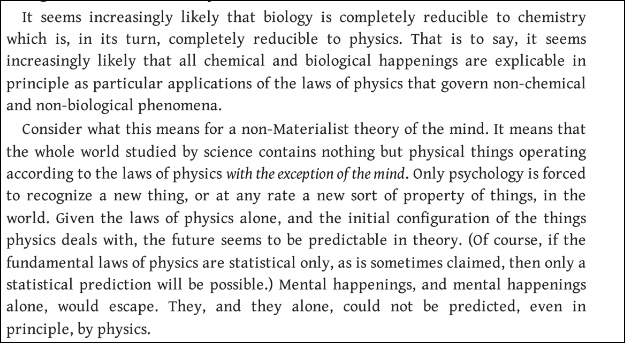
The Argument from ReasonHere's an example from D M Armstrong, A Materialist Theory of Mind - a paragraph chosen practically at random, expressing a kind of exasperation that anyone could dare think that the mind somehow is not an outcome of the law of physics or cannot be brought within the ambit of physics.
-
The Argument from ReasonI don't understand the focus on my mental behavior you consider rational, and how its being rational makes it special evidence against naturalism. — Srap Tasmaner
It is because of the physicalist assumptions of the kind of naturalism that the argument is aimed at. I mean, do you agree that 'An impersonal, unreflective, robotic, mindless little scrap of molecular machinery (i.e. the organic molecule) is the ultimate basis of all the agency, and hence meaning, and hence consciousness, in the universe?' If you don't agree, then you may not see the point of the argument, because it's not relevant to your own philosphical point of view. -
The Argument from ReasonAt most (being charitable), the "argument from reason" only narrowly applies to reductive physicalism, — 180 Proof
I was an undergrad at the University where D M Armstrong was head of school of philosophy. His best-known book is called A Materialist Theory of Mind. I would consider the argument from reason to be fatal to the premisses of that book. -
The Argument from ReasonIt's a matter of my psychological history that I have made the inferences I have, rational or not. — Srap Tasmaner
But then, that's reductionist, as well - of the type of reductionism that says that we hold the beliefs that we do, because of our psychological history, or because of some disposition. 'Psychologism', I believe it is called. Not because they're true, or can be true, regardless of those factors. -
The Argument from ReasonI think the distinction is between different types of 'because' - 'because' in the sense of 'he became ill because he ate lobster' - the observation of a physical cause and effect. The second is based on the understanding of grandfather's behaviour - hence an understanding of 'ground and consequence'. I don't think the point is to prove that what the cause of the illness was, but simply to show that one could arrive at an understanding based on insight into the subject's behaviour.
-
The Biden "bribery scandal"It seems that the investigation of Hunter Biden has basically culminated in a couple of wrist-slaps, for un-filed tax returns and illegal possession of a firearm. No doubt the maga fanatics will continue to pound the drum, but my bet is, that is all that’s going to come of it.
https://www.nytimes.com/live/2023/06/20/us/hunter-biden-plea-deal/heres-the-latest-on-hunter-bidens-case?smid=url-share -
Currently ReadingSchopenhauer’s Compass, Urs App. A new (2014) introduction to Schopenhauer, drawing on his written notebooks and the margin jottings on his copies of the Upaniṣads and with a lot of discussion of his views on the other German philosophers. Excellent, so far.
-
Science as MetaphysicsI'm certainly not suggesting you should be interested in the things I'm interested in. — wonderer1
No worries, I very much appreciate the courteous manner in which you post.
As for the differences between our views, I start from what might be called a counter-cultural orientation. I understand that scientific naturalism is regarded as normative for many epistemological claims in our culture but in keeping with the OP, I am critical of science as a metaphysic. In very summary terms, scientific methodology has yielded many amazing and indispensable discoveries and innovations, but it doesn't necessarily comprehend or address the problems of philosophy, and the attempt to squeeze those problems into the procrustean bed of the objective sciences has deleterious consequences. That's my overall take.
maybe we could switch to discussing the argument from reason that you mentioned? — wonderer1
I'm planning to create an OP, but it's going to take a few days. It's a deep topic. -
Science as MetaphysicsIf only for the fact that most metaphysical views or scientific theories make no difference to how I live my life or what choices I make. — Tom Storm
I'm sure they nevertheless have at least a subliminal influence in our worldview and self-understanding.
I will add that the principle difference between the neo-Kantian Cassirer, and standard view of physicalism, is that the latter sees mind and being as the emergent products of physical processes which are understood to be inherently non-intentional and non-teleological. The former recognises the role of mind in the constitution of the world which is the context within which all judgements about what constitutes 'the physical' are made. Mind is, in this sense, ontologically prior to the physical, not in the sense of being a class of object or substance that temporally exists before the physical, but as the fundamental ground for which and in which the physical is made manifest. -
Science as MetaphysicsI'm aware of that book, but no, haven't read it. Watched an interview with the now very aged Daniel Kahnemann the other night, he's clearly a brilliant thinker.
What I would like to see is more people developing the cognitive toolkit to recognize that an understanding of human thought and consciousness, as supervening on physical processes, is extraordinarily explanatory and not just a simplistic parsimony. — wonderer1
As far as your broader point is concerned, I can do no better than to cite @Pantagruel's excellent post immediately above yours, especially the lengthy passages from Ernst Cassirer, who eloquently states what I would struggle to articulate. I think what it brings out, is the sense in which critical philosophical reflection subverts the belief that the objective science can 'explain' the nature of existence as experienced. These of course are themes and ideas which have been considerably elaborated in existentialism and phenomenology.
As regards Sean Carroll, I'll only observe that physicists do indeed have a tendency to take the world as given, whilst overlooking or neglecting the role that the observer has in the interpretation and synthesis of meaning which is constitutive of our knowledge of the world. (I made some comments on one of Sean Carroll's blog posts here (although be warned contains references to controversial topics and thinkers.) He's plainly an influential science populariser and physicist, but I wonder if he would get Cassirer's point.) -
What constitutes evidence of consciousness?
-
Science as MetaphysicsI'm sure it's a valuable part of the overall philosophical repertoire, but it is all too often used as a kind of blanket to throw over difficult arguments or claims that we ourselves may not be able to ascertain the truth of.
-
What's the implications of this E.M. Cioran quote?A relevant educational opportunity - Dr John Vervaeke on Beyond Nihilism, with lectures, readings and online participation. (I'd consider signing up myself but the sessions are all at midnight in my timezone, and while I'm keen, I'm not *that* keen.)
-
Science as MetaphysicsI'm pretty sure that was Kepler, not Copernicus. — Janus
I stand corrected. :pray:
the odd thing is that even if we can have intuitive intellectual knowledge of reality, we cannot be certain that we can, no matter how certain we might feel about it. — Janus
Which brings us right back to scepticism 101. -
Science as Metaphysics‘Science as metaphysics’ seems a relevant topic to discuss it, although i suppose strictly speaking this is a subject in philosophy of mind. But I’d be interested in knowing more about what you propose as a physicalist theory of mind, either here or elsewhere.
-
Science as Metaphysicswhatever passes for the consensus of physicists, — wonderer1
I don’t think there is one. There are major gaps and conundrums in physics, even without considering the very tenuous connection it might have with how or if mind ‘emerges from’ neural networks, and the implications of that. I think the sense of what is physical, in this context, is post-Cartesian. This is the view that emerges from first of all dividing the world into the two domains of extended matter and ‘thinking substance’ and then by demonstrating the conceptual difficulties with the ‘thinking substance’ (a.k.a. ‘ghost in the machine’.) So having eliminated that problematical conception of the mind, there is purportedly nothing left other than ‘the physical’ in terms of which mind can be explained.
Do you think that is near the mark? -
Science as MetaphysicsYou'd probably need to start with a definition of 'physical' which I suspect will be very difficult to derive. If I was to pursue that argument, it would be along the lines that any such attempted definition could only be formulated relying on reason, which never appears in the physical data (for instance, images of neural data) but is internal to thought. That we can't arrive at an understanding of reason 'from the outside', i.e. as the consequence of something other than reason. But that would probably derail the thread, so I won't pursue it.
-
Science as MetaphysicsHence the requirement for noesis, philosophical ascent. The culmination of those states is in 'seeing things as they truly are', of arriving at an insight into the totality, an epiphany or a great 'aha' moment. This is not necessarily confined to mysticism. There are episodes in the history of science where individuals had sudden noetic insights into the nature of things which lead to great breakthroughs in scientific understanding. An example would be Copernicus' realisation that the orbits of planets were elliptical whilst searching for the Platonic ideals in his observational data; Nikolai Tesla's mystical vision of the Sun and the interchangeability of matter and energy which preceeded Einstein's discovery of the same fact. There are no doubt many other examples, at least some of which resulted in the overthrow of the current paradigm. Arthur Koestler's book The Sleepwalkers contains many examples. Another I recall is Neils Bohr's insight into 'complementarity' which he regarded as a novel insight into the nature of reality, so much so that when he was awarded an Order by the King of Denmark, he designed his own coat-of-arms, which features the Ying/Yang symbol:

(source) -
Flips and Flops of Realism and IdealismWell, perhaps you might expand on this:
Someone who is really idealistic about what is real will not accept an idea that is realistic about what is ideal. — introbert
You seem to be opposing 'real' and 'ideal' here. What exactly do you mean? -
Flips and Flops of Realism and IdealismIt has always been nice to find someone who will engage in a philosophical type of discussion, but sometimes it becomes an argument over misunderstanding. One thing that I have noticed is that the flips and flops of idealism and realism create barriers to someone accepting a fact or claim or idea. — introbert
Totally with you on that. I'm one of the posters on this forum who generally argues for an idealist, or anti-materialist, philosophy, and I know how ingrained the materialist/physicalist viewpoint is in today's culture. What you're describing is called 'talking past one another'. It happens all the time on philosophy forums, due to the widely divergent views of different contributors. It takes patience and persistence to engage on conversations with those who hold opposite views to yourself, but having the skill to do so, is the best thing a medium like this has to offer. -
Subjective and Objective consciousnessI meant, my wife corresponds to the part of you that is saying you should allocate your time better...
-
Subjective and Objective consciousnessShe says, sarcastically, ‘still playing with your invisible friends?’ I do try and point out that discussing philosophy is, you know, not like selling drugs or guns or many of the other egregious things that people do online, but it doesn’t impress her…..
Wayfarer

Start FollowingSend a Message
- Other sites we like
- Social media
- Terms of Service
- Sign In
- Created with PlushForums
- © 2026 The Philosophy Forum