
Comments
-
What is self-organization?Doesn't matter to a switch, what happens, but it matters a hell of a lot to an organism. — Wayfarer
An organism is a network of counterfactual switching. It is constructed of the very possibility to flip between polar opposites at any level of its hierarchical organisation.
Counterfactual clarity is the basis of meaningful agency. You can pick a particular direction only to the degree you can exclude all other alternatives. What you do, and what you thus don’t do in any moment, are the complementary aspects of making “a choice”.
And it is the same dichotomistic logic down at the level of sensory receptors or enzymatic regulation. You have to be able to make a choice, and indeed not choose that in the most definite sense by doing its very opposite, to in fact have choices, and thus what we think of as creative agency or freewill.
To turn over the whole question to impersonal laws, like thermodynamics or atomic physics, is in a way to dodge the question that our particular point in the evolutionary cycle has brought us to. It's to wash our hands of the responsibility we must take for our own choices. — Wayfarer
Why must we take responsibility? It is enough to suffer the consequences. You have an inflated sense of the power of the individual in a world of near eight billion people. If you want to debate the shaping hand of morality, let’s get real about what really drives modern social structure. Examine political economies rather than appeal to folk to consult their conscience. -
What is self-organization?I question whether evolution is an agent at all. — Wayfarer
Maybe I should have used scare quotes. I meant it is the general top-down constraint acting to shape the upwardly constructing degrees of freedom.
So yes, it winnows variety so that all the actors in an ecosystem fit together in a mutually optimising way. But then those local actors can be creative in their resulting developmental trajectories. They can do their best to beat the odds when it come to reproducing.
So agency - if we must use the word - boils down to a capacity to make choices. Constraints create a space of such choices. Actors then react to their constrained environments by making choices - informed or otherwise.
From nature’s point of view, it doesn’t in fact matter that organisms make particularly smart choices. It is enough for evolution that they just definitely either do one thing or it’s other.
If an organism chooses the wrong option, then the selection algorithm can tilt action towards the opposite choice the next time. But if responses are merely vague and confused, neither one thing nor the other, then nothing can really be learned.
Agency at its simple level is just the bacterium swimming in a straight line as it keeps moving towards the scent of food and then switching to random tumbling when it has lost the scent.
We don’t have to invoke any kind of divine inner spark. Just a molecular switch that flips the spiralling flagella from entangled straight line motion to disentangled and tumbling mode. -
What is self-organization?The biological system itself, being an open system, is not constrained by the second law. — Metaphysician Undercover
Enough idiocy. A biological system is closed for its materials and open for its energy flow. It sets up the metabolic turbine that an environmental entropy gradient can spin.
That is the difference between a physical dissipative system like a tornado which is helplessly spun into being by a gradient and an organism that can intelligently construct the dissipative structure to tap an otherwise blocked entropy gradient.
Read the quote I provided carefully. — Metaphysician Undercover
Learn some biology.
Now the issue at hand is the agent which imports the negative entropy into the system, or we could simply say "the cause" of that importation. You can write this agency off to "symmetry-breaking" or some such thing, but this is nothing more than just saying that chance is a causal agent. And that is not logically sound. — Metaphysician Undercover
Listen more carefully to what I actually say.
Life is agency in that it harnesses chance. It ratchets thermal randomness to sustain its organismic order.
The Universe wants to entropify. Life says here, let me help you over the humps. The second law gets served in the long run, but life gets to swim in negentropic loopholes it discovers.
Oxidation is a powerful natural force. So life came along and harnessed that for respiration. It even invented photosynthesis to close the material loop and use the inverse operation of fixing CO2 to
ensure the Earth's atmosphere had a stable life-supporting mix of gases.
Bacteria closed the whole planet for materials so a biofilm could live off sunlight while tightly regulating a Gaian O2~CO2 balance that also kept the planet at a steady liveable temperature.
In terms of top-down constraints and bottom-up degrees of freedom, this is a direct demonstration of the balancing act that maintains Earth as a Gaian level superorganism.
Life on Earth grows as freely as it can. But collectively it is restricted by the metabolic dichotomy that is the complementary processes of respiration and photosynthesis. The upper limit of the ecological carrying capacity is defined by a narrow range of atmospheric gases and a temperature band that keeps the Earth mostly ice free. Closed for materials in this fashion, the planetary biofilm can then maximise its entropy production in terms of turning 5600 C degree sunrays into 20 degree C infrared radiation.
So life as "agency" is about this Gaian wholeness. There is a will being expressed at the planetary scale just as much as at the local bacterial scale.
The bacteria want exactly this kind of world so that they can thrive. And the world wants exactly these kinds of little organisms – ones that can both photosynthesise and respire – so that such an optimised planet can continue to be the case.
Then in the larger picture, the Cosmos itself wants a planet like Earth to arrive as its Gaian self-stabilising and long run optimum.
Oxidation is the biggest bang for buck going if you are carbon chemistry. And carbon is the biggest bank for buck material if you are talking about a propensity for chemical complexity.
It would woo to suggest that the Cosmos actually has a mind, or a designer. But Darwinian evolution is the agency that ensures life did keep stumbling towards the biggest entropic combination the Cosmos had to offer.
It nearly didn't work out. When bacterial first invented photosynthesis, they produced so much O2, removed so much of the insulating atmospheric methane blanket by oxidation, that they nearly killed life as the Earth froze into a snowball. Fortunately the chemistry could be inverted and a stable dynamical balance could result. The O2 could be eaten and CO2 excreted instead.
Is this your confusion? Individual organisms might seem to answer to your simplistic definition of openness. They transact raw materials with their environments. But then the environment itself is a Gaian superorganism. Life is now woven into the material cycles of the planet itself.
Without life, Earth would not have an oxygen rich atmosphere and all its water would have boiled off due to a lack of a protective ozone layer. The chemistry of the planet wouldn't be the same. -
What is self-organization?Is it possible that your "understanding" is out of date? Not wrong, just outmoded. — Gnomon
Nope. The problem is you rabbit on about moddish stuff without having any technical understanding or metaphysical grounding. Thus your "thesis" amounts to nothing more than hand-waving pronouncements like this...
Scientists now know that mathematical Information plays many roles at all levels of reality. It's no longer just inert Data ; it's also Meaning, Causation, Organization, etc. — Gnomon
It's a shame you don't actually take time to study and understand since you seem to be so excited about what is indeed a really interesting story.
You want to hang on to the coat-tails of something while pretending to be a thought leader in it. It should be enough to just actually hang on is coat-tails and show a competence when discussing the latest developments. -
Science as MetaphysicsIncidentally the definition of energy is 'the capacity to do work'. — Wayfarer
Exactly. And that capacity is measured against the incapacity of a "gone to thermal equilibrium" system to do work. So energy as a measurable concept is derived from the more fundamental thing of entropy.
But oh wait. Entropy can't be fundamental as the Big Bang had to be some kind of highly negentropic and Planck energy dense state so that it could then unwind down to a Heat Death.
But oh wait. The kinetic energy of the Big Bang seems to have been in perfect balance with its gravitational potential energy, and hence its expansion was adiabatic, not really increasing or decreasing the total cosmic entropy count as the Universe flatly expands and coasts towards absolute zero degrees in infinite time.
But oh wait. The KE and PE doesn't quite add up to this flat balance after all. It seems there is this extra dark energy that now ensures the Universe reaches its energyless heat death condition in finite time. The trajectory is faintly hyperbolic rather than flat. The Universe will wind up closed by its holographic information limits – the de Sitter solution where space keeps expanding, but this space will be empty of everything but the faint sizzle of the quantum vacuum itself. A kind of content that is only virtual.
But oh wait. Be sure that science still has a bit of distance to digging its way down to the bottom of all this metaphysics.
Entropy and information are concepts getting us somewhere. But that is mainly to the next level of intelligible, or counterfactually-posed, questioning. -
What is self-organization?Maintaining the true status of "open" in a biological system, requires that the system's interaction with its environment cannot be modeled as top-down causation, which is the modeling of a closed system. — Metaphysician Undercover
But the biological system is still constrained by the Second Law. It can develop local negentropy because that overall increases the global entropy of the Cosmos.
Biology’s big trick is that it is open for radiation flows by becoming closed for material flows. It can transact pure sunlight because it efficiently recycles its organic matter.
So it is more open to radiation than bare earth. Rock will scatter and cool sunlight to only about 60 degrees C. A rainforest cools it to 20 degrees C. Life can extract more juice from the solar flux.
But to do this, life must efficiently recycle its material structure. And rainforests are famous for being ecologically closed to the point they manage their own rainfall and need only the thinnest soil.
So life and cosmos can both be modelled in dissipative structure terms. And when it comes to open vs closed, you have to be alert to whether you are talking radiation or matter.
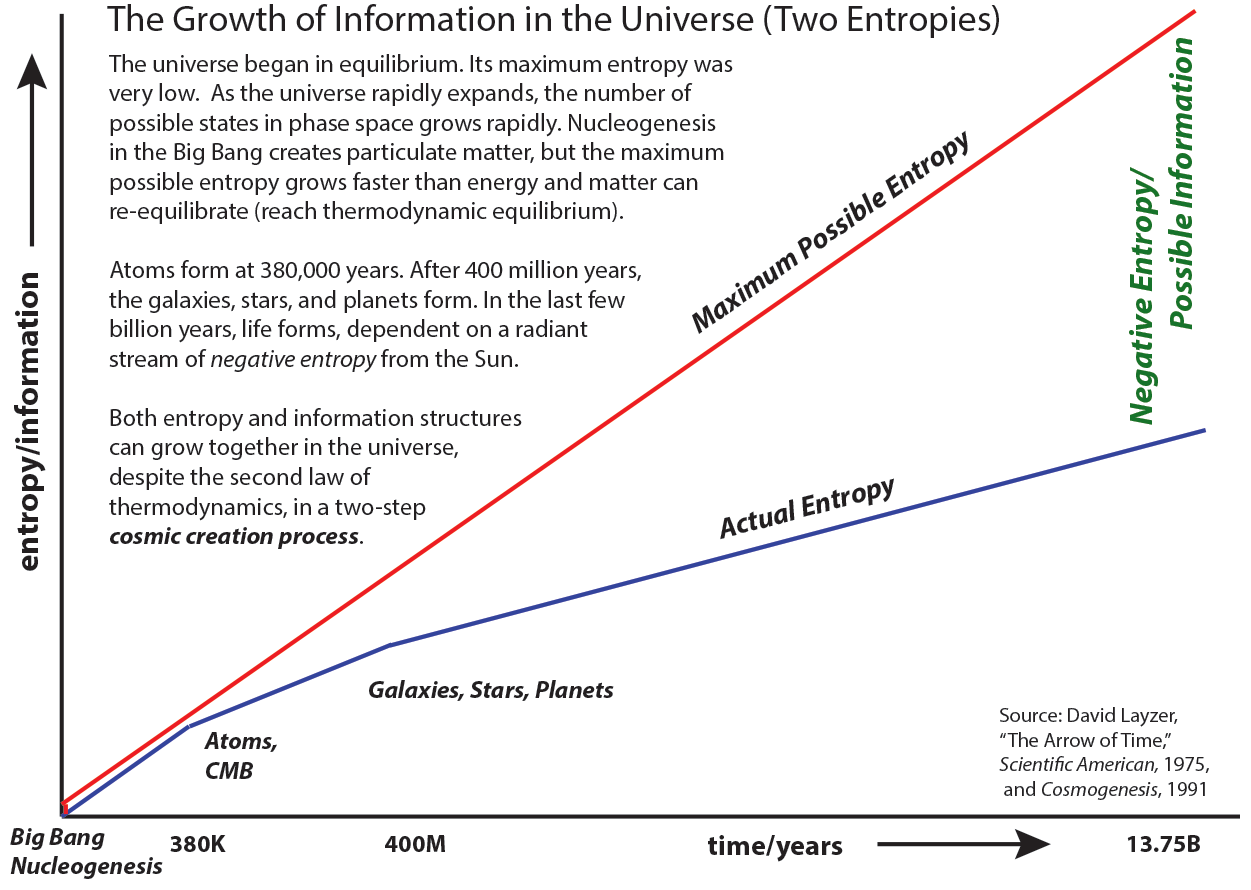
The Big Bang itself has this issue. It started off as a pure adiabatic thermal flow. Just spreading-cooling radiation. But then there was a phase change due to the entanglement of local and global symmetry breakings - an interaction between local gauge fields and a global Higgs field that made fermions massive. A smoothly expanding gas became suddenly a gravitating dust. You had a separation that was a creation of negentropy that now needed to be entropified back to pure radiation.
At the cosmic level, this produced the open dissipative structures we call stars and blackholes. It is going to take a long time to turn the dust of massive particles back to the background thermal sizzle of a quantum vacuum.
Then life repeats the story at its own micro-cosmic scale. We take what the Sun is doing, mix it with the complex remnants of past super-novae which are the further negentropy that results in the crud known as a planet, and cook up a little Gaian mix or photosynthesis and respiration.
Life uses the fuel of sunlight to drive the construction of metabolically structured cells. It self-encloses for materiality so as to beat ordinary physics when it comes to the rate at which a released flow of radiation is being entropically cooled.
The concepts of open and closed are useful in this analysis. But you also then have to be able to follow the practical complexities that help us see what is really going on.
Without understanding it, Gnomon in fact posted this graph of the creation of the negentropic gap from David Layzer, the cosmologist who saw this back in the 1960s.
-
What is self-organization?Apparently, that "Causal Nothingness" is the "crack" in the pot that you imagine to represent the thesis of Enformationism. — Gnomon
I have no problem at all with either the metaphysics or physics of raw potential. Your problem is I understand all this stuff well enough to see that you don’t. -
What is self-organization?It is only by denying the reality of the agent, that the system can be presented as top-down causally, rather than the true bottom-up causation, which is indicated when the agent is included. — Metaphysician Undercover
Well you are certainly right that it is only by correcting the faultiness of Cartesian dualism and its res cogitans dilemma by moving up to the triadic and hierarchical metaphysics that underpins biosemiosis that one can finally resolve that old logical quandary.
But you are still stuck in the immediate post-medieval stage of theistic thought. Even Kant and Schelling are adventures yet to be undertaken. -
What is self-organization?Apokrisis has directed me to enough material for me to see that Pattee's theory is hugely deficient. Interpretation of signs, or symbols, to decipher meaning, requires an agent which does the interpreting. — Metaphysician Undercover
Try reading again and realising that biosemiosis doesn’t talk about agents who interpret but systems of interpretance. The whole bleeding point is to understand things in terms of the irreducible holism of the triadic modelling relation.
So as usual you are flailing away at a straw man because you can’t focus on the critical technical distinctions being made by a precise choice of words. -
The science of morality from the bottom-up and the top-downOught we want to live harmoniously in a community? — Banno
Here we see the reductionist blundering about, missing the point, as per usual.
Anthropologist Richard Wrangham makes a good case for how Homo sapiens "self-domesticated" over 300,000 years of hunter~gatherer evolution because the unharmonious males in a small band got knocked off with summary justice. Their genes were eliminated from the tribal pool.
So is/ought covers the fact that hierarchical order develops over nested spatiotemporal scale. To even exist, a system has to become divided into what it is at any instant and what it ought to be in terms of its own hierarchy of constraints.
A directionality - a telos - is what has to get built into the fabric of its being. At base, any material state of affairs is falling apart faster than it can pull together. But a living system adds the intelligence to tilt the balance in a generally desired direction. As a metabolic network, all the chemistry is being ratcheted so the body rebuilds fast enough to cease falling apart. It becomes an intentionally self-stabilising entity, or an organism.
Human morality is just our clunky way of talking about this general system principle. Is and ought are opposed only in the sense of being these complementary limits of a global intent that serves to ratchet the local material variety in a cohesive long-run direction.
A community has to have a generalised harmony to even exist. As Wrangham argues, this necessity is wired into our genes because we down-regulated our reactive aggression neuro-circuitry to the point we can tolerate the close and constant presence of our fellow humans in ways that chimps can't even imagine.
The other side of the coin – as there is always the other complementary side to the coin once you depart reductionism – is that humans are still capable of proactive aggression. We can make the big flip from seeing our tribe mates as part of our collective in-group selves and instead now framing our fellow humans as dangerous, alien and "other".
This explains the paradoxical nature of hunter~gatherer communities who seem both incredibly peaceful, yet can then flip to total war on encountering another tribe. Or as Wrangham says, who will simply combine to agree to kill the tribemate who just happens to offend enough people often enough to need removal from the collective gene pool.
Wrangham tells how grievances are quietly aired in late night tribe discussions with a gradual "othering" of the annoying character as a sorcerer or bad luck bringer. A decision coalesces. Then a few weeks later there is a hunting party trip. The victim is teased about being brave enough to climb a tall tree and collect the honey. He puts down his weapons and climbs to the top, then looks down to see his weapons have been collected up, the other men stand patiently, a look in their eyes....
Human morality is built on this neurobiological and sociocultural dynamic of self and other, in-group and out-group, low reactivity and high proactivity.
It is not about the reductionism which means we can't have both sides of the holistic equation. It is about the fact that this dichotomisation of behavioural state is so sharply poised to go in either direction that it can be a decision taken over any spatiotemporal scale of human organisation.
To exist, a system has to embody a purpose. There must be an ought, as that is the information, the constraint, that can stabilise what reductively "just is". There can be an actual state of affairs rather than merely a vague uncertainty which is neither here nor there in any factual way.
Once you have a global ought that is in balance with a local is, then the system is equipped to self-sustain its existence. It knows how to persist.
Which is why morality seems so important. -
The science of morality from the bottom-up and the top-downCompetition becomes immoral when it is exploitative. More work is needed to clarify when that is. — Mark S
One difference is that the norms of cooperation have to be voiced clearly as these must exist in the public space of the social organism. We must hear the collective view being articulated for there to be a global norm.
But the norms of competition are then the opposite. They are instead defined as the point where differences of view start not to matter. They are the defacto freedoms. They are the give and take which needs no strong public statement because they tend to get policed on a local, more ad hoc, basis.
So a well-organise moral system is of course sensitive to exploitation – competition of the kind that crosses the line in some way that harms the global regulative order and so can't just be celebrated as a positive contribution to that social order, or even just laughed off as the kind of local difference that doesn't make a difference.
Thus we have three options to consider under the banner of the local degrees of freedom. There is the positive behaviour we want to amplify, the negative behaviour we want to suppress, but then beyond that, the neutral behaviour where moral norming simply ceases to care.
The social system has to be organised in a fashion where it can actually arrive at what is neutral as this is then the foundation for starting to make the more complex distinctions in terms of what kinds of competitive actions are positive vs negative. We can start to define exploitation or cheating in opposition to being enterprising and creative because there is the Peircean firstness – the state of action that is just "a difference" and so not yet a "difference that makes a difference" ... because of some further hierarchical level of contextual framing.
So while norms of cooperation must be publicly stated, the "norms" of competition rest on this assumption of a fundamental neutrality – the spontaneity of chance events that don't in themselves matter one way or another. It is only when they start to encounter a context of top-down judgement that they can even morally matter.
Do you run your marathon in green shorts or blue? Who could even find a reason to care?
If a vast amount of such facts can be simply ignored as morally irrelevant, then we start to boil things down to the kind of local or personal facts which could start to matter in a fair marathon race. Like is your cardio superiority due to the lottery of blessed genetics or EPO? -
The science of morality from the bottom-up and the top-downYou are on the right track. From my systems science point of view, societies are organised by the dynamic of competition-cooperation. Which is pretty close in meaning to exploitation-cooperation, without the negative moral judgement on the competitive element of being a “selfish” member of a cooperative group.
So systems theory describes all natural systems - even the universe itself - as being hierarchically organised through the holism of top-down global constraints acting to shape a system’s bottom-up and locally constructing degrees of freedom.
This makes a system a self-causing or self-organising dynamical balance. Global laws or habits act downwards to limit local action. And this then gives form and purpose to that local action as it now has the right shape, the right material and efficient degrees of freedom, to be the kind of stuff that is going to construct, or rather reconstruct, the global whole and sustain its long run existence.
So it is a causal loop based on a win/win balancing act. And in societies, that is what a morality attempts to encode. The constraints of a society are the rules around cooperation. They tilt the social collective to stability in the long run. But a society, like any living structure, must have its local individualism, its local freedom, its local creativity, its local random variety, to be able to adapt and evolve.
Competition keeps the hierarchy dynamic, while cooperation is keeping it stable. And morality has to be finely tuned to producing the balance of the two complementary forces that are best in terms of the degree of adaptability and change that match a society to its larger environment.
So morality is not universal in its prescriptions, as every human group may need some different balance. But it is universal in its form in the sense that morality is a win/win balancing act where freedom is maximised for the individual within the constraints of a collective code that says what is historically “the right stuff” for reconstructing the society as it largely exists, with enough variety to also evolve in the face of changing challenge.
Exploitation is speaking to the competitive element of the dynamic, but painting it as something more negative - an issue that needs to be addressed by adding constraints against cheaters.
The systems view recognises that the individualistic element is the part of an evolving system that provides its lucky accidents. It is the “requisite variety” to use the cybernetic term. So morality is about limits, but also includes ideas around a suitable degree of give and take.
The big problem in all this is what are then the global goals of a society.
A science of morality - as in the systems science view - speaks to the general mechanism by which a society can even exist. And so in a minimal sense, existence becomes the natural purpose of a society. Finding the balance that allows for long-run survival is the embodied reason for being - as with any evolutionary story.
Can a society really have a grander purpose than simply to exist?
But on the other hand, what does this moral minimalism say about the modern “developed world” which is starting to cook itself in its own fossil fuel fumes?
Maybe having the general purpose of just continuing to exist as some kind of successful competition-cooperation balance seems plenty grand enough as a life mission. :grin: -
What is self-organization?Apparently, something about my information-based worldview is discomfiting for you. — Gnomon
It’s the crackpottery. Simple enough. -
What is self-organization?This is the deficiency of systems theory. — Metaphysician Undercover
This is a deficiency of your knowledge of systems theory. Read Salthe. Boundaries are what systems form by symmetry breaking and dichotomies. The Big Bang Cosmos, by moving towards the opposing limits of locally cooling content and globally expanding extent, is its own self-bounding structure. It exists by falling into the heat sink it produces.
The rest of your post is just as ill informed. -
What constitutes evidence of consciousness?That's true, and I wonder if we would have achieved such spectacular levels of "entropification" if we hadn't discovered fossil fuels. That discovery has arguably enabled a massive population explosion. — Janus
Correct. This is something I’ve been researching this year. It is remarkable how human entropy production maintained a Malthusian balance even through the agrarian era showed some technical advance between 1100 and 1700. Any increase in food surplus was cancelled out by a matching growth of population, bringing everyone back to a steady state economic level.
But then technology and science made its sudden left turn with the discovery that the British midlands and European lowlands had all this buried coal. The per capita entropy production of the West became an exponential curve which then turned super-exponential with the discovery of oil.
So that is my argument. Humans have just been riding the dissipative wave of a succession of entropic bonanzas. Homo erectus already started things by stumbling across the notion of firewood and big game hunting. No one else was burning the trees or cooking the flesh. This entropic bonanza shaped a whole new level of mentality - a “self model” of the hunter-gatherer in its savannah/steppe world.
Agriculture was the next step up. And then fossil fuels became something different in that it now looked like Homo sapiens had finally tapped an “infinite resource”. And in complementary fashion, that justified a self-model as the “other” as no longer the gardener of nature, but instead the liberator of unlimited entropy production. The Elon Musk fantasy of peak humanity.
Population growth hopped on this exponential curve, finally released from its Malthusian limits. Human entropy production in general became a game of how quickly we could find more opportunities to dissipate and so do proper justice to a world of made of unlimited material resources.
Before you know it, the planet was populated by dudes like Hanover saying unbound growth is nature at work and simply an expression of the human destiny.
When animals, notably apex predators, proliferate and overuse abundant resources, they are naturally knocked back, but we are so clever at abstract thinking we have so far avoided that. — Janus
That’s the Malthusian equation. And if we had listened to science when it modelled the Limits of Growth in the 1970s, we would have realised how we had allowed fossil fuels to hijack our reasonably clever human social systems for its own mindless purpose.
We did fall upwards in previous rounds of the game. We ate all the Steppe mammals during the ice ages but took good advantage of the Holocene’s climate stability to switch to agriculture as the new thing.
And we could have also heeded the ecologists in them1970s and begun the Green transition to a more sustainable burn rate. The future would indeed have been sweet. Even if world population would have been stuck at around 1900s levels, and per capital energy expenditure at 1950s levels.
But win some, lose some. -
What constitutes evidence of consciousness?Download here: https://www.researchgate.net/publication/305375362_The_Economic_Origins_of_Ultrasociality
Those insects don't have parties, entertainment, festivals, the arts, religion, science, philosophy and history though. — Janus
They garden fungus, we harvest the biosphere. They have been successful at sustaining ecosystems for hundreds of millions of years. We are blowing through the world’s fossil fuels and mineral gradients in a couple of hundred.
So same, but different.
The point is that if we talk about the consciousness of social insects, it actually is understood in terms of a groupmind or social intelligence. The hive or nest acts as a social organism.
Realising that the highest level of ant and termite-dom is agriculture - the domestication of their ecosystems - should certainly be pause for thought when it comes the Hegelian structure of evolutionary history.
Bacteria of course had already done the Gaian thing about 2 billion years ago by learning how to domesticate the planetary carbon cycle by balancing O2 and CO2.
Semiosis is the big picture ontology. -
What constitutes evidence of consciousness?That said, I hesitate to say the human level is "higher" or "better" than the animal level. — Janus
In the logical sense, it is more abstract and so less concrete.
So higher in abstraction. And thus better at maximising entropy production. Intelligence buys access to entropy gradients.
As to moral judgements, we can tell just how much those are central to a social level of semiosis, but not a technological level, by the ruthless way they have been ripped out of modern political and economic theory.
That is another advantage of the biosemiotic turn. It places the spotlight on the current human plight.
You should enjoy Gowdy and Krall on this. We’ve evolved beyond social apes to become … technological termites.
https://pubmed.ncbi.nlm.nih.gov/25915060/ -
What constitutes evidence of consciousness?The socio-cultural aspect is simply an amplification of the self/ world modeling. — Janus
It ain't simply an amplification according to me. A change in code is a change in levels. It's not about more. It is about different.
So a biosemiotic perspective is an advance on good old fashioned cognitivism in two ways. It is both more general and more particular.
It is more particular in pointing to the difference in kind that comes with evolving new levels of symbol-processing – the steps from the genetic, to the neural, to the linguistic, to the actually symboilic.
And it is more general in indeed showing that life and mind have the same general rational structure. It is all a play on semiosis – the triadic modelling relation which results in organisms with Umwelts. -
What constitutes evidence of consciousness?I see little difference between what apokrisis is saying about the self and world being a modeling relation and what is presented by Metzinger in Being No One. — Janus
Check the references. Note the lack of a sociocultural or systems perspective. It's all neurobiology and functionalism. -
What is self-organization?But apparently you are not seeing my side : the non-physical metaphysical mental half of the universe that is meaningful only to rational philosophical animals, who think about ideas that are not physical things. — Gnomon
You tell yourself whatever gives you comfort. But I will continue calling bullshit on your conflationary arguments about "information". -
What constitutes evidence of consciousness?I don't know what Metzinger says about psychogenesis, though it would surprise me if he believed the self is "genetically baked in" - considering his minimal phenomenal selfhood idea doesn't contain a self as usually construed. And specifically, tonic alertness is construed as an essential component (and precursor of) what we'd normally construe as a self - which is the autonomous cortical feedback of that blooming, buzzing confusion of impulses and reflexes. — fdrake
I admit my response is largely based on what he was saying about 30 years ago. So maybe he applies the simplifying logic of dichotomies and symmetry breaking to brain architecture now?
But I've skimmed a few sources and he still seems to be coming from a cognitivist paradigm and so sees both this "minimal phenomenal selfhood" and "conscious self-awareness" as brain located functions. One as the low-level story, down in the basement of the brainstem; the other a high-level process, up in the prefrontal.
My approach is biosemiotic and so I see ordinary animal awareness as embodied and enactive, but
human self-awareness as a further learnt linguistic skill – a capacity that is socioculturally constructed in the Vygotskian psychology sense.
The "narrative consciousness" that humans enjoy is a habit of thought shaped at the level of our neurobiology as constrained by the cultural semiosis which is humans coming together as a dissipative social organism.
Thus the ability to pay introspective attention to our embodied existence – to model our selves as selves – is not something that is genetic and so explicable as some kind of particular neurological function. It has to be explained in terms of the kind of reality model that our societies need us to have to function as "self regulating" social beings within its socially collective space.
So Metzinger's more recent MPE work may now be informed by the enactive turn in cognitive science. The importance of embodiment to any account of the "phenomenal self" is recognised. But that is still some distance from my biosemiotic perspective which gives far more weight to the sociocultural shaping of what actually fills our heads and shapes our cognition.
And likewise, the dissipative structure foundation to that biosemiotic perspective gives far more weight to the structuralism that says brains are in general organised by the triadic logic of a system, regardless of whether we are talking biology or sociology. Ideas about computation and modularity – a construction-based ontology – has to give way to an organic causality that is based on constraints on uncertainty. A vague potential gets dichotomised and thus becomes hierarchically complex, in symmetry-breaking fashion.
The metaphysics that grounds a naturalised account of "consciousness" is quite different when you shift from cognitivism to organicism. -
What constitutes evidence of consciousness?it's not some pre-existing thing that then adds to itself a model by which it distinguishes itself from its environment. The running model is that distinction, — Srap Tasmaner
Right. It’s the logic of the dichotomy or symmetry breaking. The self is defined in terms of not being the world, and the world is defined in terms of not being the self.
Rather than having to imagined neurobiology following a complicated computer engineering approach - some kind of homuncular self model being grafted onto some kind of world model - you just need a simple neural learning algorithm.
Every newborn baby is born a blooming, buzzing, confusion of impulses and reflexes. The infant waves clenched fists about without any idea they could be instruments of its will. But a few accidents where hands are open and reflexive closing grabs objects in the world, then further learning leads to the skill of moving them to mouth or throwing them around the cot, and you can say the child knows the hands are a part of a self that is opposed to world.
So no sense of self or knowledge of the world needs to be genetically baked in. A baby’s neurology will self-organise around the central idea that there is the part of the world that is the handled, and the part of its world which is thus the handler. -
What constitutes evidence of consciousness?….Or the tl;dr version. :grin:
Which should one problematised as the essential scientific question?
What kind of thing is this ineffable phenomenal self? Or what is the neurobiology of sensori-motor discrimination?
What counts as evidence is pretty straightforward for the later.
Do rocks make self-other discriminations? Not from the available evidence as rocks on trails don’t actually grab at your skimming feet.
And the fact that these discriminations cash out in terms of voluntary and goal-constrained physical actions makes overt behaviour perfectly good evidence of sentience. We can reliably detect agency in terms of counterfactual self-other discriminations that make a real difference in the real world. -
What constitutes evidence of consciousness?I hadn't meant "material constitution" in a substantial sense. Just something the thing does. Like walking. Do you think it would be evidence for consciousness (something like a sufficient condition), even if it doesn't behave like a screen (something like a necessary condition)? — fdrake
Metzinger is another who naively accepts the framing of consciousness as the problem of a self in the world. There is this phenomenological “stuff” - the Cartesian res cogitans. And this other noumenal stuff of the res extensa, the realm of physical being.
So we walk - which is somehow on the side of physics and merely the physiological behaviour. And then at some level - usually quite subconscious unless we stumble - there is the phenomenology that seems painted on a passively representing mental screen.
An antique and dualist metaphysics is baked into the discussion by classing the mind and world as relata rather than as itself a pragmatic relation.
In practice, the neurobiology of self is all about making a running self-world distinction. What we are conscious of is being this thing of what we call “a self in its world”, or an Umwelt.
So there is no self, and there is no world. These are modelling constructs. What there is instead is a running habit of discrimination where we are continually dividing our phenomenal existence along those lines. At every scale of biological and neurological being, from metabolism, to immunology, to feet acting on ground, we are having to decide what is self, what is other.
The feeling of running a rocky trail is one of complete world mastery - it is all me as every footstep makes nimble snug ownership of the hollows and angles of the track, until it isn’t and I get the aggrieved realisation that a chunk of stone has leapt out to catch at my toe with animistic aggression.
One instant, I am owning the world, making it my passive backdrop. The next, I am aware of myself in frozen suspension, a tumbling passive weight of body falling helpless and surprised to whatever crunching impact the world has in store.
The self makes no sense without its world. And Metzinger’s focus on phenomenologising the one side of the equation - what is is like to be a mind - leaves out the other of what it is like to be my world.
That is the key to the Umwelt, and a Kantian epistemology in general. Descartes did not get the enactive equation of minds being modelling relations.
The fact is that brains exist to make a discrimination of self from other, self from world. And one is not more fundamental or real than the other. They are together the two complementary halves of the one phenomenological relation.
As relata, both are equally a construction of the modelling. Selves and worlds are to the same degree “illusions” of the mind. And yet also useful illusions as both are involved in organising physical change in the actual physical world.
There is a trail. I am indeed running it. This is possible because I have a fluid and dynamical sense of the fact that relies on a sharp discrimination of what seems self, and what seems other, in any given moment.
Treating consciousness as a screen of neural representation is homuncular. Who is there to witness the display.
An enactive and pragmatic view of consciousness says the “neural screen” is really a filter of self-other discriminations that support a dynamical accomodation of organismic goals to environmental opportunities.
As sensory deprivation experiments reveal, both world and sense of self disintegrate quickly when there is nothing to sustain a process of self-other discrimination. Sensory receptors need physical variation that can start the whole business of “having phenomenology” in terms of being a self in its world - the bit that knows it stands apart from the bit is not a part of. -
What is self-organization?One of my favorite scientists (evolutionary biology + neuroscience), Terrence Deacon, has contributed several novel ideas that I adopted in my own philosophical theories. — Gnomon
Deacon is very competent. But he also has been busily reinventing what already exists in terms of the biosemiotics + dissipative structure space of the structuralist/systems science tradition.
The primary difference is that BS & BP are hypothetical mechanisms in Biology, while EnFormAction is a hypothetical organizing (enforming) process in Cosmology. So, although both are science-related philosophical theories, they are not competing against each other. — Gnomon
That is inaccurate.
Biosemiosis is based on the physics of dissipative structure. And dissipative structure is also the basis of cosmology. The Big Bang theory describes the Universe as a cooling-expanding structure of dissipation - a system falling into the very heat sink it is making.
So the big claim now is that it is not just thermodynamics in general that is the basis of everything. It is the specific thing of open-ended dissipative structure. And the Universe is pansemiotically a dissipative structure. The information that forms its constraints is to be found in its lightcone holographic structure. This is what the decoherence model of quantum mechanics argues. It is what you get when you add statistical mechanics to QM to create a description of a cosmos that is cooling because it is expanding, and expanding because it is cooling. Falling into its own heat sink, in short.
So the physical universe can be described in informational/entropic language. It just embodies a thermal structure doing its grand developmental thing.
Then along came life and mind as ways to use semiotic codes to organise this physical world. Genes and neurons, eventually words and numbers.
This was something new in that the information or negentropy could be stored inside an organism with a memory. It was no longer something holographically built into the lightcone structure of the Universe itself - and so as fleeting and dynamical as it gets - but instead information in the new sense of being bits stored in a model of the physical world. Life and mind could stand outside the world they modelled by being able to hide the physical informational configurations safe inside their own bodies.
It is still all about a fundamental basis in thermodynamics and dissipative structure. Life and mind pay their way in the Universe by using their stored negentropy as the intelligence that breaks down environmental stores of energy. Photosynthesis and respiration allows biology to tap sunshine and chemistry and so accelerate the cosmic entropification rate a fraction or two above what it would otherwise be if there was no planetary biofilm and just naked radiation falling on bare earth and lifeless oceans.
But this biosemiosis is obviously different in that it is an organismic kind of dissipative structure. It is dissipation plus intelligence. It is dissipation plus Bayesian reasoning and forward modelling.
A tornado is pretty lifelike in many ways. Almost wilful how it touches down and then weaves across the countryside gobbling up the warm air that sustains its vortex. But clearly it lacks actual semiotics in the sense of working off a model of its organismic self in relation to its sustaining material environment.
So reality as a whole - the entire shebang from cosmology to consciousness - can be modelled in the fundamental coin of thermodynamic theory. That is why information-entropy has become the basic metric employed by physical and mental theories. It is used in quantum theory. It is also used in Bayesian Brain theory.
But then there is this sly twist that separates thermodynamics from the purely physical or pansemiotic view, and thermodynamics with the added thing of a code, and hence an organismic modelling relation of a Iiving and mindful being with its entropic environment.
Biosemiotics still founds itself on information-entropy as the basic metric. But it then has to create suitably complex versions of these things to reflect the addition of the organismic modelling relation.
For example, entropy is understood in derived terms like free energy or exergy - the raw capacity to extract work from entropy production. Or from the informational point of view, the derived units become surprisal, ascendancy, mutual information, or whatever else speaks to the sense of meaning and significance that decides what information gets remembered and stored as habits of behaviour/models of the world.
So my point is that there is a general theory of everything emerging within science that is coming from this new holist perspective. It is about information and entropy at the naked physical level, and then uses suitably derived units to bridge the organismic gap and so allow us to model biological, neurological, sociological and technological levels of living/mindful dissipative structures.
The issues involved are precisely defined. My complaint about your enformationalism is that it lacks any such clarity in its mission. You might think you are groping the same elephant. But now there is a roomful of folk hard at work. And they found the light switch to see what they are doing.
You may cite a lot of these people. But you also claim to be offering philosophical originality. From my point of view, the genre you are working in is at best fan fiction. -
What is self-organization?but exactly how lumping & clumping results in the holistic function we call Life remains unclear. — Gnomon
Bollocks. Biophysics speaks directly to the issue.
A different life-force was recently proposed by an MIT physicist*2, but it does just the opposite of aggregating & organizing compulsions. — Gnomon
Right. He is talking about physical SO as dissipative structure. Just talking about it as if it is something he recently discovered. :rofl:
And you then add the woo of calling it a “life force” rather than an entropic principle. :roll: -
Science as Metaphysics"To Conflate" means to combine two or more separate things into one concept. That's the job description of philosophical inference and holistic thinking. — Gnomon
It definitely isn’t. Holism is about the triadic story of the unity of opposites. Dialectics. You have to break a symmetry and discover its new equilibrium balance. You have to dichotomise and discover how this then leads to a self-stabilising asymmetry - a world where thesis and antithesis can persist as balanced synthesis.
Conflating is failing to make this kind of systems argument and simply claiming two different things are the same thing … just because you’ve said that.
And the Enformationism thesis combines lots of those implications into the inference : that Generic (causal) information (power to enform) is equivalent to Energy, which transforms into Matter, and eventually emerges in complex entities as Mind* — Gnomon
All a bunch of hand-waving glued together by the causal placeholder of “emergence”.
Complexity is more than just complication. And I don’t see that you understand that.
For example, a human brain is a complex integrated system of neural & supportive cells, that are not in themselves conscious. But working together, they produce the ontic phenomenon that we call "Awareness" or "Aboutness". — Gnomon
This is what I mean. My approach of biosemiosis can specify exactly where the line gets crossed at the microphysical level to turn a molecule into a message. Pattee’s epistemic cut. There is a theory with biophysical evidence to be debated, not merely handwaving about things popping out because … more is different, or whatever. -
Science as MetaphysicsI’m curious if you’re familiar with the work of any of the so-called ‘New Materialists’, such as physicist and feminist philosopher Karen Barad, and what you think of them. — Joshs
Not my bag. I had a quick skim of her agential realism.
As a pragmatist and biosemiotician, I would be making the totalising argument that the modelling relation is indeed on the side of the necessary and the general as a natural structure. PoMo instead has the interest in arguing the opposite - stressing thr plurality, contingency and particularity of agents who model their realities, even in this co-constructing fashion of Copenhagenist quantum mechanics.
So we might agree that there is something more going on in the collapse of the wave function. But biosemiotics now provides the maximally general theory of that in Pattee’s epistemic cut. It boils down to the general possibility of imposing the constraints of a mechanical switch on a quantum process - or exactly the thing of a measuring device that turns a material event into an abstract number.
Measurement forces quantum decoherence across the final line by constraining its probabilities to “good enough from an agent’s point of view” certainties. We get the numbers that fit our classical equations. And we can get stuff done.
But this isn’t something special to humans and their new world of mechanical co-construction of their nature. It is the basis of life and mind - or agency - in general.
An enzyme is doing the same quantum mechanical trick. It is a mechanical switch that makes a measurement when it deforms and forces two molecules close enough together that a desired reaction must certainly happen as its quantum probability approaches 1.
So human agency is just “more of the same” from the biosemiotic point of view. In stepping up the levels of abstraction - from genes, to neurons, to words, to numbers - it is just following its own natural structural evolution towards maximal modelling abstraction, and hence maximal causal control over the time and place of acts of thermal decoherence.
PoMo recognises that we are semiotic creatures. But it wants to define us primarily as linguistic creatures. It is uncomfortable at the thought we might be biological creatures - generalised blobs of genes and neurons - or now becoming technological creatures, intelligences shaped by the inhuman forces of maths, machines, rationality, entropy dissipation.
And fair enough given the reality that most folk live lives that are primarily linguistic and socially-ordered.
But as metaphysics, I prefer the totalising discourse that can see the fact that life and mind are generally the same thing in terms of being rational entropic structure, even as it clicks through its evolutionary gears in stepping up its levels of encoding from genes, to neurons, to words, and to numbers. -
Science as MetaphysicsBeing, as the original impetus of philosophical reflection, is actually "consciousness of the unity of being" - i.e. abstraction, what is common to all beings across all modalities of being. — Pantagruel
Cassirer is on the right page. What we would be wanting to move from is the rather particular view of the linguistic human to the abstract as could be imagined view of the mathematical model.
So we engage in the question of being already based in the frame of linguistic inquiry which has its basic established categories, such as the selves who inquire, and the kind of material being that is of the same general spatiotemporal scale as us human inquirers.
If I ask about the generality of my reality, I already am forced by language to think there is this reasoning self surrounded by all kinds of material stuffs. Things that are hard or soft, sticky or slick, metallic or fleshy, heavy or light. My physics, in its abstraction, is based on the inductive generalisation from this level of experience - this naive realism.
But since Ancient Greece started the ball rolling, we have been learning to see the world through the pure abstractions of numbers rather than words. The self and it’s concrete impressions are meant to drop out of this new level of inquiry into being. Reality is reduced to its hard logical structures and the acts of measurement - the business of counting - which are the “local accidents” of these “global and logically necessary” structures.
So that is why Newton started off talking about pushes and pulls. Action as force. The world as seen by the kind of agency that is a human thinking in terms of material and effective causes. We then generalised to categories of forceful substsnce like gravity, electromagnetism, caloric heat.
But then under the influence of the abstracting mathematical perspective, we moved on to notions about gravity being geometry, action being quantum probabilities, thermodynamics being statistics.
We were left with some logical mathematical structure that would apply to any incarnation of a type of being, and the equation variables that let you slot in the values that were the accidents - the measurements, the numbers - which would particularise these general models.
So that is why the shift to the “pure numbers” of information-entropy are how we should expect scientific progress to be made. They measure the residual uncertainty of the observable world in terms of our logically certain theories of absolutely generalised structure.
Thus in terms of abstraction, or induction from impressions, we have to see that humans have indeed stepped up a level in our semiotic technology in going from the everyday linguistic frame of philosophising to the “symbolic as possible” logical-mathematical frame of analysis.
We no longer “look directly at the world” through our collective notions of what it is like to be a human having sensory impressions, but instead focus our eyes on the numbers coming up on dials and scribbling the digits into the slots of our equations. And thus see reality more truly. :grin: -
Science as MetaphysicsClaude Shannon quantified Information not as useful ideas, but as a mathematical ratio between meaningful order (1) and meaningless disorder (0); between knowledge (1) and ignorance (0). So, that meaningful mind-stuff exists in the limbo-land of statistics, producing effects on reality while having no sensory physical properties. We know it exists ideally, only by detecting its effects in the real world. — Gnomon
It is this kind of conflation that illustrates the problem.
Sure Shannon produced the reciprocal maths to model information. Certainty could be quantified in terms of 1/uncertainty. The smaller your uncertainty, the greater your certainty. And vice versa.
But Shannon was talking about the certainty of have received a signal coming across a noisy channel. The question is whether a symbol was just transmitted, rather than whether this symbol was meaningful. A binary code then reveals itself to be the crisper way to transmit a stream of symbols as the contrast is maximised. You only have to chose between a sharp pair of choices – like a tone or its absence, a 1 or a 0.
Of course when humans are sending messages to each other, the effort involved suggests a stream of symbols is intended to have some mutually comprehensible interpretation. A binary code will at least minimise the noise and maximise the certainty of the message as it was written for sending.
But you now jump from a point about Shannon's definition of a bit to this guff about "meaningful mind-stuff". You conflate a mathematical claim – the epistemology of a model – with this ontic assumption about "the mind" being this kind of physically general "stuff" that has the intrinsic property of being meaningful – of having "sensory" qualities such as feelings and impressions.
This is an abuse of Shannon and a failure to supply a theory of meaning, such as to be found in the science of semiotics. You simply conflate Shannon's epistemology of quantification with the all to familiar speculative metaphysics where folk like to claim "information has qualitative properties". Somehow or other, information conceived of as a string of transmitted bits just has a substantial being of the kind that can shape a realm of material events.
You want to get away with this because modern information theory appears to say that Planck-scale bits really do in-form reality in a physicalist fashion. You have the holographic principle and quantum field theory appearing to support this "substantial stuff" notion.
But what I say you miss is that that Shannon and Jaynes laid the ground for a new epistemology of physics with their reciprocal work on information theory and statistical mechanics. The notion of information has become twinned with the notion of entropy. And neither of these want to make a naive claim about any kind of substantial stuff. Instead, both are about stepping back from the naive realism which sees the world as being "physical" in the way it appears to our sensory models. A realm of tables, chairs, duck, rabbits, cats and mat ... the world of "medium-sized dry goods" as Austin puts it.
We weren't getting anywhere in immersing ourselves in our direct-seeming sensuous and qualitative impression of reality – as Kant argued. And so physical theory has stepped back into a self-conscious epistemic modesty that frames acts of quantification in formal mathematical constructs.
And the great thing is that this turn in thought is holistic. It gets us back to Aristotle's hylomorphism of form and matter. We learn to describe the world in terms of its information content and its entropy content – both being metrics that make the least claims on a substantial and qualitative ontology.
This is very clean. Feelings are subjective. We each exist in our own noumenal reality model. But counting its and bits is as objective as we can get.
We can account for the globally-constraining forms of the world, and the locally-constructing events of the world, in the neutral language of definite ticks on a dial and our probabilistic models of a system with its countable microstates.
Information tells us if it was highly likely that there was just some event. Entropy analysis can then tell us how improbable it was. From the two, we can extract a thermodynamic notion of time, energy and change. The world runs downhill if its symmetry is broken in terms of a source and sink.
But anyway, the key point here is that science is backing away from naive realism to understand the world of abstract quantification. Just a mathematical model and its habits of measurement. Epistemic method replaces ontic claims about what is "really out there". This is what information and entropy are all about.
To suggest information or entropy are then "the real thing in itself" is to completely misrepresent the scientific enterprise. They are not new terms for substantial being. They are part of the journey away from that kind of naive realism which deals in matter or mind as the essential qualitative categories of nature. -
What is self-organization?Because life follows other organizational principles than inanimate nature. — Wolfgang
Yes. And you will note that I pointed you towards the two bodies of theory that deal with these two different, yet also connected, stories on self-organisation.
You are hand-waving when the actual specifics are readily available. -
Science as Metaphysicsmy notion of Energy is not mystical, but merely a combination of Empirical Science and Theoretical Philosophy. — Gnomon
The criticism you have been insensitive to is that this is a metaphysics of fundamental substance and so another stab at monistic reductionism. Yet physics itself has moved on to a more properly holistic view of substance as the emergent product of a structure of relations. The Cosmos is a triadic system - the pincer movement of necessity acting on possibility to result in “substantial actuality” - rather than substance itself being the fundamental, and hence question-begging, ground of being.
So you are reading monism into ideas about information-entropy that are in fact descriptions of this triadic systems metaphysics.
Substantial being arises hylomorphically as informational constraints impinge on material uncertainty. Atoms of being - the fundamental particles - emerge out of the murk of the Big Bang as its global dimensionality becomes stably constrained enough to thus also contain stabilised local degrees of freedom. The determinate or decohered excitations we call bosons and fermions.
The cosmos has to cool and expand to undergo the phase transitions where the global dimensionality is flat enough for local excitations to be point-like enough.
So that is the kind of thing I find absent from your enactionism. It just reads as a caricature of where the science has been heading. It doesn’t engage with the actual metaphysics - the kind familiar since Anaximander and Aristotle - that physics has been trudging towards since the great shocks of quantum mechanics and relativity.
You get a harsh reaction from me for this reason. It would be OK if you understood the systems view and yet could still argue for some monistic and reductionist interpretation in the light of that.
But instead, you show you want to reduce things towards information as though that somehow allows for the double monism of Cartesian substance - a realm of mind that somehow runs alongside the realm of matter.
In physics, information and entropy are instead complementary frames for measuring reality in terms of Planck units. And Planck units are what encode the triadic relation at the heart of the Cosmos. Planck units combine local quantum indeterminacy, global gravitational curvature, and the third thing of the lightspeed interaction of the two.
So in talking about information, you are talking about this reciprocal connection between the geometric spacetime container and its localised fluctuations or excitations. You are not talking about a new kind of fundamental substance but about the fundamentally of a triadic relation in which substantial being is an emergent property.
On the one hand, there is thus the adoption of information theory as the new way to smuggle Cartesian dualism back into public discourse. It sounds “sciency” and it’s easy to quote-mine.
On the other hand there is serious metaphysics that responds to where physics and cosmology has taken us. We can instead see how Aristotle’s hylomorphism and four cause thinking are panning out pretty well. We can see how the likes of Schelling and Peirce were on the money. We can see how systems science and its structuralism is carrying the day. -
What is self-organization?If you want to study self-organisation more formally, SO in physics is best approached through dissipative structure theory, as part of thermodynamics. SO as life and mind is best described by biosemiosis.
In physics, we can say that the information that organises material structure is just its globally emergent constraints. That is how mechanics can break it down into a description of initial conditions and boundary conditions.
In biology, the information then becomes something that is represented within an internalised modelling relation. An organism has codes to store the constraints that then bound the dissipative structure which is its body feeding off a world.
So in general, self organisation is hierarchical order. The holism of global constraints acting on local possibility. A tornado self organises as a vortex feeding off a temperature gradient. The information representing that structure is in the world as its local initial conditions and global boundary conditions.
But a wombat is an organism, with a properly informational approach to organising its entropy transactions. It can store its own information using genetic and neural codes. It has a predictive internal model of the states of organisation it want to achieve and maintain.
The difference is qualitative as it isn’t just a higher density of information. It is information in the sense of a Bayesian model of the organism operating in its world. -
Is consciousness present during deep sleep?This model helps clarify why sleep-wake transitions are relatively abrupt and mammals spend only about 1% to 2% of the day in a transitional state.
A simpler account is that the brain switches on sleep by cutting the brain off from the flow of incoming sensation at the level of the brainstem and thalamus. The brain ceases getting “real” input and so - being a reality predicting machine - generates its own hallucinations.
In a sensory deprivation tank, we are likewise taken over by waking hallucinations.
But in sleep, the brain also needs to switch off the output at the brainstem level so we can’t act in response to our hallucinations. This is why we have sleep paralysis when in vivid dreaming sleep.
In deep sleep, we are allowed to move around more as now there is a generalised dissociation of brain activity due to a lack of thalamic integration. Even in deep sleep, we are sort of conscious. We have a woozy ruminating commentary to ourselves, that is really a disconnected word salad. And it all comes and goes without memory. But when waking from deep sleep - with some training - we can learn to notice and fix what it was like to be in that vague and rambling state of minimal arousal, minimal coherence.
So sleep is itself divided into two types. Deep slow wave sleep is speculated to be a restorative sleep phase where flushing pulses of lymphatic drainage help clear the brain of the day’s metabolic waste and aid consolidation of new pathways.
Then REM dreaming sleep is a way to get the brain roused and ready to go if needed, but still keep it off-line in blocking both incoming sensation and outgoing action.
The brainstem then has authority to throw the switch from sleep to waking if something noisy or untoward is happening. A startle response is a very simple neural reflex that doesn’t require high intelligence to initiate.
Again, all this complexity of activity gets swept under the rug of “consciousness” and its equally unhelpful antithesis of “unconsciousness”. But the neuroscience is in. It ain’t a great mystery. -
Is consciousness present during deep sleep?When people ask, "What is consciousness", I think they're really asking how we have a sense of self, what is it, and how it fits into the larger understanding of the brain. — Philosophim
It is only a good word from the point of humans as social creatures who rely on folk acting the role of “consciously self-regulating selves”. We require people to take responsibility for all their actions at all times as if they were being attentive and thoughtful. That is how we civilise them. By insisting they have to be exactly that kind of biological “self”.
But then neurobiology tells us this is indeed a social fiction. Nature designs us to not think but just act as much as possible. It is a mistake to try to be “fully conscious and self regulating” even when walking down a flight of stairs.
It takes about 200 milliseconds to plan physical actions at the automatic or subconscious level of skilled habit. The brain just emits learnt routines “thoughtlessly”. To be in deliberative or attentive control takes about 500 milliseconds. And it suppresses sharp awareness for other things during the time it does its thing - the phenomenon known as the attentional blink.
So it is putting on the blinkers to operate step by step rather than letting behaviour flow. Performance on a tennis court or descending a staircase becomes dangerously choppy when we try to live up to the social ideal of being on “full conscious control” of our behaviour. It can’t actually be done.
Society finds consciousness to be useful propaganda. We have to make ourselves as much like the kind of selves that society needs so as to function as a superorganism - an integrated collective of selves. The Catholic Church really refined this cultural technology with its guilt tripping approach to restraint on every impulse, it’s policing of every thoughtless omission.
But neurobiology can strip things back to how selfhood really works in the natural world without the linguistic bondage of a social order. It can jettison the religious baggage of Cartesian duality - the idea that the self is a little witness sitting on our shoulder, responsible for every choice we might will into existence.
The brain does as much as it can in the fifth of a second timeframe of practiced skill, leaving the half second of lumbering attentive follow-up to only what deserves that extra level of scrutiny and regulation.
The business of living as a self in the world can set the bar on how “consciously regulated” we need to be, rather than a human social institution that wants to reinforce its Cartesian ideal. -
Is consciousness present during deep sleep?Also, I've heard that psychedelics reduce brain activity but increase awareness. If true, would that suggest that consciousness and brain activity are two different phenomena. — Art48
Either that or the loss of attentive filtering is a reduction of global activity that lets the selective spotlight of high level processing get flooded with a lot of “unsorted data”.
An organised mind is very accurately predicting its whole world and so minimising its need to be “aware” of everything. It is focused on a sharp sense of something as being what is unexpected, notable or concerning.
A disorganised mind would be just full of a blooming, buzzing, confusion. Like a dream state.
Most of the connections in the brain are inhibitory. The mind gains its high definition contrast by sculpting a pattern of neural excitation.
EEG recordings show this happening. The P300 wave is a wave of inhibition that comes about a third of a second after some salient or attention-worthy stimulus. It is a wave of positivity as firing is widely suppressed to create narrowed focus. -
Is consciousness present during deep sleep?Long ago I wrote a chapter on climbing as a mystical art form for a compendium on mountaineering, moving as far away from competition with it's intense focus as possible. — jgill
It gets trickier as the systems view of this is that dichotomies create the polarities that then can become the dynamical balances. So - as Kelso models - the brain wants to be in a sharply switchable meta critical state. If you have a system that is polarised in terms of attention and habit, it then can fluidly mix the two contrasting styles in a way that best fits the current task demands.
Reductionists treat dichotomies as either/or choices. The holist says sharp contrast is how you arrive at the high definition picture. Attention feels so damn spotlit and experienced because it has that lived contrast with all was the contrastingly automatic and unconsidered backdrop.
So Csíkszentmihályi‘s flow state is the brain both attending and running on automatic in a skilled and unbroken fashion. Everything is clicking as you do some challenging task.
Could be climbing, trail-running, painting, writing, whatever. But it is demanding, hence there is adrenaline. Yet it is mostly working out, so it is pleasant in its surprises rather than the surprises being nasty ones. Habitual skill dominates. Yet there is also sufficient difficulty and novelty that you have to have an alert open-minded focus.
Attentional style is also dichotomous. Left brain for endogenous or internal planning focus, right brain for exogenous outward vigilance. One selects and plans actions. The other is the kind of open mind that feels clear and ready to jump on whatever eventuates from any direction.
So part of the pleasure of flow states is that it puts us into this “zen” mode of just being in the moment and not constructing actions step by laborious step. It feels clean and direct as we are riding the activity with the lightest of touches.
I played a lot of sports and this combination of high arousal, yet a quiet vigilance that lets your habits really flow, is a familiar combination. I wouldn’t call it mystical as I knew the neurobiology that explained it. But it is counter-intuitive to the usual “consciousness has to be in complete charge” view of mind as you have to really concentrate to maximise vigilance while also really letting go and trusting to “instinct”.
In summary, flow is about letting the brain do its thing as a fast and unbroken skill. Habit dominates. But attentional style is also dichotomised. And an open-minded concentration is needed to stop unwanted interruptions from the brain’s other fusspot, micromanaging, style of running the show. -
Is consciousness present during deep sleep?This illustrates how “consciousness” is just a misleading term when it comes to the architecture of cognition. Neurobiologists prefer to talk about the contrast between attentional and habitual levels of “processing”.
So the brain is in fact set up to ignore the world as much as possible. It aims to minimise its attentional “consciousness” by being able to deal with as much of the world as it can out of learnt and routinised habit.
Thus the expectation that “being conscious” is the essential quality of mindfulness is 180 degrees wrong. The goal of neurobiology is to deal with reality at the most routine, predictable and automatic level possible.
By definition, that then leaves the brain with the least attentive work to do. It only has to stop and deliberate when things get surprising or otherwise exceptional and memorable.
So “consciousness” is used as an umbrella term that has to cover this dichotomous neural architecture. It is a one-note description of a polarised architecture,
And on top of that, it makes it sound like full attention is the true ground state when instead, practiced inattention is the general goal of the brain.
We aspire to demonstrate mastery and flow by living life with the minimum of thought. Life of course is then always full of accidents and surprises. So we need attention. But the goal is still to minimise its employment.
The brain has no off switch. But deep sleep stifles all but the most basic levels of habitual response, such as the startle reflex to loud and otherwise unexpected noises.
What this bottom-up activity has to do is reach an attentional level response where the brain is awake and can apply the full resources of the higher brain, such as the prefrontal planning and working memory areas. The noise can be “held in mind” and examined for its meaning.
We could call this reaching “consciousness” rather than attention. But then that leads you into a paradoxical issue of where habits sit in terms of this consciousness, and why we would even have this “second best” level of awareness rather than always using full attention on every mental event.
Consciousness is simply a bad word as it has come to build in a set of wrong beliefs about the architecture of mind.
apokrisis

Start FollowingSend a Message
- Other sites we like
- Social media
- Terms of Service
- Sign In
- Created with PlushForums
- © 2026 The Philosophy Forum