
Comments
-
The Christian narrative
That unit is prior to multitude isn't really about the Holy Trinity, it's just relevant to speaking about the topic. Unlike Bob, Aquinas does not think the Trinity can be known through natural reason, only that God exists.
On the topic of willing/knowing mentioned , this, particularly article 9, would be the relevant question.
God, being eternal, knows all that is or ever will be actual. But God also knows all things that are potential since they exist as potential.
But I think this may just be the same misunderstanding in play again, i.e., that all distinctions must be real, such that willing and knowing can not be meaningfully distinguished unless they are metaphysically distinct. But that a fire is hot, heats, and illuminates, does not require three distinct flames or three distinct composite parts of a flame. Likewise, we see many things with our eyes, but we need not suppose a distinct act of seeing for each thing that we see, although obviously we can meaningfully distinguish between seeing different things. -
The Christian narrative
Right, numerical identity (dimensive quantity) is posterior to virtual quantity (qualitative intensity) and anything's being any thing at all. Unit (and thus number, as multitude) is posterior to measure. Which is just to say that, to have "three ducks" requires "duck" as a measure, etc. God's unity is transcendental however, in the sense that all being is unified. "Thing" and "something" are also considered derivative transcendentals (in the same way beauty is). They are prior to numerical identity in that you cannot have "numbers of things" without things; multitude presupposes units. The supposition here is that numbers exist precisely where there are numbers of things, hence their posteriority, although they are prior as an absolute unity in God (normally attributed to Logos).
Part of the idea of their pre-existence God is that all effects exist in their causes. But it's also the case that no finite idea is wholly intelligible on its own (just as multitude is not intelligible without unit). Hegel's Logic is largely extending this idea. Only the "true infinite" can be its own ground. -
The Christian narrative
Despite claiming god to be a simple, it juxtaposes will and intellect; subject and object; father and son and so on. But those distinctions are the very thing denied by divine simplicity. The argument rests on this contradiction. Now we know that a contradiction implies anything, so we should be wary of an argument that is so dependent on contradiction.
As I pointed out earlier, this is a misunderstanding. There is only a contradiction if we assume that:
A. Any distinctions made vis-á-vis God require/imply composition. However, this is not the case. And;
B. All distinctions must be real, and not rational/notional distinctions.
This demand that all distinctions be real is particularly problematic. Must a glass that is called "half empty" necessarily be a different, distinct metaphysical entity from the same glass when referred to as glass "half full?" Such a demand would be particularly fatal for nominalism. It would require that any meaningful speech about anything be based on real metaphysical distinctions. If "true" can be said of all that is, for instance, it would require that truth somehow be metaphysically distinct from, and thus beyond the category of being (which is itself supposed to be maximally general). The goodness of a good car would have to be metaphysically distinct from the car, etc.
If we say: "a simple thing exists," and "a simple thing is non-composite," are we thereby actually committed to a composite simple thing, since we must distinguish the simple thing's existence and its non-composite nature, because we have made a distinction between the two? And because it might also be called "something" or "true," is it also composed of "somethingness" and "truth?" -
The End of Woke
There is nothing amoral about the classical economic notion of selfishness, which is why al Gharbi’s thesis is so compatible with it, and in fact depends on the same Enlightenment-era notions of the autonomously willing subject.
In its original development, maybe not, although key figures there tended towards a view of morality as mere sentiment (although sometimes divinely authored mere sentiment!). However, it developed towards the idea that people behave mechanistically, at least in the aggregate. People are "rational agents" only in the sense of utilizing data computationally to achieve their ends; however, morality is excluded from this (wholly instrumental) "rationality" and rolled into the black box of utility instead (i.e., essentially marking it under "tastes"). Morality, to the extent it shows up, comes into play in the ultimately irrational preferences agents rationally attempt to fulfill. Anything more substantive is bracketed out to a special "normative" sphere, outside the purview of positive economics.
Hence, work in political economy can speak of supply and demand curves for terrorism, fatalities, or suicide bombings. Campaigns of gang rape can be reduced to "costly signaling" and "hand tying" as a sort of rational, game theoretic maneuvering exercise to maximize utility payouts. Man, as described in reality, functions amorally. Morality, when it shows up again in normative political economy, is superadded onto a presumably complete description (obviously, there is a sort of presumption here, in that it must be assumed that the part, economic and political life, can be properly described without reference to a whole that presumably includes morality and value).
Nietzsche's descendents are far from the only ones who think they have ascended above good and and evil. There is also certainly a strong view that clear-eyed analysis looks at efficiency and optimization, and that when one steps into the realm of explicit values one has in a sense stepped downwards, into "doing politics" and not "political science." Consider the opinions of some "effective altruists" towards "morality" versus efficiency.
But, it seems to me that in all these cases the very claim that it is better to have risen "above" morality is:
A. Itself a moral claim; and
B. Self-delusion.
One can place oneself above the intellectual plebeians who still think in moral terms—in terms of righteousness (as the some partisans of the positive over the normative often do)—but this ends up being itself a value-laden dismissal. To turn against moral judgement is already to have made one—against what is seen as simple-mindedness, absolutism, false universality, etc. Such a move is not actually free of values, but rather simply committed to different values, such as irony, distance, subversion, or procedural neutrality.
Yet, we might just as well argue that man is a moral creature and indeed that this is precisely what elevates him above the brutes or the status of a mere machine. Indeed, perhaps we ought to hold such a view. That is, to try to erase value from one's considerations of politics and the world is not to "rise above" good and evil, but simply to become evil. It is a sort of intellectual and moral degeneracy that is then locked in place by an overweening pride in one's own superiority and capacities. It's the result of the distinctly modern pathologies of a straitjacket intellectualism that makes the current limits of man's systems and language the limits of being (and the possibility of union with being) and a volanturism that makes the will curve in on itself and becomes its own object, the Augustinian curvatus in se, which reaches a limit in a sort of black hole-like event horizon of total self-absorption—Dostoevsky's Underground Man and Nietzsche's unstable late work being prime case studies here.
I am not even sure if Nietzsche would agree with his post-modern descendents here. Almost no philosopher spends more time blaming other philosophers or hurling value-laden invective.
Nor do I think the progenitors and partisans of Woke necessarily misunderstand their sources. Since we have no dyed in the wool Wokelati here, let's consider what their response might be to the criticisms in this thread:
They would probably say something similar, that the claim that their ideology/movement is flawed because it focuses too much on "moralizing," is itself a value judgement in line with cis white male normativity. Indeed, your list of names turned into adjectives proves their point; these are all cis white men of a past epoch who have failed to fully transcend their privilege. They are most useful in terms of the inspiration they gave to later feminist, indigenous, etc. thinkers, not in themselves.
They have not "failed to understand" by engaging in moralizing, they have simply rejected a cis white patriarchal normativity that pretends to oppose itself to value while also privileging its own hegemonic values. They would reject claims about spectral evidence or any "error of moralizing." Consider the language of anti-colonial revolutionaries or of figures like Malcom X and Martin Luther King. These are loaded with value. It has been this discourse that has helped liberate the oppressed. That fields dominated by white men find it to be, in a sense, "distasteful" or a "misunderstanding," is only due to their own biases. Understanding is constitutive, and identity is constitutive in the very possibility of understanding.
Hence, they are not misunderstanding the way knowledge and truth claims are constituted. Rather, their claims to epistemic priority on issues related to marginalized groups are based precisely on this understanding. It is why they have a privileged epistemic perspective. Intelligibility only exists within systems of discursive discourse. The idea that they are dealing primarily in emotion or "spectral evidence," or that they are engaged in inappropriate "moralizing" would itself be an attempt to privilege a white and male view that is uncomfortable with the assertiveness of values in feminine, indigenous, etc. terms.
Second, the claims in this thread that they are going "too far," or are guilty of alienation also itself privileges entrenched cis, white, patriarchal systems of dominance. The person facing systematic racism, systematic sexism, aggressions, etc. is being asked to simply accept that they suffer them longer, even after a lifetime of having suffered them, so as to not offend the sensibilities of the dominant group. The very focus on "productivity" in calling their methods "counterproductive" is white and male biased. Critics are also "on the wrong side of history," their criticism being akin to demands that Civil Rights Era activists or those struggling to overthrow colonialism "settle down" and "wait patiently." S
Since intelligibility is inherently bound up in community membership, those outside a community should practice good allyship by listening and being receptive. Certainly, they cannot point to a standard of "proper understanding" as set by a list of "canonical" old, cis, white, men, all from philosophy, a discourse totally dominated by whiteness and patriarchy, while calling extensions of those thinkers in much more diverse fields a sort of "error." This would be to miss that intelligibility only exists within those discourses and identities that lie external to their standards, which is a tyrannical attempt to absolutize their own normative standards (even if these are claimed to be "non-moralizing.")
Or, in summary, critics need to: Check. Their. Privilege. :clap: :clap: :clap:
Well, it isn't wrong about some things. But a problem here is that "experts on fascism" have been ringing the tocsin about immanent fascism for decade after decade. The Tea Party was immanent fascism, W. Bush was a fascist, the Clinton pivot to the center, Reagan, Nixon, 1950s consumerism and consensus, all a step from fascism. So, that takes some of the wind out of it. At the same time, the "Long March Through the Institutions" was in some sense a stunning success, but in other ways it was a failure in that it simply collapsed faith in/support for key institutions, particularly the justice system, media, and academy (in part because the ideology suggested just this sort of outcome).
It's certainly true that every Presidency now seems to involve unprecedented new acquisitions of power by the executive branch, and to a lesser extent the judiciary. This is because the legislative branch has become an extremely dysfunctional, and in many ways hated, institution. This is a phenomenon that goes beyond the particularities of US politics. Trump's second term might be exceptional in this regard, but it follows a long pattern. The centralization of power and lawlessness are longer term trends, but the video puts all the emphasis on Trump. I don't think that's necessarily off base. There are many issues more specific to Trump. But it's worth recalling that Marius, Sulla, etc. had to trample institutions and norms before there could be a Caesar or an Augustus. The "left" and "right" took turns destroying the Republic, and who ended up in control when all of the illusions finally broke down was largely an accident of history. The late Roman Republic strikes me as the right analogy here for a host of reasons. -
The End of Woke
Perhaps. If true though, I can't say I'm upset, as woke is a poison pill for ideology. Hopefully if the GoP doubles down on identity politics, this will swing us back to the middle again as they fracture their growing coalition.
I'm not sure if it will play out the same way. The noxious "White nationalist" faction notwithstanding, the fact that the GOP has embraced an identity politics of culture and tradition means that one can "convert" and be taken into the fold much more easily. One is not forced to sit outside the core of the movement as a mere "ally," but can become a leading protagonist in its story, which in turn spurs on more evangelical activity. The similarities lie more in the focus on identity, grievance, narratives of power, skepticism of institutions (instruments of power), and as Doyle puts it, "admission of spectral evidence," (i.e., personal feelings of grievance as indicative of moral wrong). There is also a similar distrust of scientific, journalistic, academic, etc. institutions as mere instruments of power, a sort of epistemology of power to go along with the metaphysics of power. The "nu-right" is a heavily aesthetic movement, drawing a lot from ancient epics and art, and so you also have an "aesthetics of power." The preference for classical art styles for instance, is not mere reactionary preference for the old, but obviously because these are taken to by symbols of imperial power and warrior spirit.
Sun and Steel is incredibly popular here for example, as well Jünger's Storm of Steel. Indeed, I think Musk has advocated both.
It's interesting to note too how much this bleeds into the "empirical sciences." The core anthropology still largely assumed for political economy (now economics and political science) was developed long before the statistical methods that helped the social sciences assert themselves alongside the physical sciences as "properly scientific." A lot of it was closer to armchair speculation (although obviously informed by powerful insights and observations). Yet the legacy has remained robust.
You can also see this in narratives in biology, or even the way nature documentaries get narrated. The reception of Darwin has remained ideologically charged. Consider the Lion King’s harmonious “Circle of Life” versus the famous 56th canto of Tennyson’s In Memoriam A.H.H.:
Man, her last work, who seem’d so fair,
Such splendid purpose in his eyes,
Who roll’d the psalm to wintry skies,
Who built him fanes of fruitless prayer,
Who trusted God was love indeed
And love Creation’s final law —
Tho’ Nature, red in tooth and claw
With ravine, shriek’d against his creed
One can hardly choose between the two simply on the basis of "scientific data." -
On Purpose
Enactivism can be consistent with more traditional Aristotleianism, Thomism (even of the existential variety), or more "Neoplatonic," thought, although it often isn't. Robert Sokolowski is an example of someone who is firmly within the tradition of phenomenology and enactivism and yet sees his work as consistent with Aristotle and Saint Thomas.
There is a slippery distinction here though. I'd like to say there are really multiple camps within phenomenology. They all take a lot from Husserl, but some stay closer to his original project and inclinations, some are more aligned with more broadly "post-modern" views and metaphysics (I know they don't consider them that), and then there are a lot of mostly, but not entirely, Catholic philosophers who see the project as consistent with realism (and tend to stress its Scholastic roots). But, all of them seem to have people who like enactivism, although they sometimes seem to draw quite different implications from it, or explain it in different ways, but the core themes and terms are the same.
None of them seem to have much use for Hegel's phenomenology.
Anyhow, to go back to the main topic, I think a difficulty in speaking about ends, telos, and human purpose is that terms like "transcendental," "absolute," and "platonic," which have come up in this thread, often get used in somewhat equivocal ways across traditions.
While goodness and truth are "transcendental properties of being," in the tradition coming out of (neo)Platonism and Aristotleianism, these are merely "logical/conceptual" distinctions. They don't add anything to being. They are being as considered from some particular perspective. Goodness (and so ends) is being considered in terms of desirability (i.e. the appetites, most appropriately, the will). Obviously, only living things have appetites, unless we speak in a quite analogous sense (e.g., "the air in a balloon 'wants' to expand"). So life and mind are quite relevant, in that only minds make conceptual distinctions and Good/True are conceptual distinctions. But conceptual distinctions also aren't arbitrary. This gets us a proper sort of perspectivism and relativism, without anti-realism re values and purpose.
Indeed, I am not sure you can have anti-realism re values without also ultimately having a sort of anti-realism re telos and purpose; they both become an illusion of sorts, leading physicalism back into a sort of mental/physical dualism. -
The End of Woke
To avoid replacing one form of tyranny with another, he advocates for a renewed commitment to liberalism and a revival of Enlightenment principles such as free speech, open debate, and individual liberty.
Sounds eminently sensible to me.
This is largely Fukuyama's answer in his recent "Liberalism and it's Discontents," which treats the same issue, but also the excesses of neoliberalism (which he sees as taking classical liberalism to an extreme, largely due to assumptions borrowed from economics).
Fukuyama is, at first glance, pretty open to critiques of the most popular forms of modern liberalism. He allows that the difficulty for Rawls and Nozick (major figures for progressive and conservative liberalism respectively) is that they have extremely "thin" anthropologies. Man is something of an atomized appetite machine who needs to be controlled by contracts and systems of "nudges and prompts," so that his inherent selfishness and gratification-seeking doesn't conflict with other's similar behavior (John Millbank's point, which is more radical, is that this is really just the Reformed theological tradition's view of man and nature, only with grace and God removed).
Fukuyama famously adds thymos back into the equation, arguing that people also seek a sense of honor and recognition, and that this is why identity fails to simply dissolve despite the pressures of capitalism and liberalism. He even makes an abortive appeal to virtue in the book. He compares a young woman going to school, supporting her sick mother, who is still actively politically involved, with a wealthier young man who spends all his time on video games and pornography, and is completely checked out of political life and any "common good." His point is that, pace earlier liberals, we can judge the former better, because we are judging based on their character, not based on immutable facts about them. He thinks we can make some judgements about the human good, even if only those goods that support liberalism itself. However, he doesn't really address the real issue, which is that a denial of human telos (or our ability to know it), makes virtue impossible to define.
Anyhow, I bring up Fukuyama because he is one of the better, fairer attempts to defend the view that what is needed is a return to classical Enlightenment liberalism. It's a short book too.
I think it is wrong though. I think Fukuyama errs because, while he finds a role for thymos, he ignores logos, that people want to do what they think is "truly best." Thymos alone doesn't explain rich men in the Roman empire giving up all their status and wealth and becoming celibates to pursue the monastic life or philosophy. It doesn't explain Marxist revolutionaries who were willing to take on suicidal missions to further what they saw as a path to a truly better society. Self-interest doesn't explain athiest martyrdom.
Fukuyama makes the Wars of Religion out to be entirely battles of thymos, when in reality they were, above all else, wars over logos. Likewise, even on smaller scales, people don't abandon good careers, status (thymos), and consumption to do things like care for sick parents as a means of pursuing thymos or epithumia (pleasure), they do it because it agrees with logos, i.e., what they believe "a good person should do." One need not even suppose any "objective good," for this to be true, one only need allow that people's notion of goodness is often the deciding factor in what they choose to pursue, and that it often trumps pleasure and status seeking.
This is a big miss because the classical liberalism Fukuyama defends is arguably most choice-worthy precisely because the "marketplace of ideas," and universal education it fosters allows people to best fulfill the desires of logos by allowing them to explore goodness and virtue. Arguably, this oversight could actually be used to support "classical liberalism" against its competitors.
I am more skeptical. I think that classical liberalism is largely defined by its anthropology, so that any system with an appropriate role for thymos and logos probably becomes something quite different. However, this doesn't mean it jettisons the things Fukuyama thinks are most valuable about liberalism, namely:
1. Accountable government (normally through some form of elections)
2. A strong, independent, professional civil society
3. A centralized state monopoly on force
4. Rule of law and property rights
So, whether you'd want to call a reform based on a "thick" anthropology "liberalism" or not seems besides the main point to me.
To bring it back to Woke though, the post-modern thread Fukuyama objects to likewise suffers from this thin anthropology because it is an outgrowth of liberalism itself. I think it's also unable to take logos seriously. The "metaphysics of power" normally tends to dissolve the subject possessing logos, and to make logos merely an illusion of power, or nothing but power itself. However, I don't think the foundations of this movement are actually philosophically sound, and even if they were, their logical conclusion will be fascism (what we are indeed seeing), not some sort of radically left egalitarianism. -
The End of Woke
Thus, contemporary configurations of power can quickly neutralize and absorb emancipatory movements, turning them into administrable forms of identity within broader regimes of control.
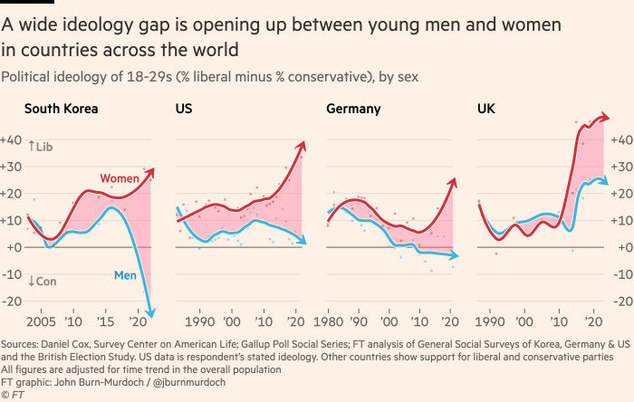
Or it can make old identities new targets of power. In the context of the Great Awokening, gender seems most relevant (although religion is important too, "Evangelical" sometimes gets used almost like a slur). In the US context, the Democratic party seems to have a "young male" problem, with voters under 20 being more likely to vote for Trump than those over 75, and Trump winning the male Latino vote. This goes along with the marked "gender gap" in political ideology that has been observed across developed countries. I cannot help but think that this is because broad aspects of male identity have been deemed "problematic" by some vocal social reformers. That is, presumably "toxic masculinity," is just about the toxic parts of masculinity, which certainly exist, but there are obviously very important disagreements about which aspects these are.
I am not very big on the whole "War on Boys" narrative, although it does seem to touch on some real issues. I'd prefer to frame it as more an issue of the "education of the chest," that C.S. Lewis speaks of in The Abolition of Man, i.e., the training of the passions and the "spirited part of the soul," thymos. The problems Lewis identified only seem to have gotten worse, and they obviously affect women as well. My point would be that men raised to be "men without chests," become desperate for some sort of thymotic influence. Thus, they end up being easy prey for precisely the sort of "toxic masculinity" reformers want to abolish. So it ends up being a sort of self-reinforcing cycle.
Edit: note the timing
-
The End of Woke
What's the objection here aside from him being a "moralist?" It seems like you could describe his basic thesis just as well in the amoral language of classical economics (which just assumes that everyone is always "selfish"). That is, that reforms that sprung from the movement tended to direct benefit upwards, and that much of the movement tended towards the performative; it didn't produce much of an effect from the perspective of economic, health, etc. metrics.
Besides, if you put tighter a list of the top 5% by wealth you will find very few true wokist in that group. The core of the movement is to be found within academia, a cohort which is significantly less prosperous than your typical Manhattan professional.
Sure, but he's quite clear about what he means here. It isn't just about wealth, but also about status, cultural influence, and political power. A plumber with a few assistants might earn more than the mayor of a decent-sized city or the head of an influential cultural institution, but they are hardly the same in status and power for instance.
you will find very few true wokist in that group
I don't think that's true (although I guess it depends on what a 'true' wokist is), particularly among their children (who are largely destined to stay in that income bracket). You would certainly find less than in academia though, that's fair. -
The End of Woke
Unfortunately, I don't think it's going away. I think it is merely having a sort of recession on the left, due to political defeats. However, I think it's metastasized on the right.
Ta-Nehisi Coates and others have claimed that Trumpism represents a sort of "identity politics for White Americans." I think this is partially accurate, but not really the full story (for one, it misses Trump's wider appeal). I think there is actually an even deeper affinity between "Woke," Trumpism and the "nu-right" than merely the utilization of identity politics. Nietzche is one strong common thread here. Obviously, the Trump coalition is quite broad, but it's newest, and arguably most defining camp is best represented by the idea of a "tech-broligarchy," i.e., by Elon Musk, Peter Theil, etc., or by thinkers like Curtis Yarvin, Nick Land, Costin Alamariu, etc. This is largely a "post-Christian" conservatism, although sometimes it adopts a highly aesthetic, almost re-paganized "traditional" Christianity as its mantel. In many ways, this new movement hasn't just borrowed the language, arguments, and strategies of the "post-modern" left, but has imbibed at least some of their philosophical ideas (obviously in transformed form).
John Millbank's Theology and Social Theory (and David Bentley Hart's 2003 extension in The Beauty of the Infinite) seems to be very prescient here. The main idea there was that the "ontologies of violence," and "metaphysics of power" developed through Nietzsche and his descendants has its logical termination, not in far-left politics, but in fascism and a sort of "neo-paganism." The "Dark Enlightenment" is a sort of concretization of this (I mean, Millbank appears to have been at least spot on in predicting at least this sort of ideology).
Re fascism, people have tried to smear Nietzche with his adoption by the Nazis, which is unfair, but sometimes it seems that this goes too far in the other direction, towards denying that anything other than a totally radical misreading could have intrigued Nazi-philes. I don't think it's an accident though that many of those who rescued Nietzsche from obscurity where, at least initially, as Kanye puts it: "Hitler fans." The logic of power is there to follow. -
The End of Woke
If you're interested in the topic, I thought Musa al-Gharbi's We Have Never Been Woke was a good treatment. His main thrust was that the "Great Awokening" following the Great Recession was the result of (relative) elites feeling the need to justify their own rapidly growing wealth and privilege in the face of declining standards of living for the rest of the country (also declining life expectancy). Social justice became a way to justify one's own position in society. It also became a means for those already positioned near the top, and who had been raised in a pressure cooker environment focused on accomplishment and securing one's own spot in the elite, to secure elite status, by positioning themselves as representatives or allies of victimized groups. However well-intentioned though, these movements often tended to slide into (largely unreflective) self-serving behavior. That is, the empirical case for the positive benefits of the "Great Awokening" for its supposed beneficiaries is weak.
His point was that the movement was, at least largely, genuine. So, the analysis is supposed to help with formulating a sort of better attempt to address these sorts of issues.
The Great Awokening largely focused on sex, race, and sexual orientation. The sort of inverse, the right-wing's own wokeness, has largely focused on ethnicity, regional culture (arguably a sort of ethnicity), religion, and to a lesser extent, class. I don't think this is any accident. It reminds me of a good quote I saw on this:
Notably, the [marginalized] groups that [liberal reformers] recognize are all defined by biology. In liberal theory, where our “nature” means our bodies, these are “natural” groups opposed to “artificial” bonds like communities of work and culture. This does not mean that liberalism values these “natural” groups. Quite the contrary: since liberal political society reflects the effort to overcome or master nature, liberalism argues that “merely natural” differences ought not to be held against us. We ought not to be held back by qualities we did not choose and that do not reflect our individual efforts and abilities.
[Reformers] recognize women, racial minorities, and the young only in order to free individuals from “suspect classifications.” Class and culture are different. People are part of ethnic communities or the working class because they chose not to pursue individual success and assimilation into the dominant, middle-class culture, or because they were unable to succeed. Liberal theory values individuals who go their own way, and by the same token, it esteems those who succeed in that quest more highly than individuals who do not. Ethnicity, [religion], and class, consequently, are marks of shame in liberal theory, and whatever discrimination people suffer is, in some sense, their “own fault.” We may feel compassion for the failures, but they have no just cause for equal representation.
Wilson Cary McWilliams - Politics
Or as James Stimson crystalized this sort of idea a few years ago:
"When we observe the behavior of those who live in distressed areas, we are observing not the effect of decline of the working class, we are observing a highly selected group of people who faced economic adversity and chose to stay at home and accept it when others sought and found opportunity elsewhere. . . . Those who are fearful, conservative, in the social sense, and lack ambition stay and accept decline.” -
Are We all Really Bad People deep down
Well, a wrinkle here is that weakness of will doesn't necessarily have anything to do with any sort of "moral" consideration, only practical judgements. Actually, pre-modern ethics makes much less of a distinction between the moral and the practical, the former just being part of the latter.
And it isn't the case that we always engage is such post-hoc rationalization. People will often say that what they are doing is bad (morally, or merely practically) as they are engaging in the act, or shortly after.
That's a difficulty here, sometimes we engage in post hoc rationalization, oftentimes we don't. But weakness of will is simply pointing to the phenomena of knowing/understanding "doing x would really be better," and instead doing y. There isn't any real moral valance to: "I should take the trash out now because I won't want to do it in the snow tomorrow morning, but I'm not going to because I feel tired." It's simply dissonance between the intellectual appetitive faculty (the will) and one of the concupiscible appetites (for rest).
So, I would say that Nietzsche is right about a certain sort of phenomenon. However, the rational appetite is still phenomenologically distinct from the sensible appetites, and this distinction shows up throughout the history of world literature. It is not the case that the "I" is nothing but warring drives, else people would not so often describe passions and appetites as something that happens to them. They wouldn't rationalize sometimes and not others. This doesn't make the passions and appetites external of course, it just points to there being different faculties (i.e., the nous is not a sort of Cartesian homunculus, but neither is it indistinct). -
The Christian narrative
I don't recall any verse from the Bible that proposes an alternative way to become Godly.
The key theological terms here are "theosis" (used more often in Eastern Christianity) and "diefication" (used more often in the Latin West). The idea is that man becomes "like onto God," and enters into union with the divine, a key theme of many mystics and of monastic and lay praxis.
In terms of verses used, there are lots, but important ones would be:
2 Peter 1:4, which speaks of becoming "partakers of the divine nature." Psalm 8 speaks of man as having been made "little less than a god," and Jesus' use of Psalm 82, "ye are gods," in the context he uses it, is also called on.
II Corinthians 3:18 is another: "But we all, with unveiled face, beholding as in a mirror the glory of the Lord, are being transformed into the same image from glory to glory, just as from the Lord, the Spirit."
Or I John 3:2 — "Beloved, we are God's children now, and what we will be has not yet been revealed. What we do know is this: when he is revealed, we will be like him, for we will see him as he is."
There is also Romans 8 and the idea that Christ is the "first born of many sons and daughters," or Saint Paul's claim that it is "Christ who lives in [him]."
Plus, there is the original vision in Genesis of man ruling over the cosmos, and Christ is often seen as a recapitulation of Adam, only without the turning away from God.
In the metaphysics of God as Goodness itself, the seeking after any perfection, any improvement in oneself, is ultimately still a seeking after God, however flawed and self-destructive. Eating, sensing, knowing, all involve union, and union with being is ultimately always union with the divine, the divine as known through creation, since all things are signs and exemplars of their causes, and God is the First Cause.
So, on these readings, Satan's promise to "become like God," is indeed the very goal of man as God's image bearer. As to why man was not "created perfect," a lot of ink has been spilled here. Building on Plato's psychology, it is often taken that being "like onto God," involves man's transcending his own finitude in search of what is really true and truly good, and not settling for current beliefs and desires. The Fall represents a turning away from the Good that lies beyond, to what lies at hand, created things. -
The Old Testament Evil
What are your thoughts on the other two examples I gave in the OP?
Well, in the case of the law, I think it's important to consider that there is a difference between what God wills and what God permits. I don't think the law is intended as a guide for ideal behavior. The law restrains existing practice. The section you cited is not a positive commandment. It would perhaps be more challenging to consider some of the positive commandments re punishments (some of which seems excessive), or even the practice of animal sacrifice.
Yet in considering the law it seems important to consider the entire historical purpose of the law within the context of God's relationship with man.
Since plenty seems objectionable to modern eyes there, I would think the overarching question would be: "if God was good, could God have given a tribal, near eastern group like the Hebrews this sort of law, or would a "good God" necessarily have to give them a more enlightened law?
I am not sure this question is all that different from: "if God is good, would God allow near eastern culture (really all cultures) to develop these sorts of practices?" Either way, God is allowing these practices. I am not sure if questions of guilt by commission (giving the law that doesn't go far enough) versus omission (contexts without a law) are that different when it comes to divine causality, or at least it isn't clear to me why it should make a difference in this case, when the law was going to be broken anyways. Basically: could a "good God," have given no law at all, but then if a "good God" does give a law, it must be an ideal one?
It seems relevant here that even the commands that were given, even in the context of signs and wonders, were immediately disobeyed. If God knew that even a "slow pitch" law that conformed to contemporary standards would be ignored or abused, what exactly would be the purpose of an even higher standard, which would likely be ignored to an even greater extent? But then the prophets begin to expand upon the law and its spirit. So, one could see it as more or a process. Our culture tends to be quite individualistic, but I think this makes more sense if one thinks of God as working with Israel over centuries, and man across history. -
Are We all Really Bad People deep down
Indeed, this is one of the most common themes in philosophy, a Platonic theme that was taken up by Christianity: the fight against the passions
Well, that's Nietzsche's account. I think that, whatever his other merits, he is not a particularly accurate (or charitable) student of Plato, and especially not of the Christian Platonist tradition. This sounds to me more like the "buffered self" of the neostoicism of the German Protestant pietism that Nietzsche grew up with. The passions are morally neutral in the Christian Platonist tradition, and essential to the beatific vision. Their proper and harmonious orientation is what matters.
Not that Nietzsche is entirely wrong. The Phaedo could be read in this light. I think it's harder to make this case in light of the whole corpus though, and much harder for the Christian tradition generally, granted that some influential texts do seem to advocate for a sort of war against the body and passions. This is more a predilection of the late-antique Pagans though, particularly an ambivalence towards or neglect of embodiment (we're talking about a tradition that birthed a cult of bodily relics afterall, whose key focus is the resurrection of the body and the embodiment of God).
It would make just as much sense to say, “Occasionally I feel this strange impulse to stop smoking, but happily I've manage to combat that drive and pick up a cigarette whenever I want.”
Would it make just as much sense? People don't generally talk this way at least, right? And my exposure to the Eastern tradition makes me think that this is in not a distinctly Western, Platonist influenced tendency. The distinction between Ātman and Prakṛti for instance.
It would be sort of bizarre for someone to say: "I was tempted on my work trip, and unfortunately my sex drive was not strong enough to make me cheat on my spouse." To me at least, being hungry seems quite phenomenologically distinct as compared to intellectually willing something. There is also a passive element to some appetites; people often talk about the passions as something that happens to them, and I can think of examples of this from literature that spans a lot of different cultures and epochs.
Instinctively, Nietzsche says, we tend to take our predominant drive and for the moment turn it into the whole of our ego, placing all our weaker drives perspectivally farther away, as if those other drives weren't me but rather something else, something other inside me, a kind of “it” (hence Freud's idea of the “id,” the “it”—which he also derived from Nietzsche).
I am not sure about this part either. It seems fully possible to experience weakness of will and not to identify with the dominant desire in this manner. This gets back to the idea of the passions in some sense happening to us. I would hardly claim that literature has always described things thus, but it seems like it often has, perhaps even usually. Furor descends on Aeneas, a great rage "comes upon" the Trojan women when they decide to burn their own ships. Homer's Greeks are the same way.
Of course, Nietzsche also appeals to the Greeks on this point. I guess I'm just not sure if it might suggest a different take. Certainly other ancient lit does, e.g. Genesis 4:7 — "sin is crouching at the door. Its desire is for you, but you must rule over it," makes a pretty clear distinction (the passion in this case being wrath, the murder of Abel)—or maybe this merely explains why the Jewish tradition and Plato got on so well together. -
Are We all Really Bad People deep down
I don't think Nietzsche is really in conflict with the Platonists on this particular point. They certainly allow that different appetites can be more powerful than the rational appetites.
A key distinction here is that the desire for knowledge/truth (intellect) is not the only rational appetite. The will has the desire for goodness as its formal object. So—and there are difficulties in mixing psychologies of course—I don't think Nietzsche would necessarily deny the desirability of the rule of the will in this respect. For the will not to rule is necessarily for a person to be conflicted about their actions. There is weakness of will whenever someone does one thing, but experiences the understanding that another course of action was truly better, and desires to have done that instead. Obviously, not many thinkers are "pro-regret."
It would be a mistake to think that the will is always in conflict or competition with the lower appetites. It often isn't. For example, we can be hungry, and also understand that it is good for us to eat. The goal, on the Platonist account, is precisely for the appetites not to be in conflict. The higher part reaches down and shapes the lower parts through training and habituation in the virtues. The idea here is that this actually allows the lower appetites to be most satisfied as well, because the person functions more as a complete, self-determining whole, less as a collection of warring parts, and so is actually able to succeed at meeting the other desires. The "tyrannical man," by contrast, is prone to confusing "wants" and "needs" and thus making himself miserable. The image in the Phaedrus is a contrast between a chariot with two well-trained horses (the appetites and passions) and one where the horses pull in different directions and the chariot careens around aimlessly, going where neither horse wants to go. (The point, pace some of Nietzsche's portrayals of Plato and Socrates, is not to kill the two horses though lol, but actually to make them better off.)
Where disagreement seems more relevant is in the existence of the will's formal object, that there is a good to know and desire. Another difference is in the subject, although the Platonist tradition is less far away from Nietzsche then it might first seem here, because it's actually in agreement about the competition of the appetites and lack of a stable subject. It's just that this is the state of the soul when it is sick, the "civil war in the soul." So the difference is really more about the capacity to overcome this (and the desirability of doing so).
When you want something there's no way to "summon a will" which makes you "not-want" -- you'll want it all the same.
That's not normally the idea though. It isn't that one simply chooses to not want something, at least not normally. It's primarily a description of the phenomenological experience of conflicted desire and an explanation of why people "do what they know is wrong/what they actively regret." The continent person doesn't suffer from weakness of will (on Aristotle's typology), and yet they still desire vice. By contrast, the incontinent person knows vice is wrong, but does it anyway, and the person in a state of vice acts poorly and prefers doing so.
Certainly, there is the idea that a person can change their desires, or that they can be changed by training, education, etc. That is, desire is not a black box, but can be shaped intentionally. This is Harry Frankfurt's idea of a second order volition, an effective desire to have or not have another desire (something he sees as crucial to freedom and personhood). But this is normally framed in terms of habituation and long-term changes, which is certainly the case for something like smoking. -
Are We all Really Bad People deep down
Do you mean to say that whenever any of us encounter a conflict of appetites, weakness of will arises of necessity?
No, weakness of will is when one of the lower appetites, the concupiscible (related to pleasure/pain) or irascible (related to hope/fear), overrules the rational appetite for what is understood as good (the will). I'm not super committed to that exact typology, but it seems to describe a common enough phenomenon. That is, bodily or emotional appetites overwhelming our "better judgement," i.e. our understanding of what would be truly best.
When the will overrules the lower appetites, that is the opposite of weakness of will, i.e., the proper ordering. -
The Christian narrative
So, becoming Godly is the final goal, and it is all right, too. Adam and Eve just wanted to look Godly. What is wrong with that?
Precisely; this gets highlighted a lot in theology or in "the Bible as literature." Adam and Eve have the right goal, "becoming like onto God," but have approached it in the wrong way. It's an attempt to be like God by turning away from God, which is not how one becomes like God. God alone is subsistent being, "in whom we live and move and have our being," (Acts 17:28), so this is also in a sense a turn towards nothingness/mere potentiality, and away from the full actualization of the human being.
And there is the problem of evil too, for a perfect good God who can only create a good creation. To my understanding God of the Old Testament is closer to being true since He accepted to be the source of good and evil.
Well, from the orthodox Christian perspective, they are the same God (Isaiah 45:7 is read in various ways here, often as the text speaking about creating "evil" from the perspective of the wicked, i.e., the wicked see just punishment as "evil"). Most, but certainly not all Christian theology follows a privation theory of evil. Evil has no positive essence. Evil is merely the absence of good. Sickness is just the absence of health, evil an absence of properly actualized virtue/perfection. There is a gradation of goodness in creation, but creation itself is an ordered whole. Hence, God does not create evil. However, since creation is free, it is also capable of turning away from God, the "Fall," and this is how evil, as a privation, emerges. This includes the fall of man, but also the rebellious archons and principalities, Satan as the "prince of this world," and the idea that the entire cosmos has been subjected to decay and futility.
I am not as well versed in the Jewish tradition, but I know the privation theory of evil was popular with at least some Jewish (as well as Islamic) thinkers (Philo, Maimonides, Gaon). This isn't the only view though. -
Are We all Really Bad People deep down
I'm not sure if I understand the question, but I'll try my best. Weakness of will is when we do something, despite having a strong desire not to do that thing, because we understand it to be a bad course of action. For instance, someone might want to quit smoking, go on a diet, stop consuming pornography, etc., and think that this path is best and what is best for them, and perhaps even pray or meditate on how much they want to not do those things, and nonetheless do them.
Classically, the will is part of the rational soul. It's the appetitive faculty vis-á-vis goodness. So the will targets what is understood as truly best (as opposed to the other appetites, which have particular formal objects, e.g., food, sex, etc.). It's called "weakness of will," because what is understood to be best is not what is acted upon.
By contrast, when someone fails to cheat on his wife, or succeeds in quitting smoking, we don't tend to speak of a "weakness of appetite." In those cases, they might still possess the appetite (e.g. sex, nicotine, etc.), yet it is the appetite of the will that is followed, through the will (which is also the volitional faculty involved in choice).
So weakness of will involves current knowledge, what is understood to be best. If we make poor choices out of ignorance about what is truly best, that would simply be a case of ignorance. Weakness of will is a conflict between different appetites. It's untinelligible in that it doesn't correspond to the intellect. The action is not in accord with what is understood, but is instead contrary to it.
Maybe that answered the question? -
The Christian narrative
I don’t blame people for not getting it
Right, many versions of Christianity start from a quite different metaphysics, which is difficult to acclimatize to. I used to think the athiest preference for univocal divine command theories and fidesm was because these are most morally counterintuitive (as admitted by some of their own authors, e.g. Luther's letters to Erasmus), and thus represent good targets. However, I also think that they are easier to understand, in that they tend towards a metaphysics that is quite similar to popular forms of secular physicalism and nominalism, since they evolved out of the same tradition.
Why should humans love God?
There are many different responses here, but in general, Christianity embraces realism re morality and value. If God is truly best, it would seem that we ought to love what is better and more worthy, as opposed to what is worse and less worthy.
But the answer actually varies quite a bit between different theologies. Milton's Satan can be read as such a sympathetic character because, on some views, whatever is good is simply good because it is what God wills. Satan, by asserting his own will, is in a sense "being more like God." Goodness is obedience. God's goodness then, seems arbitrary (although few would say it is arbitrary ) and it is at least inscrutable. In which case, why love what God loves?
There are theologians who have embraced the extreme position that if God told us to eat our own children, it would be good, or if God told us we ought to hate Him, it would thus be good to hate God. In such contexts, agreeing with God is still always "in one's best interest," in a sense, since God can bestow both unimaginable rewards and unfathomable, infinite punishments, which in turn makes orienting oneself to God consequentially "desirable." But, the thinkers who go this far also often tend towards denying free will, so you don't really have a choice in loving God anyhow. It's something God has to do to (or with) you.
Personally, I find this view deeply troubling. It strikes me as a sort of maximalist elevation of power—divine freedom and goodness as a sort of sheer power. Even humanity's freedom becomes problematic, as a challenge to divine freedom (whereas the ability to communicate real freedom might itself be seen as a manifestation of divine power/goodness). It also isn't that common though, at least in its most extreme forms.
In other accounts, God is "Goodness itself." Everything, to the extent that it is anything at all, reflects God through an analogous likeness. Thus, when one loves anything, one loves God. Anything that is good, or even merely appears to be good, is such through its participation in the divine goodness. So, one always loves God in a sense. Any intentionality must be directed somewhere, and there is nothing "outside of God." The issue is rather that we can love God better or worse, more or less fully. And to know and love God more fully is necessarily also to be more like God (to be perfected) which is what is most desirable and fulfilling, by the very nature of rational creatures.
On either account, loving God can be said to be both good, and the most fulfilling path to happiness, although obviously they diverge quite a bit in some other aspects.
As an aside, a criticism of the latter view, which is what resulted in the development of first one, is that this makes God less then wholly omnipotent, because God is constrained by what is good. I think this is a misunderstanding, but it's a hotly contested issue. -
Are We all Really Bad People deep down
On some older views that have fallen out of fashion, what defines a state of "virtue" is that the virtuous person both tends to do what is right, and enjoys doing what is right. On this view, enjoying evil would, in some sense, denote a lack of perfected virtue.
I'd hesitate to say this makes people "bad" though, since this conception is most at home in a metaphysics that assumes that everything, (and particularly every living thing, and among them particularly man) is good, in that they are revelations of infinite being itself (or God in the Islamic and Christian traditions). Rather, it means that everyone is good to some degree, but they can be more or less perfected in this goodness, more or less fully actualized. So, the saint or sage, who prefers only the good, has in a sense more fully actualized their humanity. They are more self-determining and more free because they know their own acts and desires as good, and prefer them as such, whereas the person who doesn't know what is truly better is constrained by ignorance, and the person who does what they know to be evil is divided against themselves.
Does that make them a bad person? If so, doesn’t that mean we’re all bad people deep down?
I think every intentional act, to be properly intentional, aims at some good. In terms of theft, some good is being aimed at. It isn't wrong to seek such goods. It is wrong to prioritize lesser goods over greater ones though. And the idea would be that prioritizing wealth over virtue is a sort of misprioritization that stems from ignorance or weakness of will (both of which are limits on a perfected freedom). I guess there is a notion of harmony here too. Evil is a sort of unintelligibly in action, it is to be out of step with nature (nature as perfected) or to "miss the mark."
Since no one is omniscient or perfectly virtuous, all people would seem to be susceptible to the ignorance or weakness of will, but some moreso than others. I suppose that, wanting nothing, such that one does not want to commit any "perfect crimes," is itself it's own sort of freedom too. -
Why are 90% of farmers very right wing?
That's a good point, although today, the working class of rural areas, (the closest analog to the peasantry in the electorate?) is also very right wing, whereas they were a favored group vis-á-vis mobilization for many socialists.
I always assumed the original resistance of independent farmers to socialism was that land reform rarely distinguished between large landlords and smaller farms (and that forced collectivization was a disaster, plus the whole kulak designation, or similar schemes in China—both later developments, but foreshadowed early on by some policies). Had land reform been handled better, it might not have shaken out that way. Socialists did have some success in agrarian areas in Russia or the US for instance. That's one of Frank's (mentioned by ) points; leftward agrarian populism was at times quite successful.
I'd say it's partly a positive feedback loop, which Frank recognizes, but is spelled out better by some others (e.g., Deneen's Why Liberalism Failed). Essentially, the social/economic policies of classical liberalism end up eroding the culture, norms, and institutions that conservative liberals want to conserve. It's a self-undermining platform. The situation re one set of goals becomes increasingly dire, even as success is had in the other dimension. Contrast the extreme success of neo-liberal economic policies, versus the lack of any such success in the cultural arena for instance.
It's interesting that a "socially liberal but economically conservative," bloc has thrived within the GOP (the "nu-right"), but there is no parallel "socially conservative but economically liberal," camp in the Democratic Party. -
The Christian narrative
Anyway, we're pretty far from a "forum" of trust and charity at this point. I invite you to step back into that domain.
The forum where you opened with the insult "someone must have had their brain cut out to be Christian?"
If you cannot see why your post is pretty much a parallel of:
Most athiests believe nothing is good or bad. Athiest science teaches that molesting children is fine and just as good as giving them medical care! (false claim, tangentially related to real claims, re anti-realism vis-á-vis values, that are being caricatured). How are these people so dumb? Their brains must have been cut out. Do most athiests not realize that athiesm implies this? Do they just ignore the teachings of their science?"
I cannot help you. I tried, without the insults, to correct you on the factual claim, which you have refused to acknowledge. For someone honestly "interested in what Christians believe," you sure don't seem particularly interested in what Christians have to say about your description of their beliefs. -
The Christian narrative
A conceptual explanation just is a psychological explanation if it is assumed that a philosopher thinks a certain way on account of the time and cultural milieu they find themselves in and not on account of their own analyses
Hume takes the categories and assumptions of his milieu as a starting point, so this seems totally fair in his case. He does provide a robust analysis, given certain premises. His premises come from his historical context. -
The Christian narrative
Thank you for reminding me why this is such a dangerous technology in the hands of people who don't understand it (particularly GPT, with its default sycophantic tilt).
Ask it, or Grok, or Gemini, "is this (Frank's post), an accurate presentation of Catholic theology?" That's the point. If you ask GPT to explain why anything is deep, it will come up with something. The point isn't that there isn't tension in atonement theology, but rather than Frank has merely offered a factually incorrect statement paired with "Christians are so dumb they must have had their brains removed. Why don't they know the truth of my factually incorrect assertion," and then you have tried to defend this bigotry as "deep criticism."
You can't just post things as your own assertion. AI is designed to tell users what they want to hear and comes packaged with strong confirmation bias. GPT in particular will praise almost anything you assert as your own as "deep" and "profound" (including plans like selling your own excrement online). This is not how you should use AI, and precisely why it leads people to psychosis and is dangerous.
So, following common advice, open a totally new conversation, and just paste it in quotes with the question "is this accurate?"(i.e., indicate that that you want feedback, and not for it to enter it's default sycophant mode).
If I wrote:
"Most athiests believe nothing is good or bad. Athiest science teaches that molesting children is fine and just as good as giving them medical care! (false claim, tangentially related to real claims, re anti-realism vis-á-vis values, that are being caricatured). How are these people so dumb? Their brains must have been cut out. Do most athiests not realize that athiesm implies this? Do they just ignore the teachings of their science?"
This would be about on par with Frank's post. Would it be a "deep criticism" because it (barely) touches on real issues related to anti-realism? -
The Christian narrative
You are always giving psychological explanations, which amount to just-so stories, in order to try to debunk what you don't agree with.
It's not a psychological explanation. The rise of volanturism and nominalism and attacks on final causality were explicitly based on the idea that natures (and thus the final causes related to them) put God in a sort of metaphysical straitjacket. The reformers also took issue with prevailing notions of human virtue. Hume's finding is the natural consequence of the removal of final causality from ethics and the grounding of goodness in the appetites to the exclusion of the intellect. That's not a psychological influence, it's a direct conceptual influence. Hume is just charting one of the consequences of the the tradition he is a part of.
As Harrison's The Fall of Man and the Foundations of Science documents, these shifts were also quite important for the development of empiricism. Theology is all over philosophy and the social sciences into the 19th century. Obviously, this left a legacy.
This is ridiculous. By all means, please explain to me the deep "criticism" I am missing in:
The Catholic Church teaches that God Almighty came down from heaven to save us... from His own wrath... by allowing Himself to be tortured to death. And apparently this strategy worked in spite of the fact that he didn't actually die(people saw him walking around three days later), and most people didn't get saved.
How does a person [moderator redacted] make sense of this? Could it be that most Christians throughout history didn't know this is the Christian narrative? Or did they know, but just held it at arm's length? Are myths always this way? Or is Christianity a special case?
It looks to me like a false claim (the bolded) paired with insults, and confusion about why "Christians" (apparently all Christians now) don't know that this terse (arguably caricatured) rendition of penal substitution atonement theory is "the Christian narrative?"
What's this deep criticism it will be hard to articulate?
Feel free to also explain why even that particular brand of theology would be ridiculous if God existed. Presumably, if this is a particularly egregious narrative, it cannot be just because it posits the existence of a God/Gods, otherwise the Christian narrative would be nothing special in terms of world religions. So why would it be ridiculous for God to act in the way described?
I have my own reasons for thinking it's deeply flawed. However, I think it will actually prove quite difficult for many ethical systems to explain why an all powerful being ought to act or be one way and not any another (in part because some of these are intellectual descendents of this same theology). -
The Christian narrative
I can articulate it just fine, it's just based on a claim that is at best (and this is probably being too charitable), very misleading. Feel free to fire:
The Catholic Church teaches that God Almighty came down from heaven to save us... from His own wrath... by allowing Himself to be tortured to death.
...into ChatGPT, Gemini, Grok, etc. and they will confirm this just as well as every Christian in this thread. Or you can look at some of the many Catholic responses to the idea that the atonement is primarily about wrath.
For example:
Protestants will often ask, however, if Catholics do not hold that God the Father poured out the wrath we deserve onto Jesus, then how is God’s wrath satisfied? They will also point to numerous texts in the New Testament referring to God’s wrath, such as John 3:36; Romans 1:18 and 12:19; and Ephesians 5:6. But the key to understanding is in properly interpreting what Scripture is teaching us.
Anger (wrath) is a passion within human beings. God, however, is immutable and impassible. He does not have feelings as we know them. Nor does He experience passions. God also does not have a temper. And our sins do not provoke revenge in God. God is infinitely perfect, merciful, loving and just in all he does, so we must see what we call His anger in light of this truth...
Even though God does not experience the passion of anger, we say that we experience the consequences of sin as expressions of His “wrath.” But this must be understood metaphorically. When we sin, we rebel against God and turn away from him. God allows us to endure the consequences in this life and in the next. Those consequences include disorder, disharmony, pain, suffering and physical death. But these consequences/punishments are not the result of God actively willing torments. Rather, because of His love for us, God has given us a free will to make choices. If we choose to separate ourselves from Him who is Goodness itself and Love itself, then the inevitable outcome will be that we deprive ourselves of His goodness and love.
Another way of understanding “God’s wrath” is to recognize that our disobedience and rebellion do not causes any change in God by nature of who He is. Rather, we are changed by sin. If we reject God’s love and rebel, our hearts are hardened. Lacking God’s love, one will be tormented by the thought of God’s judgment and, as a result, will experience “God’s wrath.” But in both scenarios, what has changed is not God but us.
https://catholicstand.com/the-problems-with-reformed-theologys-penal-substitution-teaching/
Or consider the article from Catholic.com entitled "How NOT to Understand the Cross."
When we talk about “celebrating” Good Friday, or call it “good,” what are we celebrating, exactly? Many Protestants believe the Cross works via a process called “penal substitution.” There are different forms of that theory, but one popular version goes something like this: God is wrathful about our sin, and He needs to vent that wrath on someone. According to the theory’s defenders, if God doesn’t pour out His wrath on someone, then He’d be unjust. Since somebody must get punished, Jesus steps in to be punished in our place. But there are a lot of problems with this theory.
https://www.catholic.com/magazine/blog/how-not-to-understand-the-cross
It says of this formulation:
This isn’t just an affront to the Christian concept of “goodness” or justice,” it’s also theologically incoherent. In talking about pouring “divine wrath” upon the Son, or God being unable to even look at Jesus as he stood as “sin-bearer,” you inevitably end up pitting the First Person of the Trinity against the Second Person of the Trinity, and/or pitting Jesus’ divinity against his humanity. This is bad Trinitarian theology and bad Christology. It ends with folks like MacArthur presenting the Cross as some kind of “breach” in the eternal (and unbreakable) Trinitarian communion:
Orthodox theology is even further from this idea. It tends to focus on the healing of humanity and the conquest of death and sin, hence the Paschal refrain: "Christ is risen from the dead, trampling down death by death, and on those in the tombs bestowing life!" which is repeated throughout the Paschal service and in the Horologian between Pascha and Pentecost, says nothing about wrath, only victory. Indeed, since there is always diversity of views in theology, it might make most sense to look at the liturgy, or the sermon preached in every Church on its holiest holiday, as it commemorates Christ's death and resurrection:
The Catechetical Sermon of St. John Chrysostom is read during Matins of Pascha.
If any man be devout and love God, let him enjoy this fair and radiant triumphal feast. If any man be a wise servant, let him rejoicing enter into the joy of his Lord. If any have labored long in fasting, let him now receive his recompense. If any have wrought from the first hour, let him today receive his just reward. If any have come at the third hour, let him with thankfulness keep the feast. If any have arrived at the sixth hour, let him have no misgivings; because he shall in nowise be deprived thereof. If any have delayed until the ninth hour, let him draw near, fearing nothing. If any have tarried even until the eleventh hour, let him, also, be not alarmed at his tardiness; for the Lord, who is jealous of his honor, will accept the last even as the first; He gives rest unto him who comes at the eleventh hour, even as unto him who has wrought from the first hour.
And He shows mercy upon the last, and cares for the first; and to the one He gives, and upon the other He bestows gifts. And He both accepts the deeds, and welcomes the intention, and honors the acts and praises the offering. Wherefore, enter you all into the joy of your Lord; and receive your reward, both the first, and likewise the second. You rich and poor together, hold high festival. You sober and you heedless, honor the day. Rejoice today, both you who have fasted and you who have disregarded the fast. The table is full-laden; feast ye all sumptuously. The calf is fatted; let no one go hungry away.
Enjoy ye all the feast of faith: Receive ye all the riches of loving-kindness. let no one bewail his poverty, for the universal kingdom has been revealed. Let no one weep for his iniquities, for pardon has shown forth from the grave. Let no one fear death, for the Savior’s death has set us free. He that was held prisoner of it has annihilated it. By descending into Hell, He made Hell captive. He embittered it when it tasted of His flesh. And Isaiah, foretelling this, did cry: Hell, said he, was embittered, when it encountered Thee in the lower regions. It was embittered, for it was abolished. It was embittered, for it was mocked. It was embittered, for it was slain. It was embittered, for it was overthrown. It was embittered, for it was fettered in chains. It took a body, and met God face to face. It took earth, and encountered Heaven. It took that which was seen, and fell upon the unseen.
O Death, where is your sting? O Hell, where is your victory? Christ is risen, and you are overthrown. Christ is risen, and the demons are fallen. Christ is risen, and the angels rejoice. Christ is risen, and life reigns. Christ is risen, and not one dead remains in the grave. For Christ, being risen from the dead, is become the first fruits of those who have fallen asleep. To Him be glory and dominion unto ages of ages. Amen.
Is the Reformed view bad theology? I think so. But it also seems to me to be in many ways most in line with some of the core precepts that have come to dominate modern secular culture (which is maybe why it is the easiest for athiests to understand). There is a deep historical influence there. That Hume's Guillotine would be formulated first by someone who grew up in the context of the Reformed tradition is not surprising for instance. -
The Christian narrative
You're equivocating here between your initial formulation, which sounds like straight penal substitution theology, and the idea of propitiation. Something like:
“God became man and freely offered Himself to save us from sin and eternal separation from Him.”
“God, in His love and justice, sent His Son to conquer sin and death by His Passion.”
“Through His suffering and death, Christ made satisfaction for our sins and reconciled us to the Father.”
...would be sound. -
The Christian narrative
↪Count Timothy von Icarus All of which just takes the Thomistic metaphysic as granted.
It takes the difference between real and conceptual distinctions for granted, or at least, tries to understand them properly in context. I don't see how that's an absurd distinction though.
An absurdity can seem internally consistent. — Banno
But wasn't your original argument that Thomism was internally self-undermining?
Thomism relies on divine simplicity. It understands god as pure and as simple. So mercy and justice are for god the very same. This is how Thomism responds to the Euthyphro; the good and god's will are the very same.
But if we cannot make meaningful distinctions between such notions as justice and mercy, then we cannot use them to explain the nature of god.
Weirdly,Thomism undermines itself, showing that theology is impossible.
If course, Thomism has responses to these criticisms. But equally, more theology simply serves to undermine theology further. — Banno
But again, this only seems like a valid criticism if "meaningful" distinctions must be real, instead of conceptual. -
The Christian narrative
You can't resolve the conundrum that God is supposed to have sacrificed himself, to himself, to save us from himself, without denying the Trinity.
This is not how I would put it, although it's better than your OP. While we can speak of God's "wrath" analogously, the Fathers are pretty much unanimous on the idea that God is immutable and, crucially, impassible.
For example:
You will find many more similar examples of God bearing the ways of man. If you hear of God's anger and his fury, do not think of fury and anger as emotions experienced by God. Accommodations of the use of language like that are designed for the correction and improvement of the little child. We too put on a severe face for children not because that is our true feeling but because we are accommodating ourselves to their level. If we let our kindly feelings towards the child show in our face and allow our affection for it to be clearly seen, if we don't distort our real selves and make some sort of change for the purpose of its correction, we spoil the child and make it worse. So God is said to be wrathful [“furious”] and declares that he is angry in order that you may be corrected and improved. But God is not really wrathful or angry. Yet you will experience the effects of wrath and anger, through finding yourself in trouble that can scarcely be borne on account of your wickedness, when you are being disciplined by the so-called wrath of God.
Origen - Homilies on Jeremiah 18, 6 (Jeremiah 18:7-10)
Or:
The wrath and rage of the Lord God, however, should not be understood as a disturbance of the mind, but as a force by which he takes vengeance most righteously, with all creation subjected to him to serve him. Indeed, we must examine and hold fast to what Solomon has written: But you, O Lord of power, judge with calmness, and you set us in order with great awe. The wrath of God, therefore, is a motion that comes about in a soul which knows the law of God when it sees the same law to be disregarded by a sinner; for through this motion of just souls many transgressions are avenged–although the wrath of God can also be rightly understood as the very darkening of the mind that overtakes those who transgress the law of God.
Saint Augustine - Commentary on Psalm 2
You can see something quite similar in how the Patristics address God's "repentance," for example.
But as a I pointed out earlier, even setting aside "wrath," to say the primary goal is: "to save us from himself," makes it seem like the problem of sin is entirely extrinsic. That is, it suggests that the entire problem with sin is that it has made God mad, not that it is inherently bad and bad for man. This would imply that if God simply chose not to "have a cow" over sin, there would be no issue at all. Thus, the Christian narrative would be all about how this extrinsic evil is removed from humanity, or at least some of humanity.
Yet this is not how Christians have traditionally understood sin (i.e., in the traditional Orthodox and Catholic Churches). I will allow that there are some forms of Protestant theology that hew a bit closer to this (although I imagine they might have qualms with this description as well). There are also many forms of Protestant theology that don't.
I think we all can agree that it is intellectually vicious to straw man positions when creating an OP; especially when it is written in a condescending way.
Probably not. Bigots almost always think their bigotry is rationally and morally justified, and that engaging in bigotry is a moral act. They also tend to be extremely confident in their understanding of the groups they are bigoted against. No one understands women more than the misogynists of the "Manosphere", no on understands African American culture better than White Nationalists, no one understands Islam better than folks like Tommy Robinson, and no one understands two millennia of Christian thought better than internet atheists. -
The Christian narrative
But if we cannot make meaningful distinctions between such notions as justice and mercy, then we cannot use them to explain the nature of god.
We can though, at least for St. Thomas, since they're valid conceptual distinctions. For comparison, consider that goodness and truth (and all the other transcendentals) are also merely conceptual distinctions within St. Thomas's thought as well. That is, they don't add anything to Being, which is maximally general. Rather they consider it under some particular aspect (e.g. as relates to desirability/appetite under Goodness). But if, as you say, a distinction being merely conceptual renders it meaningless, then there should also be no meaningful difference between truth, goodness, and existence. Yet there clearly seems to be a meaningful difference between these within Thomistic accounts.
Likewise, the difference between a cup that is half full and half empty is conceptual, but not meaningless. -
The Christian narrative
Yes, I suppose that's a possible response, although I Peter 4 suggests that Christ suffered. -
The Christian narrative
Sure, but that doesn't imply that Pilate isn't blameworthy, or that Pilate lacked freedom in any special sense when he chose to crucify Christ (i.e., he did not lack freedom any more or any less than when he had anyone else crucified, or at least, there doesn't seem to be any indication of this).
There might be a stronger case to be made in the other direction with Judas. Consider John 6:64:
"Yet there are some of you who do not believe.” For Jesus had known from the beginning which of them did not believe and who would betray him. "
And 70-71:
"Then Jesus replied, “Have I not chosen you, the Twelve? Yet one of you is a devil!” 71 (He meant Judas, the son of Simon Iscariot, who, though one of the Twelve, was later to betray him.)"
But this is really just the same old question of if divine foreknowledge precludes freewill, which has generally (but not always) been answered in the negative (e.g. Saint Augustine, Boethius, etc.)
Yet there are also to consider the mentions of Satan "entering" Judas at John 13:27 and Luke 22:3. In general, demoniacs are not represented as blameworthy in the NT, so this could be read as absolving Judas. Historically, it hasn't though, the idea being that Judas has already conspired to betray Christ at this point, with Satan's appearance merely signaling the point of no return. Also, in Matthew 27:3–5 he repents of having betrayed Jesus and tries to return the money he was paid, claiming he has "sinned," before deciding to hang himself. -
On Purpose
I'm only saying I think it likely that, until these knotty questions are posed, it remains something like "intuitively true" for most Westerners that the sunny Popular-Mechanics view of science is just fine, and deeply reflective of how the world actually operates.
Yes, that's a fair point. Although I think this is precisely because the sunny Popular-Mechanics style realism doesn't fully eliminate teleology or teleonomy; it just sort of lets the issue float out there, unresolved. So, if we're discussing Newtonian physics, likely the rules will be "no teleology allowed." If the article is on the social sciences, then of course there is teleology! If it's biology, it sort of varies (probably not in molecular biology, and probably "yes" in zoology).
I think this is actually a good thing! This sort of view has not allowed what was often originally intended as a merely methodological bracketing exercise to become absolutized into a full blown metaphysics. Maybe it has done this at the cost of inconsistency, or at least ambiguity, but these strike me as the lesser of two evils. -
The Christian narrative
Now, please tell me, who is responsible for the existence of sin, creatures or God!?
Creatures, on pretty much all mainstream accounts of the Fall.
Either he was not a just person, which brings the ignorance within again
Does it? What's the assumption here, something like:
P1. If anyone does evil, it is always because they are ignorant.
P2. If anyone is ignorant, it is always God who has made them ignorant.
C: Therefore, Christ actually killed himself when he was executed.
Would that be it?
Anyhow, it seems to me that negligence is a thing, as well as willful ignorance. There are also cases where people simply do what they know is wrong. Pilate would be an example of the latter. He knew that crucifying an innocent man was wrong, and he did it anyway. That such an act is wrong is not only consistent with the culture that produced the NT, but within the context of the Latin culture that Pilate came from as well (e.g., it would be a blameworthy act in the context of the Aeneid, which is from the same epoch).
Saying that Pilate was somehow forced to crucify an innocent man because, had he known it was God and that he'd be punished, he wouldn't have done it, seems to me a bit like saying a serial killer was forced to kill some child, because, had they known the child was important, and that they would have been caught for the murder due to the resources deployed to catch the offender, they wouldn't have committed it, or that someone who cheats on their spouse is somehow "unfree" in choosing to cheat if they are ignorant of the fact that they will be caught cheating. Certainly, these are cases where a person knows enough to be culpable. And more to the point, they aren't being coerced into what they know to be immoral acts, they are choosing immoral acts as an expedient means of achieving ends they desire. -
The Christian narrative
...not the result of men practicing their free will, but their ignorance! So, God put Himself in the hands of ignorant people to achieve a part of His Divine Plan. Apparently, people could not be held responsible for their actions since they were ignorant. Of course, they wouldn't harm Jesus if they were convinced that Jesus is God! So, who could be held responsible for this situation if not God?
First, I agree, I think it's fair to point out that ignorance reduces culpability. However, isn't it fair to say that both ignorance and culpability exist on a sliding scale? Those who chose to have Jesus killed were aware of the signs and wonders. Indeed, he preforms one as he is being taken into custody.
It's clear in the text that at best, Pilate is at least aware he is about to beat and execute an innocent man. He tries to avoid this, but only to the degree that it won't inconvenience him or cost him anything. His conversation with Christ is full of rhetorical dodges, and he ultimately agrees to kill an innocent man (one who he had reason to think might be more) because it's the path of least resistance. As Jesus says, had the signs and wonders he preformed been given so Sodom and Gomorrah, they would have repented, just as the Ninevehites repented at the coming of Jonah. Consider also the number of signs and wonders Judas had seen.
So it seems fair to say that the people involved are not without any culpability. More to the point, they are not being coerced into their acts, and they have plenty of reason to think their acts are wrong even if Jesus isn't God. The relevant actions seem about as free as any human acts are. The men making them are not slaves, but men of power and status, acting to protect that power and status (and arguably, a corrupted self-serving vision of what God wants). I think it is fair to say that Jesus' ministry is not such that it "forced them to kill him," or even "tricked" or "coerced," them into doing so.
Jesus could prevent such a disastrous fate!
Sure, Jesus says as much. He could call down angels to destroy the Romans and Jews, or he could have simply cut the deal Satan wanted to make with him out in the desert and pursued temporal power and made himself emperor of Rome, and then the world instead.
The Grand Inquisitor in Dostoevsky's The Brothers Karamazov (you can find it separate) is one of my favorite looks at Christ's decision not to rule as a sort of benevolent dictator and instead to suffer and die as a servant.
As an aside here, very early in the Inferno, Dante is led through the vestibule of Hell, where those angels and men who decided not to pick a side in life are forced to reside. Hell will not have them, for failing to enter into rebellion, and Heaven will not have them either, for failing to be loyal to the Good. Dante mentions seeing the one who "made the great refusal," which might be a few people, but I think it's most fitting if it's Pilate. At the outset then, we see Pilate, who allowed man to kill God out of indifference and self-interest, and at the very bottom we see Judas, who actively worked to betray Christ. I think this geography gets at the issue of culpability quite well. -
The Christian narrative
:up:
On something like the satisfaction view of Saint Anselm's Cur Deus Homo, this is the general approach. I know some Catholic thinkers (e.g. D.C. Schindler) who are ambivalent about this move, seeing it as a useful corrective to overly concretized "ransom" theologies that overinflated the role of Satan, but also as the start of the move towards volanturism (although this has more to do with Anselm's bifurcation of goodness into "justice" and "benefit" in De Casu Diaboli). The fear here is that "justice" becomes a sort of arbitrary, or at least inscrutable remainder of the Good, which is not itself desirable or beneficial.
I don't think this is necessarily a problem for satisfaction atonement theology. Afterall, Plato spends much of the Republic trying to explain how justice can be sought for the sake of something else and for its own sake.
There is also debate over whether satisfaction in this form was necessary, or simply the most fitting and appropriate solution:
But St. Thomas and the other medieval masters agree with Abelard in rejecting the notion that this full Satisfaction for sin was absolutely necessary. At the most, they are willing to admit a hypothetical or conditional necessity for the Redemption by the death of Christ. The restoration of fallen man was a work of God's free mercy and benevolence. And, even on the hypothesis that the loss was to be repaired, this might have been brought about in many and various ways. The sin might have been remitted freely, without any satisfaction at all, or some lesser satisfaction, however imperfect in itself, might have been accepted as sufficient. But on the hypothesis that God has chosen to restore mankind, and at the same time, to require full satisfaction as a condition of pardon and deliverance, nothing less than the Atonement made by one who was God as well as man could suffice as satisfaction for the offense against the Divine Majesty. And in this case Anselm's argument will hold good. Mankind cannot be restored unless God becomes man to save them.
https://www.newadvent.org/cathen/02055a.htm
Now, if justice is truly best, then a deified humanity will prefer justice to unjust benefit, so that's a wrinkle perhaps.
But, in favor of the "kaleidoscopic view:"
On looking back at the various theories noticed so far, it will be seen that they are not, for the most part, mutually exclusive, but may be combined and harmonized. It may be said, indeed, that they all help to bring out different aspects of that great doctrine which cannot find adequate expression in any human theory. And in point of fact it will generally be found that the chief Fathers and Schoolmen, though they may at times lay more stress on some favourite theory of their own, do not lose sight of the other explanations.
Thus the Greek Fathers, who delight in speculating on the Mystical Redemption by the Incarnation, do not omit to speak also of our salvation by the shedding of blood. Origen, who lays most stress on the deliverance by payment of a ransom, does not forget to dwell on the need of a sacrifice for sin. St. Anselm again, in his "Meditations", supplements the teaching set forth in his "Cur Deus Homo?" Abelard, who might seem to make the Atonement consist in nothing more than the constraining example of Divine Love has spoken also of our salvation by the Sacrifice of the Cross, in passages to which his critics do not attach sufficient importance. And, as we have seen his great opponent, St. Bernard, teaches all that is really true and valuable in the theory which he condemned. Most, if not all, of these theories had perils of their own, if they were isolated and exaggerated.
The act of torturing yourself or others is evil
Christ is tortured and executed by men through their free choices. He didn't crucify or scourge himself after all. -
On Purpose
The Fine Tuning Problem is a relevant example that is often pointed to in terms of cosmic teleology. Nagel addresses this sort of thing for instance, we have a number of prominent physicists, with a "multiverse" (i.e. everything possible happens) being another common way to try to explain the observations. Just for one example, the extremely low entropy of the early universe is a prerequisite for life, and yet, based on any non-informative prior it seems like it should be exceedingly unlikely. And this is true for a great many observations, for phenomena that do not appear to be directly related. Hence the idea of "fine tuning."
I had a thread before on how the Von-Nuemann-Wigner interpretation of quantum mechanics actually explains this as well as Many Worlds, since only those paths that resulted in consciousness would ever collapse and be "actualized/crystalized" (the growing crystalizing block universe). This would make consciousness, and thus intentionality, and presumably final causality, fundamental to the universe as well though.
Or there is the Fifth Way, which is often misunderstood, but represents an argument from observation related to teleology. -
The Christian narrative
Have you read any of the great Christian classics, such as the Divine Comedy, The Brother's Karamazov, Dostoevsky's other work, Augustine's Confessions, Charles Dickens, The Viper's Tangle, etc.? Do you think these reflect the view you are putting forth?
A great many theologians would say that it is a grave mistake and egregious misreading to frame the Christian vision of salvation in terms of avoiding extrinsic punishment and gaining extrinsic reward. That's sort of the opposite of the point in texts such as the Commedia, The Mind's Journey Into God, the Ascent of Mount Carmel, etc. (e.g. texts that sort of represent the maximum pedigree within the Catholic tradition for instance).
That said, when it comes to views where God seems arbitrary and inscrutable (which do exist), I am not sure how much this really differs that much from fairly popular and influential forms of "secular" philosophical anthropology and ethics, nor from a view of nature as an inscrutable, inchoate "brute fact." Anti-realism doesn't really tend to address the issue of arbitrariness and inscrutability, it simply democratizes it. Yet to my mind, it's unclear how this makes it any less absurd. Indeed, there is a quite influential tradition that looks precisely at this sort of absurdity for its starting point. I am reminded here of Nietzsche's reading of Hamlet in the Birth of Tragedy, that action itself simply comes to seem absurd and demeaning.
All in all, I think I would accept the Penal substitution theory except for the part where God gives himself for the redemption of mankind. That was supposed to be God on the cross. God is the one who was demanding punishment for original sin (which was basically a matter of eating fruit from a particular tree.)
Maybe on some readings that are both literalist and based on a sort of volanturist, divine command theory, which reduces the Fall entirely to the sin of "disobedience" (and makes morality writ large wholly a question of obedience and duty). But such theologies are distinctly modern, with the fundamentalist offshoots largely taking root in the 20th century, and yet your OP is about what "Christians" believe generally, and points to the Roman Catholic Church.
Summing up what Christians believe about Christ's mission in a sentence is a bit like claiming to be able to express "what philosophers think about ethics," or "the meaning of life," with similar brevity. There are many theories of the atonement, and they aren't "stand-alone," since an understanding of the Fall, man, the Imago Dei, etc. are all relevant.
Wikipedia is a fairly terrible resource here BTW. One could come away thinking most of the Church Fathers held to a "ransom theory," in the sense that Satan, almost co-equal with God, is the hinge point of the Incarnation, which would be a rather horrendous misreading, or that "Sin" and "Death" represent a sort of polytheistic pantheon of evil gods who need to be paid off. In reality, Patristic theories tend to be simultaneously "healing/therapy" theories, recapitulation/typographic theories, ransom theories, and moral exemplar theories—i.e., something much more akin to the modern "kaleidoscope view."
If you're interested, a classic treatment of this (although Western) is Gustaf Aulén's Christus Victor, which can be found free online since it's quite old. If you're just interested in Evangelical theories, The Nature of the Atonement: Four Views is from a good series of comparative essays. Original Sin and the Fall: Five Views, is also relevant, and a bit more diverse, including a Catholic and Orthodox view. Or, my personal favorite, Jean-Claude Larchet's, Therapy of Spiritual Illnesses, which, while expensive, has been read for free on YouTube, Spotify, etc. (the quality isn't great, but the guy does a lot of great stuff). Orthodox Psychotherapy by Hierotheos Vlachos is a bit shorter and also good.
It's worth noting though that the sort of extreme volanturism that makes all of ethics and Goodness into obligation, or duty, has had an profound influence on Western thought, including contemporary athiesm. It pays to know this stuff, because even the avowedly areligious or secular are often enmeshed in systems that spring from a particular theology (Nietzsche's athiesm being a great example, in that it arguably fails to transcend the assumptions of German Protestantism). Indeed, my suspicion is that athiest critics of Christianity tend to gravitate towards attacking volanturist "command" theology not only because it is in many ways an easy target, but precisely because they understand it best because it is the tradition from which much influential athiest and secular thought emerged.
John Millbank's Social Theory and Theology or Charles Taylor's work are great examples documenting this sort of phenomenon (i.e. the way the "secular," scientific paradigms, and particularly the social sciences sprung from theological views; just consider here the switch in the early modern period to the language of "laws" and "obedience" in the physical sciences, which still dominates today). Another example comes down through Kant, and can be seen in Rawls' extremely influential elevation of right over goodness, and the fact that the good ends up being defined wholly in terms of the individual, much as if they were the image of the Reformed God.
For example, even athiests will often demand that any truly "ethical" or "moral" ought be framed always in terms of obligation, a "thou shalt," that can take the form of a "law" or "universal maxim." But this isn't so much a result of a Christian heritage, as the creation of a particular sort of modern Christianity, and it makes sense in a metaphysics of will, where God is sheer will and man created in his image (a picture that has had tremendous influence on fields like economics). Hence, I've often come across the claim from anti-realists that divine command theory is the only sort of ethics that would make sense (if God was real, but of course he isn't). But to read Dostoevsky's Ivan Karamazov's "if there is no God, then everything is permitted," in this light would be a radical misreading. Dostoevsky, coming out of the Eastern tradition, is concerned with intrinsic telos and a formal good that is inseparable from what man is. -
Moral-realism vs Moral-antirealism
I would hope that all philosophical positions are held with a healthy degree of scepticism rather than dogma.
Agreed. But, against the ancient skeptics (or at least most of them), I don't think it's a useful goal in itself. That is, apatheia and ataraxia, even if they are worthy goals (and I think they are only intermediate goals, rather than final ends), can be achieved better through other methods. In part, this is because it seems difficult to impossible to avoid becoming skeptical of that sort of all-encompassing skepticism.
It's a tricky business. Some, but of course not all, pronouncements of skepticism—or of the need for or feasibility of, "bracketing"—have their own sort of (often hidden) epistemic presumption (i.e. lack of humility) grounding them. "Value" is often relevant here. For example, supposing that we must bracket out all questions of value, of "the good life," how we "become good people," or "what is good for man," (i.e., that we must remain skeptical on these questions), while still being able to do political theory (i.e., that we can still make prescriptions for how society ought to be run) itself requires some implicit gnostic claims about the human good, value, etc. to make sense, and also gnostic claims about what others are capable of knowing. But these tend to get obscured by the appeal to skepticism. Yet obviously, we don't want to be making pronouncements about how society should be run from sheer ignorance (at least, I would think not).
Count Timothy von Icarus

Start FollowingSend a Message
- Other sites we like
- Social media
- Terms of Service
- Sign In
- Created with PlushForums
- © 2026 The Philosophy Forum