
Comments
-
On learned helplessness?Not having to do stuff for yourself. — Baden
So, your take is that responsibility is the issue here? -
On learned helplessness?By someone drugging you, flying you to an impoverished country and dropping you off penniless in its poorest city. — Baden
Oh dear, well thanks for replying.
How would you explain the way we learn 'helplessness'? What's your theory? -
'I love you more than words can say.'I don't think so. — unenlightened
Well, I'm under the impression that the meaning in "I love you more than words can say." is extra-syntactic. The map is not the territory; but, I've already supposed that nothing in the territory is illustrative of how I feel about some person. -
Naming and Necessity, reading group?Kripke uses possible world semantics without ever considering what they are existentially dependent upon... there's nothing enlightening about using rubbish as a means for alternative rubbish production. — creativesoul
They exist in a Meinongian jungle! :grin: -
Naming and Necessity, reading group?I'm going to retire from this one. I've struggled as much as I can take to set aside the fact that I reject possible world talk(the notions of contingency and necessity to be exact) for completely different reasons than Kripke is offering. — creativesoul
Sorry to hear. Hope you might change your mind. The book is definitely enlightening. -
'I love you more than words can say.'Tsk tsk. All these people taking the statement at a constative, rather than performative level. — StreetlightX
How does that alter its meaning? -
'I love you more than words can say.'Words cannot tell what lies in unexplored territory, until we go and explore it. — unenlightened
But, we're talking about emotions and intent. Is this another case of having a huge giant beetle in a box, and saying that it is so awesome to have? -
Spring Semester Seminar Style Reading GroupYou can start, I have other things to do. — fdrake
I don't know where to begin! I'll wait patiently on when others have had time to address the paper. -
'I love you more than words can say.'Why? — andrewk
Because intentionality is the referent for meaning to obtain? -
'I love you more than words can say.'Does intention need to be part of analysing the sentence? — andrewk
According to what I've read, yes. Most certainly. -
Anyone care to read Kant's "Critique of Pure Reason"?Here's what I have found:
http://strangebeautiful.com/other-texts/kant-first-critique-cambridge.pdf
Translation by PAUL GUYER University of Pennsylvania ALLEN W. WOOD Yale University.
And a second one:
http://files.libertyfund.org/files/1442/0330_Bk.pdf
Translation by: F. MAX MULLER -
Anyone care to read Kant's "Critique of Pure Reason"?That's not a copy of the CPR. That a collection of abridged readings from different works of Kant. The CPR alone is about 800 or so pages long (from the top of my head). — StreetlightX
Oh, okay. Sorry to misinform otherwise. I'm sure a PDF is available online somewhere. I go search for one, now.
Do you want to assist us with this reading group? -
Anyone care to read Kant's "Critique of Pure Reason"?I can't tell you if those meet current criteria. Try reviews on Amazon. The Critique of Pure Reason should have two prefaces. They should be readable and you should get a lot out of them - probably even enjoy them. And no, you do not have to read Kant ten times. — tim wood
Do you want to be the leader of the reading group on Kant's Critique of Pure Reason? I'd happily oblige to your directionality on the issue. -
Anyone care to read Kant's "Critique of Pure Reason"?He sent the manuscript to his best friend who begged him to be allowed to stop reading it. By the first half the poor fellow was quite sure he was going mad. — Jamesk
*laughs* -
Anyone care to read Kant's "Critique of Pure Reason"?What do you mean by "reading"? If you read it in bite sized chunks, giving your self plenty of time to get through it, you'll do just fine. Of course parts of it you will have to read more than once or twice. — tim wood
I mean to imply that we start a reading group on Kant's monumental work with some companion in mind. It was a Copernican revolution in philosophy, according to Kant himself.
I don't know how many times I'd need to read the work to get a good grasp on it. Perhaps, ten (?) times? Have you read it?
Before starting, research what translations are best. A bad one is worse than useless. — tim wood
I'm using the Britannica's edition of Kant. Here's all the info on the subject:
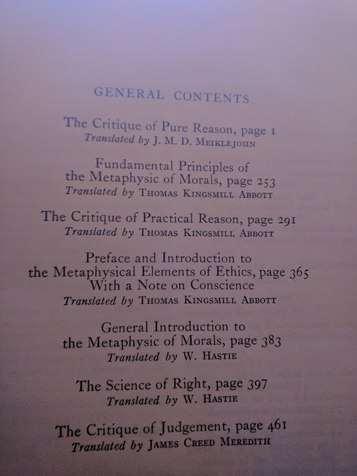
-
Trauma, DefenseWhenever I see someone new to the boards posting, despondently, about solipsism my gut-reaction is that this is someone who has been deprived of someone to trust and is looking less for philosophical engagement, than reassurance that there is no outside world (as well, probably, for some savior figure to help them reestablish that outside world.) — csalisbury
I see this was added. What's your take on solipsism. Surely, one cannot become a solipsist with regards to their own mother. Maybe had you been adopted, that might have been a comforting belief to profess. -
Trauma, DefenseIn less theological terms : if you need help, but what you need help for is not being able to receive help, how do you get help? — csalisbury
Yes, it does sound very religious. To want to get help entails that one admits that one needs help. That seems like the biggest obstacle to overcome in terms of therapy.
It sounds like your therapist was getting frustrated not with you but with your defense mechanisms. — csalisbury
Perhaps, rationalizations and intellectualization is the biggest obstacle here. One can fantasize away about what kind of help one needs or doesn't need away.
but a therapist should never place the blame on the person coming for help. — csalisbury
My therapist did that. He placed the onus on me to get better, which is understandable; but, leads to nothing but despair and hopelessness.
If there's a roadblock, its not because the person doesn't want to get better, but because their defenses are keeping them safe — csalisbury
Said like a prophet.
That's why I find Kalsched's approach so refreshing. He identifies this problem, and sees the complexity behind it - rather than reducing it to some form of obstinance. — csalisbury
Two-edged sword here. Who knows what is the issue? The patient only in some regards. There's only so much a therapist can do.
I think there's a moment in spiritual and mental growth where rationality has to take a background role. — csalisbury
But I think, before that, its an incredibly powerful tool for remaining grounded in the midst of personal suffering. — csalisbury
Please expand! -
Trauma, DefenseI haven't read too far, but one thing Kalsched talks about is a safe therapeutic environment, where there is a mutual relationship of trust, a relationship that develops according to its own pace. — csalisbury
I think, that trust is an issue for any person who has experienced trauma. Even (or especially) a schizophrenic experiences trust issues. Trust is such an important feature of humanity.
Obviously there's no such thing in reality as an ideal, but its still a good guiding light. I think its often less about any particular therapeutic modality and more about the relationship itself. Which can take time, and sometimes a long time depending on what one's suffering from. — csalisbury
Yeah, my previous therapist put the onus on me to get better. He basically told me that I have to want to get better to get better. Difficult shit.
I sometimes think that a big part of recovery is just becoming comfortable with the reality of one's experience and situation, and the limits and possibilities that situation entails. That takes a lot of courage, I think. Sometimes the need for an 'escape' is part of the problem itself. — csalisbury
Certainly. I think, the problem with recovery is developing the idea, that there's something fundamentally wrong with you that needs changing. It ain't easy admitting to yourself that something is wrong. We all wish we were infallible and competent beings.
I agree about rationality. It's a useful grounding tool. — csalisbury
What else do you think about that? I think rationality is severely underappreciated. -
Trauma, DefenseKalsched's take is that the type of defence he's talking about is a double-trauma. First there is the external event. The creation of the archetypes happens as a defence against external trauma, and does so by creating a kind of internal trauma, a secondary trauma so to speak. — csalisbury
I wonder though, to entertain a more positivistic aspect of the issue. What is required to "emerge" from this "stuck in reverse or neutral" aspect of trauma? As you've tried, LSD can bring about change in terms of addressing the issue through circumventing the hardwired defence mechanism that is stuck in neutral or reverse. I can't take LSD, and as a person suffering from psychosis in terms of schizophrenia or psychotic disorder, and contradicted too...
I've tried many therapies; but, am unsure what could possibly work for the issue. It's a difficult issue.
Kudos for the breakthrough experience though.
To post more philosophically. I think rationality is a useful tool here. One can "listen" to what reason has to say and grow out of it, so to speak. The mind obviously always doesn't listen to rationality though. -
Trauma, DefenseI think I'm about to devour his books. From what I understand the one this is taken from, The Inner World of Trauma, is essentially an attempt to create a portrait these types of defense systems, as well as to sketch how they are born and develop. He has a later book, Trauma & the Soul which I believe deals much more with growing out of them. — csalisbury
That's interesting. I take an approach towards treating trauma tantamount to the appearance of psychosis, though from an external and not internal event. Psychosis is, in essence, a trauma of the mind. But, to return to the topic... I think that trauma is a severe event in one's life that leads to the retardation of the development of one's psyche. The mind cannot cope with trauma and is, so to speak, stuck in the event. Defence mechanisms then manifest and are treated with significance wrt. to that very trauma. -
Trauma, DefenseIt seems to me to be a matter of "hope to get better". This can be provided by the active and imaginative part of the childlike psyche. Trauma often retards psychological development.
It's interesting to note that the author describes this as a "schizoid" personality. One of which I nourish one these very forums.
https://thephilosophyforum.com/discussion/comment/233444 -
'I love you more than words can say.'So, @Banno, the limits of my language are the limits of my world? Has meaning been expressed adequately with "I love you more than words can say."?
-
'I love you more than words can say.'
Hmm. I think it's quite a strong thing to say; but, then again all you need is love...
Anyway, one applies the universal quantifier to its meaning, while the other is seemingly (in)directly self-referential.
You tell me. -
'I love you more than words can say.'
So, if I say, "I hate you more than anything."
Is it the same type of expression as "I love you more than words can say."? -
'I love you more than words can say.'IN that the sentence is in a language, and is about language. But not in the way that "this sentence starts with 'this'" is self-referential. — Banno
Then it's a matter of scope, no? -
'I love you more than words can say.'The self-reference is not directly to the sentence but to the language in whcih the sentence is expressed. — Banno
That entails the sentence itself, doesn't it? -
'I love you more than words can say.'It's not a direct self-reference, but "language cannot express my love for you" is an expression of my love for you, in language. — Banno
But, self-referentiality plays a role in expressing its meaning, no? -
'I love you more than words can say.'I'm content to be the centre of attention. — Banno
What do you think about what andrewk said? Here's it again:
Is it self-referential?
— Wallows
No, because it is a statement of inequality, just like saying - 'I am taller than that anthill'. If it were a statement of equality it might be self-referential.
Another example might be 'I am heavier than this scale can measure'. It is not self-referential. It is really just saying something about the limitations of the scale.
Scale <-> words. — andrewk -
'I love you more than words can say.'Are you stalking me? My ancient wisdom, reincarnated in a new forum. — Banno
No, I'm just a student relishing in old wisdom. -
'I love you more than words can say.'BTW, andrewk, could you refer me to where I can read up on more of what you already said? Seems interesting.
-
'I love you more than words can say.'The love sentence is similar to the Commdore 64 sentence. They're both saying that the medium at hand isn't capable of doing the job we'd like for it to be able to do. — Terrapin Station
Yes; but I refer you back to what @andrewk said. Namely, the sentence achieves inequality in the case of the Commodore 64. In the case of the intentionality of love, we cannot achieve a state of 'inequality' due to the vagueness and ambiguity of the intentionality or subject of 'love'. -
'I love you more than words can say.'Why would ambiguity/vagueness have something to do with self-referentiality, though? — Terrapin Station
I don't know. That's just one component of the meaning of the sentence, is what I meant. Self-referentiality, the other. -
'I love you more than words can say.'Is that self-referential? — Terrapin Station
No, because there's no room for ambiguity and vagueness to fill in there as in the case with qualitative aspects of the intentionality of "love" in the sentence posited in the OP. I feel as though half of the meaning of the sentence is expressed in its ambiguity and vagueness. -
'I love you more than words can say.'So then simply referring to language or words when there are language or words in the sentence probably isn't sufficient for something to be self-referential — Terrapin Station
I'm not sure. It seems to me that to talk about intentionalities in the manner of being of greater significance/meaning than "what words can say" seems quite self-referential to me. -
'I love you more than words can say.'No, because it is a statement of inequality, just like saying - 'I am taller than that anthill'. If it were a statement of equality it might be self-referential. — andrewk
But, intentions have no measure of equality. Do they? They're purely qualitative, with no quantitative measure.
Shawn

Start FollowingSend a Message
- Other sites we like
- Social media
- Terms of Service
- Sign In
- Created with PlushForums
- © 2026 The Philosophy Forum