
Comments
-
Idealism and Materialism, what are the important consequences of both.And which part of this is not supported by a reductive materialism? — khaled
Well you can try to reduce mental goings on with brain states, brain states to electro-chemical activity then reduce these to atoms and reduce atoms to quarks and these in turn to fields. I don't what would be gained or illuminated by doing this. At the end one is just left with fundamental equations...
Right again, which part of this contradicts a reductive materialism? As long as consciousness, mental goingons, etc are not identified as a "different type of thing" then you can still be a materialist and talk about them. — khaled
I don't know how reducing mind to brain or brain helps much. It depends on what you want to study. If you are a perceptual psychologist, studying chemistry is not of much use. Likewise if you're a chemist, I don't know how psychology will help with chemistry. -
Idealism and Materialism, what are the important consequences of both.Eliminative materialism isn't the only materialism. — khaled
I know, but since I think most materialisms are incoherent, outside of Strawson's, then I could signal out one which I think has some implications for ordinary life.
A person can be funny and also be merely a bag of chemicals. IE reductionist materialism. — khaled
It's not that a person is not chemicals, in part, it's just that these are different levels of description. The level at which we interact with people in a day to day basis, is not the level at which we usually think of them as chemicals. It is much more complex and rich than that, or so it seems to me.
But then that's why we have so many aspects to study: physics, chemistry, psychology on to history and literature. Each one "up" encompasses more and more complexity, while often sacrificing depth in many respects.
Or more importantly, why that distinction would be needed. — khaled
It's not. At least not on these metaphysical terms. Epistemically we can speak of the experiential aspects of life (consciousness, mental going ons, thoughts, dreams, qualia) and the non-experiential aspects of life, those aspects of life which lack experience such as a rock or or particles or anything else we think has no experience. Putting panpsychism aside, of course. -
Idealism and Materialism, what are the important consequences of both.
I though I gave a reply somewhere in the thread. In any case, let me start again.
If Dennett is right in his "materialism", the view that the phenomena of the mind are illusion or bad theoretical postulates, then it should follow that one should react very little to a loved on dying or seeing people being massacred in a war.
I mean, if it's all mere reaction to stimuli and the like, then the loved one is merely a bag of chemicals, so we should be rational and think to ourselves that, I thought this person was unique, funny, smart, perceptive and so on, but I'm wrong, all it was was cleaver reactions to external stimuli. So let me not slip into the fallacy that human beings are in any way special at all.
If mind was an illusion, then most of the things I love in this life color experience, music, novels, travel all of it is just fake.
With extreme "idealism", I could start saying the words "quantum consciousness", as if that says anything, and believe I'm being profound, when I'm saying nothing at all.
Then this would be delusional, a wrong way to think about the world. -
Idealism and Materialism, what are the important consequences of both.
No, I think in essence you are correct. It's just that sometimes when I see "mind" as opposed to "matter", I just type automatically. It's not a critique.
Just emphasizing that back in 17th and 18th century, you could make such a distinction. But by now it's not very substantive.
The only thing to stress in these metaphysical disputes would be how much consciousness matters, no pun intended.
:cool: -
Idealism and Materialism, what are the important consequences of both.
Why assume that matter and mind are distinct?
Until someone can tell me where matter "stops" and mind "begins", this distinction doesn't make sense.
Another thing altogether is to say that mind (consciousness specifically) doesn't really exist, in a manner like Dennett argues, that everything is an illusion.
In that scenario we can only contrast a version of the world in which experience exists and one in which it does not. But this distinction between mind and matter can't be coherently formulated, I don't think. -
What is your understanding of philosophy?Many people really dislike this view, but I happen to think it's true. I understand philosophy as the study of mysteries, which is why the same questions keep popping up time and time again throughout history.
If philosophers manage to carve out some understanding of some aspect of reality, then it becomes a science and philosophers don't need to worry about it much anymore. Hence why it's called "the mother of the sciences"
Obviously this simplifies the situation a bit, discoveries in physics or biology or psychology can have consequences for philosophy, but these fields are now developed to the extent that they don't depend on philosophers anymore.
In this respect, philosophy is likely the broadest field of rational enquiry. -
Which books have had the most profound impact on you?In no specific order, omitting political stuff and obviously having some bias towards my present recollections, I'd say:
Confessions of a Philosopher by Bryan Magee
The World as Will and Representation by Arthur Schopenhauer
Real Materialism and Other Essays by Galen Strawson
What Kind of Creatures Are We? by Noam Chomsky
The Knowing Animal by Raymond Tallis
Cosmosapiens by John Hands
Novel Explosives by Jim Gauer
V. by Thomas Pynchon
Hard Boiled Wonderland and The End of The World by Haruki Murikami
A Brief History of Seven Killings by Marlon James -
Boycotting China - sharing resources and advice
I try to avoid using the term too frequently, it can confuse more than clear up a situation.
Being treated that way is disgusting and inhumane and should not be tolerated. But to call that a "genocide" is not something I'm comfortable saying, unless China begins killing them en masse.
Disturbing, regardless. -
Idealism and Materialism, what are the important consequences of both.
Ah, so you follow the Dennett type of thinking. OK, got it. :up:
I'm in the Galen Strawson camp in this argument.
Thanks for the examples and the reply. I don't have much to add to that. -
Idealism and Materialism, what are the important consequences of both.(in principle, not a weird invitation) — Kenosha Kid
:sad:
Obviously I can't watch me experiencing a film. — Kenosha Kid
Sure, I agree with how you present this.
What about reading a novel, don't you observe images in your head? Or when you are lost in thought? -
Idealism and Materialism, what are the important consequences of both.
Sure. Take a look at Lovejoy's essay here. Keep in mind that for some strange reason, Lovejoy was very anti-German, so take his critique with a grain of salt:
https://archive.org/details/essaysphilosoph00unknuoft/page/264/mode/2up -
Idealism and Materialism, what are the important consequences of both.
Let me rephrase:
Apples fall because of gravity, not because they're "going to there natural place". That's what the scholastic philosophers used to say about apples falling, because that's what seems to be happening when we look at apples falling.
Yes, Newton was forced to accept it. Because to him, it was obvious that the idea of gravity made no sense. Otherwise he wouldn't have been forced to accept anything. -
Idealism and Materialism, what are the important consequences of both.
Apples seem to fall, because that's what they do. So does almost every concrete object. They want to fall down.
Except that they don't and the force that keeps the moon orbiting the Earth is the same force that causes apples to fall.
And Newton agreed with this, it was incomprehensible to him that objects can affect each other absent physical contact. -
Idealism and Materialism, what are the important consequences of both.it is misleads us from the very start. It requires years of misleading philosophical study before one begins to doubt the human instinctive sense of realism. — Banno
And good that we did mistrust this instinct, it led to the great discoveries made by Galileo and Newton and many others. The way the world is (absent us) , is not the way it appears to us.
Had we stayed with instinctive realism, we'd still be debating in scholastic terms. -
Idealism and Materialism, what are the important consequences of both.
Sure I understand your Chomsky angle. I do like Kant, but I think he is way too obscure at times.
As for disagreements with Schopenhauer, let's see:
I believe we have freedom of the will, unlike him.
I'm unclear if will is actually continuous or discrete. I'm more sympathetic to the continuous angle, but am I'm not convinced yet.
I don't think his doctrine of Platonic ideas makes much sense. It allows for way too many ideas. Not that I'm unsympathetic to Platonism, on the contrary I very much like this school of thought, just not as articulated by him.
I think history is more important than he gives it credit for.
Obviously he was quite wrong about phrenology and vision and women.
But these are not huge disagreements, just different points of emphasis so far as philosophy is concerned. -
Idealism and Materialism, what are the important consequences of both.
Sure, because I don't see a reason to stipulate that these things need be incompatible.
One can be a materialist like Dennett or a materialist like Strawson which are extremely different.
One can be an idealist like Berkeley or Schopenhauer also very different.
Similarly, I don't see why realism and idealism need to be in tension. It could be that only those aspects of the world that interact with our innate science forming faculties give us access to reality absent people.
Or mind could be an illusion or reaction like Dennett says. Many options to choose from. -
Idealism and Materialism, what are the important consequences of both.
Sure you can stay with Kant. Nothing wrong with that at all.
I personally follow Schopenhauer and Chomsky, but I don't always agree with them. -
Idealism and Materialism, what are the important consequences of both.Ahh, I forgot to add Mainländer! He was a TI but believed that there was will, but not one. He thought many wills existed but at one time did not. So how did plurality emerge from individuality? At one point in time, there wasn't plurality there was only a simple being. It emerged with time.
So yeah, I think there are a few paths open in TI. -
Idealism and Materialism, what are the important consequences of both.
Well take Schopenhauer, he added the idea of will to TI.
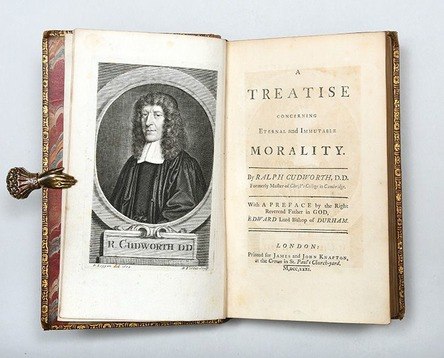
Or Cudworth before both of them argued that we know nothing of the things themselves outside of "motion" and "pressure".
Although Russell certainly would have not called himself a TI and he didn't agree with Kant, some of his statements carry forth a TIist flavor when he says "we know nothing about the intrinsic quality of physical events except when these are mental events that we directly experience.”
Or Einstein when he discovered that space and time aren't absolutes and independent of each other, but relative.
One can disagree with Kant having so many categories or with Schopenhauer on will. One can argue that things in themselves is misleading, as we should speak of events in themselves, because nature is constantly in flux and not stable. And so forth.
It's building on the edifice, not taking it down. -
Idealism and Materialism, what are the important consequences of both.Ain’t been done yet, but maybe just because nobody cares anymore. — Mww
Perhaps. I think some people do, very few obviously.
I think some conceptual work can be done in TI, but it's just extremely difficult. -
Idealism and Materialism, what are the important consequences of both.QM can be seen as a refutation to that. It only refutes the “in themselves” part, it doesn’t refute the “things” part. There is things outside of us but that depend on us for their existence. Electrons in a double slit experiment for example. — khaled
Maybe. That is if we think that QM exhausts everything there is to know about reality. It could be the case. It could also be the case that there are things that exist which we have no capacity to cognize, but an intelligent alien species could and they might be able to sort out some of the difficulties we have in physics.
It's not an unreasonable suggestion, I don't think.
I don’t know where the justification for the split came from so I’m not sold on that. — khaled
I can't speak for him but I have my own views. The gist of it would be that a part of "things in themselves" is cognized by us, the rest is not, because we don't have the necessary intellectual or sensory apparatus to detect them. So more exists than what we can detect.
This is extremely speculative, but if I had to guess, I'd agree with you that a "separate sort of thing" need not be of a different nature: it's all physical stuff, or ground stuff. The claim is monist.
I’m just not sold that we doing the collapsing are in any way special, or that the collapsing couldn’t be done by the exact same type of stuff as the stuff getting collapsed. — khaled
We are special in so far as we can discover this aspect of the universe. But as to what causes the collapse, I don't know. I believe most physicists say we don't play a role in that, so I'd defer to them for now.
As for a practical application of materialism vs idealism, if materialism a la Dennett or Chuchland is true, then nothing really matters, we are just bags of molecules that don't actually suffer or laugh or think. We are mere illusions. I don't think that's true, nor do I believe people think this is the case either. Even scientists don't behave as if they were mere chemicals or molecules. -
Boycotting China - sharing resources and advice
Ah, fantastic political speak "vocational training schools". :roll:
The situation in Hong Kong is sad, I would've liked to have visited while it still had the social freedoms they have now lost, to a large extent.
What is most worrying to me is Taiwan. There it's very, very dangerous. And the US has to to stop being provocative, as well as China. Nuclear war is no joke.
Thanks for the sources. :up:
The Uigher situation is worse than I initially thought. -
Boycotting China - sharing resources and advice
I'm not pro or anti China. Here it's a bit tricky to get good info, that is info that is not extremely laden with very strong ideological lenses.
So I wanted to ask, how bad is the Uigher situation? Is it actually genocidal?
And lastly, where do you get reliable info on this topic? I sometimes struggle finding info that I think is solid on this specific topic.
Sorry for the barrage of questions, it's just that I'm curious. -
Israel killing civilians in Gaza and the West Bankhttps://www.haaretz.com/israel-news/.premium-israel-stops-its-mapping-raids-but-constant-surveillance-of-palestinians-remains-1.9916213
The abuse doesn't stop. Then people wonder why "they" hate Israel. -
Idealism and Materialism, what are the important consequences of both.Schopenhauer didn’t like Kant’s ding an sich, so went on his merry way towards working around it. Representation is internal; the object represented is external, with respect to the subject. Subjects can only know the representation. If the representation can be external, and knowledge is still only possible by means of them, then the thing-in-itself is representable and therefore knowable. POOF!!! Kant is refuted, but....oh oh.....transcendental idealism, for all present intents and purposes a Kantian creation, is sustained. — Mww
I can't resist making a comment here:
I don't think Schopenhauer would've minded that he be labeled a TI. He believed he was carrying forward that tradition which was cemented by Kant but was foreshadowed and articulated by Cudworth and other Neo-Platonists.
I'll likely be is "losing" territory here speaking to you about Kantian affairs but what the heck, I'll embarrass myself once in a while, why not? It's not clear to me that Schopenhauer is wrong here in that what is represented is internal.
We may receive some "residue", as it were, of the thing in itself, but only the side which is represented is what we can call knowledge. Sure, Schopenhauer can say that our bodies are also part of the world of representation and that in experience we are acquainted with will - energy essentially - in merely having experience of our bodies.
But there's an open textual problem here in which it is not entirely clear whether will for Schopenhauer is "in-itself" or mediated as well. I think it is mediated, thus we are mostly overwhelmingly ignorant about things in themselves.
But I don't think I've seen an argument that refutes "things in themselves" that is satisfactory. Probably because I think it is true. -
The death paradox
Yes, I think this is mostly linguistic too.
It's roughly what Wittgenstein said "Death is not an event in life." We can speak of dying, but not of the exact moment of death or afterwards, since nobody can tells us what happens (if anything, though it is likely similar to what before birth was), aside from very dubious near-death reports. -
The death paradox
If he dies, he's already dead. A person can't literally die twice.
If he was living he wasn't dead by definition. A living person can die, they can be murdered or killed. But once they die, they are no longer alive. -
Idealism and Materialism, what are the important consequences of both.Wow, there is actually some agreement here. That's insane.
In philosophy? No way. -
Idealism and Materialism, what are the important consequences of both.
Our powers of abstraction and reasoning are sublime. Carroll wrote brilliant stories. I should actually re-read that some day. -
Idealism and Materialism, what are the important consequences of both.All we did was designate. Label. We didn't create the something. And the something will stay behind after we die. Agreed?
Furthermore I'll add that we are also made of that "something". And that that "something" is called matter. And that there is no "other type of thing". — khaled
I agree with the latter part, there is something we call "matter" not depending on us.
Speaking of "creating" can become complicated. By virtue of how a specific object induces in us certain sensations and perceptions, we put these properties together in what we call a "rock", a "river" or anything else.
If by creating you mean bringing matter into existence, sure we did not create it. If you mean all the concepts, associations and uses any object has, we do create these specific objects automatically, I think. Other animals likely don't have such concepts such as tree or river or rock.
And that's what I don't get. A structure, needs something to get structured. A "structure without base matter" is like a building without bricks. — khaled
It's the debate between epistemic structural realists and ontological structural realists. The former are what Strawson and Russell favor. As well as you and me. The latter view, is favored by Ladyman and Ross. These two think that there are only structures all the way down.
Yes, I also agree that it is incoherent to say structure is all there is: a structure is a structure of something. -
Idealism and Materialism, what are the important consequences of both.
Well we are the ones who designate a world. I don't know what else in biology could even have a concept of a "world".
If we don't want to say that we create everything - and some do - then we'd have to say that something remains, which does not depend on us. Presumably physical stuff ("base matter").
But how this physical stuff remains - what nature it has absent us - is quite obscure. Some can say colorless, odorless particles remain, or perhaps quantum fields. But the only thing we can attribute to them is whatever physics says about them.
But if Russell (and Strawson and Chomsky) is correct, then only those characteristics picked out by our mathematical equations remain, but that wouldn't exhaust what these things are.
Another view is that structure is all there is, so in this respects we do exhaust the nature of the physical with our physics. -
Idealism and Materialism, what are the important consequences of both.As Schopenhauer said in the opening line of The World as Will and Representation: "The world is my representation". No me, no world. Except that if other people exist, then there is a world for them.
But when all are gone, no world is left. Or no intelligible world at any rate... -
Idealism and Materialism, what are the important consequences of both.Only that what we can know about physical stuff is inextricable from our perceptions. Not that the actual physical stuff is inextricable from our perceptions. — khaled
Very similar to Bertrand Russell:
“...we know nothing about the intrinsic quality of physical events except when these are mental events that we directly experience.”
or
"...we have no reason to assert that events in us are so very different from the events outside us - as to this we must remain ignorant, since the outside events are only known as to their abstract mathematical characteristics, which do not show whether these events are like 'thoughts' or unlike them."
And so on. -
Idealism and Materialism, what are the important consequences of both.As Magee says in his book on Schopenhauer, humans are generally born with an instinctive sense of realism, the problems with which only become clear after considerable intellectual effort. — Wayfarer
A fantastic source, by the way. :up:
In short - the world is not simply given. — Wayfarer
This is a big problem. I want to start a thread on this topic one day, but I'm working on how to articulate it. I'm very slowly re-reading C.I. Lewis' book on the topic, which is very interesting and talks a good deal about this.
People often associate "the myth of the given" through Sellars' essay, which is quite epistemological and can become quite technical. Lewis makes it epistemic-metaphysical, which makes for a more interesting read.
Manuel
Start FollowingSend a Message
- Other sites we like
- Social media
- Terms of Service
- Sign In
- Created with PlushForums
- © 2026 The Philosophy Forum