
Comments
-
Thing-in-itself, Referent, Kant...SchopenhauerAs to the things in the environment they affect the body differently pre-cognitively it would seem such as, for example, one appears as a tree and another a waterfall. One I can move around, remove branches and leaves from, maybe use its bark, even cut it down and burn it, the other I can go under and be washed, or watch the sunlight sparkling on the water and feel the fine mist of water vapour on my skin and so on. So, it seems to me that thgere is no arbitrariness in the ways we come to differentiate the things in the environment, they all have real pre-cognitive affactes on the body, on the skin, on the nerves, it seems. — Janus
If someone adds a chemical solution to what we call a river, it hardens and if I paint yellow lines on it, it becomes a road - and can be used as such. The change is chemically trivial, yet our conception radically alters, notice that in this case, we wouldn't perceive this hardened thing to be discontinuous from the surrounding terrain.
And if you put a concrete wall in front of the waterfall, it becomes a dam of sorts.
These small changes raise questions about how we individuate. Where I cannot find a fault in this, is in mathematics, it seems necessary.
It's not arbitrary, you are correct, it's subtle and delicate. Small changes drastically change how we conceptualize items as being one or many (is a tree one thing, or many?, etc.)
Our understanding of the microphysical seems to show us that things are not merely as they appear. But then the micro-physical itself is another, sensorially augmented, appearance. It's truly a mystery. — Janus
100% agree. It makes no sense as to how these microphysical things could lead to anything really... -
Thing-in-itself, Referent, Kant...Schopenhauer
But you are hitting on a most interesting point, often overlooked. What you say about animals is indeed correct. It raises the same issue, the animal is doing the individuating (in so far are we are able to discern what they do), meaning, it's an internal mechanism of the creature. And I think this generalizes to all creatures, that have a minimum level of experience (above a slug, for instance).
To me, the mystery is as to what that diverse world is in itself; I don't even consider what to me seems the most implausible possibility that it is all a human production. — Janus
I just don't see an alternative, with the only exception, is to give cognition to the world, a kind of panpsychism.
No two things in the world are exactly the same. Individual things are perhaps never the same from one moment to the next, some more obviously different through time than others, of course. The hill near my house, covered with tall eucalypts looks the same from day to day, but if I cast my thoughts back a few years I remember the trees were much shorter (Flooded gums grow 3-4 meters a year). — Janus
This is another mystery to me, the lack of identical aspects to object in the world. This changes in the micro-physical world, but that's virtually alien to lived experience.
Interesting, we seem to have different starting conditions, but agree on similar conclusion. -
Thing-in-itself, Referent, Kant...Schopenhauer
It's something like that, I've yet to read the official English translation, which is allegedly coming out this year.
As I understand it's "as if" (and it's very important to keep this in mind) God killed himself, creating the universe and life being as it were, his remains, going on to eventual total extinction. Which is fine for his metaphysics.
But for our concerns about metaphysics here, I don't see a practical difference between non-being and non-being, in that, prior to us arising, we were part of the process that made up "God's corpse" as it were.
We weren't alive and are now alive by accident. And death will be the same, I think. He was more or less correct in describing something like the Big Bang, but what happens after, we do not know. Maybe it's the complete cessation of all activity, maybe we contract back again to another Big Bang, maybe there are more universes. We have no idea.
Funny that you mention Nietzsche, in some other places I go to, he so popular. Never really got his popularity, aside his good prose. -
Thing-in-itself, Referent, Kant...Schopenhauer
Yeah, he's quite dark. But I think his account, when read secularly is quite coherent. But the problem of how out of one many arise, remains, no matter who espouses it.
As to what happen in death, I don't think Mainlander's is any more coherent than Schopenhauer. Once one tries to say that death is a long sleep or terrible isolation or whatever, it becomes kind of empty talk, imo. It's just whatever metaphor you prefer to use. -
Thing-in-itself, Referent, Kant...Schopenhauer
Correct. And, incidentally, also Kant's flaw - which they could not have predicted.
I think modern physics shows that space and time exist external to us, while not denying that we have a particular way of interpreting and cognizing these aspects.
So I am not clear that time is not metaphysically real, some physicists see it as fundamental. Others as emergent.
But I do agree that the specific version of the will as expressed by Schopenhauer, while I think valid in some important respects, does break down when it comes to multiplicity. Perhaps Mainlander does a better job here. -
Thing-in-itself, Referent, Kant...Schopenhauer
"Here we have a wide ocean before us, but we must contract our sails." As Cudworth puts the matter.
You give good arguments on a most difficult topic: to account for one-ness in an ocean of multiplicity. I currently have no horse on either side, but I think the logic is a bit hard to beat:
What comes prior to something, must be simpler that the resultant. Likewise, these separate things we see in the universe, must have been more closely united then they are now and our best theory suggests something like this via the Big Bang Model.
The issue is if we can maintain that all is one, or if we are forced to say that there are several simple things, which cannot be further united, for whatever reason.
A most interesting topic, probably beyond our understanding. But you have a point, no doubt. -
Thing-in-itself, Referent, Kant...SchopenhauerSure, and even here, one could make the Cartesian argument that even mathematics could be deluding us, some demon making us think 2+2 is 4, maybe it’s something that else. Very unlikey, not impossible.
I mean, a good deal of epistemological questions do not affect our day to day life, we pursue them because we find some of them interesting. What makes a tree seperate from the ground a *fact* about the world? Or a chair different from a table? Is that a fact about the world or something that pertains to the way we conceive the world?
It seems to me that hard problems remain, no matter what we postualte, individuality being a hard topic, as is identity and grounding relations… -
Thing-in-itself, Referent, Kant...Schopenhauer
The example of Schopenhauer pointing out that Kant assumes plurality when he argues for the existence of "things-in-themselves", isn't an intuition. Individuation is something we do to nature, it's not something that is inherent in it. So, in this sense the "thing-in-itself" makes more sense than "things-in-themselves".
I mean, sure, if you ask for demonstration in the sense of empirical evidence like physics, that can't be given here. But this arises too with many issues such as free will or that each of us has conscious experience, etc. Demonstration can be an extremely high standard to meet in philosophy. -
Thing-in-itself, Referent, Kant...Schopenhauer
It's a bit like what Descartes said, I forget the exact quote, but the gist of it being some philosophers try to complicate things so much to hide or obscure the fact that they are saying either silly or trivial things. Or as Tallis cleverly pointed out in one of his books, the explanations they try to give are more difficult than the phenomena they are trying to explain.
And I think this applies to most "illusionists". It's just too obvious and when you deny things to this level, it's hard to proceed and get anywhere.
I do recall reading from you that you dislike Schopenhauer or aren't a fan. Now I can see your reasoning about it clearly. I think your reasoning is on the right track, though I very much disagree with calling Schopenhauer "stupid" - heck the fact that a good deal of the fathers of modern physics - Einstein, Schrodinger and Pauli all considered him a genius, cannot lead me to that conclusion.
But putting that aside, issues of taste are not a matter of convincing anyone, we have to attempt to look at the topic as clearly as possible. It could be that by thinking about this issue too "Kantian" or "Schopenhauerian" or even "Russellian", could be an impediment to try and clear up what we are talking about.
I agree, we have access only to representations. Even what physics tells us about the world are representations, the way we are able to discern what parts of extra mental world is made of. But we have a problem, if physics were the whole story, then we would have to posit representations "all the way down", it could be the case, but it would eventually lead to a kind of Berkeleyan idealism.
So we can say something about it, I think. Whatever the "thing in itself is", we can, more or less safely say that it is non-representational in nature, it grounds our representations, and it must be something extremely simple.
Then we can argue if it makes sense to speak of this concept as being plural or monist, or if it has in itself, any causal powers. I very much agree with you that we do not know if the world has causality as a built-in feature. Our minds appear to have such a built-in causal mechanism.
Here we enter difficult territory. So while agree with most of what you say, I depart a bit in thinking it is completely futile to attempt to give (at least) some negative characterizations of what the thing in itself could be, there are a few clues we can follow, though we will never reach certainty. -
Thing-in-itself, Referent, Kant...Schopenhauer
I think something like what you suggest is quite true. We have to purge ourselves of the idea of "dead and stupid matter". To be clear, such a view was entirely coherent and sensible (for the most part, some acute observer like Gassendi, Locke and Hume noticed something strange here), that's what matter looked like for those who studied it, with the technology and theories they had.
With what we know now, matter is not nearly as vulgar as we once thought. Nevertheless, we can't say it's dead exactly (that's a human category, after all - it's in biology too, but it's a bit unclear it seems to me), but we can't say it's alive either. It just is. Maybe it is a blind striving of some kind, a sort of impetus or tendency to just go on, and perhaps, complexify itself, to some degree.
That's a fantastic quote of his, and applies entirely to most (if not at all) of those who call themselves "illusionists", Frankish, Churchland, Rey and others.
But they wouldn't find this reasoning convincing because, they don't believe that in having consciousness, we know anything about it. Which just manifestly and clearly overlooks some utterly obvious and important factors, which have played a large part in the history of philosophy, including the nature of identity, continuity through time, the nature of testimony, discussions about the appearance of ideas and on and on.
But it seems some of the old problems remain, in slightly different terminology. Thankfully, it's not a very popular current, because of its obvious problems, not unlike panpsychism, which also has its issues and followers. -
Thing-in-itself, Referent, Kant...SchopenhauerI find it funny that there's discussion about materialism in relation to Schopenhauer, for the very thing I quoted is quite relevant, I'll post it again:
"The tendency to gravity in the stone is precisely as inexplicable as is thinking in the human brain, and so on this score, we could also infer a spirit in the stone. Therefore to these disputants [between 'spiritualists' and 'materialists'] I would say: you think you know a dead matter, that is, one that is completely passive and devoid of properties, because you imagine you really understand everything that you are able to reduce to mechanical effect. But… you are unable to reduce them… If matter can fall to earth without you knowing why, so can it also think without you knowing why… If your dead and purely passive matter can as heaviness gravitate, or as electricity attract, repel, and emit spark, so too as brain pulp can it think."
He thought the materialists of his day and the subjective idealists (Berkeley, Fichte) were both wrong.
Today's view of materialism is outright incoherent if we take as benchmark Dennett or the Churchlands as main figures, it barely makes any sense. As for "subjective idealists", if there are any, don't arise much in discussion, maybe Kastrup gets a mention sometimes, but has his own issues.
Obviously any avenue of research you find interesting ought to be pursued, but it does no harm to be more-or-less clear of what you mean when you say "materialist", "idealist" and so on.
As for the thing in itself, whether Kant was right, or Schopenhauer or Cudworth or maybe even Plotinus is more "on the right track", we do not know. But, aside from Plotinus (who can be read in secular manner), this is no mysticism, it's just sensible, heck even John Lock agreed with it - though he called it "substance", still, extremely similar idea.
Now, the more we speculate on its nature in a positive sense - aside from brief comments - the more liable we are to make mistakes. Schopenhauer avoids this, mostly and provides interesting reasons, but as with anything on the edge of our understanding, not unlike quantum mechanics, a lot of woo can arise. -
Thing-in-itself, Referent, Kant...Schopenhauer
Sure - I was only commenting on that specific quote which Mww provided, if you add more context then that often changes things. Schopenhauer does frequently mention animals and was one of the first philosophers to call for empathy to animals and applauded the then very progressive laws passed in London offering animals some rights, so he does have an idea similar to that of the umwelt, though not in that term, obviously.
"Therefore to these disputants [between 'spiritualists' and 'materialists'] I would say: you think you know a dead matter, that is, one that is completely passive and devoid of properties, because you imagine you really understand everything that you are able to reduce to mechanical effect. But… you are unable to reduce them… If matter can fall to earth without you knowing why, so can it also think without you knowing why… If your dead and purely passive matter can as heaviness gravitate, or as electricity attract, repel, and emit spark, so too as brain pulp can it think."
He did not like materialism at all, but he wasn't of a fan of religious spiritualism, though he did very much enjoy The Upanishads and had a mystical side as expressed in his view of the arts, specifically music.
You might say that the idea of a short canal across forbidding mountains was the ding an sich (ideal referent) of the man-made watercourse we have today. Is the visionary concept of a future state merely a poetic metaphor, or also a causal force? — Gnomon
But the ding an sich is meant to be introduced, in a way, as a limiting notion, in a sense something which we cannot go behind or understand, it serves as a reasonable postulate indicating the limits of enquiry.
In Schopenhauer, the Will is not an idea, it is a concrete phenomena which pervades the whole universe. -
Thing-in-itself, Referent, Kant...Schopenhauer
Again, will as the closest approximation we have of the "thing in itself".
Willed actions, as felt phenomenologically, could be labeled representations, though they surely feel immediate in a way nothing else in the world does. So here it's tricky.
But I don't see a contradiction. In so far as we have to conceptualize the idea of the will in order to talk about it to others, we proceed to do so. -
Thing-in-itself, Referent, Kant...Schopenhauer
I agree, it need not follow and is false as can be appreciated just by merely looking at how other organisms interact with the world.
Unless he has in mind existence in a special sense of the word, that supposition is difficult to defend. -
Thing-in-itself, Referent, Kant...Schopenhauer. In other words, a human being is merely a robotic machine programmed (by evolution?) to do whatever is necessary to propagate its core program (seed) into the future --- to what end? But if invisible intangible abstract Energy is the universal ding-an-sich, it must also take on the causal, material & mental forms that we observe in the world. — Gnomon
Not a machine no, a creature of nature - not his exact words, but that's what he means. He appears to have something quite similar to evolution in mind and discusses some interesting ideas associated with such concepts.
He does not deny matter, but matter for him is a representation. Which is why his book is titled "Will and Representation", sometimes alternatively translated as "Will and Idea".
That notion is similar to the 21st century concept of Information*1 as the ubiquitous shape-shifting "substance" that exists in the various forms of Energy & Matter & Mind*2. Hence, the evolutionary offspring of the Prime Mover (power to create & animate Forms) is the essence of all things in the world. In that case, our perceptions of mind, matter & energy may be the "approximations" (representations) that Schop was referring to. Could universal generic Information be the referent of Will? Does that make sense to someone more familiar with his publications? — Gnomon
I think he would have some issues with the term "information", as it comes loaded with many ideas that are quite the opposite of his elaboration of "will". The will is a blind striving, with no goal in mind. While there are several elaborations of "information" theory that are clear that information is meant in a technical sense, it becomes very slippery very quickly.
The second option of mind as energy would likely be less problematic to him. -
Thing-in-itself, Referent, Kant...Schopenhauer
His second publishing of The World as Will and Representation, which now included Volume.2, supposedly establishes his complete view on the matter.
It's hard to say. If he believes, as he says, that will is the closest approximation to the thing in itself, how close is this approximation? Sometimes he sounds rather confident in saying that will is the ultimate stuff of the universe.
But when he discusses representations themselves, as they appear to us ordinarily, he very clearly recognizes that these appearances are rather mysterious.
So, the answer to your question depends on the problem of similarity. If will as experienced by us is a good approximation to the thing in itself, then we have a somewhat decent idea of it, if the approximation is misleading, then it's mysterious. As I read him, he tends to lean to the former view.
What he really struggled with, is with the idea of how from one thing (will), many could arise. He used to be confident about this but appears later in life to become rather troubled by this issue. -
Thing-in-itself, Referent, Kant...SchopenhauerIt's important to keep in mind that for Schopenhauer, the will as thing in itself is the closest approximation to the thing in itself "unaltered" as it were, it's the closest approximation we have of it, but it's not the actual thing in itself - though he should be much more explicit than he was on this point, he does state this quite clearly in Volume 2, though the specific essay's title is currently eluding me.
The so called "referent" would be the simple act of will - energy in today's term - which can be felt all the time, made more explicit when, say, we move our arms or legs and focus on the act of moving it. Or if we attend to it by being observant of our breathing, and so on.
But, again, this is not exactly the thing in itself, just its closest approximation. -
Currently ReadingThe Mill House Murders - Yukito Ayatsuji
Re-reading:
Tales of the Quantum by Art Hobson -
Hidden Dualism
As far as I understand, the person who first adopted neutral monism, though I don't believe his used this term, was William James. Russell was influenced by it and then developed a version of it. I unsure if Whitehead would accept this very label, probably sticking to "the philosophy of organism".
Whitehead did influence Russell to think of the world in terms of "events", rather than object and properties.
In any case, I think that the actual problem is matter - not consciousness, we know very little about matter, much more about consciousness. But people tend to go the opposite route and say that experience is the problem. -
Hidden Dualism
Yes, he even mentions something to that effect about not knowing the intrinsic nature of physics and that this intrinsic nature is irrelevant to the contemporary use of physics.
Indeed, a lot of this stuff (not all to be fair) are stories about what we guess the brain does in relation to mind.
I've seen you quote this, I believe. I got it from reading Russell's book and thought it was quite well put. -
Hidden Dualism
There is a lot here.
But as Bertrand Russell points out, in a long quote, worth citing in full:
"To return to the physiologist observing another man’s brain: what the physiologist sees is by no means identical with what happens in the brain he is observing, but is a somewhat remote effect. From what he sees, therefore, he cannot judge whether what is happening in the brain he is observing is, or is not, the sort of event that he would call "mental". When he says that certain physical events in the brain are accompanied by mental events, he is thinking of physical events as if they were what he sees. He does not see a mental event in the brain he is observing, and therefore supposes there is in that brain a physical process which he can observe and a mental process which he cannot.
This is a complete mistake. In the strict sense, he cannot observe anything in the other brain, but only the percepts which he himself has when he is suitably related to that brain (eye to microscope, etc.). We first identify physical processes with our percepts, and then, since our percepts are not other people’s thoughts, we argue that the physical processes in their brains are something quite different from their thoughts. In fact, everything that we can directly observe of the physical world happens inside our heads, and consists of "mental" events in at least one sense of the word "mental".
It also consists of events which form part of the physical world. The development of this point of view will lead us to the conclusion that the distinction between mind and matter is illusory. The study of the world may be called physical or mental or both or neither, as we please; in fact, the words serve no purpose. There is only one definition of the words that is unobjectionable: "physical" is what is dealt with by physics, and "mental" is what is dealt with by psychology. When, accordingly, I speak of "physical" space, I mean the space that occurs in physics."
- Bertrand Russell "An Outline of Philosophy"
We fool ourselves into thinking we leave our bodies to look at a brain from a "neutral" perspective - this is not what actually happens. -
The Scientific MethodI suppose a trivial thing which could be said about a "scientific method", would be to look for simplicity within complexity, you'd want to eliminate as much irrelevant information as possible.
If an idea is too complicated, or has too many variables, the less subject it will be to be considered "scientific". Of course, simplicity has to be used only in so far as it helps explain more complex phenomena, but if one forces this idea to the extreme, you won't get anything out of it.
There's also the curious aspect of "elegance" that arises in some of the sciences, which I know is somewhat controversial, but, for whatever reason, theories pertaining to physics say, and sometimes some aspects of linguistics, have this property to it. -
Is Philosophy still Relevant?
Maybe more than ever. We face problems the human species has never seen before, and are also at the very cutting edge of new discoveries in almost all fields of knowledge, we need to make some sense of all these things.
And, we have the old Chesnuts - the problems that remain since Plato, which we are still wrestling with. -
Evidence of Consciousness Surviving the Body
I think it's factual, and there's an interesting history behind this. Granted everything I say is my opinion, unless I'm quoting someone else.
The debate about "mind" and "body", these days are mostly terminological. It was substantive in Descartes time, and prior to that, but not so after Newton.
One can assert that "consciousness is not part of body". That's fine.
Now I ask the question, why? Because consciousness is "non-physical"? That doesn't make sense. Or maybe consciousness is unlike the rest of the world? Yeah, so is gravity.
Maybe you have something else in mind. -
Evidence of Consciousness Surviving the BodyIt might be interesting to discuss in some fashion, but as stated it's not coherent.
Consciousness is part of body, like lungs are or feet. -
What is the "referent" for the term "noumenon"?
I'd say contained within rational idealist doctrine. It's not as if it's an established school like Rationalists and Empiricists, but I think Lovejoy's label is accurate. -
What is the "referent" for the term "noumenon"?It's a very long story, but worth sharing:
He's the guy Chomsky always references instead of Kant, because he says he finds his ideas to be "richer" (the ideas, not the theoretical side), which people rarely ask about and nobody reads. Me being astonished with Kant and Schopenhauer, simply had to find out why he says this and if it was true that someone said what Kant did before him.
I believe I may be one of the 5 or so that did bother to read him, maybe less.
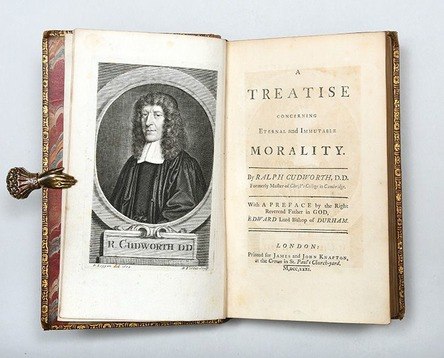
His main work is a mostly unreadable theological-laden trilogy, which, with some effort, sections and pages of pure gold can be found. Luckily, after he died, he left an unpublished manuscript called A Treatise Concerning Eternal and Immutable Morality, which is mostly about epistemology, and is amongst the richest books in innatist epistemology in the history of philosophy.
Far more than Descartes or Leibniz, in my opinion.
The name "rationalistic idealism" is given by historian Arthur Lovejoy referring to Cudworth and Henry More, in his Kant and the English Platonists, I believe. I think you've read that. I can't really think of a better label.
Defies categorization? In some respects, sure. But he certainly in the rationalist camp. -
What is the "referent" for the term "noumenon"?
I'm not a fan of reductionism.
I'm a rationalistic idealist, like Descartes or Cudworth or Chomsky - along those lines, though not metaphysically dualist.
We probably agree on like 90%+.
Now that I have been informed that I am getting a Christmas card, I have to do one for you...
Sigh.
Fair enough. :cool: -
What is the "referent" for the term "noumenon"?
Yep! Can count on you to put it in that sophisticated formulation.
Once a dualist always a dualist, right? — Mww
Hah.
Well man, what can I say? We eliminate as much as we reasonably can. Whatever remains, call it what you will, is what we have to work with. -
What is the "referent" for the term "noumenon"?
I take it to be the notion that beyond this postulate (negative noumenon, thing(s)-in-themselves), we cannot know the nature of reality.
We can study representations, not noumena.
Edit:
In fact, Kant goes so far as to argue against Leibniz' monads, precisely because Leibniz was introducing these as positive noumena (not that Leibniz used these terms), the fundamental and complete nature of reality.
And Kant argues, correctly, in my view, that we don't have access to this type of knowledge. -
What is the "referent" for the term "noumenon"?
I believe it does. All I'm claiming, is that I believe the idea of the "thing-in-itself" is more coherent, for the type of limiting notion Kant was introducing.
It could be that "behind" or "supporting" the representations, there are a plurality of things. That's an additional thought, that is, it adds an extra notion to the idea of "thing-in-itself", which as stated, is singular.
Granted, saying this "solves" almost nothing, there is still stuff left to iron out, that is what kind of grounding relation exists, how does multiplicity arise, are we postulating the simplest possible thing, etc.?
I believe Kant would say that we can't answer these questions, as we would be entering the idea of "positive noumena", and fair enough.
My intuition (in the non-technical sense) is that this idea can be worked on at the margins anyway. -
What is the "referent" for the term "noumenon"?
He's an empirical realist and a transcendental idealist. Kant has some very acute and critical things to say about common sense, incidentally, though the comments I have in mind appear in his Prolegomena, not the Critique.
We might think it or think it and perceive it or maybe imagine it - this is terminological, which is not to say it does not matter, it does.
The point is that individuation is an extra step, as applied to the concept of "things-in-themselves", it adds something to what would otherwise be singular, the thing-in-itself.
If we want to attribute only what is strictly necessary to such an idea as the negative noumenon, then it is simpler to assume the existence of a single "thing", than to attribute many things, and say all these several things each have a thing-in-itself as the grounds of the representation.
Maybe plurality is correct. It's not so clear to me.
As for the specific page in Schopenhauer, I do not recall, he probably does mention it in the Appendix, but I believe he also mentions it in both volumes, more so in the second one.
My memory isn't pristine either, though it's not an age issue. Limited "software" as it were... :wink: -
What is the "referent" for the term "noumenon"?
That's right, I think on this point Schopenhauer was correct.
I think you are starting from the wrong end. We see plurality, much the same way we see color, we can't help but see them in objects. Doesn't mean the object has color, or that the objects are in fact separate from something another object.
We identify a tree from the surrounding ground (both as representations, of course), but that's something we apply to the environment, it could be considered a single thing. -
What is the "referent" for the term "noumenon"?
I meant to say that isn't he making an assumption that things in themselves, are plural? The fact that he is referring to plurality by speaking of "things" adds individuation, which is an additional attribution to the general idea of the "thing-it-itself".
I'm not questioning that something like the thing in itself exists, I think such a postulate is quite necessary. -
What is the "referent" for the term "noumenon"?
Thanks for the clarification.
Nevertheless, isn't Kant making an assumption by saying there are "things in themselves"? This includes plurality, how do we know if there is such a thing? -
What is the "referent" for the term "noumenon"?
Yes, that is my understanding too. That doesn't mean that positive noumena are impossible, just that we can't comprehend how they could exist, or even if they could exist at all, but the possibility of such a thing remains open.
Kant sometimes oscillates between the "thing-in-itself" and "things in themselves", and these, obviously, are different in an important respect, in that one presupposes individuation, the other does not.
Manuel
Start FollowingSend a Message
- Other sites we like
- Social media
- Terms of Service
- Sign In
- Created with PlushForums
- © 2026 The Philosophy Forum