
-
Ukraine Crisis
So are you saying that demanding that independent countries have no right to make decisions on their own security policy is diplomatic?I do know Putin has remained fairly consistent regarding his dislike of NATO expansion and has not exactly been undiplomatic in his tone — I like sushi
One can say those things without ranting as Putin does. But they are threats.
And just why would there be a right for Russia for a 'buffer state'?As for annexing Crimea there was a whole lot of unhanded US and Russian business going on in the Ukraine at the time where both were actively in disagreement about the Ukraine's position as a kind of 'buffer state' between Russia and the West. — I like sushi
Is Canada a 'buffer state' of the US?
After the war of 1812, when the British kicked the asses of the young upstart US, the US hasn't had claims for Canadian territory or had ideas that Canada ought to be part of the US. If the US still had such aspirations, I can guarantee US-Canadian relations wouldn't be so warm and friendly. With Ukraine, the present Russian leadership has quite different and in fact hostile ideas, starting from the idea of them being the same people. (Putin won't have Russia to join Ukraine, you know...)
And seems one has to remind that a de facto state of war already exists between Ukraine and Russia. So it's ludicrous to assume that Russia wouldn't be here the aggressor, but it somehow is the US and NATO. The sad fact is that prior to all this, prior to the annexation of Crimea, Putin actually was very popular in Ukraine.
He isn't anymore. -
A Mathematical Interpretation of Wittgenstein's Rule Following Paradox
That what is generally depicted with 2,4,8,...yes, in the case of a potentially infinite sequence of numbers — sime
Not that it ends sometimes, which would be 2,4,8,.....,a.
?it is meaningless to consider any particular function, let alone algorithm, as being descriptive of the sequence unless and until the sequence comes to an end. — sime
if the sequence is for example N, then the correct algorithm is "list all natural numbers". And natural numbers don't come to an end.
Either there is the correct description or their isn't. Those are your choices, they aren't meaningless. -
Ukraine Crisis
Would do you think so?I think war is pretty much what the US government is looking for. — I like sushi
Did the US put over 100 000 troops on a border of Ukraine?
Did the US annex territory of Ukraine?
Has the US expressed doubts of the sovereignty of Ukraine?
A bit illogical. -
About a tyrant called "=".Is math powerless without =? — Cornwell1
Basically, yes.
Math is all about =.
You see, math has emerged from a need to picture reality around us.
Calculation, addition and substraction has been something that we need for practical uses. Math hasn't developed from some existential philosophical interest, but how to solve practical problems. Even animals can count: if a bird sees three men going to a barn and two of them later come out, the bird can count that one of the men is still inside the barn. And calculation, computation, is all about something is equivalent to another.
Now people might think that < or > would be different, but basically it's applying the same logic. The real opposite to this is the non-computable.
And what does and can mathematics say about the non-computable?
Only that it exists. That there exists mathematical entities that are non-computable. And that's it.
And what do we do when we face a problem that is non-computable?
Well, we surely don't use math to solve it. In fact, we likely don't approach the problem as if there would be one certain true solution for it and that one can deduct it somehow. And to describe it we don't make any mathematical models or formulas, but for example use narrative. -
A Mathematical Interpretation of Wittgenstein's Rule Following Paradox
I find this confusing.Now, let's take your numerical example:
From a 2, 4, 8 sequence we could interpret all kinds of pattern (rule) that this sequence follows - but as it has been established, our interpretation of the rule has nothing to do wether we're obeying it or not.
But what exactly is our rule then? Where does it come from? How can we confirm it?
The rule, in the case of such a sequence, is determined by the author. — Hermeticus
If there genuinely is a pattern with 2,4,8,... then that pattern will describe the number chain or series to infinitum or otherwise it's a wrong pattern or the series of numbers is basically without a pattern, patternless. Here to talk about rules it would be better to talk about algorithms in the general sense. And either you have an algorithm that correctly tells you how the series 2,4,8,... goes or either you have the wrong algorithm or the series is non-algorithmic.
Nothing to do with the author, the subject. Our understanding or incorrect understanding about the series doesn't brake this logic. -
Ukraine Crisis
Nope, I've been born in the early 1970's.did you live through the Cuban missile crisis? — The Opposite
I think there's nobody here who is genuinely backing Putin, but many of course are very critical about US foreign policy and the West in general. This can then make people to actually mouth the views of what Putin is saying.But this is a time for clear-headed, measured, assiduous communication between all sides involved. Upon initially going through this thread I felt like insulting those I believe to be backing Putin (something about taunting certain people about not having a real Russian tradwife like another particular member presumably does), however, this ultimately gets no one nowhere. Just a microcosm of the overall discussion, but worth noting. — The Opposite
Yet one should really think twice just how "aggressive" the West is here. The Soviet Union collapsed. The countries that emerged from that rubble didn't genuinely want be part of any Russian-lead union and the idea of CIS (Commonwealth of Independent States) was a non-starter. Ukraine, which was as wealthy as Poland when the Iron Curtain fell, has seen the East European countries and the Baltic States become far more prosperous countries while it hasn't basically gone anywhere economically. The desire to join the West is real among the people of Ukraine, it isn't some astroturf movement concocted by the US using George Soros as a front.
(How Polish and Ukrainian economies have been on totally different tracks, with one being a member of the EU and one not.)
This is the issue that those "understanding" the Putin line of NATO expansion forget: that a) these are independent countries have wanted to join NATO and b) Russia's actions, especially it's now several annexations of parts of it's neighbors, has just reinforced the reasoning why to do this. Putin's Russia obviously wants to have the power that the Soviet Empire once had. The denial that Russia lost it's empire is the crucial issue here.
To say that Russia has a right for a "sphere of influence" is basically an imperialist argument that Russia deserves somehow to have it's old empire. It doesn't and it surely hasn't tried to be friends with it's new neighbors. It has lost it just like Austria has and should face reality. And as it has been a real bully, it hasn't had the success that the UK has had with the British Commonwealth with CIS. -
Ukraine Crisis
Ok, so the conflict is at the point that here in PF it got a dedicated thread!
Actually, I genuinely hope that this (or similar) threads aren't going to be very long or as long as the COVID thread. Everybody understands what would make this thread go on for long... I myself have commented the Ukrainian on the Biden adminstration thread two months ago (starting here), so it's not something out of the blue.
The bottom line is that the demands Putin put on the table were obvious non-starters, they simply won't be achieved, and that's the worrying issue. In fact, when Saddam Hussein decided to "solve" his financial troubles by annexing Kuwait, the fig leaf for deploying a huge army on the Kuwaiti border was far better than now with Putin. Hussein accused Kuwait of drilling into Iraqi oil fields and demanded OPEC countries to stick to their quotas in order to get the oil price up. This got several countries to support his actions...until he invaded the small neighboring country that had actually assisted it during the Iran-Iraq war (another war he started). Making demands you know the other side won't accept at start seems very, very worrying.
Now many might argue that this is a negotiating tactic, that Putin will now milk concessions from the West. Might be, but then, this is a guy who started his political career with war, has relied on wars and hasn't avoided using military force. And has actually sinister views about Ukraine, especially on the validity of the country's sovereignty. And above all, what's to stop a nuclear armed power doing whatever it wants, when the other side has already said it will only respond with economic sanctions.
As Neil Ferguson said, the chances for an enlarged war is 50/50. I agree, it's very worrisome. -
Joe Biden (+General Biden/Harris Administration)
And this just shows that there is truth to what they say about EU and NATO: that these organizations make members to be team players, or at least not to have open military hostilities with each other. Greece and Turkey, two NATO countries with the worse bilateral relations, have barely avoided war. Yet without them being NATO members, they would surely have had a war or two between the two armed forces since WW2.Maybe not Austria, but the Hungarian rightist government still thinks it should be granted its 'greater' pre-WWI borders. This is the gut feeling Putin has for Ukraine and many Ukrainians are sympathetic to Russia. — magritte
What are the options? The end of democracy in America in 2024 or another world war. — magritte
Oh yes.If Trump would win in 2024 and if the US and the West would be at that time even deeper mired to an Ukrainian bog (assuming if Putin would make large scale attack into Ukraine), that would be a really, really confusing time. -
Can this art work even be defaced?
Money or influence doesn't make you hear things differently.The elite have different cultural and practical predispositions than the lower class, so it only makes sense that they experience things differently. — baker
On the other hand, it's understandable that people don't have as a sport hobby polo as horses are expensive. But listening to classical music isn't. -
Donald Trump (All General Trump Conversations Here)
They are not blind. And yes, as you said, a person always calling everyone else a liar is the usually the biggest liar. You see, these persons usually genuinely believe all people to be liars so the person thinks that lying is just the way the World works. For Trump lying is totally normal. It's the way he works and how he thinks the world works. After all, he has gotten to be President, he has been able to create this picture of being a billionaire when nearly bankrupt, so everything he has done reinforces his own twisted worldview. Objective truth is for idiots and losers.Yeah, a man always pressing fake news is probably himself spreading it. I heard that he wants to go for president again. Will the people still buy that? Or are they truly blinded? — Raymond
With Trump supporters it's just like with the case of conspiracy theorists. Naively you would assume that a conspiracy theorist would want truth, honesty and objectivity upholded. Bullshit. Nothing is farther from them. You see, they promote willingly the most obvious propaganda as ever, because they assume everything they hear on the evil mainstream media to be propaganda. Everything. It's not a world where a journalist might get something right and something wrong and may have some bias. It's all and everything. So to counter this evil propaganda, you have your own propaganda. Everything is just propaganda. You counter the other sides propaganda with your own and with propaganda truth doesn't matter, but that you win the argument and support your side.
Hence it doesn't matter what crimes Trump is accused of, it's all simply propaganda. No need to hear it, no need to take it into consideration as only the people who are against you promote it. -
Can this art work even be defaced?
Well, if you wrap yourself around old social structures, you'll find awfully many instances of how it is said that the peasants/ the rednecks/ the white trash don't appreciate the higher things in life. Or understand them. You see, to uphold a class society in things like art, culture or sport, you not only have to have those that think it's their thing, you also have to have the others who think that it's not for them, but only for those other people who they don't belong to. At worst, the thinking goes, if someone likes for example the music of "the other class", they are just trying to be someone who they aren't. Phonies.I only need to remember my music teacher and my literature teacher from elementary school! And then some teachers from college, and the general attitude among the academics and the intelligents.
In their view, people like me are not able to "genuinely" like the music. I mean, there are essays and other texts written on how people from lesser socio-economic classes (ie. "peasants") can have only a shallow and sentimental understanding of art. — baker
Basically it comes to this: if you cannot laugh at haughty people, it's more of a problem of yours. Because those people who say they can like "genuinely" more music than others are simply very silly, haughty people.
Liking music isn't the same as understanding everything about quantum mechanics or molecular biology.
Now you might disagree with me, fine, but please understand that I was brought up in a society that isn't so class conscious in every way as the US or UK are. -
Joe Biden (+General Biden/Harris Administration)
Uumm...because they have already done that? You see, there already is a war going on in the Donbas. Or that they had made demand the West cannot accept (based on Westphalian sovereignty). It's hard to deny something that has already happened, as you are saying.But whence this idea that Russia wants to invade Ukraine?? — baker
Really?This is pure provocation on the part of the US and their EU allies. — baker
Just who has put 100 000 troops on it's border to a neighboring country? And furthermore, please note how Putin views Ukraine. As I said 6 days ago, I urge really to read what Putin himself has said about Ukraine and Russia, if one dares to venture to the official site of the Kremlin:
Article by Vladimir Putin ”On the Historical Unity of Russians and Ukrainians“
Yes, it's a lengthy historical text, but do notice the open hostility towards the current independent Ukrainian administration is clearly evident. Even the independence of Ukraine as an sovereign state is put into question. I already had a long debate earlier with @StreetlightX about just how "nazi" the current administration in Ukraine is. Yes, Ukraine has a small fringe of the extreme right, neonazis, of whom many volunteered for the fight against Russia in 2014, but president Zelensky or his centrist party are not nazis.
I only hope that you would also look at how Russia has been behaving here towards it's neighbors as it's actions, it's wars and annexations of parts from two neighboring countries is the reason for all this.They've been treating Russia as if it was a rebellious teenager who needs to be put in place. They've been pretty much telling Russia words to the effect of "You're bad, and you're doubly bad because you don't admit that you're bad". — baker
And if you really argue that Russia has a right to do this, please think twice what you are saying. The Soviet Union collapsed. Period. It went into the garbage bin of history just like the Austro-Hungarian Empire. But now it would be as if Austria would demand "a sphere of influence" over Hungary and the Czechs and Slovaks. -
Joe Biden (+General Biden/Harris Administration)
It really happened when the Soviet Union collapsed. The best example of this when you had the liberation of Kuwait by older Bush and the occupation of Iraq by his son. The great diplomatic lengths that Bush senior went, the huge alliance consisten of Pakistan, Egypt, GCC countries, Morocco and even Syria (whose armed forces actually during his vice Presidency the US had bombed and had lost aircraft shot down) show how that wasn't the unipolar moment. After it, it was. Many same guys where there with the younger Bush and basically didn't care a shit about others. Not even France, a long term ally of the US, didn't bother. (And the US response was Freedom Fries!)I'm sure you realize that American unilateralism started before Trump — frank
I would say bluntly, that for the US to behave reasonably, to take into account other countries and to form alliances, the country needs a real threat of nuclear weapons. Then it truly thinks of how others might respond...and makes rational choices. When there's no actual threat of large losses, then some cabal can hijack the whole foreign policy to cater for their own objectives. Many examples of this in Central America and the Caribbean.
Definately not. Just as Sweden, the US isn't a military threat. Why would the US put sanctions, threaten with occupation or annexation Finland? In the 19th Century the US was a similar bully as Putin's Russia towards it's neighbors and in the case of it's northern neighbor back then, it got it's ass kicked in a humiliating way. Hence you have warm relations now, I guess.What does that mean in practical terms? I thought you said that the Finnish prefer Russia to the US in terms of hegemony. — frank
Do notice that the membership in the Warsaw Pact wasn't voluntary for the countries under Soviet occupation. The non-aligned status of Yugoslavia is notable here, as it hadn't been liberated by Soviets and had no Soviet troops. It had no interest voluntarily joining the Warsaw Pact, as neither had Albania. Yet NATO is voluntary. The de facto non-voluntary allies of the US, those countries where US has put a leadership into position by force, have huge problems with the relationship with the US (Iraq case example). The rapid speed of the collapse of the Afghan government just shows how this simply doesn't work: you don't just occupy a country, put your lackeys into power and assume everything will go smoothly and then just walk away. South Korea is a case example of how long it takes for a war torn country to get on it's feet. It could well defend itself, but left alone, naturally would have to start a crash-program to obtain a nuclear deterrent.
I think many Americans see NATO as just an extension or tool of American security policy. Yet a lot of European countries have put their own security policy on the hands of NATO and hence NATO is genuinely also European security policy. Many times US has wanted to do something, but other NATO countries haven't been interested.
If the US would go out of Europe, oh boy! Think about instability as everyone would rearrange their security policy and alliances would be enormous. But Putin would be extremely happy. -
Can this art work even be defaced?Indeed.
What is really fascinating in live music is that a lot of music that you wouldn't otherwise listen to and would immediately change the channel while listening to the radio while driving, suddenly feels great when you hear it played live. And naturally the smaller more intimate the music session is, you naturally focus even more.
However good our headphones and audio systems have become, there is so much more to a live performance. It just shows there's more to music than our ear sensoring the vibration of acoustic waves. -
Joe Biden (+General Biden/Harris Administration)
If so, who then the US sees as a reliable and effective ally? Or is like with Trump that the US needs no allies?I don't think the US military sees Europe as a reliable or effective ally. — frank
* * *
And Again. Biden being Biden just the way Biden can be. This was noted here in the papers and also in Ukraine. So a small incursion is OK? Or did he utter what the views are going around in the White House?
Finland admitted that it has increased it's military readiness due to the present tense situation. The UK is increasing arms exports (NLAW anti-tank guided missiles) to Ukraine and increasing it's military advisors to train the Ukrainian armed forces as part of Operation Orbital. (The link has also an interesting map just where the UK armed forces are now around the World.) -
Can this art work even be defaced?
Ok! I take my words back. I think it is you who got bored with the people...In the past, I would regularly go to the monthly concerts of the resident symphony orchestra, the chamber music groups, and the occasional fancier performances held by VIP guests or at VIP venues (like an organ concert at the cathedral).
Back then, I was quite naive and wasn't all that aware of the class issues. I actually stopped going to the concerts mainly because I saw myself becoming a snob and didn't have the money to justify it. For example, for a piano concerto, I would pick a seat in the front row right before the piano, so that I could focus on the piano best. Or I would collect and compare different interpretations of the same piece, and I would get a thrill out of watching out for how each interpretation handled a particular passage. I just don't have it in me to "sit down, relax, and enjoy" the music. I don't know how other people do it. — baker
Your front row experience make's me remember when I was a child, I was dragged to see ballets with my father and his cousins family. Actually I liked it, but we we're always at the cheapest seats high up many times on the last row sweating. Few years ago my wife bought tickets to a ballet with seats on the parquet actually close to the dance. And for the first time I saw that the dancers had expressions. The classic Swan lake was far more awesome to see the expressions of the dancers.
If they genuinely like the music, why on Earth not?So you really, genuinely believe that anyone, regardless of socioeconomic status, can be the appropriate audience for a classical music piece?
If yes, what is the basis of this belief of yours? — baker
So yes. Assuming the person doesn't mind the "what the hell is a person like that doing here??!!!"-looks from others and people will try to ignore you. You see, people won't be thrown out because of their socioeconomic status in any open event. A private club is a different matter.
And if we start arguing if a homeless guys that stinks horribly (for not taking a shower) for months will be thrown out or not let in or not, the conversation is a bit off the actual issue. -
Why You're Screwed If You're Low Income
It's naturally permanent, because naturally there always will be those low income. And income classes aren't fixed. Some rich oil country which has no taxes, provides all the services free and gives salaries to it's citizens still have those who are "low income". Yet one simply has to look at this on absolute terms. Just what kind of lifestyle those that have the lowest income enjoy? That is quite different from country to country.The state of being low income is what's permanent, not necessarily the people. — L'éléphant
It's just like with income inequality. Income inequality decreases in a severe economic depression or in war. That's just how statistics work. -
Joe Biden (+General Biden/Harris Administration)I think the focus is on Ukraine, but action against Ukraine will have effects on relations with other countries also.
If either Finland or Sweden or both join NATO, of course there's going to be sanctions and extremely tense relations and a strong response from Russia. But then again, something like a large invasion of Ukraine might trigger that and the countries could see that "enough is enough". Remember, things aren't just about a full scale occupations, but all the ways that then Russia can pressure both countries. Putin might be very happy if the times of "Finlandization" come back and Finns will have none it. It's not 1945, he's not Stalin and present Russia isn't the Soviet Union.
And then there is the other side to the equation: now Finland and Sweden have far more better relations with Russia than NATO countries and both would be happy if things would be OK as now. A passive Russia likely would mean that neither countries would join NATO. There isn't a desperate urge to join the alliance.
Of course an "out-of-the-blue" occupation of let's say of demilitarized the Åland Islands or the Swedish island of Gotland is a possibility, but I think that probability is still very low. -
Joe Biden (+General Biden/Harris Administration)
Oh don't be sorry.I thought you were admiring his ingenuity. Sorry. — frank
To admire someone means that you have overall positive image of the person. Yet one can admire, or acknowledge something in a person, even if other things are negative. Ingenuity and shrewdness Putin definitely has, and balls too. People have their good and bad sides.
I just think he has started to believe his own lies, that the US is out to get Russia, the public reasoning behind everything including his insistence in staying in power. Not that he's trying to act as the he can get the Soviet Empire somehow or at least partly back together. Basically he just didn't understand that to keep calm, be positive and you could get your way. Simply put it, the US couldn't uphold the Monroe doctrine if all the other countries would truly feel threatened by it.
In fact Central Asia is a perfect example how Russia could defeat "the imperialist" US. By mid-1994,
Kazakhstan, Kyrgyzstan, Turkmenistan, and Uzbekistan, had joined NATO’s partnership for peace program (PfP), and officers from these states, plus Tajikistan, began participating in PfP exercises as of 1995. Then happened 9/11. Suddenly Uzbekistan, in particular, and to a lesser extent Kyrgyzstan, Tajikistan, and Kazakhstan became frontline states in the U.S.-led struggle against the Taliban and the Al Qaeda network. Top U.S. officials streamed through Central Asian capitals. And what do you know, the US had then bases all over in Central Asia! Tajikistan even had both a Russian military base and a US base.
(This is how it looked before the US withdrawal from Central Asia. Now east of Iran there are no US bases, except those in the Far East facing China.)
Then simply the US withdrew and now the Central Asian states hold military exercises with Russia and Kazakhstan had to ask for military help to quell riots, which Putin gladly assisted with. I guess now Kazakhstan has quietly buried the defense cooperation agreement it made with the US. So what happened? Russia simply operated in the shadows, didn't start to threaten (not at least openly) the countries and in the end just waited it out that the US became exhausted and pulled away leaving the place back in the sphere of itself. They got the message, just which country would defend them against possible "muslim extremists" from Afghanistan.
The the biggest error Putin made was to go and annex Crimea, simply put it. But the glory to take it back was perhaps too much for him. The fact is that his actions have made it so the we and the Swedes are having a real discussion about NATO. Sweden even got back it's military conscription. -
Blood and Games
I'd say the virtuousness of gladiators has to be viewed from the values of the Roman society. Martial prowess was something that was revered and held important in a society which basically needed to invade, occupy and loot the wealth of others to increase and basically sustain it's wealth and stature. Once Rome didn't conquer new loot, it faced problems. Even if the "globalization" of Antiquity worked well enough to uphold an advanced economy, that basically we only started to see in the Renaissance of after, it simply couldn't grow as our own societies. So no wonder why the country was basically constantly fighting others and itself and the ordinary Roman likely didn't know (or care) who the emperor in Rome was. But martial prowess, bravery in war and combat, was seen as something good.Well, I've rambled, I see. But I think interesting issues are raised by the subject matter of my rambling. Were gladiators virtuous? Did the games provide examples of virtuous conduct? — Ciceronianus
I think the older historians from early 20th or 19th Century could capture far better the feel much better than current generation, who wouldn't tolerate such "nonsense" talk of glory or virtue.
Unfortunately. -
Joe Biden (+General Biden/Harris Administration)
Of course.So you love him too. Good for you. — frank
What else could you think of a person who starts their political career by killing 300 totally innocent Muscovites and other Russians to restart a war that then kills from 50 000 to perhaps 150 000 people, because the first war before was an unmitigated disaster? -
Big Pharma and their reputation?Many people like to discuss the pharmaceutical companies as a kind of leach that creates expensive treatments that just about never go down in price, but very rarely cures. Like their only incentive could ever be keeping people sick. Is it helpful to discuss them in that fashion? Does it light a fire beneath them, or are they actually doing their best and nothing anyone says could have any meaningful effect? — TiredThinker
Some criticism is needed, but then again, the industry has to be understood.
Which is preferable for a pharmaceutical company: to create a vaccine or have people eat daily medicine doses for the rest of their lives?
Now the answer would seem to have vaccine shots for the rest of their lives, but I think people get the drift. Naturally having people eat daily their medicine is the more profitable option. A huge pharmaceutical company might get the vast bulk of it's revenue from only a few medicines and once those patents run out and others can produce cheaper alternatives, the "gold mine" of a successful medicine dries up. That the R&D costs much it's a gamble. And creating vaccines was very difficult and a long process (as Operation Warp Speed isn't the typical way these things are done).
In the US this whole debate gains a totally different perspective as the whole system is so absolutely flawed and performs so poorly by every standard, that it's understandable that people might think of "big-pharma" as something nearly evil. Yet here one has to remember that if you really would have universal health care coverage, the companies would adapt in no time to the new environment. After all, the do just great also in countries with universal health care and cheap medicines. -
Joe Biden (+General Biden/Harris Administration)
He is a Silovik, something like a "securocrat". And an awesome spymaster.So he's a petty warlord. Very Russian. — frank
Perhaps the problem with all the US administrations is that US Presidents basically seem to assume that other leaders are like them, that they are also people that have risen through a political party system to gain the highest places in their country. Not so with the career spy and FSB director that Yeltsin just put on the chair of the prime minister. There were no elections, no election campaign for Putin to get that job. His election campaign for President was to fight and destroy the Chechens in the second Chechen war. That's a totally different world than making speeches in New Hampshire. And that reality makes you think about the World differently.
I guess only George Bush senior as a former CIA director himself and perhaps a military man like Eisenhower would have understood Putin right away. But the current one's with their administrations have seemed to have tried to make "a reset" and then have been disappointed in the end of the outcome.
I mean, literally, they have tried to push "the reset button":
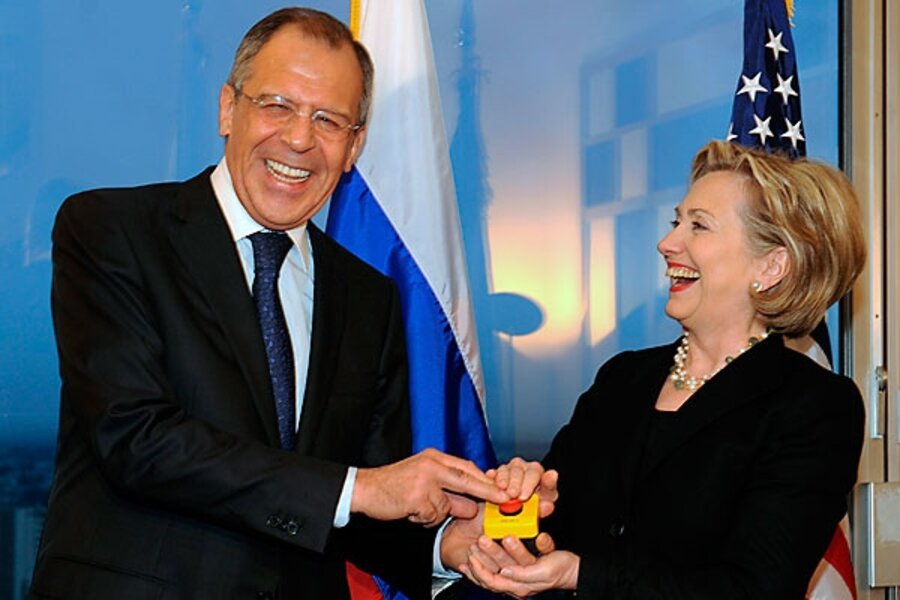
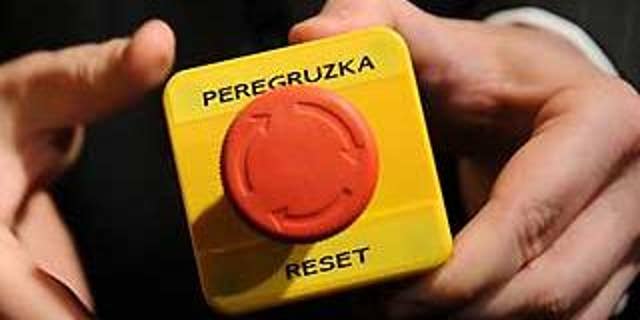
At least Biden didn't try to push it. Not yet. -
James Webb Telescope
The private programs have shown us that space exploration isn't just a thing that NASA or other great powers can do. That's the really positive issue with them.Seems like costs don't matter for Musk. The guy wants to move to Mars and die there, together with his girlfriend. Something has gone horribly wrong on Earth! — Raymond
The problem with the private space programs where billionaires want to go to space / to Mars is that:
a) The can die (of old age or disease) and their heirs likely will want to argue about the inheritance rather than continue on with the (vanity?) project.
b) They can run out of money or interest (likely money).
c) The stock market can crash and these multi-billionaires are left as ordinary billionaires or even worse, as rich "billionaires" as Donald Trump. And that simply stops the programs.
If there is a stock market crash and a severe economic downturn, Jeff Bezo's private space and Elon Musk putting a Tesla roadster on an escape trajectory might seem as the excesses of an age where the wealth differences, unequality between the rich and the poor and the stock market hype hit the extremes.

Then of course, the future might be so that the saying "You ain't seen nothing yet!" will be appropriate. -
Joe Biden (+General Biden/Harris Administration)
Start from what Putin thinks of the collapse of the Soviet Union:Is it that Putin wants to grow Russia back into a regional power? — frank
The classic quote from Putin. That is his World view.“First and foremost it is worth acknowledging that the demise of the Soviet Union was the greatest geopolitical catastrophe of the century,” Putin said. “As for the Russian people, it became a genuine tragedy. Tens of millions of our fellow citizens and countrymen found themselves beyond the fringes of Russian territory."
Yeah. In fact without annexing Crimea and trying to act as an mediator in Ukraine NATO countries (except the US) would have continued to dismantle their armed forces, the basket case of an economy Ukraine likely wouldn't have gotten into NATO and many Ukrainians would supprt Putin, who along with Russia would have been treated in high esteem (after all, he is a talented smart leader).It just seems like he would benefit financially from good relationships with western Europe. Why alienate them? — frank
Just remember, Putin rose into by starting a war, the second Chechen war, with a very likely "false flag" operation of killing Russians citizens in a distant sleeping suburb to get the "casus belli" to go after the Chechens after a peace agreement had been signed with them. Then his popularity got up with the Russo-Georgian war (where the Georgians overplayed their hand) and finally got huge popularity boost by annexing Crimea.
You think this guy really thinks about the economy, the stock market and foreign relations first? -
Joe Biden (+General Biden/Harris Administration)What do you mean? — frank
Basically that tensions have escalated and the threat of war has basically increased to the level that we saw during the Cold War.
Yet here I have to say that during the Cold War the threat of war in Northern Europe (Sweden and Finland) was basically low compared to places like the Middle East or here earlier in the 1930's (then the Finnish Army considered a war with Soviet Russia basically a certainty, not a probability).
After the Russo-Georgian war in 2008 basically only few analysts and the Baltic States raised the alarm. Yet Obama decided (again) to reboot the US-Russian relations, try to be friends with Russia while NATO was focused on it's "new missions": things like operations in Afghanistan and later Libya.
2014 changed all that. The annexation of Crimea took the US and the West totally at surprise, but then NATO basically "found back to it's roots". Suddenly NATO troops did start exercises in the Baltics. If the 2008 war and annexation of parts of Georgia didn't wake people up, the annexation of Crimea did it. And the climate truly changed. After that now US and NATO troops have exercised in both Sweden and Finland and basically are all but in name in NATO. For me it's nearly a culture shock to see foreign troops, young British soldiers, in one of our naval bases eating pizza at the soldiers home.
Yet that fig-leaf of not being a member of NATO is crucial for Russia and for the two countries. And naturally gives a similar option for NATO to withdraw if there would be crisis in Finland or Sweden with Russia.
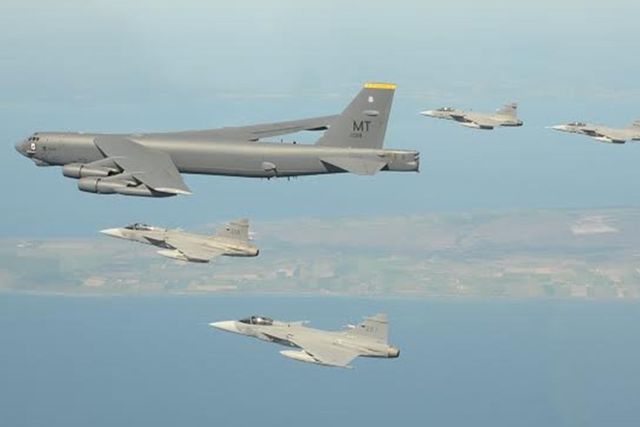
B-52's practiced mine-laying in Swedish waters in Baltops 2015. Here one of the bombers posing with Swedish fighters for a photo in Swedish airspace:
Sweden has raised it's readiness by deploying more troops to the Gotland Island and rolled armored vehicles into the street of Visby just two days ago:
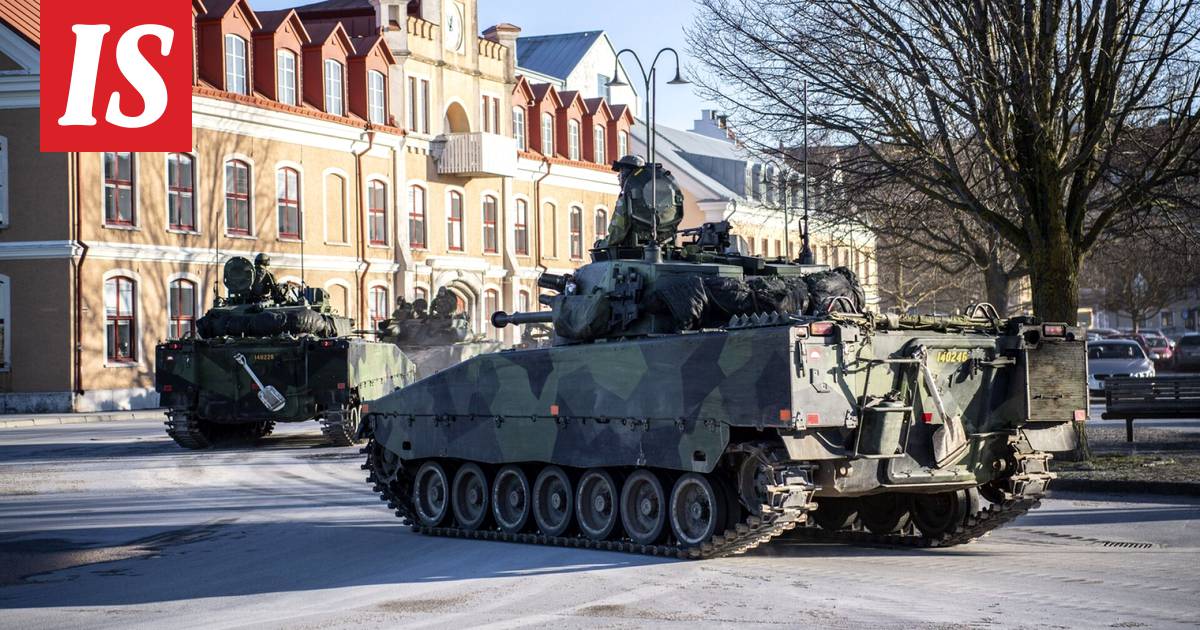
I remember Neil Ferguson commenting a week ago that the chance of the war escalating in Ukraine is about 50-50. 50% probability is quite high in my opinion. Let's hope we get lucky and these tensions ease... -
James Webb TelescopeGreat example of how programs are pushed further and how the costs just balloon.
Interesting to see what James Webb tells about exoplanets and early galaxies. After all, I remember the time when exoplanets were just a hypothesis, although a very strong one.
But then there is the cost, as always. Something similar will surely happen with Manned Mars missions. If they really leave the drawing board.
Good if I see something happening there in my lifetime. Or my school-aged children's lifetime. -
Joe Biden (+General Biden/Harris Administration)
Yet after the Pershing expedition going after Pancho Villa, the US hasn't deployed it's military to fight in Mexico. In fact, Mexican troops were invited by Bush to assist in disaster relief during Hurricane Katrina, this first time since WW2 that Mexican troops were sent abroad.Any insight into why the US might care if Russia formed a military alliance with Mexico and put its missiles there? Same reason. — Baden
A Cartoon during the last time US went into Mexico:

Bush with Mexican marines and US Navy Seabees in Gulfport, Missisippi:
/https://www.thestar.com/content/dam/thestar/news/world/2017/08/27/mexican-troops-saved-american-lives-after-katrina-would-they-be-inclined-to-do-so-now/katrina-mex.jpg)
But you can just ask how successful the Monroe doctrine has been especially with Cuba and later Venezuela? Or ask President Ortega of Nicaragua. You see, once you start to pressure countries and act as a bully, you might get the whole country backed on the corner and find that there are no more avenues to influence otherwise than direct military attack. Covert actions can go only so far. And then other one won't back down and just face your military. Remember that Fidel Castro wanted the Russians to use nuclear weapons if the US Marines would land on Cuba during the Cuban missile crisis. Sure, the US can be the bully in Guatemala, Haiti, Panama and Grenada, but when it comes to Mexico and especially South America with Brazil, Chile, military intervention would be a huge quagmire. And then the neighboring countries really could ask for help from China or Russia. In it's near abroad, Russia has simply been too aggressive.
Simply put it, you can be a bully up to a point, but friendly relations simply work better.
Good at least that you offered the Baltic States NATO membership. At least they have enjoyed a moment without been under Moscow's supervision.Yeah, the US doesn't need that iceberg they're sitting on. — frank
I remember when the Baltic States had just re-emerged as independent states that the US and UK in diplomatic talks asked both Sweden and Finland if the two countries would guarantee the independence of the Baltic states. Both were horrified about the idea: the two barely can guarantee their own sovereignty (Finland even more trouble with that), so the two neutral Nordic cordially rejected the idea. There was both in Helsinki and Stockholm true happiness when the Baltic states joined NATO, but immediately both militaries noticed that there wasn't any plan how to defend them as NATO didn't exercise in the Baltics. That all changed after the annexation of Crimea. Now NATO has exercises even in Finland and Sweden. It's a lot colder now in this region than before 2014. -
Joe Biden (+General Biden/Harris Administration)
If people find the subject interesting, I urge people to read what Putin himself has said about Ukraine and Russia, if one dares to venture to the official site of the Kremlin:Why does he want Ukraine anyway? Access to the sea? We've already talked about why Ukraine doesn't give up. Can't say I understand the region at all. — frank
Article by Vladimir Putin ”On the Historical Unity of Russians and Ukrainians“
There you can read a short introduction to Russo-Ukrainian history, just how close or basically the same country they have been. And that Ukraine has basically been an artificial construction. And how, of course, everything done to break this bond between the two people have been come from outside, from the West (not by Ukrainians seeing that other countries have prospered under the EU). But read it yourself.
And why? Purely on defensive issues, Russia then will have a huge border with NATO. US and NATO tactical combat aircraft can already reach Moscow from the Baltics, but with Ukraine
And why does Putin think that the West is going to attack and get them? Well, a good enemy gives one a reason to stay in power, to fight against "color revolutions" and everything else purely machinated from the evil US. First it was Napoleon, then it was Hitler, and Putin will make it sure it's not going to be Biden or any other US president. -
Joe Biden (+General Biden/Harris Administration)Oh right, irrelevant blabber like what is the actual administration ruling Ukraine now is. :roll:
Of course, when Russia annexed Crimea and started the Donetsk and Luhansk uprising, the nearly bankrupt Ukraine didn't have at first nothing than one paratroop brigade and these voluntary battalions to fight in the Donbas as their mobilization was extremely slow. And of course these voluntary battalions proved to be a headache later and naturally the Russians used extensively these people to portray the Ukrainian altogether as nazis (as those fighting in Donetsk and Luhansk are Russians, Novo-Rossija and so on).
But I guess that a volunteer battalion that was taken out of the front line in 2015 (as all other volunteer battalions) and now made one National guard regiment, but likely still has those ulra-rightwing soldiers, means that the whole Ukrainian armed forces of 225 000 (plus the 900 000 reservists) are ...nazis.
Because the Ukrainian army is where the training and support is going. The little that has been given. -
Joe Biden (+General Biden/Harris Administration)
Yeah, that's the way!I think the Ukrainians that the Americans are supporting are Nazis. — StreetlightX
Well, for me Oleh Tyahnybok (and his Svoboda-party) were the "Nazis" if you could say the ultra-right party was like that in 2014. Right, they have now one seat in the Parliament. Yet President Zelensky's 'Servant of the People' party claims to be centrist, which has 254 seats in the Parliament.
Yes, a party that says it promotes "Ukrainian centrism" with an ideology that "denies political extremes and radicalism", but is for "creative centrism" and has roots in libertarianism and is said to be "centrist, big-tent, anti-corruption, pro-Europeanism) is obviously pure Nazi talk according @StreetlightX.
(Just waiting if we get comments from someone that Ukraine is actually an artificial country...) -
Joe Biden (+General Biden/Harris Administration)Boy we'll hear Michael Hudson even more on RT.
Of course. Ukrainians are Nazis (because there were few right-wing volunteers, so obviously it's a Nazi regime. The comedian President has to be a Nazi).So the U.S. is fighting on the side of the Ukrainian Nazis against Russia.
Soon Estonians, Lithuanians, Latvians, Finns and Swedes will be Nazis I guess. Because why would US help Nazis!
How about the fact that NATO is a voluntary organization that the states have opted to join? Do note that the US allies that didn't voluntarily become allies, Iraq and Afghanistan. Aren't in good terms with the US (and oh wait, one isn't even anymore an ally).And Russia has made it clear you’re not going to go anymore with these salami tactics of moving NATO bit by bit.
Just like the Monroe doctrine: it works well when the US has good relations with the countries. But when the US is a bully, the states regimes can truly feel threatened, the end result is like with Cuba, Venezuela or now actually with Nicaragua. -
Global warming and chaos
I don't think so. Just look at the Muslim countries. They are still religious. No Muslim Nietzsche.After the di-forced divorce, all people on the globe were obliged to dance to the scientific imperative. — Raymond
Yet look at how many scientist have been religious. How many have tried to prove the existence of God? The idea that all scientist are or especially have been atheists is wrong.The scientific view of the ancient Greek was rediscovered by a small group of people who rightly didn't like the church imperatives and dethroned God. — Raymond
And do note that totalitarian regimes can have scientists and engineers making even good science. And what's the problem for those in power when the scientist write their discoveries in the most politically correct way? Simple truth is that scientific inquiry and political totalitarianism can both succeed. Totalitarianism and Enlightenment ideas doesn't go in hand in hand, so no wonder Enlightenment is under attack, actually.
Only fools will try to argue that with science you can find a solution on what is morally right or morally wrong. Objective science just tells how things are (assuming you have the correct model or premisses). There's still place for religion and philosophy separate of science. And it isn't so unimportant as some atheist scientist might argue.In fact we find ourselves in the same situation as Galileo found himself back then, but the role of God replaced by Science. — Raymond
And what you seem to be talking about is more of Scientism, the view that science is the only objective means by which society should determine normative and epistemological values and subjectivity doesn't matter, is different. Religion is first and foremost a belief system. It's about faith, not reason. Even the Bible says to find faith in your heart, not to "use your brain and think it out". -
Joe Biden (+General Biden/Harris Administration)That would mean WW3.
Invading further Ukraine doesn't mean WW3. But it could mean at worst that NATO goes to the dustbin of history, just like CENTO or SEATO and be a weak inefficient or compromised organization. You see, Putin doesn't have to invade Poland, if he gets Poland to act like, well, neutral Finland or Sweden, he has succeeded! What do you do with a NATO that would have members basically taking a neutral stand on any issue?
What Putin wants is for the Americans go away from Europe, just like they went away from Afghanistan (or the Central Asian states) and Russia could face Western countries purely on the bilateral level as one to one. Hence he's against the EU too.
And he can always "escalate to de-escalate" as the Russian armed forces have trained in their large exercises. Use a tactical nuclear weapon and everyone in the West would shit their pants and cry angrily for the cessation of any hostilities... and likely blame Biden. Because, a use of tactical nuke will obviously lead to an all out nuclear war and Armageddon. Or that's how it will be interpreted...and that's why the "escalate to de-escalate" doctrine is so dangerous. It could genuinely work. (I think even a nuclear weapon test could do it even)
Of course getting entangled even more into Ukraine would be counterproductive. But this isn't the issue Putin cares anything about. After all, in the start of the 2000's guess who was the most popular politician in Ukraine? Putin, actually. Nope, he doesn't worry that feelings toward him have obviously changed. He is a man on a mission. -
Global warming and chaosI understand.
But is that at all really about "The Enlightenment"?
Or would you find all that criticism you are talking about in Ancient Rome where a huge complex logistics structure with huge long aqueducts, roads and an enormous harbour is created to feed the million inhabitants of the City? To feed a million city dwellers every day, especially in Antique Times, is a huge technological feat as you needed Africa to supply the grain to the Capitol. And then look at the Imperial system: a former Republic that boast militarism and keeps the masses and the rabble happy with free bread and violent circus acts? Doesn't that sound familiar to our times?
I think that the Romans would have gladly taken on new inventions like gun powder weapons or gotten the steam engine to replace the slave workers and put the slaves into better use. They surely would have used that technology to overcome their enemies, the barbarians, and surely would have invaded what we now call Iran and perhaps continued further. What's the difference between a Ballista and a field howitzer other than the latter is immensely more lethal? The Romans already had a society that relied on using technology, having entertainment as "the opium" for the masses and all the negative aspects you mention. And above all, the Roman society was ruled by the rich and molded in their favor. There was no religion limiting the study of science in Rome. It just didn't happen back then. But I think that Romans would very gladly accepted modern materialism. After all, they had orgies where people threw up on purpose just to eat more.
So if Enlightenment increased our scientific understanding and this lead to technological innovations, perhaps to see Enlightenment as the bad guy here is a bit unfair. Perhaps it isn't technology, but something else, how you use technology. Because in Rome, already, and in other cultures too, technology served the military and served the rich to become more rich.
Also, the Enlightenment gave us also ideals such as liberty, progress, toleration, fraternity, constitutional government, and separation of church and state. Why would those things be bad? -
Joe Biden (+General Biden/Harris Administration)In my view the situation with Russia and Ukraine looks very bad.
What makes it dangerous is that both sides cannot basically back down form their positions, so the discussions cannot go anywhere (as they didn't). Russia just assumes it has a sphere of influence of the Soviet Empire and the West upholds basically Westphalian ideals. (Renewed and increasing discussion of NATO membership here and also in Sweden. Even the Green Party here is having a serious discussion about joining NATO.)
Biden's threat of economic sanctions doesn't actually matter as security policy is far more important to the Kremlin as an economic issues. It simply isn't a credible threat.
And the situation is looking just going to be worse:
(the Independent) White House Press Secretary Jen Psaki said that the Kremlin was laying the groundwork for an attack through a social media disinformation campaign framing Kiev as the aggressor.
Speaking on Friday, Tobias Ellwood, chairman of the Commons defence committee, said: “I am afraid an invasion by Russian forces is inevitable and imminent and we have allowed this to happen.
“We had the opportunity to place sufficient military hardware and personnel in Ukraine to make president Putin think twice about invading but we failed to do so.”
The buildup continues:
(Bloomberg, Jan 16th, 2002) In the last 24 hours, Russian-armed militants have deployed 275 military vehicles in the parts of the Donetsk and Luhansk regions that have been under their control since 2014, Ukraine’s military press-office said. Those include tanks, self-propelled guns and howitzers.
Have a feeling that this can be the next thing, just like Afghanistan, that will explode in Joe Biden's lap. And I'm afraid that the domestic situation between the two dominant parties in the US is so bad, that if the thing explodes, it will lead just to political bickering. Republicans have insisted on the US to give more military aid to Ukraine before anything happens.
House Foreign Affairs Committee Lead Republican Michael McCaul (R-TX)
“Diplomacy has little chance of success unless approached from a position of strength – yet the Biden Administration has been much too slow in sending additional military assistance to Ukraine and has capitulated on the Nord Stream 2 pipeline,” said Rep. McCaul. “This legislation firmly rejects this pattern of weakness that has dangerously emboldened Putin by immediately providing Ukraine with the support it needs to ensure the Kremlin understands a further invasion of Ukraine would come at a terrible cost. Vladimir Putin must take note that Congress will not stand for the reconstitution of Russia’s sphere of influence nor the abandonment of Ukraine and our other NATO allies and partners in Central and Eastern Europe.”
Let's hope that the war isn't further enflamed by an invasion. -
Why You're Screwed If You're Low Income
What do you mean it's a crime? If the economy is weak and people are poor, how can it be a crime? Must be a lot of criminals in Lebanon nowdays.Abject poverty no longer exists now because it is a crime. — L'éléphant
And just why is that? First and foremost, it's the economy. Only then it's that there are safety networks.But I guess, we don't have destitute people these days because there are always supplemental help or income provided by the government. — L'éléphant
The reason is that the majority do live in prosperity, compared to earlier times. That governments do have the ability of giving such amounts to transfer payments tells also about the prosperity of the society. In fact, that there isn't widespread abject povetry shows that things can indeed improve. Likely if prosperity increases, in the future people with low income will enjoy a lifestyle that now is limited to upper middle class and even upper class. -
Can this art work even be defaced?
Seems you don't go to classical concerts, I presume, when you write it like that. :snicker:We shouldn't, insofar as we don't belong to the socio-economic class in whose domain classical Western art is nowadays, ie. the elite.
You cannot just go to a classical concert if you don't have the appropriate socio-economic status for it. It can even happen that people will hiss behind your back, "What is she doing here?!" At least in Europe, people have a very sharp sense of socio-economic class and can recognize a person's class just by looking at them. — baker
And just how many teenagers have the money to get tickets to a Rock concert of some "Superstar", especially with prime seats? The vast majority of people listen to music, not go to live concerts. And that kind of attitude "What is she doing here?!" is quite present in any kind of pop / trance / hip hop / whatever concert. If everybody is far younger than you, then obviously you will stick out like a sore thumb. And many people will have the feeling that they don't "belong" there.
That music would have "appropriate socio-economic status" is one way we build up these perceptions of others. Basically it's nonsense. I do admit that there might be differences by country, but that just shows how far the social classes are from another in a specific country. For example, the UK is extremely class conscious society compared to the Nordic countries. In the British society ALL social classes are hostile if someone from another class tries to "join them". However the differences aren't there as they were before. At least where I live and on the occasions when I've gone to classical concerts people look suspiciously if a person would be "overdressed". Ties aren't used, as people are on their spare time. Talk about rigid 'casual clothing'.
In fact it's an old stereotype, the rich and classical music, as trendy (rich) people are more for things like jazz. The old stereotype is something that was depicted in cartoons of Robert McManus of "Jiggs and Maggie" (or Bringing up Father), which was started in 1911:
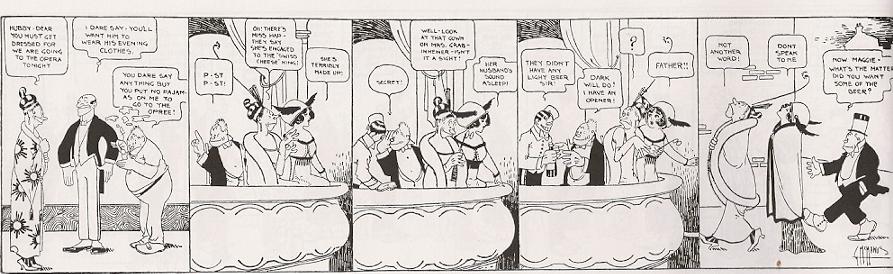
People don't actually dress up for classical concerts as they did earlier, the slavish formality on proper clothing is what you see in heavy rock concerts and the like. -
Global warming and chaos
No, I think you didn't understand what I meant here with specialization. Primitive cultures have specialization and are quite specialized: some are hunters (and they can have different roles in the hunt), some cook and take care of children, some even farm. That is basic specialization. It's really not about "a special kind of society", it's simply how human society differs from let's say a pack of animals. Specialization is one of the basic reasons why societies emerge as they are.Here you already start from the picture of a special kind of society. Not having material specializations, doesn't mean no culture. There are lots of cultures based on principles different from the ones entertained by enlightenment. Usually these cultures are called primitive. — Raymond
ssu

Start FollowingSend a Message
- Other sites we like
- Social media
- Terms of Service
- Sign In
- Created with PlushForums
- © 2026 The Philosophy Forum