
-
Afghanistan, Islam and national success?A good response , just some observations about it:
Right. By first killing the Afghan president. I wouldn't use the term "protect" there.In 1979, the Soviets invaded Afghanistan to protect the communist-led government there. — Apollodorus
I think it's more true to say that the CIA simply organized the money and arms procurement while the Pakistani ISI was basically in control of day to day operations and which rebel groups got the arms. No CIA agents entered Afghanistan, while some British agents did enter the country to train the rebels.In addition, they were trained, funded, and armed by Pak (ISI), US (CIA), and UK (MI6, SAS), becoming the Mujahedin guerrillas fighting the Soviets. — Apollodorus
Pakistani ISI wasn't here a rogue actor or an agent of the CIA, the Pakistani involvement was lead directly from the top, from general Zia ul-Haq, the dictator of Pakistan who was a devote muslim. I think he is the main reason just why Pakistan got so entangled with islamist terrorists in the first place.
I would hold the ISI having here a bigger role than just islamic schools on the creation and backing of the Taliban movement.After the Soviets withdrew in 1989, the same Jamaat-Deobandi infrastructure that was used to radicalize the Mujahedin, was used to radicalize the Taliban. Taliban founder Mullah Omar graduated from a Deobandi school in Pakistan, joined the Mujahedin and founded the Taliban in 1994. — Apollodorus
Northern Alliance would be proper as both Pashtun fighters of the Taliban and members were mujaheddin opposing the Soviet invasion. That Pakistan could be both "being an ally in the War on Terror" and supporting the Taliban and harboring Al Qaeda leaders and then get away with it is at least to me quite incredible.From 1996 to 2001, the Taliban held about two thirds of Afghanistan until they were beaten by a coalition of Mujahedin and Western forces, after which the Taliban withdrew over the border to Pakistan from where they have been launching attacks into Afghanistan until they seized power again in 2021. — Apollodorus
President Imran Khan meeting Trump...
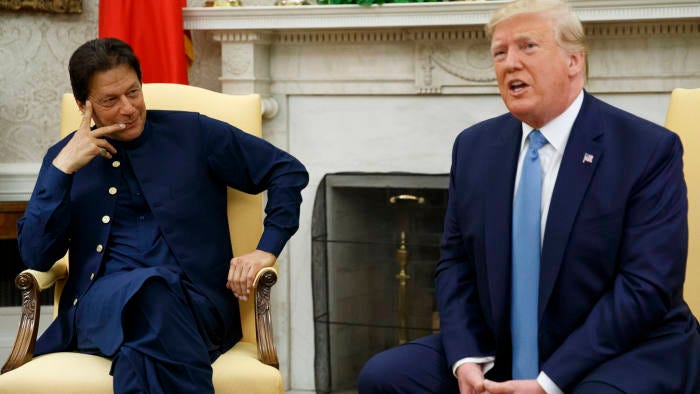
...and then meeting the Taliban, those that have now "broken the shackles of slavery" according to him:

And Pakistanis are quite open about the role of the ISI in this. The former ISI director Hamid Gul went on to say in Pakistani TV the following:

And where did they find OBL? -
Covid denialism as a PR stunt
Yes. If it is so.If the misinformation on the internetz can be traced back to a relatively small number of sources, this is suspicious and smells of sabotage. — baker
But notice the other options:
a) For Media programs it's great for ratings to get the most extreme views to be declared on the program, even that a fight starts (perhaps even a physical one). Moderate views and boring experts that argue about complex details, yet understand or respect others viewpoints hardly makes a good show for basically an audience that wants more entertainment than actual information.
b) It genuinely is possible that a cabal of crazies do something as absurd as storm the TV in Slovenia. Slovenia is a small country (very beautiful, btw) and I assume they aren't security obsessed there.
Basically you really have to find links that would approve that there's a conspiracy and not options a) or b) would be likely.
Are you familiar with the history of the Algerian civil war?Are you familiar with the series Person of Interest? — baker -
Afghanistan, Islam and national success?
Likely as just like with communism, it's the means how this "well-being of everyone" is achieved I guess.It is my understanding the stated purpose of communism and Islam in the physical, social, mental, and spiritual well-being of everyone in a civilized society and I am having a hard time understanding why the British and Americans are opposed to that? — Athena
I think the basic uneasiness with the Muslim Brotherhood is that it doesn't respect so much "Western" democratic values like minority rights etc. -
Covid denialism as a PR stuntLast night, a group of covid deniers stormed the studios of Slovenian national television. — baker
Sorry baker, but I'll have to ask this.
Were they really "covid deniers"?
To myself a "covid denier" would be someone who denies that millions of people have died of COVID-19. Not people that are against the policies implemented to fight the pandemic.
Were these really people who don't accept that there has been a pandemic?
Well this sounds like a counter-insurgency tactic!Thesis: If you want to control the situation, create an extreme opposition to yourself that you can control, and this will help you to control the legitimate opposition. — baker
If you have an insurgency that has a) popular support, b) sound reasoning behind it, c) possibility to gain outside acceptance and justification, then this is the way to go. Create a group that is so bananas, so insanely crazy, and make them to attack the reasonable (actual) insurgents.
Worked in Algeria! -
The Supremes and the New Texas Abortion Law
There you have it. It's not all about the existing laws, but how they are implemented. And how the society works.Yet the abortion rate is about the same as in the US, at least in more recent years. — praxis
Besides, one should note that both in the US and in the Nordic countries contraceptives are popular in use. This basically is more of a moral or a philosophical issue (and indeed fits perfectly in a Philosophy Forum). -
The Supremes and the New Texas Abortion Law
Uh, no.Is this something that can be laid out in a few sentences? And what are the consequences of the laws? — tim wood
I'll refer to my original post on another thread (one year ago):
For some reason this isn't a hot topic in any Nordic country (I could be wrong, but I haven't heard about abortion clinics set on fire or the thing...)
Sweden:
Women can freely opt for abortion before 18th week. After that they have to have permission from the authorities and after 22nd week it isn't allowed.
Finland:
Abortion requires the signature of at least one physician (and in some cases, two), and in some cases additional permission from Valvira (the National Supervisory Authority for Welfare and Health). One doctor's signature is enough in the case of terminations 0-12 weeks when the applicant is under 17 years old or has passed her 40th birthday. Above 20 weeks, a threat to the physical life of the mother is the only valid reason for terminating a pregnancy.
Denmark:
Women can also freely opt for abortion before 12 weeks. An abortion can be performed after 12 weeks if the woman's life is in danger and even in cases where the woman has mental health problems. A woman may also be granted an authorization to abort after 12 weeks if certain circumstances are proved to be present (such as poor socioeconomic condition of the woman; risk of birth defects to baby; the pregnancy being the result of rape; mental health risk to mother)
Norway:
Women can have abortion on before 12 weeks, by application up to the 18th week, and thereafter only under special circumstances until the fetus is viable, which is usually presumed at 21 weeks and 6 days.
Abortion on request is legal until the end of the 22nd week of pregnancy
Iceland:
Abortion on request is legal until the end of the 22nd week of pregnancy. The request can be done for many reasons. Medically, an abortion is lawful if a pregnancy threatens a woman's physical or mental health, if the fetus has a serious congenital defect, or if the woman is deemed incapable of caring for a child because of her age or mental disability. Social grounds for allowing abortion include: if the pregnancy is the result of rape or incest; if the woman has had several children already with only brief periods between pregnancies; if the woman lives in a particularly difficult family situation; or if the woman's or her partner's ill health prevents them from being able to care for a child.
And if people don't know it, abortion laws in the US are actually more lax than in the Nordic countries. Alaska, Colorado, New Hampshire, New Jersey, New Mexico, Oregon, and Vermont don’t limit abortion by gestational age at all. I think Roe vs Wade puts the limit to 28 weeks. It can be argued that state by state, a nearly uniform consensus has emerged in America: After roughly two dozen weeks, women should not be able to get an abortion for non-medical reasons. -
Afghanistan, Islam and national success?
Still, generally the Muslim Brotherhood is viewed to be founded in Egypt by Hassan Al-Banna.The Muslim League started the Caliphate Movement in 1919 to restore the Ottoman Caliphate and was of course in touch with Muslims from other countries, including Egypt.
Abul Ala Maududi was a leading Islamist ideologue who wrote al-Jihad fi al-Islam. (Jihad in Islam). — Apollodorus
There you said it yourself.Maududi was a member of the Caliphate Movement and inspired the creation of the Muslim Brotherhood (founded in 1928) and Jamaat-e Islami which he personally co-founded in 1941. — Apollodorus -
The Supremes and the New Texas Abortion LawFrom what I read the primary driving forces were poverty and lack of education. Women are still intentionally educated at a fraction of the rate that men are. The gains in child mortality are primarily due to government midwife programs. — praxis
(I first thought you were responding to my next response about the Nordic countries... :joke: )
Yes, this is true. Povetry means lack of funding for everything. Lack of education means things won't change easily. Especially the illiteracy rates are extremely high in Afghanistan, although a lot have been done during the last twenty years. Naturally with women's education starting from the 90's Taleban policies anything would be an improvement. From it's neighbors only Pakistan has an low literacy rate (56%) while Iran has fairly high rate and the former Soviet Republics enjoy high literacy rates after enjoying many decades the (Russian) Soviet school system.
One of the worst things was the radical islamists like Al Qaeda actually were in favor of this "pious povetry". The backwardness was a blessing for them as Western materialism was not apparent in the country. These militant radicals would literally destroy economies. But let's see what happens.
Yet I think the Taliban would be happy to sustain the present health care system, but I'm not so sure how they can do it. The basic problem was that the now collapsed Afghan government was financed 80% by foreign aid and assistance, aid which now will go to near zero. That has to have an effect on Afghan health care. -
The Supremes and the New Texas Abortion LawThis thread reminds me of it again.
The fact that my country, and Sweden and Norway and Iceland and Denmark are in fact are legally tougher at women getting an abortion than the US as abortion laws in the US are actually more lax than in the Nordic countries.
And for some reason there isn't a debate about in our countries as there is in the US.
It hardly comes to mind when looking at the US discourse about abortion. -
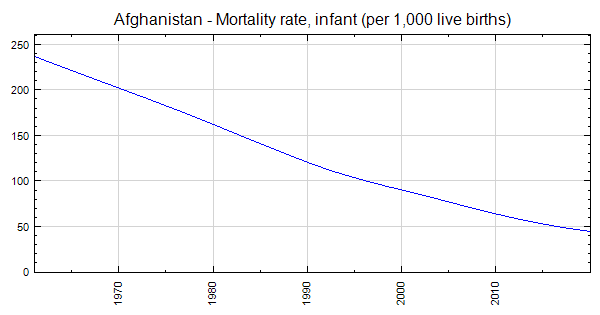
The Supremes and the New Texas Abortion LawAfghan women are immiserated to the degree that the child mortality rate is the highest in the world. Nothing expresses the sanctity of life and the love of children like the highest child mortality rate on the globe. — praxis
Gosh that's terrible. Imagine if the US was running the place for the last twenty years.
Oh wait. — StreetlightX
And if Afghanistan has the highest child mortality rate (exceeding countries in the Sahel region), then things have gotten better:
-
Madness is rolling over AfghanistanOne Trump would have been passed as a peculiarity. But the unilateralism that Biden made it two in row and really put it out there.
I think Europe is the last place to understand this. Already Middle Eastern "allies" of the US are totally doing their own policies.
Next question: What will happen in Iraq?
Again there the situation is quite mad with parts of the Iraqi Army, the Shia militias, being hostile towards the US. Again the result of the actions of Trump (btw).
* * *
Here is in my view one of the best documentaries about the war in Afghanistan done in 2013, "This is what winning looks like". The meltdown of the Afghan Army is quite understandable after seeing documentaries like this. It really shows how badly the war was going even then. One of the excellent Vice-documentaries, when the news media was young and independent.
-
Afghanistan, Islam and national success?
No, yet Afghanistan is different from Pakistan. And wasn't part of British India. The influence that the British had until 1919 was limited.The topic is "Afghanistan, Islam and national success". Perhaps you have forgotten. — Apollodorus
This is incorrect. Muslim Brotherhood was started in Egypt.Pakistan was part of British India and that was where the Muslim League, the Muslim Brotherhood, Jamaat-e Islami, and eventually, the Taliban started. No? — Apollodorus -
Afghanistan, Islam and national success?
India?Try to think a bit harder then. It is a well-known fact that there were major tensions between Hindus and Muslims in British India and that, for geostrategic (and cultural) reasons, the British have always sided with the Muslims. — Apollodorus
I think you are confusing the topic that we were discussing. -
Afghanistan, Islam and national success?
I'm not an expert, but I would agree. During those time when nationalism (& socialism) were the new in the Middle East, Islamism likely was seen as negatively, even if religion wasn't dismissed (as in the West).If Kemalism was in any way inspired by Ataturk's agnosticism, and Ba'athism inspired by Aflaq's Christianity, it could be said that these types of Arab-nationalist ideologies (inspired by Western thought) were against Islamism in state affairs. — NOS4A2
Once those failed, back to the "good 'ol ideas".
I think you are not paying attention. — Apollodorus
I think you lost me.
British Empire? Yes, Egypt was a protectorate. Yet don't forget the French in the wider picture. But anyway, decolonization is a rather different matter. -
Censorship and Forced hypothesis fallacy?Several members of the group write that they believe it was a strong wind picking up a small stone and that there are no other hypotheses being proposed that could explain it. — AndreasJ
Couldn't one reason from the above that anybody saying anything else than that will be instantly banned from the site? Just that "a strong wind" would be the only hypothesis that could explain it is so delirious that something has to be wrong with this picture.
What comes to mind are the over-enthusiastic applause and cheers the dictator gets with nobody daring to be the first person to stop cheering. -
Afghanistan, Islam and national success?
Who reads history in other language than English? I read naturally Finnish, but even Finnish or German would be difficult to follow.As you must be aware, we don't read history as written by the Arabs. — Olivier5
Actually, the real bad guys are the Mongols during that era. Saladin isn't the great hero, the Mamluk Sultan Baibars is the great here.E.g. The Crusades Through Arab Eyes, by Amin Maalouf is interesting in that it present the Christians as the bad guys. — Olivier5
Another example of the West thinking always it's the center of everything. ( I remember even OBL himself was comparing the US invasion of Iraq to the Mongol invasion, not the crusades.) -
Afghanistan, Islam and national success?
?I think you are mixing up your dates, and Arabs with Turks :smile: — Apollodorus
I was referring to the Egyptian revolution of 1952. the military coup that topple king Farouk. Egypt had already been a kingdom during the era of the British protectorate. -
Afghanistan, Islam and national success?
People look to find from history things that suite them for the present.Vice versa, why the insistence (among some) on erasing Arabs from history? Give to Mohamad what belongs to Mohamad. — Olivier5 -
Afghanistan, Islam and national success?
The fall of Constantinople was what I referred to being "the last bastion of the Roman empire" to be conquered. And Turks then were muslims.Very interesting! I want more information. How does this tie into a change of attitude that began during 1950-1960? * * * Not exactly by Muslims. - It still lasted another two centuries before it fell to the Turks, though. — Athena
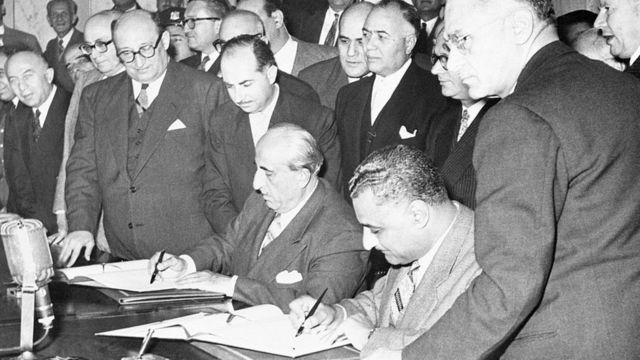
Why Pan-Arabism was so hip is because naturally you had had Middle East under Ottoman control, which then in WW1 had been taken away from them. The Arab revolt (with the famous Lawrence of Arabia) was a clear sign of Arab nationalism and that the people were not at all loyal and devoted subjects of the Sultan. And in the 1950's Nasser and the military coup that overthrew the King of Egypt were basically nationalists and later socialists, not at all islamists. So hardly the slogan would be to form a new Caliphate as the old Ottoman Empire with a Sultan hadn't worked, was revolted against and had lost to the West.
(Nasser trying to make Egypt and Syria one single country. At least the flags are similar still.)
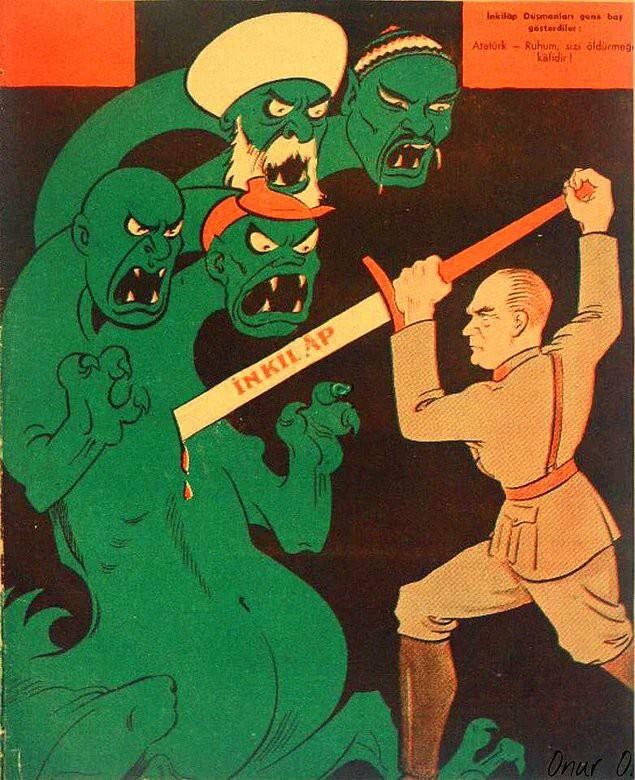
Also, it should be noted, that Kemalism of Kemal Atatürk was for westernization as a way to defend Turkey from outside powers and the religious aspects of the Ottoman Empire was seen as a reason for the weakness of the Empire.
(A Kemalist propaganda picture. Down with the Old, back then...)
-
Afghanistan, Islam and national success?
And were brought down by Muslims, who's state actually still exists even today. :wink:Sure. But the Roman Empire lasted much longer than 400 years. — Apollodorus
I agree with this. I think the obsession on things "Arab" is a far more modern issue and likely grew out of Pan-Arabism, which has it's origins in the 19th Century and was ever so popular during the 1950's and 1960's during Nasser's rule. I bet the Abbassids didn't think of themselves as Arabic. Islamic culture with a caliphate was naturally universal. And since the Prophet Mohammad was the first ruler of the Caliphate, the bond to a state is obvious in Islam.The Abbasid Caliphate was a mixture of Greek, Persian, and Arab elements. Islamic philosophy, for example, was based on Classical Greek philosophy. There were attempts to combine Greek philosophy with Islamic teachings, but that did not make it "Arab". — Apollodorus
So why the insistence of Arabs and Arabism?
Why so?
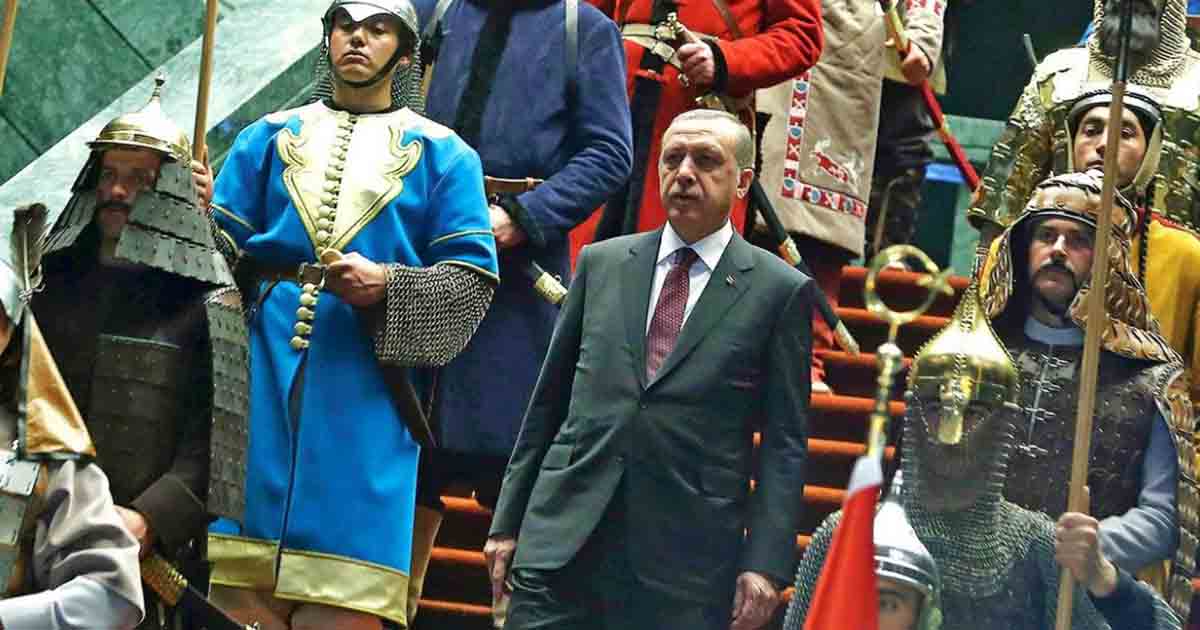
The answer of course is the most successful Islamic nation that is still among us, even if it doesn't have a Sultan as it's leader. The Ottomans, the Ottoman Empire and modern day Turkey. The guys who actually conquered the last bastion of the Roman empire.
(The neo-ottomanism that a certain Recep Erdogan likes!)
-
Axioms of Discourse
Many of those that have an agenda have the best intentions. They are there just to change your mind. :wink:Sure, and I didn't make clear in the OP, but I'm assuming good faith. If there are ulterior motives, then that's a different story — Xtrix
And naturally we take things personally. Someone telling us we are incorrect feels to many like an ad hominem attack, a personal insult. We are social beings and in real physical meeting with people there is a multitude of factors on how we approach the other. In the internet there is just a name without anything else. Hence we can be incredibly different in the social media (or here, where we are anonymous) than when actually meet people or have to work with them.Yes, which is unfortunately what "debate" has often turned into: scoring points. As if it's a boxing match. That can be entertaining, but I for one am often left disappointed by interchanges like that. — Xtrix
Back to the subject, we can censorship in many different things. Let's take for example this Forum. I believe there isn't de facto censorship here. But Let's look at the suite guidelines:
Types of posters who are not welcome here:
Evangelists: Those who must convince everyone that their religion, ideology, political persuasion, or philosophical theory is the only one worth having.
Racists, homophobes, sexists, Nazi sympathisers, etc.: We don't consider your views worthy of debate, and you'll be banned for espousing them.
Advertisers, spammers: Instant deletion of post followed by ban.
Trolls: You know who you are. You won't last long
Sockpuppets
Now, how many of those who have been (and are going to be) banned because of the above will themselves think that they have been the victims of censorship? I presume many.
Besides, I remember when the old Philosophy Forums -site went down the first time, I wasn't alone in thinking that "Jesus! What did I say to get banned?". Yet the fact is that a discussion board without any moderation will become simply ugly. But what's the difference between moderation and censorship? -
Afghanistan, Islam and national success?
Well, during the Spanish-American war the Spanish didn't actually attack you (likely the explosion on the Maine was an accident). Or what about the Mexican-American War? That too wasn't about defense.Our constitution tried to limit our wars to our defense and survival but that has not been the reason for the wars of the US since Eisenhower established the Military-Industrial Complex — Athena
(Map of Mexico prior to some events with the US)

Yet one should ask, which other country would have defended South Korea? It hadn't been a Western colony. I think that we have South Koreans that haven't seen starvation and don't live in a totalitarian state as their northern counterparts is great outcome for humanity. Or at least for the 52 million South Koreans. And if the 25 million now North Koreans would be similar as the South Koreans today and the division of Korea a sidenote in history, what would be so bad? Soviet Union tried a similar tactic in Northern Iran, made a puppet regime there, but the Iranians (South Iran?) defeated the puppet state. (And for some time Iran was the best and strongest ally of the US in the Middle East...before becoming it's enemy.)
Or how many would have died more in the Yugoslavian Civil War if it wouldn't have been for the US intervention? Is that so bad that actually there peace has prevailed and the hated "nation building" actually worked?
Just to say that the US has done good when it has engaged in war, so to think it is all bad is simply not true.
Actually, the Emirate of Afghanistan tried to give Osama bin Laden to the US. That wasn't at all enough for the US. In fact, the Trump Doha peace deal is hugely more lenient than what Bush demanded in 2001. In 2001 the Taliban would have immediately jumped on such deal that Trump now gave them. And how much "diplomatic effort" there was can be seen that the war was started only a few weeks after 9/11.. The US was not in Afghanistan because it was a nation that threatened our nation. — Athena
The US went straight to war with the Taliban in 2001. It has been at war with the Taliban since then until now. The idea that "The US first went to fight Al Qaeda and then lost it's objective and wandered off to 'nation building' is simply wrong. It's that strategic narcissism, believing your own propaganda. A denial or basically a lie. -
Is it really the case that power wants to censor dissenting views?Hello wanderoff, wellcome to the Forum.
Outright censorship as a government action is quite rare especially in democracies. Hence as a tool of power it is quite rare. Perhaps the more interesting issue is self censorship and what norms the society has, not only what the written laws say. Things like the Overton window are interesting.
its quite clear that, nowadays, the proliferation of political discourses online and offline serve their own, possibly more potent programmes of control. — wanderoff
The extensive use of computer algorithms makes this apparent in the online realm. When the realm is created by computers themselves, it's so easy to then control by computer programs. It took some time for governments to figure out how to take control of the internet, but they surely have learned it. At least some countries. Now they know how to control the social media.
Control is simply baked into the system. It's simply that the service providers use extensively them from start and then that governments have urged them to control the discourse. To directly set limits to freedom of speech is difficult for especially the US government, hence it is far more easy to demand private companies to take care of it (somehow).
Trying to work with the US Congress while smiling happily:
/cdn.vox-cdn.com/uploads/chorus_asset/file/10626629/944424184.jpg.jpg)
-
Afghanistan, Islam and national success?
I'd disagree. Don't think that these countries are so obsessed with Afghanistan as the US is. Both have already dealt with their own internal "muslim problem" quite ruthlessly and successfully. The Second Chechen war was won and the Uighurs are in concentration camps.Nope, they are not. — Olivier5
Russia NATO expansion and US military bases in their near abroad is number 1 threat to Russia. They have stated this officially in their military doctrine:
8. The main external military dangers are:
a) the desire to endow the force potential of the North Atlantic Treaty
Organization (NATO) with global functions carried out in violation of the
norms of international law and to move the military infrastructure of NATO
member countries closer to the borders of the Russian Federation, including
by expanding the bloc;
b) the attempts to destabilize the situation in individual states and regions
and to undermine strategic stability;
c) the deployment (buildup) of troop contingents of foreign states (groups of
states) on the territories of states contiguous with the Russian Federation
and its allies and also in adjacent waters;
d) the creation and deployment of strategic missile defence systems
undermining global stability and violating the established correlation of
forces in the nuclear-missile sphere, and also the militarization of outer
space and the deployment of strategic nonnuclear precision weapon systems;
e) territorial claims against the Russian Federation and its allies and
interference in their internal affairs;
f) the proliferation of weapons of mass destruction, missiles, and missile
technologies, and the increase in the number of states possessing nuclear
weapons;
g) the violation of international accords by individual states, and also
noncompliance with previously concluded international treaties in the field
of arms limitation and reduction;
h) the use of military force on the territories of states contiguous with the
Russian Federation in violation of the UN Charter and other norms of
international law;
i) the presence (emergence) of seats of armed conflict and the escalation of
such conflicts on the territories of states contiguous with the Russian
Federation and its allies;
j) the spread of international terrorism;
See how low in the threat level of international terrorism is? It's from point a to b at point j. Afghan Taleban aren't a problem. As Russians do follow their military doctrine, they are genuinely happy that the US is out of their back yard.
And as I noted far earlier before the Afghan government had collapsed, Russia was already holding large military exercises with neighboring countries Tajikistan and Uzbekistan. Countries that earlier held US bases (but not anymore).
And China?
Here is what they say:
On the basis of fully respecting the sovereignty of Afghanistan and the will of all factions in the country, China has maintained contact and communication with the Afghan Taliban and played a constructive role in promoting the political settlement of the Afghan issue. On July 28, State Councilor and Foreign Minister Wang Yi met with the visiting delegation led by head of the Afghan Taliban political committee Mullah Abdul Ghani Baradar in Tianjin.
We hope the Afghan Taliban can form solidarity with all factions and ethnic groups in Afghanistan, and build a broad-based and inclusive political structure suited to the national realities, so as to lay the foundation for achieving enduring peace in the country.
The Afghan Taliban said on multiple occasions that it hopes to grow sound relations with China, looks forward to China's participation in Afghanistan's reconstruction and development and will never allow any force to use the Afghan territory to engage in acts detrimental to China. We welcome those statements.
The rhetoric is quite different from the US. Above all, even ISIS isn't now interested in China:
The Islamic State has most likely abandoned its aggressive stance toward China for these strategic reasons. To preserve the useful dynamic of a non-militarized China replacing a militarized United States in the Middle East and South Asia, the Islamic State appears to have abandoned its previous advocacy and adopted a near total, systematic silence on not just the Uighur issue, but also Chinese influence more broadly.
The US is the one who sees everything from the viewpoint of fighting muslim terrorism. China or Russia have not announced a "Global war of Terrorism". -
Axioms of Discourse
Perhaps one simple (if not already mentioned) issue is what is the agenda, the motivation of someone to engage in a discourse. This can vary a lot.How much time and energy would be spared if these simple propositions were adopted? — Xtrix
Many say that they are engaging in a discussion and are open to ideas of others, but in truth they aren't. In fact, they can take your notes just as things to remember when winning the argument (in style). Philosophical debates can lapse into a competition about who knows best. Some think it's a contest of who is the most intelligent. Not that we can learn something from each other and different viewpoints and arguments are beneficial. -
Afghanistan, Islam and national success?
Yes they are. They ought to be.ISIS is a common enemy of the US and Taliban. I expect some collaboration on this front at least. The CIA and co. are pragmatic folks, they speak with whom they need to speak. — Olivier5
But fun fact: The American voter isn't. The ordinary US soldier isn't either.
Hence policy is made by what the voter wants in a democracy. Or otherwise you would have to have politicians with real leadership skills to change and mold the views of the voter, to make him or her to understand that realpolitik is the way to go. For example to us Finns this is easy to understand as we know that we are the quite dispensable country, so for us foreign policy is not about right or wrong, but basically survival.
Yet I view this as an American virtue. Americans will deeply think of the morality of their actions and will constantly have a huge debate about their actions. But this makes extremely hard to do this kind of thinking what you referred to. I gather that the CIA is in no mood to have some clandestine thing exploding in their faces later after this debacle.
Large part of Americans don't see things from the viewpoint of realpolitik where former enemies suddenly can come to be your friends or totally normal once the fighting stops. The US has had truly ideological opponents with Nazi Germany and the Soviet Union. The last time they actually had an enemy they didn't utterly loath (at least later) was the United Kingdom and actually Spain. Above all, the Blob, the Foreign Policy establishment has played only the fear card and a black and white picture to the Americans, that any kind of other discourse is extremely difficult.
This can be seen from that especially when faced with a fanatic enemy that doesn't share similar culture, even the old veterans rarely if ever meet their old enemies. There is a deep hatred against the Japanese and I'm sure that the Global War on Terror will never have a "get together meeting" of old Taliban fighters meeting their counterparts after many years.
US Domestic policy will lead to that the US will truly leave Afghanistan. As it has left already other Central Asian countries. The only reason would be perhaps an ISIS-K attack in continental US. The Russians and the Chinese can be happy how things are going now. -
Afghanistan, Islam and national success?If we forget Afghanistan, just like we forgot Vietnam, that would be success. No news is good news. Because that "no news" means that the US won't do drone strikes into Afghanistan.
I think now success would be defined simply as peace: no bombs going off, war going on in some part of the country. The first obstacle is how the Emirate deals with Panshjir valley. And if other places become Panshjir valley, that would be a bad start. Likely life will be harder in Kabul. The economy will surely be worse.
It's easy to be an insurgent as you can pick your fights. Far more difficult to be the authority. At least now the Taliban is starting from a far better position than it was during the mid 1990's. It's up to them how they manage the situation. -
Afghanistan, Islam and national success?
That is true, but by "the West" people typically forget (or ignore) East Rome.In contrast, the parts of Eastern Europe under Greek control (Eastern Roman Empire) had no need to re-learn philosophy from the Arabs. On the contrary, it was the Arabs who learned from the Greeks and transmitted some of that knowledge to Western Europe! — Apollodorus
My point is that the populations that the Muslims conquered likely knew the philosophy too. And just like noted, muslims quickly noted the importance of knowledge and philosophy. Unfortunately that "renaissance", if you can call it so, didn't last for much time.
Yet coming back to the subject, I'm really not very optimistic of how the Emirate of Afghanistan will succeed. Far too much of radical islam is against everything considered Western. And Western philosophy goes with it too. -
Afghanistan, Islam and national success?Arab culture was inadequate to support an empire and dominate the more advanced cultures of the conquered territories. The only medical system was that of the Greeks. The only philosophy going was Plato and Aristotle — Apollodorus
Or too dismissive of the prevailing culture in what just earlier had been part of the Roman Empire or the Sassanid Empire. Besides, this was many centuries later that Hellenism, thanks to Alexander the Great, had already influenced the area, so I assume Plato and Aristotle were quite well known already.That is way too dismissive of the early Muslim genius. — Olivier5
And let's not forget that the West re-learned it's philosophy and math basically from the muslims. The Dark Ages were quite dark, you know. -
Madness is rolling over Afghanistan
China can use their proxy Pakistan to try to calm things down in Afghanistan. Then if there is peace or let's say enough stability, then the Chinese can make those investments to mine for raw materials. They don't have to worry about Western competition, that's for sure.Because Afghanistan falls within their presumed geographical "sphere of influence". Every superpower eventually feels compelled to define it's sphere of influence, over which it asserts a paternalizing authority. The U.S. did way back in 1823, with the so-called "Monroe Doctrine". China might view this as it's chance to better define it's sphere of influence. — Michael Zwingli
(And Chinese military bases? Very few of them. Basically they have one in Djibouti.) -
Joe Biden (+General Biden/Harris Administration)
Of course.I don't think the US still funds Pakistan. Does it? — Shawn
From the US embassy in Pakistan internet page:
During Pakistan’s 2019-2020 fiscal year, the United States was once again the top donor country to Pakistan of on-budget, grant-based assistance. U.S. assistance to Pakistan is always in the form of grants, which does not add to Pakistan’s debt burden or balance of payments challenges.
This commitment reflects our belief that if Pakistan is secure and peaceful and prosperous, that’s not only good for Pakistan, it’s good for the region and it’s good for the world. A stable, prosperous, and democratic Pakistan that plays a constructive role in the region will remain in the long-term U.S. national interest.
Yep! I'm not making up that above. Constructive role. See https://pk.usembassy.gov/our-relationship/policy-history/us-assistance-to-pakistan/

The US trying to bribe Pakistan didn't work. What is utterly crazy is that Pakistan's strategy did work!
The usual. Gaining territory, holding cities, gaining the initiative in military operations.Anyone interested in a discussion would look at this with a raised eyebrow? What does that even mean that the Taliban were winning the war in Afghanistan? — Shawn
Making their enemies (the US) to choose to withdraw without any concessions from the Taliban side.
That is meant by the Taliban winning the war. -
Madness is rolling over Afghanistan
:up:This is, bluntly speaking, crazy talk. — Bitter Crank
Glad that we can have lived for so long in peace with other cultures, I guess. -
Joe Biden (+General Biden/Harris Administration)
I'm not sure just what year was it, but for a long time the Taliban was winning this war, not losing. If I remember correctly, someone put it to 2014. From that year or so, the US was losing. But the US was fighting an one-year war twenty times over.If I'm not mistaken from the moment the Taliban started taking over Afghanistan to the point where the US made it's departure was 2-3 weeks. In that time they evacuated 120,000 people from Afghanistan. Only the US military could accomplish that without RPG's shooting at landing planes or grounded planes or guided missiles shooting at planes taking off.
Isn't that a success? — Shawn
13 American soldiers killed in action is not much. But then it's more than the crew of three in a C-17.Only the US military could accomplish that without RPG's shooting at landing planes or grounded planes or guided missiles shooting at planes taking off. — Shawn -
Joe Biden (+General Biden/Harris Administration)
:snicker:Yes, that did happen. Yet, what's this got to do with the US' failure. — Shawn
Good question, glad you asked it.Do you know how else the US would have dealt with the situation especially under a republican tenure for a peace deal? — Shawn
Ummm...how about like, uh Iraq?
You left, but didn't. Is it catastrophic that you have 2500 US troops, similar amount actually that you had in Afghanistan? Is it intolerable that the US is in Iraq? And then how about forgetting that strategic narcissism, and face the reality.
The US for a time, actually, defeated Al Qaeda in Iraq, but then snatched defeat from the jaws of victory, and in the end you had ISIS. Do notice just how this was done. But I guess making an ally of part of your enemy is far too incomprehensible for the US. To find the political solution.
And let's start with the facts: You have been at war basically with Pakistan for all the time when it comes to the Taliban. But somehow you have not face this reality. So start at least from there. -
Madness is rolling over Afghanistan
This is so true.You can run a guerrilla war on opium plantations but not a country. — Apollodorus
I think the former Afghan vice-President is back at his comfort zone when fighting now the Taliban as an insurgent in Panshjir Valley. -
Joe Biden (+General Biden/Harris Administration)
The actual date was September 11th. But the Taliban conquered the country far more rapidly. So actually the US had to change it's timetable. Which I guess was OK for the Taliban.Actually, the Taliban were cooperating with the US by making promises to allow evacuations until the 31, which they even assisted in transporting and allowing US citizens to the airport. Yeah... — Shawn
Have you actually read the Trump Doha peace agreement?
Who wouldn't be in favor of such terms if you would be fighting the US?
YOU don't see any similarity???I don't really know what your getting at here. Like I said, if helicopters flying near embassies in Afghanistan makes you think it's Saigon, then I don't know how that makes any sense. — Shawn
Sorry, but this was an even a more uncoordinated and a far more hasty withdrawal. -
Joe Biden (+General Biden/Harris Administration)
Yes, this is so true, James. :up:Within 45 minutes of watching the second plane go in the second tower, live, I knew what was going to happen (including Iraq). It did. I talked then, as did others. But to no avail. For the reasons you state. To do what I and others recommended would have taken real leadership. Not Dick and Donny and the MIC. I tried to dig up some of the analysis but I find it strangely lacking in open source. Hmmm. I'd wax on but I have to run to town. I assume if you care, you'll ask and I'll get to it. — James Riley
Only a Houdini-level mastermind of a politician would have pulled it off in some other fashion. Falling Afghans that have climb to a jet (not understanding what the wind will be at 900 km/h) is one thing. But American leaping off to their death from a burning skyscraper is another. Try then as a leader to start with a police inquiry when everybody already know that an international terrorist organization is behind this!!!
Still, I will be optimistic. I think that the US can still learn from it's mistakes. Those in Foreign Policy establishment and those in the military. There should be that genuine American soul-searching. That makes you better! -
Joe Biden (+General Biden/Harris Administration):roll:
Yeah, unlike with the case of South Vietnam, you still had US ground troops in Afghanistan. Not so when in the pictures of the Saigon embassy. Then it was only the marines in the embassy. And note, the collapse happened before the planned September 11th withdrawal date. (How conveniently that is forgotten, actually.)
So yes, neither the withdrawal of US troops from South Vietnam and the Soviet withdrawal from Afghanistan happened so hastily, in such chaotic manner as now. In fact, this war crumbled far quicker that the Vietnam war. Or the Soviet war in Afghanistan.
Far more orderly event in 1973:

Just compare to this image. No lights, a picture taken with night vision. I bet the commander of the 82nd Airborne, major general Chris Donahue in the photo, had a full magazine of live rounds in his rifle. Just in case. It's really telling what a debacle this was as the enemy was just waiting few meters away to take the airport and would be in minutes looking at the US aircraft left in the hangars:
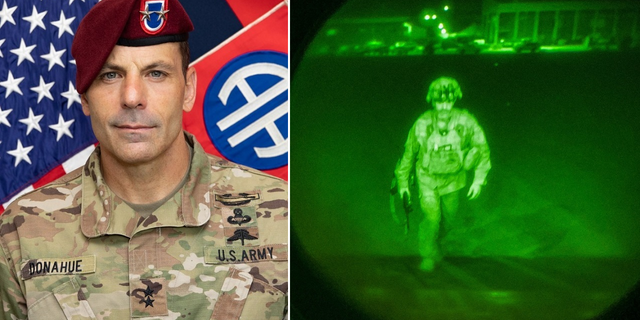
And compare the image above to the last Russian general leaving Afghanistan back to the Soviet Union, when Boris Gromov walked over the bridge (at the newsclip below).
Sure. A dismal future ahead then too for Afghanistan. Yet the Najibullah goverment actually survived until Soviet Union itself collapsed. Not something that the ex-Afghan president (that made his career in Western universitie, think tanks and the World Bank) did before general Donahue left Kabul. Ghani had already fled away with over 100 million dollars in cash. Here's a news report from February 1989. (Do note the interview of Zalmay Khalilhad, the Mazar-i-Sharif born US diplomat and Charley Wilson in the 1989 report)
What is obvious that the Islamic fighters will surely say that they beat both of the Superpowers. You just leaving for them is a victory in war. -
Madness is rolling over AfghanistanThe Afghan state is a separate issue. Until now it has been receiving Western aid amounting to 43 percent of its GDP. — Apollodorus
This actually is a primary reason why the house of cards fell down. All the money poured into Afghanistan made it simply totally impossible for the Afghan nation with it's own revenues to support such a large bureaucracy.
It's actually a similar thing the pro-Soviet administration of Afghanistan faced. They could keep out the mujahideen from the cities and fight the war and upkeep the administration until the Soviet Union collapsed and no money was sent into the country.
ssu

Start FollowingSend a Message
- Other sites we like
- Social media
- Terms of Service
- Sign In
- Created with PlushForums
- © 2026 The Philosophy Forum