
-
General Mattis For President?Mattis can retire very happily as I think he's the only person that has served in the Trump administration that hasn't gotten a stain on his career from serving in this highly inept, dysfunctional and corrupt administration.
He's going to be missed. -
A new study proves parachutes are uselessFrom the article:
In order to get people to agree to take part in the study, the scientists had to structure the experiment properly. The airplane was both on the ground and stationary, as they thought it would be impossible to get people to agree to leap from a moving plane several thousand feet up without a parachute. The authors admit this was a "minor caveat" in the study's design.
Now this of course was a joke. But many times similar "minor caveats" are admitted to various "scientific" tests where some agenda is pushed forward and people want scientific testing to back the agenda up. And unfortunately, the "minor caveats" open only to those who know the field of study extremely well. -
The War on Terror
That very likely is the truth. The war hasn't gone anywhere, for example this year the US and the small Afghani Air Force have dropped more bombs in Afghanistan than any other year of the war. And a lot of the country isn't controlled by the government.I have heard from my Afghan side of my family that the situation in Afghanistan is deteriorating. — Wallows
As the US Military can (or could) fight a low intensity insurgency in a land blocked country basically without no end in sight, there is no need for American politicians truly to think what the real objectives are and what would be "mission accomplished". No politician has to think about this war, that's the basic problem. Trump hasn't even visited Afghanistan or any other frontlines and can easily just lie about the situation.Anyway, how is the war on terror progressing? Are things getting better or worse? Is it mission accomplished for America? — Wallows
Just think a little about the present reasoning for the US being in Afghanistan: The Americans are in Afghanistan because if left to it's own, those fighting the current government could overthrow the present government and possibly provide a safe haven for terrorists that want to attack mainland US.
Now think how many ifs there are in this reasoning. And notice that the reasoning has absolutely nothing to do with Afghan objectives or take them into account. Neither what Pakistan or any other country has on it's agenda for Afghanistan and/or for the overall region is given any thought. And this creates the huge SNAFU here: the current strategy and objectives are made just for the American domestic political scene and doesn't take into account the realities on the ground in Afghanistan. This is basically the same thing that is wrong with the War on Terror altogether, be it in Mali or Somalia, Yemen or Iraq. -
Donald Trump (All General Trump Conversations Here)
Yep.first impression he sounds like a reasonable guy. — Jake
Mattis just get fed up with Agent Trumpov. His resign letter tells it clearly: no "Thank You" for Trumpov, who obviously doesn't care about US allies. But Putin is happy; not only the US is withdrawing from Syria, but also diminishing troops in Afghanistan.
And perhaps now Trumpov can finally hold one of his campaign pledges, to reinstate torture, or "enhanced interrogation techniques” like waterboarding and "worse than that". His supporters will surely like that. Whopee!
I predict that John Bolton will be the next secretary of defence. -
Brexit
This is true. For example, this is why Russia is so against the EU and would be extremely happy if it dissolved. Any European country alone isn't at all superior to Russia. And smaller countries (just like my own) wouldn't dare to protest against the annexations of Russia with sanctions if not part of a bigger community.The EU has far more impact on global affairs than the sum of all the individuals countries would have separately, and I would argue this influence is far more positive than what would otherwise occur. — boethius
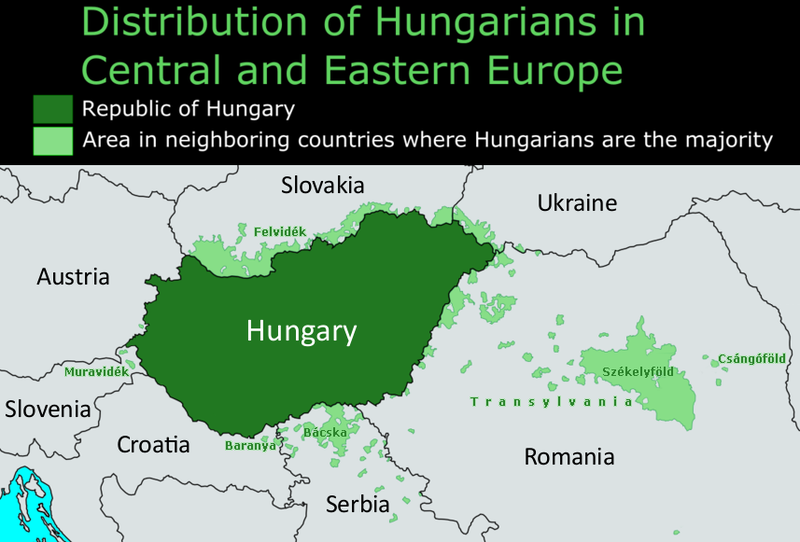
When you look at geopolitics in Europe with a longer view focus, one can see an obvious thing that is lacking especially in Eastern Europe, and that is the void that has been let after the collapse of the Austro-Hungarian Empire. In a way the EU has replaced the old power politics in this area and has been able to sweep aside old tensions. The other organization that has also eased tensions between European countries has been naturally NATO and membership in the mutual defence organization.
Just to give one example is to look where Hungarians are a majority:
-
Donald Trump (All General Trump Conversations Here)
I lost count on the number of oxymorons there.The Guardian is biased because it offers a simplistic, manichean, super-racist, anti-west, pro-feminist, pro-globalist view of the world; and their reports are heavily filtered by those human algorithms. — DiegoT -
Brexit
The EU was simply an awesome idea as an union for commerce. It's hideous as a vehicle for political union especially if the objective is some kind of US of Europe. I think the worst threat to the EU are the idiots in charge that are trying to make it into a tight political federation.The EU is both a successful peace mission and a failed neoliberal-corporatist experiment (with undertones of NATO encroachment to Russia's border and playing second fiddle to disastrous US militarism in the middle east) with these bills now coming due. It's tempting to walk away from the failure parts, I do sympathize with the Brexiters, but on a global scale the EU can anchor a peaceful re-ordering during the US-China inversion. — boethius -
Brexit
You are correct. The real winner of the Eurozone is naturally Germany.This figure has gained some interest as of late, making some question who's really gaining an advantage from the centralized Euro. I realize that the UK isn't one suffering, but the German success is an interesting phenomenon. — Hanover
You see, during the old times when countries had their separate currencies, the old trick was to devalue your currency and hence get your export industry back to being competitive for a while ...until inflation kicked in. Once all these countries that joined the eurozone couldn't resort to this gimmick as there was a single currency, the masters in competitiveness, the German export industry, were the ones being even more the winners. But heck, can you name some awesome Greek company making some well known industrial products like Volkswagen, Daimler Ag or Siemens etc? Nope. -
Dimensionality
Aren't natural languages invented too?Mathematics is an invented language, initially based on how we think about relations, and then the bulk of it is akin to extrapolating how we think about relations into abstract "game" of sorts. — Terrapin Station
I bet that English and Urdu didn't just surface from genes or something. -
Donald Trump (All General Trump Conversations Here)The real amazing event here is just how did the Republican party get castrated and became these fearful yes-men for an inept idiot.
-
Brexit
Some Americans just don't understand what exports (or trade) mean to other countries. You just produce for yourselves and get the rest as imports from China. Don't have to care a damn about things like your main export partners as over 300 million of Americans is quite enough of a market.I've never seen a nation so in fear of independence. I know the world's a great big scary place little birdie, but take a deep breath, jump off from up high, and flap those little wings. Everything's gonna be alright. — Hanover
Export ratio, meaning export of goods and services (% of GDP):
UK: 28,1%
USA: 12,6%
(Germany: 46%)
UK's exports (in £, 2015):
1. To the EU 133 bn
2. To the US 45 bn
(And of course that the EU is in reality more a confederacy made up of independent states, not a federation of non-independent subjected states.) -
The new post-truth reality and the death of democracy
Great powers exist. And even small countries can be very hypocrite and have double standards, because states are utterly selfish in the end. Somehow many have this idea that the US is exceptional in this.And U.S. (or great power) exceptionalism is not a taboo either, but it remains exceptionalism (and a double standard). In a way that's what makes a state a "great power"; it exempts itself from the rules others are expected to follow, till people are conditioned to accept it as "ordinary". — Πετροκότσυφας
No. It was given to the Russian government. Please read more carefully what I say. The loan the International Monetary Fund gave as Russian media now tells it:That's crap. The loan was specifically given to a candidate in order to boost his chances of election. — Πετροκότσυφας
granted a US$10.2 billion loan to Russia that enabled the embattled government to throw huge sums at recompensing paying long-owed back wages and pensions to millions of Russians — some overdue wages arrived just before (or indeed on) June 16, polling day.
Or as it was explained by the New York Times in 1996:
The West has few means at its disposal to influence the Russian electorate, especially since too blatant an endorsement of Mr. Yeltsin could backfire with nationalists. But the West does have money to encourage market reforms here and is willing to use it.
At $10.2 billion, the fund's loan is $1.2 billion more than had been discussed just a month ago. Significantly, more than $4 billion of the loan is to be provided during the first year. That is especially important because Mr. Yeltsin has signed a number of decrees to increase social spending in the run-up to the presidential election. On Feb. 15, in announcing his intention to seek re-election, Mr. Yeltsin also promised to pay $2.8 billion in back wages, addressing a compelling emotional issue in a country where many laborers, scientists and teachers have not been paid for months.
Still, the loan will not be provided on the basis of trust. There are steps the Russians must take in order to keep the money flowing. Before the first installment can be disbursed, Mr. Camdessus must present his recommendation to the I.M.F.'s executive board, which is expected to give formal approval for the loan by mid-April.
In the meantime, Western officials said, Russia must demonstrate its commitment to economic reform by phasing out tariffs on the export of natural gas and by beginning to eliminate tariffs on the export of oil. All export tariffs on oil are to end by July 1.
Nothing? Are you saying that Yeltsin had nothing to do with the collapse of the Soviet Union being so peaceful?Which of course has nothing to do with Yeltsin's "accomplishments" and USA's involvement. — Πετροκότσυφας
(NY Times, AUG. 25, 1991) President Boris N. Yeltsin of the Russian federated republic said today that his republic formally recognized the independence of Estonia and Latvia and urged President Mikhail S. Gorbachev of the Soviet Union and the rest of the world to do the same.
Mr. Yeltsin issued decrees recognizing the two republics. Lithuania, which declared its independence in March, has already been recognized by Russia as a sovereign state.
There's a reason why Putin's media critisizes harshly Yeltsin nowdays. It isn't suprising coming from the country lead by a leader who thinks that the collapse of the Soviet Union was the “greatest geopolitical catastrophe of the twentieth century" and " would reverse the collapse of the Soviet Union if he had a chance to alter modern Russian history". -
Proof that a men's rights movement is needed
There you go. Gotcha!When they give up at least some of their hegemonic political power. — Noah Te Stroete
And that's why WISDOMfromPO-MO so apologetically added to his (or her???) OP that " I should probably add that somebody who is reading this thread is probably saying that just by bringing the topic up I am being complicit to misogyny and complicit in the systematic oppression and domination of women. " -
Only dead fish go with the flow
That's a nice tweet. :up:If your worldview fits in a tweet, think harder! — andrewk -
Proof that a men's rights movement is neededReading this thread comes to my mind the following thought: when will one specific hated and historically quite often persecuted minority be given the right to view itself as a victim and as a persecuted minority?
Yes, there is that minority, who people openly and unashamedly attack with the most stereotypical prejudices and basically people are OK about it. Nobody gives a damn about the open hate speech against this minority.
Above all, this minority is taught just to take it. All the bad mouthing. And many members of this minority try to hide the fact that they belong to this minority. That is actually something that people see as a good thing, that persons don't openly show that they belong to this minority, but hide it. To everything I have said I can give easily examples from history and from the present.
Now you likely have already guessed what minority I'm talking about. Yes, the minority I'm talking about are the rich.
No really. You could make the book that shows that rich people have been persecuted. Just think about all of the Communist revolutions that have literally gone after this class of people. -
The new post-truth reality and the death of democracy
One thing is to get journalists themselves educated before anybody starts a disinformation campaign. Disinformation is most effective when people cannot see it, when they are totally ignorant about the subject at hand. Just look how confused the Western media was when Russian troops invaded Crimea and simply took off their Russian flags and spread the outrageous lie that these well armed, uniformily clad, young fit soldiers were "Crimean volunteers", not Russian paratroops. (That's actually the lie that Putin did admit being wrong, but hey, he could had been silent to this day about it.). In the end you have to choose between the least of evils, and the choices are often far from obvious. Sometimes the least worst option is to do nothing. I am not saying that this is the case here. I don't know what the best approach to deal with information warfare (as Russians themselves like to refer to it) would be. — SophistiCat
The best example of this "pre"-education is what the BBC did at the height of the Crimean crisis: it sent one of it's journalist to a potential possible flashpoint, to the city of Narva in Estonia and interviewed people of the sleepy town and made a story about it.
Now why Narva is a strategic flashpoint is because it's a border town (opposite to Ivanogorod in Russia) and the most ethnically Russian city in the European Union. Estonia is part of NATO and has a large Russian minority and it has unfortunately already experienced hostile Russian active measures operations with the 2007 cyberattacks during the Bronze Statue-incident and the kidnapping of an Estonian intelligence officer Eston Kohver in Estonia after Obama visited the country. Hence Narva in Estonia was the perfect place to visit.
So when the British journalist went to interview ordinary ethnic Russian EU-citizens, it could discover what the people actually thought and what the reality was as there wasn't any ongoing information campaign underway. Now if the situation would escalate, that journalist that has already visited the town would understand what could be true and what is invented far better than the journalist that hears the name Narva or Estonia for the first time. -
The new post-truth reality and the death of democracy
How many options were there?When there are options, and you choose one of these options, you pick it! — Πετροκότσυφας
Yep. Sometimes what people say they thought earlier is actually what they thought earlier.I guess they must have been forced to be involved and be involved exactly in the the way they did. Some sort of fatalism, I presume — Πετροκότσυφας
Yet my point here is that US moves here aren't out of the realm of ordinary influencing. Now with a small Latin American country they, the US, could and have been far more hostile and rough as these countries have been considered the backyard of the US. Yet with a nuclear state like Russia things have to be handled far more delicately, just as with the Yeltsin and the US. To try to influence opinions, views and policies isn't a taboo. After all, the job of all ambassadors is to influence their country of residence.
Yet the Trump-Russia axis is quite different from the ordinary. And for Russia to get involved with US politics in such way is very much "out-of-the-box" moves.
(And anyway, after the Soviet Union collapsed there indeed was a brief window when Russians were totally open to new ideas and genuinely open to the West. During that brief time you would have to had larger than life politicians to understand the exceptionality of the situation and do a dramatic reallignment either by truly accepting Russia into the West and into NATO or dissolve NATO. But that didn't happen. We had mediocre ordinary politicians that didn't use the opportunity. And with the war in Kosovo, that sealed Russian thinking to what it is today.)
Sure, it would.Had Putin given a 10bn loan to Trump to boost his chances for success, the whole world would have imploded — Πετροκότσυφας
Because that IMF loan went to the Russian state, not to the personal pockets of one individual reality TV celebrity. Yeltsin's administration could pay salaries to government employees thanks perhaps to the IMF loan. When you give Trump money, that isn't the same as giving money to the US and it uses it to pay public sector salaries.
Furthermore, it's really difficult now to understand how perilous the situation of the collapse of the Soviet Union was. For example my country was really making plans how to cope with masses of refugees if there would happen a civil war in Russia (as we have an +1000km border with Russia). We seldom give credit to the many Soviet politicians that made the disintegration so peaceful. Now with the ongoing war between Russia and Ukraine we can indeed imagine that the Soviet Union could have gone the way of Yugoslavia and disintegrated to a bloody civil war (which it actually did in the Caucasus), and then we could have seen deaths in the hundreds of thousands or even a million or so. -
A flaw in the doomsday hypothesis
Well, even if Malthus obviously contributed a lot, there was going on a revolution in agriculture in England, so he could have perhaps seen something down the road. Yet the scientific and technological advances starting from the 1930's surely wasn't apparent back then. Just how much productivity can grow is extremely difficult to predict.but Malthus could not have foreseen the development of agricultural science and technologies that allowed us to transcend his gloomy logic trap. — karl stone
For example, the second largest agricultural products exporter after the US, before Germany, Brazil, France and China is... the Netherlands. Such little country, the 131st largest in the World, being second only to the US tells what modern agriculture can do, if it would be globally adapted as it is now done by the Dutch. (Hence I do have hopes that food will not run out in the future.) -
The new post-truth reality and the death of democracy
Trump surely isn't coerced, he was a willing partner here.Trump retweeting Russian (or any other kind of) disinformation is just Trump being Trump, not a success of the Russians. It's not like there were negotiations and they convinced him to do something he didn't want. — Πετροκότσυφας
After all, who could know that one of the main missions of the FBI is to keep taps on the actions and operations of foreign intelligence services in the US? -
The new post-truth reality and the death of democracy
Handpicked Yeltsin??? Where on Earth do you get that idea?Given the fact that Clinton and the IMF hand-picked Yeltsin — Πετροκότσυφας
Did Clinton handpick Yeltsin to climb on a tank in front of the White House (the Russian one in Moscow) and oppose the "August Putsch" and be the leader opposing the Soviet establishment? Because that was basically the reason that Yeltsin, then the head of the Russian Government, got to lead new Russia as the Soviet Union quickly collapsed afterwards. If I remember correctly, it was Yeltsin that abolished the Soviet Union.
The idea that the US picked Yeltsin because the IMF gave a loan is really absurd. Yes, it is support, but how does this mean they picked Yeltsin? Who else would the Americans have picked? The communists? If the other candidate was Zyuganov of the Communist party, how much picking sides there was? Would Clinton pick a candidate riding on nationalism and Soviet nostalgia and the candidate of the party that was (and is) the immediate successor of the Soviet Communist Party (that Yeltsin banned)? Basically Americans were more like forced to back Yeltsin. Especially when you remember that Russia had the Rubble crisis in 1998, one IMF loan here or there doesn't matter so much.
No, the Clinton administration just assumed that everything would be fine and dandy and democratic with Yeltsin and simply hoped for the best. As your article emphasizes, then the Russian leader was then at an extremely weak position, which naturally the Americans thought as the new normal. Yeltsin couldn't even handle the Chechens and everyone was back then writing off the Russian military. And actually the article you refer to notes the obvious thing: Yeltsin had the same policies, starting from opposing NATO enlargement, as Putin has now. But then, American leadership seemed to have thought that Russia is over, it will never recover as obviously oil prices couldn't rise.
In fact those who supported in a crucial way Yeltsin in the elections were the infamous oligarchs of the period. They did the promoting, they supported the media campaign roughly giving over 700 million dollars to Yeltsin's campaign. They likely got their money back until Putin cracked on them.
And finally, how much CIA involvement was there in this support of Yeltsin? There is really a profound difference with giving public and Private support or picking sides in an election (as even the EU sometime does) and an intelligence service operation. -
A flaw in the doomsday hypothesis
Up to a point demography is very accurate: that is when you make estimates going two three decades from now. This is obvious as the population that makes babies is already around.The problem with this hypothesis to my mind, is that human beings are not probable. We are wildly improbable. — karl stone
The false "inescapability" of the Malthusian predictions is a case study of the dangers of simple logic and simple mathematical models when modeling extremely complicated issues. Extrapolation goes only so far. -
The new post-truth reality and the death of democracy
Great powers do that. They do influence especially smaller countries in their "sphere of influence". For example France meddles a lot in the politics of it's old African colonies. Yet trying to meddle directly in Russian affairs? Or the Chinese? That Russia had an success with this, that Trump retweets Russian disinformation etc, is quite astounding.They outright admit that the USA meddles in foreign elections and other kinds of domestic politics of foreign states. — Πετροκότσυφας
Please do give an example of this in Russia. I truly would like to know this.among their examples of American interventionism you'll find that of the US meddling in Russian elections. — Πετροκότσυφας
Some may say that the US had Yeltsin as "their man", yet that the US (especially the Clinton administration) pinned hopes that he would make reforms in Russia is quite different to this when you think about it.
And how many are disconnected or just uninterested? Those are the focus group of disinformation. In fact, one could argue that the whole objective of active measures such as disinformation is to disconnect and confuse people.Anyone who's not totally disconnected with reality can see that events, actions, facts and "scandals", of varying magnitude, are rationalised and/or ignored all the time. — Πετροκότσυφας -
The new post-truth reality and the death of democracy
Please do check then and correct me if I'm wrong.One thing you and Trump have in common is that if either of you said the sky is blue on a sunny day, I'd be inclined to fact check it. — frank
Yet please understand how Russia works and how different it is from other countries.Beware of bias. Beware of propoganda. Beware of people who are preying on your darker nature. Be aware of what constitutes your darker nature. — frank
It's peacetime deterrence would be with any other country seen as preparations for war. Russia understands that it's not as strong as the US and it's allies, but it can improve it's position by smart intelligence operations.
The bias a lot of people in America have is the "we likely do it also"-bias. This is really a bias because many times no serious thought goes into this, just with the assumption that because the US has it's CIA, it has to do totally similar things as the Russians. Well, the fact is that you can see these information warfare operations that the US has done especially in hindsight. The reasoning to the Iraq War is a classic information campaign, pushed by the White House. The help that the State department gave to the Serbian opposition in throwing out Milosevic is another classic move (which the Russians use as the justification for their own operations). Yet do you think that the US would openly start meddling in Russian elections? They think, after Operation Ajax in Iran, assume that there wouldn't be blowback with direct meddling in Russian politics?
And here is the utter brilliance of Putin. Any ordinary politician or even an intelligence chief would think that this kind of operation, direct interference on the elections and also direct assistance to one candidate (with the candidate being totally open to this) would be extremely risky and create a huge blowback as Americans would go ape shit crazy about the thing. But Putin likely understood this wouldn't happen.
You see, the outrage would be seemed as partisan. It's the losing democrats bitching about losing to Trump. The Trump voters simply would see it as a way that to take away their victory. And many Americans will want to sideline the humiliating issue and want to forget it. I actually believe that in a few decades young Americans will be totally ignorant about this whole event. Not only is the whole debacle very humiliating for the Republican party, but actually also for the intelligence services too.
This is because after the Mueller report comes out, the obvious question would be then "How did the system let this to happen"? One of the jobs that the FBI is stated to do is to keep taps on foreing intelligence services and their operations in the US. Why was the FBI asleep on the switch? Hence there isn't this urgency from the intelligence services to look at their own performance. Actually the whole thing would have been over if total idiot Trump wouldn't have fired Comey.
Above all, it's the American voter who did vote for Trump who will not get it. He or she will likely go with the excuse that the whole thing is blown out of proportion by the leftist liberal media. That a Republican presidential candidate conspired with a foreign nation that isn't even an ally won't sink in. The Trump supporter will fail to look at the issue objectively. And that's the brilliance of what Russian intelligence services did. -
A flaw in the doomsday hypothesis
People want to believe in doomsday hypotheses?This seems so obvious to me, so I'm not sure why so many people believe in the doomsday hypothesis - am I missing something? — Fuzzball Baggins
Anyway, Germany built only 22 A7V tanks and some other prototypes, hence likely reasoning of the small amount of tanks came from the simple fact that encounters with German tanks were rare. That the serial numbering did show roughly the amount of the tanks is only something that enforces the former reasoning as there simply would be no reason to hold back in reserve a huge amount of tanks and not use them in an concentrated manner, just like the British and the French did.
Your reasoning is obvious, and so should be the understanding that never before has there been so many people alive of all of humanity as of today. And likely there will be more in ten years. We quite easily understand that some of our own ancestors must be relatives as otherwise there would have to be a huge population of people that aren't related to each other in the bronze age or stone age (as the mathematical series (2,4,8,16,32,64,128, 256, 512, 1024,...) adds up in a few generations. -
Would it be ethical to clone people like Einstein?Likely some countries would want to clone their best athletes. If it would be allowed. With intelligence it isn't so straight forward as different people can have different interests. Perhaps physical abilities are more about the genes here.
Above all, let's remember that clones that we can make now aren't so good as identical twins in nature. And identical twins can be different. -
The new post-truth reality and the death of democracy
Unknown? Really?The degree to which this has happened is still a known unknown. — Wallows
Perhaps it might be even worse, but that it has happened is quite clear already. It was perhaps unclear in 2016, when Trump's appraisal of Putin and Russia was a bit odd (among other odd things with Trump). I personally noticed the odd thing in an article that was questioning why Trump had put Carter Page into his foreign policy advisor team as that was totally off from the ordinary GOP thinking. Now we have a better picture.
Special counsel Robert Mueller’s team has indicted or gotten guilty pleas from 33 people and three companies that we know of — the latest being former Trump lawyer Michael Cohen.
That group is composed of five former Trump advisers, 26 Russian nationals, three Russian companies, one California man, and one London-based lawyer. Seven of these people (including now all five former Trump aides) have pleaded guilty.
But we don't know. Yeah, sure. But this really is only now about the degree. Otherwise there's a problem with this argument.
You see, to give a proof the argument that Trump furthers Russian agenda you just need to listen to Trump. Has Trump any time something negative or critical about Putin? Never. He has deliberately altered a speach with taking out the pre-written part about the US commitment to NATO at a NATO summits. Trump makes this all very simple to follow. Of course, one has to follow it and not retreat to one's own echo chamber. -
The new post-truth reality and the death of democracy
That the Russians have leverage over the US President and the president is compromised like this is the most outstanding intelligence coup of all time.But, I must ask. What has the Russian active measures campaign resulted in, which goes all the way back to the creation of the KGB and now FSB? That Trump got elected? — Wallows
Historically in my view no spy scandal does top this. Even the stealing of nuclear secrets (the Klaus Fuchs case) isn't as big, as it's obvious that good enough physicists can create a nuclear weapon even without stolen information.
That the US president doubts Americas own alliance, goes against his own intelligence services and sides with Vladimir Putin (even if later tries to change his remarks) and many time states Russian views is simply unbelievable. Naturally Trump's own administration, that got immediately rid of the russophiles in the Trump team, tries to show that everything is normal: that the US policies haven't changed, but a lot of damage has already been done. Biggest damage is that people understand that the US is an untrustworthy ally, where corruption is so rampant that even an presidential candidate and later president in Office can be influence by a competitor nation. And that his supporters are totally happy with this. -
The measure problem
Perhaps with numbers and mathematics one should stick to the logic of math itself and not bother about physical time and physical doing, of what kind of numbers our present day computers or computers of the future can handle. Even a atural number that is one hundred thousand digits long can be problematic for us to handle and our Computers to handle, yet the logic of the number is totally similar to a natural number that is two digits long, basically one between 0 and 99. Otherwise you will start looking for the quite illogical "first too big number that cannot be handled by a computer".However it has occurred to me that the measure problem would apply equally well to a large finite set, say a set of a billion integers which it would take a very long time to actually count in order to determine the correct ratio of odd-to-even. — Fuzzball Baggins -
The new post-truth reality and the death of democracy
I think that Putin plays his game brilliantly. Thanks to his earlier life as a career spy, who rose to be the director of the FSB. And he has a clear objective.If you sit down and think about it, Russia only stands to lose from its current disinformation campaign. People can only be fooled so many times. — Wallows
You see what Russia wants is that the multinational organizations like the EU and NATO to dissolve or severely weaken. This weakening makes Russia to have more say especially if Western countries have to negotiate with it on a bilateral basis. How to weaken these multinational organizations and institutions is simply to get the people not to trust their own states and especially multinational organizations like the EU.
Yet one has to remember that the whole disinformation or active measures campaign isn't based on totally artificial or made up reasons. Americans are wary and disappointed in their political establishment and the Europeans are somewhat dissappointed to the EU. These things would happen even without Russia. But as they exist, it's easy to nurture that disenchantment and enforce these kinds of current undertows with a disinformation campaign. And that's why the campaigns have been so successfull. -
How can you justify your rights? Should we need to?Humans having rights is a very smart way to organize the society we live in.
-
At what age should a person be legally able to make their own decisions?
I don't think so. I think age limits portray quite well how permissive and non-permissive the society is and how our societies have changed. Usually earlier adulthood was between ages of 24 or 21, but typically it has gone down to 18 and in some cases 16 year olds are considered adults.It seems to me that every country has arbitrarily decided these age requirements, and they're different everywhere. — MonfortS26
In some cases the typically permissive societies have raised the age requirements: for instance when girls can get married or at what age can one join the military. -
Donald Trump (All General Trump Conversations Here)I think that people have difficulties understand basically "agendas" and "bias" that media typically has. How these "agendas" can come out is simply looking at what isn't reported and what things are reported. Some unfortunately think that this means that the articles published are then "fake news" and totally untrustworthy. I think that in mainstream news the "liberal agenda", or in the case of Fox News the "right-wing agenda", is totally observable. One simply needs some understanding of the issues, some awareness of the current events and some source criticism. Disinformation is still quite easy to spot.
Yet the unfortunate fate of many nowdays is that they are totally complacent and happy to stay in their own echo chamber, which enforces their own views. They can do this and refer only to that the media "is biased". True Trump loyalists are the perfect example of this. Anything related to the Russia inquiry is dismissed as fake news, hence they don't have any reason to follow what is happening in the Mueller investigation. And with the "Trump is Hitler"-people the simply fact to be understood ought to be that one man doesn't make an administration. -
Low Unemployment, Slow Wage Growth(I'll continue the response here as the answer was getting too long and the Computer for some reason was getting slow.)
Naturally a lot of investment is done with debt and this brings a nuance to the subject as debt and savings aren't exactly the same thing. (And debt basically gives rise to speculative bubbles: try to come up with a large speculative bubble which wasn't related to increased debt and financial market growth)This asset price inflation is not caused (though apparently it is) fundamentally by an increase in savings, but I would say an increase in the money supply that is confused with real loanable funds (it is, those backed by savings), lowing the interest rates bellow from what in the Wicksellian theory it could be called "natural interest rate", i. e., the theoretical level of interest rate relative to the quantity of savings in which supply and demand for funds are equal. When interest rates are bellow that, there could happen to be different effects in market depending on where exactly this additional quantity of money first enters the economy by the funds market. This money variation (ΔM) that lowers interest rates is called forced saving. If those new created funds enter the market in the demand for assets, there will be inflation caused by demand and the suddenly rise of prices given a certain sort of agents' expectations can lead us to a bubble; on the other hand, if all funds are backed by savings, the relative consumption will be lower, since what induces inflation in the previous case is that the interest rates were lowered while consumption remains the same. — F.C.F.V.
As I come from a Nordic country, here the trade unions do have a huge role (and hence the employer sector has also formed an organization for itself) and you can speak of labour in the aggregate. The rules that the unions, employers and the government decide do effect those people that don't belong to an union. Hence we are talking about the issue from a different perspective. Once you take into focus the political side of this, it becomes extremely complex.my point is that Union Trades can increase transaction costs and thus induce unemployment.
We cannot consider here labor as an aggregation; we have to consider each market separately, because people have different skills, preferences, knowledge and live in different circumstances. — F.C.F.V.
Structural unemployment is a good issue to point out in this discussion, F.C.F.V. It basically comes from things like the advances in technology and it does kill a lot of jobs. But that transformation of the workforce has happened for a long time ever since the steam engine and the Spinning Jenny. In the end of the 19th Century a huge portion of the people in the US worked in agriculture and now it's a very small portion. Yet even if some do get permanently off the workforce, the workforce has still adapted to the new reality.Second: what if those people who were unemployed have different abilities from the sort of work that now is demanded? So there is a structural unemployment. — F.C.F.V. -
Low Unemployment, Slow Wage Growth
Labour unions can haggle wage increases in whole sectors. Real wages just mean that you take into account inflation, and the crucial part then is not to get inflation going.I meant that union trades cannot ultimately do much thing to make real wages increase, since they are concerned with wages defined in contract by employees and employers. — F.C.F.V.
Call them rights or benefits, basically they all can be looked simply as increased labour costs. Improved work safety? Increased cost. Maternity leave? An increase in costs. Hence when the competing labour market is one with far cheaper salaries and nonexistent labour laws, your labour costs go way down and hence production moves to some fascist country like China.I must differentiate social rights from benefits. What I meant by workers right was negative rights, not positive ones; simply such as the right of not being badly treated, etc. — F.C.F.V.
There are some basic rules to saving and consumption. First thing is naturally that extremely poor people, and I mean here poor as in the Third World countries, cannot save as basically they use the meager income just to stay alive and feed their families. On the total opposite are the extremely rich. As extreme voluntary parsimony isn't popular, it basically comes down to that once your income meets your necessities, then with getting income over that level one typically becomes a saver. Also worth noting is that younger adults starting their family are the largest consumers there are as they typically buy a home, car and raise children etc. When people get older, they likely will earn more than they consume. And this wealth will then be transferred to the next generation. Now I say the above as this is important in that the whole society becomes more affluent this way and Western economies have grown affluent by this method. If for some reason wealth doesn't add up and the vast majority of people do stay poor, that has a huge impact on the economy. Cheap labour might be a great thing for a plant owner, but dirt cheap labour also means that they are lousy consumers themselves and hence the local economy has small aggregate demand. This means very likely that the government tax income is less (as typically global companies can evade taxes and are given tax incentives) and hence public services are bad and likely the institutions are weak.Well, I must ask you to continue. People, whoever they are, ultimately save to invest or consume. — F.C.F.V.
It's not so simple. Interest rates, or should we say the price of money, is today basically controlled by the central banks and cannot be said to priced by the market mechanism.Unless you consider the Keynesian paradox of thrift to be true (and that is something we can discuss), an increase in savings must, in the fund market, lower the interests rates, enabling long-run investments that will absorb any occasionally factor unemployed by a relative low consumption. — F.C.F.V.
Furthermore, savings (and debt finance) don't necessarily go into smart long-term investments. Once the smart investments are financed, the rest can go into raising real estate prices and speculation, creating a speculative bubble. Rising real estate prices can indeed create more housing and commercial real estate, which in turn creates more jobs (as houses cannot be built by robots in China). But that stock prices go up doesn't have such direct effect on employment.
And if that speculative bubble bursts (as it has happened in many countries), the effects on the real economy are dramatic. The reason is that if people lose money by investing in let's say bitcoin, that's not a big thing as people don't invest in things like that really much. But if you are the unfortunate home buyer that comes to the market at the worst time, you will make the biggest investment of your life perhaps at the worst possible time, which will dramatically effect on your life.
No? You really argue here that the rich don't get the richer if asset values increase while who don't own them are stay the same?No! — F.C.F.V. -
Low Unemployment, Slow Wage Growth
What you mean by this? The last time the US experience high inflation was at the start of the 1980's and afterwards inflation has been low. Hence slow wage growth, if you understand it meaning nominal, wages has transformed into non-increasing real wages.That is not true. First you should differentiate nominal from real wages in your analysis — F.C.F.V.
And to get higher salaries. And btw those "workers rights" also raise the labour costs...Trade Unions are useful to the extent in which they can be a more practical way to speak by a community of workers and defend their rights. — F.C.F.V.
However, assuming you don't consider any theory of exploitation (such as Marxist surplus value), any attempt of rising wages will just rise nominal ones, which ultimately means redistribute and centralize incomes. — F.C.F.V.
I surely don't believe that Marxist crap. Yet raising wages, ceteris paribus, exactly means redistribution of income. It doesn't necessarily produce inflation. Perhaps you assume that here, but that's simply false. If the additional income (from technological advances and more efficiency) is also redistributed to workers, they usually spend it and the local economy profits as aggregate demand rises. However, if every increase in profitability goes only to the owners of companies, the additional income is basically saved. Now saving is a good thing on one hand, but only up to a point, because in the end if all profits go basically to increase the stock value (especially with companies buying back their shares), you end up with what is called asset price inflation, which just helps a tiny portion of the people.
Oh it's been a while since I took first microeconomics lesson at the university (and shouldn't you talk here about macroeconomics when you talk about aggregates like labour?)Let me give a very very simple example — F.C.F.V.
And do you think those exist in the real world? Do you think the market, dominated by oligopolic competition and government intervention is as competitive as the premisses of economic theory assume a competitive market to be? Can we assume an equilibrium level of workers employed given a certain supply and demand for work? You see, simple economic models usually just make one certain argument about reality and have to have a lot of dubious premisses in order to make the model mathematically sound.assuming a competitive market, real wages equal marginal production of labor factor; in a labor market, we assume a equilibrium level of workers employed given a certain supply and demand for work. — F.C.F.V.
Yet perhaps here the actual economic history ought to be adressed.
That reality has been that in the last few decades there has been an astounding historical reduction in povetry and rise in affluence in Asia. That hasn't transformed into astounding economic growth in the West. The ones who have benefited from this, apart from the Asians, have been the rich. And partly thanks to that, we have populists everywhere dominating the political scene. -
Low Unemployment, Slow Wage GrowthAlthough I'm not a leftist, one obvious reason for slow wage growth in the US is the small and shrinking role trade unions have had in the country. There it's a small minority that belong to trade unions.
And the larger reason in the West is of course that the one thing that globalization; a global economy. When you have dirt cheap labour in Asia and you can easily produce there cheaper, who could argue for higher salaries? -
The American Gun Control Debate
I would emphasis the part "very symbolic" as it has far more to do with symbolism than anything else.I understand that many Americans consider owning guns, or at least having the right to, a very symbolic element of their democracy. — DiegoT
The fear that Americans have of their own government is perhaps something very unique considering the US is a Western democracy. So either people fear Obama taking away their guns and turning the US socialist or Trump turning the US away from a democratic republic to corrupt fascism. In both cases there isn't much trust on the institutions of the Republic.In addition to this, there arer very legitimate concerns of citizens as they become increasingly over-powered by the digital and military might of the police and army. — DiegoT -
Is Democracy viable in a post-space-age civilization?Why on Earth, sorry, Universe you need a Monarch?
This reasoning I don't understand:
But it does have significant shortcomings that are not evident today. The largest of which is its dependence on peaceful diplomacy. Democracy is not nearly responsive enough to function in an environment where the first communication between two civilizations might be a declaration of war — Eric Wintjen
Do you know how rare it is for democracies go to war with each other?
Has happened, yes, but the occasions are very rare. And especially the distances are a quite natural reason for the diplomatic ties to be cordial. Usually countries that aren't neighbours and are on the other side of the Earth have not many problems with each other. I would suspect that different planets, especially one's in different solar systems, have not many reasons for conflicts.
And anyway, do notice that even now when it comes to space, the Astronauts and the Kosmonauts have worked quite well together on orbit, even if the countries have their quarrels down here. -
We Don't Create, We SynthesizeHumans look for and notice patterns. That's what we are wired to do.
It's evident in the reaction we have when we see something totally new: we'll say it is "like this or that". In order to describe something we need to use descriptions that others understand. And in ideas and concepts this is even more obvious. If there emerges a totally new ideology in the 2070's the new ideology wouldn't open us as to those that understand in the future what it is about.
I think so. Of course it's very difficult for you to get the idea through to others.So, I think the question still stands, can we learn to generate concepts, ideas, etc, perhaps even imitate nature? — BrianW
The system is actually simple: first you are familiar with concepts or ideas for some certain field. Then you come up with a new concept / idea. Then you doublecheck the literature and everything that someone hasn't already come up with the idea. Now if that new concept or idea would be also useful, then you have really made it.
ssu

Start FollowingSend a Message
- Other sites we like
- Social media
- Terms of Service
- Sign In
- Created with PlushForums
- © 2026 The Philosophy Forum