
-
Limits of Philosophy: IdeologyYou are more the type to lay a siege and employ a trebuchet to hurl depressing texts over my high walls which do, over time, minutely undermine the enthusiasm to go on living of those whose viewpoints are subject to your bombardment. I, on the other hand, project positive sounding non-inferential dramas on my walls, which lure your troops into thinking that life might possibly, perhaps, be at least slightly worthwhile, after all. — Bitter Crank
Haha, I do enjoy your imagery!
Both of us can rest, assured that nobody is much persuaded by anything we say. Hell, they're not even listening, the sons of bitches. — Bitter Crank
Yep, shouting nothings into the aether.
The People are in la la land. "If you aren't depressed it is only because you aren't paying attention" Snark the Great said. — Bitter Crank
That is a great quote. -
Limits of Philosophy: IdeologyI was thinking more of the the kind of practice the ordinary good citizen deploys: volunteering time to local needs, helping neighbors in need, staying on the job and supporting one's self and family--and staying in the family, as well. Keeping informed of what is going on in the world; tending one's garden, all that stuff ordinary good citizens do. — Bitter Crank
The repetitively absurd tasks of existing at all. Round and round we go. Just doing stuff. Your solutions are not off from the norm: projects and community stuff. Build skills to sublimate the mind in projects and participate in community events. The stately king that belies the laughing jester showing up with diagrams of Sisyphus. -
Is pessimism an absolutely corrupt philosophy? How is it different from Nihilism?
Absolutely not. Pessimism is about assessing the reality of the situation and understanding what is going on at a fundamental level. Nihilism is used in too many different ways to pit it against specifically, Philosophical Pessimism. Philosophical Pessimism generally views existence as not good due to structural and/or contingent reasons. For example,
Being a human means coping with systemic futility. Systemic futility comprises:
1) Repetitive acts of living
2) The hedonic treadmill phenomena of finding "novel" goods in life that can't last
3) Being deprived of some preference or state at almost all time (deprivationalism)
4) The emptiness behind all pursuits
Being a human means coping with the conundrum of death which is the idea that:
1) Once you are living, you can never be released with death as there will be no "you" to feel the release of death.
2) Much of what is thought of relief is really just ideation- a projection of experience after death
This long-range emptiness to all projects I call "instrumentality". It is instrumental "EN TOTATLE" in that we pursue but with no final satisfaction to any particular goal, just a general striving that underlies our linguistic-conceptual minds. Conceptually we can break this general Will or Striving into three basic categories of motivation: survival (in a cultural and/or economic context), seeking comfort/maintenance (e.g. you clean your house, you brush your teeth, you make your bed, etc. etc.), fleeing boredom (e.g. you get lonely, you pursue a hobby, you make art, you take a walk, etc. etc). All the most complex goals/technologies/outputs come from a combination of those three underlying motivations. However, these motivations are simply conceptual breakdowns of our originary Striving/Will that manifests from within us in the first place. It is an instrumental moving-forward-but-for-no-reason. All goals are subsumed by the simple sheer need in our waking daily lives for striving/willing.
So yes, we slap on a label after-the-fact for what we are doing it for. The problem is, that we are an existential creature. Whereas other animals may have motivations of survival (and perhaps maintenance/boredom for higher level animals), they are not self-reflective to our degree. We are the animals that know that we simply live to live to live. Our conceptual minds turn in on ourselves and there is no easy way out by slapping a label on why we do anything. We simply keep the continual striving for survival/maintenance/boredom-avoidance going to the next day, and the next day, and the next day, and so on and so on and so on. Meanwhile, we are plagued by the contingencies of our circumstances- mental/physical conditions, uncomfortable circumstances, tragedies, and what not.
Hence I categorize suffering into two main camps- structural suffering and contingent suffering.
Structural suffering is the instrumental nature of existence- the striving that is never satisfied, the motivations of want/desire (survival/comfort/maintenance/boredom) that lead to the repetitious Sisyphean aspect of existence (yet another day of survival, comfort seeking, boredom fleeing).
Contingent suffering is the circumstances which can be different for each person is identified with classical notions of suffering in the West (i.e. circumstances of physical/mental pain, circumstances of negative situations, etc. etc.). Contingent suffering is the suffering that is contingent on situational context. These are things like disease, illness, natural disasters, physical and emotional anguish, etc. We all know that some people "have it better" than others in terms of illnesses, bad experiences, suffering experienced etc.
The classical retort to structural suffering is to minimize one's purview such that you get "caught up" in something. Thus the bigger picture of existential issues will be ignored/suppressed. Thus, analyzing a spreadsheet for 8 hours, or figuring out an engineering differential equation, or writing a paper on the philosophy of biology, will keep one's mind on intra-worldly affairs and not on the global situation of our existential place. Thus, just go play a video game, just go read that book on evolution, networks, form and function, language, and logic, write that paper on biophysics, or just go knit a pair of socks.
The classical retort for contingent suffering is Nietzschean- Live life like its your work of art. All the suffering one experiences just adds to the art to make life its own special thing for that individual. It is what makes life more challenging, and challenges are somehow transcendentally good (for some reason). I guess the reasoning is that it gives life its flavor and stories to tell about oneself? People can post-facto embrace life because of the challenges it affords them to overcome and make into their life story. This to me is a turning away from the reality of the suffering. N wouldn't have to write a response so vigorously against Schopenhauer if he didn't realize the import of the suffering itself. That it is something there, and cannot be explained away with exuberant aphorisms of Eternal Returns and Ubermensches. -
What is the solution to our present work situation?
These are exactly the social relations and values that I am questioning. Perhaps @Bitter Crank can add some force to this. BC, do you think these purported values of work are necessary or a notion we picked up and just accept. Do we humans have no more imagination than "recognition, competition, rivalry, one upmanship" and the like that supposedly comes from work.
A) Should we strive for these values?
B) Are these values simply manufactured by those who want to see these values manifest?
C) Doesn't the very fact that we would be "bored" without these things, as you claim, provide some insight into existence itself? -
What is the solution to our present work situation?Not so straightforward as "what humans really want out of life". There is some structure that humans want. It's in the background. It just happens that the result is what we now have -- jobs, goods, recreation, buildings, material possessions. If you want to change human habits, you need to change that "structure", whatever that may be. (And now we are speaking about humans as if we're not of the same composition!) — Caldwell
Yes, actually that is what I'm getting at. What do we humans have to do en masse to change the structure and thus change the habits? -
What is the solution to our present work situation?
I guess like most things I write about, this is more an existential and social questioning exercise. Let's look at two issues.
1) Existential- the seeming human need to get caught up in projects and past times for work and entertainment.
2) Social- with the complexity of a post-industrial economy, we work to make sure the "gears are moving". We work for the maintenance of the technology complex. Have the tools taken over to the extent that we are just the conveyor of current and new technologies? It's like the movie 2001: A Space Odyssey.. just maintaining the ship. I think you are getting at this notion of getting away from "complex of technology conveyors" by trimming it down to a mere minimum. -
What is the solution to our present work situation?The thing about the UBI, or an advanced economy anywhere, is that if one lives simply one wouldn't have to work so much. But living simply is hard -- the cultural code doesn't encourage it. Even simpler living is viewed as something of a pathology. There are barriers put I'm the way. — Bitter Crank
You run into problems like in the health care field which requires complex biochemical solutions, technology, and the like. Eat some turnips and the like, but once you need medical help, you're going to want that complex economy which provides the complex technology to keep you alive. -
What is the solution to our present work situation?Paying out $2000 a month to millions of people is economically feasible ($24,000 a year is not a large income for one person) because most of it would still be spent on goods and services immediately, but it becomes a steeper political challenge. Legislators would probably feel that $24,000 a year for nothing just would not entail enough suffering on the part of recipients.
But let me remind you again, this proposal came from conservative economists, not closet communists. They understood that money spent by the government on individuals across the board would come back to the government by way of greater income for companies supplying basic needs, and then the taxes on their profits. — Bitter Crank
How about the relation to work itself? I guess here's my problem. The assumption is that everyone has some instrumental value in "contributing" their work into some sort of organization that needs people's labor and expertise. Well, I am asking to question this assumption. What would humans do with themselves without these relations that are roughly following this model below:
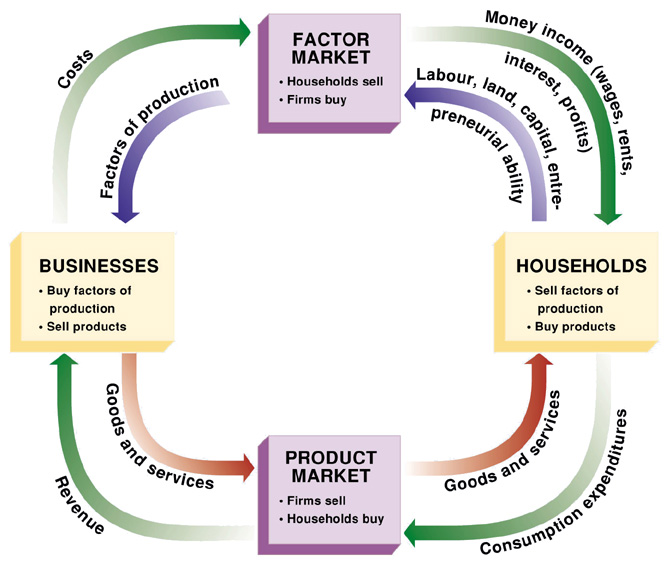
-
What is the solution to our present work situation?Too expensive? No. For one thing the UBI or GBI would replace other welfare programs. For present day single welfare recipients without children, UBI would represent an increase in their standard of living. The UBI or GBI, like welfare payments, would flow back into the economy almost immediately. Buying food, clothing, and shelter would use up most of the payment. Government spending of this sort stimulates the economy (or helps support the economy) because it buys goods and services.
It isn't necessary now for many people to work an 8 hour day. 8 hours has become, in many cases, a convention. Managers figure that a worker will spend 8 hours per day at their task. Workers figure that if they do their job In 6 hours, they'll just get more work, or they'll be dropped down to part-time. But a lot of jobs can actually be dome in less time than is spent.
Of course some jobs don't work that way. A waiter In a restaurant can't serve customers until they arrive. Actors in a play can't say their limes all at once and leave early. (Hmmm, perhaps an interesting play could be written where characters come on stage one at a time, say all their limes, then depart--leaving the audience to surmise who was telling the truth.) A lot of jobs do space out work on an unpredictable basis. But production workers (whether it's paper production or widget production) can be done at variable speeds. — Bitter Crank
I have heard of the UBI. Would that be the only main way to change the current system? Even that would never get off the ground, but it's something. -
What is the solution to our present work situation?Julio Cabrera sees this idle behavior as ultimately negative - the authentic decision to commit to projects and whatnot is an onerous reaction of disgust. Every sequences of positive instance that comes from our own initiative is preceded by this gathering-of-oneself: — darthbarracuda
Oh, that is an interesting way to frame the situation. Do you want to elaborate a little about authentic decisions to commit to projects being reactions of disgust? It's as if the projects come out of spite with knowing our baseline futile situation. Nice Cioran quote too.
A window would be a better analogy, in my opinion. Dasein is the "opening" from which Being is understood, including its value. — darthbarracuda
Interesting, can you explain more about your window analogy and Dasein? -
What is the solution to our present work situation?The technological revolution we have all witnessed over the last 60 years ought to have freed us all to have more leisure. Sadly the good old Protestant work ethnic has meant the contrary, has happened.
Inequality is up; we are more dependant on work, yet we have less work security; we have more labour saving devices, yet we we seem to work more, longer hours with fewer rights and lower guarantees.
This travesty of the possible has been brought to you by Neoliberal Ideology which has made the rich richer, the poor poorer, and continues to restrict democratic rights and freedoms.
This is not the world predicted in the 1970s. — charleton
So what would radically change our situation, en masse? I am hoping the answer won't be the same old REVOLUTION. Besides which, the slow yawning anguish of a "just feasible" life in middle class mediocrity, doesn't seem to engender people to act much with any haste. -
What is the solution to our present work situation?And that alone is significant, because they displace workers who once carried out the tasks which computers now do. Lost jobs for humans or not, there are a lot of jobs I would prefer a computer to do because the job is so gawd-awful boring, detailed, and tedious. — Bitter Crank
But what of the distribution of resources? What would make people, en masse, NOT do the 8 hour work day? -
What is the solution to our present work situation?The logic of life is what makes living "make sense" - everything we do "makes sense" because it's "part of life", it's what people do and what we're supposed to do. We're supposed to have projects, we're supposed to have jobs, relationships, progeny, etc. "Edge of life" issues, like suicide, are swept under the carpet because they are outside of the logic of life. Suicide does not make sense, from that perspective. — darthbarracuda
Well, that is an interesting part of our human experience that no other animal seems to share- a perpetual ability to understand itself qua itself. We live but we don't know why. This question entails not just our own personal lives but bringing forth new life. We can be what Sartre might call "authentic" and do things in "good faith", that is in knowing what we are doing in full awareness of the stark futility, or we can simply bury our heads in ongoing projects that we don't know how or why we took on, or perhaps were just kind of "foisted" on the person by circumstances. What is it we are trying to get at as individuals, as a species? This is something only we (or the proverbial self-aware aliens) must contend with. Suicide I see as an ideation coping technique. The thought of it is more relief than the actual action. As Schopenhauer stated,Suicide may also be regarded as an experiment — a question which man puts to Nature, trying to force her to an answer. The question is this: What change will death produce in a man’s existence and in his insight into the nature of things? It is a clumsy experiment to make; for it involves the destruction of the very consciousness which puts the question and awaits the answer. — Schopenhauer- On Suicide
But indeed suicide, like existential angst, extreme boredom, questioning of life, absurdity of life, and the like are on the edges of things. It needs to be pushed out for more projects to be put through. Projects good, questioning bad. Navel-gazing and self-indulgence will be the main accusations.
I don't like to use the brain-computer, mind-software metaphor too much, but it does seem to be as you say - the software ("us") is fundamentally an infinite loop that only breaks when it is interrupted by some priority. When there is no queue, we are simply idly looping, waiting for something to happen. — darthbarracuda
And what is this idly looping? What is the nature behind all the looping? What does this tell us about what it means to be human, about life, about humanity as whole? Are the projects/programs something to quickly queue up in memory so to execute post haste or does the idling have any merit?
Also, I know you don't like the idea of a mind as a computer- but what is your best analogy if there is one? If not neural networks, what would you use? Is there any appropriate analogy or is the brain's mechanism of a category original and ontologically different? -
What is the solution to our present work situation?It was really, really tedious work, but simple. It was great. The supervisor told us we could all talk, snack, joke, and laugh or whatever, as long as there was a steady stream of boxes moving through the process. So, we did -- talk, laugh, joke, and so on, and we sorted and re boxed thousands of boxes of files. It was good, because we had control over our time and over our style of interacting. 3 months was plenty of that activity, but it demonstrates the point. — Bitter Crank
So hierarchies and the culture that comes with it is your biggest complaint against the current system it seems. -
What is the solution to our present work situation?An easy solution is to guarantee the right to work in the constitution. If you cannot find work, the state will assign you one. You need to look at this perspective from a more analytical one rather than assuming that everyone has their inner individualistic needs which take priority over the monarch (who's right to rule has been given by God). If you cannot understand this and the other policies that made conservatism so successful until the birth of liberal ideas, no wonder you support this false idea of individualism and liberalism. — Count Radetzky von Radetz
So why would working for the monarch be better? Seems arbitrary or just a joke. -
What is the solution to our present work situation?Is that better? — Bitter Crank
Yes, there's the fire and fury! :grin:
But, well, let me "loop you in" to @Caldwell's comments as I think this question can pertain to both. Do you think the modern business dynamic is just a natural outgrowth of what humans really want out of life? If not, what is it that we want? You seemed to hint at making things ourselves. What if that doesn't really do much for people? Like if the furniture was rearranged and people made their own clothes and food, this really didn't change much to their satisfaction? Is there something else we are discounting? -
What is the solution to our present work situation?While it appears we have now digressed from your topic, I'll indulge you. People who have hearts that don't work very well and need help from inorganic sources should go get a heart from inorganic sources. We haven't grown inorganic hearts in the lab yet. But certainly, we now have body parts that are inorganic. Like hip, knee, and heart pacer. — Caldwell
You are taking that a wee bit too literally or you are using really really dry humor. Either way, I don't think it is organic in how you are using it. People don't, in my opinion, have a natural tendency to like office spaces, corporate culture, hierarchies and the like. These came about through contingent forces of history, too complex to lay out here. If by organic you mean that it came about through an array of sources, well yeah I agree but as you stated, that has no normative value and is pretty self-evident. -
What is the solution to our present work situation?
You mean most federal bureaucracies?Why don't you ask the Federal Bureau of Futility? — Caldwell
The work situation is an organic thing. Humans do want responsibilities. They want to be tied to an organization — Caldwell
Ah I see, it has to be this way because it is this way. By adding the word "organic" does that give more import to your statement? Do you think the modern relations were "organic" or rather the result of a number of factors that may or may not have lead to ideal conditions as it is now. Even if it is organic, does that mean it is good? Some people have hearts that don't work very well and need help from inorganic sources. -
What is the solution to our present work situation?The movie “I :heart: Huckabees” has a great scene where the idealistic tree-hugging crusader finally sees his “stuffed suit” opponent as himself, and it changes everything. Great metaphysical movie. — 0 thru 9
That is a good one.
Acceptance is usually a good thing, even if one tries then to change what is accepted. Patience is wonderful and rare is our insta-google world. Don’t know how it would all come together, but eventually we all have to come together. We might be all huddled together on the mountain tops when the oceans rise and the levee breaks! — 0 thru 9
Acceptance just means lack of imagination, no? Isn't it a self-sustaining system if you don't try to change aspects of it that you don't like? The hope is powers are big enough to make you conform or you have extreme options of suicide or living a desperate life as an outlier of society. -
What is the solution to our present work situation?I give you that. Machines do not know the concept of futility. They know utility, functionality, and redundancy. — Caldwell
Yes, like many workers who don't stop to think about their position or how their day is taken up. How much are we missing with our current model of the modern workday? -
What is the solution to our present work situation?I enjoy using new technology. But the fact is, the act of creative destruction which brought us the current crop of gadgets was a extremely huge waste of resources--duplicating what already existed. Land lines vs. cell phones? There are apps on my cell phone that I find worth the cost -- for instance, the MetroTransit app which provides me with the bus schedule for any one of thousands of bus stops I might want to catch a bus at. Or the taxi app that shows me where my taxi is, as I wait for it. On the other hand, voice quality of cell phones is usually crappy, and everyone using the world as their private phone booth is annoying, if not fatal. — Bitter Crank
This is a tepid condemnation- I was hoping for fire and fury. If we go all Hegelian- development and synthesis of old into new, seem to be the point of humans. The march of history and all that. Technology self-generating more things.. But to stop and wonder why do anything, that seems to not fit into the scheme. -
What is the solution to our present work situation?Very true... It is fear that keeps us in chains. — matt
And no beat, if you strive to be a drummer. -
What is the solution to our present work situation?
Well, animals seem to not have this problem of self-awareness. Either do machines. Another problem would be that people would rather not be either of those, now that we've experienced our Promethean situation. -
What is the solution to our present work situation?
Again, another inspired post, thank you.
If new investment, manufacturing, and retail opportunities were to exist, acts of creative destruction were required to wreck big old markets and create huge new markets. — Bitter Crank
So is this good or bad? Does new mean better? Your implication is no. Why not? New technologies were created through the process. Isn't this ENOUGH to proclaim it GOOD in and of itself? (to be read sarcastically).
Skilled craftsmen and craftswomen have always used tools or made tools to their own liking. Carpenters, for instance, have their own tools and perform work mostly on a contract basis for individuals (as opposed to construction workers...)
One of the reasons we all are dissatisfied with life is that we don't have our own tools to perform our own work for our own customers. You might like to make cloth from flax and wool by yourself, and you could. People do it. But up against the fabrics industries, an individual isn't likely to make a living doing that. — Bitter Crank
So creating something by oneself rather than relying on others is the answer? What if that is not satisfying either? It's just the whole day filled up with making stuff rather than inventing new stuff. What is the trade off? Besides that it fits the model of Marx' idea that somehow not being alienated from the sources of production is better for the individual, what makes this inherently better/good/satisfying? What makes this any better than what we have now? -
What is the solution to our present work situation?When you ask professional engineers for help with some device and they tell you "I don't know", that doesn't always instill confidence. It's also scary how many people are desperate to get through error checking, testing, etc. — darthbarracuda
I know that one first hand.. tables upon tables.. all work together intricately.. you never know how one table might affect another with a bit of change to the code.. I'm not talking coffee tables obviously :).
Artificial intelligence might make some people question the value of human existence qua human existence, as A.I. presumably would do most of the work while we sit around idly, twiddling our fingers.
If the creation is "better" than the creator ... what will motivate people to reproduce? Why make humans, when artificial intelligence is even better? But without humans, what's the point of artificial intelligence? Hold on, back up a moment - what's the point of humanity in general? — darthbarracuda
Bingo.. what ARE we doing. What is humanity's point? The error written in our code is that self-awareness leads to understanding of systemic futility. If projects work with functions, the fully self-aware human has to trick himself into constantly being "driven" by these programs.. Every once in a while the baseline futility seeps in; the eternal WHY creeps in and haunts us. It's as if the software has run out of programs to execute. -
What is the solution to our present work situation?Ahh... well that’s the tricky part, isn’t it? The devil hides in the details. I’d imagine that there would have to be many different approaches, coming not just from experts and scientists, but from anyone who has something useful to add. For example... perhaps if a significant percentage (not even a majority, just a spark so to speak) really were convinced that humans are more than just a bowlful of isolated marbles barely touching, never intersecting, merely bouncing off each other either painfully or pleasurably ad Infinitum (I am a rock... I am an iiiii-aaa-land. And a rock can feel no pain. And an island never cries)... Then just maybe, life and work on this third rock from the sun, this blue-green space marble might actually be quite enjoyable.
For inspiration of this sort, i usually turn to the Tao Te Ching, and the writings of Daniel Quinn, Joseph Campbell, Ken Wilber, and some others. — 0 thru 9
Is it a change in how products and services are distributed? Is it a change in what we value? Is it a change in relations? Is it a change in how we think? And then how would it all come together? Yep too much for my mind. As we've seen, any "attempt" at some kind of change led to violence and domination of one class or group over another. Better to just accept no? -
What is the solution to our present work situation?Hahaha, this is somewhat ironic in my case since I just recently switched majors from engineering to computer science. One thing I realized in my experience with engineering is how janky things tend to be. It actually sort of lowered my confidence in many pieces of technology that I regularly use. When the only thing that keeps something running is a single resistor, and the rate of failure of this resistor is relatively high, suddenly the whole thing looks as if it's already broken. — darthbarracuda
That's funny actually.. any product types in particular? I've had TVs with shitty speakers and hard drives that break real easily, but I'm not sure if that is much resistors as other technology.. hard drives that aren't solid state can break easily due to their physical movement of parts.
Just as there are only a few that actually design the products we use and consume, there are also a very, very small amount of researchers and explorers who actually get to take the pictures you see in Nat Geo. The hope is to be one of these few, but the chances are small. But it's better than working as a desk-slave, designing products that will be replicated ad infinitum and ad nauseum. — darthbarracuda
Yes, most technology is foreign to us. I guess I'll pose the question to you that I posed to BC:
Going back to how technology replaces meaning- what do you think humans' relationship with technology is? Are tools one and the same with what it means to be a fully functioning Homo sapien? Some posters on here seem to place technology as the be all and end all it seems. Our very brains are said to work similar to specific kinds of computer- connectionist programming networks with neurons acting like transistors or circuits of sorts. What's funny is that if robots became fully sentient, I don't think it would end up like a Terminator scenario, but more like a Douglas Adams book. That is to say, the computers would have existential angst like us humans, and not be able to compute the systemic futility of existence. That would be truly horrifying for the poor little machine bastard. -
What is the solution to our present work situation?In that sense, condoms and other forms of birth control are symbols of liberation. No political philosophy will ever be satisfactory, and a contributing reason why this is so is because it just is not possible to get along with as many people as there are. Less people = less potential for conflict. — darthbarracuda
Well, you bring up the problem of large populations- this adds to alienation. Think about how many people made the goods and services, the complicated technology you use. What did you have to do with it besides consuming it? All the processes to make all our goods are so complex, that we can never in a lifetime understand it all. The processes and those who get the "privilege" of making the complex technology lives in large labs in corporations and universities. The rest get to run the cogs.. I don't mean computer programmers- they are modern bricklayers.. It's the Intels, Apples, IBMs, Ciscos, etc. etc. and the Harvards, and Oxfords, and MITs, etc.etc . Sure, some might get to be a part of it, but most will be simply the ones who get the final products in consumption form or nicely printed "How things work" books to ease the mind enough to not "really" want to know the complexities and minutia. Essentially there are those who make the cogs, and those who run the cogs. Probably 98% run the cogs. -
What is the solution to our present work situation?Some say technology will save us (eventually). Some say there is no way to change flawed, sinful human nature. There is another view that says if the future is to be different, it will come not from machines or powerful computers, but from people with changed minds. — 0 thru 9
Yes indeed, but what does that require from us? What would we have to do to end the despair of the modern work life? Right. Now. -
What is the solution to our present work situation?
I really like how you framed the problem there.
Going back to how technology replaces meaning- what do you think humans' relationship with technology is? Are tools one and the same with what it means to be a fully functioning Homo sapien? Some posters on here seem to place technology as the be all and end all it seems. Our very brains are said to work similar to specific kinds of computer- connectionist programming networks with neurons acting like transistors or circuits of sorts. What's funny is that if robots became fully sentient, I don't think it would end up like a Terminator scenario, but more like a Douglas Adams book. That is to say, the computers would have existential angst like us humans, and not be able to compute the systemic futility of existence. That would be truly horrifying for the poor little machine bastard. -
What is the solution to our present work situation?
Also, this all just speaks to the absurd futility of things. I just think of how happy Ford and the Dodge brothers were and other early car makers, and just the assembly line full of cars rolling out.. technology is somehow a replacement for meaning. As long as we keep working on making more things, we don't have to stop and ask why.
It's to make us "live better" so we can enjoy the stuff right? That's what most of the self-assured pragmatic types would say right? -
What is the solution to our present work situation?We can at least get clarity. The truth is that a lot of work is not intended to benefit the worker at all, and the kind of jobs where workers find direct benefit employ a smaller part of the workforce and are hotly sought after. Capitalism, and the command economy of the soviet socialist system, are not ground-up systems where workers establish priorities and methods. They are both top-down systems where powerful apparatchiks decide what is going to be done, and the individual worker can get with the program or go fuck himself. — Bitter Crank
This is true. I still see the problem of work is more related to what Durkheim might call anomie, or perhaps more pointedly, what Marx called alienation. But does Marx solution really solve alienation? Whether or not plans are made by you and your coworkers through committees or what not, can't this be just as alienating as committees handed down from corporate bureaucracies or government institutions? Most work is inherently not that interesting I would presume. Life is not meant to be a wonder playground apparently. Not that I ever thought it was or will be. -
What is the solution to our present work situation?Were you the sort of person who could read a motivational psychology book, take it seriously, apply it assiduously, consult with successful people for coaching on how to be a middle class success, you could solve this problem. And if you had wings, you could fly like a bird up in the sky. — Bitter Crank
This is hilarious. -
What is the solution to our present work situation?
What's funny is communism tried to solve the problem of work by changing society itself. It is a very American idea that it is YOU who has to change, not society's social relations. Business as usual for the last 150 years (with some changes to labor laws to make sure the plebeians don't change too much) is an interesting idea. We really can't fathom a different lifestyle. The only hints of this are the technophiles who that robots will solve the problem. I'm weary of that too, and that is about the only ideas that people float around. -
What is the solution to our present work situation?Social production of goods and services actually yields a good deal more time and energy to spend on optional activities. IF we had to produce our own goods and services, (food, clothing, shelter, fuel for heat, water, etc.) we would have to work exceedingly hard and for very long hours every day, and even then we wouldn't have everything we needed. — Bitter Crank
Granted, but I am not proposing that we make everything ourselves either.
All the empty rhetoric of the work place come into play when managers have nothing better to do with their time. When factories, offices, mines, mills, hospitals, etc. are working well, and the managers have actual work to do, you don't hear this stuff a lot. — Bitter Crank
Yes, but I also think it is self-driven too. We "take on" these slogans so as to justify why we need to get involved with work we might otherwise not get involved with.. For example, "This task right now will prepare me for a possible future job with more money that I will tolerate more because of the higher pay". Or, perhaps the work itself is not what one would chose, but one gets caught up in the minutia because you get paid for it. Or maybe people just think about the weekends and vacations as their release and this is enough.
See C. Wright Mills, White Collar: The American Middle Classes, 1951. It's a classic sociology text. In one chapter he described how academics, feeling trapped and under-paid in their liberal arts college offices, sometimes set up consultancies to advise corporations on how to achieve greater productivity in the work force. Sixty some years later managers are still looking for advice, though there are now whole bookstores full of it. And now there are a lot of less-than-professors out hawking industrial nostrums to spur apathetic workers (and cure them of their insensitive racist, sexist, transphobic, tendencies). — Bitter Crank
Interesting, managerial interactions is a fascinating beast.
But the question still remains, is there something better than our current economic and social relations in regards to work? -
What makes life worth living?
Most people would say that life is worth living based on how consumed they are by projects that they initiate themselves minus (-) the external pains, pressures, and annoyances of unwanted suffering or undo control by others.
I would contend that life is not worth living if one is in a continuous repetitive loop of absurdity. If one realizes that life is basically survival (economic/survival related goals), maintenance (getting more comfortable in surrounding goals), entertainment (fleeing from boredom goals). The projects no longer consume, it is biding time through these three main goal-related events. There is a sort of banality to it that cannot be overlooked by those who see it. The banality of work, the banality of maintenance, the banality of entertaining oneself. It is absurd repetition, even in its novelty. The projects themselves no longer consume as if they are a wonder to behold. They are laid bare our inherent restless natures.
Life is made even worse by not only life's structural/systemic futility but by its contingent harms (that is to say, harms based on circumstances). So your neighbors making noise which prevents you from sleeping, the ACME anvil that fell on your foot, the hurricane that flooded or completely destroyed your property, the short term or long term mental or physical illness, the annoyances of the everyday interactions with other people, technology, and social institutions in general.
schopenhauer1

Start FollowingSend a Message
- Other sites we like
- Social media
- Terms of Service
- Sign In
- Created with PlushForums
- © 2026 The Philosophy Forum