
-
What is the purpose of Art?I do think that art being valuable because "we enjoy it, find it refreshing, invigorating" is a starting point, but I don't think that answers the question of what it's purpose is. Those aspects are just results of our experience. — Noble Dust
Now wait a minute here... Art is something we create ; we get something out of something that we do that makes us want to do it again. Yes, "just results of our experience". What more is there, pray tell, than our own estimation of a purpose in something we do? Is there something more to a bicycle than our estimation of what it is good for, like transportation or exercise and the usefulness that we identify in riding a bike rather than walking or riding a horse? No, there isn't.
If you think there is something above and beyond our own estimation of the value in something that we do, then you need to come up with that something PDQ. Art doesn't have an existence outside of human activity. -
What is the purpose of Art?I said art was an integral part of the human enterprise. We can say it either way: "The mind that can draw a map can also paint a picture" or "The mind that can paint a picture can draw a map." Art isn't valuable merely because it has utilitarian values. Its also valuable because we enjoy it, we find art refreshing, invigorating, and so on.
-
Why is social conservatism generally associated with religion?Yes.
Posters have offered various reasons why religion is associated with conservatism, and they are good observations. But the effect of inter-generational instruction has to be counted too. We were not blank slates until we were old enough to have political opinions. We had already absorbed a lot of politics, from radically conservative to radically revolutionary. Language, diet, politics, hygiene, etc. are all heavily shaped by upbringing. -
What is the purpose of Art?Clearly, art never helped man to survive — Agustino
Rather than art being a superfluous add-on whose function isn't clear, art is an integral part of the human enterprise. The mind that can paint a picture can also draw a map. The skills required in perspective drawing is part of the skill of navigation. The bard who can recite the people's myths in poetic form might also incite the people to action. Building a cathedral might seem to contribute nothing to survival except: what it takes to build a cathedral also is required to build a castle, fort, factory, mill, etc. What it takes to amuse the people with fireworks is also required to blast a lead ball down a narrow tube. Workers chanting can better coordinate their movements. Comedy can give release from the tedium of the day; it can also be used as a weapon (like savage travesties directed at a recently elected president, for instance...) -
What is the purpose of Art?
- expression (especially if one performs an artistic act, like singing in the shower, writing a poem)
- pleasure in doing art as well as in consuming art
- decoration of spaces
- stimulation of the emotions and intellect
- distraction
- interesting stories, melodies, sounds, rhythms, scenes...
- socially shared--experiencing the arts with other people
- "spiritual" functions (gaining "power over the human soul" through rituals, ceremonies, incantations)
- obtain income
-
Why is social conservatism generally associated with religion?Why is social conservatism generally associated with religion?
How many adult atheist progressives migrate to the opposite end of the spectrum and become religious conservatives? I would guess few. Similarly, how many religious conservatives make that trip and become atheist progressives? Again, not very many. Why?
As Alexander Pope noted, "Tis education forms the common mind, Just as the twig is bent the tree's inclined."
Conservative believers and progressive atheists alike are usually the product of their education -- not just formal schooling, but the education that comes from living in a particular milieu. There may be backflips off the high board along the way -- the offspring of the conservative religious parents who in college becomes quite the progressive. Usually that progressive fit fades away, and a few years out of college the one-time white campus champion of colored people, gays, women, migrants, etc., is a member of the Chamber of Commerce and Rotary.
The same can happen to the boy from the wrong side of the tracks whose parents are union folk and at best lukewarm towards the church. He might do the Collegiate About Face and get into Republicanism and religion, maybe because it confers an advantage among his immediate peers. But like his opposite, a few years out of college and he'll be back among the progressives, and will be trying to get his workplace unionized.
There are exceptions, of course. But a common theme among people aging out of youth into middle age is how they find themselves resembling their parents more and more. They find themselves doing the annoying things that parents used to do. They start thinking more and more like their parents did. (That one is becoming one's mother and father is a humbling realization.) -
Embracing depression.Right. Some theorists want to find an evolutionary advantage in anything that they find common or persistent. Like I said, I don't really buy this theory for depression. My guess is that depression (properly diagnosed) in the present world doesn't have an analogy in our early evolutionary history when life was shorter and simpler. Also, neuro-chemistry has been evolving a lot longer than primates have been in business.
-
Embracing depression.Well, people say they are "depressed". Depression is a mood disorder, not the same as "life sucks". Maybe they are not actually depressed, in terms of clinically defined terms. They might be angry, unhappy, grieving, stressed out, might have sleep apnea, be alcoholic or addicted, fearful about debt, immigration status--all sorts of things that can 'grind one down' but which aren't depression.
Long-term stress and unhappiness might resemble depression, and it might even get better if treated like depression, but a change of life circumstances would be more effective (but much more difficult to arrange).
People who are clinically depressed have some of these symptoms, (National Institute for Mental Health):
Difficulty concentrating, remembering details, and making decisions
Fatigue and decreased energy
Feelings of guilt, worthlessness, and/or helplessness
Feelings of hopelessness and/or pessimism
Insomnia, early-morning wakefulness, or excessive sleeping
Irritability, restlessness
Loss of interest in activities or hobbies once pleasurable, including sex
Overeating or appetite loss
Persistent aches or pains, headaches, cramps, or digestive problems that do not ease even with treatment
Persistent sad, anxious, or "empty" feelings
Thoughts of suicide, suicide attempts
Just because somebody isn't sleeping well doesn't mean they have depression; and over-eating isn't a reliable sign either--not these days. Just checking off the list isn't enough. Normally one is interviewed and other factors are taken into account.
Clinical depression might not have some readily identifiable cause. A very active person who is injured and in a cast might slide into depression. Generally this will go away as they recover.
Some people are bi-polar; their feelings of elation or depression aren't usually linked to any particular life circumstance. The mood swings can be very severe. -
Embracing depression.... is an evolution... — Noble Dust
Speaking of evolution, why did we evolve in such a way that we can be 'depressed'? Presumably, there was some benefit to either the person or to the biologically related group. I'm not sure what that might be. Perhaps it had a protective value. individuals under excessive stress would withdraw for a while and perhaps thereby recover. Or perhaps depression caused ruminative thinking that helped individuals realize something useful.
I'm not sure I buy this 'evolutionary psychology' theory. I've experienced long periods of depression and it didn't yield any advantages. (It caused me to lose weight I could hardly afford to lose that first round. Alas, it hasn't had that effect again when I could really use some loss of appetite.) It sucked a lot.
Why should anyone 'suffer' from depression? — Question
Because it is quite unpleasant, that's why. -
Do you talk about Philosophy w/ people who don't know much about it?Ah, well, lack of culture... You do know that he doesn't have a lack of culture, he just doesn't have YOUR culture. (Don't get me wrong; I value literacy highly, but in anthropological terms, he is probably as "cultured" as you or me.)
Actually I thought his answer was perfectly adequate. Lots of people don't know what to believe anymore. You weren't giving him a cultural literacy test, you asked him a reasonable question, he gave you a reasonable answer. -
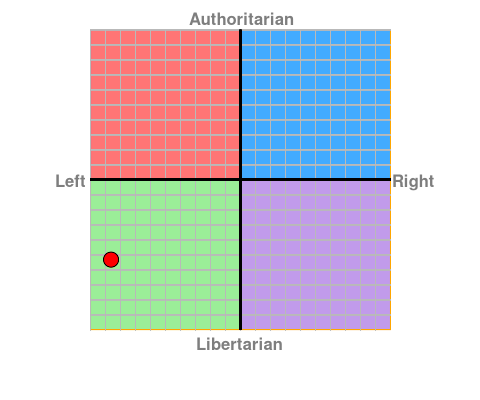
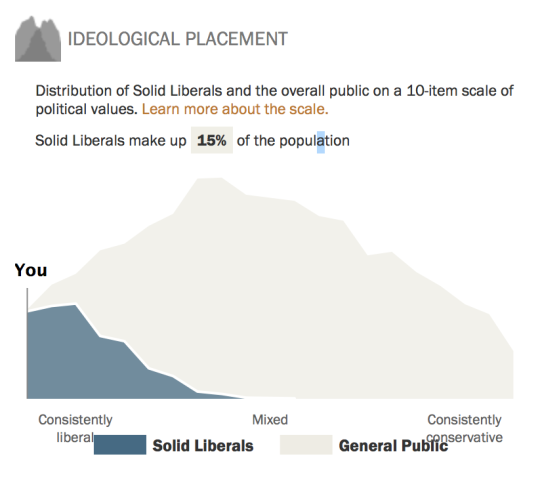
Political Spectrum TestIn this way it doesn't make any difference whether the questions make sense or not: If conservatives consistently answer poorly constructed questions in a certain way, and liberals consistently answer the same questions in a different way, the test will work.
The New York Times published some maps this morning showing how the popularity of a bunch of TV programs were very closely correlated with voting patterns in the recent election. The concept works because it tends to be the case that a majority of people in a census tract tend to like the same TV programs and they also like the same candidates. The programs (and the candidates) might be dog shit, but that doesn't matter for purposes of prediction.
The Minnesota Multiphasic Personality Inventory asks somewhat meaningingless questions that by and large don't suggest anything at all, but people with (and without) psychiatric diagnoses tend to answer the questions in a predictable way. That's all that's necessary. -
Do you talk about Philosophy w/ people who don't know much about it?Actually, I do like to talk about some areas of philosophy with other people who may or may not know much about it, but I find it fairly difficult to find those people who are interested and have the time.
-
Do you talk about Philosophy w/ people who don't know much about it?I talk to myself all the time. — m-theory
Quite so. It's often the only way to have a conversation with someone intelligent. -
Do you talk about Philosophy w/ people who don't know much about it?it's kinda stupid... rational speculation into the nature of the world and humanity's relationship to it. — darthbarracuda
Very true. -
Do you talk about Philosophy w/ people who don't know much about it?Ah, there you go. Enjoy your discussions.
-
Do you talk about Philosophy w/ people who don't know much about it?but drinkers are usually suspicious of non-drinkers — anonymous66
As well they should be.
Don't they serve hard liquor where you live? Do you dislike vodka, gin, whisky, and bourbon too?
Maybe you could find a socialist or atheist study group. They are usually relentlessly sober, and drink coffee in the evening. -
Why is social conservatism generally associated with religion?Judaism and Islam were conservative from the very beginning — Agustino
Wait a minute, how can you call a religion conservative from the beginning that spread as fast as Islam did, disrupting one society after another? Are you classifying Islam conservative (at its birth) because religion was allied with conquest and control of territory and people? Or are you saying that Islam became fixed and rigid very early?
Judaism probably began as one of several religions in the inland territory at the eastern end of the Mediterranean, and from that perspective might have hatched out as conservative from the get go. Is that why you classify Judaism as conservative from the beginning? I would think Egyptian religion would be a better candidate for "conservative at its birth". What about Greek and Roman religion? -
Do you talk about Philosophy w/ people who don't know much about it?What kind of philosopher hates beer? That's absurd.
-
Do you talk about Philosophy w/ people who don't know much about it?If I were you, I'd avoid talking about philosophy with people who are just then having their morning coffee. Some people are very irritable in the morning and she might smash a chair over your head for bringing up heavy topics. Try a bar with people who have had just enough beer to be slightly lubricated.
Philosophy flows better with beer in the evening than with coffee in the morning. -
Why is social conservatism generally associated with religion?When does the association between conservatism and religion begin? Not in the youth of a religion, it would seem. The youth of the 3 Abrahamic faiths were not especially conservative as I remember--more like associated with social upheaval.
Once established, (period of centuries) religions accumulate cultural and material assets. They become a 'vested' interest, which they wish to preserve. Individuals who identify as members of the religion become both asset and preservation police. They want what they joined to maintain its attractive features. Members and administrators regularly police the boundaries and inner precincts of the religion to prevent subversion and decay.
That's very simplistic, of course. Christianity went through a lot of social and theological upheaval prior to the Reformation; Luther wasn't the first disruptor, and he wasn't the last, obviously enough.
But what is a more interesting question, Agustino, is why and how some people make of the conservative religion a springboard into very non-conservative, even radical, religious practice? I'm thinking of Dorothy Day, here. (You may not be familiar with her). She was at best a lapsed Christian, maybe moving towards atheism; a journalist, socialist, who in the 1930s experienced a reconciliation with the Catholic Church and (with Peter Marin) founded the rather left-wing Catholic Worker, which practiced a radical hospitality for the burgeoning numbers of homeless men and women in New York. She died sometime in the 1980s, and is on track to sainthood -- something she would have abhorred. "Don't call me a saint," she said. "I don't want to be dismissed that easily." There were maybe a hundred Catholic Worker houses of hospitality at their peak; some of them are still operating.
Day didn't soften up her radical views as she aged, but she was always faithful and obedient to the Church. (Granted, she sometimes had to look for a bishop with views friendly to her own.)
It isn't very common that that people do this--launch "revolutions" within the church, yet preserve their conservative faith. The Berrigan brothers come to mind--both priests, both involved in radical political activity. -
This forum should use a like optionI hate "like" buttons. Long live the Grinch.
They are too blunt a facebooky instrument. How about 3 emoji that indicate:
want to vomit
don't give a rat's ass
thrilled to pieces
The old forum had a plus and minus members could click. Some liked it. Some didn't. -
An Alternative To The Golden RuleI wasn't quite disputing the golden rule's ability to be understood, it was more about whether it succeeds in being applicable to humans given the reasons the we may behave the way we do. — SuperAJ96
I am afraid that "given the reasons the we may behave the way we do" doesn't help much, because our reasons for behaving in any particular way may vary from person to person, time to time, context to context. Sometimes we have to assume that moral agents decide to obey the golden rule (or any other commandment or rule) because they recognize it as a legitimate, even categorical, imperative. It's possible that a moral agent will help somebody change fix a flat tire because they plan on stealing the car as soon as the tire is fixed to use as a get-away car after robbing a bank. There are numerous motives that one could imagine, but it is more sensible to assume that someone feels sympathy for the driver with the flat tire, and wants to help. Sure, it could be that fixing the tire was meant as a mating ritual, but reasoning like that takes us deep into the weeds.
I have no way of using logic to either agree or disagree with whether one "ought" to be taken in for questioning by the Ethics Department, so I suppose I'll leave it at that. — SuperAJ96
Fine by me. An ethicist will be by in 5 minutes to arrest you and drag you into the Ethics Department building for questioning. It will all be very ethical, rest assured.
Do you believe it is possible to ever be true to someone else?
No one can be truer to someone else than they can be "true unto their own self". Our own selves are the only selves we can know really, really well.
— SuperAJ96When you said "should" there, what did you mean exactly? — SuperAJ96
"should" was inverted (normally write, "you should go" rather than "should you go") to emphasize the question of what you should or ought to do in the situation (of someone wanting to be gang banged).
This is actually an idea similar to what I said in my opener, as far as it relates to your decision in how to treat someone else is an entirely personal one. An agreement can be reached when the parties involved mutually feel that it what they personally want to do. Is that something we are in agreement on? — SuperAJ96
That would seem to be more for the "Platinum Rule" where two people have to get down to brass tacks as far as what one thinks the other one really wants. "Oh, you want me to beat you up first. I see. Well, how beaten up do you want to be? A black eye? broken teeth? A skull fracture? Or just soft tissue bruises? How thorough a gang banging do you want after the beating? Do you need to have an orgasm? And, how much are you paying each of us, again? OK, so we have a deal." POW, THUD, SMACK, etc.
If I see you being harassed in public by a group of thugs, and you are getting the worst of it, the Golden Rule asks me "If you were in that situation, what would you want somebody to do for you?) I would want effective help as quickly as possible. I don't have to speculate long about what you might want. If you are bleeding, I will bind up your wounds, even though you were trying to commit suicide. That's what I would want. "Next time, attempt suicide in private, please."
What do you believe it means it be mentally ill? Do you you believe someone can be objectively mentally ill, or is it more of a relative thing? — SuperAJ96
Yes, somebody can be objectively mentally ill. There are diagnostic criteria to separate out the actually insane from the merely confused and unhappy. Unhappy, depressed, angry, confused people don't have visual hallucinations, as a rule. They don't generally have auditory hallucinations, either They don't scream inarticulately for hours. Their blood pressure, heart rate, and so on doesn't fluctuate wildly. They do not experience terror. (I'm describing someone having a manic attack.) Merely unhappy people haven't been awake for 72 hours. Give a small dose of Thorazine to an unhappy person and they will fall asleep right away for several hours. Give a small dose of Thorazine to someone in mania and it won't have any effect at all. A very large dose of Thorazine and chloral hydrate might not have much effect. In which case, it's into the seclusion room, aka, a padded cell, until a drug combination can be found to take the edge of mania.
If someone is able, they can take the Minnesota Multiphasic Personality Inventory which will indicate whether the person has one of a dozen diagnosable mental illnesses, like OCD, bi-polar disease, deep depression, schizophrenia, and so on.
I suspect that the estimate of how many people are technically mentally ill is exaggerated. Too many people who are merely unhappy, dissatisfied, disappointed, fucked over, lonely, sad, harassed, and so forth are diagnosed as ill. They're not crazy, they just need a new life. -
An Alternative To The Golden RuleWho gets to decide whose wishes are crazy? — darthbarracuda
To be technical about it, admitting physicians get to decide whose wishes are very crazy. Ordinary craziness won't earn one a bed on the ward, but it might get one an Rx for some anti-psychotic pills or tranquilizers. In an unofficial capacity, we all get to decide who is crazy. Most of the people we interact with on a typical day are not mentally ill (excepting people who work with mentally ill patients). Of those who are, there is a range from slightly-to-very mentally ill. People who are fairly to very mentally ill are readily detectible. No one is under any obligation to serve up what a mentally ill person asks for if we think it contrary to their well-being. Why not?
Not, because the details of this alleged "platinum rule" have been worked out by law makers, and harming other people, when they are mentally ill and want us to harm them, has been ruled "unacceptable and illegal.
I'm not sure how someone who engaged in consensual S&M as a top (M=master, top, sadist) would fare in court if an S (S=slave, bottom) accused them of assault. I'm not sure how the S would fare in a psychiatric hospital admissions interview either. Samuel Steward (mentioned above) was hospitalized several times after receiving the requested beating. Which, apparently, Steward considered highly satisfactory. He merited the judgement of "sound mind" but maybe he was a bit unhinged as far as his sexual satisfaction was concerned.
"Treat others how they want to be treated" is a less reliable over-arching principle than the golden rule because it doesn't require a person to test an action against one's own (much better known and understood) feelings. — Bitter Crank -
An Alternative To The Golden RuleWe were not discussing the golden rule, we were discussing
the Platinum Rule: treat others how they want to be treated. — Babbeus
Interpreting the gold, platinum, paladium, or plutonium rule is well within your operational capability.
"Rules" such as the so-called "platinum rule" are general, over-arching ideals. Specifics have to be worked out between individuals. You might not want to be gang-banged, but perhaps somebody else does. Should you contribute your services for the satisfaction of this person?
You have your own rules which might or might not allow you to do what somebody else wants. The person whose wishes are different than yours can be questioned about specifics, and a negotiated agreement reached.
Samuel Steward, a literature professor in Chicago, desired to be beaten up and raped by hired assailants. He was an intelligent, sophisticated man, of sound mind, and very "specialized tastes". He found men who were willing to accommodate him, and gave him real beatings -- no punches pulled. Had he asked me, I would have rejected his request to be beaten up. On a few occasions I have come across guys who wanted something extreme. No. Wouldn't do it.
"Treat others how they want to be treated" is a less reliable over-arching principle than the golden rule because it doesn't require a person to test an action against one's own (much better known and understood) feelings. -
An Alternative To The Golden RuleIt's not so easy, you would need a neutral and objective judge that can establish without a doubt what is fair and what is not. — Babbeus
Baloney. Interpreting the golden rule is well within your operational capability. No one is 100% unbiased and this case does not require a verdict beyond a doubt. The meaning of the golden rule is obvious; you know that; there is nothing significant to debate about it.
There are nuggets that everyone accepts that might be more worthwhile for you to investigate, like "The unexamined life is not worth living." which Socrates is alleged to have said at his trial, according to Plato. Really?
Is ""To thine own self be true." ALWAYS good advice? It comes from WS, spoken by Polonius in Hamlet. Maybe there are times when "thine own self" ought to be taken to be taken in for questioning by the Ethics Department.
Never tell a lie? Obey your superiors? My country right or wrong? There is a long list of moral rules that deserve your attention. Get to it. -
An Alternative To The Golden RuleWhat if they want to be treated unfairly well compared with any other? — Babbeus
In that case they have a diagnosable mental illness. Crazy wishes are best suppressed with a little Thorazine. -
An Alternative To The Golden RuleThere isn't any need for revisions to the Golden Rule which, if I remember correctly, was the summation of Jewish law. The various laws applied to various situations, of course. Laws governing the treatment of animals didn't address what to do in cases of adultery, for instance.
No one has had difficulty understanding the Golden Rule for the last 2000 years, though lots of people have had difficulty following it. -
Is everything futile?Isn't "if everything is futile, discussing how futile everything is... is futile" a tautology?
If you say "all men are liars" why should I believe you? there isn't any way out of such statements. -
Is everything futile?IntrapersonaSo if I said to you that I don't need to prove to you that I am a pink fairy that looks like a unicorn ... — intrapersona
I sort of assumed you were. I wasn't willing to stoop to saying you looked like a unicorn.
if everything actually is futile, ... then it would be futile to ask "is it all futile?"
— intrapersona
So the question is not genuine. — jkop
The pink fairy needs to attend to this point. If everything is futile, then discussing futility is... futile. -
Most of us provide no major contributions...So, this does not need to be limited to just the ones in the major histories and documentaries, but anyone who contributes to major innovations that are recognizably useful, admired, and appreciated by a large population of people. — schopenhauer1
Robert Koch arrived at the Germ Theory in 1875, give or take a year. Important? Yes. How long had it taken the germ theory to come about? 15 minutes? 15 weeks? 15 years? 15 decades? More like the last.In 1546 Girolamo Fracastoro proposed that epidemic diseases are caused by transferable tiny particles or "spores" that could transmit infection by direct or indirect contact or even without contact over long distances.
Fracastoro was an atomist, and "rejected appeals to 'hidden causes' in scientific investigations. He was right, "particles" are responsible for disease, but he didn't have the scientific means to carry the idea forward. 150 years later, Van Leeuwenhoek (microscope) saw the germs, but he wasn't prepared to interpret what he saw.
Midway between Van Leeuwenhoek and Pasteur, Lister and Koch, a supervising doctor noticed that women delivered by midwives had a lot fewer infections than women delivered by the hospital doctors. He put 2 and 2 together and figured out that the difference was that the midwives didn't do autopsies, and the doctors did, often going back and forth directly between deliveries and autopsies. He instituted a hugely resented rule that doctors had to wash their hands before treating women patients. That lasted a while, and while it lasted women had a lot fewer infections in that hospital. But again, what exactly caused the infections wasn't clear.
In the mid 19th century everything did become clear, Koch's Postulates was the result, and from then on we could figure out which germs cause which diseases. Koch wasn't able to do a whole lot about the diseases germs caused, but we were suddenly much more able to reduce infections, and determine causes. Production of Penicillin started about 65 years later when a rotten melon in Peoria, Illinois produced the strain of fungus that could be fermented in a tank. That's 400 years between Fracastoro and an effective antibiotic in pill form.
There were maybe a dozen doctors who contributed various pieces of information that enabled Koch to put it all together. None of them would, alone, win the Nobel prize. None of them were "giants", but gradually the "social knowledge" accumulated. (People are often unaware of how slowly critical knowledge does accumulates.) -
Most of us provide no major contributions...Most of us go to work, consume, have some hobbies, friends, and family to fill the time. The utility we produce for the rest of the population is nil — schopenhauer1
This assessment is very far off the mark.
When we go to work we 99% maintain and reproduce society. You may not see the point in doing that, but most people think it worthwhile. We raise food, keep the sewage disposal systems working, plow snow, bear and raise children, care for sick people, manage society (government services of all kinds), scrub toilets in university buildings where all those brilliant people piss and shit.
The 99% perform all of the functions which are required for society to exist at all, and enable the 1% to invent and improve technology, art, science, space travel, music, film, manga comic books, porn, etc.
Besides, the 1% are not spending 100% of their time being brilliant. Maybe they are only brilliant 5% - 10% of the time. On most days they are no more brilliant than you are.
We are our own ends, every one of us, from Einstein to the toilet cleaner. Our existences do not have to be justified in terms of productive value. I think it is good to be productive, but being productive doesn't alone justify anyone's existence. -
JudgmentWelcome to The Philosophy Forum.
Sometimes it is important to know what the propaganda is, even if it is 85% false. -
Judgmentpicking out films — Terrapin Station
For picking out paperbacks and films, I find that a reasonable amount of information improves my selection success, which given the gravity of choosing a paperback or movie rental, isn't exactly a life-and-death matter.
Oddly, I have made choices that were a good deal more likely to have had life-and-death implications with a good deal less information than I had for deciding to watch XYZ movie or reading XYZ paperback. -
JudgmentPersonally I believe truth and good decisions are linked, and it is one of the reasons I strive so hard to be as accurate as I can. Is it possible for me to reach a poor conclusion while being well informed? Yes, but I am far more likely to reach a poor conclusion when I am poorly informed, or when I believe what is not true. — Jeremiah
Seems reasonable. Because, "garbage in, garbage out" as they say in data processing.
Now, how much more likely are good decisions based on good information, when we are paying attention and when we are trying to make a good decision?
I'm not a futilitarian. Futility doesn't universally apply, but it is possible. -
Is everything futile?Was this a serious proposal ("Everything is futile.") or more along the lines of sarcasm ("Life is like a sewer; what you get out of it depends on what you put into it.")?
The author of Ecclesiastes thought everything was pretty much futile, and he was being quite serious, as far as I can tell. -
JudgmentThere is nothing lurking, and that is the issue. It is a simple straight forward truth that is too often over looked because we work hard to convince ourselves there are no consequence to being wrong. — Jeremiah
True enough, there are often major negative consequences resulting from being wrong. And there are (at least) two additional problems:
a) We can't always tell whether we have latched on to truth or non-truth.
b) Even if we think we have the truth, it may not be clear what "good judgement" would therefore be.
Take Syria:
T or F Assad is worse than "the rebels"
T or F At least some of the rebels are worse than Assad
T or F Regardless of who is better or worse, continued combat will kill a lot of non-combatants
T or F Russia is inherently evil for assisting Assad.
T or F US is inherently evil for not assisting the rebels.
T or F It would have been possible to evacuate non-combatants from Aleppo if "we" had tried.
And so on. Lots of people believe they know what is true and false about Syria. Knowing what is true, if it is true, doesn't seem to have helped everyone make good judgements. Even if they made good judgements, the resulting actions (or inaction, as the case might be) haven't always worked out well.
Syria is very complicated, but truth and good judgement may be difficult to determine in simpler situations. -
JudgmentSince the answer would seem to be obvious (Someone who believes what is true and makes judgments based on those beliefs) and since there would be little point in asking a question with a very obvious answer, I assume there is something lurking that is not obvious.
Who is more likely to make a bad judgement call would seem to depend on the relationship between what is believed (whether it be true or not true) and the nature of the judgement call. One could believe in both a flat earth and an earth-centric cosmos, but make perfectly good judgements about when to sell property. One could be an astrophysicist, fully understand the true nature of the solar system, and make a bad judgement call about whether to continue to support the Hubble Telescope.
Now, if the judgement call is directly related to what is believed, then I would suppose that the best person to make a judgement call about Hubble would be the astrophysicist rather than the flat earther. But that person might still make a bad call.
Ceteris paribus, people make bad judgement calls all the time regardless of what they know for sure, and whether what they know is true or not sure.
So what was I supposed to derive from your question that I didn't get?
BC

Start FollowingSend a Message
- Other sites we like
- Social media
- Terms of Service
- Sign In
- Created with PlushForums
- © 2026 The Philosophy Forum