
-
ModerationAnd here I was all set to discuss moderation in all things, rather than moderation on THE Philosophy Forum.
-
What's wrong with being transgender?Really if you ask me, the priest is actually better than the psychiatrist for mental illness. So are great philosophers. — Agustino
Perhaps your experience with psychiatrists has been unusually bad.
What psychiatrists spend most of their time doing is treating garden variety mental health problems. They see case after case of run-of-the-mill anxiety, depression, free-floating hostility, suicidal ideation, too much drinking, and so on. My experience is that what these millions of people need is not more medicine (except for acute symptom relief) but a significant change in the way they conduct their lives, and much, much more self knowledge.
Rather than an epidemic of depression and anxiety, what we have is an epidemic of bad work situations, bad relationships, totally unreasonable expectations of life, debt, frustrated aspirations, poor sleep (it's more destructive than most people think), insufficient exercise, too much alcohol and other recreational intoxicants, and (maybe most damaging) very disorganized lives.
None of the actual problems are medical. Tranquilizers and antidepressants can't cure the way people live their lives. That's where "therapy means change, not adjustment" comes in. If you are in a sick, debilitating work situation, then get out of it. if your partner is driving you crazy, then send the crazy-making person packing. Stop drinking so much. Not getting enough sleep? Go. To. Bed. Turn the television and the lights off. Turn off your phone. Etc.
Will this sort of advice solve everyone's problems? No, but it will solve a lot of the problems. A skilled social worker, pastor, or... philosopher could be useful in teaching people what good priorities are; how change can be brought about; what is really important in life. Now all we need to do is find a few million skilled social workers, pastors, and philosophers who aren't busy and find a few $billion to pay them with.]
Some psychiatric practices deal with major mental illness involving psychoses, schizophrenia, bi-polar disease, OCD, criminal sexual behavior, and the like. I have quite a bit of respect for these doctors. The major diseases can be as devastating as cancer, and are difficulty to treat successfully. The manifestations of major mental illnesses are ugly, some of the drugs have bad side effects, and it's all very hard on patients families. -
What's wrong with being transgender?My beef with them is that they accept to work as psychiatrists in these circumstances - that knowing that they can't do much for their patients, they accept to go to their jobs and do a half-hearted job. — Agustino
But isn't this true of many areas of professional work -- including several areas of medicine?
After all, physicians treating problems related to obesity can't follow their patients around and intervene in their dietary choices (they might, but then they could treat only 1 patient at a time). Some psychiatrists treat hospitalized patients and patients who are not, and do not need to be hospitalized. How can a good defense attorney, who has perhaps committed no worse crime than overstaying a parking meeter, possibly understand the circumstances of a first degree murderer?
Psychiatrists, like every other adult, have parents, childhood experiences, difficulties in adolescence, had crushes on favorite teachers, conflicting motivations in college, marriage problems, a long slog through medical school, and difficulties on the job prior to becoming a psychiatrist. All that saves them from irrelevance in their patient's lives. -
What's wrong with being transgender?"As the innkeeper is, does he trust his guests". — Benkei
Perhaps this is a problem peculiar to the Dutch? -
What's wrong with being transgender?Nobody will be dying in the streets. We will take care of them. — Agustino
Would that we were so kind. We have come close to letting people die in the streets--literally, not figuratively. There are mentally ill homeless people who are (slowly, granted) dying in the streets. It took a long time for the northern city I live in (Minneapolis) to recognize that "public inebriates" need caring alochol-tolerant shelter, especially in the winter. (Most shelters here are rigidly alcohol-intolerant.) We finally have it, and it is a good thing.
In San Francisco there are thousands of homeless living on the streets. I've seen them there years past. They won't freeze, they're mostly not insane (crazy maybe, but that's a different story). They aren't cared for. -
Are philosophers trying too hard to sound smart?Of course, survival in academia is difficult; very competitive. The material on which docs and post-docs are expected to be expert is narrow, technical, and deep. I get it. Haven't done it, but I've seen others doing it. Don't envy them.
It really doesn't matter what academic field one is in, whether it's supply chain management, medieval French poetry, molecular biology, or philosophy. It's tough at the top. Deepest sympathies. -
Are philosophers trying too hard to sound smart?that means using the vernacular of the field — Carbon
Ah ha! A potential customer...
Try the latest Vernaculator 7.32, now with 8 more cant and jargon packages with the new Grammar Perverter tool. It's easy to use. You buy the philosophy package (or if you subscribed to the Tecno-updator it's already a dropdown menu), specify the sub-specialty, fill in the fields requested (which enable the vernaculator, grammar perverter, and the critical random dithering device to customize your output).
Press the Crapitout button, and in seconds or minutes (depending on your onboard computational resources) a perfectly adequate, suitable-for-publishing document will be generated. Think the paper is publishable, just not in a philosophy journal? ¡No problemo! Try the Agilent Ajustor. This fabulous program can take a so-so sociology paper, for instance, and reprocess it for a dramatic arts or physics journal--with no further input from you, other than to select the field of scholarship.
Thousands of satisfied scholars have published 32,085 papers using our tools, and 9% of the papers are frequently cited. No one has been fired for using our software. Indeed, ambitious PhD students swear by it.
Take the Time and Tedium out of publishing. You have more important things to do, like head to the bar to seduce a few undergraduates. -
What's wrong with being transgender?This is perhaps the dumbest thing I've ever read. — Heister Eggcart
You have read dumber things than Agustino's proposal.
I've sat across the desk from psychiatrists on many occasions, on my own behalf. Some of them were good at what they do, some were not. Psychiatrists mostly prescribe medicine for mood disorders and base their treatments on patient reports. Good psychiatrists can cross examine a patient's report and determine whether the patient is exaggerating or covering up their symptoms. Bad psychiatrists aren't so capable.
The actual daily circumstances of the patient are not of great importance to psychiatry, because the model of care by which they are paid doesn't allow for more than the briefest specific familiarity with the patient's life. Besides, all they hear is complaining: They know people are unhappy, and that their jobs and spouses are driving them crazy (literally).
They can't counsel the patient that "Therapy means change, not adjustment" because they really don't have the time to help the patient examine their lives and actually make changes. That kind of therapy requires maybe two or three hundred hours of very good talk therapy. Most psychiatrists will see the patient...8 to 12 times, for perhaps 15 minutes a shot (if you are lucky) or for a half hour per visit if you are severely ill (like manic depression).
Psychiatrists have been called "Paid friends" but that is way out of date. Psychotherapists or social workers can sometimes be paid friends. Psychiatrists are more like hired acquaintances, or hired passers-by.
Having an intelligent, insightful friend or two is very good for one's mental health. Ideally, depressed, anxious, paranoid, vindictive SOBs would have these two or three smart insightful friends to draw upon during the day. The trouble is, the screwed up unhappy people hugely outnumber the smart, insightful population of friendly people. And sometimes, smart, insightful friendly people have perplexing problems of their own. Like all the lunatics they know. -
What's wrong with being transgender?I meant that in a bygone age, transgenderism would not have passed the status quo — darthbarracuda
Not only not passed the status quo, not even existed! To what extent transsexualism existed before it was conceptualized as a thing (normal or pathological), is hard to say. There aren't any physical characteristics of transsexualism. It's an oddity of humans that we can feel all sorts of things, and act on our feelings with great satisfaction, (or be greatly distressed) but not recognize what we are doing and feeling until we have a label/term/concept which fits the behavior.
"Transsexual" or "Transgender is a recent "'liberation' movement"--the 'T' added onto the GLB: Gay/Lesbian/Bisexual movement for GLBT.
Had Christine Jorgensen been committed to a mental institution and been given shock therapy and a lobotomy in 1951, instead of estrogen therapy and a penis-ectomy, and had a sex change industry not grown up at several large medical schools (like the University of Minnesota), we might not be having this discussion. The "transgender movement" might have been stillborn, and lots of people would have found other obsessions. other problems to focus upon.
Had the American Psychological Association decided in 1972, "No, we think homosexuals really are sick and twisted sons of bitches, and we are not pulling their disorder from the index." the Gay Liberation Movement would probably have developed along different lines.
I never cared for AIDS Pride, which is sort of like gay, bisexual, and transgender pride. Or Crip Pride, Deaf Pride, Blind Pride, Cancer Pride (especially breast cancer pride), Downs Pride, and the rest of it. Dead Pride, I suppose is around the corner. Most of the Gay Community, and many in the wider world, were guilt-tripped into buying the story about the virtues of living with AIDS, not being a victim, and learning so much about life from being intensely ill.
"No, no -- we're NOT victims. We're living with AIDS."
Sure you are. That's why so many of the people "living with AIDS" are dead already.
"AIDS has been so good for me, it has taught me how important kindness is."
Christ--couldn't you have figured that out without anal tumors, constant diarrhea, brain infections, and severe pain?
And living with AIDS... not when that slogan was cooked up. Sure, people were living longer than they would have if they had been run over by a train, but between 1981 and 1996, AIDS was hell on wheels. -
What's wrong with being transgender?and are just tied together by a transcontinental temporally transcendent tether of tampons — Wosret
Excellent! -
A World Without Work- A Post-Work SocietyA 3D printer is not making a material substance out of energy. You load the printer with plastic, powdered metal, or a slurry of cells and spray it, layer after layer, until you get the designed object. Sort of like papier-mâché.
A replicator [somehow--doesn't matter how because it doesn't exist] turns raw energy into a volume of Earl Grey tea at 160ºF in a ceramic cup for Captain Picard. Apparently the replicator and the transporter share basic technology. The transporter somehow [doesn't matter how because it doesn't exist] disassembles the person or object down to the sub-atomic particles and then reassembles them someplace else. It's a very data-dense procedure.
A 3D printer is to a replicator as meiosis is to Mercury--in other words, no relationship at all. -
A World Without Work- A Post-Work SocietyThe idea of the post-work Star Trek-like society is fantasy, fiction, imaginary, and unreal. Where is my replicator, I want to know?
What's in it for them, anyway? Are "they" really going to produce the food, clean water, clothing, shelter, heat, medical care, education, and so on that I-you-we require to live? For nothing? Just come and get it? Why would they? If you do not have a tangible and valuable exchange good to give them (cash, labor, gold bricks, etc.) why the hell will they support you?
There are still substantial costs in producing food, clothing shelter, clean water, heat, medical care, education, entertainment, and so on. Who is going to pay for it? Yes, I understand that robots can do all sorts of things. A lot of what people do for work and home maintenance can be robotized, computerized, and digitized--but not for nothing.
The bigger revolution (not the robotization part) hasn't happened yet, and doesn't appear to in the offing any time soon: the post-ownership world.
You may like your existence and I may like mine. But so far we have been been maintained in our existence because either we, or someone on our behalf, paid for our upkeep. Our existences were not considered so-worthwhile-in-themselves that we were declared national treasures worthy of free-support for life.
Well, you object... 7 billion people; that's too many to get rid of. WE outnumber THEM. THEY will keep supporting us forever.
I wouldn't count on it. We may be numerous, but we are not too numerous to be gotten rid of, one way or another. My guess is that the elite already sees no reason to keep 7 billion people on board, and would just as soon there be a major die-off. It can be arranged, rest assured. -
What is the best realist response to this?If the forest doesn't exist because we are not in it, and a tree falls silently because a human ear is not there to hear it, then how did we come into existence? I mean, if we weren't there to observe evolution happening, how could nature have gotten away with an outrageous trick like that?
Were there craters on the moon before a telescope enabled us to see them? (Yes.) Were there canals on Mars before a telescope enables us to not see them anymore? (No.) Are there really a trillion trillion galaxies in the universe? (Maybe. They'll have to count them all. Finding out how many holes it took to fill the Albert Hall was relatively easy.)
I assert that nature existed prior to our existence, it exists independently of our observations, and it will be around after philosophers have departed the scene at some (in)convenient moment of time in the very near future. -
Does it matter - in practice - who is right?But you see - you are still playing the game, as if either the parents or the child actually gave a fuck about what the truth is. — Agustino
I don't know what the TRUTH is for this family, they don't know what the TRUTH is for themselves, and you don't know, either.
Take my own case: Up until a few months before high school graduation, I had no clear idea about what I would do after I finished high school. When I was a senior, I expected to find work immediately after graduation -- in the state civil service or something worse... My parents thought I had done well to get ready for some sort of paying job. I had no idea how I would live (day to day details). A few months before graduation, thanks to a social worker's intervention, financing for college became available and I applied/was admitted to a state college. I trained to be a high school English teacher but I was, I quickly discovered, singularly NOT cut out to be a high school teacher. (That was a stab of truth.) I finished college, hired on to a two-year stint in the domestic peace corps (1968) which was kind of a halfway house/sheltered workshop for me. It was great. Then I got a masters degree to be a high school guidance counselor. The faculty didn't recommend me (they thought I would fail in the role). I promptly succeeded doing the equivalent of guidance counseling with college freshman.
In all of this, there was no TRUTH revealed. Truth didn't begin to appear till decades later, and at the time that I needed it, it was nowhere in sight.
What do people really know? Well, we have desires, we have thoughts that sort of reflect what we desire, and we have a trove of stand-in material to clobber ourselves and each other over the head with -- like TRUTH.
The TRUTH is that we have to figure out how to live for ourselves and with other people, and that is a process of learning, failures, negotiations, set backs, advances, successes, pauses, confusions, loves and hates... but all that isn't, in itself, about truth.
The truth is that The Truth manifests itself only rarely, and usually too late. There is no useful category of statements called TRUTH. -
What's wrong with being transgender?Now look I am not an a close-minded arsehole, people can do whatever the hell they please as long as it doesn't cause dis-ease or impact on to someone else's life. But I just can't for the life of me see any reason in why there is acceptance over such a thing in society. — intrapersona
The trick is to learn how to put up with what we don't like, and that, objectively, isn't a cause of major problems.
Advice to a young actress who asserted that an older actor in a production showed too much affection for the leading man (c. 1910); "My dear, I don't care what they do, so long as they don't do it in the street and frighten the horses."
Frightened horse, of course, might bolt and cause bodily injury or death. So far as I know, a transsexual donning a wig, dress, and heels and sashaying down the street to Target has not yet caused a horse to fall dead on the street from shock, except when the shoes and dress didn't match. That can kill a horse outright.
There are questions about rightness and wrongness, and those should be debated. The rightness or wrongness of Donald Trump can be debated. There are also questions about liking and disliking, and those need to be resolved. You don't have to like anything on the long list of diverse appearances, but it is helpful to separate "like and don't like" from "right and wrong". Transsexuality, homosexuality, all sorts of paraphilias (like foot-fetishes), tastes in partners, prostitution, and so on can be extremely off-putting.
What a philosopher needs to do with his likes and dislikes is learn to live with them. That doesn't mean learning to like what one finds repellent. It means recognizing what and why one dislikes something and then putting it in context, and moving on. Why should you resolve your likes and dislikes?
Because, to put it plainly, all the things we merely dislike and find intensely annoying are not going to go away. There are things I have found annoying, irritating, and very unlikeable for the last 70 years, and they haven't disappeared, damn them!
You can accept transgendered people without especially liking or understanding their psycho-social dynamics. You don't have to. There are lots of things about the way people tick that I don't like, don't understand, don't find appealing, and so on. That's just LIFE. -
Does it matter - in practice - who is right?it's always about what's the right thing to do and who is right. — Agustino
I'm not sure that people really do fight over the right thing to do, or who is right.
Take the parents and child squabbling over which college he will attend. The 16 year old wants to go to Podunk State College, where several of his friends think they want to go. He currently wants to be a biologist. The year before he wanted to be an historian and then an engineer. His parents want him to go to the University of Wisconsin and take a pre-med program. The 16 year old boy has no clear idea of what his life could or might look like next year, let alone in 10 years. The parents want him to take up a vocation which they think will bring prestige and large earning potential.
Who is right and what is true? Neither are "right" or "wrong" and the only truth about the situation is who is going to pay the bills. The boy's interest in biology is probably transitory and the parents interest in prestige and earning potential is quite possibly self-referential. The boy may not care much about either prestige or big bucks.
The boy might be right that the state college will be more comfortable socially, and maybe he thinks he isn't good enough for the huge UW campus in Madison. The parents are probably right that the Madison campus is a better launch pad than the Podunk State College campus. Madison is better, as a matter of fact, but only for ambitious students.
The most important issue in this case may not be on the table: which decision will be in the long term interest of the boy? Whose interest is most important here--the boys or the parents? What will lead the boy into the happiest future, and what will lead the parents to the certainty they did the best they could for their child?
My advice would be for the parents to stop worrying about income and prestige, and get the boy some high quality vocational testing and counseling (which is probably not being provided by the school). There are many vocational and educational possibilities the boy is not aware of. It is also the case that UW-Madison, which is a fine Big Ten research university, is also something of a mill. Lots of students end up coming out of the chaff chute rather than the escalator to the top. -
Is it good to cause stress in others?Quote of David Sarnoff, who ran RCA (parent of NBC) from 1919 to 1970: "I don't get ulcers, I give them."

-
Is it good to cause stress in others?Not only did I not know it, but also it is not true. — unenlightened
Rats! You're right again.
Stress
Middle English (denoting hardship or force exerted on a person for the purpose of compulsion): shortening of distress, or partly from Old French estresse ‘narrowness, oppression,’ based on Latin strictus ‘drawn tight’ (see strict) .
Distress:
Middle English: from Old French destresce (noun), destrecier (verb), based on Latin distringere ‘stretch apart.’
Maybe 'rictus' is a shortening of strictus. -
Is Boredom More Significant Than Other Emotions?If this is true, that boredom is a baseline experience for humans, then what does that say about the nature of being and existence itself? — schopenhauer1
I disagree that boredom is a baseline experience for humans. The baseline is "rest", unstressed quiet. There are many states of excitation, one of which is boredom. "Being bored" isn't being at rest -- its being irritated, stressed, oppressed, with monotony. Boredom isn't "at rest" -- it's a stress that seeks release. You've been at work, doing some fucking dull pointless activity all day, and are bored out of your mind. That is not a baseline status.
What it says about being and existence is that life is a mixed bag: some pleasure, some suffering--usually not in the preferred combination. In other words, life is a bitch and then we die. -
What's wrong with being transgender?This discussion is bottom of the rung. — Heister Eggcart
No, it isn't the "bottom of the rung". Rungs do not have tops and bottoms; it's the ladder that has those. What you mean to say is that we have succeeded, at long last and with great effort, in reaching the bottom rung of the ladder.
So, what's below the bottom rung? -
Is it good to cause stress in others?So is it ever good to cause stress in others? When is it justified to cause someone stress? — schopenhauer1
Without stress, life would not have the structure of noodles that had been boiled past the point of dissolution.
Stress, tension, and release is as necessary to life as air. Even the 'stress of the job' or 'the stressful relationship' or the dozens of 'stresses' we complain about all the time are necessary. If there were no deadlines by which time the bill had to be paid, or the gangrenous leg had to be removed, life-as-we-know-it (and can know it) would bog down and eventually cease.
What you are speaking of is your usual concern about suffering. "Stress" is, for many people, interchangeable with "suffering". For the psychologically fragile person, stress is nearly intolerable--but few if any are permanently that fragile.
Yes, sometimes it is good to cause stress in others. Had not a teacher leaned on you, and made you learn the rules of grammar and basic arithmetic, you would have been severely stunted and would have suffered much more by being an illiterate, innumerate lout. Your teachers may have even caused you suffering. Perhaps you were forced to stay after school and finish your assignment under the baleful eye of the detention hall monitor. Suffering, stress, pain. It paid off because you can communicate effectively.
Gratuitously causing stress, suffering, in others is of course another matter altogether. Deliberately causing suffering, stress, for one's own amusement at the discomfiture of others, is wrong, unproductive, fruitless, and pointless. -
Is it good to cause stress in others?what is the difference between stress and distress? — unenlightened
You knew damn well that 'stress' is the shortened form of 'distress'. -
What's wrong with being transgender?haltering up mares, turning over their water buckets and leave plastic gloves behind — ArguingWAristotleTiff
Lesbians, obviously. -
What's wrong with being transgender?I just want to investigate how I might be wrong in my thinking — intrapersona
How might you be wrong? Let me count the ways... (The count will take quite some time; I'll get back to you when the processing is complete. This may take many months of computational time.)
the square cube — intrapersonathe circular hole — intrapersona
God, in His infinite wisdom and gracious, loving mercy solved this problem before the beginning of time. No matter how large the peg and how tight the hole, they will always fit together. Because the square peg is somewhat flexible and the circular hole is quite commodious, being gay is not a problem.
What do you think about what I said about gays having a disorder of the mind? Isn't it counter-evolution and therefor going AGAINST your own fundamental nature? — intrapersona
An individual human is to evolution what an individual ant is to evolution. My fundamental nature crosses a lot of categories, of which sex is only one.
It might be considered a "disorder of the mind" IF 1 or 2% of the population were homosexual and 98% - 99% were 100% heterosexual. But that is not the case. Freud said that humans are prone to 'polymorphous perversity' - meaning we are quite capable of being erotically aroused by all sorts of stimuli that have nothing to do with reproduction from birth to about the age of 5 (in psychoanalytic terms).
Kinsey found that heterosexuality and homosexuality are two poles of sexual orientation and rather than being all or nothing, there is a shading of interest in behavior between exclusive homosexuals (2.5% of the population) and exclusively heterosexual (maybe 70% of the population). A fairly large share of the adult male population have a little, some, or quite a bit of attraction to the same sex at various times during their lives. This attraction may be entertained only in the imagination, but when acted upon the behavior is very episodic, brief, and limited in terms of the actual acts performed. In a fairly large percentage of cases, it will be acted upon once or twice in a lifetime, or more often for a short period of time. "Acted upon" may be nothing more than mutual masturbation or getting a blow job
The "slightly interested in other men" guy would probably not look forward to getting fucked by some guy hung like the aroused horse shown below. I'm posting a picture, knowing that it might excite some philosophers to an elevated state of arousal. If you do get aroused, just be aware that you are evidently oriented towards homosexual bestiality. Well, we are polymorphously perverse, after all. The least you can do to demonstrate it.

Go horse go. -
What's wrong with being transgender?But I also belief we should all be multiplying at the faster rate possible so that we can create more geniuses per 100,000 stupid people. — intrapersona
The Normal Distribution will not be mocked.
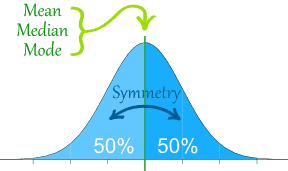
As you can see, most people cluster in the middle of any distribution of traits where millions / billions of subjects are included. The people in the middle are not "stupid" -- they are normal -- that is they have the usual range of traits characteristic of very large numbers of people.
The "stupid people" are on the left tail of the distribution. The dumber, the fewer. The geniuses are on the right tail. For them too, the smarter the fewer. So when counting traits and people, you should find about as many extremely stupid people as extremely geniusy people.
(Normal distributions are sometimes skewed. Practical experience will inform any moderately observant statistician that the normal distribution isn't actually normal; it's skewed in favor of somewhat-to-very-stupid-people. Secret research has shown conclusively that no matter how fast geniusy parents breed, they can not outbreed stupid parents.)
Aside from the normal distribution, there is always a question of whether society can educate and use a lot more geniuses. I tend to doubt it. A million Einsteins will almost certainly NOT solve a million different and unique problems. Out of 7 billion people, we already have quite a few geniuses and they are not stepping forward with solutions to our problems. The large number of problems not solved by geniuses is due to:
1. Many geniuses are too lazy to get anything done (just as some ordinary people are)
2. Some geniuses are too crazy to get anything done (just as some ordinary people are)
3. Some geniuses are lazy, crazy, and not very imaginative to boot (just as some ordinary people are)
4. Many geniuses are interested in the same few problems. The other 950,000 problems go begging.
5. Some geniuses prefer to do manual labor or engage in meditation. Some are crooks or politicians.
6. Many geniuses have plumbed the universe and have found that we're totally fucked no matter what.
Therefore, forget about it. -
What's wrong with being transgender?Call me stupid, ignorant or morally fucked up but I for one fucking believe that biological sex is one and the same with gender! — Agustino
Dear Stupid, Ignorant, and Morally Fucked Up: I appreciate the three of you stopping by. No. "sex" and "gender" have separate meanings. "Sex" is biology, "gender" is psychology -- so to speak. In most cases, like 95% of most people, sex and gender reinforce, supplement, and augment each other. Men fuck women and act like men. Women want and expect to get fucked, and they are. They they complain that it was unpleasant and it didn't last long enough. Transgendered people apparently experience a contradiction between their biology (male and female) and the gender role they think is naturally appropriate for them. Should one wear heels or oxfords, dresses or pants, and fuck or get fucked?
In the past it was believed (by psychoanalytic psychologists) that homosexuals were heterosexuals who had been deflected from their normal development and could be directed (through therapy) back to heterosexuality. It has not worked. No amount of therapy is effective at redirecting object choice (as far as I know).
Some people think that transgendered or transsexual people have been misdirected to think they they are trapped in the opposite sex's biological body. I am not sure whether any therapy has proven successful in redirecting transsexual / transgender person to think they are in the correct body. Probably not. Very basic personality traits seem to be fixed already in childhood, even normal childhoods, and never seem to fade away.
Sex roles are, of course, important to people, but we have many other roles to fulfill and gays, for instance, fulfill their occupational, recreational, financial, intellectual, social roles as well as anyone else (on average). Guys may think about sex a lot, but most guys don't spend all that much time each day actually performing sex. The average heterosexual (and homosexual) encounter tends to be pleasant, enjoyable, and short--at least from the male perspective. Nobody knows what women want, so we won't go there.
Transsexuals also have many roles to fulfill and they spend most of their time performing those various roles, and do not think about being trapped in the wrong body most of the time--especially when all the identity issues remain locked down and unresolved. -
What's wrong with being transgender?For the same reason that we find it OK to allow doctors to make money from people requesting rhinoplasty. — Michael
Cartoon:
Surgeon and woman sitting in consulting room...
"I can't make you look young again, but I can make you look like
you've had a lot of expensive plastic surgery." -
What's wrong with being transgender?Also, a transgender isn't pretending to be a woman. — Benkei
Except that a penis/balls-bearing transexual male raised as a male or a transexual vagina/ovaries-bearing female raised as a female has to imagine what it is like being the opposite. They do for a while have to pretend. Having watched a tall, broad-shouldered kind-of-homely 45 year old guy transition to being a woman, (not a particularly graceful experience for the two of them) yes, imagination, pretending, and just plain stage work is required to get from one gender to the other.
Ditto for the secular Jewish woman who transitioned to ultra orthodox bearded manhood. Ditto for most of the transexuals I have know. It takes a hell of a lot of "balls" to pull these transitions off, whether it goes well or not. -
The alliance between the Left and IslamProgressives = crazy — dukkha
Dukkha, you are doing the same kind of thing that you think the progressives are doing: projecting some stereotypes which have some validity, (as stereotypes are wont to have) onto groups of people.
You are not altogether wrong, of course. Neither are progressives, Moslems, fundamentalist Christians, socialists, nor atheists all wrong, all right, or all alike. You know this of course, you being a worldly-wise sophisticated intelligent thinker. -
What's wrong with being transgender?I don't mean for this to sound harsh — intrapersona
Well... just a teensy bit harsh, perhaps. If everyone were gay or transgendered, we would be in deep doo doo. Fortunately for the species' future the rate is quite low. Out of a population of 320 million, there are perhaps 3 to 5 million gay men and maybe a million transexuals in the US. That's a low rate. It's a lower rate than than the rate of heterosexuals who are not reproducing themselves. If you are worried about the future of the species, get on all those heterosexuals who aren't breeding.
I am gay. I knew I was "different" from an early age -- way before I had a set of words to describe myself accurately. Like most young homosexuals boys born in the 1940s, I didn't announce to my first grade class that I liked boys. I kept it under cover. It didn't seem like the sort of thing one announced openly. (At the time it definitely was not.) I was not ready to deal with my own sexuality and community rejection while I was in high school or the first year or two of college. Some gay people act early and often, and if they can manage it, maybe OK. A lot of gay people need more time--into their 20s or 30s.
I am fairly unhappy with parents who have become aware of their children's possible transgender status who allow, or maybe encourage their young transgender children to go public in elementary school. The children--whose sexual identity isn't developed yet--are not ready to take on the stones and arrows of community resistance or peer rejection. Quite a few people decide they are transgender as adults, and decide to act upon it in the 40s, 50s, or later, even. I think the individual should deal with this at home for a while, and then gradually do so publicly--maybe around 16.
Some day in the future, MAYBE it will be possible for children to declare their sexual orientation while they are still in diapers, but we are not there yet.
These days we tend to not find ways in which we are all alike. We tend to find ways in which some of us are very different, and then we make a big deal out of the difference and the lack of acceptance. Like the enormous suffering of transgendered Somali community (all 3 of them in this town).
I think we would be better off understanding that gay people, celibate people, transgender people, and so on think, act, and function pretty much like everybody else in all sorts of consequential ways. Of course there are differences in sexual behavior between gay men and straight men, but compared to the similarities in occupational, intellectual, or recreational performance, sexual object choice is kind of minor. -
The alliance between the Left and IslamI do not use the word liberal, since its popular use has lost its meaning. I use the word “Left” instead. — Emptyheady
Like "Left" has a precise meaning.
I find that most of the basic terms that describe common political views have been debased. It isn't just that people have mis-used terms, though they have done that. It also the case that politics have also changed. For instance, a lot of what the far left (communists and socialists) once consisted of has crumbled. The concrete referent isn't there any more. What used to be the far right (libertarians and communist conspiracy paranoiacs have moved in their positions relative to some past "center point". New positions which have nothing to do with libertarianism or anti-communism now occupy the far right. Center? Who knows what the center is?
Plus we now live in a "post-factual world" where the binding between rhetoric and reality has been snipped. In this world the two parties say various things during the election campaigns and may or may not remember what they said after they have won, and may do something else entirely different after the inauguration.
Politicians and PR firms have worked to death terms describing left, center and right. Liberal? Conservative? Who knows what they mean? The continuum of positions on certain issues has shifted "rightward".
Eventually these terms will either be replaced or new definitions will be found, or both. It will happen in the fullness of time. Until that happens, we are stuck with vagary. "Democrat" and "Republican" can only refer to organizations and specific persons. What any given Democrat or Republic will or will not vote for is increasingly difficult to work out.
Neo-paranoiacs suspect the wealthy classes of deliberately destroying the means of rational political discussion (the words) as a way to destroy opposition to their rule. This isn't anti-left or anti-right. It's designed to disenfranchise everyone with New Speak.
It's a double minus downer. -
Islamic sociological problem or merely a Quran problem?Modernism, economics, and secular humanism have done, do, and will do to Islam what they have done to Christianity or most any other religion: They undermine it--which is generally a good thing. There are in the Middle East very, very lukewarm Moslems who do not give a rat's ass about Mohammed, just as there are very, very lukewarm Christians in the Bible Belt who don't give a rat's ass about Jesus. There are also atheists in Islamic countries, just as there are atheists in Christian countries. Whatever they believe -- Moslems, Christians, Buddhists, Jains, Sikhs, Mormons, Zoroastrians, (or what have you) -- they are also members of communities with tribal, national, group, professional, family, and other loyalties. So an atheist Moslem in Damascus has problems unique to living there, just as an atheist Moslem in Jedda does, or an Atheist in West Fuck, Alabama or Atlanta has.
And there are TRUE BELIEVERS in every community, who can take selected texts -- religious and secular -- and make strait-jackets out of them. They are the biggest problem. -
Are philosophers trying too hard to sound smart?Rather than blame philosophers, we might want to blame English teachers for not teaching students how to write. The unwillingness of many professionals (outside of advertising) to match their prose to the needs at hand is a running sore.
I waged a long battle with public health pros back in the earlier days of AIDS and pressed them to write educational materials to the reading level and language habits of their target audiences. Less educated people (and a lot of more educated ones) do not usually talk about "pre-ejaculatory secretions" for example. And what a turn off that would be if they did! They are more likely to say "pre-cum". They thought that sort of word choice (pre-cum, cum, spit, shit...) was dumbing down the message. No, not dumbing down unless you are writing a pamphlet for the 3 or 4 whores with Public Health master or PhD degrees.
One of the keys to accessible writing is avoiding obscure words, especially obscure words derived from Latin and Greek. (See George Orwell on how a lot of latinate words are a clue that someone is lying). Another key is using relatively short sentences. "See Dick fuck Jane." is too short, but sentences running into several dozen words are too long, they are rather unwieldy, many people find them tiresome or irksome, and just because you don't know when, where, or why to insert periods and other terminating punctuation marks does not mean that other people are similarly handicapped, and they will judge you negatively--and wouldn't that be awful!


Anglo-saxon words and Middle English, which added a lot of everyday French words, will help you write clearly. J. R. R. Tolkien wrote the Lord of the Rings Trilogy in language that was about 90% Anglo-Saxon and some Middle English. Did you find his prose tiresome? Probably not.
Granted, Tolkien wasn't discussing Heidegger. -
Brexit: Vote AgainI feel the European/British unease at a sudden influx of distressed people into Europe. There are a LOT of people in distress around the world and mobility means that the "wretched refuse of teeming shores" can move from distant parts of the world and arrive on one's doorstep quickly and in quantity.
Immigration can be a very good thing (all those immigrants coming to the US, for instance) and Europe is scarcely reproducing it's workforce on its own. Get busy, you lazy heterosexual Caucasians, or somebody else will do your reproducing for you.
It does need to be controlled, however, closer to the source. The developed countries don't seem to understand that Lebanon and Jordan need assistance in taking in and keeping many more Syrian refugees than Europe was ever thinking of taking in. (Saudi Arabia, for instance, has taken in... how many?) -
Brexit: Vote AgainI want to draw a comparison, and one I know is fetched from afar at this point--the establishment of a federal union among the 13 separate colonies which spawned the United States.
Europe is some sort of (fairly clunky) federal system. Formerly sovereign (still sovereign, I guess) states agree to join a centrally administered European Union and give up some/most/all the prerogatives of independent states.
The first effort to organize a union under the Articles of Confederation didn't work out all that well for us, and required a do-over (the constitution we now have). A Civil War was required to fully establish the principle of indissoluble union. Once in you stay in, period. Yes, slavery was an over-riding issue, but the southern states that would secede from the union weren't anxious to cooperate too much with each other in a lot of practical matters--like building what could have been a Confederacy-wide railroad system. Each of the southern states only built the railroad that it's richest citizens wanted, which wasn't much. The southerners didn't want a strong government vs. the local economic interests.
All of this is compounded in Europe, given its much longer history and the clutter of distinct administrative and governing cultures and conflicting interests.
Maybe the English Channel is part of the problem. Perhaps it gives Britain a sense of separateness from Europe it really shouldn't have. Geographical Determinism at work. We are an Island in ever so many ways. One would think, though, if the UK could digest an influx of Indians, Pakistanis, other Asians, Jamaicans, and various Africans it could also manage a batch of Catholic Poles. But... maybe not.
The problem is more like the proverbially variable tide -- rising for some, sinking for others, with boats going up and down right next to each other. It seemed like the EU had done quite a bit to equalize the tide -- didn't it?
The main thing is, once out of the EU Britain will have to deal with falling tides all by it's island self. Rising tides are of course easier to deal with, but if I were a Brit I wouldn't have counted on that.
It's not too late. You haven't left yet. You have not put the Brexit shotgun in your mouth and pulled the trigger... yet. -
Are philosophers trying too hard to sound smart?Writing graceful accessible prose is hard work. It's easier to sling cant and jargon. Yes, some people try too hard to sound erudite. They use too many words like "erudite". This is by no means limited to philosophers, however. Lots of learned folk could not write a graceful, easily understood sentence about something reasonably complicated if their lives depended on it.
Write the best prose you can, and maybe someone will notice that it sounds good and will copy your style. If not, at least people will be able to understand you. -
Brexit: Vote AgainI'm not actually dissing the working classes in any of this. I'm commenting on the uniquely difficult problems of the 21st century, such as this one. — Wayfarer
Good. But life has been difficult for all classes of people for a very long time (except the small number of most pampered persons). People at all sorts of levels in society, dealing with varying levels of complexity, have had a tough time of succeeding.
Yes: life is complicated, and is not getting simpler year in, year out. One of the reasons for this complexity is off-loading tasks onto people that have too many things to do--things like figuring out how to use the fucking clunky software that some autistic programmer produced, or figure out how to turn off all the new bells and whistles that some corporation decided to stuff their software with so it always looked new and "better" somehow... Microsoft and Apple are both guilty of this.
A lot of our "complexity" is needless. That's a big fat glittering generality that should take a few threads to untangle.
BC

Start FollowingSend a Message
- Other sites we like
- Social media
- Terms of Service
- Sign In
- Created with PlushForums
- © 2026 The Philosophy Forum