
-
PurposeUnless you have been living under a rock, you have encountered the several basic ideas. There are not 'thousands'. Some of the contenders...
a) become King of the Hill by making tons of money; consolidating all of the local crime families under your control; owning the biggest house in town; cornering the market in soybeans; becoming Governor, Senator, or President; win first place on the FBI's Most Wanted List--or, if you are really ambitious, all of the above. Die rich.
b) become a learnéd person; write the definitive history of North Dakota; become a self-supporting poet, artist, composer, author, actor, sculptor; become the archetypal porn star. Die with uncompleted projects.
c) find a job, do good work, get married, stay married, have children, grandchildren, retire, mow the lawn weekly, die. Dead.
d) Love and serve YHWH, Jesus, Brahma, Buddha, Ahura Mazda, Odin, or Aphrodite all the days of your life, die and then go to your eternal reward, somewhere, eventually. Or not.
e. Discover tabletop fusion, or some other world-changing phenomena. Win the nobel prize, or die first.
f. Dither and fret over what the meaning of life is until it is over and you're dead.
If you don't happen to like any of these, or some variation thereof, then you will have to come up with your own plan.
Aren't there any famous people you would like to resemble? Jesus? Mao Zedong? Mother Theresa? Lady Gaga? Donald Trump?
Any books or movies that impressed you with their message? Mein Kampf? Ten Nights in a Bar Room and What I saw There? Naked Came the Stranger? The Collected Works of Emily Dickinson? Looney Tunes? -
Philosophical implications of the placebo effect.There are two placebo effects: experiencing symptoms suggested by an outside source (like a medical textbook) and experiencing the demise of real symptoms after taking a 14 day course of capsules containing starch.
I do not find a mind over matter problem here.
Some of the people with serious, diagnosed diseases who sign up for experimentation are going to end up in the placebo-receiving arm of the study. In double blind studies, it has been found that there is a placebo effect. As far as I know, nobody who had a serious disease has been cured by placebos, but taking the inactive drug has resulted in measurable improvements. Conversely, nobody has died as the result of symptoms arising from reading a textbook.
Ideas have an influence on brain cells behave and thus they affect the body. When somebody says something to you that makes you very angry, your physical stasis is severely upset. The insulting phrases are heard and processed. Electrical signals stimulate a cascade of neurotransmitters and hormones which results in you developing a full, fast head of steam. Let the battle begin!
The wish/belief/hope that you are receiving a beneficial therapy, through the physical channels of the nervous system, may have an effect on the chemicals which the body makes to suppress or remove an infection.
There is very little in the body which is free of interaction with the neuro-system together with the immune system. (Well, there are a few small places in the body which are sanctuaries). -
It's backYou're sort of a special person, since we've actually met face to face. Glad things are going well for you. I am about the same (opinions vary about whether that is good or bad...) But... that was a long time ago that the old-PF member from UK came through Minneapolis with the van, his father, and the destination of South Africa. Can't remember his name or handle. Too bad they did't just settle here.
-
Unconscious "Desires"I don't see any distinction between "unconscious" and "non-conscious". — Harry Hindu
Let me see if I can show it to you, because it is significant. — unenlightened
I used to like Freud's id, ego, and superego model, along with the conscious and unconscious mind. There is something to say for it as a kind of drama which is acted out on the stage of our life. Lately I have come to doubt the division of sub- vs. un- vs. non- conscious.
The model I have been thinking about lately is that "consciousness is one function among many equals". Most of what goes on in our brains is invisible to us. Not only is 'edge detection' invisible, but so are the detections of horizontal and vertical lines, shape, color and texture recognition, face recognition, phoneme identification, and so on. Proprioception is another of many always on, always background operations. I have zero knowledge of how my brain assembled the sequence of words in this paragraph, or coordinated finger movements with the flow of thought.
Clearly our brains are aware of a great deal more than our conscious function is aware of. If not, we would have crashed our cars, bicycles, or bodies long ago.
What is called "the subconscious" is just more of the many invisible, background operations that make up a person. We are not aware of these background operations because there is no need for us to try to coordinate, manage, control, or suppress them.
Perhaps in dreaming our conscious minds obtain a glimpse into these background operations. It isn't that "horrible things are revealed which can otherwise not be faced" (Freud) but rather we (possibly) get a glimpse of the way reality is perceived, or stored, or processed in the usually invisible background systems.
Well, if it's always background, how do we know it exists? Research of course. Investigating simpler brains, and investigating human minds that have malfunctioned. A woman I know had a stroke in the visual cortex of her brain. Her visual experience was extremely distorted. She couldn't see the window in her hospital room; instead she reported a horizontal bar of light. She could identify the color of the walls (a variety of beige-yellow), but not that the walls were plain (no decorations, calendars, etc.) or that they composed of rectangles.
People who have stroke-caused aphasia (inability to produce language) can often swear articulately. Apparently cursing is handled in a different background system than ordinary language. -
PurposeAh, that eternal question: WHAT is the meaning of life?
It appears that it is up to us to decide, since no oracle has spoken, no golden tablets have been located, no sky writing has been noticed that spells it out for us.
This open-endedness is both a very good thing and a very bad thing. It's a very bad thing if you want the meaning of life spelled out for you. It's a very good thing if you feel like drafting your own 'meaning of life' statement.
So, what sort of person are you--Joachim--ready-made or blank page? -
The Many Faces of Godthe Pythagorean theorem is the cause of the foundation being square — Metaphysician Undercover
We intended to build the foundation 4 square according to the Pythagorean theorem, and we built it in the dark (we didn't have a permit). When the sun came up we discovered the the foundation has 7 irregular sides. Clearly the theorem was not up to the task. -
The Many Faces of GodOne interesting interpretation of God and Jesus is that God became Jesus, and ceased being God. The death of God? Yes, at a particular time for a particular reason. In Jesus, God poured himself into this world.
This theory doesn't do much for people who thought God was part of this world anyway, and it does nothing for people who were planning on meeting God in heaven. God isn't in heaven anymore. I haven't heard what actually is in heaven, these days; maybe just unsupervised spirits of the deceased -- perish the thought. This theory doesn't do much for people who thought that God was co-terminus with the cosmos. -
The Many Faces of GodI am at best ambivalent about believing that God in any form exists, so I'm probably not a very reliable witness to the validity of the Trinity. On many days I'm pretty sure He doesn't exist at all. But still, the Trinity seems to me to be an utterly unnecessary contrivance even for ardent believers.
An all powerful, all knowing, all present God just doesn't need this divine ménage à trois. Whatever happened, the omni-etc. unitary being (God, period) is perfectly capable of doing it. The cosmos-creating god can manage a few miracles and can comfort a bunch of troubled believers without needing to add personnel to himself, or play different roles.
So I guess I would be a Unitarian on the days that I ambivalently believe anything about God's existence.
All that aside, I understand that the Trinity has a long history, and the trinitarian formulation was uttered as early as the second century.
The first of the early church fathers to be recorded using the word "Trinity" was Theophilus of Antioch writing in the late 2nd century. He defines the Trinity as God, His Word (Logos) and His Wisdom (Sophia) -- so says Wikipedia.
Aside from the difficulty of extricating the trinitarian invocation from ritual (along with cross-sign-making) the trinity is also a major plank in the creed. Not much chance of revisiting the Council of Nicaea (325 a.d.) at this point.
Besides the theological investment in the Trinity, there would be many expenses involved in dropping it. Billions would need to be spent renaming buildings, institutions, and colleges, plus all the stationary that would have to be reprinted. Then the behavioral therapy to suppress sign-of-the-cross making among Catholics, Lutherans, Anglicans, and Orthodox would be high. (It would be a boom for pavlovians or skinnerians, though. That's a plus.) -
Does medicine make the species weaker?The larger issue about drugs (especially antibiotics) is their activity way down the line among the bacteria. Bacteria can acquire genetic information without having to mate. A bacteria dies, it breaks up, its DNA floats free, and other bacteria can acquire and incorporate the dead bacteria's genes that are useful. Imagine what is going on in the puddles of India where bacteria that are awash in OTC antibiotics rub up against each other.
Imagine what is going on in feed lots, hog barns, and chicken coops where animals are wallowing in shit loaded with antibiotics. How long do you think it will be before some Indian bacteria will have acquired really bad characteristics and will start spreading? (Answer -- yesterday. It's already happening.) How long will it be before your next rare hamburger slides down your throat, carrying with it entero-bacteria that have learned some new mean tricks? -
Does medicine make the species weaker?Indeed. The Burning Issue of Merck vs. Best Buy in World Trade...
Merck sells internationally, Best Buy doesn't. The real question is whether Merck has a drug in its pipeline that can cure Best Buy of its so-so market performance. For that matter, Merck needs a blockbuster for it's own market performance, and it doesn't have a new one, right now. -
Does medicine make the species weaker?What part of R39.5 billion in revenue do you not understand?. Whatever Merck's standing in the lineup of world companies, Best Buy is going to be close to it, if revenue is compared. They have about the same annual revenue.
-
Does medicine make the species weaker?In the US. I don't know what its rank in the list of world corporations is. Of the worlds 25 largest pharmaceutical companies, it's Novartis, Pfizer, Roche, Sanofi, then Merck. After Merck it's Johnson and Johnson, GlaxoSmithKline, AstraZenica, Gilead Scienes, then Takada. There is a second Merck company in the 25th position, which is, if I remember correctly, the German firm that was the result of an international dispute over patents and the original Merck company.
-
Does medicine make the species weaker?The positions change. Best Buy is a MN based electronics and appliance big box operation. It generates $40b in sales, has 1500 stores, and 125,000 employees. They started in 1966 as the Sound of Music Record stores.
I worked for them briefly as a temp in 1981. The two guys I was working for were starting a video tape business. At the time I thought "Well, that will never go anywhere. Total waste of time." Immediately after I left they changed the name of the business to Best Buy. I took it personally, of course. -
The Many Faces of GodI do know that Mormons find the concept of the trinity as set forth in Catholicism and most of Protestantism to be incoherent nonsense. — Hanover
Some of us pretty much heretic protestants and catholics find the concept of the trinity kind of incoherent and nonsensical too. Press a priest and you get "It is a mystery." I'll say it's a mystery, all right. -
Does medicine make the species weaker?Freakin' mold, termites, and bacteria. — Mongrel
Yeah, I don't see why anybody voluntarily lives south of Iowa. -
Does medicine make the species weaker?By saving lives, is medicine holding onto genetic stuff that Nature would have gotten rid of — Mongrel
Our natural defense against bacteria and viruses is gene related, sure. But the variety of antibodies produced is greater than that specified by genes. Plus, individuals gain some immunities by hosting and surviving certain infections. Each individual starts out from scratch, pretty much, as far as immunity goes. Many of the antibodies produced never see action.
After millions of years of co-evolution, neither bacteria, viruses, nor their prey (including us) have won an unequivocal victory. Effective medications and procedures against disease haven't been around for very long, so they will not have had a genetic effect. In rapidly reproducing species (rats, for example) there is a greater chance of genetic change over a given period of time. But rats don't get a lot of medical care.
Prior to modern, 20th century medicine (particularly, vaccination, cleanliness, and nutrition) the average life span was quite a bit shorter than it is now. That is because so many infants died before they were 1 year old. If they made it out of childhood, they had a good chance of living 3 score years and 10. Are we weakening the species by enabling a large number of babies to survive their first year?
Probably not, because the risks that children face after their first year are different than in their first year. First, infants do not have very well developed immune systems. They have a batch of antibodies from their mothers which disappear over the first 6 months. By the end of their first year, they have a much more robust immune system--and this is the case whether they were born in 2016 or 1620.
If children are saved from death by genetic causes like inherited organic defects that would otherwise cause their death in childhood, and they survive and reproduce, we might be tilting the genetic pinball machine in favor of a defect for that child's progeny. (Does anybody still play pinball machines that can be physically tilted?) The same goes for adults: If they would have died at 25 from a genetic defect, and health care enables them to live and reproduce, we tilt the genetic game a bit. However, we are increasingly aware of which organic defects are inheritable and which are not.
Preventing someone's death by a stab wound doesn't tilt the genetic game one way or the other, except if there is an inherited blood clotting disorder. We are designed to recover from injury if it isn't too severe or if it doesn't get fatally infected. Stitching up the stab wound doesn't guarantee we won't die from an infection originating in the wound.
Is Merck the biggest corporation? No, it's between Best Buy and Liberty Mutual Insurance.
71 Best Buy
72 Merck
73 Liberty Mutual Insurance Group -
Does medicine make the species weaker?There's some highly unwarranted leaping to conclusions, here.
Animals, in general, didn't seem to be very good at resisting novel diseases prior to the invention of modern medicine. The plague (Yersinia pestis) wiped out 1/3 of the European population and it wiped out a lot of other populations elsewhere. Were people who lived before modern medicine better at resisting more familiar, less novel diseases? Maybe. Before modern sanitation people were regularly exposed to more bacteria and viruses. They may have been resistant to some frequently encountered pathogens found in food and water. But people definitely got sick from these common pathogens.
Non-human animals are as likely as us to fall victim to novel pathogens. West Nile Virus is fatal to North American crows, for instance.
It isn't entirely up to the target species how virulent a disease is. Influenza viruses come in many varieties that are established before they reach humans. Their genes are juggled in birds and swine before they get to us. The 1918 variation killed around 50 million people, and you can't blame medicine for that death rate.
After it was introduced into Europe, syphilis probably became less virulent (say, a century after introduction). Small pox, on the other hand, has always killed a large percentage of those infected. It doesn't seem to have moderated much (now it is gone for good). Syphilis has remained totally curable with ordinary penicillin. Gonorrhea, on the other hand, started becoming resistant to penicillin from the get go. Today it is approaching resistance to just about all of the available antibiotics.
IF the Spanish Churro sheep do better in the southeast US, it is probably because the climate they originally evolved in (SW Europe, NW Africa) was closer to the climate of the SE part of the US. Domestic type-sheep aren't native to the US, so maybe there weren't any sheep-specialist pathogens to prey on them. Maybe the Shetlands sheep, evolved in the much colder, wetter north sea Islands got their harmful pathogens from the hotter, drier-evolved Churro sheep.
Modern antibiotics and vaccinations have not been around long enough -- not even remotely long enough -- to affect the "natural" robustness of the human, or most other mammals. It's only been since the 1930s that sulfa drugs were available and the late 1940s that penicillin and other antibiotics were available. The first vaccinations (smallpox) were introduced in 1796. There's been relatively few human generations since then (7, assuming 30 years to a generation). -
Islam: More Violent?My suspicion is that aside from the commonality of a shared religion there must also be various psychological influences exterior to the religion itself that play a role in the creation of terrorist psychology... — VagabondSpectre
Your whole post pretty well wraps it up. Excellent presentation. -
Unconscious "Desires"Is it meaningful to talk about intentions, beliefs and desires - which I find generally to be constitutive of having a consciousness - w.r.t to the unconsciousness? For it at least seems that part of what it means to have these intentions, beliefs and desires is that one directly realizes them. — Marty
Consciousness is one aspect of the brain's operation, but the brain does many things that we can not observe. There are many functions that are invisible to us. For instance, I ask you "Is Kraków a town in Spain?" What process did your brain follow to come up with whatever answer you arrived at? I'm pretty sure you have no idea. I don't either. We can't observe how the memory or cognition works.
"What did you have for lunch today?" How did you remember (or fail to remember) what you ate for lunch? Of course, we don't know how we did or did not remember; memory either delivers up responses to queries, or it doesn't. Further, we can't tell for sure that what it delivers up is right or wrong. If you can't remember, that doesn't mean you had nothing for lunch. If "Ham and cheese on rye", we can't be sure that is actually what we ate today. Maybe we ate it 3 days ago.
Wishes, resentments, desires, fears, and so forth are not always conscious. Sometimes they are, but often they recede into invisibility from the conscious mind (which is, remember, just one aspect of mind). -
Sub-forumsI suppose in the beginning there were requests for adjustments to the first philosophical schools, too.
"There aren't enough students in this school."
"We need more shade."
"There are too many flies."
"The smell of the roasting meat on the Zeus's altar is distracting."
"I have to park my chariot too far away,"
"I don't like the way you painted the sign out front."
"You never have enough papyrus or lambskin for note taking."
"Your benches are too rough."
"Your wine is watered down."
"The other people here are not serious."
"The handsome naked athlete over there must join the class. He has a very flexible mind, I hear." -
People often forget that...I'm an advocate for better alternatives, or at least safer and not as profound as amphetamines. — Question
There may be better treatments; let us hope and let us advocate.
There are not very many classes of psychoactive drugs (a lot of the brand names are 'the same thing only different'). Most of them, whether for depression, schizophrenia, ADD, bi-polar, sleep disorders, anxiety, and so forth, have been around for quite a long time; have significant side effects; don't work for some patients at all (or not well); and sometimes abruptly fail to continue working.
I've been taking the available classes of drugs for glaucoma for 30 years. This past winter the drugs abruptly stopped working in one eye, but continue to work effectively in the other eye. How is that possible? Beats me. -
People often forget that...Let me add one more thing: Not being able to succeed in school is a genuine, life-long disadvantage. The desire to help children learn is genuine and important. We know that under normal circumstances, most children learn quite well -- even excel. So when some children are way behind by 2nd grade, a real problem exists.
-
People often forget that...Does anyone have any idea why we prescribe children this stuff? — Question
The initial experiments with amphetamines and hyperactivity go back to the 1960s. It was found that children who were "hyperactive" experienced what is called a 'paradoxical effect' -- the stimulant acted as a sedative. The effect of sedation (apparently) does not work once puberty kicks in. Then the drug acts like the stimulant it is.
I was working at a hospital in Boston, back in the late 60s, where Ritalin was being tested on children with learning difficulties. (I didn't work in the Ritalin program.) Behavior modification was also being employed. It was controversial then, and still is. First, is "hyperactivity" a real disorder, or is it a behavior associated with certain environments? Second, does the drug result in the therapeutic effect desired (better learning) or does it just sedate the child, both, and does it have additional untoward effects?
If it is a real disorder, that's one thing. Then the issue arises, "Why is this disorder becoming so common?" It seems to be just too common. Maybe it is being over-diagnosed; maybe the environmental behavior response is being mistaken for a disorder.
If it is a behavioral response to untoward environments (poverty, lead poisoning, overly restrictive classrooms, unstable homes, chaotic surroundings, etc.) then has a change in environment been tried? Environmental change is a lot more complicated than writing a prescription, of course. The cluster of poverty, chaotic surroundings, instability, violence, lead, etc. are all difficult environmental factors to change.
My guess is that quite often it is a cluster of environmental factors. IF one could change the environment, then the behavior problem could be reduced. For instance, schools could be operated differently. Most schools don't have recess anymore. That means the children are in class, under controlled supervision, all the time. There is no break. Letting the children out for 20 minutes twice a day can help reduce behavior problems. Are the classroom teachers and school principles expecting a higher level of quiet and order than is reasonable? Maybe classrooms should be more active, noisier (at times), and have fewer restrictions on movement. Like, get rid of the desks. Have chairs, tables, standing activities, sitting activities, moving around activities, and laying down activities.
I can't claim that this looser school regime would cure all the problems. It probably wouldn't, because the home and neighborhood environment are critical, too. -
People often forget that...People often forget that they go looking for evidence to support their screwed up views of the world. Not that I, an Enlightened One, would ever do that -- or you either, of course.
-
Islam: More Violent?
The Times of Israel reported that in 2016 "Israel’s INSS think tank charted 469 attacks, carried out by 800 perpetrators in 28 countries, killing 5,650 people (injuring an additional 9,480), and warns that terror groups are redoubling their efforts". Most of the attacks were in Iraq, Syria, Afghanistan, Yemen, Nigeria, Libya, Somalia, and Turkey.
That's a lot. It's not surprising, and not altogether illogical, to connect a pressure cooker bomb by a Kyrgyzstani in Boston, or a truck attack by an Uzbek in Stockholm to the larger number of bombings elsewhere, especially if there are some commonalities.
If there were a similar number of attacks, killed, and injured in Europe and the United States and sponsored by reactionary Catholics, I think it would be quite likely that Catholics in general would become suspect, at least to a substantial degree. Further, it would be difficult for progressive Catholics to completely distinguish themselves from reactionaries, because the basic shared faith (sans politics) is the same.
No doubt the kind of classification and study of Islamic Terrorists has been done. Security services around the world have been characterizing terrorism and terrorists. There are patterns which people don't overlook. -
Islam: More Violent?In support of your post...
We forget, or we weren't born yet, that there was more terrorist activity in Europe in the 1970s than in Europe in the present decade. Most of the attacks were sponsored by European political radicals, separatists, leftists, Catholic/Protestant mutual hate groups, et al. Here's a graph from Quartz illustrating this:
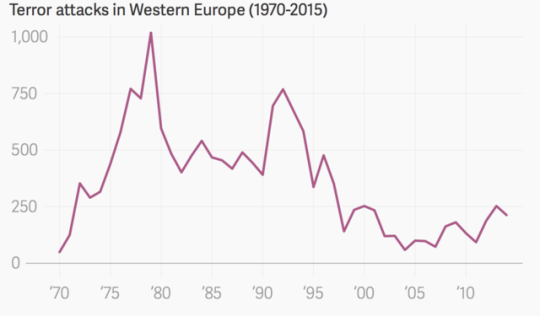
You may have forgotten (or didn't know) about the Baader-Meinhof Gang that conducted bombings and assassinations in Germany and elsewhere. There was a string of bombings in the US running from the 60s to, oh say 1995 (which includes the first World Trade Center bombing). These were not firecracker bombs, either. The Army Math Building bombing at the University of Wisconsin was a van bomb in protest to the Vietnam war and the university's perceived involvement. The WTC bombing in 1993 conceivably could have brought one of the buildings down (if all the variables were lined up just right). The Unabomber (Ted Kaczynski) sent many letter bombs through the mail, killing 3 and injuring 29 others.
The post-Christmas bombing of LaGuardia Airport in New York in 1975 killed 11 and injured many others. A number of groups were thought to potentially be responsible including FALN, the Palestinian Liberation Organization, the Jewish Defense League and also a Croatian nationalist named Zvonko Busic, no organization ever claimed credit and the crime remains unsolved.
None of this information makes the current terrorists any better, of course. They are just as counterproductive, despicable, and loathsome as earlier terrorists. -
Islam: More Violent?I had maintained from the get go that the US did not have the capacity to solve the problems of the Middle East. It wasn't that we lacked force; that we had (and still have). It was that we did not have the competence to sort out the internal conflicts and contradictions of Iraq or anybody else. We were not alone in this--I don't know who else had (has) both the competence and the ready force necessary. Certainly not Europe.
A big part of our problem is OIL. We most definitely do not want a collapse of the oil-producing infrastructure in the Middle East--not until the last affordable gallon has been sucked out and shipped to our refineries. Saudi Arabia still has a vital pool of oil under the sand, and we want to make sure it remains available to us. Consequently, the policy choices of those involved were probably blinkered. For instance, Saudi wealth supports the export of the extreme form of Wahhabism, which is a major piece of the radical islamic problem. Were we to plan (or have planned) for the end of oil which isn't in the distant future we could better see how much, or little, we really need the Saudi family.
Syria? Syria has been run by two generations of cannibalistic Assads. Apparently non-Syrians were happier with predictable cannibals than unpredictable non-cannibals. Which seems like a pretty succinct summary of Middle-eastern policy: Let vicious dogs lie, as long as they don't inconvenience us. A million refugees, flooding into Europe -- now that's inconvenience. -
What is truth?What would you say truth is? — mew
A good question for Holy Week.
Pilate then went back inside the palace, summoned Jesus and asked him, "Are you the king of the Jews?"
"Is that your own idea," Jesus asked, "or did others talk to you about me?"
"Am I a Jew?" Pilate replied. "Your own people and chief priests handed you over to me. What is it you have done?"
Jesus said, "My kingdom is not of this world. If it were, my servants would fight to prevent my arrest by the Jewish leaders. But now my kingdom is from another place."
"You are a king, then!" said Pilate.
Jesus answered, "You say that I am a king. In fact, the reason I was born and came into the world is to testify to the truth. Everyone on the side of truth listens to me."
"What is truth?" retorted Pilate. With this he went out again to the Jews gathered there and said, "I find no basis for a charge against him. — John 18:33-38
Pilot doesn't get an answer to his question. It seems like Jesus is dodging the question, "just who the hell are you and what did you do?"
The 'truth' to which Jesus is testifying about has been presumably been revealed to the reader of the Gospel, in the life and teachings of Jesus, and this Jesus can't, won't, or isn't able to summarize in a "25-words-or-less-definition".
"Truth in labeling" is straightforward. If the package says "1 dozen large brown eggs" then there should be 12, large, brown, eggs in the package. A lot of labels are very difficult to define clearly. "Climate warming is True" or "Climate warming is False" are not simple claims. I believe the claim that "climate warming is True" because it seems to align consistently enough with statements I find factual. For instance, "January in Minnesota is 60% warmer now than it was 50 years ago" is a fact, according to the historical record. In the historical past, Minnesota was damned cold in January, so 60% warmer doesn't mean that that one can pick roses in January.
Those who disbelieve the claim of climate warming can site similar facts, like "July in Minnesota is not hotter than the historical average." If January is 60% hotter, then July should be 60% hotter too, right? Apparently not -- more facts about climate warming or climate stability have to be brought in.
So, some facts seem to support the truth, and some facts don't. One has to decide which facts have the most weight, or are most numerous and consistent, and which facts aren't. As Pierre-Normand says,
circularity only is bad when the circle is too small, and hence uninformative. — Pierre-Normand
All the facts connected with the truth of climate warming are voluminous, and the circularity is large. -
Islam: More Violent?you give the impression of someone who hates Islam — Baden
You raise a question in my mind: May one hate Islam? May one hate Christianity? May one hate atheism? May one hate capitalism or communism? May one hate... any number of things?
Granted, when one hates something one is likely to simply the object, probably distort the picture of what one hates, and overlook positive aspects which one--in a different context--might be tolerant of, or even like. None of that is good practice of course. None the less, most of us have a list of things we love, hate, and have negative and positive feelings for, in varying degrees.
I don't think I hate Islam, but I don't like it. I don't like very conservative Catholics and Fundamentalist Protestants either. I approach mild hate towards these groups.
There are practical reasons to avoid hate. Hate may lead one (or many) into ill-considered actions which they will later regret, for good reason. Picking a hate-fight with the wrong people may lead to one getting a proper beating, or worse.
Hate is incompatible with a pluralistic society. But do I have to desire a pluralistic society? Can one reasonably or legitimately prefer less plurality of ethnicity, religion, politics, and so on? There are times I blanch when I hear "diversity". I often feel like there is just a bit too much diversity, and a little more homogenization wouldn't be a bad thing.
Any guidance here? -
Artificial Super intelligence will destroy every thing good in life and that is a good thing.And for christ sake stop calling me Shirley — MonfortS26
Good -- he has seen the movie (or at least the scene). -
Artificial Super intelligence will destroy every thing good in life and that is a good thing.assumptions. [insert break here] It seems
What I meant by "what is the matter with you" was directed at your enthusiasm for eliminating the individual human, or the human altogether.
What advantage to the individual human do you see in his elimination? -
The Philosophy of the Individual in the Christian Westmany of my early encounters were via hallucinogens — Wayfarer
Harvey Cox, a Baptist, liberation theologist, professor in the Harvard Divinity School, and a fairly adventurous believer (he's a about 87 years old now) tried hallucinogens in a quite proper setting -- out in the desert with a bunch of others, a good sound system, wine, etc. He thought it was a worthwhile experience, but I don't think he repeated it. He also wrote a couple of books about eastern religion -- not as a believer, but in an ecumenical context. [Turning East: Why Americans Look to the Orient for Spirituality-And What That Search Can Mean to the West; Many Mansions: A Christian's Encounter with Other Faiths (1988), (Beacon Press reprint 1992)].
His next to last book was The Future of Faith (2009). Haven't read it, don't know whether I will. I got a great deal out of his earlier books (like The Secular City, 1964) but found some of his later books much less helpful. Anyway, in Future of Faith Cox analyzes the new grassroots Christianity of social activism and the kind of non-institutional spirituality we've been discussing.
Maybe his last book (last year) is/was The Market as God. Here's a link to an excerpt in The Atlantic Magazine

-
The Philosophy of the Individual in the Christian WestThe thing that I dislike about "spiritualism" is that it is too individualized (to suit whatever idiosyncrasies happen to be in play) and it's way too private (related to too individualized).
One individual may return from a long fast in the desert and have a new revelation to report. When people engage in spiritual doodling by themselves, there is rarely revelation or insight. There is no one to challenge the quite likely solipsistic experience of their 'spiritualism'.
I wouldn't say that revelation, a pregnancy of celestial fire, or an anointing by the spirit CAN'T happen by one's self. It just isn't all that likely. -
Artificial Super intelligence will destroy every thing good in life and that is a good thing.Well, go back into your post and break it up into paragraphs. Shirley you can manage that?
Having exhausted faith in the dead end of the Hive Mind you have moved on to pinning your hopes on Super AI?
What is the matter with you? -
The Philosophy of the Individual in the Christian WestEh, what you say about gaining energy through forming a new denomination is undoubtedly true, but there are other reasons America is so Christian. And as far as ethnic sects of the same denomination of Christianity within America, those existed because of immigration; early immigrants stuck together with those of their same race; naturally their unique form of the faith remained in tact while those close-knit communities did so. Once those ethnic communities began to splinter, the ethnic sects of the denominations began to blur. — Noble Dust
The Second Great Awakening (late 18th, early 19th Centuries) was another reason for religion doing well in the U.S. The SGA was led by Methodist and Baptist preachers. (Baptists hadn't become conservative Southern Baptists yet). The SGA was a continuing stimulant well into the 19th Century.
Because Americans had no state-sponsored church, we were free to wander into all sorts of oddball beliefs. The SGA produced the "burnt over area" of Western New York--an area so heavily evangelized, that all the "fuel" for future conversions had been "burnt up". Several groups sprouted in that area about that time: Mormons, 7th Day Adventists, Jehovah's Witnesses, Shakers, et al. In addition, the feminist Elizabeth Cady Stanton and the Women's suffrage movement started here. The Fourierist utopian socialists, as well as the Oneida Society began here. Walter Rauschenbusch and the Social Gospel came out of this area.
Immigration did influence Christian and Jewish religious activity. Over time (like, by the 1970s) the ethnic-religious nexus was dissipating.
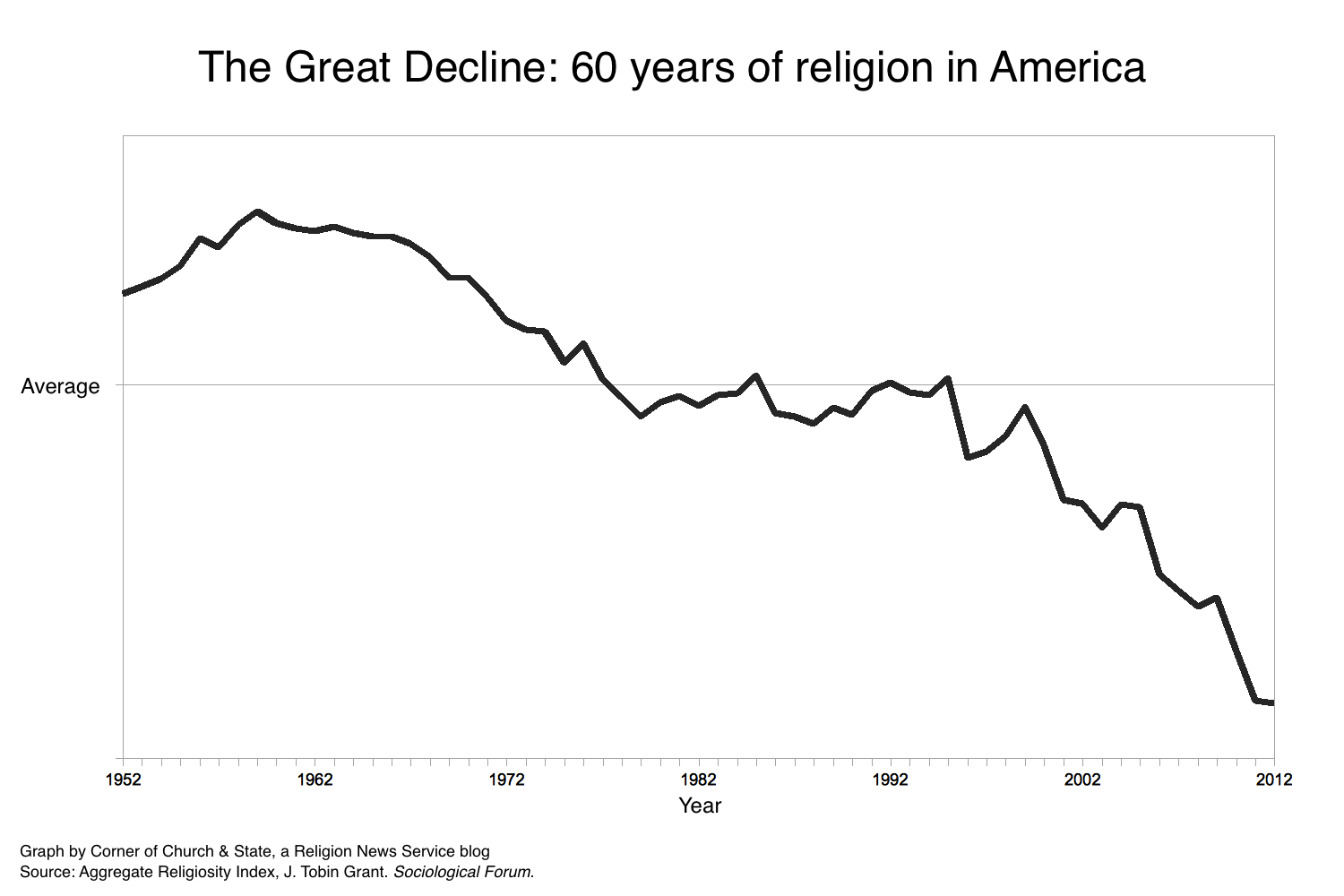
During the 1960, American religious participation and religious affiliation crashed. The Methodists, for instance, lost 5 million members during the 1960s. This 5 million didn't go somewhere else, apparently, and they never returned. Other denominations experienced the same severe losses. The Roman Catholic educational. medical, and social ministries were greatly diminished by professed nuns and monks leaving their orders. What began in the 1960s did not stop. Only the conservative evangelical and fundamentalists denominations have been able to actually increase their membership over the last 45 years. It is likely that they will experience a decline as well, at some point.
Even with these declines, however, religion and religious belief and activity is much higher than in Europe. "The Church" is in no danger of disappearing.
The chart below combines several measures, so there is no left-hand scale.
The Truth will set you free, but it costs money to report it. -
SocialismAs man started living in communities, to contain flagrant behavior of the members, communities started making rules. This is socialism. — Ashwin Poonawala
No, this is not socialism.
Isolated individuals who came together to form even a small community quickly discovered that rules are needed to enable ego-driven individuals (normal people are ego-driven) to get along together peaceably. Larger communities discovered that some sort of 'enforcer' was needed to help everyone abide by the rules. We can this enforcer 'government'.
Socialism is one of several economic / political arrangements which can exist in a community. In socialism, labor, operation and direction of the economy is the responsibility of the workers (who are, of course, the vast majority of any community). There are no capitalists in socialism (obviously). Another term for socialism is "economic democracy".
Capitalism is another way of arranging economic activity. In capitalism, the operation and direction of the economy is the responsibility of those who own factories, mines, railroads, etc. The object of capitalism is to extract a maximum of profit (surplus value) from the labor of workers. Capitalists are generally a small proportion of any community. Capitalists hate the idea of workers being in charge.
Capitalism is essentially economic terrorism. -
InequityIn the USA, there is alot of denial about what 'equality" actually means as the founders intended. Originally the statement was that we are CREATED equal in accordance of the laws of nature and God. — ernestm
We are created innocent, and we are judged not for what we have, but what we do with it. — ernestm
I thought it was specifically dignity and rights. — unenlightened
There is some confusion about the Declaration of Independence, which is a good read, and the constitution which is less of a good read, but has the force of law.
We hold these Truths to be self-evident, that all Men are created equal, that they are endowed by their Creator with certain unalienable Rights, that among these are Life, Liberty, and the Pursuit of Happiness….” Thomas Jefferis--The Declaration of Independence — Thomas Jefferson
As for being created "innocent" and it being more important what we do with it than how much we started with, I don't know where you get that. Who said we were born innocent? (We may be born innocent, but there is a large industry devoted to the notion that we are actually not innocent, but carry the stain of Original Sin. And the notion that we are not judged by how much we have was not a very popular sentiment in the 18th Century. (It isn't all that popular now, either.) One of Jesus' parables points toward being good stewards of what you start with, but getting as much as possible was discouraged in another one.
Some of the FF probably thought we were innocent, but some FF wanted the phrase to be "life, liberty, and the pursuit of property". Franklin discouraged the "property" phrasing. So I have heard..
However nice it is, the Declaration of Independence is neither constitution nor law. It was a letter to King George III. It reads much better than a latter president's tweets (farts). -
The Philosophy of the Individual in the Christian WestCarl Schmitt asserted that "All significant concepts in the modern theory of the state are secularized theological concepts" — Cavacava
AT LAST!!! The occasion where one of my favorite quotes (since 1983) is appropriate: "Everything begins in mysticism and ends in politics." Charles Peguy (a late 19th century early 20th century Frenchman).
BC

Start FollowingSend a Message
- Other sites we like
- Social media
- Terms of Service
- Sign In
- Created with PlushForums
- © 2026 The Philosophy Forum