
-
An argument that an infinite past is impossibleSample objections:
A more accurate conclusion (sequitur), 5,6, is that now does not have a specific (whole, positive) number.
And that would be the case if there were an infinite amount of prior moments.
You'll notice that items 1,2,3 refer to non-indexical moments (1st, 2nd, 3rd), whereas 5,6 is indexical (now).
This is masked a bit by item 4.
There are examples of indexical and non-indexical information being two classes of knowledge.
With an infinite past, the present, now, does not have any particular number, if you will.
Or, alternatively, any numbering is equally fine.
Item 5 a non sequitur. -
Leibniz: Every soul is a world apartI guess "every soul is a world apart", if you will, because self-awareness is sort of private?
I don't experience your self-awareness, you don't experience mine, we can't (unless we become the other) - we're apart (in that respect).
Self-awareness is essentially indexical, a kind of self-knowledge, and bound by ontological self-identity, like a kind of noumena.
Perhaps, by Leibniz, self-awareness is (implicitly or explicitly) integral to "soul", and thus inherently private (in part)?
As to phenomenological experiences, is your red my red, as it were?
This seems somewhat related to @Mongrel's angle #1. -
Abstract numbersNot a whole lot of objections to the attempt at letting abstract numbers fall back on the more concrete world. :-/
The difficulty is, though, that whatever the 'substance' is, that appears as 'mind' from some perspectives, and 'matter' from others, is neither! So, work that one out. — Wayfarer
The diallelus applies, whether you bring up mind, matter or whatever. Some apparently think that matter is simple, uninteresting, lacking, yet that's false; plenty questions in that area of inquiry.
Perhaps, then, a more interesting question is whether both sides of these apparent dualisms can be accounted for. Not necessarily derive one side from the other, just account for both coherently, contextualize sufficiently (without multiplying entities to no end).
Aristotle was right about mathematics after all; James Franklin; Aeon Essays; Apr 2014 -
Abstract numbersI know of Ramanujan. Studied some of his mathematics many years ago. One of my (several) heroes. There are many known (child) prodigies in all kinds of areas. Ramanujan was surely one of them.
directed towards providing a naturalistic account of numbers — Wayfarer
In the opening post I suggested one more concrete account of abstract numbers, which is somewhat different. Whether or not this account holds up, was one of the intended discussion points.
It seems some of the posters find some sort of dualism inevitable...? -
Abstract numbersIf there were an infinite amount of sand, storing it might be problematical, because there wouldn't be room for anything else..... — Wayfarer
Hilbert's Hotel says differently. ;)
It's called a paradox, but it's not actually contradictory, it just has counter-intuitive implications. -
Abstract numbersWell, you cant account for numbers that way. — tom
One of the intended discussion points.
Where does it go awry?
I suppose a conundrum is that I (or whomever, doesn't matter) take abstract numbers just as serious as not taking Platonism serious.
Is measuring quantities, counting or physics examples of instantiating abstract numbers? (If yes, then it seems a kind of Platonism.) -
The kalam/cosmological argument - pros and consThis paper, for example, is about t=0 and it has 487 citations!
http://journals.aps.org/prd/abstract/10.1103/PhysRevD.27.2848 — tom
Indeed, there isn't anything stopping us from doing serious research.
Why would there be?
Such research may even be fruitful, who knows. -
Abstract numbersI'm not you, you're not me, the two of us may chat about the number 2.
numbers are ideas — Punshhh
With the opening post I tried to account for abstract numbers by falling back on the concrete world.
If we speak of just 3, the abstract number, then it becomes more concrete when we speak of 3 Hollywood celebrities, 3 meters across the yard, ...
Kind of analogous to speaking of hypotheticals, if you will.
If my attempt (at falling back on concretes) works, then we could perhaps remove such numbers from Platonism?
(That was an intended discussion point. Where's Nagase?)
I don't think anyone disputes that axiomatic set theory is abstract.
I suppose there's a question of unwarranted ontologization involved somewhere as well. -
Abstract numbersIt seems @apokrisis, we have a situation where you could just pretend to be me, and have at it. :D Please go ahead. You mentioned something about realism (not I)?
(I'm not sure where your sudden demand for personal confessions came from, but feel free to jump ahead.) -
Abstract numbersIn the lack of a reply on the question of how you ontologise quality. The first rule of naive realism is explaining is losing, so just deflect. — apokrisis
? -
Abstract numbersWhere do you see naïve realism, @apokrisis?
(I'd ask the cows, but they always chase me off the field, and don't carry a cellphone.) -
The kalam/cosmological argument - pros and consWhat is inflation, expansion? — Metaphysician Undercover
A fictional law firm.
Err... The terms just refer to epochs and changes over time as per the model. Lots of technicalities. Many years ago things were much denser.
Big Bang; Wikipedia article -
Abstract numbersReminds me a bit of 1984:
How many fingers, Winston? — O'Brien
···

— How many cows, Thinker?
The quantity of cows seems real enough to me. Surely there are 3 cows regardless of anyone walking around counting them. Remove the cows, and just "3" (supposedly) remains? Well, not really, but perhaps it's surprising (to some), that there are some structural consistencies among such quantities, regardless of the subjects?
Quoting Philosophy 103 (cheatsheet) at Lander University, just for the usual technicalities:
The quantity of a categorical proposition is determined by whether or not it refers to all members of its subject class (i.e., universal or particular). The question "How many?" is asking for quantity.The quantity of a standard form categorical proposition determines the distribution of the subject (such that if the quantity is universal, the subject is distributed and if the quantity is particular, the subject is undistributed), and ... -
Abstract numbersThere being Euclidiean geometry and non-Euclidean geometry doesn't create a Paradox. These belief that all geometry is Euclidiean is just false. — ssu
Right. I tend to agree. Seems @Wayfarer does as well.
If it weren't, you would want to check your change very carefully. X-) — Wayfarer
But maybe @Barry Etheridge doesn't?
As it is not always true in this world I would have thought it perfectly obvious that it is not. — Barry Etheridge
I take it you're not a Platonist @Barry Etheridge?
Dealing with numbers as things in themselves is the door to madness. — Barry Etheridge
Personally, I'm not much of a Platonist. Yet we do this sort of thing all the time. See the 3 cows over there?
We identify, differentiate and predicate them, coming up with a set (or just "those cows over there"), which, in turn, has a property, a cardinality which is 3. If the set both had 3 members, and not 3 members, then the law of identity (or the law of non-contradiction) would be violated, and something similar could be said of each of the 3 cows individually. -
Abstract numbersSee that fellow over there?

If you were to answer "that is 3 fellows", then I'd likely wonder if you were drunk or something. :)
Of course I could just have missed the other 2, but that would just re-emphasize the non-arbitrary nature of the number of fellows over there, wouldn't it?
The semantics of what we count can also be questioned, yet that also seems different.
Abigail and Brittany Hensel are considered 2 persons.

These details do not really seem all that relevant to the numbers, do they? -
The kalam/cosmological argument - pros and consPlease note, Big Bang is not the assertion of a zero-dimensional singularity of infinite density and temperature, nor is it the assertion of a definite earliest moment (a "t = 0" to use Guth's wording). Such assertions are unwarranted extrapolation; for one, we don't have a sufficiently justified, stable theory unifying relativity and quantum mechanics (both of which are overwhelmingly well justified, albeit domain-specific). Per se, Big Bang is a model of inflation, expansion, and attempt to go as far back as is warranted. These scientists don't tend to just make things up and call it a day.
-
Abstract numbersThe above definition of abstract numbers falls back on the more concrete world.
Whether or not it works is perhaps up for debate. Multisets or hypotheticals were mentioned, along with induction and recursion, since otherwise we'd automatically have to assume infinitudes of concretes. From memory (i.e. unreliable :)), Russell (and Frege and a few others) had something to say on this.
Clearly our mathematical systems can work consistently and coherently with infinitudes, it actually makes them (more) useful. Yet, that by itself surely does not imply there are infinitudes in the universe.
But there's the question of Platonism. If these abstract numbers can be coherently defined by deferring to concretes, then Platonism might fall back on concretes as well (as far as numbers go at least). Otherwise, do we somehow arrive at (justify) Platonism automatically?
Technically, a basic abstraction is axiomatic set theories (somewhat analogous to foundationalism over in epistemology), though that by itself wasn't really the intended topic of the opening post.
Are numbers (modally) necessary?
FYI, this thread was prompted due to comments by @Wayfarer, @John and some others, in a parallel thread, which seemed better in a thread of it's own. -
The kalam/cosmological argument - pros and consI wasn't suggesting platonic realms or anything of that sort; just a purely logical exploration of the concepts "existence' and 'real' to see what ways we can think or imagine them. This would involve trying to start form a position devoid of any ontological commitments, kind of like Husserl 'epoche' — John
Oh, OK. Well, the semantics thing (earlier in the thread), Husserlian (reductive) phenomenology and such, seems tangential to Craig's argument, but surely has material for a thread of it's own? I think it came up after one of the side-tracks (subjective/objective, mind/other, ...). Do you think there's an angle to Craig's argument?
I may have picked up on (focused too much on) this comment ...
As others have already pointed out numbers do not empirically exist, they cannot be seen or touched, and so on, but yet they seem obviously to be real. — John
... recalling this ...
It sounds trite, but in that case, '4' is the terminus of explanation. There is no point asking 'why does 2+2=4'; it is simply the case. — Wayfarer
Anyway, defining existence and reality, phenomenology and empiricism, abstracts and numbers, are topics with plenty material for topics on their own. -
The kalam/cosmological argument - pros and cons
According to Craig God is personal, according to Armstrong God is not; according to your alternative, one end of God is personal, and another end is not. :D
Up for grabs. (Unless there's a means to verify/falsify?)
Craig is going for an omni*, atemporal, aspatial, simple/indivisible/atomic, selfaware, sentient, conscious, perfect, loving/caring/compassionate, personal, intervening all-creator (of the universe, heaven, hell, you, I), that brought the universe about (ex nihilo) by free will, and that warrants worship/prayer. Something along those lines anyway. -
The kalam/cosmological argument - pros and consI think that a properly formulated cosmological argument would go something like this:
p1. If there is observable activity, then time is passing.
p2. For any particular observable activity, the potential for that activity is prior in time to the activity itself.
c1. Inductive: The potential for observable activity, in general, is prior in time to that activity.
Problem: We now have a potential which is prior in time to all observable activity.
p3. Any potential requires an actuality as a cause, if it is to be actualized.
c2. If potential is prior to actuality, absolutely, this would ensure an eternal potential without the capacity to actualize itself, and therefore eternally no actual existence.
p4. There is actual existence.
c3. There is an actuality which is prior to observable activity.
Problem: how to describe this actuality. It is generally agreed that this actuality is God, but is God a type of perfect, eternal efficient cause, as Aristotle said, or is God a distinctly different type of immaterial cause, as the Neo-Platonists and Aquinas said? — Metaphysician Undercover
You should open a new thread. (Y) -
The kalam/cosmological argument - pros and consGod is not a personal being who stands apart from and over his creation. God, Nirvana, Brahman or Dao is simply a name we give to ultimate reality. — Armstrong
I guess the word "God" apparently is up for grabs. :-}
The majority of contemporary theists would disagree, or at least speak of a different God/god; they and Armstrong can't both be right.
Hence ignosticism; unlike, say, the Moon, or even dark energy, there just isn't anything particular to show.
Craig's God and Armstrong's God are not the same. -
The kalam/cosmological argument - pros and consScience is fallible, evidence-driven, bias-minimizing, self-critical methodologies, whereby models converge on evidence. But it's worthwhile noting that "the map is not the territory", perhaps like knowledge about something isn't that something.
Since science is the single most successful epistemic endeavor in all of human history, you might take that as evidence of self-justification - science meets it's own criteria.
But there's no promise of omniscience (assuming omniscience makes sense). In principle, though not (necessarily) in practice, scientific results are descriptive, rather than pro/prescriptive. Scientific results can be useful to a somewhat unparalleled degree. If your kids fall ill, then I personally recommend taking them to your accredited medical doctor, not your homeopath, witch doctor, priest or shaman, and there's a reason for that.
There isn't anything stopping us from taking near death experiences, reincarnation, miracles, Noah's flood or what-have-you serious. If we were to do so, I'd expect development of fallible theories we could learn from, that would be of some use. -
The kalam/cosmological argument - pros and cons[...] and they have nothing whatsoever to say on the subject of where those fields came from, or of why the world should have consisted of the particular kinds of fields it does, or of why it should have consisted of fields at all, or of why there should have been a world in the first place. Period. Case closed. End of story.
The diallelus.
Unless...are you insisting that Krauss start talking about "nothing" (here, here), or make things up, or ...? I once ran into a fellow that had written a whole book about "nothing"; you'd think there wouldn't be much to write about, but...a whole book. :)
From the earlier post:
So where does that "come from"?If that holds, then what does it mean to ask where it all "comes from"? -
The kalam/cosmological argument - pros and cons@John, nah, I wasn't thinking of strange Platonic realms, just contrasting real with fictional.
Like Superman isn't real, but he does exist as a comic/movie character. Here he is:

Of course you may use the terms differently; my suggestion was just directed to @Metaphysician Undercover to avoid confuzzlement (per earlier posts).
Platonism was briefly touched upon in the opening post
anything that's changeless (or "atemporal") cannot be a mind, in part or whole, since we already know that mind (consciousness, thinking, phenomenological experiences, etc) is strongly temporal, comes and goes, starts and ends, un/consciousness (anesthetic)
... and some later posts here and there, including this one. -
The kalam/cosmological argument - pros and consThought I'd just add an extra post here, to increase the count. :D
As mentioned, a scientific response seems to involve virtual particle pairs, quantum fluctuations, radioactive decay (temporal indeterminism), spacetime foam/turbulence, the "pressure" of vacuum energy, the Casimir effect, Fomin's quantum cosmogenesis, ... Whereas there are prerequisites for the existence of quantum fluctuations (for example), like spacetime, whichever particular fluctuations themselves are not otherwise determined. Something that can also be found in radioactive decay, where the duration between absorption/excitation and emission/relaxation is non-deterministic. If a scientist was asked about the kind of "nothing" in the post above, then what would you expect them to talk about...? Hollywood scandals at least are something. :)
However, going by the expansion of the universe, spatiality itself is obviously not conserved, not temporally invariant, there's literally more of it by the second.
So where does that "come from"?
Why wouldn't this then be a counter-example to nihil fit ex nihilo, incidentally consistent with scientific findings?
As to conservation, also check the zero-energy universe hypothesis; the sum total of it all comes to exactly zero.
If that holds, then what does it mean to ask where it all "comes from"? -
The kalam/cosmological argument - pros and consI think that the changes he makes, perhaps to modernize the argument, distract from the overall coherency of the argument — Metaphysician Undercover
What objections are they? (That was part of the intent with the opening post.) By the way, please feel free to present your own argument, if you have it reasonably formalized.
Quoting Atheism: A Philosophical Justification (1990), regarding Craig's argument (and two others):
Although there are other contemporary versions of the cosmological argument, these are among the most sophisticated and well argued in contemporary philosophical theology. — Michael Martin
No-boundary theories are [...] consistent with Craig's solution for the cosmological argument — Metaphysician Undercover
No.
Big Bang is not quite justification towards this, entropy may or may not be (also see the fluctuation theorem), the Borde-Guth-Vilenkin theorem more likely is, no-boundary theories are incompatible.2. the universe began to exist
The assumption of an infinite past duration doesn't account for existence, because it doesn't give us the cause of existence. — Metaphysician Undercover
What else is there? Non-existence? :o
which refers to things that are generated and corrupted, contingent — Metaphysician Undercover
? -
The kalam/cosmological argument - pros and consRe: Briefly on the old contingent versus necessary thing.
Quoting the British theologian from a 2009 interview:
All explanation, consists in trying to find something simple and ultimate on which everything else depends. And I think that by rational inference what we can get to that’s simple and ultimate is God. But it’s not logically necessary that there should be a God. The supposition ‘there is no God’ contains no contradiction. — Richard Swinburne
Rather, this would have to proven (after answering the ignostic question, and what warrants worship/prayer). -
The kalam/cosmological argument - pros and consThe argument demonstrates through logic, that causation as we know it is insufficient to account for existence as we know it. Therefore it demonstrates the need to appeal to a further type of causation to account for existence as we know it. — Metaphysician Undercover
That would be your reading, not Craig's argument (at Leadership University, at Reasonable Faith).
- there are temporal things, therefore there are non-temporal things
- there are natural things, therefore there are unnatural/supernatural things
- there are things that exist, therefore there are things that don't exist
- there is everything, therefore there is something else
- ...?
Craig's aim isn't to show that there are things we don't know. But feel free to show there is a special kind of causation (without extraneous implicit presuppositions, special pleading or the likes), preferably applicable here, or, better yet, in a new opening post (might well be interesting). :)
Just as an aside:
the main reply to the simultaneous causation argument is that the cases appearing to exemplify it are misdescribed — Mellor
Something real exists; not all that exists is real. Fictions and imaginary things exist, for example, and hallucinations similarly, but they're not real. Or that's how I tend to use those words (reality ⊂ existence). (Maybe we could agree on that distinction?)
Assuming only one type of causation like this leads to an infinite regress of causation. An infinite regress does not account for existence. — Metaphysician Undercover
Craig's justification of a non-infinite past duration is largely scientific (Big Bang, entropy, the Borde-Guth-Vilenkin theorem), as mentioned in the opening post, though he evades the no-boundary theories.
We already know that his deductive justification doesn't quite work, doesn't prove that an infinite past duration is impossible. Hilbert's paradox of the Grand Hotel and The diary of Tristram Shandy are known as "veridical paradoxes" because they're not logically inconsistent, they just have certain counter-intuitive implications.
Why wouldn't an infinite past duration account for existence? What would be unaccounted for? For that matter, what else could there be? Non-existence? We don't get to invent things for the occasion. -
The kalam/cosmological argument - pros and cons@Metaphysician Undercover, I'm not going to plead specially to supernatural causation.
The kalam/cosmological argument appeals to causation as we know it; otherwise it would have to demonstrate another kind before appealing to it.
The most common use is that causes and effects are events, and events are subsets of changes — they occur, and are temporally contextual — causation consist in related, temporally ordered events.
That's how we know causation.
It so happens this is aligned with conservation. -
The kalam/cosmological argument - pros and consBriefly on the old contingent versus necessary thing.
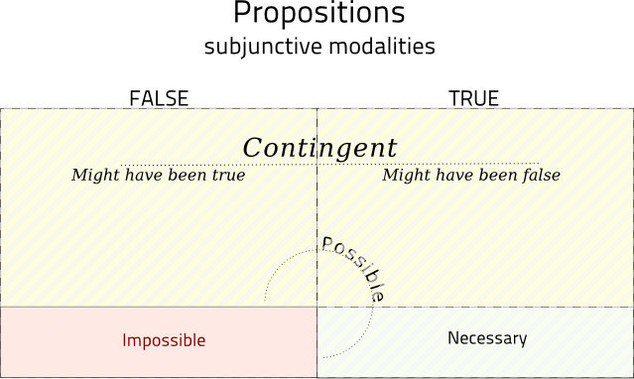
How does "nothing" categorize here?
It doesn't, it's nonsense.
Ontologization of "nothing" into something is contradictory. "Nothing" isn't something that can be, isn't anything at all. "Nothing" is but a referent-less word (hence quoted), making a stage entry as if it were. Absence of anything and everything also means absence of probabilities, events, conservation, constraints, prohibitions, beer, etc. "Nothing" is merely a linguistic curiosity expressing the missing complement of anything and everything.
How about everything — all of existence — then, how does that categorize (if it does in the first place)?
Does anything necessary necessarily exist?
Well, if you take "nothing" to be the default, then no, at least.
From necessary propositions only necessary propositions follow. — AJ Ayer -
The kalam/cosmological argument - pros and consExpressing temporality with tensed verbiage can be difficult; the word "to exist" has a past tense, for example. Our language can express things "existing" tensed — did exist, do exist, may yet come to exist. Though, if we speak of time itself, it would seem odd (or incoherent) to use tense.
Does time exist or is existence temporal?
As suggested by Wittgenstein, we shouldn't let linguistic practices fool us.
Contemporary cosmology will have it that spacetime is an aspect of the universe. It would seem appropriate then, to speak of spacetime/spatiotemporality using non-tensed terminology. I'm not sure how feasible that is, but at least keeping these linguistic curiosities in mind is appropriate.
spacetime is an aspect of the universe, but "before time" is incoherent; causality is temporal, but "a cause of causation" is incoherent — jorndoe -
What are you listening to right now?@The Great Whatever, didn't know that one, thanks for sharing, it's hit the airways here.
Ouzo time.
jorndoe

Start FollowingSend a Message
- Other sites we like
- Social media
- Terms of Service
- Sign In
- Created with PlushForums
- © 2026 The Philosophy Forum