
-
Schopenhauer's Transcendental Idealism
You misunderstand - those geometric objects aren't objects at all - they are pure spatial relations. Geometry is the study of possible spatial relations.No, my main point was that space has no properties. I was thinking of physics when I said material objects. Geometry, you are right, deals with mental objects like lines and triangles. But these are imagined as being in space, just as material objects are perceived to be in space. — Thorongil -
Schopenhauer's Transcendental Idealism
The categories are provided by the mind, by the understanding, they are pure concepts and therefore they are ideal... In addition to these I include space and time which are also ideal and are forms of cognition provided by the mind.Firstly, what exactly do you mean by "if the categories are not ideal"? — John
The empirical is NOT space, but what is found within space. Kant makes this very clear in the paragraphs I have quoted to you - there is no doubt that for him space is transcendentally ideal fully and completely. He makes it very clear - he says space is not empirical.I mean, the empirical must contain, independently of our actual experience properties of its own which we may later discover, or maybe never discover, right? So space could be real in this kind of sense that its properties are not exhausted by what is intuitive self-evident to the human mind. — John
This is not Kant's meaning at all. If it was, Kant would not have thought that the propositions of geometry are synthetic a prioris and hence certain. It seems to me that your love for Kant is getting in the way of your quest for truth. Kant makes it very clear that space is not empirical. That space is not empirical means that there cannot be empirical truths about the nature of space, that much is certain.I think that Kant's meaning in saying that space is a function of the human mind, is to say that it is a function of the transcendental ego, the totality of which we cannot be intuitively aware. — John
Not according to Kant.So space could be real in this kind of sense that its properties are not exhausted by what is intuitive self-evident to the human mind. — John -
Political Spectrum Test
Fuck the far-leaning - they are crazies too >:OBut when it comes to far leaning the right has the numbers advantage. — m-theory -
Schopenhauer's Transcendental Idealism
Yes it does, because lines not being material objects don't show up in your experience a posteriori at all. They are possible solely because of the nature of space that is given in your intuition. Thus geometry studies space as given in the intuition. Lines apply to material objects only as limiting conditions - they determine the spatial relations possible among material objects. But lines, by virtue of having no thickness for example, are constructs of your spatial intuition - they literarily are nothing except a spatial relation.That's technically true, yes, but it doesn't affect my main point. — Thorongil -
Political Spectrum Test
That's not true, even there liberals dominate currently. It's not as bad as in universities though (especially social sciences universities >:O )I think in general population polls it is closer to half. — m-theory -
Schopenhauer's Transcendental Idealism
Geometry does not study material objects... A line is not a material object at all. Neither is a triangle for that matter. Remember that a line has no thickness for example. Show me a line in the world that has no thickness....Only material objects in space have properties and these properties are what geometry studies. — Thorongil -
Political Spectrum Test
Motheryucker >:OYes, I agree, and I know what you should do about it. You should lose more. — Sapientia -
Schopenhauer's Transcendental Idealism
Kant said this - does everyone see it? Space - if it is to be a form of our intuition, must condition and determine all possible spatial relationships that can exist within it.Similarly, geometrical propositions, that, for instance, in a triangle two sides together are greater than the third, can never be derived from the general concepts of line and triangle, but only from intuition and indeed a priori with apodeictic certainty — Agustino -
Schopenhauer's Transcendental Idealism
Which is a property of space governed by geometry... the fact that two objects can't be in the same place at once is a statement of geometry. This is what individuates as you say... Why do you think Kant and Schopenhauer thought that geometry is synthetic a priori? Because geometry is the study of space qua space. Spatial relations and what they entail - that's what geometry studies. It's those relationships which individuate things.It doesn't create whatever relationships you might be referring to. It creates your ability to say "figures," plural. — Thorongil
You perceive lines in space, but they are possible only because of the properties of space itself.Rubbish. Try thinking of or drawing a line that is not located in space. It's impossible. — Thorongil -
Schopenhauer's Transcendental Idealism
You asked me what I meant by that expression. I didn't mean something very technical by "world" in that context, so my apologies for not being more clear.But that passage says nothing at all about the world. :s — John -
Schopenhauer's Transcendental Idealism
Kant thinks exactly this as well, are you kidding me? This is quotes from Kant in the OPDoes Schopenhauer think space. time and causality are, exhaustively, functions of the human mind, such that they can have no existence or properties beyond, or contradictory to, how we directly experience and intuitively conceive them? — John
Space is not an empirical concept which has been derived from outer experiences. For in order that certain sensations be referred to something outside me (that is, to something in another region of space from that in which I find myself), and similarly in order that I may be able to represent them as outside and alongside one another, and accordingly as not only different but as in different places, the representation of space must already underlie them. Therefore, the representation of space cannot be obtained through experience from the relations of outer appearance; this outer experience is itself possible at all only through that representation
— Kant
Space is not something objective and real, nor a substance, nor an accident, nor a relation; instead, it is subjective and ideal, and originates from the mind’s nature in accord with a stable law as a scheme, as it were, for coordinating everything sensed externally
— Kant
Space is a necessary a priori representation that underlies all outer intuitions. One can never forge a representation of the absence of space, though one can quite well think that no things are to be met within it. It must therefore be regarded as the condition of the possibility of appearances, and not as a determination dependent upon them, and it is an a priori representation that necessarily underlies outer appearances.
— Kant
Space is not a discursive, or as one says, general concept of relations of things in general, but a pure intuition. For, firstly, one can represent only one space, and if one speaks of many spaces, one thereby understands only parts of one and the same unique space. These parts cannot precede the one all-embracing space as being, as it were, constituents out of which it can be composed, but can only be thought as in it. It is essentially one; the manifold in it, and therefore also the general concept of spaces, depends solely on limitations. It follows from this that an a priori intuition (which is not empirical) underlies all concepts of space. Similarly, geometrical propositions, that, for instance, in a triangle two sides together are greater than the third, can never be derived from the general concepts of line and triangle, but only from intuition and indeed a priori with apodeictic certainty
— Kant — Agustino -
Schopenhauer's Transcendental IdealismTime to go back to Berkeley, and Leibniz, and Spinoza and those guys... if that doesn't work... we can all become Skeptics, nothing to worry about >:O (joking lol)
-
Schopenhauer's Transcendental Idealism
I mean this nonsense:What do mean by "world as spirit"; who promotes that idea? — John
On the other hand something like this seems that it might work if we allow a triune noumenon (God) Who is both immanent and transcendent and drop the notion of absolute monism. We should also drop the idea of the noumenal as blind (Schopenhauer) or deterministic or necessitous (Spinoza). — John -
Schopenhauer's Transcendental Idealism
The noumenal just becomes unnecessary if the categories aren't ideal. Experience is no longer representation.Any transcendental realism in Kant can really only a be a kind of transcendental empirical realism, though; and that is what I have been trying to get you to see. The noumenal is still, for Kant, unknowable. — John
It doesn't work for Kant either, just for corrections of Kant. Kant certainly didn't allow for it. Space is ideal for Kant through and through. Non-Euclideanism disproves unaltered Kant as well.The move to realism may well not work for Schopenhauer's system but I think that only goes to show that he has not corrected, extended, or improved upon Kant at all, but rather muddled him up. — John -
Schopenhauer's Transcendental Idealism
I did see this paragraph but I don't see how it answers the point. By means of what is space the principle of individuation if not by the relationships it creates amongst geometric figures?Agustino wonders what space is if not its properties, Euclidean or otherwise. There are several ways to answer this question. First, I think we can say that space is the principle of individuation, i.e. it is that part of my cognition that makes what I perceive a plurality of distinct objects. However, because space is inseparable from our cognition generally, the question is technically based on a category mistake, because it's asking for knowledge of that which conditions all knowledge. Space can no more be known in itself than the eye can see itself or digestion can digest itself. It can still be known and perceived, but not in the way that the question assumes. Lastly, geometry tries to determine the properties of points, lines, surfaces, and so on, so it's technically not correct to say that it determines the properties of space itself, since points, lines, and surfaces are themselves in space. Any attempt to know what space is through experience, that is, a posteriori, necessarily presupposes it. — Thorongil
No lines aren't themselves in space - rather they emerge from the properties of space itself. It is the properties of space that make lines possible to begin with. These properties are what geometry studies. -
Schopenhauer's Transcendental IdealismMan this guy just loves promoting his own philosophy... >:O
-
Schopenhauer's Transcendental Idealism
I find the world qua Spirit to be quite insipid personally.We can approach the latter with intellectual or mystic intution, but any attempt to reduce it to a monistic substance objectifies it. The triune conception is not completely intelligible to us, which is as it should be; it is the best we can do with out limited intellectual capacities. That's my take anyway. — John -
Schopenhauer's Transcendental Idealism
........ :-}On the other hand something like this seems that it might work if we allow a triune noumenon (God) Who is both immanent and transcendent and drop the notion of absolute monism. — John
Okay, I have no problem with that position in-so-far as this thread is concerned. I told you that moving towards transcendental realism is the only way to save Kant. But it won't work for Schopenhauer.Thorongil raises a good point that we don't directly perceive space and so we do not directly perceive it as either curved or flat. But apokrisis also makes the good point that at the scale of our perception, given our ability to build structures that consist of parallel members that can be shown not to converge, that we naturally conceive space as flat. If you accept, though, that gravitational warping of space points to a real phenomenon which is independent of our perceptions, then you are inevitably moving towards transcendental realism. Personally, I am more in favor of transcendental realism (only when it comes to the phenomenal, however the phenomenal in this context is not conceived as being exhausted by our perceptual experience). So, I think there is both a transcendental aspect of the phenomenal, and beyond that a transcendental noumenal. Of the latter I don't believe it could be appropriate to refer to it as either ideal (in the sense of being a function of our minds) or real (in any empirical sense as a phenomenal existent). — John
Schopenhauer's system is indeed a bit muddy, but these are hardly serious difficulties that are unresolvable based on Schopenhauer's own system. The Platonic Ideas are glimpses - partial glimpses - of the noumenon - hence why they are still individuated, or they appear individuated (this is my interpretation to make this clear). The noumenal doesn't consist in two aspects at all, except that we never encounter it as it is in-itself, we just encounter glimpses of it.So, to return to an earlier question I asked you: are the Platonic Ideas noumenal or phenomenal? It seems odd to say they are noumenal if they are multiple. If they are not multiple then there would only be the Platonic Idea. But even then the noumenal would consist in two aspects, which again seems wrong. This is just why I have been saying that I don't think Schopenhauer's ontology is well thought out. — John -
Schopenhauer's Transcendental Idealism
Yes, that is true. But I think the version I outline is stronger and more internally coherent than the one outlined by Schopenhauer, hence why I dared :PYou can disagree if you like, but again, Schopenhauer still explicitly says they do. — Thorongil -
Schopenhauer's Transcendental Idealism
Personally I would disagree, and I would say they're dependent on the thing-in-itself. Their objectification as representation - that is dependent on the will, since they are objectified further down into the representation through the means of the willNo, not according to Schopenhauer. The Platonic Ideas are dependent on the will, as the adequate objectification thereof. — Thorongil -
Schopenhauer's Transcendental Idealism
Why then are geometrical judgements synthetic a prioris? They are synthetic because they are reducible to a perception a priori. And they are a priori because one doesn't need experience to have such a perception. Such a perception is achievable a priori.In other words, we have immediate knowledge of the conditions of knowledge, while all other knowledge is mediated by those very conditions, and so is a posteriori. — Thorongil
But the relationships between geometric figures is what space itself is. I mean I ask you again, what else could space be? You say a form of our cognitive faculties... well, to be more exact, what is that?It's one thing to say, "lines and shapes can be measured a certain way, a way different from what Euclid taught in some cases," which is what non-Euclidean geometry says, and quite another to say, "this describes space itself. — Thorongil
I don't actually remember Schopenhauer using the term stage, but it may be possible. It's been awhile since I read WWR in full.Well, what I said is what I believe Schopenhauer means by that term. The stage is the unity of what I am presently conscious of. — Thorongil -
Schopenhauer's Transcendental Idealism
I agree with (1) and (4), but (2) and (3) should be reversed. First, the will is given under time - we know of the will in time. The Platonic Ideas are known outside of space, time and causality, and hence must be higher than the will in the hirearchy. I might disagree that Platonic Ideas still presuppose subject/object, rather I'd say that in the case of experiencing the Platonic Ideas the subject and the object become one - thus there is a quieting of the will, temporarily - one knows a Platonic Idea by being it. But the Platonic Idea is a relic of the thing-in-itself so to speak - only a glimpse. So it is still individuated.- The thing-in-itself, which is completely unknowable.
- The will as the thing-in-itself when the latter becomes conscious of itself, which is knowable in time as distinct acts of will identical to the movements of the body.
- The Platonic Ideas as the different grades of the will's objectifying itself, that is, the different degrees of what the will wills, which is life/existence, and knowable in aesthetic contemplation when willing has temporarily abated, wherein one is conscious solely of the Idea and not the movements of one's body or of individual objects in space and time.
- Individual objects as the Platonic Ideas come under and known in space, time, and causal relation to each other. — Thorongil -
Schopenhauer's Transcendental Idealism
I would say part of the principle of individuation because time for example also individuates.. First, I think we can say that space is the principle of individuation, i.e. it is that part of my cognition that makes what I perceive a plurality of distinct objects. — Thorongil
This is problematic. Space being inseparable from our cognition means that our knowledge is spatially mediated. Knowledge must have both perceptual and conceptual content according to Kant/Schopenhauer, because remember all knowledge must be ultimately reducible to some perception. If space is inseparable from our cognition, and non-Euclideanness is not perceivable in perception a priori, that means that non-Euclidean geometry cannot be knowledge, since it has no perceptual referent. That is obviously absurd.However, because space is inseparable from our cognition generally, the question is technically based on a category mistake, because it's asking for knowledge of that which conditions all knowledge — Thorongil
Yes but I meant it in a different way. I meant it in the sense that the Will isn't material. In that sense it is a form of ontological idealism - the Will is closer to an idea or a subject than to matter.No. He's an ontological voluntarist, in that the being of the world is will, as opposed to mind, a la Berkeley. — Thorongil
I don't mean that by stage. I mean space, time and causality by stage.The stage, assuming by that you mean the mental picture appearing before a conscious subject, is both empirically real and transcendentally ideal. Our experience of objects is not false. — Thorongil -
A Simple Argument against Dualism
That's because it is both wave and particle... and it's not the only interpretation of QM. Pilot wave theories also exist for example.I believe this "vague" position is all the position particles have. It's not that they "really" have a non-vague position but we're just incapable of determining it. So to occupy the same "vague" position is to occupy the same space. — Michael -
Political Spectrum Test
Okay that was my fault for not expressing myself correctly. That's something that most liberals would deem sexist, simply because that's how they label it when it is discussed. They do so out of ignorance or prejudice most of them. But then prejudice exists on both sides.Talk about a straw man. If those values do equally apply to men and women, then how can they be sexist? Why do you think I would hold such an irrational position? — jamalrob -
Political Spectrum Test
Well I do happen to share what Emptyheaded considers as the Tragic Vision of mankind with some contrasts - for example I don't place such a strong value on authority (for the sake of authority) or tradition (for the sake of tradition). Indeed, in my vision authoritarianism undermines all authority, because it removes the reasons one would have in the first place for obeying authority - it reduces authority to lawless tyranny. I also disagree that the ends justify the means, because I see means and ends as being connected together to begin with such that a nasty means cannot lead to a good end - indeed that would be nonsensical in my opinion.Taking a disparaging position by labeling leftists as 'children' to justify superiority in your political world-view does not legitimize it only because you proscribe the other and quote some people. When exactly will you be speaking? And I hardly think that in its sharp "adult" contrast a pessimistic view of humanity where the ends justify the means can be considered any different to the very source of your opposition. — TimeLine
But I do believe that most human beings will be selfish and have a tendency towards immorality. Despite this, I think that people are perfectible, and they can improve and change for the better. There can also be exceptions, but this is just what the majority will always be like in my view. I am a conservative, though I wouldn't say I'm a conservative because I share the Tragic Vision. Indeed, I'm not a reason-skeptical conservative the way Empty is. I'm a conservative simply because I think conservative values make for a better society - greater social cohesion, greater levels of morality, people more likely to strive for what is higher, etc. Liberalism - in my opinion - naturally degrades into all of us striving for the lowest common denominator - what is worst in man - hedonism. Liberalism tends to see freedom as the freedom to do whatever you want - and so freedom ends up being equivalent bondage to lust. I tend to see freedom in a different and more positive way - freedom is the capacity to achieve virtue and act virtuously. -
Why are Christians opposed to abortion?
:D excellent!Your reward will be a post in the space thread. — Thorongil -
Why are Christians opposed to abortion?
I would be honored if I receive one from the great Thorongil 8-)You want a medal? — Thorongil -
Why are Christians opposed to abortion?
I'm one of them! O:)Christians believe that a sex is something sacred, either physical and spiritual connection of partners — Takerian -
Original and significant female philosophers?My favorite is this one:
https://en.wikipedia.org/wiki/Emmy_Noether
She was a genius, her work on symmetry and conservation laws accounts for some of our most fundamental scientific laws, and explains them merely as cases of symmetry breaking. -
Political Spectrum Test
This is a little bit of a strawman with respect to some conservatives like me. I'm a rational conservative instead of a reason-skeptical conservative à la Burke (see here for distinction). As shown by the last chart I posted in this thread, I don't value authority as much as other conservatives. However, I am conservative in that I share many of their values/ideals with regards to, for example, sexual behaviour, values which you'd deem to be sexist or whatever, despite the fact that they would apply equally to men and women (such as chastity for both). Furthermore, I decide in the favor of such values based on reasoning, not based on tradition.For conservatives, the status quo, e.g., class hierarchies or disparities in the treatment of men and women, is defended partly on the basis of its supposed naturalness — jamalrob -
Schopenhauer's Transcendental Idealism
... No we're definitely not saying the same thing.It has an "intrinsic curvature", so its straightness is just an illusion — Metaphysician Undercover
http://mathworld.wolfram.com/IntrinsicCurvature.html
As I have said a million times, Non-Euclidean geometry does not refute the axiom that the shortest distance is the perpendicular - among many other axioms that aren't refuted. So you have to explain to me where does this axiom get its certainty from, because it seems that regardless how our space is, it can't be refuted. -
Political Spectrum TestI mean you'll obviously have conservatives attending university (like myself for example), but the peer pressure washes most away, because they just seek to fit in. There's not actually many people who think for themselves, and who actually have their own views on things, not determined by what others encourage them to think.
-
Political Spectrum Test
Yes, so at least for the developed world that is the case, and I guess it will continue to be the case for quite awhile. In a way, it cannot NOT be the case - liberalism leads to more spending and more diverse markets than conservatism, so I wouldn't expect an economy leaning on capitalism to lean towards conservatism, especially in today's world when capitalism must adopt a "human" face, without sacrificing sales.Yeah, I agree with that, and it's pushed along by universities leaning so much towards the liberal side, and a culture where now it's more or less seen as a requirement for a reasonable career that one goes to university. — Terrapin Station -
Political Spectrum Test
It could be, but given the cultural milieu I doubt that the rate of conservatives being produced is greater than the rate of liberals being produced. Children end up being liberals simply because they're a lot more likely to be exposed to liberal thought and influences.It could just be that a lot more people who identify as liberals decide to take the quiz. — Terrapin Station -
A Simple Argument against Dualism
So a particle is literarily in the same spatial position as the other? Isn't it around the same vague (in QM) position? That's entirely different from what I said.As far as I'm aware, particles interact only when they do occupy the same space.
It's only identical fermions that can't occupy the same space. — Michael -
Political Spectrum TestBut it's disastrous - if you look at the number of liberals compared to conservatives, only 20% are conservative. We're losing, and we have to do something about it.
-
A Simple Argument against Dualism
They don't. They're merely correlated with one another. The ideal is parallel to the material.It is not any more clear than how a material and 'ideal' thing can interact (although 'ideal' is a poor descriptor for the mental in Descartes' view). — The Great Whatever
Tell me TGW, can you conceive of two objects occupying the same position in space at one and the same time? No.OK, why can't they, and how do you know that? If you know it by experience, then we also know about physical-mental correlations and their effects on one another from experience. — The Great Whatever
Which is stupid. If they interact, they could really affect each other, but they don't. They're merely correlated with each other - two attributes of the same substance. Serotonin in the brain is correlated to a feeling of happiness, just as a feeling of happiness is correlated to serotonin in the brain. One doesn't "cause" another.But this is just false. Obviously the dualist thinks the two realms interact in systematic ways – hence interactionist dualism. — The Great Whatever
No, things which have a different nature cannot interact. A thought cannot kick a stone.Just because two things are distinct doesn't mean they can't interact: if that were true, distinct physical things couldn't interact either. — The Great Whatever -
Political Spectrum Test
>:OAnd given a 0 purity score, of course I don't mind that it's disgusting, haha.
See, I said I'm not a purist. — Terrapin Station
Mine is 3.3 on Purity. -
Political Spectrum TestThis was slightly more interesting - as can be seen I highly value Harm, Loyalty and Purity
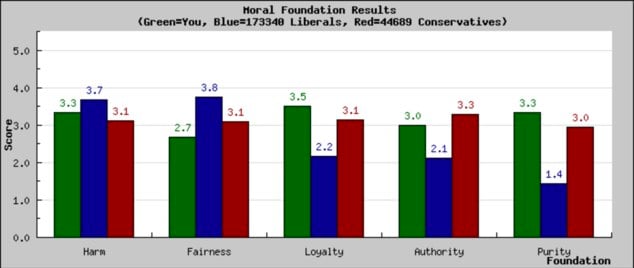
Loyalty seems to be the "highest" for me and I think that's true. I would say that fairness is probably also above authority, just intuitively thinking about myself, but definitely below the others.
Agustino

Start FollowingSend a Message
- Other sites we like
- Social media
- Terms of Service
- Sign In
- Created with PlushForums
- © 2026 The Philosophy Forum