
-
Indirect Realism and Direct Realism
I'd also say there's no "distal object" -- that this is a conceit of indirect realism.
I’m with you on that. I think the use of “distal” to describe objects in the world is used to get around the inherent question begging of the position, to contrast the rest of the world with mental objects before having to prove mental objects exist in the first place. Mental objects are afforded primacy as the true and known object while the sun, for instance, is relegated to the status of the unseen and unknown, “distal”. At any rate, it’s a silly piece of jargon. -
Indirect Realism and Direct Realism
I think we’re all aware of the arguments from illusion and the argument from science. Searle addresses these in his so-called "Bad Argument". Both fall prey to the fallacy of ambiguity; there is some ambiguity with the verb "see", for example. In the case of hallucination there is no object of perception. If there was, it wouldn't be a hallucination. So we're confusing the object of perception with perception itself.
The experience of pain does not have pain as an object because the experience of pain is identical with the pain. Similarly, if the experience of perceiving is an object of perceiving, then it becomes identical with the perceiving. Just as the pain is identical with the experience of pain, so the visual experience is identical with the experience of seeing.
https://www.degruyter.com/document/doi/10.1515/9783110563436-003/html?lang=en
I don't agree with Searle's positive account of perception, all this about "intentionality" and whatnot, but we at least need to try to move the arguments forward instead of reiterating them. -
Indirect Realism and Direct Realism
Computers are one thing, organisms are quite another.
It is true that organisms perceive. It is untrue that brains do. It isn’t even conceivable that brains perceive. Even the brain-in-a-vat scenario requires things external to the brain to mimic the reality of a body. -
Indirect Realism and Direct Realism
Bodies are required to keep brains alive and functioning, but conscious experience is to be found in the brain activity. When there's no (higher) brain activity there is no consciousness, e.g. those in a coma or in non-REM sleep.
Brains are required to keep bodies alive and functioning, as well. In either case, bodies and brains grew together as one organism, one object, all of it inextricably and intimate linked together into a single object. Conscious experience, perception, or whatever other activity is impossible if one or the other is missing or deceased or uncoupled. That’s a brute fact we ought to consider, in my opinion. -
Indirect Realism and Direct Realism
The only thing a disembodied brain can do is rot. So brains do not think or experience or perceive. Only bodies do. And the body is, conveniently, the only thing standing between your perceiver and other objects in the world.
The attempt to dismiss the rest of the body in the act of perception is clearly motivated by something other than scientific inquiry, and it would be interesting to find out what that motivation is. -
Indirect Realism and Direct Realism
The toe is the trigger. It's where the sense receptors are. But the sense receptors are not the pain. Pain occurs when the appropriate areas of the brain are active.
When we put a brain on a table it’s impossible to say the brain feels pain or experiences, therefor it is just untrue to say brains feel pain and experience. Much more needs to be added to the equation in order for pain or experience to occur in the first place. How much more needs to be added to the equation is an important matter of debate, and would make a good thought experiment, but I wager the organism needs to be relatively complete. Organisms are so far the only objects in the universe that can be shown to feel pain and experience.
Mind or experience or whatever other spirit dualists postulate cannot occur with one single organ. So the dividing of the body into pieces and parts technique of philosophy of mind doesn’t serve us as well as it might in biology and anatomy. -
Indirect Realism and Direct Realism
I don’t doubt the brain is involved, but clearly the toe is as well. I’m just wondering the biology of “experience”, for instance how far from the brain it extends. -
Indirect Realism and Direct Realism
Then wouldn't experience be limited to the prefrontal cortex, or does it extend to the toe? -
Indirect Realism and Direct Realism
If I stub my toe, injure my toe, and feel the pain in my toe, is it your position that I am feeling it in my prefrontal cortex? -
Indirect Realism and Direct Realism

Missing from your image is the organism's body, which I assume would encompass both the pain and cognition. Is the "I" that feels pain the organism or the organism's cognition? -
Donald Trump (All General Trump Conversations Here)
The alleged felony crime is falsifying business records, repeated 34 times, all of which happened after the election. Now we are left to wonder how such book-keeping can be said to influence an election that happened in the past. The alleged crime Trump intended to conceal, according to Bragg, was a misdemeanor long past its statute of limitations.
Actually, the crime you're alleging is what the Clinton campaign did when they funnelled money through Perkins Coie to fund the Steele dossier, which they then hid as "legal fees". They also lied about it for years. Clinton and the DNC got fined by the FEC for their efforts. Of course, as is typical with a 2-tiered justice system, none of them were held accountable for what you call a crime. -
Donald Trump (All General Trump Conversations Here)Trump breaks another record: the first former president to face a criminal trial. The supposed federal crime is that Trump never reported payments to Michael Cohen as “hush money”, or some such nonsense. He signed the check wrong? Who knows.
At any rate it’s another non-crime. It’s so hard to make sense of any wrong-doing on the part of Trump, while the anti-Trump weaponization of the justice system seeks a desperate win before the election. So desperate are they that they tried to use the famous Access Hollywood tape as evidence. :lol: -
What is the true nature of the self?
Write the word “self” on a label and stick it to any one of the options you’ve provided. The entity upon which that label finally sits is the self, and in every case it is the human individual in its entirety. -
Donald Trump (All General Trump Conversations Here)
Clever? It’s authoritarian. He used the insurrection lie as a pretext to weaponize the DOJ against his political opponent, jail those who protested his presidency, and to paint those he doesn’t like as extremists. -
Indirect Realism and Direct Realism
In any case, it’s unfalsifiable and cannot be proven, except when it comes to the science of perception. -
Indirect Realism and Direct Realism
I’m not sure there is any good reason for the indirect realist to believe in any of them, since any evidence regarding anything about the external world lies beyond his knowledge. He doesn’t know what he is experiencing indirectly. Hell, he can’t even know that his perception or knowledge is indirect. -
Indirect Realism and Direct Realism
I don’t think so because Berkley’s objection to indirect realism still stands, and the direct realist can raise it without himself believing in idealism.
Given that any evidence of the external world lies beyond the veil of perception, or experience, is the realism regarding the external world a leap of faith? -
Indirect Realism and Direct RealismExperience is a causal consequence of our body interacting with the environment but our knowledge of that environment is indirect; we make inferences based on our direct knowledge of our own experiences.
We infer on the basis of evidence and reasoning, but since we only have direct knowledge of experience, we cannot be aware of the evidence of anything outside of it. -
Indirect Realism and Direct Realism
Experience is a causal consequence of our body interacting with the environment but our knowledge of that environment is indirect; we make inferences based on our direct knowledge of our own experiences.
How does one know that experience is the causal consequence of his body interacting with the environment if he only has direct knowledge of his own experience, and not of what causes it? -
Indirect Realism and Direct Realism
I can see things when I close my eyes, especially after eating magic mushrooms. The schizophrenic hears voices when suffering from psychosis. We all see and hear and feel things when we dream.
There's more to the meaning of "I experience X" than simply the body responding to external stimulation, else we couldn't make sense of something like "some people see a black and blue dress and others see a white and gold dress when looking at this photo" or "I'm looking at this 'duck-rabbit' picture but I can't see the duck".
I get all that, I just don’t understand how someone can see something without eyes. If sight involves eyes, and those eyes are missing or closed, then is he really seeing?
I don’t think so. In my view the nomenclature is strictly metaphorical, a sort of folk biology, the result of the disconnect between states of feeling and states of affairs.
Perhaps better verbs are in order, for instance “I dream of such and such” or “I am hallucinating”.
Do we directly experience the external world? The indirect realist accepts that we experience the world; he just claims that the experience isn't direct.
So what is the relevant philosophical meaning of "direct"? It's the one that answers the epistemological problem of perception that gave rise to the dispute between direct and indirect realists in the first place. Direct realists claimed that there isn't an epistemological problem because perception is direct, therefore the meaning of "direct" must be such that if perception is direct then there isn't an epistemological problem of perception. Given that experience does not extend beyond the body and so given that distal objects and their properties are not constituents of experience, and given that experience is the only direct source of information available to rational thought, there is an epistemological problem of perception and so experience of distal objects is not direct.
But the indirect realist does not experience the external world. As you say, experience doesn’t extend beyond the body, and the indirect realist does not believe the external world is a constituent of his experience. Well what is?
So in my mind the important philosophical question is: “what does the indirect realist believe he is experiencing directly”? The history of philosophy and the myriad terms and theories regarding the nature of this mediator attests to the importance of the problem. -
Donald Trump (All General Trump Conversations Here)
Moose hat? No, he was the guy claiming it was an insurrection. In fact, I think he might be the first guy to use the term, and everyone else just followed. -
Indirect Realism and Direct Realism
What does it mean for some A to view some B?
That’s what I don’t understand. In layman’s terms viewing, seeing, looking etc. involves the eyes. How does one see a representation?
That question doesn't address the philosophical disagreement between direct and indirect realism. It's a red herring.
It's like asking "do we kill people?" Yes, we kill people; but we kill people using guns and knives and poison and so on.
So one person says "John didn't kill him; the poison killed him" and the other person saying "John killed him (using poison)" and then they both argue that one or the other is correct. It's a confused disagreement; it's just two people describing things in different ways.
This is the confused disagreement that you and others are trying to engage with.
It ought not to matter if the grammar is irrelevant. It’s basically the same question, just worded differently and without the ambiguity.
Do we experience the external world? The direct realist would say yes, the indirect realist would say no. After answering we can approach the philosophical disagreement. So what’s missing? -
Donald Trump (All General Trump Conversations Here)
But that’s exactly what they did. The J6 protest was Biden Inc’s Reichstag fire. Remember that Nazis claimed the fire was a plot to topple the government, and used the lie to crush their opponents. -
Indirect Realism and Direct Realism
True and false are two different ways of speaking about the same thing. Predicates can be true or false, for instance. So dismissing grammar is a mistake, in my opinion, and I’m not sure why someone would want to eschew it.
The arrows in the pictures are meant represent the direction and indirection of the interaction. For indirect perception, something in the world causes a representation of an apple, which is viewed by something in the brain.
The relevant philosophical difference between direct and indirect realism is that regarding the epistemological problem of perception; are distal objects and their properties constituents of experience and so does experience inform us about the mind-independent nature of the external world. To be a direct realist is to answer "yes" to these questions and to be an indirect realist is to answer "no" to these questions.
The question is loaded. If I answer “yes” I confirm there is a realm of experience in which phenomena occur, and the existence of an epistemic mediator called “experience”. Experience is treated like a place or thing, in which these other objects are parts. But “experience” as used cannot be instantiated, so I must say “no”.
Perhaps we can formulate it another way. Do we experience “distal objects”? -
Indirect Realism and Direct Realism
This image seems absolutely nonsensical to me, intuitively and reflectively. What does that say? I don't know, and i'm implying anything. Just curious as to your reaction to that. It may say nothing.
It’s nonsensical to me too. I’m just describing the images evoked by the arguments. -
Indirect Realism and Direct Realism
All perception is direct—we all agree there is an immediate object of perception, and that X perceives Y. The only difference between the two positions is the nature of what it is we are directly perceiving (an apple or representation of an apple), the nature of who or what perceives it (a person or a brain), and how they go about doing so.
Elucidating each position requires the use of grammar—nouns, verbs, and adjectives—each of which can be confirmed to be true or false when compared to states of affairs. So the grammar is relevant because it describes (or at least ought to) the subject of perception, the object of perception, and how both are interacting with each other.
The grammar can indicate where a position goes off the rails. For instance, upon hearing the arguments my alarm bells go off. "Well, that noun doesn't refer to anything in particular"; "that object of perception is just a reiteration of the subject and predicate, an equivocation"; "experience is treated as if a space or container in which things occur, albeit with no defined boundary or volume or location".
The imagery the grammar evokes is important, in my opinion. For me it evokes as follows:
Direct Perception
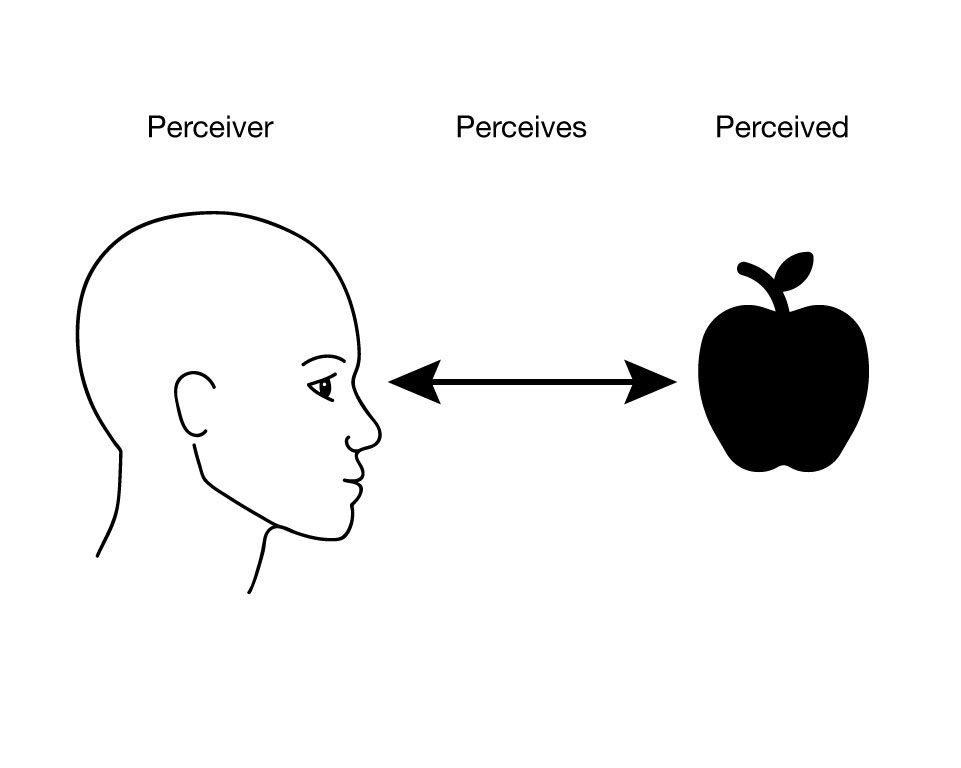
Indirect Perception
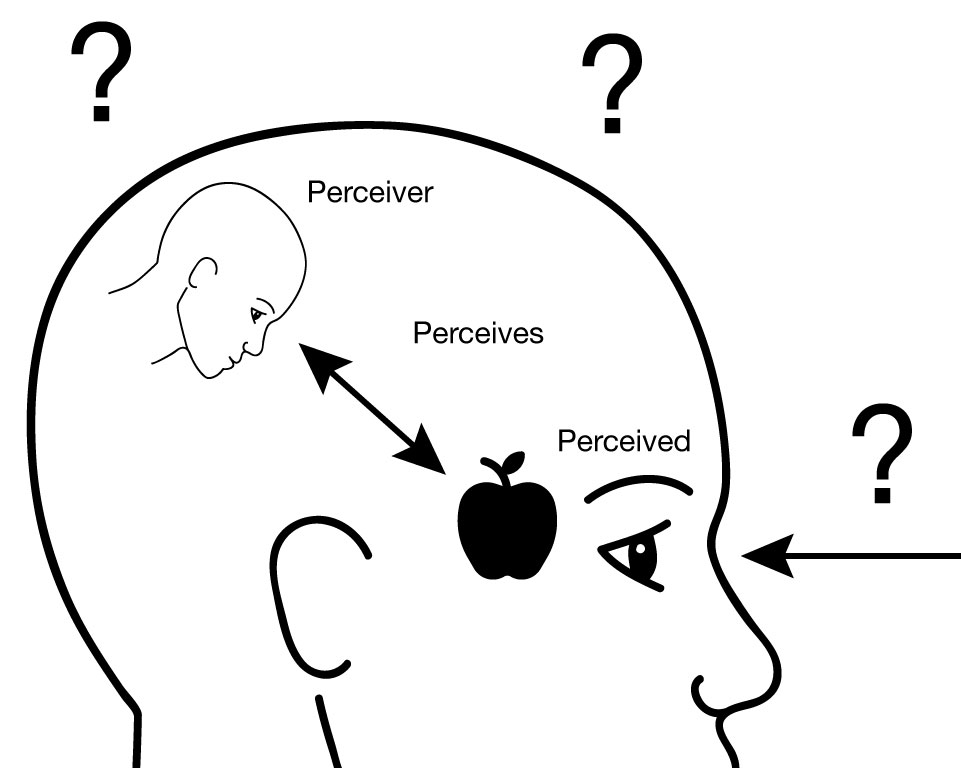
-
Donald Trump (All General Trump Conversations Here)
I'm not sure what it means to be "strictly caused", but there's a clear, predictable connection between Trump's verbal attacks on named individuals and threats by Trump supporters to that individual. Do you deny that? Do you seriously think Trump is unaware?
I do deny it. The ability to criticize is a precious right. Criticism does not constitute a threat, plain and simple, but that’s how they and you are trying to portray it. And again, there is little to no evidence these threats even occurred, that they were from Trump supporters, that they are the result of Trump’s criticisms. -
Donald Trump (All General Trump Conversations Here)
Mr. Trump’s documented pattern of speech and its demonstrated real-time, real-world consequences pose a significant and imminent threat to the functioning of the criminal trial process in this case in two respects
The theory is complete nonsense. Trump making people aware of someone's name through criticism or otherwise does not cause threats. The worst it could ever do is inform others, and that's where his culpability ends.
Their entire theory is premised on the fallacy post hoc ergo propter hoc. At no time do they consider the millions of people who do not threaten anyone, but will violate their rights in order to stop the few people (if any) who do.
The threats, if there really are any, are strictly caused by the motives of the threatener. We don't even know who they are, and the court never mentions who they are. It is only assumed they are Trump supporters, based on the scantest of evidence, but that's it. The recipients could be lying, like Jussie Smollett. Those issuing threats could be operatives pretending to be Trump supporters, doing so to influence the trial. They could be foreign actors. They could be kids goofing off.
Either way, the very high burden of proof for a prior restraint gag order has not been met. -
Are there primitive, unanalyzable concepts?
I hold a similar view. I imagine concepts derived from the fact of one’s embodied state are quite primitive and foundational. Concepts such as “inside” or “outside”, “forward” and “backward”, “through” or “over” or “under”, all seem inextricably linked to one’s form as a being insofar as it moves through space and time.
NOS4A2

Start FollowingSend a Message
- Other sites we like
- Social media
- Terms of Service
- Sign In
- Created with PlushForums
- © 2026 The Philosophy Forum