
-
Panprotopsychism
I wasn't there at the beginning, so I don't know from personal experience that our world suddenly began to exist about 14 billion years ago. But the best guess of modern science is that the physical universe -- the only one we have any experience with -- is not eternal, but emerged from an unknown background in a creation event that is usually referred to as the "Big Bang". What existed before that is anybody's guess. But whatever the time-before-time was, it was not a part of our current space-time world.How do you know an absolute beginning exists? Why couldn't substance be inanimately eternal, with all psychical phenomena an emergent property and no fundamental creation necessary? — Enrique
Of course, some ancient sages, and a few modern thinkers, postulated that the universe cycles eternally. But they had no actual evidence for that assumption. The best evidence we have in the modern world is summed-up in the Big Bang Theory (BBT), which ends, not with a bang, but a Big Freeze. Since I have seen no good reason to think otherwise, my worldview is generally based on the BBT. But you are entitled to your own opinion.
If you think of "Substance" as Matter, the BBT implies that its existence is temporary, because it emerged, along with Space, from an initial Singularity. But if, by "Substance", you mean Aristotle's notion of Immaterial Essence, then it could indeed be eternal. In my thesis, Matter is inherently temporal, but Essence (Form ; Information) is timeless. According to Aristotle's theory of hylemorphism, the matter we are familiar with is a combination of ideal Form (morph ; essence) and real Matter (hyle ; stuff) What we perceive with our physical senses is Matter. But what we conceive with our reason is Form.
Anyway, for the purposes of my personal worldview, I do assume that the world had a Beginning (creation), and hence a First Cause (creator). If you have more "absolute" knowledge, I'd be interested to hear about it. :smile:
Personally, I'm not religious, but I am philosophical. And, unlike most people, I have a well-thought-out thesis to backup my personal belief system. So, based on a detailed & documented chain of reasoning, I do think that our world necessarily had an outside Cause of some sort. However, I've had had no personal "experience" of divinity. Hence, I am not "awe-inspired", and have no motivation to worship the abstract hypothetical First Cause of my worldview.(I should say that I'm not trying to be irreligious, because if you've experienced God this makes Him no less awe-inspiring, but seems to me we shouldn't base belief in God on fallacious ideas, so that's what motivates my challenge.) — Enrique
I certainly am not interested in any "fallacious ideas" about "God". So, I try to make sure that my worldview is based on plausible information. Since the world has entertained thousands of ideas about gods, some of which may be contradictory or fallacious, I tend to be skeptical of most of them. So, if you want to "challenge" my god-model, you'll have to engage in a philosophical dialog, and not a battle of Faiths. And on this forum, I put my theories out-there to be challenged. :cool: -
QUANTA Article on Claude Shannon
That's OK. If you are not a scientist, the fuzzy logic of Quantum Physics won't make much difference in your life. Philosophers, especially, have extolled the virtues of black vs white Logic for millennia. And, for all practical purposes, on the macro scale mathematical Logic still holds. But, on the micro scale (foundation) of reality, Logic has a statistical element, which makes it unpredictable. Fortunately, for humans, the uncertainties of Quantum Probabilities tend to average-out to predictable logical physics on the macro level (human scale) of the universe. You seem to be thinking in terms of ideal two-value (true/false) Logic, but in reality, Logic can be multi-valued (maybe). :nerd:Sorry, I will not dismiss logic for something that is illogical. And your appeal to quantum physics doesn't help, they can't even distinguish between one universe and an infinite number of universes. — Metaphysician Undercover
Is quantum mechanics wrong/illogical? :
http://www.quantumphysicslady.org/category/is-quantum-mechanics-wrong-illogical/
Quantum Logic :
https://en.wikipedia.org/wiki/Quantum_logic
Fuzzy Logic :
https://en.wikipedia.org/wiki/Fuzzy_logic
Fuzzy Logic : Although most human knowledge is uncertain & relative, Langan is confident that his two-value true/false reasoning can lead to absolute Truth. I'm not so sure, but it may be as close to Truth as we can get without divine revelation. All of our normal thinking has to deal with Fuzzy Logic and more-or-less-true statements of fact.
http://bothandblog2.enformationism.info/page36.html
My reference to a "defect" was tongue-in-cheek. That's because I think the random & fuzzy element of reality is actually an intentional positive "feature", that allows for FreeWill. If the world functioned according to absolute cause & effect Logic (Determinism), there would be no allowance for deviations from the road to Destiny. Of course, some people have assumed that we are all subject to inevitable Fate, hence their fatalistic cynicism. But I am able to remain optimistic, because I see some maneuvering room within the range of possibilities offered by statistical Probability. :blush:Instead Randomness exists as a hidden defect within Determinism. — Gnomon
OK, so there is a defect in the program. — Metaphysician Undercover
In a world of Fuzzy Logic and Quantum Uncertainty, it can be both. Hence, my BothAnd philosophy. You are using two-value (either/or) Logic, while I am using multi-valued (statistical) Logic. Reality is relative, not absolute. :cool:This contradicts what you said above. Either randomness is a defect in the program, or it is an integral part of the program. It can't be both. — Metaphysician Undercover
BothAnd Principle :
* Conceptually, the BothAnd principle is similar to Einstein's theory of Relativity, in that what you see ─ what’s true for you ─ depends on your perspective, and your frame of reference; for example, subjective or objective, religious or scientific, reductive or holistic, pragmatic or romantic, conservative or liberal, earthbound or cosmic. Ultimate or absolute reality (ideality) doesn't change, but your conception of reality does. Opposing views are not right or wrong, but more or less accurate for a particular purpose.
* This principle is also similar to the concept of Superposition in sub-atomic physics. In this ambiguous state a particle has no fixed identity until “observed” by an outside system. For example, in a Quantum Computer, a Qubit has a value of all possible fractions between 1 & 0. Therefore, you could say that it is both 1 and 0.
http://blog-glossary.enformationism.info/page10.html
You forget that I characterized the "program" as offering FreeWill-within-Determinism. Hence, while the overall general path of evolution is predictable (foreordained), local specific elements (you & me) are free to deviate from the program, due to the inherent randomness of the Darwinian process. The actual path is a result of both Randomness (variation) and Selection (choice). Presumably, the evolutionary Programmer intended to allow local divergent paths within the universal deterministic program. Where you see Contradictions, I see Opportunity. Where you see Crisis, I see Choice : a fork in the road. :yum:Now you've contradicted your original premise that the program is deterministic, to say now that it is "inherently indeterminate". — Metaphysician Undercover
Crisis Choice : The Chinese word for "crisis" (simplified Chinese: 危机; traditional Chinese: 危機; pinyin: wēijī, wéijī) is, in Western popular culture, frequently but incorrectly said to be composed of two Chinese characters signifying "danger" (wēi, 危) and "opportunity"
https://en.wikipedia.org/wiki/Chinese_word_for_%22crisis%22
As I said before, the Programmer, in my scenario, intentionally -- with full knowledge of the unpredictable consequences -- included a degree of Freedom within He/r otherwise Predestined world program. The empirical evidence for that conclusion can be found in the dualities of the Real World, and the dialectic of History. Some Christians believe in Predestination, because they don't think their rigid absolute God can do anything halfway. It's all or nothing. But for my flexible relative LOGOS, all things are possible (but not everything is actual) : positive & negative ; yes & no ; light & dark ; life & death, good & evil ; either & or . :brow:You didn't answer my question. Either the programmer knows about the indeterminateness, in which case the programmer knows that the system is not deterministic, or the programmer does not know this, in which case the program itself is in error because the programmer thinks the system is deterministic when it is not. Which do you think is the case? — Metaphysician Undercover
Unpredictable Program :
https://en.wikipedia.org/wiki/Undefined_behavior
Historical Dialectic :
Georg Hegel introduced a system for understanding the history of philosophy and the world itself, often called the "dialectic" : a progression in which each successive movement emerges as a solution to the contradictions inherent in the preceding movement.
http://www.age-of-the-sage.org/ philosophy/history/hegel_philosophy_history.html
http://blog-glossary.enformationism.info/page11.html -
Delayed Choice Pseudo Free Will
I assume you are referring to the Benjamin Libet experiment, which detected indications that a subconscious choice had been made, a fraction of a second before the subject became aware of making the choice. His tentative interpretation was that the Brain had already made its choice, and later informed the conscious Mind of the decision. But, that interpretation has been criticized in detail by other scientists. So, I won't go into the tricky reasoning on both sides about the apparent delayed awareness after the action had been initiated.Question 1: What explains this delaying/deferring of actions even after choices have been made? — TheMadFool
However, here is one scientist's critique. It seems to support my understanding that the Brain, like office staff, processes incoming information, and then presents its recommendation to the CEO for an executive decision. This is not an illustration of absolute FreeWill, but of relative freedom of choice : of freedom within determinism. So, you are free to go-on acting as-if you have FreeChoice --- and that your Vote will count :grin:
How a Flawed Experiment “Proved” That Free Will Doesn’t Exist : It did no such thing—but the result has become conventional wisdom nevertheless
https://blogs.scientificamerican.com/observations/how-a-flawed-experiment-proved-that-free-will-doesnt-exist/
PS___There is another Delayed Choice experiment that raised questions about FreeWill.
delayed choice quantum eraser shows that free will exists :
https://www.happyatheistforum.com/forum/index.php?topic=5986.0 -
Creation-Stories
Dan. This is an afterthought or postscript to your question.Do both parts of the ying-yang always exist? Are they opposites which have existence as a constantly common characteristic, or could one of the opposites actually never exist (is there a scenario where there is only ying or only yang)? — Daniel
The existence of a Yin without its complementary Yang would be like finding a Magnetic Monopole. All magnets have two poles. But some theorists imagine that a Monopole should exist somewhere out in the physical universe. Of course, in imagination, anything is possible. But Yin-Yang is not a physical thing. It's a metaphysical concept. To remove the Yin from the Yang would be like playing on a See without the Saw. :smile:
Magnetic Monopole : A magnetic monopole is the magnetic version of a charged particle like an electron, and for the last 70 years physicists have believed that one might exist somewhere in the universe.
https://phys.org/news/2016-08-mysterious-magnetic-monopole.html -
QUANTA Article on Claude Shannon
Yes, yes, yes! Yes Virginia, there is a Soft Determinism. Your "hard" either/or distinction may have made sense in Classical Physics, but since the discovery of Quantum Physics, there is no more "hard determinism". There also is no "true randomizer". Randomness exists within Determinism.No, no, no, I don't buy this. There is no such thing as a "soft link". Either Randy is atrue randomizer, or there is hard determinism. — Metaphysician Undercover
Again, you take my tongue-in-cheek metaphors too literally. There is no Randy as a separate entity from Mini (determinism), and there is no single "soft link". Instead Randomness exists as a hidden defect within Determinism. Each link in the chain of determinism is infected with a degree of uncertainty, which is numerically defined in terms of statistical Probabilities. No link is 100% certain, but has a tiny possibility of breaking the chain. Cosmos still retains a bit of Chaos. :worry:
How Randomness Can Arise From Determinism :
https://www.quantamagazine.org/how-randomness-can-arise-from-determinism-20191014/
Soft Determinism :
* Randomness is synonymous with unknown, unexpected. Yet is it real? Can anything be truly random? Is it simply a faith, an idea, or is randomness just an illusion?
* Theorized in statistical mathematics, the notion of randomness exists as a concept. But the definition of random models assumes that different events can be observed following identical initial circumstances. Such a form of randomness cannot exist in a world governed by determinism under the laws of physics. Determinism can imitate randomness.
* But quantum physics has proven its effectiveness where the great principles of today have failed. This introduces a new paradigm. Statistical physics, which at the same time explains the possibility of predictions and the residual gap between predictions and observations. Randomness can imitate determinism.
https://towardsdatascience.com/when-science-and-philosophy-meet-randomness-determinism-and-chaos-abdb825c3114
* “Nature itself doesn’t know through which hole the electron will pass”.
___ Richard Feynman.
* “What we call randomness is and can only be the unknown cause of a known effect.”
___Voltaire.
No. Randomness is not an intervention from "outside" Determinism. It is an integral aspect of the deterministic program. Due to the inherent uncertainties of a heuristic search, the Programmer is not able to accurately predict the output of the program because it is inherently indeterminate. The Programmer can steer the process in a certain direction, with criteria & initial conditions. But the solution will still be a surprise. If the Programmer knew the solution in advance, there would be no need to run the program. And if the destination was predictable, there would be no freedom to choose an alternate path.The only reason why "I am", the Programmer is not sure how the program will turn out, is that the program allows for an outside agent Tron, to enter the program and alter the soft link. — Metaphysician Undercover
Engineers are currently using evolutionary algorithms to solve complex problems with a high degree of inherent uncertainty. The program is an aid to design, but the designer does not know in advance what the solution will look like. Instead of a direct deterministic path to the solution, the program imitates Natural Selection in that it allows a random heuristic search pattern to sample a variety of possible candidates. An evolutionary program is a journey of "self-discovery". An open question here is whether it's the Creator or the Creatures who are learning about themselves. Maybe both. :chin:
Evolutionary Programming :
Special computer algorithms inspired by biological Natural Selection. It is similar to Genetic Programming in that it relies on internal competition between random alternative solutions to weed-out inferior results, and to pass-on superior answers to the next generation of algorithms. By means of such optimizing feedback loops, evolution is able to make progress toward the best possible solution – limited only by local restraints – to the original programmer’s goal or purpose. In Enformationism theory the Prime Programmer is portrayed as a creative deity, who uses bottom-up mechanisms, rather than top-down miracles, to produce a world with both freedom & determinism, order & meaning. https://en.wikipedia.org/wiki/Evolutionary_programming
http://blog-glossary.enformationism.info/page13.html
Evolutionary Design :
In radio communications, an evolved antenna is an antenna designed fully or substantially by an automatic computer design program that uses an evolutionary algorithm that mimics Darwinian evolution.
https://en.wikipedia.org/wiki/Evolved_antenna
Heuristic Technique :
any approach to problem solving or self-discovery that employs a practical method that is not guaranteed to be optimal, perfect, or rational, . . .
https://en.wikipedia.org/wiki/Heuristic
No. The freewill agent not outside the parameters. But yes, S/he adds an intended element of uncertainty to the otherwise formulaic program. The element of randomness scrambles the deterministic algorithm just enough to add a degree of unpredictability to the plan. And that touch of whimsey is the creative feature that adds the "magic" to the mix. So yes, humans are highly predictable in general ways, but unpredictable in the ways that make them unique. :nerd:Either way the agent is outside the parameters of the program, it is an unknown in relation to the Programmer. — Metaphysician Undercover
Note -- In any competitive game, you have to play it out to the end in order to know the final score. -
QUANTA Article on Claude Shannon
No. My imaginary friend is Randy, who is the Programmer's unpredictable servant. The Programmer's name is not "Will", but "I am". Get it? :joke:Your Programmer friend's name is Will? — Metaphysician Undercover
Yes. The Creator (I Am) is the Causer/Determiner, and all Creatures, including the little-gods, are the Effect/Determined. But Randy, the randomizer, serves as a weak link in the chain of causation. Absolute Determinism is rigidly organized, but relative Randomness inserts a degree of limp Uncertainty into the chain. Due to that soft link, even the Creator can't be sure of how He/r program will turn-out. S/he is still waiting expectantly. But stuck outside the system, S/he has relinquished control to the program.OK, I assume then that all creatures, and all human beings, are all subjects of determinism, and the only one outside the chain of causation is the Programmer, Will. — Metaphysician Undercover
It's like in Douglas Adam's Hitchhiker's Guide to the Galaxy the genius white rats program their super-duper computer "Deep Thought" to answer the ultimate question about "Life, the Universe, and Everything". And it took the computer 7.5 million years to come-up with the answer : 42 (binary 101010). Ironically, the evolutionary program of our world has been running for 14.8 billion years, and still has not spit-out a final solution. So, whatever the question is, it's the ultimate Hard Problem. :grin:
Yes. In this creation story, there is no good God versus bad Satan. The Programmer is ultimately responsible for everything that happens inside the computer world, except for any free choices made by freewill agents. Like innocent babes in the garden, Adam & Eve, succumbed to the temptation of Freewill, to make their own decisions. But their sudden knowledge of good & evil (morality) also made them responsible for their own lives. They grew-up and left the nest. And ever after, had to look-out for themselves. No more paternal divine intervention.But I might ask, if the Programmer, Will, has programmed things to make it appear to the "self-interested" individuals as if they have freewill, when they really do not, then isn't the Programmer Will really the evil one? — Metaphysician Undercover
So, the world is indeed rigged to give the appearance of Freewill. to those who choose. Even dumb animals act as-if they choose their behavior. But only humans are aware of their chains. Do you act as-if you have freewill? Are you deluded? Or does natural randomness weaken the chain of causation enough to allow options to those who know the difference between a good choice and a bad choice? To those who can see the fork in the road. :naughty:
No. As I said before, Randy is dumb pointless patternless randomness. It's smart guys like you and me, who choose to take "the road less traveled" -- the strait and narrow path to the mountaintop. I think you got lost back at the last fork in the road. :wink:This is where you lost me. I thought the causal link which "is smart enough", is the Randy agent. — Metaphysician Undercover
It's the weak link in our Deterministic chains, Randomness, that allows us to escape the Fate that Destiny has in store for us. Quantum Indeterminacy is the exception to Classical Physical Determinism.This does not provide an exception to the premise, that the program is deterministic. How could something escape that determinism, in any real way? — Metaphysician Undercover
Paradox of FreeWill : Freewill vs Fate, Fortune, Destiny, Determinism, Predestination, Foreordination, Kismet & Karma
http://bothandblog5.enformationism.info/page13.html
Indeterminacy :
“Prior to quantum physics, it was thought that
(a) a physical system had a determinate state which uniquely determined all the values of its measurable properties, and conversely
(b) the values of its measurable properties uniquely determined the state.”
https://en.wikipedia.org/wiki/Quantum_indeterminacy
The only way that creatures in a deterministic world could "come to know" how to escape their bonds, is for the Programmer to have made provisions for that very exception to the Rule (sorry). In Theology, Freewill is a free gift of God. In my story, it's how the Programmer can come to know He/rself through He/r creatures. The program is a mirror to the lonely Programmer. That's my theory, and I'm sticking to it . . . for now. But, without that intentional weak link in the chain, nobody would be smart enough, or good enough, to avoid their Predestination. So, thank "I Am" (and Randy) for your freedom, "should you choose to accept" your mission impossible. :cool:I don't understand how these agents could come to know good and evil. — Metaphysician Undercover
Note 1. in my thesis, I give a new twist to old theological questions.
Note 2. I'm getting this thread crossed-up with the Creation Stories thread.
"Ironically, a perfectly balanced universe would leave no room for Free Will. That may be why the Epicurean philosopher Lucretius postulated a "Swerve" or "asymmetry", which allowed some freedom for Change in the world. "
https://thephilosophyforum.com/discussion/comment/485198 -
QUANTA Article on Claude Shannon
No. My "agent of randomness" is Randy, my invisible friend. :joke:Let me see if I understand your position. You propose an "agent of randomness", which acts as a "self-conscious link" within the determinist chain of causation, to actually interfere with that chain. — Metaphysician Undercover
And no, Randomness is a mathematical property of the world, and not a "self-conscious link" in the chain of causation. So Randy cannot "interfere with that chain". Randy is a soulless figment of my imagination. Again, you are taking my metaphors too literally, and getting the various "agents" confused. Warning : more metaphors below! :cool:
Yes, you are confused. But No, my hypothetical Programmer is not an "agent within randomness". But, in a very real sense, the Programmer's intention (Will) is "immanent" in the program (EnFormAction = Energy + Laws). So, the Programmer, like a pool shooter, remains outside of the chain of causation, which carries-out He/r intentions (aims ; goals ; design). However, every creature (billiard ball) that emerges in the process of calculation (causation) is subject to the Determinism of the program.Now you really confuse me. Is the hypothetical Programmer within the agent of randomness, as in immanent? Otherwise, how could the agent be free from the chain of causation? — Metaphysician Undercover
There may be one exception to that general "rule" (sorry), though. If one species of creatures develops the power of self-knowledge (like Adam & Eve) it will also have the power of self-determination (self-interested behavior). For another metaphorical analogy, think of Tron, who somehow becomes an agent inside a program inside a computer. Tron is not the Programmer, but an algorithm within the program. The emergence of such loose-cannon Freewill Agents would be a mistake though, unless the ultimate goal required some degree of god-like Will, directed by an inner Moral Sense.
In reality, those Intelligent Causal Agents (homo sapiens) eventually learned to re-direct natural processes toward their own selfish ends, And recently, they have created (programmed) Artificial Intelligences that are determined by their own inner programming. But some fear that AI will eventually make the mistake of Adam & Eve, by taking moral responsibility for their own actions, to choose either Good or Evil. Hence, opening another Pandora's Box of worldly evils, to plague those sentient creatures, and perhaps to come back to haunt their Makers (Programmers). :yum:
Freewill Within Determinism : “Determinism is a long chain of cause & effect, with no missing links. Freewill is when one of those links is smart enough to absorb a cause and modify it before passing it along. In other words, a self-conscious link is a causal agent---a transformer, not just a dumb transmitter. And each intentional causation changes the course of deterministic history to some small degree.” ___Yehya
Quote from Quora Forum
http://bothandblog2.enformationism.info/page68.html
What is deterministic programming? : A deterministic program would behave the same way each time it is executed, or would behave in a manner consistent with its logical design. ... This is also true of programs that employ pseudo-random number generators; given the same seed and the same user input, the program will behave the same way each time.
https://cs.stackexchange.com/questions/38152/what-is-determinism-in-computer-science
The problem with your analysis, is that you forget that the Programmer is the Determiner of the program (the pool shooter). So in that sense, the program is deterministic. But, what if the Programmer intentionally included an sub-algorithm with a feedback loop. So it could figuratively "see itself" in context (their nakedness). That's what I mean by Self-Knowledge or Self-Consciousness.Do you see where the problem is? If the programmer is working within a determinist world, then no matter what is put into the program, there can be no real free choice. Then this whole issue of bottom-up causation is not true, it's all an illusion, there is no such thing, and all causation is really just following the chain. So if we want to make this idea of bottom-up causation into something real and truthful, we need to get rid of the external programmer, and opt for something like a soul instead. — Metaphysician Undercover
By seeing itself Objectively in context, the sentient algorithm comes to a knowledge of Good & Evil. Then, like Adam & Eve and Tron, that knowledge makes them responsible for their actions, in a moral sense. They have limited freedom from Determinism (natural laws) to the extent that they can create Technology and Culture, and even artificial creatures. They become like little gods. In that sense, they possess a Soul, or as I prefer : a Self-Image. :nerd:
Self/Soul :
The brain can create the image of a fictional person (the Self) to represent its own perspective in dealings with other things and persons.
http://blog-glossary.enformationism.info/page18.html
PS___If it's not obvious from these metaphors & analogies, the Feedback Loop of Self-Consciousness is what allowed Bottom-Up Causation, within an evolutionary system of Top-Down Determinism. The "little gods" in the chain of causation, become Causes in themselves, and take-over some of the programming of the world toward willful goals of their own. The billiard balls become self-guided missiles. :halo:
Programmer vs Creator : But it still must somehow explain the emergence of conscious minds. Moreover, any intervention from above by any of these role-models would have to work from the bottom up, in order to agree with the observed mechanisms of reality.
http://www.bothandblog.enformationism.info/page16.html -
Creation-Stories
That is indeed the ultimate opposition. That's why I say that BEING (power to exist) is the ultimate Truth. But, apparently, absolute BEING somehow became split into Existence vs Non-Existence. The possibility of non-existence is inherent in the Life or Death duality of our world.Just to be super clear my opposites are simply existence vs non-existence. — Thinking
And it's also pertinent to my understanding that Information is fundamental to our reality. In Information theory, the number One represents Existence (something), while the symbol Zero represents Non-existence (nothing). Everything else we know in Reality is some variation on that same essential opposition, which places us into a competitive situation : Live or Die, Succeed or Fail, Win or Lose . But the secret to happiness, not just survival, is find the BothAnd (win-win) sweet-spot between those extremes. :cool: -
Creation-Stories
I can't speak for Taoists. But in my worldview, the natural world is inherently dualistic. It's as-if the Big Bang Singularity was a fertilized Ovum, which divided via Meiosis/Mitosis, and has continued to divide ever since into the myriad "forms most beautiful", as described by Darwin. The first division converted Eternity-Infinity into Space-Time. Then came Matter/Energy, and so forth & so on, right on down to the essential Male/Female distinction that is necessary for most reproduction..Do both parts of the ying-yang always exist? Are they opposites which have existence as a constantly common characteristic, or could one of the opposites actually never exist (is there a scenario where there is only ying or only yang)? — Daniel
So it seems that everything in the Real world has its opposite. In Physics, that same notion is called "Symmetry". And one example is the assumption that every Electron (matter) is balanced by a Positron (anti-matter). But in reality, the symmetry (balance) is not perfect, in which case the world would be static and unchanging. Hence, the world maintains a dynamic see-saw balance between opposites.
Ironically, a perfectly balanced universe would leave no room for Free Will. That may be why the Epicurean philosopher Lucretius postulated a "Swerve" or "asymmetry", which allowed some freedom for Change in the world. The Yin Yang symbol illustrates that principle, by including dots of the opposite color within each lobe of the circle.
Moreover, even the hypothetical holistic Singularity, would necessarily possess the Potential for duality & opposition. If you want to go even further back into pre-existence, even G*D (ALL) would have the creative power to multiply the fish & loaves (so to speak) into enough to feed the multitude. Yet, for all practical purposes, the Yin Yang opposition is a characteristic only of our imperfect Reality. Perhaps though, as an optimistic speculation, it is evolving toward ultimate perfection at the Omega Point. :nerd:
Cosmic Symmetry : The symmetry of the universe would bake us in no time at all, but an asymmetry rescues us.
https://slate.com/technology/2013/08/symmetry-in-the-universe-physics-says-you-shouldnt-exist.html
The Swerve : Lucretius’ arguments on the swerve and free-action
https://philpapers.org/archive/EVALAO.pdf

-
Creation-Stories
I haven't studied Taoism or Yin-Yang in depth. My definitions are tailored to fit my own personal philosophical worldview. I was not intending to adopt the "Chinese indigenous religion". Instead, I was only interested in the general concept of a natural balancing & harmonizing trend that is similar to my own BothAnd Principle.↪Gnomon
It's not the same if you study yin-yang further my definition is different, it is also slightly different from what you explained — Thinking
The Taoism definitions in my post above came from websites. And the BothAnd definition was only intended to show a family resemblance to Lao Tse's philosophy. But, I would be interested in hearing about any important differences you see between our worldviews. :smile: -
QUANTA Article on Claude Shannon
That's OK with me. I read Pinker for the science, not the philosophy. My worldview is compatible with Neo-Darwinian materialism, up to a point. Beyond that point, my Neo-Aristotelian Enformationism takes over. :smile:Pinker takes ‘neo-Darwinian materialism’ for granted, as if it’s the obvious truth about life, the universe and everything. When he narrows his scope to evolutionary psychology and the like, then it’s not so important, but as soon as he starts to wax philosophical, his underlying scientism shows. — Wayfarer -
QUANTA Article on Claude Shannon
Are you referring to Pinker or Singer meddling in Philosophy? Both are guilty, but that's what makes them interesting to me. Philosophy picks-up where Science is forced to stop, due to its self-imposed limitations. However, I agree that Singer sometimes goes to unwarranted extremes. And Pinker is usually careful to note his flights of philosophical fancy. :smile:I like many of Singer 's books - until he sets foot in philosophy. — Wayfarer -
QUANTA Article on Claude Shannon
I see the distinction you are making. But the observation that some people voluntarily run red lights, does not diminish the punitive power of the law. That's exactly why we have Law-Enforcers, who can't rewrite "inaccurate" laws. The Exception proves the Rule. :joke:The human beings have free will to disobey the laws when they desire to, and often do, at risk of punishment. The inanimate objects continue to act as the law describes, without exception. If there is any exception, we do not punish the things, we look for inaccuracies in the law. See the difference? — Metaphysician Undercover
That's exactly why I have made an argument for FreeWill Within Determinism. Which is an update on old theological arguments against Determinism and Predestination of human Souls. Fortunately for us non-theologians, immortal souls are no longer necessary to escape Fate. :grin:So, the point I made, is that we cannot proceed logically from the observation that the behaviour of inanimate things can be described by laws, to the conclusion that these things are governed by laws, because of the difference I described above. Being governed by laws implies that the things governed can freely act otherwise. Being describable by laws of science implies that things cannot freely act otherwise. This is a fundamental difference and the incompatibility needs to be resolved. — Metaphysician Undercover
Freewill Within Determinism :
“Determinism is a long chain of cause & effect, with no missing links.
Freewill is when one of those links is smart enough to absorb a cause and modify it before passing it along. In other words, a self-conscious link is a causal agent---a transformer, not just a dumb transmitter. And each intentional causation changes the course of deterministic history to some small degree.” __Yehya
http://bothandblog2.enformationism.info/page67.html
True. Most "holons" don't have any freedom from Top-Down causation. But the exceptional "holon" in my assertion is a "a self-conscious link" in the chain of Causation. Theologians attribute that significant distinction to a divine Soul. But, from a scientific perspective, Free Choice could emerge from evolution along with the exceptional Self Concept of primates. :cool:I don't see that the concept of a holon solves the issue of bottom-up causation. — Metaphysician Undercover
Can You See Your Self? : The mirror test is a measure of self-awareness developed by Gordon Gallup Jr in 1970. The test gauges self-awareness . . . .
https://www.sciencedaily.com/terms/mirror_test.htm
Again, with the literal picky-picky definitions. My comment was not a statement of natural fact, but an analogy with our common concept of Agency. Of course Randomness is not "really" a free agent, or a scientist. And the agent of Randomness is not a Soul, but the hypothetical Programmer, who metaphorically used a random number generator (algorithm) to produce a patternless distribution of forms, from which Natural Selection (another algorithm) can select those best fitting the Programmer's criteria for fitness. Again, these are not scientific statements, but poetic analogies, referring to questions that are beyond the reach of the Scientific Method, but not beyond philosophical imagination. :chin:This really doesn't makes sense. Randomness cannot experiment, all it can do is continue in a random fashion. You could assume an agent which experiments with randomness, but then you'd need to account for the existence of that agent. What is this agent, the soul? — Metaphysician Undercover
Agency Attribution : to non-humans and non-persons
https://epistemocritique.org/the-right-amount-of-agency-microscopic-beings-vs-other-nonhuman-creatures-in-contemporary-poetic-representations/
PS___ I call my hypothetical random agent "Randy". He's my imaginary friend. :yum:
Sorry, officer. I didn't mean to run that red light. I thought I could make it through on the yellow light. Do I need to show you my Poetic License? :yikes:
Poetic License : the freedom to depart from the facts of a matter or from the conventional rules of language when speaking or writing in order to create an effect.
Philosophical Metaphors :
https://plato.stanford.edu/entries/metaphor/
Sign seen along the Philosophical highway : "Caution Metaphorical Bumps Ahead". -
Creation-Stories
Sorry for butting-in. But . . . :naughty:So, yin-yang = opposites. What exactly do you mean by opposites? — TheMadFool
Yin Yang : Taoism is China's indigenous religion. It's also a religion of unity and opposites, as evident in its best-known symbol, the circle of yin and yang. This represents two primal opposite forces in the universe: light and dark, male and female, hot and cold.
https://news.cgtn.com/news/3d3d674d7a45444f34457a6333566d54/index.html
Complementary Opposites : This article is an attempt to incorporate Taoist wisdom into contemporary process theory, and clinical and social philosophy. It highlights the coexistence of opposites (harmony and conflict, creation and decay, union and separation) in varying proportions, and the priority of differentiation over synthesis, and of creation over decay. Opposites are complementary, and complementaries are opposite, both synergic and antagonistic. Opposites coexist (dialectics) but separated (logic). Interacting opposites co‐create novelty, complexity and diversity. Life and culture emerge from the intercourse of opposites. Creation requires and fosters diversity.
https://onlinelibrary.wiley.com/doi/abs/10.1002/%28SICI%291099-1743%281998090%2915%3A5%3C429%3A%3AAID-SRES270%3E3.0.CO%3B2-T
Both/And Principle :
My coinage for the holistic principle of Complementarity, as illustrated in the Yin/Yang symbol. Opposing or contrasting concepts are always part of a greater whole. Conflicts between parts can be reconciled or harmonized by putting them into the context of a whole system.
* The Enformationism worldview entails the principles of Complement-arity, Reciprocity & Holism, which are necessary to offset the negative effects of Fragmentation, Isolation & Reductionism. Analysis into parts is necessary for knowledge of the mechanics of the world, but synthesis of those parts into a whole system is required for the wisdom to integrate the self into the larger system. In a philosophical sense, all opposites in this world (e.g. space/time, good/evil) are ultimately reconciled in Enfernity (eternity & infinity).
* Conceptually, the BothAnd principle is similar to Einstein's theory of Relativity, in that what you see ─ what’s true for you ─ depends on your perspective, and your frame of reference; for example, subjective or objective, religious or scientific, reductive or holistic, pragmatic or romantic, conservative or liberal, earthbound or cosmic. Ultimate or absolute reality (ideality) doesn't change, but your conception of reality does. Opposing views are not right or wrong, but more or less accurate for a particular purpose.
* This principle is also similar to the concept of Superposition in sub-atomic physics. In this ambiguous state a particle has no fixed identity until “observed” by an outside system. For example, in a Quantum Computer, a Qubit has a value of all possible fractions between 1 & 0. Therefore, you could say that it is both 1 and 0.
http://blog-glossary.enformationism.info/page10.html -
QUANTA Article on Claude Shannon
Apparently, you haven't looked at the links. The connection between Holism and bottom-up creation is much too complex for a forum post. Instead, I have dozens of essays that look at different aspects of the question --- from the perspective of a top-down Whole, and a bottom-up Holon. You seem to think Top-Down and Bottom-Up are mutually exclusive. But I think it's a question of perspective, point-of-view, frame-of-reference.As far as I can tell, you haven't defined "holism" yet so as to make it consistent with bottom-up creation. — Metaphysician Undercover
The computer program example illustrates that the Programmer writes a top-down strategy for calculating the answer to a problem. But if the answer was already known or knowable, there would be no need to bother with laborious calculation. In my worldview, the Programmer had a question about FreeWill that could only be answered by actually allowing some degree of freedom. Even an omnipotent creator could not mandate moral behavior without permitting agents to choose.
So, I view Natural Evolution as a program of Freedom Within Determinism. Natural Laws place limits upon freedom, but Randomness is free to experiment with various solutions to the question of Survival. Likewise, Natural Selection is a top-down choice of fitness characteristics, but Random mutations provide many potential bottom-up solutions to the Ethics of Freedom. Hence, I view Evolution as an on-going experiment in the creation of Moral Agents. The World System is a whole, and the individual Agents are holons. The System itself is only retro-predictable after the output has been computed. And the Agents are unpredictable in that they are able to choose different paths in life. :cool:
Holistic Systems : Holistic approaches are those that consider systems in their entirety rather than just focusing on specific properties or specific components. In each case, enormous culture shifts are required in education, training, business, government, and economic models.
http://www.csl.sri.com/users/neumann/holistic.pdf
Holon : something that is simultaneously a whole and a part.
https://en.wikipedia.org/wiki/Holon_(philosophy)
Free Will : The puzzle of reconciling 'free will' with a deterministic universe is known as the problem of free will or sometimes referred to as the dilemma of determinism. This dilemma leads to a moral dilemma as well: the question of how to assign responsibility for actions if they are caused entirely by past events.
https://en.wikipedia.org/wiki/Free_will
Moral Agent : A moral agent is a person who has the ability to discern right from wrong and to be held accountable for his or her own actions. . . . Traditionally, moral agency is assigned only to those who can be held responsible for their actions.
https://ethicsunwrapped.utexas.edu/glossary/moral-agent
Note -- Responsibility is a bottom-up reaction to a top-down forced choice. Cause - Choice - Effect. -
QUANTA Article on Claude Shannon
Again, we butt heads over specific vs general terminology. In human societies, governors (kings, congressmen, parliamentarians) make the laws, and the governed people obey the laws. So, if you observe a pattern of obedience to a law, wouldn't you infer that the obeyers were somehow compelled to conform? The observed pattern of behavior can be described in terms of specific actions, or in terms of a governing principle : a Law.So it's clearly fallacious logic to proceed from the premise that natural things are describable by laws, to the conclusion that they are governed by laws. — Metaphysician Undercover
The relevant distinction is between a specific pattern, and the general cause of that pattern. For example, if most cars wait patiently at a red light, is that a random coincidence, or would you infer that there is some governing Law that they are obeying? If you watch long enough, you may see a car that does not stop at a red light, and then is pulled-over by a law-enforcement officer.
Some scientists refer to Natural Laws as merely "habits". The implication is that the predictable regularities of natural behaviors is characteristic of individual actors, not of any general imperative imposed from above. Is this your position? That makes sense from a Reductive (part) viewpoint, but not from a Holistic (system) perspective. So again, our different understanding reflects a preference for looking at Isolated Parts or Whole Systems --- or for Bottom-up Inductive Reasoning or Top-down Deductive Logic. Both approaches are reasonable, but applicable to different contexts. No need to butt heads . . . just define terms and contexts. :smile:
Law is a system of rules created and enforced through social or governmental institutions to regulate behavior, with its precise definition a matter of longstanding debate. It has been variously described as a science and the art of justice.
https://en.wikipedia.org/wiki/Law
Principle : a general scientific theorem or law that has numerous special applications across a wide field.
Most of The So-Called Laws of Nature Are More Like Habits : There is no need to suppose that all the laws of nature sprang into being fully formed at the moment of the Big Bang, like a kind of cosmic Napoleonic code, or that they exist in a metaphysical realm beyond time and space.
https://www.sheldrake.org/research/most-of-the-so-called-laws-of-nature-are-more-like-habits
Inductive reasoning, or inductive logic, is a type of reasoning that involves drawing a general conclusion from a set of specific observations. Some people think of inductive reasoning as “bottom-up” logic, because it involves widening specific premises out into broader generalizations.
https://www.masterclass.com/articles/what-is-inductive-reasoning -
Creation-Stories
Since I have no personal revelation from G*D, all I can say is that the Creator of this world necessarily had the Potential for Life, Intelligence, and Rationality, among other features of the creation. But one characteristic that my Holistic G*D could not have is Duality. That imperfection may be an intentional "flaw" in the Creation. :cool:I would certainly like God to have an intelligence so it fit neatly into many concepts, but to how far could this intelligence fathom? Mayhaps unfathomable with our limited intellect. Anywho, what do you think on the rationality and anti-rationalityduality of the universe in aiding it's creation? — Thinking -
Creation-Stories
Yes, our space-time universe is indeed a dynamic system of oppositions, with a historical pattern similar to Hegel's zig-zag Dialectic. The Multiverse Theory assumes that our world is just one of an infinite series of dynamic worlds, with no point of origin. But that's not how I imagine the static eternal state from which our time-bound world emerged.Taking it a step higher all matter can be boiled down to information or energy. Then, perhaps information and energy are synonymous. Okay, then it goes that the universe is comprised of these opposites(1s and 0s). With this principle in mind (no pun intended) what came before the universe of 1s AND 0s is the universe of 1s OR 0s, or you could say the existence before this one was filled with extremes and only extremes of energy(1s OR 0s). — Thinking
Of course, I don't know any of this from personal experience. But, in my Enformationism worldview, I picture the Source of our Reality in the metaphor of Plato's Chaos : infinite Potential, nothing Actual. So, since our finite world is a dynamic competition of oppositions (Life vs Death), I conclude that anything infinite/eternal must be balanced & harmonious, or it would eventually tear itself apart. So, the Source was not "filled with extremes of energy" but with the inert Potential for patterns, forms, and oppositions. That un-actualized Potential is Hofstadter's "eerie type of order" . You could call it "occult order", but I don't like the spooky implications of that term. So I simply call it "The Unknown G*D".
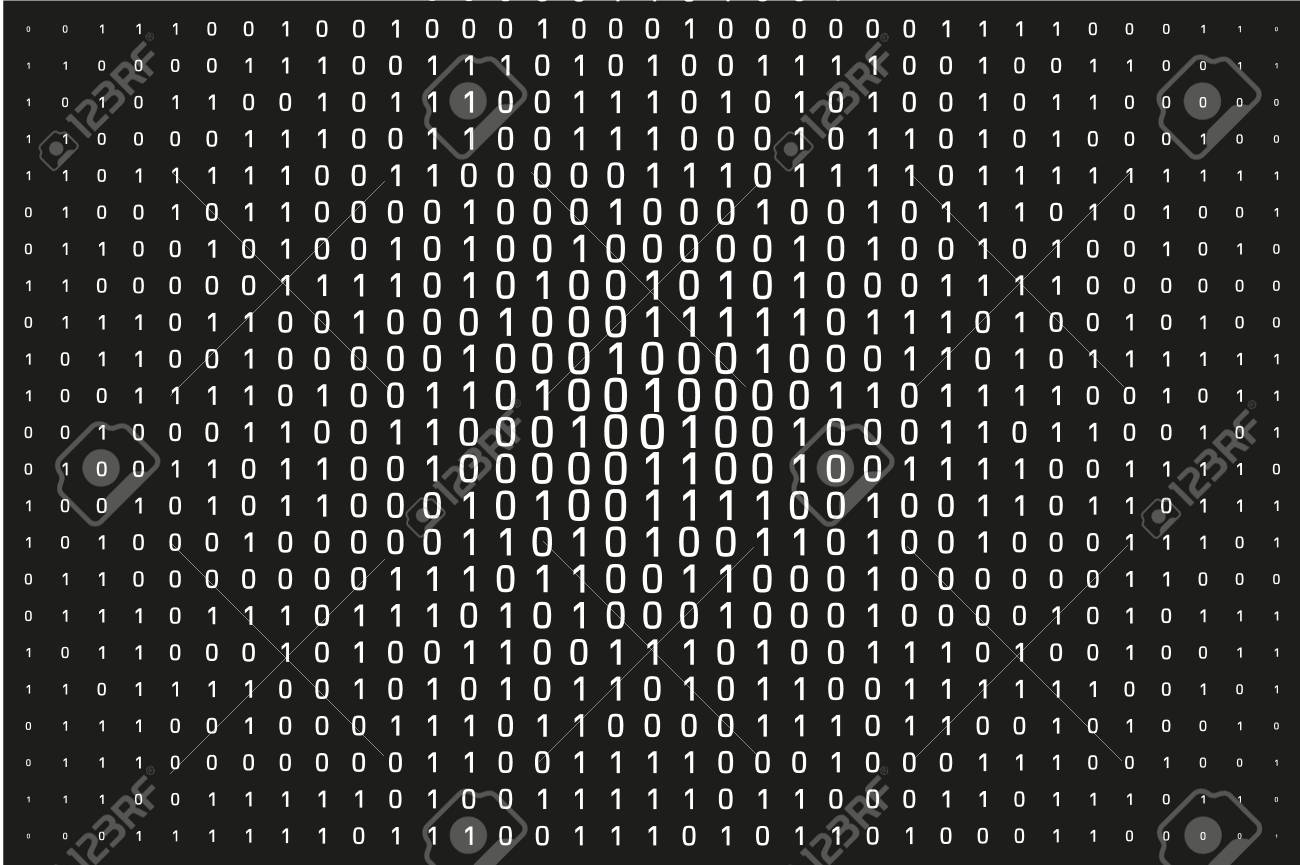
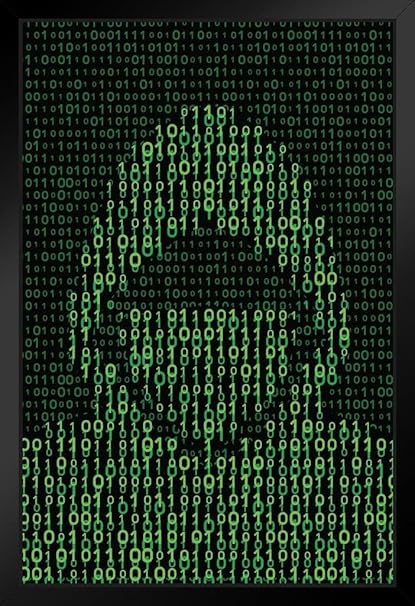
Randomness is defined as the quality or state of lacking a pattern or principle of organization. In that case, you can't tell the 1s from the 0s, so to speak, because they are all mixed-up, like gas molecules. However, mathematical Randomness is also full of Potential for an infinite variety of forms, once some input force has knocked it off-balance. From that point onward, it displays patterns where groups of elements are clustered into recognizable forms.
What we call "Energy" in the real world is the flow of Changes due to the imbalance of 1s & 0s, of Hot & Cold, of excess & deficit. Yet, in "the existence before this one" there was no dynamic Energy, but only a Static, Virtual, Potential & Pent-up Organizing Force --- Nothing happens until an intentional Act releases the Force. And that "pop" is the origin of our crazy mixed-up world. :smile:
Chaos : the formless immaterial substance supposed to have existed before the creation of the enformed universe.
"It turns out that an eerie type of chaos can lurk just behind a facade of order - and yet, deep inside the chaos lurks an even eerier type of order"
-- Douglas Hofstadter
PATTERNLESS RANDOMNESS
PATTERN WITHIN RANDOMNESS
-
QUANTA Article on Claude Shannon
That wasn't my classification, but a definition of "Law" as used in different contexts : Scientific Laws (observed regularities, with no inference of divine regulation), Laws of Nature (religious assertion of divine Lawgiver), and Natural Laws (a legal term, which doesn't take a stand either way on the provenance of the observed order in Nature).:cool:I don't understand this part. Are you making three classifications, scientific laws, laws of nature, and also natural laws. — Metaphysician Undercover
OK, "what is represented by these [so-called] laws"? Would you prefer to call them "accidental random patterns in Nature"? Einstein referred to them as "Reason", "order", "harmony", "structure", and "lawful", among other terms. :smile:But you can see, as I've argued, that I don't believe we're justified in even calling what is represented by these laws as "rules' or "laws" or anything like that. — Metaphysician Undercover
Einstein :
. . . "the Reason that manifests itself in nature"
. . . "Scientific research is based on the idea that everything that takes place is determined by laws of nature, and therefore this holds for the actions of people."
. . . "Veneration for this force beyond anything that we can comprehend is my religion. To that extent I am, in point of fact, religious."
. . . "the marvelous structure of existence"
. . ."I believe in Spinoza's God, Who reveals Himself in the lawful harmony of the world, not in a God Who concerns Himself with the fate and the doings of mankind."
https://todayinsci.com/E/Einstein_Albert/EinsteinAlbert-Nature-Quotations.htm
Again, you may be thinking of "Holism" in the New Age sense. Scientists prefer to use the term "Systems" in order to avoid any theological implications. If you think of Evolution as an ongoing Program of world-creation, then the final output is unknown (undetermined), even though the Programmer specified the parameters by which the Solution will be judged. Initial Conditions & Natural Laws are parameters, but the system uses statistical Randomness to instill novelty into the otherwise deterministic system. My essay on Intelligent Evolution is an attempt to introduce the notion of bottom-up creation of an unfathomably huge Uni-verse (one whole) from a minuscule mathematical Singularity. :nerd:I do not see how you can make bottom-up mechanisms consistent with holism. — Metaphysician Undercover
Freewill Within Determinism : http://bothandblog2.enformationism.info/page67.html
Intelligent Evolution : http://gnomon.enformationism.info/Essays/Intelligent%20Evolution%20Essay_Prego_120106.pdf
Systems Theory :
A system can be more than the sum of its parts if it expresses synergy or emergent behavior. Changing one part of the system usually affects other parts and the whole system, with predictable patterns of behavior. More parts, means more interrelationships, and more complex properties & activities, including mental functions.
https://en.wikipedia.org/wiki/Systems_theory
http://blog-glossary.enformationism.info/page18.html
Holism ; Holon :
Philosophically, a whole system is a collection of parts (holons) that possesses properties not found in the parts. That something extra is an Emergent quality that was latent (unmanifest) in the parts. For example, when atoms of hydrogen & oxygen gases combine in a specific ratio, the molecule has properties of water, such as wetness, that are not found in the gases. A Holon is something that is simultaneously a whole and a part — A system of entangled things that has a function in a hierarchy of systems. In the Enformationism worldview, our space-time physical reality is a holon that is a component of the enfernal G*D-Mind.
http://blog-glossary.enformationism.info/page11.html#Holism -
Panprotopsychism
Yes. But I try to avoid religious or anthro-morphic preconceptions about the Psyche behind creative Causation (Evolution). That's why I prefer to use the more general term "Information" in place of "spirits". "ghosts", "souls", or even "consciousness". The First Cause Enformer necessarily has some characteristics of human consciousness, such as Intention, but from our narrow perspective inside the world-system, It's a metaphysical (immaterial) abstraction unbounded by space-time & natural laws. So, the hypothetical "Creator" may be beyond the reach of our real-world imagination. In that case, all we can do is make metaphorical & mythical allusions. Therefore, I don't know the "parameters of final causality" --- all I know is the spatial & temporal effects of that Cosmic Causation. Anything beyond that is an inference from evidence. :cool:So you think the parameters of final causality which are present while form is given to the world intrinsically arise as a product of mind, in essence psychical? — Enrique
Creation Stories thread : https://thephilosophyforum.com/discussion/comment/484299
The most complete, step by step, explanation of my understanding of Causal Information is in the Enformationism thesis. That exposition uses the Matrix movie, instead of ancient notions of Panpsychism, to illustrate the universal role of information in creating our world, both in Reality (Nature) and in Ideality (worldview). Unfortunately, few forum posters are interested enough to actually read it. So all they know of the thesis is a few isolated comments in specific contexts.What is your information exactly? — Enrique
The word "Information" originally described the meaningful contents of human minds : ideas, thoughts, concepts, feelings. But Shannon divested the term of specific meanings in favor of general utility for technological communication & computing by means of reductive Bits, instead of whole Concepts. Then, more recently, physicists have equated mental Information with causal Energy and physical Matter. So, in general, Information is the power to Enform (to give visual shape or tangible substance or meaningful content to) the things & concepts we know in the real world. It's a Holistic concept that is difficult to grasp for those indoctrinated with modern Reductionism. :nerd:
The mass-energy-information equivalence principle :
https://www.researchgate.net/publication/335673226_The_mass-energy-information_equivalence_principle
Enformationism :
As a scientific paradigm, the thesis of Enformationism is intended to be an update to the obsolete 19th century paradigm of Materialism. Since the recent advent of Quantum Physics, the materiality of reality has been watered down. Now we know that Matter is a form of energy, and that Energy is a form of Information (en-form-action).
As a religious philosophy, the creative power of Enformationism is envisioned as a more realistic version of the antiquated religious notions of Spiritualism. Since our world had a beginning, it's hard to deny the concept of creation. So, an infinite deity is proposed to serve as both the energetic Enformer and the malleable substance (Spinoza) of the enformed world.
http://blog-glossary.enformationism.info/page8.html
Enformationism Thesis : http://enformationism.info/enformationism.info/
The brain is an information processor, and its purpose or function is to extract meaningful information from the environment, and to use it for the interests of the body. From a design perspective, Consciousness is the intended reason for having a centralized brain rather than isolated sensors. From an anti-design worldview, Consciousness is a fortunate accidental product of a random tangle of neurons.What do you mean by saying that the metaphysical mind is the function or purpose of the physical brain? — Enrique
Function : 1. an activity or purpose natural to or intended for a person or thing. -
Creation-Stories
Energy is a general name for Change. And change occurs when a whole is divided into parts, that are then attracted to each other as positive & negative charges. Negative Change (Entropy) is destructive, while positive Change (En-formation) is constructive. In a polarized state, positive & negative are separated, with no in-between. That results in maximum attraction, as in the poles of a magnet. But most things are not completely polarized, so there is a continuum, which gradually shades from positive to negative. Energy "flows" from the hot (excess) pole to the cold (deficit) pole, so that eventually the system becomes balanced as "warm" (unified, complete). For example, a battery has positive & negative poles, but its energy is only Potential or Virtual, until the circuit is completed.I identify an energy as that it has an excess and a deficient. Energy is always in constant motion and is always trying to balance/compete with the other(like your two feet walking), but the question is: Who set the pendulum in motion? What is it that could unify these extremes in all the energies of the universe to create one that is alive and full of dances? A universe in which it is most certainly abound with creative potential? I feel like one of those questions should be unanswered and the other self-evident. What is your take?↪Gnomon — Thinking
In my Enformationism thesis, everything in the world, both physical & metaphysical, is a form of Generic Information. And, as Shannon discovered, Information boils down to 1s & 0s : the ratio (percentage) between Everything and Nothing. Once you grasp the significance of that simple notion, the attractive force between Polarity & Continuity, you have the basis for a Theory of Everything.
"Creative Potential" is what I call Enformy as the opposite of Entropy, and EnFormAction as the creative power to give form to the formless. As to Who or What "set the pendulum -- of construction (Enformy) and destruction (Entropy" -- in motion", Aristotle called it the "Prime Mover" or "First Cause". But a more common term is "Creator" or "God". For theists, the Creator is self-existent, hence eternal. But for atheists, the ongoing Causation is due to self-existent Energy + Laws. However, "a rose by another name would smell as sweet". So, I compromise, and sometimes call the pendulum pusher by the ambiguous label "G*D". That Prime Mover is a combination of Power (energy) and Intention (laws). :smile:
Energy :
Scientists define “energy” as the ability to do work, but don't know what energy consists of. They assume as an unproven axiom that it's an eternal causal force that existed prior to the Big Bang, along with mathematical laws. Energy is a positive or negative relationship between things, and physical Laws are limitations on the push & pull of those forces. So, all they know is what Energy does, which is to transform material objects in various ways. Energy itself is amorphous & immaterial. So if you reduce energy to its essence of information, it seems more akin to mind than matter. Likewise, all we know of G*D is what it does : create. That's why I think of Energy as the “power” aspect of the willpower of G*D, which is guided by the intentional (lawlike) “will” aspect. Together I call them :EnFormAction.
Generic Information :
Information is Generic in the sense of generating all forms from a formless pool of possibility -- the Platonic "Forms".
http://bothandblog2.enformationism.info/page29.html
Both/And Principle :
My coinage for the holistic principle of Complementarity, as illustrated in the Yin/Yang symbol. Opposing or contrasting concepts are always part of a greater whole. Conflicts between parts can be reconciled or harmonized by putting them into the context of a whole system.
http://blog-glossary.enformationism.info/page10.html
Creative Potential :
Enformy, in the sense of positive change; counter-balanced with Entropy as negative change. The +/- values are relative to the original design intent.
Note : Energy is merely Change that can go both ways.
http://bothandblog2.enformationism.info/page76.html
What is EnFormAction? : http://bothandblog2.enformationism.info/page29.html -
QUANTA Article on Claude Shannon
I don't have a problem with that as-if usage of "rules". It's no worse than atheist scientists referring to observed regularities in nature (Laws) as-if they were imposed by a divine authority. When patterns in nature appear to be rule-governed or lawful, I attribute that predictable behavior of natural systems, not to top-down Design, but to bottom-up Programming. Human programs are intentionally teleological, but the final output is unknown until the computation is complete --- or the fat lady sings, whichever comes first. :wink:Don't you see a problem here? If psychologists are referring to "rules' which account for, or cause certain types of behaviour, and there is really no rules there, then what are they actually talking about? — Metaphysician Undercover
Evolutionary Programming :
Special computer algorithms inspired by biological Natural Selection. It is similar to Genetic Programming in that it relies on internal competition between random alternative solutions to weed-out inferior results, and to pass-on superior answers to the next generation of algorithms. By means of such optimizing feedback loops, evolution is able to make progress toward the best possible solution – limited only by local restraints – to the original programmer’s goal or purpose. In Enformationism theory the Prime Programmer is portrayed as a creative deity, who uses bottom-up mechanisms, rather than top-down miracles, to produce a world with both freedom & determinism, order & meaning. https://en.wikipedia.org/wiki/Evolutionary_programming
http://blog-glossary.enformationism.info/page13.html
Natural Laws : Laws of Nature are to be distinguished both from Scientific Laws and from Natural Laws. Neither Natural Laws, as invoked in legal or ethical theories, nor Scientific Laws, which some researchers consider to be scientists’ attempts to state or approximate the Laws of Nature, . . . Some of these implications involve accidental truths, false existentials, the correspondence theory of truth, and the concept of free will. Perhaps the most important implication of each theory is whether the universe is a cosmic coincidence or driven by specific, eternal laws of nature.
https://iep.utm.edu/lawofnat/
My interpretation of evolution as bottom-up design is compatible with human Free Will. :yum:If we dismiss this term "rule", and look at the fact that a human being is a free willing and free thinking human being, then we have a different perspective form which we can ask why is a person inclined to act in such a way as to create the appearance that one is following rules, when really there are no rules being followed. — Metaphysician Undercover
Freewill Within Determinism : “Determinism is a long chain of cause & effect, with no missing links. Freewill is when one of those links is smart enough to absorb a cause and modify it before passing it along. In other words, a self-conscious link is a causal agent---a transformer, not just a dumb transmitter. And each intentional causation changes the course of deterministic history to some small degree.” ___Yehya
http://bothandblog2.enformationism.info/page68.html
Perhaps you are thinking of the New Age interpretation of "Holism". But my usage is that of the guy who literally wrote the book. It's only "mystical" in the sense that Einstein called "spooky action at a distance". :nerd:I have difficulty with the "holistic" approach because in my mind it cannot adequately account for the appearance of intention and free choice. — Metaphysician Undercover
Holism : Regarding the concept of Holism, he says it "has a somewhat mystical association, in its commitment to a single unified whole being the ultimate reality. But there are strong scientific arguments in its favour. . . . The American philosopher Jonathan Schaffer argues that the phenomenon of quantum entanglement is good evidence for holism. Entangled particles behave as a whole, even if they are separated by such large distances that it is impossible for any kind of signal to travel between them."
https://www.philosophybasics.com/branch_holism.html
Neural holism and free will : This approach locates free will in fully integrated behavior in which all of a person's beliefs and desires, implicitly represented in the brain, automatically contribute to an act.
https://www.tandfonline.com/doi/abs/10.1080/09515080307765
Holism and Evolution : although Smuts' meaning differs from the modern concept of holism.[3] Smuts defined holism as the "fundamental factor operative towards the creation of wholes in the universe."
https://en.wikipedia.org/wiki/Holism_and_Evolution
https://reflexus.org/wp-content/uploads/Smut-Holism-and-Evolution.pdf -
Creation-Stories
Sorry to disappoint you. I only refer to Infinite Potential as "no-thing" to indicate that -- as Pure Potential -- it contains nothing Actual --- just as a blueprint is not a physical building, but merely a teleological description of a future structure. However, part of the Ultimate Potential of the whole design-build system is to execute the design, resulting in a real brick & mortar house.↪Gnomon
We don't see eye to eye regarding your concept of infinite potential as pertains to nothing. For me, the infinite potential of nothing would, of its own accord, bring something into existence. There would be no need for "...some kind of Mind" to actualize the potential. What's the point of having infinite potential if it needs something else to get things moving? In fact the infinity in infinite potential is reminiscent of the divine and I expected you to grab that opportunity to introduce god into your theory. It turns out, I was wrong. — TheMadFool
Unfortunately, calling something "Nothing" sounds paradoxical. So, I prefer to use the ancient notion of "Chaos" as an analogy of unlimited Potential. This is not an indication of "chaos" in the conventional sense as "complete disorder and confusion", but of un-formed randomness as raw fodder for en-formation. Hence, I think of Chaos in the Platonic sense of "a pre-existent chaos to generate the ordered universe" Plato typically avoided using the term "god" to label his workmanlike creator (demiurge). Yet, he implied that the Workman was merely carrying out the plans of The Architect. In my myth, they are one and the same. But, If you prefer the workman analogy, I also call it "EnFormAction", which is my term for directed Energy.
Unlike Plato, I see no need for "something else" to cause random Chaos to become orderly Cosmos. Infinite Potential (omnipotence) iherently includes the power to actuate. Another term I use instead of Chaos is "BEING" : the unlimited power to be, and to become. However, although I see evidence of Teleology and Intention in the evolving world, to avoid biblical inferences, I have been forced to likewise remain ambiguous about the nature of my hypothetical deity, which I sometimes label "G*D". Is that close enough for you? :cool:
Chaos :
In ancient Greek creation myths Chaos was the void state preceding the creation of the universe or cosmos. It literally means "emptiness", but can also refer to a random undefined unformed state that was changed into the orderly law-defined enformed Cosmos. In modern Cosmology, Chaos can represent the eternal/infinite state from which the Big Bang created space/time. In that sense of infinite Potential, it is an attribute of G*D, whose power of EnFormAction converts possibilities (Platonic Forms) into actualities (physical things).
http://blog-glossary.enformationism.info/page12.html
Platonic Chaos : In the Timaeus Plato presents an elaborately wrought account of the formation of the universe and an explanation of its impressive order and beauty. The universe, he proposes, is the product of rational, purposive, and beneficent agency. It is the handiwork of a divine Craftsman (“Demiurge,” dêmiourgos, 28a6) who, imitating an unchanging and eternal model, imposes mathematical order on a preexistent chaos to generate the ordered universe (kosmos). The governing explanatory principle of the account is teleological: the universe as a whole as well as its various parts are so arranged as to produce a vast array of good effects. For Plato this arrangement is not fortuitous, but the outcome of the deliberate intent of Intellect (nous), anthropomorphically represented by the figure of the Craftsman who plans and constructs a world that is as excellent as its nature permits it to be.
https://plato.stanford.edu/entries/plato-timaeus/ -
Panprotopsychism
Maybe the unpronounceable polysyllabic term "Panprotopsychism" scared-off some posters. :joke:What core facets does modeling an intersection between the conscious mind and physical body entail? — Enrique
Apparently, you find that intersection in various forms of Causality : in "space" (physical relationships), "time" (sequential relationships), "mathematics" (abstract ratios), "verbs (words, ideas)", "introspection (subjective thought), and "models" (imagination). But, the common denominator of those loosely-related concepts is that all are subjective mental forms, not objective physical things. Which is exactly where I see the intersection between a physical Brain and a meta-physical Mind in my model of causality in the real and ideal worlds. The metaphysical Mind is merely the function (purpose) of the physical Brain.
My Enformationism worldview is built upon the observation that ordinary mental Information --- made popular by Shannon in mathematical form --- is the Universal Substance of world. Another genius had already equated invisible Energy with tangible Matter. And other scientists in the 20th century found that (1) mental Information can be converted into (2) causal Energy, which can be converted into (3) substantial Matter, and vice versa. So, I put 1, 2, and 3 together to conclude that the common denominator of that trio is meta-physical (mental) Information. In other words, Information is everything and everything is a form of Information.
That general notion could be interpreted as Panpsychism, meaning "All is Mind". And "All" is another term for God. But Panpsychism has been erroneously interpreted as "all is consciousness". Yet my thesis limits Consciousness to the recent emergence of Self-conscious beings, and of course to the All, from which all things emerged. But "Pan-proto-psychism" could more accurately interpreted as a primitive or original form of Mind, instead of the intermediate forms that we find in Energy, Matter, and Life. In that case, the "hard problem" of Consciousness can be answered by simply assuming that the Potential for human consciousness was already encoded in the Big Bang Singularity (or Creation Event). But, I hasten to add that I don't imagine the Creator as a humanoid being with a creature's limited and flawed consciousness. I doubt that we could ever "know the mind of G*D". :nerd:
Universal Substance : The most distinctive aspect of Spinoza's system is his substance monism; that is, his claim that one infinite substance—God or Nature—is the only substance that exists.
Information :
Knowledge and the ability to know. Technically, it's the ratio of order to disorder, of positive to negative, of knowledge to ignorance. It's measured in degrees of uncertainty. Those ratios are also called "differences". So Gregory Bateson* defined Information as "the difference that makes a difference". The latter distinction refers to "value" or "meaning". Babbage called his prototype computer a "difference engine". Difference is the cause or agent of Change. In Physics it’s called "Thermodynamics" or "Energy". In Sociology it’s called "Conflict".
http://blog-glossary.enformationism.info/page11.html
The mass-energy-information equivalence principle :
https://www.researchgate.net/publication/335673226_The_mass-energy-information_equivalence_principle
Plato's Forms : The theory of Forms or theory of Ideas is a philosophical theory, concept, or world-view, attributed to Plato, that the physical world is not as real or true as timeless, absolute, unchangeable ideas.
Note -- Capitalized "Form" is eternal, infinite & general Potential for the actual specific Things we know in Reality. Un-capitalized, "form" is the ordinary Actual stuff we know via our senses. "Form" is known only by the sixth sense of Reason. -
Creation-Stories
I'm not sure I understand what you mean by "existential pressure". Your implication seems to be that "infinite existential potential" works like a balloon that inevitably goes "pop" when punctured. But the question arises, who or what does the puncturing? In a physical system, the internal pressure obeys the Pressure Law as defined by Boyle, but -- post pop -- the final arrangement of gas molecules is always random & disorganized. That eventual disorder may also apply to a Quantum Fluctuation in an amorphous mathematical field.I want to explore this idea of nothing as infinite potential a little more. Infinite potential can be taken to exert a "existential pressure" of equivalent magnitude and by "existential pressure" I mean that which makes the possible/potential actual/real. So, nothing as infinite potential exerts infinite "existential pressure" and something, perforce, comes into being - the real/actual pop out of this field of infinitie potential/possibility. Nothing then can't exist for the infinite potential in it exerts an infinite "existential pressure" that makes things (something) come into existence. There, you have your creation story based on nothing as infinite potential. No god though unless, of course, you call the infinite, in infinite potential, god. Nothing as infinite potential as infinite possibilities is reminiscent of omnipotence? — TheMadFool
My notion of Infinite Potential, though, is a meta-physical concept, in that no physical things (such as gases) exist a priori. Instead, it's the transformation of inert Potential (think Plato's Forms) into Actuality, that creates the real things we call "gases". The potential exists timelessly & spacelessly as the idea or design of a possible thing. But the transformation (or EnFormAction) from Ideal to Real requires a causal act, in the form of an intention or decision. For example, in billiards, the 8 ball in a rack has the statistical potential to end-up in any pocket. But, until the shooter aims & acts intentionally, there is no ball in any pocket. The Potential is converted to Probability only after the stack is broken by the cue ball, imparting direction (laws) and momentum (energy) to each ball. That kind of "creation" results in teleological order : an organized goal-directed System.
In that metaphorical analogy, the "existential pressure" of the shooter is his mental Intention or teleological aim, which is the Final Cause of the Creative Act, The future pattern of actual balls in real pockets is a result of the Action of moving the cue-stick guided by Aim So, I don't think the improbable existence of our universe was an accidental release of "existential pressure". Instead, some kind of Intention (plan), by some kind of Mind, was necessary --- not to pop the balloon into random motion, but to Activate the Big Bang into the teleological process, we call Evolution. Randomness merely causes variations on a theme (Ideal Form), from which the "Program" naturally Selects the varieties (real forms) that meet certain criteria of fitness.
Since I know nothing about the hypothetical shooter -- who popped the Big Bang from a static stack of Potential, into a dynamic Organic system -- I don't claim to know the Mind of God. But, since, evolution shows signs of intention (teleology), I call that mysterious World Creator -- not the infinite Potential but the Actualizer -- by the suggestive but ambiguous name "G*D". :cool:
Platonic Forms : The Platonic Forms, according to Plato, are just ideas of things that actually exist. They represent what each individual thing is supposed to be like in order for it to be that specific thing. For example, the Form of human shows qualities one must have in order to be human. It is a depiction of the idea of humanness.
https://owlcation.com/humanities/An-Introduction-to-Platos-Theory-of-Forms
Law of Meta-physics :
Since the mechanical laws of physics don’t explain the emergence of metaphysical Life & Mind & Qualia, we must assume that the program for our evolving world includes algorithms for the immaterial aspects of reality. Exactly what those “laws” might be, remain to be discovered. But, like the regularities of physics they are probably mathematical and proportional in nature.
http://blog-glossary.enformationism.info/page14.html
Aristotelian Final Cause : End or Purpose: a final cause is that for the sake of which a thing is changing. The design intent or goal.
Infinite Potential : In ancient Greek creation myths Chaos was the void state preceding the creation of the universe or cosmos. It literally means "emptiness", but can also refer to a random undefined unformed state that was changed into the orderly law-defined enformed Cosmos. In modern Cosmology, Chaos can represent the eternal/infinite state from which the Big Bang created space/time. In that sense of infinite Potential, it is an attribute of G*D, whose power of EnFormAction converts possibilities (Platonic Forms) into actualities (physical things).
http://blog-glossary.enformationism.info/page12.html
Note -- "Infinite Potential" is another term for Omnipotence. -
Creation-Stories
Yes. In my creation story, BEING is simply No-thing, except infinite Potential. Hence, nothing is Actual . . . until Actualized or Realized or Enformed. So BEING, in Dawkins' simple-to-complex conundrum, is Nothingness. And you can't get much simpler than that. But then, how can we explain how Something came from Nothing? That's easy, if No-thing is Potential.Ergo, the creator needn't be more or even as complex as the universe. — TheMadFool
For example, the Big Bang Singularity ( a hypothetical simple mathematical point with no extension in space or time) somehow "existed" prior to space-time. And it was too tiny to contain a universe of Energy or Matter. That is, unless it contained universal Potential . . . perhaps in the form of immaterial Enformation : the power to enform. :smile:
Aristotle describes potentiality and actuality, or potency and action, as one of several distinctions between things that exist or do not exist. In a sense, a thing that exists potentially does not exist, but the potential does exist.
https://en.wikipedia.org/wiki/Potentiality_and_actuality -
Confirmable and influential Metaphysics
The paper makes a good point : not all "influential" theories are "confirmable". :smile:An article worth reading: Confirmable and influential metaphysics. — Banno
Watkins : "There are two other kinds of existential statement which are unempirical. The first alleges the existence of something un-localised and abstract, e.g. 'There is a law of nature governing these phenomena'. This statement will get verified, or at least strongly confirmed, if a hypothesis happens to be invented from which can be derived numerous precise and successful predictions about the phenomena in question. But it will not be refuted if no one manages to hit upon such a hypothesis".
For example, Quantum Physicists have, to the dismay of Einstein, hypothesized non-local phenomena, that meet the criteria for spooky Metaphysics, but have nevertheless been useful and "influential" in Physics. :nerd:
"Nonlocality suggests that universe is in fact profoundly different from our habitual understanding of it,"
https://www.physicsoftheuniverse.com/topics_quantum_nonlocality.html
So, as the paper suggests, we should not automatically reject all metaphysical theories out-of-hand, just because they are not empirical, but merely inferential. In some cases, they help us make sense of realities that are "outside of human sense perception". Hence, they are "Influential", true or not. :chin:
Metaphysics : referring to an idea, doctrine, or posited reality outside of human sense perception. . . .
. . .Under the skeptical analyses of the philosophical movements known as postmodernism and deconstructionism, all of these facts have resulted in a modern repudiation of both metaphysics and science. Their criticisms are based on the cultural and historical relativity of all knowledge. These two philosophical "schools" deny any existence at all of an objective or universal knowledge. Thus, metaphysical claims stand today between the absolutist claims of science (scientism) and the complete relativism of postmodernism and deconstructionism.
https://www.pbs.org/faithandreason/gengloss/metaph-body.html -
Has science strayed too far into philosophy?
:up:I didn't read the book referred, but judging from the table of contents, it looks like it completely ignores the principal ontological feature of time, and that is the important difference between future and past. When we respect the empirical fact that the past consists of events which have actually already occurred, and the future consists of the possibility for events, it becomes evident that we need a conception of space which is radically different from anything employed by physicists. — Metaphysician Undercover
Absolute and Relational Theories of Space and Motion : Since antiquity, natural philosophers have struggled to comprehend the nature of three tightly interconnected concepts: space, time, and motion.
https://plato.stanford.edu/entries/spacetime-theories/
Note : maybe physicists are not any smarter than ancient Greek philosophers. :joke: -
Does the "hard problem" presuppose dualism?
The "easy" answer to the problem of Life, Consciousness, & Everything is Dualistic, hence too complex to be a final answer, a singular solution. All physical mechanical change requires are least two elements : Energy (causation) and Matter (malleable stuff). But the only answer to the "hard" problem is Monistic.My hunch is that the so-called easy problem of consciousness at a mechanistic level is equally as difficult as the so-called hard problem at the subjective level. They might even be the same problem. — Wheatley
The absolute monistic answer goes all the way back to the beginning of everything. Some call that perfect singular solution "God". But I call it "BEING" : the power to be. All else stems from that indispensable root cause. Hence, the potential for emergence of Life & Consciousness must originate in the First Cause : BEING. You can't prove the existence of the power to exist, except as a Logical Necessity. It's that simple. :smile: -
Creation-Stories
That's why I have concluded that the explanation for the existence of our world, is not just eternal Energy or persistent Matter, or even creation ex nihilo, but the essential power or potential to exist --- which I call "BEING". So, my creation myth begins with Ontology. :smile:That a state of nothingness cannot be forces the existence of a state of absolute existence. — Daniel
BEING :
In my own theorizing there is one universal principle that subsumes all others, including Consciousness : essential Existence. Among those philosophical musings, I refer to the "unit of existence" with the absolute singular term "BEING" as contrasted with the plurality of contingent "beings" and things and properties. By BEING I mean the ultimate “ground of being”, which is simply the power to exist, and the power to create beings.
Note : Real & Ideal are modes of being. BEING, the power to exist, is the source & cause of Reality and Ideality. BEING is eternal, undivided and static, but once divided into Real/Ideal, it becomes our dynamic Reality.
http://blog-glossary.enformationism.info/page10.html -
QUANTA Article on Claude Shannon
Apparently, in your strict vocabulary of technical terms, that might be the case. Since I'm not a professional scientist, I tend to use such jargon more loosely. Besides, in psychology, formal "rules" or "laws" are hard to come by. Most behaviors that psychologists take-for-granted are more like rules-of-thumb than empirically-confirmed-natural-laws. That's why The Diagnostic and Statistical Manual of Mental Disorders has to be regularly updated to weed-out definitions of disorders that turn-out to be too broad or too narrow or just plain wrong. :smile:Isn't a "rule" necessarily formal though? That's the point, to talk about Innate, informal commonalities, as if they are rules, appears like a mistake to me. — Metaphysician Undercover
7 Psychological Rules That Can Make Your Life Shine Brighter :
https://brightside.me/inspiration-psychology/7-psychological-rules-that-can-make-your-life-shine-brighter-533910/
The "language instinct" is a well-known effect, but its cause is a matter of debate. Stephen Pinker says that "A three-year-old toddler is "a grammatical genius"--master of most constructions, obeying adult rules of language." And he attributes those "rules" to a combination of Nature and Nurture. But he provides lots of observational evidence, so the mechanism behind the human talent for language is not exactly unknown. Some may claim it's a miracle, but Pinker thinks it's a Darwinian adaptation. :smile:That might be the case, if we both see this "instinct" as an unknown concerning its true nature, then we have commonality here. — Metaphysician Undercover
The Language Instinct : To Pinker, a Massachusetts Institute of Technology psycholinguist, the explanation for this miracle is that language is an instinct, an evolutionary adaptation that is partly "hard-wired" into the brain and partly learned.
https://www.amazon.com/Language-Instinct-Creates-Perennial-Classics-ebook/dp/B0049B1VOU
All I can say to that is, Pinker is the reigning expert on psycholinguistics, and he thinks he knows why humans act like they have a special talent for language, that other animals don't. But his theory is based on evolutionary assumptions, that some other linguists, and theologians, disagree with. Yet again, the science of Psychology is inherently Philosophical & Meta-Physical, hence not empirical, and will always be subject to debate. But Pinker's explanation is close-enough for me . . . for now. :cool:but we have no approach to the cause of that commonality. If we say that the person is following a rule, we create the illusion that we know why the person is acting in that particular way. — Metaphysician Undercover
Is psychology a “real” science? : Does it really matter?
https://blogs.scientificamerican.com/the-curious-wavefunction/is-psychology-a-e2809creale2809d-science-does-it-really-matter/
PS___Shannon's definition of passive carrier "Information" is on the reductive & empirical end of the Science spectrum. But my definition of active causal "EnFormAction" is more towards the holistic & philosophical end, along with Psychology and History. Does that lack of hard evidence invalidate the hypothesis that Enformation might be the driver of evolution --- including the Language Instinct? Maybe. What do you think?
Information/Enformation :
* Knowledge and the ability to know. Technically, it's the ratio of order to disorder, of positive to negative, of knowledge to ignorance. It's measured in degrees of uncertainty. Those ratios are also called "differences". So Gregory Bateson* defined Information as "the difference that makes a difference". The latter distinction refers to "value" or "meaning". Babbage called his prototype computer a "difference engine". Difference is the cause or agent of Change. In Physics it’s called "Thermodynamics" or "Energy". In Sociology it’s called "Conflict". -
A fun puzzle for the forums: The probability of God
Thanks for finally revealing the missing piece of the puzzle. Your reasoning is exactly why I defined my hypothetical "First Cause", not as an empirical physical "being". but as meta-physical "BEING per se" (the power to be, to exist). In Physics, all causation is attributed to the mysterious force we call "Energy". But, like all causes, we only know Energy by its effects.The flaw was not in any of the possibilities, it was in denying the same possibilities to a non-being as I gave a being. Since the ratio is now equal, this leaves the chance of a Being as a first cause versus a First Cause that is not a being at 50%. Of course this still holds a God is possible, just not as possible as my first conclusion held. — Philosophim
For example, astronomers have tracked a continuous chain of physical events (mostly star creation & destruction) all the way back to a so-called Singularity at the beginning of Time. But where did the Singularity come from? Nobody knows, but we could continue the Cause & Effect sequence (turtles all the way down) back into eternity (Multiverse theory) with no satisfactory end on sight.
Or we could do like those astronomers, and just end the causal train at the furthest point we can calculate (Planck time or Asymptote). And, for convenience, we could call that mythical time-before-time and space-before-space : "the First Cause" or "Ultimate Potential". That's not a thing, or an object, it's merely a Trait of Existence. You can call it "God", if you like, but like the Singularity, it's undefined. We know nothing of its make-up, only its effects : the world we live in. The odds-of-god in that sense are 100%. :smile:
What is energy made of? : Energy is not made of anything, energy is a term used to describe a trait of matter and non-matter fields.
https://physics.stackexchange.com/questions/14444/what-is-energy-made-of
Trait : attribute ; feature ; quality (from French "tract" -- to draw out, to create
Singularity : a point at which a given mathematical object is not defined
Ontological Cause : Ontological arguments are arguments, for the conclusion that God exists, from premises which are supposed to derive from some source other than observation of the world—e.g., from reason alone.
Ontology : the branch of metaphysics dealing with the nature of being. -
Creation-Stories
The OP requested "philosophical" theories, not "fictional" stories. Unlike Physicists, philosophers can indulge in Meta-physical theorizing to illustrate possible scenarios, but not to the point of fantastic narratives. Even such fictional characters as Unicorns are not beyond belief : in the course of evolutionary mutations, a horse could conceivably grow a horn. The absence of evidence is not evidence of absence. Like a Black Swan, it could happen. So, let's not get too crazy here. :joke:So this is a non-scientific, fictional ("create a myth") kind of discussion? Neat if so. — Outlander
Black Swan : The black swan theory or theory of black swan events is a metaphor that describes an event that comes as a surprise, has a major effect, and is often inappropriately rationalised after the fact with the benefit of hindsight

-
Panprotopsychism
Yes. I don't use that particular term in my Enformationism thesis, but it's the same basic idea. The "fundamental entity" of my theory is Generic Information, which I also call EnFormAction. It's based on the revelations of Quantum science that the ultimate "particles" of reality are actually cloud-like Fields of mathematical potential. And that Potential is not a material object, but the information (e.g. DNA) necessary to construct a particle. This is similar to Plato's notion of potential Forms that serve as recipes, or definitions, or blueprints of possible things. Information alone is not "intrinsically conscious", but it has the potential to cause Consciousness to emerge from evolutionary processes. :smile:Panprotopsychism, by contrast, does not require matter to be intrinsically conscious, only that it be comprised of features equaling consciousness when combined. — Enrique
Panprotopsychism : the doctrine that the fundamental entities described in abstract and structural terms by our physical theories possess unknown underlying natures that, while not mental themselves,
https://philarchive.org/archive/WISPPA-4v1
Aristotle describes potentiality and actuality, or potency and action, as one of several distinctions between things that exist or do not exist. In a sense, a thing that exists potentially does not exist, but the potential does exist.
https://en.wikipedia.org/wiki/Potentiality_and_actuality
Yes, I have reached that conclusion regarding the Enformationism thesis. But of course, I prefer my own custom terminology. And there are others out there who are proposing that the "seed" or "essence" or "potential" of Consciousness is a universal quality of the physical universe. I call that cosmic potential EnFormAction : the power to enform -- to create. :nerd:Is this a valid foundation for hypothesizing that panprotopsychism resolves the hard problem of consciousness, — Enrique
Panqualia :
* The author, Dr. Sam Coleman, proposes a different kind of stuff (essence) that is “neither mental nor physical in itself, but which possesses properties capable of generating both the mental and the physical.” The “one fundamental stuff” he's referring to is Consciousness, but for technical purposes I think that the scientific term “Information” fits the description better.
* As Claude Shannon discovered in mid-20th century, Information is not just ideas in human minds, it is also the substance of physical objects; it's both physical and mental. Coleman also offers a novel term to replace Panpsychism : Panqualityism. He admits that name is a merely a placeholder for unspecified “neutral properties” (potentials) that are able to emerge into reality as either physical or metaphysical, depending on the context.
* Yet again, Information already has this monist/dualist BothAnd property, which could explain how metaphysical minds emerge from the functioning of material brains. It might also suggest how a physical universe could emerge from a mathematical Singularity consisting of nothing but the design information for constructing a universe from scratch : a program for creation.
http://www.bothandblog.enformationism.info/page14.html -
Towards Theory/Definitions of Data, Information, Knowledge, and Wisdom
OK. I can see that this thread is way above my pay grade. Sorry for butting-in. :smile:It is just not useful (at least to me) in the realm of delineating and creating all the (mental/cognitive/algorithmic) transforms that go from measured scalar values to the transcendental wisdom achieved bymetacognition. — Sir Philo Sophia -
QUANTA Article on Claude Shannon
I think I'm beginning to see your objection to the notion of "rules" in communication. Apparently you are thinking of imposed "explicit" formal rules, while I'm talking about innate "implicit" informal commonalities. As a rule (i.e. normally) humans are born with something like a mental template for language.I have nothing against "natural logical structure in communication". But we cannot conclude that natural logical structure implies rules, just because artificial, or formal logic consists of rules. In fact, that's what I see as the difference between formal logic, and natural logic, the former consists of rules, the latter does not. — Metaphysician Undercover
My position on inherent human behaviors (instincts) is basically that of cognitive psychologist Stephen Pinker in The Blank Slate. He calls it "the language instinct", which gives humans an advantage, over most animals, in social communication. Anyway, I doubt that our concepts of communication are very far apart. It's just another failure to "first define your terms". :joke:
Rules :
1.one of a set of explicit or understood regulations or principles governing conduct within a particular activity or sphere.
1a : a prescribed guide for conduct or action. b : the laws or regulations prescribed by the founder of a religious order for observance by its members. c : an accepted procedure, custom, or habit.
As a Rule : usually, but not always.
The Blank Slate : arguing that human behavior is substantially shaped by evolutionary psychological adaptations
https://en.wikipedia.org/wiki/The_Blank_Slate
The Language Instinct : Pinker argues that humans are born with an innate capacity for language. . . . . but dissents from Chomsky's skepticism that evolutionary theory can explain the human language instinct.
https://en.wikipedia.org/wiki/The_Language_Instinct
That is not what I was proposing. Sorry for the mis-communication. :smile:Then, very clearly, your proposal that people must agree on rules in order for communication to be possible, is false. — Metaphysician Undercover
OK. I'll try to avoid using the term "rules", since it seems to trigger your indignation. Instead, I'll use something like "norm". The human language instinct is not a "law of nature" or a "man-made rule", but it is common enough to view it as "the rule rather than the exception". :cool:I really do not see how you can portray learning how to talk as a matter of learning rules. — Metaphysician Undercover
Rule : If something is the rule, it is the normal state of affairs.
Language structure : You're born with it
https://www.sciencedaily.com/releases/2014/04/140408122316.htm -
Confirmable and influential Metaphysics
Yes. Most of those theories are meaningful, but non-empirical. That's why I say that Quantum Physics has inadvertently crossed the line into Meta-physics. Yet, by "meta-physics", I don't mean ghosts & gods, but merely those aspects of our world that are not directly accessible to the Scientific Method. That's why there is still some fertile territory for philosophical exploration.Examples given include determinism, historicism, mechanism (the denial of the existence of empty space), its opposite - field theories, vitalism and its denial, various aspects of mind, and conservation doctrines of all sorts. — Banno
Some of the pioneers of Quantum Physics saw its meta-physical implications, and used Eastern Philosophical terminology to express some counter-intuitive concepts. But they eventually lost-out to the hard empiricists, who rebuffed the "errant" theorists with "shut-up and calculate".
I have downloaded the PDF, and may have more to say later. That's because us meta-physical types often get booed off the stage in this forum, just because we go beyond the purview of empirical Physics. Apparently, some posters here have Physics Envy. :grin:
"Physics envy" refers to the envy (perceived or real) of scholars in other disciplines for the mathematical precision of fundamental concepts obtained by physicists. ...
https://en.wikipedia.org/wiki/Physics_envy -
QUANTA Article on Claude Shannon
Since I am not an authority on the subject of Semantics and Syntax, I was referring you to some authorities that do see evidence of commonalities, if not formal "rules", in human communication. If you are really interested in the evidence, you can click on the links. But, it seems that you have something against the idea of natural logical structure in communication. And I'm not quite sure what that objection is. :smile:The appeal to authority is insufficient until you bring out the evidence presented by those authorities. — Metaphysician Undercover
Well, except for some picky-picky philosophers, most people don't have to establish formal rules before they communicate. Instead, most of us learn the rules informally at our mother's knee, and just by growing up in a particular culture, or may even inherit some mental structure biologically. That's what I referred to as "Intuition".I don't see that people agree on rules before communicating with each other. — Metaphysician Undercover
Are you arguing against Chomsky's theory of innate language structure? I generally agree with the notion, but I've never studied the theory in detail. So he may have over-stated his case. But what does that have to do with Shannon's theory of Parsimonious Transmission of Information? :grin:
Born Ready for Language : Chomsky based his theory on the idea that all languages contain similar structures and rules (a universal grammar), and the fact that children everywhere acquire language the same way, and without much effort, seems to indicate that we're born wired with the basics already present in our brains.
https://www.healthline.com/health/childrens-health/chomsky-theory
For and against Chomsky : https://www.prospectmagazine.co.uk/magazine/forandagainstchomsky -
Towards Theory/Definitions of Data, Information, Knowledge, and Wisdom
So, you have your own private definitions. As do I. But I don't reject the common definitions. I just look at Information from a different supplementary perspective, which is more philosophical & metaphysical, than scientific & physical.I do not agree with those dictionary definitions. It, as with the interpretations you proffer, do not account for the logical Distinctions and Transformations, which must occur To get from one cognitive step to the next. In your framework everything is Information So you miss and lose what operations must be performed And what cognitive structures/dynamics/Algorithms are needed To make and use those transformations. — Sir Philo Sophia
"As we know dictionary definitions on this are circular and useless, and current best scientific definitions are not in agreement, are very incomplete and very flawed at best." ___Sir Philo Sophia
But to separate Information from Knowledge seems to miss the original meaning of the term. As I said, in my thesis, Information is much more than just knowledge in a human mind -- it's also Energy & Matter, among other forms. As you quoted, in my view "everything is Information".
So, apparently, you have some particular distinction in mind. Which may be valid. But doesn't necessarily invalidate the other applications of the term. It's possible that your "logical operations" may be over my head, since I have no formal training in philosophical Logic, beyond one basic Mathematics requirement. So, I haven't yet got the gist of your "Scientific Theoretical framework". And maybe it's none of my business, as an amateur philosopher and non-scientist.
However, I am interested in the Philosophy of Information, in general. I've been engaged in a dialog with on the Claude Shannon thread. https://thephilosophyforum.com/discussion/comment/483334 He is also concerned with the missing meaning of Modern Information Theory. While that discussion is partly scientific, it doesn't get into abstruse technical details of philosophical Logic. Nevertheless, if you can dumb it down for me, maybe I can follow the logic of your topic. If not, I'll bow out. :smile:
Gnomon

Start FollowingSend a Message
- Other sites we like
- Social media
- Terms of Service
- Sign In
- Created with PlushForums
- © 2026 The Philosophy Forum