
-
Intelligent design; God, taken seriously
That's a common problem in religious discussions : whose orthodoxy are we talking about? Orthodoxy for Catholics would be different from that of Baptists, which would also be different from Mormons. But ironically, regarding the evolution of the world, Calvinism is similar to the orthodoxy of Materialistic Science . Most scientists assume that the ultimate end of the universe was predestined at the moment of creation (i.e . Big Bang). Hence, the notion of freewill is a fantasy. Others interpret the same evidence to conclude that the final destiny of the universe, and of its individual creatures is open to individual choices.What i'm saying is to some degree "collective soul" doesn't completely (completely) fall outside the "Pail of Orthodoxy". — christian2017
Of course, most non-theologians in the Calvinist tradition don't take predestination literally. It seems too cruel and pointless for a good god to create a world full of hell-bound soulsJust to be fair Calvinism doesn't always imply a cruel vindictive or hateful view of "people enjoying themselves" — christian2017
FWIW, my worldview is not the same as typical New Age collective consciousness cosmologies. :nerd:"collective consceeeence" — christian2017
4 Ways Calvinism Differs From Lutheranism :
https://www.newsmax.com/FastFeatures/christian-theology-calvinism-lutheranism/2016/01/25/id/710818/ -
Intelligent design; God, taken seriously
In my Enformationism worldview, the Laws of Physics are simply initial conditions and logical operators of the program that is running as Reality. The Programmer, or "super turtle" if you prefer, defined specific limitations on infinite possibilities to describe the kind of world S/he wanted to create. For example : another species of universe could be created, in which energy never condenses into matter, and any creatures that emerge are merely clouds or fields of energy.Do you think the laws of physics are necessary or contingent? — 3017amen
Laws of physics are contingent in the sense that they could have been different, if the Programmer wanted to create an alternative kind of world, but are necessary for our own unique universe. Scientists call those necessities "fine-tuning". Once executed into an on-going evolutionary process though, I doubt that the "laws" could change in mid-stream. Of course, our limited knowledge of those universal laws will develop and deepen over time --- perhaps making them seem to vary.
As for the universe being essentially Space-Time, I can see some truth in that notion. Without those fundamental parameters for quantitative and qualitative extension, the Big Bang would have been the "Big Choke", and nothing could happen. :nerd: -
Intelligent design; God, taken seriously
No. I'm a "G*D-wrote-the-program, and-observes-the-on-going-computation" kind of guy. I call my worldview, which includes a hypothetical creator/programmer, Enformationism. But, if you want a conventional philosophical name for this god-model, it's PanEnDeism : all-in-god. Hence, the creation is a part of the creator. Our world is an idea in the MIND of G*D. So, what we now call "Evolution" is actually a creative mental process, that we experience as Reality. Another term for such an abstract god-model is "the god of the philosophers". Look it up. :smile:Are you a "God wound up the clock and walked away kind of guy". I think that is usually called deism or is it theism. I don't feel like looking it up. — christian2017
I'm sure this sounds bizarre to those with conventional religious views. But it's just a theory to explain the role of ubiquitous Information in the world. I was raised as a back-to-the-bible fundamentalist Christian. But, I have since concluded that, while all world religions have correctly intuited the necessity of some kind of creator/sustainer to explain the existence of our world, most of their specific beliefs are based on outdated science, and priestly propaganda. So I have updated both the traditional and scientific worldviews to suit my own needs for philosophical understanding. Those needs do not include worship & prayer though, because my abstract deity should have no need for such human sycophantic servility. :nerd: -
Intelligent design; God, taken seriously
That rule only applies to an actor operating within space-time. It doesn't apply to the creator of space-time. As space-time creatures, we don't know what the rules are for spaceless-timeless existence. But I think the ancient Greeks had the right idea in their myth of Cosmos from Chaos. Chaos was not a real space-time thing, but only infinite Potential : creative power. It was metaphysical, not physical. This is inherently a philosophical hypothesis, not a scientific fact. :smile:Creation is an action and an action happens as a reaction, which in turn occurs because of another action. This means that creation or creating and concepts that can only exist in a time-restricted world. — Leviosa -
Intelligent design; God, taken seriously
Yes. Scientists have postulated a variety of rationales to allow the creation of something from nothing. But all are violations of either the Law of Thermodynamics, or the Law of Logic. And their belief system prejudicially excludes the simplest, most-intuitive explanation, because of the supernatural implications. However, I have concluded that the Big Bang theory is a super-natural explanation. And the only viable alternatives are self-existent mindless Multiverses all-the-way-down, or a self-existent Intelligent Enformer.Some physicists will say for matter to pop into existence there needs to be a positive and negative matter/energy created at the same time — christian2017
That's why I had to invent an unlimited Law-Maker to handle the job. Of course, my Enformer/Creator is merely an enformed hypothesis, not a revelation from on high. And it only serves as an axiom for further development of the Enformationism thesis of Intelligent Evolution. No creeds, no worship required. :smile: -
Intelligent design; God, taken seriously
Voila! Just like magic.I must add that this is something I have not given much thought, but if you were to ask me to, I would go for the sudden popping into existence. — StarsFromMemory
That works for Pragmatic Purposes, but for Philosophical Pursuits it's pretty lame. -
Intelligent design; God, taken seriously
Yes. Since the Big Bang theory indicates that our universe is not eternal, there must be "something" outside of space-time with the power to create new worlds. Materialists simply assume "turtles all the way down" with their Multiverse hypothesis, for which there is no empirical evidence. But, based on the ubiquity of Information --- the "substance" of energy, matter, & mind --- in every aspect of the real world, I assume that the hypothetical Source or Creator must be an Enformer, in the sense of possessing the potential for converting Platonic Forms (ideas, concepts, designs) into real, material, objects. The "energy source" is what I call EnFormAction. I won't go into more detail here, but the notion of Intelligent Evolution (guided by Information and motivated by EnFormAction) has been explored in my blog for several years.Does your theory then consider an eternal Creator existing outside of time (eternity), be one in the same energy source as a self contained universe that has neither beginning nor end, similar to Spinoza's pantheism? — 3017amen
My Enformationism worldview is indeed similar to Spinoza's Pandeism, but has included evidence that he was not aware of in the 17th century : e.g. Big Bang, Information Theory, Quantum Physics. Spinoza's "Universal Substance" is what I call "Enformation" or "EnFormAction". Since he believed the universe was eternal, his Pandeistic God was also eternal. But, now we must postulate something else that is self-existent : either multiplying Multiverses or eternal Enformer. And since this hypothetical World Maker must exist prior to the emergence of space-time in the BB, we can assume that it exists "without beginning or end". :nerd:
Information : Knowledge and the ability to know. Technically, it's the ratio of order to disorder, of positive to negative, of knowledge to ignorance. It's measured in degrees of uncertainty. Those ratios are also called "differences". So Gregory Bateson* defined Information as "the difference that makes a difference". The latter distinction refers to "value" or "meaning". Babbage called his prototype computer a "difference engine". Difference is the cause or agent of Change. In Physics it’s called "Thermodynamics" or "Energy". In Sociology it’s called "Conflict".
http://blog-glossary.enformationism.info/page11.html
The Enformer : AKA, the Creator. The presumed eternal source of all information, as encoded in the Big Bang Sing-ularity. That ability to convert conceptual Forms into actual Things, to transform infinite possibilities into finite actualities, and to create space & time, matter & energy from essentially no-thing is called the power of EnFormAction. Due to our ignorance of anything beyond space-time though, the postulated enforming agent remains undefined. I simply label it "G*D".
http://blog-glossary.enformationism.info/page8.html -
The myth of material wants and needs
In his 1997 book, The Lucifer Principle, Howard Bloom made the same assertion in these terms : "poverty with prestige is better than affluent disgrace". By "prestige", he meant "pride".I would argue that the main driving forces of men and women, at least in 1st world countries are "higher mental" wants rather than pure material wants — IvoryBlackBishop
He went on to say, "we assume that humans desire food, clothing, and shelter, but we forget that people crave something far more vital : status and prestige." He gave several examples, including Revolutionary Iran, and Islamic Terrorists. Although many of their people live in poverty, their motivation for attacking Western Civilization is not primarily economic, but because they blame Europe and US for Islamic decline from the prestige of the Ottoman Empire to the patchwork of backward Arab nations after WWII. Their leaders use that collective shame to inspire acts of self-sacrifice that defy Maslow's Hierarchy of Needs. -
Intelligent design; God, taken seriously
The term "Intelligent Design" is usually taken as a reference to the top-down short-term creation described in Genesis. But based on current scientific knowledge, the universe did indeed emerge abruptly from an unknowable nothingness, and has taken billions of years to reach its current state of development (some estimate halfway to The End). So I have my own hypothesis of "Intelligent Evolution" (via "bottom-up Darwinism), that is based on Information Theory. It attempts to explain how Intelligent creatures have developed from the initial conditions of the Big Bang, which don't seem conducive to Consciousness : Intelligence In -- Intelligence Out.And so, in other words, top-down intellect seems more likely than bottom-up Darwinism. — 3017amen
The linked essay was written over fourteen years ago, and could be much more detailed if re-written today --- but then, it was just a layman's hypothesis (a hunch). BTW, it does assume an abstract axiomatic Creator God, or Enformer, to "design" the process of evolution, but not the final product.
Intelligent Evolution : http://gnomon.enformationism.info/Essays/Intelligent%20Evolution%20Essay_Prego_120106.pdf -
How do you have a science of psychology?
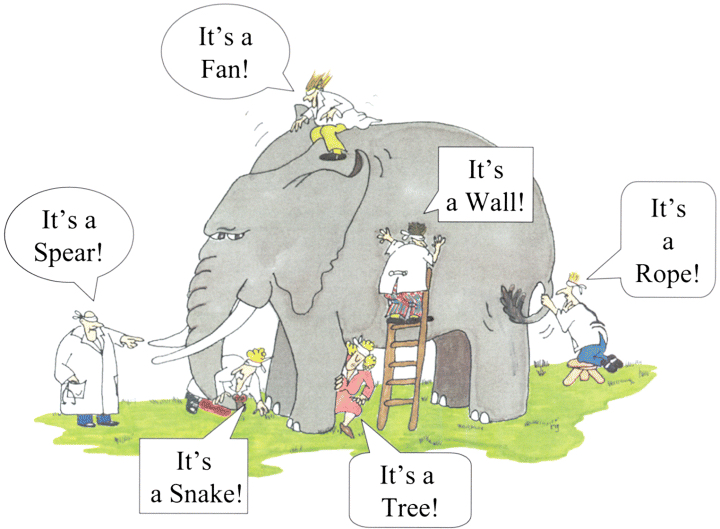
The study of the Psyche was considered to be a branch of philosophy (metaphysics) until the mid-20th century. B. F. Skinner attempted to make a pragmatic science of psychology by observing overt behavior, instead of occult thoughts & feelings. He discovered some practical applications of behavior modification, such as Operant Conditioning (useful in brainwashing). In the 21st century, brain scanning devices have extended the reach of Behaviorism into the physical operations of the brain --- mapping Bio-Chemistry, but not Psycho-Meaning. Since the Psyche is not a physical machine though, Neuro-scientists are still groping around like blind men and the elephant.How does the scientist proceed? — Gregory
Unfortunately, the thoughts & motives behind the personal behavior remain opaque to our pragmatic probing. Today, Information Theory offers some insights to the formal processing of ideas. But the personal experiences of other people will always remain beyond the reach of empirical Science --- unless you accept the propaganda of Psychics. So, I guess that "hard" scientists will continue to proceed with observing physical analogs of Mind, while "soft" philosophers will persist in penetrating the Psyche with their own impenetrable imagination. :nerd:
-
America: Why the lust for domination and power?
I just finished reading Howard Bloom's 1997 book, The Lucifer Principle. He addresses that very question. And the answer is . . . well, you need to read the book. His thesis is that "evil --- which manifests in violence, destructiveness and war --- is woven into our biological fabric". He's talking about Genes (inheritance; testosterone) and Memes (beliefs; ideals). The Genes, for good evolutionary reasons, cause males to become aggressive and competitive as they enter puberty. And Memes, for the benefit of tribes & nations (superorganisms), take advantage of the innate tendency of individual males to challenge "the pecking order", by creating belief systems that glorify war & violence. Thus has it ever been.Will this incessant need for power and domination ever cease? — Wallows
But, in answer to your plaint, Bloom has concluded --- like Steven Pinker, in The Better Angels of Our Nature --- that our species is making slow-but-measurable progress toward controlling our primitive impulses. Yet, he warns that America is on the downside of its brief period of "greatness" that Trump -- emulating Hitler -- wants to return to. And, the blood-thirsty "barbarians" --- i.e. less constrained cultures, such as the Islamic Caliphates --- are at the gate, itching to knock-off the "top dog", the "alpha male", the "cock of the walk", the Roman Empire. So, don't expect the adolescent dominance- testing to end anytime soon. -
Human Nature : Essentialism
Yes. Being is a process. But BEING (the power-to-be) is more like a timeless law or principle. Pragmatic folks take the brute-fact of existence for granted, while theoretical thinkers wonder about "why is there something instead of nothing?"Being, knowing and experiencing are necessarily temporal — Siti
Nobody knows how or why existence is what it is. But philosophers are free to speculate. The only plausible account of the transition from nothing-to-something requires a prior state of Potential, Possibility, or Probability, which is taken for granted by Statisticians (those who study the static state of what's possible-but-not-actual). I simply include that state under the heading of BEING. The creation of something-from-nothing is a necessary assumption, if nothingness is a viable concept. Is it? If not, why do humans keep dredging-up such nonsense?the ideal 'realm' is necessarily timeless and changeless (but gives no plausible account of how on earth time and change might possibly have emerged from changelessness in no time at all)... — Siti
Of course. Experience is a process of knowing what's going on. But the power-to-know is a Principle (a fundamental truth or proposition that serves as the foundation for a system of belief or behavior or for a chain of reasoning). And Principles are assumed to be changeless. So in what sense do Principles exist? Are they like universal Forms with local instances?There can be no experiential reality without time and change — Siti
PS___Our temporal vs timeless assumptions remind me of the differences between Plato's and Aristotle's worldviews *1. Plato postulated a hypothetical unchanging state as the reservoir of eternal Forms. Yet, while Aristotle accepted the notion of Forms, he could not imagine how an inert state of Potential could have any effect on the constantly changing Real World. So, he concluded that the Forms only existed as embodied in real things. And, I agree that the defining pattern of a thing is embodied, but the body is not the pattern.
For example, when I see a furry object wagging it's tail, how do I infer that it's a dog instead of a deer? Although the physical layout is similar, there is an invisible, but unique, pattern of qualities that we associate with dogs-in-general, not with ungulates. Although the physical details differ from one breed to another, we can usually "see" the pattern that connects specific instances (shapes) to the general Form (definition).
*1 Complementary Worldviews : "Plato’s philosophy is abstract and utopian, whereas Aristotle’s is empirical, practical, and commonsensical."
https://www.britannica.com/story/plato-and-aristotle-how-do-they-differ
Taken together, they cover what's Possible (Ideal) and what's Actual (Real). -
Something out of nothing.
Perhaps not "all will be as-if it never was". Most of us can find a bit of solace in the notion that we can live-on in our genes, our children will be our mark on the world. Even if our physical gene-line comes to an end, the memes (memories) that each person has generated may still inhabit the minds of those that survive. Those who have made a more permanent impact on the world, in writings or in deeds, may even "live-on" as historical personages. But that is small comfort for those who can't deal with the idea of non-being. I have no idea where I was before I was born, and no idea where I'll be after death.This is vastly different from saying that we can live a meaningful existential life if there is no extension after death, it says that if we do not exist after physical death then all will be as if it never was (which is certainly not to be feared or even thought about). The logical conclusion is that if on physical death all will be as if it never was, then the rational choice is to live the most positive life that we can with belief in the possibility, no matter how slight, that there is a non-physical life after death which gives meaning to both the First Act and Second Act. To do otherwise is to believe in the myth of the Übermensch. — CommonSense
The "possibility, no matter how slight" sounds like Pascal's Wager. But he was assuming that a heavenly hereafter was promised only to those with blind faith. Yet, many believers make their lives miserable with pathological anxiety about their eternal destiny. And Pascal should have known from experience that mundane Gambling is an act of blind faith that creates far more losers than winners. So why not bet on a sure thing : today? Besides, what is a "non-physical life?" The only life we know anything about is a property of physical beings.
Anyway, if non-being after death is no more scary than non-being before life, then why should we hope in vain for 'the possibility, no matter how slight"? If we can't find our meaning & purpose in this life. why should we expect to find it in another life? Nietzsche didn't proclaim that a person alive today will become a superman tomorrow. He was talking about evolutionary progress of the species. That possibility doesn't give any meaning to my life right now. So why not forget about meaning & purpose being assigned to you from above, or inherited without doing anything meaningful. Instead, write your own story with your actions, and your relations with others. :cool:
" Therefore do not be anxious about tomorrow, for tomorrow will be anxious for itself. Sufficient for the day is its own trouble. "
Matthew 6:33-34
“I don't want to achieve immortality through my work; I want to achieve immortality through not dying. I don't want to live on in the hearts of my countrymen; I want to live on in my apartment.”
Woody Allen -
Something out of nothing.
That is indeed the strategy of most religions : to look for life's meaning in some kind of afterlife, either in spirit-body or in re-incarnation. Because when you're in the middle of your life-story --- it's all Second Act, it doesn't yet make sense. That's why meaning-of-life questions usually refer to the Setup (or backstory) and the Resolution (tying-up loose ends), because we --- the not-yet existent or no-longer-existing actor or protagonist --- are not there to see where-we-came-from, or where-we-are-going.A logical argument for meaning and value in human life can only be built on a non-physical existence. It is far more rational to seek meaning in the possibility of a non-physical life after physical death, no matter how unlikely you may believe it to be, than it is to create a humanistic myth attributing positive qualities to that which is nothing. — CommonSense
Only the omniscient story-teller and the objective audience can know the Prelude and the Denouement. Hence, they can place a single life-story into a larger context. For the Protagonist, the only way to know the whole story is "to create a humanistic myth attributing positive qualities to that which is nothing". Pre-life and Afterlife myths fill a need for closure, that is lacking in the open-ended life-as-lived. But, those religious and cultural myths are obviously [to some] popular fictions, not objective reports from the hereafter. There are common themes --- as in the Hero's Journey thesis --- but the details are relative to specific locations and cultures.
However satisfying the Preface and the Epilogue might be to a complete personal history, the most important part is the development of the Protagonist in the process of navigating the exigencies of life. Ironically, most theories of Afterlife seem to assume a continuation of the Second Act. When psychics relay messages from the dead, their situations and activities seem to be more of the same mundane life-story that they left behind --- only this time in Utopia. So, personally, I don't worry about the nothingness before and after Life. Instead, I focus on writing my own life-story day-to-day, by developing my character as best I can. After all, some famous philosophers have opined that "to philosophize is to learn to die". Thus, we learn to live, by doing what needs to be done, which develops the kind of character that doesn't waste time on worrying about non-existence. :cool:
Hero's Journey : "Campbell describes 17 stages of the monomyth. "
https://en.wikipedia.org/wiki/Hero%27s_journey
Learning how to die : Michel de Montaigne begins his essay “That to Philosophize Is to Learn How to Die” by quoting the same idea from Cicero:
https://sententiaeantiquae.com/2015/09/19/2343/
http://essays.quotidiana.org/montaigne/that_to_study_philosophy/ -
Human Nature : Essentialism
The term "occasions of experience" sounds to me like quanta of incoming information. But my personal experience of the world is continuous and constantly changing, while flocks of photons fly into my eyes, and phonons into my ears, and phonemes in my brain.its either all or nothing (although sometimes - often - I might not be acutely aware of seeing it) - it is in that sense that "occasions of experience" are "atomic" - they are not themselves divisible...but they might be nested or overlapping and at our level of experience they almost invariably (if not absolutely always) are. — Siti
As you say, " Each moment of a human life is an impossibly tangled web of overlapping, nested and intertwined events - and yet, because of the organismic unity of the human individual, each moment becomes an indivisible occasion in its own right." But, even though a TV screen is a field of pixels, I am not normally aware of those "atoms of experience" myself. So, what makes them atomic? Is an energetic photon a physical quantum of experience? If so, it must be an on/off code that the brain interprets as something or nothing to be aware of. Has anyone hacked the brain system to decode the photon pattern that I experience as red? How does 450 THZ of light become red in the mind? Is it a continuous process, or a sudden transformation?
In my Enformationism thesis I don't worry about such details, because the transformation process is assumed to be continuous from Big Bang to my experience of a red rose. Each "step" is a phase change, but some phases are purely physical (energy to matter), while some "high level" transitions are metaphysical (mental).
I suppose that of my lack of "prehension" is due to my experience that the Whitehead process seems to be mostly quantitative, while my experience is qualitative. Since I take "Information" (EnFormAction) to be both quanta & qualia --- Energy > Matter > Mind --- there are no gaps in the process from photon to visual chemistry to mental experience. This may be what you mean by "a sequence of physical/mental processes that combined becomes the experience".I have no idea whether this is helping or hindering your prehension of the idea — Siti
In my thesis, the current one-way "sequence" of evolutionary enformation began in the BB and will end in the Big Sigh. But the Source and Origin of the power to be, to know, and to experience, presumably exists eternally in some never-never-land that we have no access to, since our ability to experience is limited by the boundaries of space & time. :smile: -
Human Nature : Essentialism
Ouch! A hard-cover of Unsnarling the World Knot is listed for $894.90 on Amazon. It's as way-over my budget as Whitehead's "reality" is way-over my head. :smile:David Ray Griffin's book — Siti
Several years ago I tried to read Whitehead's Process and Reality, because it seemed to be aimed in the same direction as my own thesis. But his arcane, abstruse, and abstract terminology was way over my head. Hartshorne was a little better, but I still got lost in the labyrinth, with few landmarks to guide me. Their reference to such entities as "occasions of experience" didn't ring any bells for me. I couldn't fit them into any real-world system that was amenable with my intuitive understanding of the world.but the essential idea is that the actual entities composing reality are "occasions of experience" (a la Whitehead)...little "droplets" (perhaps) of experiential reality — Siti
Can you give a real-world example of one of those "little droplets of experience"? What are they made of? If they consist of "experience", whose experience? How would these entities fit into a well-known system such as Information Theory or Quantum Theory? How do they "add-up" to human awareness and feelings? How do they relate to Physics and Metaphysics? In my own thesis, I equate the hierarchy of information transitions --- from energy exchanges to idea communication --- to physical phase changes on a rising scale of complexity and power, eventually forming what I call Metaphysics (mental phenomena).
The notion of "actual entities" seems to imply that there are "potential or virtual entities" to be distinguished from. Are these fundamental elements self-existent, or did they emerge from an even more basic system? How do they relate to space & time? How do they relate to the Big Bang? Are they equivalent to a mathematician's purely abstract "dimensionless point" in empty space. or like a Klein bottle in hyper-space? Rather than numerical abstractions, I need something Qualitative that I can relate to.
In my Enformationism thesis, human ideas and feelings are essentially composites of lower forms of Enformation, such as Energy, but they are also holistic, so the whole is more than the sum of the parts. Are Whitehead's "experiences" like Democritus' atomic theory, unitary physical objects that simply aggregate like sand into sand hills? Or are they like water droplets that integrate into the ocean? Information is like memes that leap from the mind of one organism (person) into many other minds, thereby constituting a super-organism (tribe or nation).The upshot of all this is that the kind of experience we think of as human experience is really no more than a rather complex, (self-)organized composite of the kind of "experience" that simpler aggregates (such as atoms, molecules, cells...etc.) "enjoy". — Siti
I still don't see how "bipolar panexperiential physicalism" relates to what-it's-like (the experience) to be a conscious being. Sounds like it assumes that physics is inherently conscious, as in Panpsychism, but in much less straightforward language. Hence, one could also assume, without empirical evidence, that the universe as a whole is a thinking, feeling, conscious being. If so, can we "enjoy" an exchange of personal experiences (communicate) with the World Mind? Or must we take his/her/its existence on faith? :cool: -
Does the in-between disprove the extremes
That depends on your attitude and viewpoint. Philosophers and Scientists tend to analyze the world into finer & finer distinctions. But that kind of arcane rationalizing is confusing to the average person, who can't deal with such complexity. So, the typical man-on-the-street-viewpoint is more direct, simplistic, and obvious. This results in what psychologists and sociologist call "binary thinking" --- what I call "Either/Or" thinking. In Western societies, the primitive science and binary thinking of ancient tribal law-makers has codified Either/Or opinions into dogma. For adherents to doctrinal religion ---even in modern multi-cultural contexts --- the technicalities of continua have no bearing on their moral judgments. You can argue about the broad range of racial or gender types all you want, but your reasoning will have no force against faith. You're either an "innie" or an "outie". :nerd:So when it comes to question of race and sexual identity, it is easy to say "look at the continuum in between the 'races' and between the 'sexes'". Is this a valid argument though? — Gregory
Binary Genders : The term gender binary describes the system in which a society allocates its members into one of two sets of gender roles, gender identities, and attributes based on the type of genitalia
https://en.wikipedia.org/wiki/Gender_binary -
Human Nature : Essentialism
Please give me a brief synopsis of how "the bipolar panexperiential physicalism" softens the hard problem of Metaphysical Consciousness in a Physical Body. That might help to adjust the aim of our dialog, where we keep missing points. :smile:The "hard problem" vanishes with the bipolar panexperiential physicalism that I have suggested — Siti -
Human Nature : Essentialism
What I enjoy about our dialogs is that we can disagree without being disagreeable. Of course, part of the reason for our mutual broad-mindedness is that neither of us is defending a dogma, or fighting for a faith. Our philosophical views tend to be more pragmatic than dogmatic. And our beliefs are open to reinterpretation.If you were to stop there, we would be in almost complete agreement...and we would both be saying: — Siti
But what I especially like about dialoging with you, is that you ask good questions. You make me see my ideas in a new light, and force me to justify some of my assumptions. I just this morning was reading a Sherlock Holmes story, The Valley of Fear --- The Tragedy of Birlstone. Ironically, it involves a gun-slinging American in England. When the evidence seems like a tangle of contradictions, Watson asks a question that puts Sherlock on the spot. " There is an appealing directness about your questions", Watson, said Holmes, shaking his pipe at me. "They come at me like bullets." I enjoy dodging your bullets, in the Gunfight at Philosophy Forum*. :cool:
* Obscure reference to the old western movie : Gunfight at OK Corral.
PS___Although I think my personal worldview is close to the truth, I must remain somewhat humble, because I could be deceiving myself with self-justifying logic. Paraphrasing Borges, in A Refutation of Time : the Enformationism thesis might be “the reductio ad absurdum of a preterite [outdated] system or, what is worse, the feeble artifice of an [American] lost in the maze of metaphysics”. :joke: -
Human Nature : Essentialism
Yes, the Enformationism thesis does give primacy to the “mental” aspects of the world : consciousness, qualia, etc. To non-scientists, including philosophers, these are the most important “realities” in the world. So, even if it doesn't flip the Materialism paradigm on its head, like Wilberg's Qualia Revolution, it will necessitate a paradigm shift. But, unlike some proponents of Panpsychism, it doesn't attempt to over-ride Physics with Psychics. Any proposed psychic powers will have to show practical results, instead of requiring faith.The problem is that you then go a step further and place God's "primordial nature" beyond reality, you take the "mental" aspect of reality and insist that it must preempt (logically if not temporally) any and all "physical" aspects of reality. — Siti
A major philosophical problem here is how you define "reality" : either "all-that-is" or "all-that-could-possibly-be". Scientists, for good reason, limit their scope of Reality to the here-and-now --- but make some small allowance for imagining the past & future. Philosophers, for their own reasons, leave their definition of Reality open to all possible times & places : Ontology. So, as a trained professional scientist, your definition is understandable. But, as an amateur philosopher, I am not so constrained. For an Inorganic Chemist, matter is the primary reality, and the mind of the observer is immaterial. But for Quantum Physicists, the material foundations of classical physics have been undermined by the squishy mind/matter nature of the sub-micro-scale foundation of reality.
The "primordial nature" of G*D is, like the existence of a Multiverse, only a hypothesis, since there is no way to directly experience that state before space-time. But both go beyond the physical limits of space-time to mentally imagine an as-if "time before time". For me, it was a logical progression from the Big Bang theory and Quantum Theory. So, the super-natural aspect of G*D was inferred, not from religious myths, but from scientific "facts". Many threads of science are now constructing a picture of ultimate Reality that is actually what I call Ideality. My blog has several examples. In that case, G*D exists, not outside of Nature, but everywhere in Nature. It's just that G*D-nature is more inclusive than Man-nature.
One way to rationalize an extra-real deity is to run the program of evolution in reverse. Astronomers traced the motion of galaxies back to a single point-of-origin of space. As I mentioned before, that hypothesis entails that the Singularity was not a physical container for all the matter in the world. Instead, it could be be something like a capacitor for Cosmic quantities of Energy. But then, for Chemists, Energy is nothing but a Property of Matter. So, if there was no matter in the Singularity, where would the Energy come from? Some imagine a Quantum Field full (?) of Zero-point Energy : i.e. infinite Potential. In place of that mystical notion, I imagine the infinite Potential of EnFormAction, which is both the power to enform (create novelty), and the raw material to sculpt into real things. In that view, Matter is merely a temporary phase of Energy, and Energy is merely a temporary phase of BEING, the power to exist (i.e. G*D). That latter default state of Ultimate Reality is normally outside the purview of empirical Science, but not of theoretical philosophers and theologians.
So, unlike New Ageism and Panpsychism worldviews, mine does not require scientists to “pre-empt” the physical aspects of reality with Orgone energies, or Akashic fields, or Prana Chakras. On the other hand, non-physical scientists --- psychologists, sociologists, etc --- might benefit from taking into account some non-physical aspects of reality, such as Memes, Fuzzy Logic, and Self Image, not to mention Sociobiology, and Superorganisms/Global Minds. :nerd: -
Human Nature : Essentialism
The reality of virtual particles is subject to debate among scientists, but my position is that "virtue" is a Quality, not a Quantity. A virtual particle has no physical dimensions and no mass, only potential. Hence, in my vocabulary, it's Ideal, not Real. A photon, which is supposed to be real, is massless, hence no stuff, only potential (energy).OK - virtual particles are NOT particles that are virtually real, — Siti
Massless particles : "A virtual particle does not have measurable mass."
https://www.quora.com/Do-virtual-particles-have-mass
That statement sounds to me like a reference to Plato's Forms. For every Thing, in this case an atom, there is a Form : "the universe's idea of [fill in the blank]". The notion of "disembodied ideas" floating around unconnected to anything, is foreign to me. You seem to interpret my notion of Ideality as a separate place in space. But Ideality and Reality are merely different aspects of the same singular Ultimate Reality, which I call G*D. G*D is not "out there", but everywhere.My point is not that ideas must be made of atoms, but that an atom cannot be separated from the "idea" of an atom - not my "idea" of an atom, not even a scientific consensus "idea" of an atom but the universe's "idea" of an atom. — Siti
I have no way of knowing empirically whether Physics or Metaphysics is more fundamental. But based on my understanding of how Information works in the world, Physics must be an emergent property (qualia) of G*D, who is assumed to be omnipotential. The Big Bang began from nothing physical, only potential : a dimensionless Singularity couldn't possibly contain a whole universe of 3D physical stuff. So, I assume all that stuff was stuffed into the Singularity in the form of dimensionless Information, like a computer code : the idea of the ultimate product. Since generic Information, EnFormAction, is equivalent to Energy, it can cause Matter to emerge even though the Energy per se is immaterial [ref massless photons]. As a rule, scientists tend to regard Energy as a property of matter, but a massless photon lacks the essential property of matter. So, which came first, which is fundamental : the power or the product?Is the metaphysical aspect fundamental or is it co-emergent with the unfolding reality? That's the question. — Siti
Can you swallow a primordial, creative, pre-Big Bang, super-local-natural Multiverse as a real thing? If our local temporary universe is what we call Nature, then a non-local eternal Multiverse must be by definition Super-Natural. If you can imagine G*D dreaming multiple universes, that would be a crude notion of my Ultimate Reality.what I can't swallow is ideas, ideals and universals as primordial, creative, pre-cosmic supernaturalistic 'reality'. — Siti
Argument Against Reality : "quantum physicists have to grapple with the mystery of how there can be anything but a first-person reality."
https://www.quantamagazine.org/the-evolutionary-argument-against-reality-20160421/
Ontology : If G*D is the known universe, then it must be Natural and Temporal, limited by the laws and conditions of physical Reality. If G*D is the postulated (imaginary) Multiverse, then it must be Super-Natural and Eternal, existing beyond the boundaries of the reality we experience. If the potential for imagination was always inherent in the physical processes of universe creation, then it must be superior in some sense to the collective imagination of a minor world in its ocean of bubble worlds.And I would say that even "God" was not supernaturally imaginative and creative...that, in a nutshell, is where we differ. — Siti
PS___To an impartial observer of this dialogue, we may seem to be arguing about how many angels can dance on the head of a pin. :grin: -
Human Nature : Essentialism
Do you have any "un-real-ized potentialities" in your mind? If so, they exist only as ideas until you actualize them. Is there a place in your reality for such ideas about future possibilities? Are ideas in a human mind in a physical world real in any sense? Just because Qualia and Ideas are not reducible to Atoms & Void, are they "unconnected to reality"? (rhetorical question)But your thesis and Wilberg's argument both require that such qualia, such colours, necessarily exist - just waiting for the opportunity to be actualized...they are (presumably) un-real-ized potentialities...
That is the "unconnected to reality" bit that I am finding difficulty swallowing. — Siti
Does your worldview have a role for Metaphysics? When we include "Virtual" particles in this expanded Reality, are we guilty of trying to "redefine 'reality' to include things that are patently not real". Far from denying Classical Reality, I am merely expanding the scope of Reality to include Ideas and Qualia, as in the invisible Quantum realm of Reality. I agree with Wilberg and many others that Materialist Science left Qualia behind in its quest for more & more Quanta. I just don't think Qualia give humans the creative powers of gods. They just allow us to be aware of colors that are not in the material stuff out there, but like Beauty, in the mundane subjective mind of the perceiver.
My Ideality merely acknowledges that Ideas and Qualia are non-physical, or not-yet-physical (i.e. metaphysical). They are what Einstein was talking about when he said "Imagination is more important than knowledge. Knowledge is limited. Imagination encircles the world." By "Knowledge", I assume he meant Facts about real actual things. By "Imagination" I assume he was referring to Ideas about currently un-realized possibilities. When I refer to G*D's "knowledge of potentiality, it's no more mysterious than Einstein's imagination, except that G*D's possibilities are backed-up by infinite power to actualize (EnFormAction). Albert had only a fraction of that creativity. Can you swallow Imaginary possibilities (ideas, ideals, universals) as an aspect of Cosmic Reality?
I can agree that G*D is "gnosis" in that sense, but Wilberg and I part ways when he claims that ordinary humans are capable of god-like Gnosis. We may be more gnostic than animals, but IMHO, even Einstein was not supernaturally imaginative and creative..What we call God is 'gnosis' --- a knowing awareness of potentiality that is the source of knowable actualities.” — Gnomon -
Human Nature : Essentialism
That synopsis sounds like a summation of the Enformationism worldview. Even what I call Ideality is not an "unconnected reality". It's merely a phase of reality that consists only of ideas (principles & potential, as in mathematical ratios & probability). Plato called it the "realm of Forms". And no need to “abandon physicalism” as the foundation for physical Science. It's only metaphysical philosophical Science that needs a different vocabulary. Mind/Body dualism is merely different expressions of the same fundamental substance : information. We're very close, but you still seem to see something “unconnected to reality” in my worldview.That's what I'm driving at - it is (all) an organic, ecological, holistic process - there are no unconnected realities - there is no mind/body dualism - mind and body are simply - or rather very organically, holistically and complicatedly but nevertheless quite naturally - two aspects of the one reality. — Siti
EMPIRICAL vs MYSTICAL SCIENCE
I've been moving over the last week, and discovered a book I bought several years ago, then never read, because it slipped behind other stuff on the bookshelf. I've only read a few chapters, but I get the impression that it espouses a worldview that you would find similar to the Qualia half of my own BothAnd philosophy. It's entitled The Qualia Revolution, From Quantum Physics to Cosmic Qualia Science, by British philosopher Peter Wilberg. He seems to use the term “qualia” in a sense similar to my own use of “information”. The new revolution he speaks of is what he perceives as a paradigm shift which is turning back the clock on Modern Science --- based on empirical evidence and rational analysis –- toward what I would call a pre-scientific "religious" or "mystical" worldview. He quotes Martin Heidegger, calling Modern Science "the new religion. For in essence it is a gigantic socially-constructed myth". Moreover, he says of the "First Scientific Revolution" : "The myth was a revolution in the most literal sense, for it turned our whole understanding of reality [pre-enlightenment] upside down or on its head. It does so by taking scientific representations of reality -- mathematical symbols and scientific models -- as more real than the consciously experienced phenomena they are used to explain" [my bold]. I too, see an emerging emphasis on Qualia and Metaphysics among scientists, but in addition, not to the exclusion, of Quanta and Physics.
.
Wilberg's critique is interesting to me primarily because it is diametrically opposed to my own views. He discusses many of the same topics that I address in my blog essays and forum posts --- consciousness, awareness, fields, etc. --- but his vocabulary is foreign to me, partly because he speaks in terms of Phenomenology (subjective sensations) instead of Ontology (objective things). For example, he says, “Cosmic qualia science has its roots in the field-phenomenology of Michael Kosok. Field-phenomenology is distinguished by its recognition that subjectivity or awareness is not a property of a localized subject or 'ego', but has a non-local or field character.” This sounds like Panpsychism, but the term is not in his index. My own version of Panpsychism says that the universal “field” is composed of EnFormAction (energy; power to enform) not Consciousness (awareness).
He also has a notion of God that might sound similar to mine. “Cosmic qualia science is the only framework of scientific thought in which God not only might but must have a place. Qualia theosophy allows us to recognise that God does indeed not exist as any actual being or entity that we can be aware of, but is no less real for that --- being the primordial field of potentiality that is the power behind all actualities. Potentialities, by their very nature, have reality only in awareness. What we call God is 'gnosis' --- a knowing awareness of potentiality that is the source of knowable actualities.” He goes on to assert that “what we call 'energy' is nothing but the 'formative activity' by which this knowing awareness of potentiality is constantly actualized in the form of sensual qualities and perceptual patterns of awareness.”
My problem with these assertions is that they assume humans have two ways of knowing : 1> perception via physical senses, and 2> gnosis via extra-sensory perception. The latter is sometimes called “Intuition” (the ability to understand something immediately, without the need for conscious reasoning), but that term is not in his index, so I'm not exactly sure what he means by "gnosis". Likewise, the index includes “Feelings”, but not “Reason”, so you can begin to see where he is coming from by noting omissions. His “field of pure awareness” seems to be accessible only by emotional subjective “feelings”, and not to rational objective “logic”. Since I am not an “emotional person” (no mood swings), I am sometimes accused of being too rational (Vulcan Logic). So, it's possible that I am blind to half the knowledge (the gnosis part) of the whole world. Which would prejudice me against the invisible and intangible aspects of the world (magic & mysticism) that are so important to many others. Am I missing something here, or are they reifying metaphors, and blinded by the smoke & mirrors of deceivers? Are they “unconnected to reality” or am I?
Phenomenology is the study of structures of consciousness as experienced from the first-person point of view. The central structure of an experience is its intentionality, its being directed toward something, as it is an experience of or about some object.
https://plato.stanford.edu/entries/phenomenology/ -
Human Nature : Essentialism
Ha! The target is full of holes in all the wrong places. But, if we continue this machine-gun dialogue, the pattern of holes might just get closer to the bullseye. :smile:I think you are missing the point again — Siti
That's the main difference between the Materialism worldview and the Enformationism worldview. In materialism, some important events "just happen" randomly, so any meaningful pattern of activity is astronomically unlikely (a miracle). In a world where Information is fundamental, nothing noticeable happens randomly. Any happening has a prior cause. And the unbroken chain of cause & effect (en-formation) in the space-time world has an origin : the First Cause. But, if so, we can always ask "what caused that cause". Some dubious answers are "a quantum fluctuation in eternal space-time", or a "collision between miniverses in eternal space-time". However, if we assume, as the Big Bang theorists did, that space-time itself emerged from the Singularity, that would entail a pre-existing infinite Hyper-Space with antecedents back into eternity, and "dimensions" invisible to the human mind. Yet, as the early Cosmologists realized, that assumption still sounded too much like the old Creation theories : where the deity "just happened" to exist forever for no apparent reason.The universe does not have to imagine an electron BEFORE it produces one...it just happens - the idea and the reality just pop into existence together at the same time. — Siti
I don't remember seeing that term before. And a quick Google search wasn't much help. But the idea seems to be related to Whitehead's "panexperiential" proposal, and to other attempts to explain Consciousness as a physical process. But I long-ago gave up on mechanistic processes as a dead-end, and turned to humanistic processes for an explanation of Consciousness. This flip was not motivated by religious impulses, but by the emerging notion among scientists that a "turning point" was near, and that a "paradigm shift" was necessary. The shift is from Reductionism to Holism, and from Mechanism to Organism. A holistic worldview can re-unite the Physics and Meta-Physics of Aristotle into a new paradigm. The atomistic & materialistic "physics" of ancient Greece is mostly obsolete, while the mental "metaphysics" is still debated by philosophers, yet has become the foundation of Psychology, Sociology, and History.The "hard problem" vanishes with the bipolar panexperiential physicalism that I have suggested — Siti
Turning Point : "The new concepts in physics have brought about a profound change in our world view; from the mechanistic conception of Descartes and Newton to a holistic and ecological view, a view which I have found to be similar to the views of mystics of all ages and traditions. . . . What we need, then, is a new 'paradigm' - a new vision of reality; a fundamental change in our thoughts, perceptions, and values "
https://en.wikiquote.org/wiki/Fritjof_Capra
But it's a reasonable assumption, in light of Einstein's merging of space & time into a single concept. Both extension-in-space, and extension-in-time are human mental constructs. Time is imagined as a "space" for Change, but what is it really? Donald Hoffman, in The Case Against Reality, said regarding Model Dependent Reality : " there is an objective reality. But that reality is utterly unlike our perceptions of objects in space and time.”Non-local does not either imply or entail non-temporal and that is not what we "find" in Quantum Theory — Siti -
Human Nature : Essentialism
I would agree except for your insistence on the primacy of the material world. To me, and many others, Matter is secondary to Mind. This flips the worldview of Materialism, to one where Qualia, Consciousness, and Mind are primary. But, despite similarities, it's not the same as Spiritualism. That's why I coined a new term : Enformationism.Now who's missing the point? Just because it itself is not a piece of matter doesn't mean it is does not belong to the material world. — Siti
Here's the dimensionless mathematical "point" where we disagree. You seem to assume the world is a substance monism : all matter all the way down. But Aristotle postulated two components of his single "substance" : Hylos (matter) and Morphos (form). Form is the idea, concept, structure, or design of a material thing, which is logically prior to the embodiment of the idea in matter. Where you think Mind is just a property of matter, I see Matter as a form of Mind/Energy (E=MC^2) : E = Information -- the power to enform. And lots of physicists are coming to that same conclusion (e.g. Paul Davies).
Mind you, we are not disagreeing with the concept of "no matter, no mind", in the space-time world. Instead, we are assuming, like Plato that there is a non-local, non-temporal realm, such as we find in Quantum Theory. That's not a supernatural heaven out-there in the great beyond, but right-here-right-now, everywhere, everywhen. I probably confuse you with my metaphorical references to the traditional notions of Eternity & Infinity. If "non-local" is meaningful to you, we can use that word.
So, I make a crucial distinction between the material (actual) world, and the mental (potential) world. Where in the world is the human mind --- in the brain, where in the brain? I acknowledge that Mind is a function of brain processing, yet it is not a material object, but a holistic quality. Until Quantum Physics upset the apple-cart, physics could ignore the mind of the observer, and had no variable for that non-stuff in its equations. I was surprised that many posters on a philosophy forum are still confused about the "hard problem" : the Subjective aspect of an Objective world.
Descartes attempted to set-aside the mysteries of the mind to make way for empirical Science, when he proposed a substance dualism : res extensa (material stuff with three dimensions) & res cogitans (meaningful stuff). But now Stuart Kaufman --- theoretical biologist, and complex systems researcher, and professor of bio-chemistry --- has updated that dichotomy with what he calls "res potentia", which includes both mental phenomena and such quantum features as observer dependence & non-locality. Classical Physics assumed that non-local cannot be causal, but Quantum queerness says otherwise. Res Potentia is the realm of Virtual Particles and Quantum Tunneling, and Entanglement. It was proposed by A, N. Whitehead, among others, to explain the reality of Consciousness as an agent in the world.
Res Potentia : https://www.npr.org/sections/13.7/2010/08/17/129250892/res-extensa-res-potentia-and-the-poised-realm
PS__My upside-down worldview wouldn't sound so crazy, if you would read the thesis, which begins at the beginning, instead of the middle, like these posts.
http://enformationism.info/enformationism.info/
But energy is even harder to pin down than semi-solid matter. By definition, energy is inherently mercurial, unstable and transitory. Technically, a quantum of energy is not a physical object, but an "action potential"[10]. If "potential" sounds suspiciously like "probability", that's probably because both refer to future events, not to right-here-right-now, put-your-finger-on-it matter. So both matter and energy in the current paradigm of science have proven to be as fantastic as fairies. -
Human Nature : Essentialism
Drat! My nefarious scheme to pull the wool over your eyes was foiled again, by your astute reasoning. :wink:Oh c'mon Gnomon! You almost had me believing that you had a solid argument — Siti
No. That's not what I said. Your astute reasoning missed the point.Those infectious agents are invisible to the naked eye. So ancient people attributed diseases to demons. They are still invisible to the naked eye, but today we are assured by scientists that they are the cause of many diseases. So, from the perspective of the average person, they are just as real as the demons of the pre-scientific era. I've never seen a virus, except in photographs (ancients also had pictures of demons), but I take it on faith in scientists that they are both agents of disease, and tools for curing disease.Are you suggesting that bacteria and viruses are not material realities? — Siti
Doctors don't like to admit it, but the placebo effect is a major weapon in their arsenal against disease --- just as it always has been for tribal shamen. I just read today, in Skeptical Inquirer magazine, about a doctor who kept Pink Pills in his office, to assuage the ambiguous ailments of those for whom he had nothing better to offer. Often, they would return, asking for more of those effective Pink Pills. He also gave some to his daughter as candy.And "placebos work better than most drugs"? — Siti
The Powerful Placebo : https://www.health.harvard.edu/newsletter_article/The_powerful_placebo
Again, you have missed the point. Potential Energy is indeed a feature of the Real World. It's only the ultimate source of all energy, pre-Big Bang, that I refer to as "Ideal". Scientists cannot measure energy stored in material form, until it does something. They know the voltage of a chemical battery, because they have measured similar setups. But they can't actually measure the voltage until electric current is flowing. They know what energy does, but they only know what it is mathematically by imagining an invisible point in space relative to another point : it's a ratio or relationship (information), not a piece of matter....and you seem to be deliberately misapplying terms like "Potential Energy" - which is, of course, actual — Siti
Potential Energy : Potential energy is fundamentally energy due to position in a field.
https://www.quora.com/Does-potential-energy-really-exist
The Greeks had a primitive notion of what we now call Thermodynamics. Since they saw evidence that the order of the world was constantly declining (entropy), they wondered where the original organization came from. So, they imagined a default state of disorder or void or nothingness, and then reasoned that it took an input of creative energy to organize nothing into something. Modern cosmologists also assume that there was nothing prior to the Big Bang, except the potential for organization (chaos, scalar energy field). Both of those essences (inert energy + physical laws) are literally no-thing until actualized. But combine creative power with laws to regulate the application of power, and voila! you have Matter & Physics. When scientists imagine something essential prior to the beginning of space-time, who is obfuscating whom?And then you put the icing on your obfuscatory cake by redefining chaos as some kind of infinite "state" of unlimited potentiality — Siti
Order & Disorder : In thermodynamics, entropy is commonly associated with the amount of order, disorder, or chaos in a thermodynamic system.
https://en.wikipedia.org/wiki/Entropy_(order_and_disorder)
Chaos : In ancient Greek creation myths Chaos was the void state preceding the creation of the universe or cosmos. It literally means "emptiness", but can also refer to a random undefined unformed state that was changed into the orderly law-defined enformed Cosmos. In modern Cosmology, Chaos can represent the eternal/infinite state from which the Big Bang created space/time. In that sense of infinite Potential, it is an attribute of G*D, whose power of EnFormAction converts possibilities (Platonic Forms) into actualities (physical things).
http://blog-glossary.enformationism.info/page12.html
Just as they applied the ancient notion of "Atom", to a modern discovery that is not literally un-cuttable, scientists loosely applied the ancient notion of "primal disorder" to the modern discovery that there is potential order within a physically disordered system. In the real world, there is no absolute Chaos; there is only "apparent" chaos, with mysterious potential for order, once triggered by initial conditions. That's similar to the Big Bang Singularity containing the potential for a whole universe in a dimensionless mathematical point. Something triggered that potential into a Phase Change with both initial conditions, and the power to create matter.In the modern scientific context chaos describes the inherent unpredictability of complex physical systems. — Siti
Deterministic Chaos : https://en.wikipedia.org/wiki/Chaos_theory
Again, you missed the point of EnFormAction : it's the concept plus the execution, law plus action. If you have the idea of something new in your mind, what difference could it make in the real world --- until the Idea is implemented by action? Nature is the implementation, the actualization, of the idea of a world. Besides, what possible meaning could abstract (immaterial) mathematics (ratios) have in nature, apart from implementations by humans, who saw invisible relations between things?If not, then what possible (difference-making) meaning could those laws have in the absence of nature? In your proposed primordial ideality of unlimited potentiality, what possible meaning could those "laws" have had? — Siti
For example, Einstein used the abstruse math of Riemann to describe his novel notion of Space-Time, as one of zillions of possible n-dimensional manifolds (hyperspace). Even the relatively simple 4D version of that concept is meaningless to the majority of humans, but when applied by a few physicists, it can allow puny humans to project their influence into outer space. Information is the abstract Difference (ratio) that makes a meaningful Difference (relationship) to a receptive mind, When that information is applied to the real world, it makes a physical Difference. :nerd: -
Is there any intrinsic difference between human nature and human potential?It would help to know what raised the question in your mind. Some context would narrow the range of answers. With no frame, I'll just focus on "Human Nature", which was discussed in the topic : Human Nature : Essentialism. That topic was raised by a book which assumed that humans have an immortal soul, making an "intrinsic difference" between Human Nature and Animal Nature. The Soul concept implies that Human Potential extends into the supernatural realm of Eternity. Otherwise, we could limit our discussion to stay within the limits of space-time.
Although my worldview has a place for an immaterial Soul-like function, that I call the "Self", I don't presume to know what happens after death of the physical body. I could guess, but here I'll just say that humanity has already demonstrated some of its amazing potential to change the world to suit human needs and wishes. The most obvious difference is in the rate of evolutionary change that has accelerated since the advent of human culture. My personal view of that applied potential is illustrated in the Cosmic Progression Graph.
Many animals, such as ants and termites, leverage their power in the world by evolving group minds. But their ability to change the environment is still limited by their weak brain-power. But humans have already created a primitive global-mind --- a non-physical organism --- that we call "Civilization". With its associated advances in technology, civilization has reached the point where it has the potential to destroy the world (nuclear war, global warming). But so far, we have postponed the full negative consequences of misused potential. Nevertheless, if we continue to progress more and more rapidly, without catastrophic repercussions. humanity may artificially evolve a completely new species of androids or robots. But, I'm not completely sold on that sci-fi techno-dream.
Whether those man-made brains are capable of consciousness, is debatable at the moment. But assuming that the upward curve of technology is matched by sufficient advances in ethics, the sky's the limit --- limited only by the expected Heat Death of the universe. Borrowing from Teihard deChardin, I have designated that far-off ultimate end-point as the Omega Point. That's not exactly the same as the new heaven & new earth prophesied by some Soul proponents. But it's radically different (superior?) from anything we can even contemplate today. How's that for Human Potential? Or, do you think we are headed for the Abyss? :wink:
Cosmic Progression Graph : http://bothandblog3.enformationism.info/page28.html
Human Nature -- Essentialism : https://thephilosophyforum.com/discussion/7298/human-nature-essentialism/p1 -
Information Theory and Simulated RealitiesBut, think about this... can a solipsist recreate the world in a more perfect form? This verges on my other topic about intelligent design and solipsism... — Wallows
Over & out.PS__Some of us have too much time on our hands for discussing such abstruse topics as Simulated Realities and Imaginary Worlds. I'm retired. What's your excuse? :cool: — Gnomon -
Information Theory and Simulated Realities
I was just teasing you. Modern Science is the best consensus opinion of reality that humans have invented so far. But scientists are far from a quorum on fringe topics like Information Theory and Simulated Realities. I have expressed my informed opinion. And you have had your say. But neither of us has the last word. Science evolves. :smile:Well, that seems inconceivable if no consensus can be attained, and that seems even harder to assess than had 7 billion people living in their own worlds! — Wallows
PS__Some of us have too much time on our hands for discussing such abstruse topics as Simulated Realities and Imaginary Worlds. I'm retired. What's your excuse? :cool: -
Qualia and Quantum Mechanics, the Reality Possibly
Do you think algorithms (programs) exist eternally apart from a Programmer? Or were they, like computer algorithms, a creation of an ententional mind? Who created the algorithms of Nature? Who was the rule-maker? Who gave the instructions to impose order upon chaos. Did organizing constraints on randomness just miraculously appear out of nowhere? Who was the miracle worker? Like any patterns within randomness, algorithms are a sign of an organizing intervention : in most cases, a Mind.My statement was that with such random initial conditions you do not have to have any kind of “First Cause (or Enformer)” because all the algorithms are perfectly fine starting off with a random set and quickly evolving/converging to a solution from there. — Sir Philo Sophia
Apparently, your worldview is based on the ancient notion of Materialism : atoms bouncing randomly in the void, and accidentally creating the marvelous world we know & love. Mine has been updated with 21st century Information and Quantum Theory. Early Quantum researchers were surprised to learn that their measurements [root : from mensura : -mens = mind] were affecting the particles being measured. That's because they were ignoring the power of the human mind to influence the physical world --- not by magic, but by making choices. Likewise, you are taking the Mind behind reality for granted. Like any philosopher, I want to know what's actually going on behind the curtain : Ontology.
Algorithm : Algorithm : a finite sequence of well-defined, computer-implementable instructions, typically to solve a class of problems or to perform a computation.
https://en.wikipedia.org/wiki/Algorithm
I'm not a mathematician --- are you? But I get my information from scientists who are mathematicians. And not all of them are Materialists. In fact, mathematicians are more likely than biologists to believe in some kind of God, because of the "the unreasonable effectiveness of mathematics” in the formulation of the laws of nature. ___Eugene Wigner.you do not seem to understand what those math formulations mean. — Sir Philo Sophia
That's your opinion. I beg to differ.which definitely has nothing "to do with the ancient notion of "Spirit/Soul". — Sir Philo Sophia
Nevermind. :smile:Please factually explain otherwise. — Sir Philo Sophia -
Qualia and Quantum Mechanics, the Reality Possibly
I'm using a conventional mathematical probability concept for my own special purposes. Shannon information is abstract & mathematical. Bayesian Information takes into account human beliefs, which are subjective & metaphysical. It definitely has something to do with the ancient notion of "Spirit/Soul", as described in Aristotle's Metaphysics. His hylomorphic concept says that body & soul are a union of physical Matter (raw clay) enformed by metaphysical Form (design; structure). Form is the essence (soul) of every thing. Aristotle's rational discussion of human understanding of reality, later came to be applied to irrational fears of ghosts and demons.what are you meaning there? Are you making up your own terminology? 'Bayesian Information' should be related to using Bayes conditional probabilities in forming the information. Yet, that has nothing to do with "Spirit/Soul" stuff. — Sir Philo Sophia
Meta-physics : The branch of philosophy that examines the nature of reality, including the relationship between mind and matter, substance and attribute, fact and value.
1. Often dismissed by materialists as idle speculation on topics not amenable to empirical proof.
2. Aristotle divided his treatise on science into two parts. The world as-known-via-the-senses was labeled “physics” - what we call "Science" today. And the world as-known-by-the-mind, by reason, was labeled “metaphysics” - what we now call "Philosophy" .
3. Plato called the unseen world that hides behind the physical façade: “Ideal” as opposed to Real. For him, Ideal “forms” (concepts) were prior-to the Real “substance” (matter).
4. Physics refers to the things we perceive with the eye of the body. Meta-physics refers to the things we conceive with the eye of the mind. Meta-physics includes the properties, and qualities, and functions that make a thing what it is. Matter is just the clay from which a thing is made. Meta-physics is the design (form, purpose); physics is the product (shape, action). The act of creation brings an ideal design into actual existence. The design concept is the “formal” cause of the thing designed.
Because, by definition, Randomness alone cannot evolve any novelty. That's why evolution requires both Random Mutations -- most of which are destructive to order -- and Natural Selection -- which is the design criteria (Platonic Form) for fitness. Would you expect anything meaningful to emerge from the random noise on your TV screen? When you see a meaningful image, you know that an intentional signal has been superimposed on the formless randomness.why could it not be a randomly formed set of initial conditions for the system(s) to evolve from there? no need for super-natural stuff. — Sir Philo Sophia -
Human Nature : Essentialism
Einstein described the universe enigmatically as "finite-but-unbounded". That literally means "finite-but-infinite". How can we make sense of such a contradiction? I think it's both. The finite aspect is physics, and the infinite aspect is metaphysics. They are not two different universes, but two sides of the same coin. Yet, it takes Einsteinian imagination to see beyond what's actual to what's possible.But that would be the end of time - no time, no change, no anything...that can be the end, but it could not possibly be the beginning — Siti
If we imagine for a moment, that unlimited Eternity-Infinity is the base state, then Space-Time is contingent upon that non-physical fundament (equivalent to the absurd quantum state of superposition)*1. Likewise, Actual particles are contingent upon Virtual particles. When the full cycle of the space-time world has run its course, what will remain is what was "there" before the "beginning", which is all possibilities superimposed in a timeless-spaceless-unformed state. The notion of eternal nothingness is, of course, absurd to a materialist, even though they pretend to understand quantum queerness. But spiritualists have postulated such a timeless Ultimate Reality for millennia : e.g. Brahman. My Enformationism is an attempt to make sense of both ancient Spiritualism and modern Materialism. The bridge between those opposing views is the dual function of Information : it's both physical quantifiable (Shannon), and metaphysical qualifiable (Bayesian).
The New Age movement among young people in the 20th century, was a rejection of Western Materialism, which threw-out Qualia with the religious bathwater. So, they turned to Eastern religions, looking for what was missing in meaningless modern society. But, they became enchanted by the imaginary magical aspects of their new worldview, with visions of Transcendental Meditators "flying" in the lotus position, and the adolescent appeal of being able to "throw Chi" at their enemies, and the power of hallucinogenic drugs to allow ordinary people to leave their bodies and wander the world . Unlike Eternity/Infinity, those real-world possibilities are subject to empirical testing, and have been found to be BS.
So, my approach to the same missing Quality of Life problem was to combine the best ideas of the ancient world (Metaphysics) with the best ideas of the modern world (Physics). I found that Consilience in the definition of Information as the fundamental element of both physical reality (Quanta) and metaphysical ideality (Qualia). But I didn't just make that up. The notion was expressed repeatedly by the pioneers of Quantum Physics. Which unfortunately inspired the New Age notions of Quantum Mysticism. My position though is that the ancient sages were not idiots, but insightful philosophers, who interpreted the mysteries of the world in metaphorical terms. Unfortunately, the masses took their allegories literally, which led to the many errors of world religions. What they called "Spirit", invisible forces, we now call "Energy". But a rose by another name is still the power to cause change. It's the Act of En-Forming (information). Although Energy is invisible and intangible (metaphysical), we know it by its effects on matter (physics).
Logically, what is inherently impossible in Space-Time would be inevitable in Infinity-Eternity. Logically, if something exists, then the possibility of existence must be prior to the actuality of something. But why should we believe that such a counter-intuitive Ideality is more real than Reality? We shouldn't, unless we can understand how that Ideal stuff (metaphysics) relates to the Real stuff (Physics). And that is the long-range project of the Enformationism thesis.
The core problem is that the evolved human brain is designed to make the physical world predictable (science) in order to ensure survival. Ironically, that brain has also developed the ability to imagine "realities" that don't exist in the here & now. Which allows people to predict unlikely futures and to make them happen. For example, they imagine idealized Utopias in empty spaces, and then work to make them real. Ironically, that same imaginary power has allowed people to imagine invisible gods & demons interfering in the normal operations of the world. But we can laugh at those in Bible times who believed that diseases were caused by demons. Yet modern doctors expect us to believe that we are besieged by invisible bacteria and viruses. The difference is that medical doctors are slightly better than witch-doctors at curing the sick. And placebos work better than most drugs, even though the active ingredient is faith. The power of the mind (metaphysics), is far above the power of the body (physics).
If the clock of space-time was wound-up 14 billion years ago, and will run-down in a few billion more years, that would be the death of our world. Hence, it has a finite life-span. When a baby is born, where was it before it emerged in a Big Pop? When an old man dies, where does his Persona/Self go? We don't know the answers, but that doesn't stop us from imagining various scenarios. Some assume there was a pool of souls waiting to be born. while others try to imagine that something came from nothing. I don't know what will remain when Time stops ticking, but based on worldly experience, nothing comes from nothing. So, I must assume there was the Possibility of something, before there was the Actuality of something. Chaos before Cosmos*2. Does that make sense? :nerd:
*1 Superposition : all possible quantum states from 0 to 100% actual
*2 Chaos : In ancient Greek creation myths Chaos was the void state preceding the creation of the universe or cosmos. It literally means "emptiness", but can also refer to a random undefined unformed state that was changed into the orderly law-defined enformed Cosmos. In modern Cosmology, Chaos can represent the eternal/infinite state from which the Big Bang created space/time. In that sense of infinite Potential, it is an attribute of G*D, whose power of EnFormAction converts possibilities (Platonic Forms) into actualities (physical things).
Time and Space are indeed necessary for Kinetic Energy to work. But my EnFormAction is a combination of Potential Energy and the Laws that limit its application in reality. Potential Energy is not actual, so it does not occupy space or time. It's essentially the idea of Change, not the effect. The Laws of Nature are not written on slabs of stone, but inscribed in the code of the Big Bang.What is the use of en-ergy if there is no time or space in which to erg en? — Siti -
Qualia and Quantum Mechanics, the Reality Possibly
Where did you get that? I'm not qualified to offer an expert opinion on the possible future of AI. But some Cognitive & Computer Scientists are skeptical of machine consciousness. Are they of necessity supernatural/theological? Personally, I'm agnostic on that possible future. Are you a firm believer in AI as the replacement for humans, as Qualia perceiving moral agents?so, according to your beliefs/thesis, it will be impossible for AI implemented on computational machines to attain human level qualia consciousness of themselves? If you say 'yes' then, IMHO, your philosophy on the subject is not so much metaphysics but supernatural/Theological. — Sir Philo Sophia
FWIW, my thesis does conclude that there must be a First Cause (or Enformer), which is "super-natural", in the sense that it must exist logically prior to the emergence of space-time in the Big Bang. I don't call that Theological/doctrinal, but perhaps Deological/scientific. Yet, again, I am agnostic regarding any features of the Prime Mover beyond what Aristotle postulated in his Metaphysics.
Emergence of SpaceTime : “Spacetime and gravity must ultimately emerge from something else,”
https://www.knowablemagazine.org/article/physical-world/2019/quantum-origin-spacetime
Note : He postulates that something quantifiable existed before the BB. But I think it more likely that the First Cause was qualifiable (i.e. Qualia). But neither of us can prove it. -
Information Theory and Simulated Realities
I don't know, What?Think of a solipsist arising within a simulated world.
If, then, what? — Wallows
What does this have to do with my world?
I'm afraid the only solipsist I know anything about is me : imagining my own little world. The only other worlds I'm aware of are those in the minds of my fellow solipsists, whose realities seem to be approximate simulations of my personal reality. Are we creating our personal realities by observations of quantum fluctuations within the very worlds we are imagining? Does that mean 7 billion realities are being created by quantum collapse, every second of every day, around the world that I alone am dreaming?
Obviously, if we each create our private worlds, the infinite possibilities are mind boggling. That's why I prefer to assume that my reality is the only reality, and everyone else needs to get on board. They can do that by accepting the "facts" revealed by the imaginary scientists within my world as the sole truth.
Otherwise, we will have to just compare our subjective personal worldviews via philosophical dialogue, and construct a collective composite worldview (common sense) from the parts that are generally in agreement. That's what you might call "Conventional Reality". And no need to worry about collapsing quantums. It's all imaginary anyway. :cool:
The Case Against Reality : http://bothandblog6.enformationism.info/page21.html
The Evolutionary Argument Against Reality, Quanta Magazine : https://www.quantamagazine.org/the-evolutionary-argument-against-reality-20160421/ -
Information Theory and Simulated Realities
You are talking about a sub-process, perhaps with feedback loops. I'm talking about the whole process, which has a beginning and end. I'm talking about a complete Program, not a sub-routine.No, this process is non-linear, and hence, at any moment the wavefunction may collapse and differentiate realities from (again) non-linear ones. — Wallows
Are you talking about multiverses? I prefer to discuss the only world we know. In Infinity & Eternity all things are possible, including : "collapse" and "non-collapse". But that negation gets us nowhere.Or in other words, the best of all possible worlds would be a twig on the branch of the tree. — Wallows
I don't follow. :smile:The self-guided rational goal must include the possibility of wavefunction collapse and a static (best) wavefunction non-collapse. — Wallows -
Human Nature : Essentialism
Those people are materialists, and imagine that all the stuff in the present universe was stuffed into the"the singularity" that some people imagine was the origin of the universe must have been perfectly ordered - which is just another way of saying there was only one possible state — Siti
Singularity. But that's physically impossible. So instead, I imagine that the singularity was a program of coded (numerical) instructions for creating a world from scratch (i.e. from nothing but creative Information/Energy/EnFormAction). Potential Energy, because it's not actual, takes-up no space, and requires no time. So it can easily be compressed into a spaceless/timeless mathematical Point. Metaphysical Information is dimensionless, and can be compressed infinitely. How much space does the number 1.314 . . . . occupy?
The notion is similar to a physical gene as a recipe for building a physical body. The adult body is a billion times larger than the gene, but the information in the gene is not the amino acids, but the organization and interrelationships (the Code). Likewise, the information in the Singularity takes-up no space or time, so it began as a singular dimensionless state --- until the program was started by by the metaphorical act of pressing the "Run" button we call the Big Bang. That's when the fun began. :grin:
Unlike the monistic Singularity, the space-time world is dualistic. Like a cell dividing, the first step in running the program is to make a difference (division), in which one thing becomes two. So evolution is a continuation of universal division and discrimination. And each phase transition is thermodynamic, in the sense that it divides Hot from Cold : Energy from Entropy. So, we now call that process of creative order positive Evolution, and the process of disorder is Entropy. In a space-time world of incessant change, disorder is inevitable. It's a by-product of all construction. You win some, you lose some. :wink:But then whence the increasing disorder. — Siti
Well, maybe not forever. Cosmologists now predict that the war between Chaos and Order (Entropy & Energy) will eventually self-destruct, by neutralizing each other in a "Big Sigh" of Entropy. The temperature at that point will be absolute Zero. No more Change.My guess is that the universe will be somewhere between chaos and order - always and forever. — Siti
That "something" is what I call the Program of Creation (the Singularity). In order to produce Change, it had to be polarized : to create both Energy & Entropy, Hot & Cold, Order & Disorder. When the program said "let there be light", the first vibration began as a distinction between On & Off, Up & Down. And that Difference (change) makes a Difference (meaning), which we now call "Enformation".My guess is that 'something' rather than 'nothing' banged. My guess is that that 'something' was neither perfectly ordered nor absolutely chaotic, but somewhere in between — Siti
If that dimensionless point was literally Infinite, then was it unbounded space, or no space at all? But what difference does it make? If the Singularity preceded the emergence of space-time, was the "before" timeless or Eternal? Space & Time are meaningless without Matter & Energy. So the point of origin would have been either No-thing (no matter, no energy), or everything-in-Potential : the power to create matter & energy. That Omni-potential is what I call G*D. But you can call it Deus, if you prefer.. :joke:
Big Bang Singularity : The universal origin story known as the Big Bang postulates that, 13.7 billion years ago, our universe emerged from a singularity — a point of infinite density and gravity — and that before this event, space and time did not exist (which means the Big Bang took place at no place and no time).Dec 5, 2017
https://www.space.com/38982-no-big-bang-bouncing-cosmology-theory.html -
Qualia and Quantum Mechanics, the Reality Possibly
Qualia is the metaphysical manifestation of Information. Matter is a physical form of the same fundamental stuff. If you want to know how I arrived at that conclusion, you'll have to read the Thesis. But if you are a committed Materialist, you won't like it.You make it sound like qualia referred to by the consciousness research community has to be spiritual/soul stuff. — Sir Philo Sophia
"Spirit" and "Soul" were ancient terms describing the metaphysical aspects of the world. So "Qualia" and "Information" are simply modern terms for the same phenomena. But, in my thesis, the magical properties of Spirit & Soul are merely mundane mental deception, using memes & metaphors instead of smoke & mirrors.
So, yes, Bayesian Information (including Consciousness & Qualia) is what used to be referred to as "Spirit/Soul". But the magic is in the mind of the believer, not in the real world.
Meta-physics :
The branch of philosophy that examines the nature of reality, including the relationship between mind and matter, substance and attribute, fact and value.
1. Often dismissed by materialists as idle speculation on topics not amenable to empirical proof.
2. Aristotle divided his treatise on science into two parts. The world as-known-via-the-senses was labeled “physics” - what we call "Science" today. And the world as-known-by-the-mind, by reason, was labeled “metaphysics” - what we now call "Philosophy" .
3. Plato called the unseen world that hides behind the physical façade: “Ideal” as opposed to Real. For him, Ideal “forms” (concepts) were prior-to the Real “substance” (matter).
4. Physics refers to the things we perceive with the eye of the body. Meta-physics refers to the things we conceive with the eye of the mind. Meta-physics includes the properties, and qualities, and functions that make a thing what it is. Matter is just the clay from which a thing is made. Meta-physics is the design (form, purpose); physics is the product (shape, action). The act of creation brings an ideal design into actual existence. The design concept is the “formal” cause of the thing designed.
http://blog-glossary.enformationism.info/page14.html
Intelligent Evolution : http://gnomon.enformationism.info/Essays/Intelligent%20Evolution%20Essay_Prego_120106.pdfwhat is the basic concept? I do believe that evolution of any system creates new innovative configurations as if they were intelligently designed as such. — Sir Philo Sophia -
Human Nature : Essentialism
Yes. Because they were looking for a measurable physical force like gravity. But in 1907, Bergson only meant it metaphorically as a natural organizing principle, not "some mysterious and supernatural 'organizing principle'".But wasn't elan vital abandoned by biologists — Siti
Elan Vital was similar to what I call Enformy, and to what physicists now refer to by the awkward term Negentropy. According to Claude Shannon, Information is measured in terms of Negentropy. The only thing "supernatural" about Information/Enformy is the postulated eternal Enformer. Do you think Negentropy existed prior to the Big Boom?
In terms of physical evolution, yes. In terms of First Cause Creation, it's a miracle. :smile:The potential for novelty is within the current reality - not without — Siti
Not in my vocabulary. :cool:Only one: is 'experientiality' a real word? — Siti
But, in my version of Process Theory, I call that inter-relatedness "Holism" or the BothAnd Principle.
Enformy : In the Enformationism theory, Enformy is a hypothetical, holistic, metaphysical, natural trend or force, that counteracts Entropy & Randomness to produce complexity & progress.
http://blog-glossary.enformationism.info/page8.html
Negentropy : reverse entropy. It means things becoming more in order. By 'order' is meant organisation, structure and function: the opposite of randomness or chaos.
https://simple.wikipedia.org/wiki/Negentropy -
Qualia and Quantum Mechanics, the Reality Possibly
It's a long story. My Enformationism thesis takes mundane Information (Quantitative/Shannon & Qualitative/Bayesian to be the essence of both Matter & Mind (also Quanta & Qualia, Concrete & Abstract). Ancient people had no concept of modern Information, so they referred to the same things as Body & Soul. If you take it that way, it is indeed "spiritual stuff", and could be easily dismissed by Materialists as a "quack topic". If you don't take Qualia seriously, the thesis won't make any sense to you. If you don't like the notion of "Creation via Evolution", don't bother looking into the thesis. :nerd:please explain in more concrete terms what you guys mean by this. — Sir Philo Sophia
My thesis includes a primordial program that is similar to modern Genetic or Evolutionary programming.In my model (way of thinking), the only thing that is 'primordial' is the genetic-like programming — Sir Philo Sophia -
Information Theory and Simulated Realities
The programmer defines the parameters for success, but not the final form. The program gradually evolves an optimized form to meet the designer's requirements. The heuristic trial & error path from start to finish is erratic, and similar to Hegel's Dialectic. It is deterministic in its teleological goal, but allows freedom to try novel forms, and then to test them for conformance to standards, those that are better than the previous phase are allowed to reproduce in the next phase. In evolution, that's called Mutation and Natural Selection.And what would it take for that to be true? — Wallows
No. Who dat?Are you Kevin Langdon? — Wallows
Gnomon

Start FollowingSend a Message
- Other sites we like
- Social media
- Terms of Service
- Sign In
- Created with PlushForums
- © 2026 The Philosophy Forum