
-
Indirect Realism and Direct RealismDo you believe most philosophers are direct realists? — flannel jesus
No. I don't think they set out the problems of perception in those terms, having moved on to more fertile issues.
But overwhelmingly, philosophers are realists. -
How to do nothing with Words....the last one... — NOS4A2
This?
NOS4A2 elicited responses from Banno and others
Ok, then if you accept the rest, you accept that we sometimes do things with words?
Seems to me you are reading to much in to "elicited responses". I would not have written this unless you had posted; that's all that we need in order to say you elicited this reply.
Cheers. -
Indirect Realism and Direct RealismWhat I believe this shows indirect realism does not get support from science as much as they would think. — Richard B
Yep. When held down, their arguments tend to fall apart. -
Indirect Realism and Direct RealismThe offence of indirect realism, so much as it commits one, is found in the dictum "We never actually see the world as it is, but only ever see the..." and then suggest variously "sense data", or "qualia", or some variation of "mental model".
Regardless of that, we do, on occasion, see, hear, smell or touch the world as it is, and thereby make true statements about things in the world. It is true that you are now reading a sentence written by me.
Now there are a range of arguments brought against this view. You can read a summary of them in SEP; there are various articles on the philosophy of perception, but the one most germane to this discussion is The Problem of Perception. I commend it to those who would treat the topic with a bit more rigour than might be found in a quick Google search, WIki article or YouTube video. But don't stop there - the article has a fine bibliography: read on!
The article ends with the following conclusion: "The question, now, is not so much whether to be a direct realist, but how to be one."
For those who are relatively new to the forums, there is a thread on this topic about every three or four months, and they generally go for two or three dozen pages. They consist in the main in some folk expressing pop accounts of indirect realism while others with a background in Philosophy point out the many flaws in those pop arguments, only to be informed repeatedly that they "have not understood the argument".
It is a good topic for a forum like this, because there are some neat arguments involved. Just don't think that what you are presenting is original, or hasn't been addressed previously. -
Indirect Realism and Direct RealismWe can't see a single photon because it's too small. Similarly we can't see the star Alpha Centauri because its projected diameter on our retina is too small. — Quk
Sure we can see Alpha Centauri. Here it is:
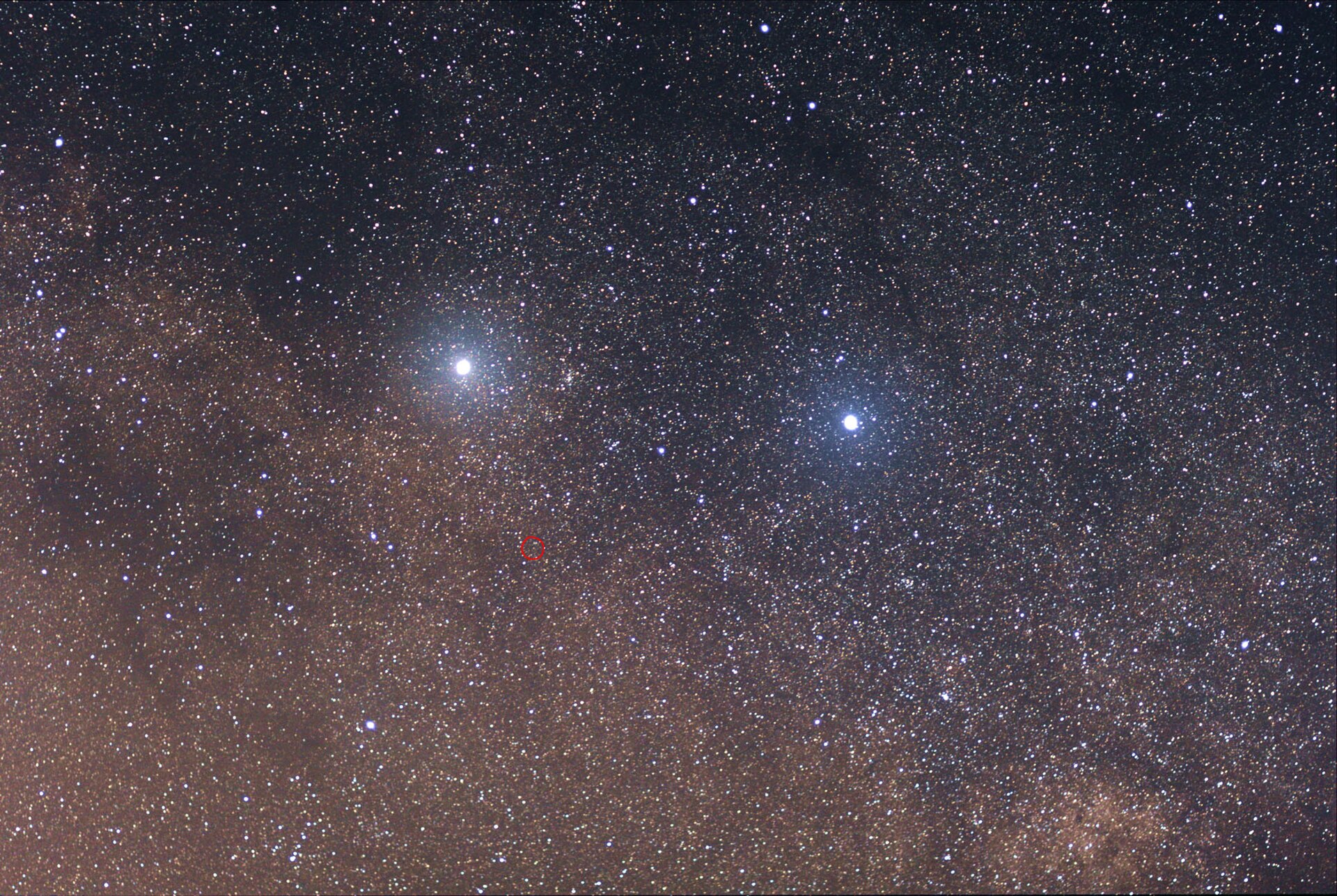
It's a triple star system, Alpha Centauri A on the left, Alpha Centauri B on the right and Proxima Centauri, the closest star apart from the Sun, circled in red.
You are not seeing them directly, but in a photograph. You can resolve the main pair with a small telescope or binoculars.
None of the light that is entering your eye as you look at Alpha Centauri, originated at Alpha Centauri. It originated from your screen.
So it would seem reasonable to say in this case that you are looking at Alpha Centauri indirectly, as opposed to when you stare up a the southern night sky and see it directly.
That's not like seeing a single photon. Nor like not seeing a single photon.
None of which is to deny that we see because light from the thing we see enters our eyes. We see with light: we don't see light.
So you are right, if you like, that there is a whole lot going on between Alpha Centauri and your eye, none of which stops you sometimes seeing it directly, sometimes indirectly. -
Indirect Realism and Direct RealismThat wasn't sarcasm.
It's late here and I'm not going to spend time gong over this with a newbie right now.
Take a look at the thread i cited earier -
The arguments you present were articulated by Ayer and demolished by Austin. See the thread Austin: Sense and Sensibilia. — Banno -
Indirect Realism and Direct RealismMmm. I've spen a bit more time on this than just Google and wikipedia.
But hey, you go for it. -
Indirect Realism and Direct Realism
That's the question I ask the indirect realist!What do you mean when you say 'touch the ball directly'? — flannel jesus
This bit:But I will repeat a point that may have gone unnoticed. The argument, in the title and in the OP, is framed as if there were two sides, the one being indirect realists who point out various anomalies they think show that we never perceive things directly; and a presumed opposition who think that somehow we do perceive things directly...
But why not reject the very framing of the argument in those terms:
There is an alternative, which is to reject the juxtaposition of direct and indirect experiences entirely, and admit that we do sometimes see (hear, touch, smell...) things as they are; and that indeed this is essential in order for us to be able to recognise those occasions in which we see (hear, touch, smell...) things in the world erroneously.
— Banno — Banno -
Indirect Realism and Direct RealismThe scientist proceeds to "hook up" a subject to a machine, gives the subject a ball, and records the activity of the nerves to the brain. The scientist solicits a reply from the subject that he is in contact with a ball. — Richard B
Ok, well and good. There are a few problems here, but let's set them aside and look at the conclusion.
If we follow the theme of the OP, an indirect realist would need to conclude that one never touches the ball directly. But that does not follow from the experiment. The subject touches the ball directly in the first case, and has the sensation of touching the ball without actually touching it, in the second.
It does not follow that we only touch the ball "indirectly".
So what more can be added to this experiment so that it supports indirect realism? -
Indirect Realism and Direct Realismit flies in the face of physical facts, — AmadeusD
What does, and how so? -
Postmodernism and MathematicsThanks. Yes, when I was looking for a paper by a mathematician with post modern leanings, it became apparent that most were pedagogical rather than methodological or mathematical.
Hope your leg is improving. Reading your paper. -
Postmodernism and MathematicsI did read have a cursory read of Izmirli's piece which you provided. Aside from the historical survey I wasn't quite sure what the piece was saying. I was just pointing out that people's take on postmodernism varies. In this case, White versus joshs. It seems to me that joshs was making the point that White has it wrong. — Tom Storm
What's odd is that the article, which @Joshs pilloried, makes much the same point as he makes.
It specifically provides an example of where a re-situated 2x5=1 is true.
It also presents a sympathetic account of PoMo pedagogy in maths.
No pleasing some folk. -
Indirect Realism and Direct Realism
It might be better if I were to let you two discuss the topic for a bit.Perhaps you could attempt to provide what I'm missing - no one seems to want to engage directly with the problem (i.e where is the 'direct' connection between the object at the experience?)... — AmadeusD
But I will repeat a point that may have gone unnoticed. The argument, in the title and in the OP, is framed as if there were two sides, the one being indirect realists who point out various anomalies they think show that we never perceive things directly; and a presumed opposition who think that somehow we do perceive things directly...
But why not reject the very framing of the argument in those terms:
There is an alternative, which is to reject the juxtaposition of direct and indirect experiences entirely, and admit that we do sometimes see (hear, touch, smell...) things as they are; and that indeed this is essential in order for us to be able to recognise those occasions in which we see (hear, touch, smell...) things in the world erroneously. — Banno -
Indirect Realism and Direct RealismI can't get past the experience of that touch being mediated by, say, electric impulse/CNS activity which is not the thing, ferrying a 'message' of that direct physical touch, to the mind for examination in 'feeling'. — AmadeusD
Isn't this a homunculus argument? As if you were sitting inside your head, "feeling" nerve impulses?
Is that "electric impulse/CNS activity" something you experience? If it were, why did it take the development of modern physiology for us to understand this?
I do't think that description works. I think you feel the wall, not the nerve impulses.
@Isaac was particularly adept at setting out this issue, layers of Markov blankets and so on. -
Postmodernism and Mathematics, , interesting then that this thread so quickly ceased to be about mathematics and became instead a discussion of the opinions of the various PoMo theorists.
-
Indirect Realism and Direct RealismFor touch, the middle man (by analogy, rather than "this is my position") is the nervous system, surely? — AmadeusD
Can this be filled out? Would you say that you don't touch the wall, you touch your nervous system? That doesn't seem right.
I touch the wall indirectly if I wear a glove, perhaps? Directly, if I do not wear a glove. -
The whole is limitlessSeems to me you have reinvented the universal set. As such what you have shown is that there is nothing outside of W, not that W is limitless.
-
Indirect Realism and Direct RealismDoesn't this still place a middle man in your 'direct' position? — AmadeusD
How?
We see using light; we don't see light. What you see is your hand, not the light. So the argument presented does not work.
Have you a different argument?
And what is the middle man in touch? -
Indirect Realism and Direct Realismhallucination" is closer to "delusion" than to "illusion", in that something is conjured up in both an hallucination and a delusion, but not so much in an illusion.
That we sometimes hallucinate does not imply that we never see things as they are. indeed, in order to identify an hallucination we must be able to differentiate between what is "conjured up" and what is veritable. Recognising that we sometimes hallucinate requires that we also recognise when we are not hallucinating.
When it isn't a real duck but a hallucination, it may still be a real hallucination-as opposed, for instance, to a passing quirk of a vivid imagination. That is, we must have an answer to the question 'A real what?', if the question 'Real or not?' is to have a definite sense, to get any foothold. — Austin
Curious that this thread emphasises hallucination rather than illusion. -
Indirect Realism and Direct Realism...you see photons — Quk
A common response that is wrong. No one sees photons. Folk might well see using or because of photons. But photons are not visible.
It's very important to get the language right here. Sure, you see your hand because it reflects photons, but you do not see the photons.
And one should take care not to preference one sense over others. How is touch indirect? Smell? Taste? -
Indirect Realism and Direct RealismA dream is as subjectively real as your current experiences. These two are exactly the same to us. — Ashriel
Having a dream is indistinguishable from not having a dream? But I know what a dream is, and I'm not having one now. Dreaming is different to being awake - that's why we mark the distinction between dreaming and wakefulness by making use of those words. If one could not tell a dream from wakefulness, we would not be able to make that very distinction.
Then why do folk bother taking LSD?Non-veridical experiences like hallucinations are not subjectively distinct from veridical experiences — Ashriel
Hence,
We do make such distinctions.P1 if we were directly acquainted with external objects, then hallucinatory and veridical experiences would be subjectively distinct — Ashriel
Hallucinations are very different to "veridical experiences", which is why some sometimes take drugs in order to experience them, and at other take drugs in order to avoid them.P2 hallucinatory and veridical experiences are not subjectively distinct(i.e., subjectively identical) — Ashriel
Therefore,
does not follow. We may on occasion be "directly acquainted with external objects".P3 therefore, we are not directly acquainted with external objects — Ashriel
's response fits here, as does myP4 if we are not directly acquainted with external objects, then we are directly acquainted with our perceptions of external objects — Ashriel
. We do not experience our perceptions, nor are we aquatinted with them. Rather our perceptions are, more often than not, our seeing, tasting, smelling and touching the things in our world. And it is only in virtue of this being so that we can note the oddity of dreams and hallucinations and illusions and mirages and so on.representing is perceiving — Banno
These no longer follow. But we might take a few seconds to wonder, what could it possibly mean to be indirectly acquainted with our perceptions? And if that leaves you unsure, are you so sure you understand what it is to perceive directly?P5 therefore, we are directly acquainted with out perceptions of external objects
P6 therefore, Indirect Realism is true — Ashriel
This is a misarticulation of the issue. That casual process is not between the object and the perception, it is the perceiving of the object. Folk are misled by considering only vision here. Consider touch: the contact between say finger and texture is in part the touching; Or smell: the contact between nose and perfume is in part the smelling. The smelling and touching do not occur at the end of the casual chain, but are integral to it. The alternative leads to homunculi.P1 if there is a long causal process between the object that we perceive and our perception of the object, then we do not know the object directly — Ashriel
Why should one accept this? In an illusion, a pencil in water is made to appear bent. Perhaps one might be tempted to say that the bent pencil does not exist, but the pencil certainly exists. Otherwise there could be no pencil to appear bent. And what could it mean here to say that the pencil is not perceived directly? That it is not perceived directly, but only through the water? Why not then say that I perceive the pencil directly, through the water? This is just what a straight pencil in water looks like.P1 if the things we perceive do not exist, then we do not know the things we perceive directly — Ashriel
Again, why should we accept this? If I hear a jet overhead, and o n looking, find it further over in the sky than the sound might indicate, I do not conclude that therefore the jet does not exit. Why should a delay in some perception convince us that the thing perceived does not exist?P2 if the causal process that allows us to perceive things takes time, then the things that we perceive do not exist — Ashriel
The remainder of the points, again, fall in a heap.
Skepticism comes from the realisation that it is logically possible for your experiences and reality not to properly correspond. For example, during hallucinations, your experiences(the hallucination) and reality do not correspond. — Ashriel
IN order to be aware that you are hallucinating, you must be able to differentiate between what is an experience that is hallucinatory, and an experience that is (shall we say...) veritable.
Skepticism is dependent on our being able to recognise the veritable.
Therefore we sometimes experience the world as it is.
I don't see any argument left for indirect realism.
Do we conclude that therefore we only ever see things directly? That direct realism is true?
Not at all.
There is an alternative, which is to reject the juxtaposition of direct and indirect experiences entirely, and admit that we do sometimes see (hear, touch, smell...) things as they are; and that indeed this is essential in order for us to be able to recognise those occasions in which we see (hear, touch, smell...) things in the world erroneously.
This is I believe the account offered by Austin, applied to the OP. -
Infinity~~But the order of the elements is essential to determining the identity of a thing. — Metaphysician Undercover
So an hourglass changes its identity as each sand grain drops.
A few pages back I said:
...and here it is. Thanks.So the reply will consist in an obfuscation of the law of identity by confusing it with an "ontological" principle. Mistaking a language act for a thing in the world. — Banno -
Proof that infinity does not come in different sizesI've heard that in the USA a huge amount of natural gas just goes missing. Where does it go? — Metaphysician Undercover
Into your posts?
(Ok, but someone had to say it...) -
Infinitythe ordering of the elements which make up "a thing" is essential to the identity of the thing. — Metaphysician Undercover
...unless it isn't, as is the case with sets...
That's why if two sets are said to be "the same", they are not the same by the conditions of the law of identity, because the order of the elements is not included in that supposed (fake) identity.. — Metaphysician Undercover
No; and that's why the order is irrelevant when determining if two sets are the same...
Fucksake.
I sincerely regret having entered into a direct discussion with you. I will try not to make the same error again. -
InfinityI don't see a point in philosophical discourse with you either. — Corvus
Then, please, don't feel any need to reply to my posts. For page after page. :wink:
But if you do want to get back into a conversation that is on topic, you might re-phrase whatever your position is, taking into account the various responses hereabouts.
I wonder what makes of this. They haven't responded at all, but that seems to be their way; they are in the unusual position of having less comments (8) than Discussions (11)...
I think I've had enough of this. There's been no progress for days. Thanks for sharing your insights. -
InfinityI am here to read and discuss philosophy. — Corvus
You havn't posted anything of philosophical merit for page after page; just bitchin'.
Here's the link that proves it. -
Infinity
Christ, Meta, sets are not order.Jesus Banno, if A is the same as B, as implied by "A=B", (if "=" signifies identity, or "the same"), then the order of A's elements is the same as the order of B's elements, necessarily, as this is a part of "being the same".. — Metaphysician Undercover
The order of the elements is not part of what a set is. SeeClearly "identity" by the law of identity includes the order of a thing's elements, as it includes all aspect of the thing, even the unknown aspects. — Metaphysician Undercover
But we are at the point where further discussion is without purpose. Again, you have shown that there is no value in discourse with you. -
Indirect Realism and Direct RealismPerhaps. Seems a long bow.
I see my hand directly when I look down, indirectly when I see its reflection in a mirror. Here I have a clear enough understanding of what it means to see my hand directly and indirectly.
But if someone says that when I look down at my hand I am seeing it indirectly, I do not have a way to make sense of what they say.
If they say I am not seeing my hand, but a "mental image of my hand" or some such, my reply is that, the "mental image", so far as it makes any sense, is me seeing my hand. -
Infinity
What?"A=A" implies that not only the elements, but also the order to the elements of A and B would need to be the same. — Metaphysician Undercover
Why would A=A imply that the order of the elements in B would need to be the same as A?
I think you've lost the plot entirely. -
Indirect Realism and Direct RealismOr neither. Perhaps representing is perceiving.
-
InfinityYep.
So the reply will consist in an obfuscation of the law of identity by confusing it with an "ontological" principle. Mistaking a language act for a thing in the world. -
Indirect Realism and Direct RealismThe arguments you present were articulated by Ayer and demolished by Austin. See the thread Austin: Sense and Sensibilia.
Overwhelmingly, philosophers accept non-sceptical realism and strongly lean towards representationalism.
This argument is interminable because folk fail to think about how they are using direct and indirect. -
InfinityThe point is that the sense of "identity" employed in set theory is not consistent with, therefore violates, a proper formulation of "the law of identity" expressed as an ontological principle. — Metaphysician Undercover
Here is the axiom of extensionality:
If A and B are sets, then A = B iff every element of A is also an element of B, and vice versa.
Here is the law of identity
A=A
Set out for us exactly how these are not consistent. -
InfinityPretty much. One can't do philosophy well without being critical, which entails sometimes pissing people off.
-
InfinityIf folk wish my posts moderated, then they have been paying attention to them.
-
Postmodernism and MathematicsSo far as I can make sense of what you have written here, you have said that maths is abstract, and applying maths requires something like particularising (?).
I might be wrong. I find your style quite obtuse. To be candid, it seems intended to be clever rather than clear.
So for instance that second quote from Husserl looks to want to say that an individual is determined by the predicates that apply to it, but of course Kripke's modal logic tells us otherwise. No fault to Husserl, since possible world semantics post dates him. But why the language?
If I am right you have not explained a "more primordial and fundamental" way of thinking from which mathematical "qualities" derive.
I find the following laughable, so I must be misunderstanding it:
This seems to be saying that maths is only about maths; the "existential foundations" of maths are applicable in applied maths, or physics, or engineering.Mathematics is not more exact than historiographical, but only narrower with regard to the scope of the existential foundations relevant to it.
Maths has a far, far greater reach and explanatory power than 'historiography'. -
InfinityWho are those many people? — TonesInDeepFreeze
For my part, I hope he's right...
Captures the theme admirably.
Banno

Start FollowingSend a Message
- Other sites we like
- Social media
- Terms of Service
- Sign In
- Created with PlushForums
- © 2026 The Philosophy Forum