
-
Humans are advantage seekersThis is something that's been discussed a lot here on the forum. — T Clark
So is this true, or is it just to your advantage? Has this been widely discussed, or are you merely making a rhetorical ploy?
If you think it true, then you are yourself relying on truth in your argument. But if you are relying on truth, then you are implicitly valuing it, in contrast to what your argument claims.
And if you do not value truth, and your point is merely rhetorical, then we have no need to pay your argument any heed.
There are two points here. The first is that the logic of any discussion depends on the propositions of the argument being true. If they are not subject to truth, your arguments become illogical. The second is that if you are more concerned with advantage than with truth, you join the class of Bullshiters, in the philosophical, Frankfurt sense. And as such we ought pay no heed to what you have to say.
Rejecting truth is self-negating, both logically and rhetorically.
This is the poverty of pragmatism. Sure, go ahead and do what is to your advantage. The truth will catch you up. It plays the long game. -
Humans are advantage seekersLooks to be Hoffman, again. Fitness beats truth, substituting advantage for fittness.
First off, even if it is true(!) that "humans are primarily driven by their quest for personal advantage", it remains open to ask if the ought to be so. Perhaps we ought dissuade ourselves from seeking advantage and instead seek after truth. That's a view with a long heritage.
See also Donald Hoffman’s denial of materialism -
Analyticity and Chomskyan LinguisticsAnd the curious thing about convention is that it requires communality of intent. That's how it differs from mere habit.
Which is anathema to supposed I-language.
So the workings of analyticity exposed here appear incompatible with I-language. -
Analyticity and Chomskyan LinguisticsIf we take the answer to the above as "yes", we seem to be left with making a fairly arbitrary distinction. Sure, all unmarried men are all of them men, but, by way of a counter instance with the same structure, are all ungrammatical sentences, sentences? If a string of words are not grammatical, then they presumably do not form a sentence...
So "all ungrammatical sentences are sentences" is not obviously analytic, despite the similarity in structure to "all unmarried men are all of them men"; and that we can see this seems in some way to be dependent on some sort of play on words; perhaps even on a convention.
Perhaps we ought be more sympathetic to Quine's suggestions, and think that "all unmarried men are all of them men" also relies to some extent on convention. -
Analyticity and Chomskyan LinguisticsSo we have that all unmarried men are men. We can put this in a simple deduction. But we don't get to all bachelors are men without relying on convention?
-
Analyticity and Chomskyan LinguisticsYou can eat your cake and keep it?
Some statements are analytic, but only by convention? Wouldn't we thereby lose any advantage to their being analytic, since someone who disagrees with the convention need not be bound by it? -
Modified Version of Anselm's Ontological Argument
Goats eat everything; therefore there is something that eats everything. therefore It is possible that something eats everything.
So you have a proof of the Great Goat:
Either it is not possible that something eats everything or it is necessary that something eats everything.
It is possible that something eats everything.
Therefore it is necessary that something eats everything.
And this we all call the Great Goat.
A few more small steps and we have that everything is a goat. -
Infinite Regress & the perennial first cause
This is gobbledygook. But I would not be surprised were you unable to see that.A circle is a very close approximation of Pi which is infinity itself. — invicta -
Analyticity and Chomskyan LinguisticsWhere do concepts exist? I'm not sure. Or if it's even quite right to say they exist, or if this is a reification. — Moliere
Yep. The argument seems to be that we need a place for concepts, hence the I-language.
So it's based on a misguided spacial notion of "concepts". -
Infinite Regress & the perennial first causeIf you think Pi and infinity are the same number, then you're view is pretty much fucked.
So I'll leave you to it. -
Infinite Regress & the perennial first cause, Pi and infinity are two quite different numbers. Pi is not infinity.
-
Modified Version of Anselm's Ontological ArgumentHmm. The we are now a long way from Canterbury.
-
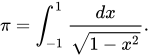
Infinite Regress & the perennial first causeAs I said, it cannot be express with a finite number of digits in decimal notation.
But that does not make it infinite.
It is expressed exactly by
-
Modified Version of Anselm's Ontological ArgumentThe second premise is true if the definition doesn't contain a contradiction, which I think is an easy condition to satisfy. — Michael
If the definition is "a something a greater than which cannot be conceived", I'm not convinced. There's the obvious comparison of "A number a larger than which cannot be conceived" - the idea is not coherent. -
Infinite Regress & the perennial first causeif it’s not infinity why haven’t we been able to calculate it’s finite value. — invicta
You are far too casual with your terms. Pi is exactly the ratio of circumference to diameter. It is not infinite. It cannot be express with a finite number of digits in decimal notation.
Pi is not a circle. -
Infinite Regress & the perennial first causeA circle is a very close approximation of Pi which is infinity itself. — invicta
That sentence is nonsense. A circle is not Pi. Pi is not infinity. -
Modified Version of Anselm's Ontological Argument
-
Modified Version of Anselm's Ontological ArgumentI don’t know how accurate that website is at parsing modal logics — Michael
The counter model looks right.
There might be something in the " suitable assumptions about the nature of accessibility relations between possible worlds", butI don't see it. It's invalid in all six, according to the tree proof generator.
So I'm left to supposing that it's down to how we pass
- There is a possible world in which there is an entity which possesses maximal greatness.
- (Hence) There is an entity which possesses maximal greatness.
◇∃xGx→∃xGx looks invalid. there can be a world in which ◇∃xGx is true, and yet ∃xGx false - It is possible to have green cows, but there are no green cows. -
Infinite Regress & the perennial first causeYou’re saying im being irrational just like Pi. — invicta
Hmm. Well, it seems you both go on forever. -
Infinite Regress & the perennial first causeI don't see how that has anything to do with attempting to show that infinite linear arguments are actually circular, nor with your OP.
-
Infinite Regress & the perennial first causeIt’s an example of circular logic in Action. — invicta
No it isn't. The methods used to calculate Pi are iterative, not circular. -
The value of conditional oughts in defining moral systemsWhat does your claim that "well-informed and rational are normative” mean to you? I can make no sense of it. — Mark S
That's apparent, and has been through the several threads you have started.
Un's joke captures the point most succinctly:
But from your response it seems to have fallen flat. I don't think I'll try explaining it.Are well informed rational people better than ill-informed irrational people? — unenlightened
It seems, from multiple cases hereabouts, that engineering is poor preparation for doing philosophy. -
Infinite Regress & the perennial first causeIf you only knew Pi, which you obviously can’t as it’s irrational and infinite — invicta
Of course we can know Pi: it's the ratio of circumference to diameter. I can draw a reasonable circle of any diameter up to a 20cm or so; after that the paper is too small.
I don't see that your argument works. -
Will Science Eventually Replace Religion?"There are those" seems to be covertly pointing at yours truly. — Gnomon
Indeed.
Nowhere have I accused you of new ageism, nor of "science bashing"
The most I have "accused" (your word) you of is not being able to either follow or present a clear argument.
Despite the faux footnotes. -
Infinite Regress & the perennial first causeI find his dissatisfaction with infinite regression unsatisfactory for if infinite causes are the chain of sequences ad infinitum does such a chain not imply a closed loop, like that primordial snake ouroboros eating it’s own tail. — invicta
Closed deductive loops are quite valid.
They just do not get you very far - no further than where you started.
Here, though, you seem to be claiming that a "sequences ad infinitum" implies a closed loop. It doesn't.
The trouble with making use of "first cause" is that the notion of causation is problematic.
Russell (1912: 1) famously denied that there are any causal relations at all, quipping that causation is “a relic of a bygone age, surviving, like the monarchy, only because it is erroneously supposed to do no harm” — SEP: The Metaphysics of Causation
At the very least, causation causes more philosophical problems than it solves.
I applaud your perspicacity. — jgill
Just so. -
How ChatGPT works.Wolfram's conclusion is that "human language (and the patterns of thinking behind it) are somehow simpler and more “law like” in their structure than we thought".
Yet human language thrives by breaking the rules.
Perhaps we might have moved a step closer, not to setting out the rules of language and of thought, but to showing that there are no such rules. -
How ChatGPT works.So who got to the end of the article? Wolfram begins to be a bit more philosophical:
So how is it, then, that something like ChatGPT can get as far as it does with language? The basic answer, I think, is that language is at a fundamental level somehow simpler than it seems. And this means that ChatGPT—even with its ultimately straightforward neural net structure—is successfully able to “capture the essence” of human language and the thinking behind it. And moreover, in its training, ChatGPT has somehow “implicitly discovered” whatever regularities in language (and thinking) make this possible.
The success of ChatGPT is, I think, giving us evidence of a fundamental and important piece of science: it’s suggesting that we can expect there to be major new “laws of language”—and effectively “laws of thought”—out there to discover. In ChatGPT—built as it is as a neural net—those laws are at best implicit. But if we could somehow make the laws explicit, there’s the potential to do the kinds of things ChatGPT does in vastly more direct, efficient—and transparent—ways.
Overreach, I think. But what do others make of this? -
How ChatGPT works.See, I'm not making any of the claims you suggest. So I can't choose one.
I'm just noting that you expresses some agreement with the phenomenological approach to defining consciousness, and then I showed why it is not much help, using a reductio argument: we agree that air conditioners are not conscious, yet the phenomenological approach cannot show that this is so.
That's all. :meh: -
How ChatGPT works.
This:What exactly are you saying, I guess? — schopenhauer1
You expresses some agreement with the phenomenological approach to defining consciousness. I have pointed out that it's a useless definition. It cannot help us to decide if ChatGPT, creativesoul, or your air conditioner are conscious. — Banno
Since this isn't getting anywhere, might best just leave it. -
Analyticity and Chomskyan Linguisticsa) Chomsky's view on analyticity as described in your OP article is just that. — schopenhauer1
Well, yes. Hence the direct question to Chomsky.
:meh: -
Analyticity and Chomskyan LinguisticsSeems to me bringing vague, muddled notions of objective and subjective into the discussion can only lead to it becoming vague and muddled.
Banno

Start FollowingSend a Message
- Other sites we like
- Social media
- Terms of Service
- Sign In
- Created with PlushForums
- © 2026 The Philosophy Forum