
-
Neuroscience is of no relevance to the problem of consciousnessIn what way are you suggesting his evidence is not scientific? — universeness
I'm not suggesting anything about him or his theory. -
Neuroscience is of no relevance to the problem of consciousnessOk, that's fine, so we now need very strong evidence, that more than the brain is involved. As Carl Sagan said, extraordinary claims require extraordinary evidence.
What is the current proposal, that you personally, assign your highest credence level as 'vital,' to what we observe as the effects and affects of human consciousness. Do you for example, assign a high credence level to Rupert Sheldrakes morphic resonance and morphic fields? — universeness
I'm not arguing that something else involved. I'm only arguing that if something else is involved then we can't have scientific evidence of it (or against it). -
Neuroscience is of no relevance to the problem of consciousnessFirst of all I don't know what you mean by the term "identical". Brain activity enables conscious experience and previous experiences with different biological setup enable the subjective quality of them.
Arguments from ignorance isn't the best way to understand something. We only know that the we can not share our mental experience on real time. That doesn't imply that brain activity is not responsible for it when we have already demonstrated its Necessary and Sufficient role — Nickolasgaspar
I'm not saying that brain activity isn't responsible for it. I'm only saying that if there is some non-physical aspect to consciousness then there can be no physical evidence of this non-physical aspect.
I would have thought this a quite obvious truism. -
Neuroscience is of no relevance to the problem of consciousnessSo, if you agree the brain is 'involved' then what do you find objectionable, when I claim that it's therefore valid and appropriate to use the label 'human consciousness,' to label the phenomena you exemplified? — universeness
Because there might be more to consciousness than just that brain activity.
But you just agreed that in your exemplar, the brain was involved. Was that a subjective opinion?
Your above quote, seems to be invoking a high personal credence level that you hold towards the above quote, but you have not provided much evidence to support it.
Do you think that's wise? — universeness
I don't understand your question. That the brain is involved isn't that only the brain is involved. -
Neuroscience is of no relevance to the problem of consciousnessOnly a specific aspect of it isn't accessible in real time. — Nickolasgaspar
And so that specific aspect of it isn't identical with brain activity, which is accessible in real time. -
Neuroscience is of no relevance to the problem of consciousnessSo no brain activity involved? — universeness
The brain is part of the body, so it's involved. -
Neuroscience is of no relevance to the problem of consciousnessI have already analyzed the issues in that huge leap. Science use forensic reasoning and methods. Not having direct access to the end product of a process doesn't mean that we can not objectively study the phenomenon and verify its causal mechanisms.
Aspirin and dosage recommendations exist because we have ways to understand and study the subjective aspect of a conscious state.
It seems like (maybe I am wrong) that Philosophy is using the same practices with those used by religion and spiritual ideologies in an attempt protect their claims from science. — Nickolasgaspar
There is no huge leap.
If A is inaccessible and B is accessible then A isn't B. It's very straightforward logic.
If subjective experience is inaccessible and brain activity is accessible then subjective experience isn't brain activity. -
Neuroscience is of no relevance to the problem of consciousnessI am not trying to straw-man you, only to understand your claim. — Nickolasgaspar
My claim is exactly what I've said: if the subjective aspect of consciousness is inaccessible to science then ipso facto the subjective aspect of consciousness isn't identical to brain activity, and so nothing could be evidence that the subjective aspect of consciousness is identical to brain activity. -
Neuroscience is of no relevance to the problem of consciousnessWhat would you choose as your label for this phenomena, and all it's demonstrable variations? — universeness
Bodily behaviour? -
Neuroscience is of no relevance to the problem of consciousnessSo, for you, what is your example above, evidence of? — universeness
That stimulating certain nerves in certain ways causes the subject to flinch and say "that hurts". -
Neuroscience is of no relevance to the problem of consciousnessWe can change the stimuli, or the biological setup and observe changes in behavior, in brain patterns in blood metrics. We can create the experience by stimulating the suspected brain area and observe changes in our blood profile, behavior , brain patterns etc. — Nickolasgaspar
What does that have to do with consciousness? You can have evidence that stimulating certain nerves in certain ways causes the subject to flinch and say "that hurts", but that isn't prima facie evidence of consciousness, and certainly isn't evidence that consciousness just is some physical phenomena like brain activity. -
Neuroscience is of no relevance to the problem of consciousnessWow that is a huge leap you made there. — Nickolasgaspar
How so? If the subjective aspect of consciousness is inaccessible to science and brain activity is accessible to science then ipso facto the subjective aspect of consciousness isn't brain activity.
Whether our efforts point to physical mechanisms , that either means the phenomenon IS PHYSICAL or that we don't need to make up additional entities to explain it (parsimony).
If it exists but isn't physical then any theory that reduces the mental to the physical is wrong and doesn't explain consciousness at all. -
Neuroscience is of no relevance to the problem of consciousnessI don't know why you find it so important not to be able to replay from a first person view. Why do you think this is a problem? — Nickolasgaspar
I'm not saying it's important or a problem. I'm just saying that if the subjective aspect of consciousness is inaccessible to science then nothing would count as evidence that the subjective aspect of consciousness is reducible to some physical phenomena like brain activity. -
Neuroscience is of no relevance to the problem of consciousnessScientific evidence for what? — Nickolasgaspar
For the inaccessible aspect of consciousness. -
Neuroscience is of no relevance to the problem of consciousnessBy first person consciousness you refer to the subjective content of a conscious experience and because we can not share the exact same experience, your claim is that it makes it inaccessible to science. — Nickolasgaspar
Not exactly. I'm only saying that if it is inaccessible to science then there cannot be any scientific evidence of it. -
Donald Trump (All General Trump Conversations Here)Apparently he won't be getting a mugshot (and won't be handcuffed).
Ex-Presidents get special treatment. -
Neuroscience is of no relevance to the problem of consciousnessConsciousness is basically a behavior. — T Clark
That's one theory. I wouldn't take it as a given.
We see the results of it in other people all the time, in their public behavior and communication. — T Clark
I can think things and yet not tell you or anyone else what I am thinking. There's more to consciousness than just public behaviour.
That consciousness drives behaviour isn't that consciousness is behaviour. -
Neuroscience is of no relevance to the problem of consciousnessI'm not seeing how that follows. I can see how, if a thing were inherently and unassailably private we couldn't publicly discuss what is is, but I don't see how we couldn't publicly discuss how it came about or what purpose it might serve.
If there were some completely secret contents of a black box but if every time I added a coin to that box it spat out a can of beer, I don't need to know what's in the box to have a reasonable scientific theory that the box is designed (evolved, if natural) to vend beer, and that it does so in response to money being placed in it. I could experiment with different coinage, different currencies. See if there's a relationship between coin and beer type... I could develop a dozen perfectly valid, sound theories about this box, how and why it works, all without having a clue what's in it. — Isaac
You asked for evidence, not theories. So assume you have two theories to explain how and why it works. What evidence would prove which one is correct, assuming you can never look inside the box, and that both always correctly predict the box's response?
I don't see how we couldn't publicly discuss how it came about or what purpose it might serve.
We might be able to do that, but I read bert1 as arguing that neuroscience fails in any attempt to show that consciousness just is brain activity.
So it might be that we can explain how consciousness came to be, and the purpose it might serve, but also that consciousness is some non-physical supervenient phenomena which, like the contents of your black box, cannot be directly measured (except by the person whose consciousness it is). -
Is indirect realism self undermining?Right. so if it's not a property of external world objects, then what's your theory as to why we sense it? And how do you justify undermining the current paradigm that the brain senses external states in order to predict the results of interaction with them? — Isaac
I don't understand the issue. Pain isn't a property of external world objects. I feel pain. There's no problem here. Colours aren't a property of external world objects. I see colours. Suddenly there's a problem?
When our nerves are stimulated in certain ways, we feel pain. That pain, even though an "internal" thing, indicates that something is going on outside us, and we react accordingly.
When our temperature is lowered sufficiently, we feel cold. That cold, even though an "internal" thing, indicates that something is going on outside us, and we react accordingly.
When our eyes are stimulated in certain ways, we see red. That red, even though an "internal" thing, indicates that something is going on outside us, and we react accordingly.
what's the evolutionary advantage of a system where the brain spends time detecting the state of other parts of itself?
I'm not saying that the brain "detects" the state of other parts of itself. I'm saying that external stimulation triggers brain activity, and that this brain activity is either identical to or causes "the feeling of pain", and that this pain isn't a property of the external stimulation but is a property of that brain activity (or some supervenient mental phenomena, if there is such a thing). The same with feeling cold and seeing red. -
Neuroscience is of no relevance to the problem of consciousnessSo what's the sort of thing you'd be satisfied with? If I went into my lab tomorrow, had a really good look at some brains, and came back to and said "Brain activity requires consciousness because..." What would you accept? — Isaac
The potential problem here is that if there is such a thing as first person consciousness, and if first person consciousness is essentially private, then by necessity there can’t be any sort of public, scientific evidence of or explanation for it. -
Is indirect realism self undermining?Now you seem to be going back to semantics. — Isaac
And that's all semantic direct realism is: semantics.
The epistemological problem of perception that gave rise to the distinction between the direct and indirect realist concerns the relationship between the phenomenology of experience and the mind-independent properties of external world objects. That has nothing to do with the choice to describe our experience as "feeling pain" or as "feeling the fire", which is irrelevant to the substance of the disagreement, because it's not the case that either one or the other is "correct". They're just different ways of talking that emphasise different aspects of perception.
When I talk about seeing red I mean it in the same sort of sense as when I talk about feeling pain, and the red I see, like the pain I feel, isn't a property of external world objects. This is the indirect realist’s claim contra the (phenomenological) direct (naive) realist’s. -
Is indirect realism self undermining?Where is this 'pain' and what sensory nodes to you use to 'feel' it? — Isaac
The question is mistaken. Ironically Searle explains it well:
It is like the pain and the experience of pain. The experience of pain does not have pain as an object because the experience of pain is identical with the pain. Similarly, if the experience of perceiving is an object of perceiving, then it becomes identical with the perceiving. Just as the pain is identical with the experience of pain, so the visual experience is identical with the experience of seeing.
So it is not the case that "feeling" is one thing, that "pain" is another thing, and that the former is "done" to the latter; it is just the case that "feeling pain" is a single (possibly private) thing. The same with feeling cold and seeing red. -
Is indirect realism self undermining?You don't feel pain — Isaac
Then we're at an impasse. Nothing you say can convince me that I don't feel pain. Headaches are real. -
Donald Trump (All General Trump Conversations Here)There was no secession. Secession is when a state leaves the union. — frank
Secession from reality. -
Is indirect realism self undermining?That's a representation. Those objects in the thought bubbles are representations of apples. — Isaac
They are no more representations of apples than pain is a representation of fire or cold a representation of a temperature of 0°C. They are just an effect of stimulation.
When we say "the post box is red" we don't mean that there's some thing 'redness' which the post box possesses — Isaac
We do according to the (phenomenological) direct realist. They commit themselves to something like colour primitivism. Indirect realism is a response to such claims.
Then why have representations at all? Why have the word? — Isaac
I try not to use the word. I think it's a distraction. I have repeatedly said that the epistemological problem of perception – the very thing that gave rise to the distinction between the direct (naive) realist and the indirect realist – concerns the relationship between the phenomenology of experience and the mind-independent properties of external world objects.
The pain I feel isn't a mind-independent property of fire. The cold I feel isn't a mind-independent property of the air. The sweetness I taste isn't a mind-independent property of sugar. The colour I see isn't a mind-independent property of the apple.
It makes no real difference if we describe this as feeling or tasting or seeing "mental representations" or if we describe this as feeling or tasting or seeing fire and air and sugar and apples. That semantic argument is, really, a non-issue.
When I talk to my parents on the phone, it is perfectly acceptable to say that I talk to my parents on the phone, not to some representation of my parents; but it is also correct to say that our conversation is indirect; that their voice isn't actually "present" in my experience (given that sound can't travel that fast, and at the volume they speak also can't travel that far).
When I talk about my parents, it is perfectly acceptable to say that I talk about my parents, not about some representation of my parents; but it is also correct to say that there is no "direct" connection between my words and my parents; that they are not actually "present" in my conversation.
This is the problem I have with so-called semantic direct realism. It doesn't actually address the epistemological problem of perception, or the substance of the indirect realist's arguments. As was argued in the paper I referenced before, semantic direct realism is just an attempt to maintain direct realist terminology in the face of the insurmountable problems of illusion and hallucination, and to our current scientific understanding of the world and perception. It abandons the direct (naive) realist's claim that we see things as they (mind-independently) are, and retreats simply to the claim that we see things, which doesn't really say anything significant.
In my preferred model of perception, we attempt to predict the external causes of our sensory inputs so that we might combat the entropy otherwise induced by external forces and maintain our integrity. You could put that in evolutionary terms as being a need to predict the environment so that we can survive what it's going to throw at us.
But this requires that what we're predicting is the external world, the actual thing outside of us which might impact our integrity. And when we live in groups, we do this socially. We co-operate to better predict external causes and make ourselves more predictable to others (in the hope they will return the favour). So the important thing about labelling something 'red' is the co-operation, the surprise reduction, entailed by doing so. It's important that we agree and it's important that what we agree about is an external cause.
If all we're labelling is our own private 'representations', then I really can't see the point. Why would you care? Why would I? What difference does it make to anyone what your private representation is called? — Isaac
It's not an either-or. When you tell me that something is cold, I understand it both in the sense that the temperature is low and in the sense of how such things feel. I can make sense of someone being out in such temperatures and yet not feeling cold. I am able to recognize the distinction between cause and effect. The same with pain, and smells, and tastes, and colours. The mistake direct (naive) realists make is to project the effect onto the cause, e.g. in the case of colour primitivism. -
Donald Trump (All General Trump Conversations Here)I would rather they gone after him on the Georgia case. — RogueAI
It’s not an either-or. The New York prosecutors are prosecuting him for alleged crimes committed in New York, the Georgia prosecutors are investigating him for possible crimes committed in Georgia, and federal prosecutors are investigating him for possible crimes related to classified documents. -
Is indirect realism self undermining?But there is a difference between these two explanations, one metaphysical and one scientific. The scientific explanation has physical theory behind it. Verified countless times by a community of scientist. It has power to predict future occurrences and the power to construct our environment. All verifiable in the public realm. — Richard B
Yes, and the science shows that objects don’t have colour properties, a la colour primitivism. It is just the case that objects reflect light of a certain wavelength stimulating the sense receptors in the eye which in term stimulate brain activity, creating the experience of coloured objects. I referenced an experiment earlier that explicitly determined that colour is a perceptual construct of this kind, not to be found in light or apples.
It’s no different to a low temperature causing me to feel cold or a punch to the face causing me to feel pain. A temperature of 0 degrees doesn’t have a property of coldness and fists don’t have properties of pain. I don’t know why anyone would think colour is any different given our modern science of the world and perception.
If you want to argue that the feeling of being cold isn’t some essentially private mental phenomena but is reducible to brain activity then fine, but the same must also be said of seeing colours. Sight isn’t a uniquely special sense. They key point is that colour, like coldness and pain, aren’t properties of the external stimulus that trigger such experiences. -
Is indirect realism self undermining?I just meant that there's no intermediate object, no 'representation' of an apple. — Isaac
I’m not saying that either. I’m saying that the reality of colour perception is like this:
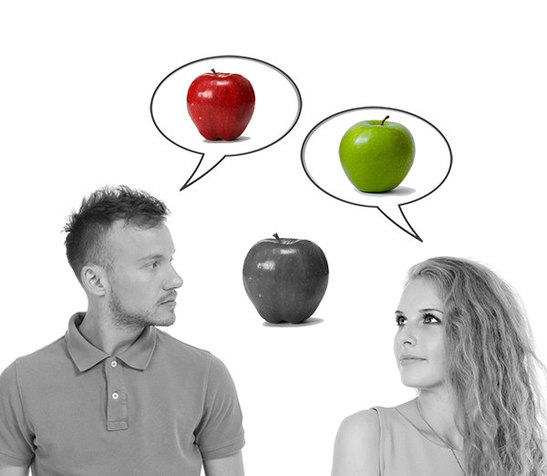
Or maybe even that both the man and the woman have the same kind of experience. The essential point is that the apple in between them isn’t coloured. It reflects a certain wavelength of light, but that’s all. Colour primitivism, which naive realists believe, is false.
And further, that when the man uses the term “grue” to describe the colour of the apple, he’s referring to what’s present in his experience and not present in the woman’s (in the particular example of that image), not to the fact that the apple reflects light with a wavelength of 450nm. -
Is indirect realism self undermining?Searle wrote "… the experience of pain is identical with the pain" — RussellA
Yes, same with colour. -
Is indirect realism self undermining?However, I think you would agree that you can't say to me that "I actually see a blue object when I say "I see red object." This make no sense. — Richard B
But it does make sense to say "what you mean by 'red' might not be what I mean by 'red'".
Referring back to this picture, if the man were able to see through the woman's eyes, he wouldn't say that the colour red looks different to this woman; he would say that the apple doesn't look red to the woman, it looks green.
Or at least that's what I'd say were I that man and able to see through the woman's eyes.
The indirect realist may want to posit "sense data" as the explanation for the difference between people reporting different colors, and claim it the best explanation. Unfortunately, I would have to break the news to the indirect realist that this is an unnecessary explanation. The car was painted with a pigment called ChromaFlair. When the paint is applied, it changes color depending on the light source and viewing angle. In this example, this was intentionally done, and I am sure this can happen un-intentionally too. — Richard B
But there are occasions where people see different colours despite nothing like this happening. Arguing that sometimes the differences can be explained with reference to the light source and viewing angle doesn't disprove that sometimes the differences must be explained with reference to something other than the light source and viewing angle.
The example of the dress is one such example that cannot be explained away the way you do here, as is the experiment I referred to before. -
Donald Trump (All General Trump Conversations Here)Pay attention to the malum per se and malum prohibita distinction. That was the point. — Hanover
So any law that prohibits something that isn't, in itself, an evil, is an unjust law that shouldn't be a law and so shouldn't be punished?
They eventually got him for tax evasion. That crime is not malum in se, but is a regulatory crime and a convenient excuse to take him down. — Hanover
So are you saying that tax evasion shouldn't be crime? That nobody should be punished for not paying their taxes? That taxes should be optional?
The Georgia fraud issue is the real crime, not this NY one, and it will appear to some that the NY crimes are BS, and now they just keep taking stabs trying to get one to stick. — Hanover
I can't quite understand the reasoning here. Is it that if someone has committed some greater crime then they shouldn't be punished for their lesser crimes? That committing some major wrong somehow absolves them of some minor wrong?
Like, I'm a murderer, so you shouldn't imprison me for stealing that car?
A crime is a crime. Either argue that the crime shouldn't be a crime (for anyone), or accept that people who break it should be prosecuted.
I don't think there's any good reason to argue that the average guy who embezzles money should be punished for it, but a rich, powerful ex-President who embezzles money shouldn't be punished for it because he might have done much worse. -
Is indirect realism self undermining?But you were arguing earlier that even language-less creatures see colours. Now you're saying the only reason we're the same is that we were taught the language. You're using our response again (saying 'blue') and then just inserting this other element (a colour experience) in between the actual light and our response to is without any need for it to be there. — Isaac
You asked me "Why is it .. that .. the overwhelming majority of people will see that it's blue and black."
What you mean by this is "why is it that the overwhelming majority use the words 'blue' and 'black'" to describe what they see".
And I explained that. We have learnt to use the words "blue" and "black" to describe objects that, upon closer examination, are found to reflect a certain wavelength of light.
My theory has the additional benefit of actually explaining why it is that we sometimes use different words to describe what we see, despite the shared external stimulus, i.e. light of a particular wavelength. Clearly something is going on in my head that isn't going on in your head that explains why you reach for one word and I reach for another. We can argue over whether this thing is some non-physical mental phenomena like "qualia" or simply physical brain activity, but we need to at least agree that something different is going on in our heads to explain the different descriptions.
It is certainly insufficient to argue that it is just the case that we use different words, and that there's no further explanation as to why this is.
It's not 'reasonable' at all. It don't understand from where you're getting this assumption that assuming the world to be the way you think it is is reasonable, but for others to disagree isn't. — Isaac
And I don’t understand how you think you can gaslight me into rejecting the reality of my first person experience. It is the foundational truth upon which all my other empirical knowledge rests.
If you were just trying to have me question the existence of other minds, and consider solipsism, then your arguments aren’t unfounded, but that seems to be for a different discussion. I think it fine to assume that solipsism isn’t the case when discussing direct and indirect realism.
At the very least, the indisputable (to me) reality of my first person experience is proof enough (to me) that me seeing red and me saying “I see red” are completely different things. I can see red things without saying so. I can lie about seeing red things. There are no rational (or empirical) grounds for me to deny this about myself.
b) There's something wrong with my brain - in which case it's perfectly possible for brain to interact directly with the world, and so no reason to think indirect realism is necessary. — Isaac
I don’t understand this conclusion. Given that your brain is inside your head and the apple is on the table in front of you, in what sense does the brain “interact directly” with the apple? There’s a whole lot of intermediate stuff in between, such as the air, light, your eyes, the nerves leading from your eyes to your brain, etc. Unless you want to stretch the meaning of "direct" into meaninglessness, in a very factual, physical sense, the brain does not interact directly with the outside world.
You're talking to someone who disagrees with you about these 'private experiences' and yet are wanting to use their apparently self-evident nature as evidence. It's directly contradicted by the fact that I don't feel that way. — Isaac
Then perhaps you are, in fact, a p-zombie, which would also explain your inability to make sense of p-zombies. Someone who doesn't have anything like first-person experience/qualia isn't going to understand the proposed distinction between something that has them and something that doesn't.
So at best you can argue that it's unreasonable of me to assume that other people are like me rather than like you. Maybe everyone else is like you, and I'm the only person in the world with first-person experience. But I think it unreasonable to assume that I'm unique. I think it more reasonable to assume that everyone else is much like me; that I'm an example of the typical human. Of the course the paradox is that you have to think the same, and assume that, like you, nobody has first-person experience.
Perhaps the more reasonable assumption is that everyone who denies the existence of first-person experience/qualia and the sensibility of p-zombies is a p-zombie, and the rest of us aren't. -
Donald Trump (All General Trump Conversations Here)a law created by the government — Hanover
Isn’t that all laws? -
Is indirect realism self undermining?Again, all you're showing evidence of is responses. — Isaac
Yes, and different private experiences are the best explanation for the different responses. I know that the reason I describe the colours of the dress to be white and gold is because it appears to me to be white and gold. My description comes after the fact, if I choose to describe what I see at all. It's not unreasonable to assume that this is the case for everyone else.
The fact that we can lie about what we see, or refuse to talk, is proof enough that there is a very real distinction between how the dress appears to us and our public description of how the dress appears to us. Of course, it's entirely possible that either everyone who describes the dress as black and blue is lying, or that everyone who describes the dress as white and gold is lying, but I don't think that a reasonable assumption at all. It is reasonable to assume that most people are being honest and that, like me, first the dress appears to have certain colours and then (if they choose) they describe the colours.
Why is it, do you think, that when shown the actual dress in normal lighting conditions the overwhelming majority of people will see that it's blue and black. What explains that extraordinary convergence? — Isaac
Because in normal lighting conditions objects which reflect a certain wavelength of light always appear to have a certain colour to me, and always appear to have a certain colour to you, and as children when shown such objects we are told that it is blue, and so we come to associate the word "blue" with the colour we see. Given the normal regularity between the wavelength of light and the apparent colour, there is normally a regularity in when we use the word "blue".
But then, in abnormal conditions, when an object which reflects a different wavelength of light nonetheless appears to be blue to me, but a different colour to you, I use the word "blue" to describe the colour I see and you use a different word.
This explains how it is the case that a) colour terms refer to a thing's private appearance, that b) in normal conditions we usually use the same colour terms to describe what we see, and that c) we sometimes don’t use the same colour terms to describe what we see. It’s a parsimonious explanation that’s consistent with the empirical evidence. -
Is indirect realism self undermining?The same experiment triggers conflicting conclusions. It is clear evidence of direct realism. The dress is a duck-rabbit. Everyone can see the same duck-rabbit dress, and that is indeed the assumption on which the experiment stands. If they didn't see the same thing, there would be nothing to explain. Because it is only an image, it can be ambiguous; if it were even a short movie, let alone a live encounter, the illusion could probably not be maintained, any more than anyone is deceived for long about ducks and rabbits, (or frogs and horses). One can mistake what one sees for something it is not, but this is no reason to deny that one sees it. — unenlightened
I think you need to read this.
Indirect realism is a response to naive realism (what the author of the above paper calls "phenomenological direct realism"), not to what he calls semantic direct realism, which is in fact consistent with indirect realism, but for whatever reason uses direct realist language.
Indirect realists argue that the cold I feel isn't a mind-independent property of the Arctic air but a private experience caused by a particular temperature range. It's not the case that the polar bear who lives in the Arctic, but isn't cold, lacks the means to detect the cold in the air; it's just the case that he doesn't feel cold in such temperatures. Things like colour are no different in principle; they're just a different mode of experience (visual) caused by a different kind of stimulus (electromagnetic radiation). -
Is indirect realism self undermining?This is not a fact, it's completely unsupported conjecture. Where is your evidence? — Isaac
The fact that two people, fluent in English, describe the colours of the dress differently is evidence that the colours the dress appears to have to one are not the colours the dress appears to have to the other. -
Is indirect realism self undermining?If we assume that we do have eyes and brains, and that the mechanics of perception is as we currently understand it to be, then the explanation above shows indirect realism to be the case. — Michael
Interestingly, I've just discovered that Bertrand Russell made much the same argument in An Inquiry into Meaning and Truth.
Scientific scripture, in its most canonical form, is embodied in physics (including physiology). Physics assures us that the occurrences which we call ''perceiving objects'' are at the end of a long causal chain which starts from the objects, and are not likely to resemble the objects except, at best, in certain very abstract ways. We all start from "naive realism', i.e., the doctrine that things are what they seem. We think that grass is green, that stones are hard, and that snow is cold. But physics assures us that the greenness of grass, the hardness of stones, and the coldness of snow, are not the greenness, hardness, and coldness that we know in our own experience, but something very different. The observer, when he seems to himself to be observing a stone, is really, if physics is to be believed, observing the effects of the stone upon himself. Thus science seems to be at war with itself; when it most means to be objective, it finds itself plunged into subjectivity against its will. Naive realism leads to physics, and physics, if true, shows that naive realism is false. Therefore naive realism, if true, is false; therefore it is false. -
Is indirect realism self undermining?We do something similar to the experiment I referenced before in my discussion with Issac, show individual A an object that he previously described as being blue, but have it fire neuron cluster 11 instead of 99 and ask him what colour the object is. If he says red then we know that the colour terms he uses refer to something that goes on in his head, not to something that goes on in the external world.
But, again, we don’t even need to consider anything so complicated. What colours do you see this dress to be? I recall a survey being done that showed that 2/3rds see it to be white and gold and 1/3 black and blue. How could I make sense of this and describe this if colour terms can’t refer to private experiences?
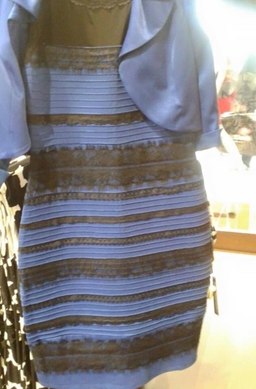
But as I’ve mentioned before, all this talk of language is a red herring. The fact remains that the dress appears differently to different people. The same stimulus triggers different, even conflicting, private experiences, and it is these private experiences that directly inform our understanding (hence why people use different words to describe that they see). That is clear evidence of indirect realism.
Michael

Start FollowingSend a Message
- Other sites we like
- Social media
- Terms of Service
- Sign In
- Created with PlushForums
- © 2025 The Philosophy Forum